
THE CREWTHE SECONDARY CREW A Power Point lesson


- Slides: 18
THE CREW-THE SECONDARY CREW A Power. Point lesson by Jim Soto
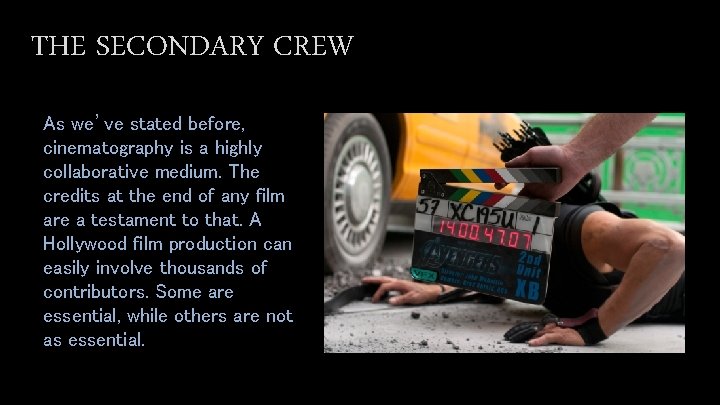
THE SECONDARY CREW As we’ve stated before, cinematography is a highly collaborative medium. The credits at the end of any film are a testament to that. A Hollywood film production can easily involve thousands of contributors. Some are essential, while others are not as essential.
If you pay close attention to the credits at the end of any film you will notice some job titles that might sound unfamiliar to you. You might wonder about: best boys, sound editors, and matte painters. Well, in this lesson we will learn about some of the hard working grunts of the film industry.
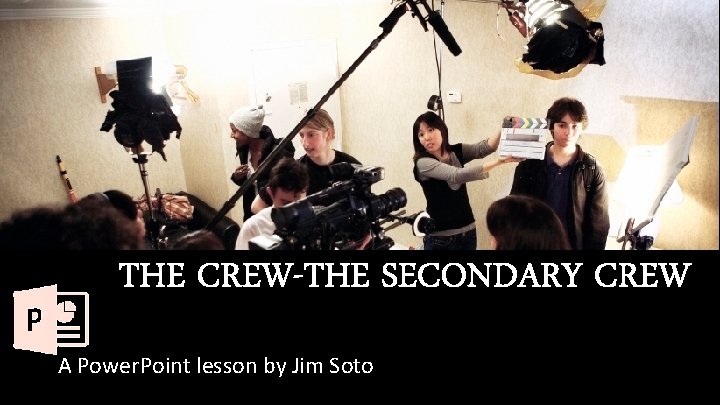
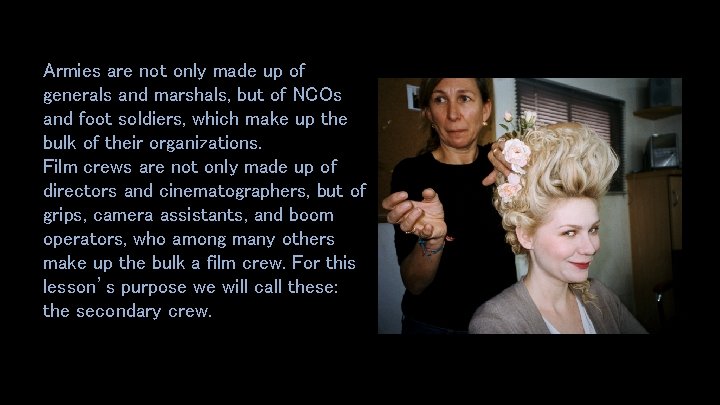
Armies are not only made up of generals and marshals, but of NCOs and foot soldiers, which make up the bulk of their organizations. Film crews are not only made up of directors and cinematographers, but of grips, camera assistants, and boom operators, who among many others make up the bulk a film crew. For this lesson’s purpose we will call these: the secondary crew.
Production Managers run productions on behalf of the Producer. They help to determine the most efficient and economic way to schedule shoots, negotiate business deals for crews, locations and technical equipment, and make day-to-day production decisions to ensure that productions proceed smoothly.
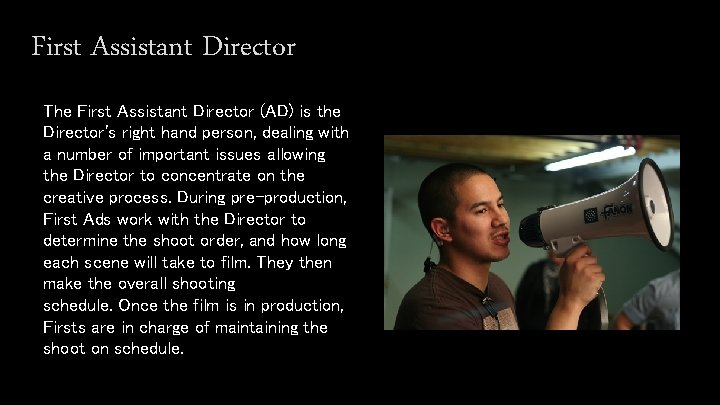
First Assistant Director The First Assistant Director (AD) is the Director's right hand person, dealing with a number of important issues allowing the Director to concentrate on the creative process. During pre-production, First Ads work with the Director to determine the shoot order, and how long each scene will take to film. They then make the overall shooting schedule. Once the film is in production, Firsts are in charge of maintaining the shoot on schedule.
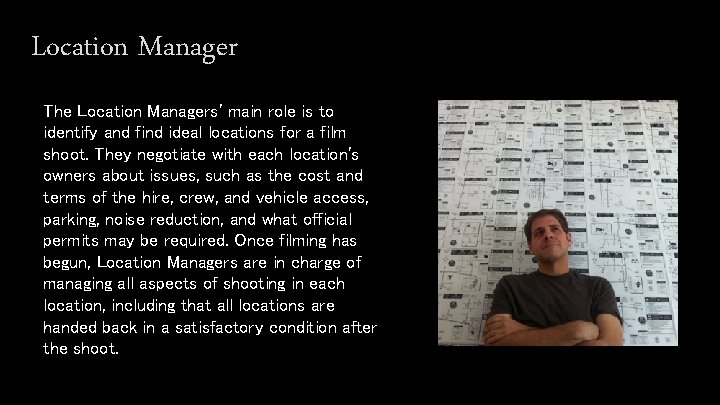
Location Manager The Location Managers' main role is to identify and find ideal locations for a film shoot. They negotiate with each location's owners about issues, such as the cost and terms of the hire, crew, and vehicle access, parking, noise reduction, and what official permits may be required. Once filming has begun, Location Managers are in charge of managing all aspects of shooting in each location, including that all locations are handed back in a satisfactory condition after the shoot.
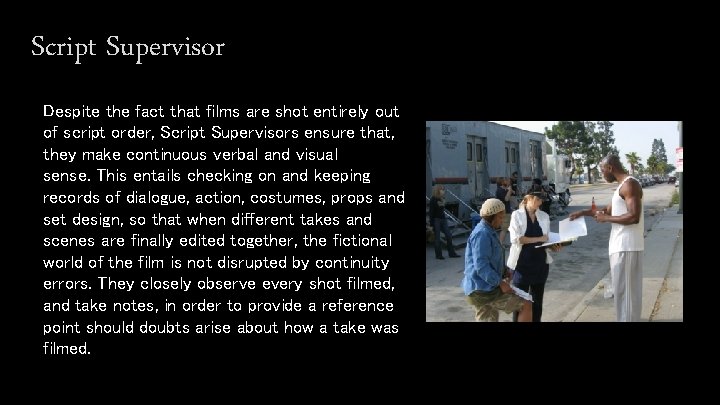
Script Supervisor Despite the fact that films are shot entirely out of script order, Script Supervisors ensure that, they make continuous verbal and visual sense. This entails checking on and keeping records of dialogue, action, costumes, props and set design, so that when different takes and scenes are finally edited together, the fictional world of the film is not disrupted by continuity errors. They closely observe every shot filmed, and take notes, in order to provide a reference point should doubts arise about how a take was filmed.
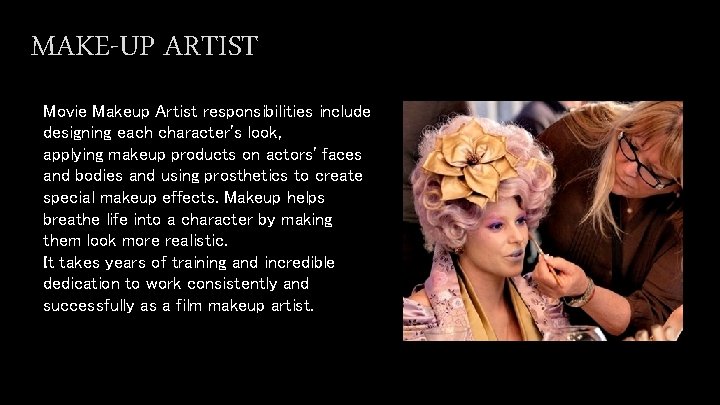
MAKE-UP ARTIST Movie Makeup Artist responsibilities include designing each character's look, applying makeup products on actors' faces and bodies and using prosthetics to create special makeup effects. Makeup helps breathe life into a character by making them look more realistic. It takes years of training and incredible dedication to work consistently and successfully as a film makeup artist.
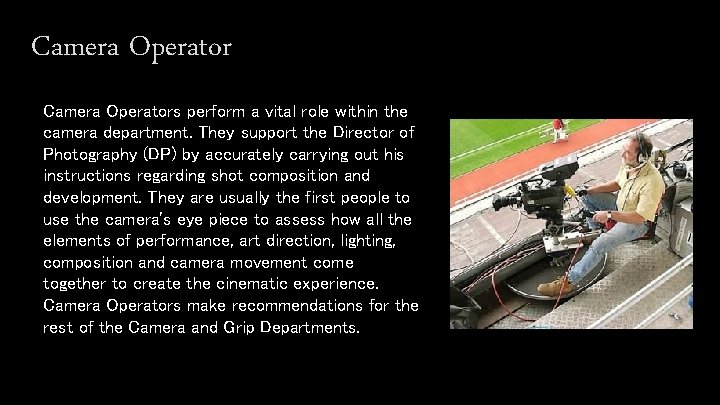
Camera Operators perform a vital role within the camera department. They support the Director of Photography (DP) by accurately carrying out his instructions regarding shot composition and development. They are usually the first people to use the camera's eye piece to assess how all the elements of performance, art direction, lighting, composition and camera movement come together to create the cinematic experience. Camera Operators make recommendations for the rest of the Camera and Grip Departments.
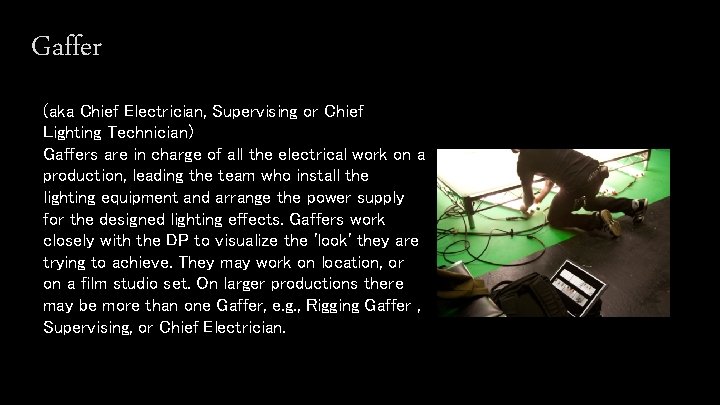
Gaffer (aka Chief Electrician, Supervising or Chief Lighting Technician) Gaffers are in charge of all the electrical work on a production, leading the team who install the lighting equipment and arrange the power supply for the designed lighting effects. Gaffers work closely with the DP to visualize the 'look' they are trying to achieve. They may work on location, or on a film studio set. On larger productions there may be more than one Gaffer, e. g. , Rigging Gaffer , Supervising, or Chief Electrician.
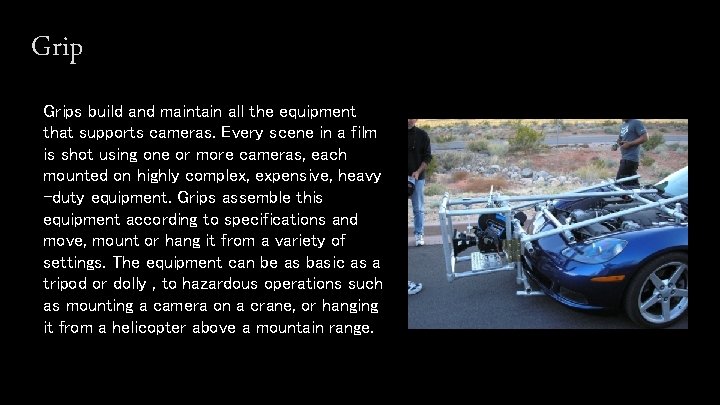
Grips build and maintain all the equipment that supports cameras. Every scene in a film is shot using one or more cameras, each mounted on highly complex, expensive, heavy –duty equipment. Grips assemble this equipment according to specifications and move, mount or hang it from a variety of settings. The equipment can be as basic as a tripod or dolly , to hazardous operations such as mounting a camera on a crane, or hanging it from a helicopter above a mountain range.
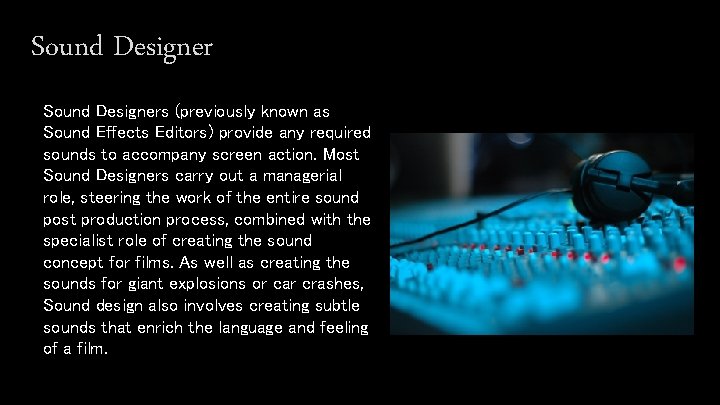
Sound Designers (previously known as Sound Effects Editors) provide any required sounds to accompany screen action. Most Sound Designers carry out a managerial role, steering the work of the entire sound post production process, combined with the specialist role of creating the sound concept for films. As well as creating the sounds for giant explosions or car crashes, Sound design also involves creating subtle sounds that enrich the language and feeling of a film.
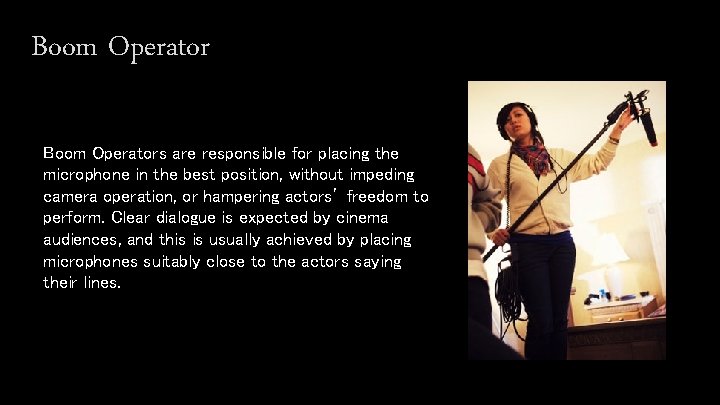
Boom Operators are responsible for placing the microphone in the best position, without impeding camera operation, or hampering actors’ freedom to perform. Clear dialogue is expected by cinema audiences, and this is usually achieved by placing microphones suitably close to the actors saying their lines.
it’s a wrap! We previously stated that Hollywood film productions can easily involve thousands of contributors. Today we have only discussed a very few of them, those deemed essential. But, don’t be fooled, there are many, many more positions we won’t have the time to discuss.
IN YOUR PLANE OF REALITY The reality of non-professional filmmaking is that many of these positions are blended into others. As you may have already experienced, you’ve probably already worn several hats in the film projects you have been a part of. But it’s always better when we have people who are good at something that only do that something. Only in a perfect world!
RESHOOT 1. Explain briefly what each of the crew positions discussed in this lesson contributes to the filmmaking process. 2. If you had the option of assuming any one of these jobs, which one would it be? Why?
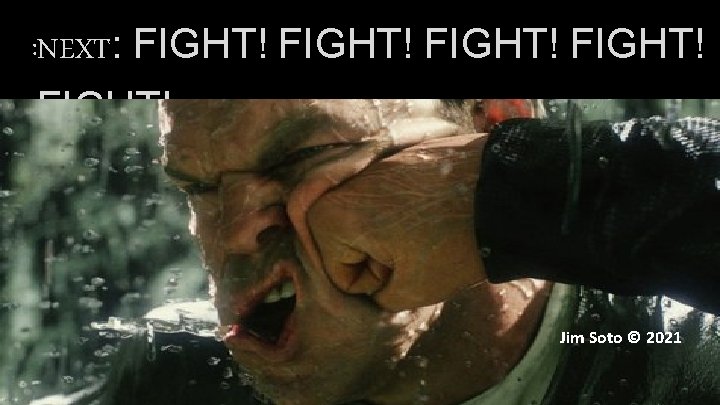
: NEXT: FIGHT! FIGHT! Jim Soto © 2021 Jim Soto © 2014