
THE CRETACEOUSPALEOGENE KPG MASS EXTINCTION EVENT Dr Arjun
- Slides: 20
THE CRETACEOUS-PALEOGENE (K-PG) MASS EXTINCTION EVENT Dr. Arjun Singh Rathore Dept. of Geology Govt. P. G. College, Rajouri 1
What Is a Mass Extinction? • an episode in evolutionary history where more than 50% of all known species living at that time went extinct in a short period of time
Mass Extinction • Fossil record shows significant jumps in the pathways of evolution that suggest mass extinction events • Since the “Cambrian Explosion” of 540 Ma, 15 mass extinctions have been identified with at least five catastrophic extinction events 3
K-Pg Extinction Boundary • 65. 5 million years ago, earth experienced a global mass extinction event • that extinction defines the boundary between the Cretaceous and Palaeogene (abbreviated K and Pg) geological periods and, a broader scale, the boundary between the Mesozoic and Cenozoic eras • Second largest mass extinction • Half of life on Earth died out • Tropical groups suffered most • Seawater cooling, global regression
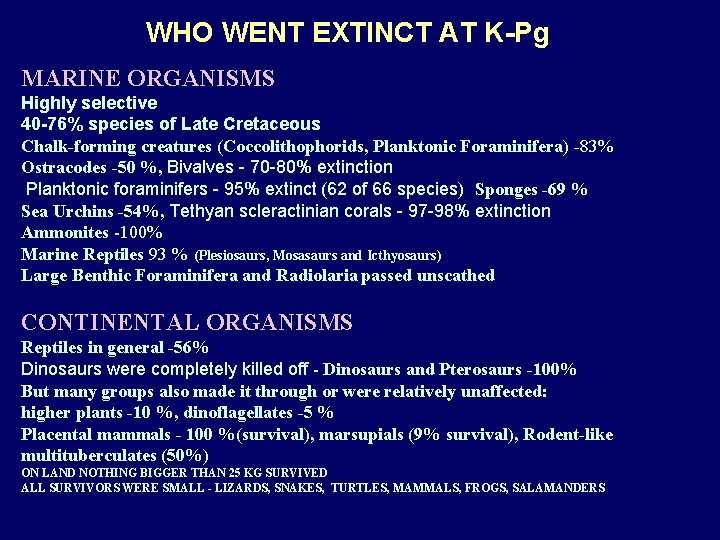
WHO WENT EXTINCT AT K-Pg MARINE ORGANISMS Highly selective 40 -76% species of Late Cretaceous Chalk-forming creatures (Coccolithophorids, Planktonic Foraminifera) -83% Ostracodes -50 %, Bivalves - 70 -80% extinction Planktonic foraminifers - 95% extinct (62 of 66 species) , Sponges -69 % Sea Urchins -54%, Tethyan scleractinian corals - 97 -98% extinction Ammonites -100% Marine Reptiles 93 % (Plesiosaurs, Mosasaurs and Icthyosaurs) Large Benthic Foraminifera and Radiolaria passed unscathed CONTINENTAL ORGANISMS Reptiles in general -56% Dinosaurs were completely killed off - Dinosaurs and Pterosaurs -100% But many groups also made it through or were relatively unaffected: higher plants -10 %, dinoflagellates -5 % Placental mammals - 100 %(survival), marsupials (9% survival), Rodent-like multituberculates (50%) ON LAND NOTHING BIGGER THAN 25 KG SURVIVED ALL SURVIVORS WERE SMALL - LIZARDS, SNAKES, TURTLES, MAMMALS, FROGS, SALAMANDERS
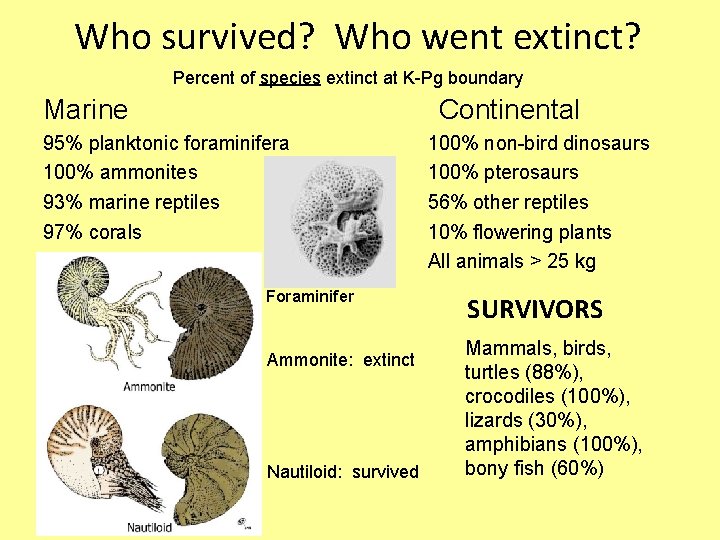
Who survived? Who went extinct? Percent of species extinct at K-Pg boundary Marine Continental 95% planktonic foraminifera 100% ammonites 93% marine reptiles 97% corals Foraminifer Ammonite: extinct Nautiloid: survived 100% non-bird dinosaurs 100% pterosaurs 56% other reptiles 10% flowering plants All animals > 25 kg SURVIVORS Mammals, birds, turtles (88%), crocodiles (100%), lizards (30%), amphibians (100%), bony fish (60%)
Cause/s of Extinctions • The cause of the K-Pg extinctions is one of the great mysteries in science, and scientists have proposed many theories to account for it. They range from asteroid or comet impacts, volcanism, sea level changes, supernova explosions, and so on
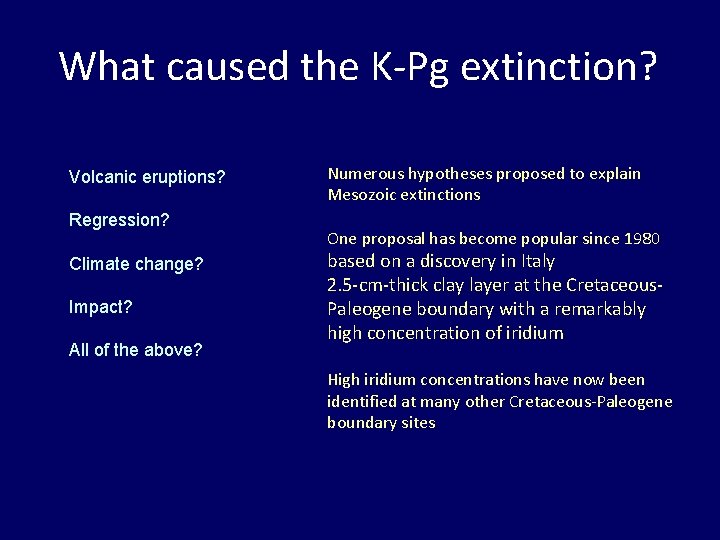
What caused the K-Pg extinction? Volcanic eruptions? Regression? Climate change? Impact? All of the above? Numerous hypotheses proposed to explain Mesozoic extinctions One proposal has become popular since 1980 based on a discovery in Italy 2. 5 -cm-thick clay layer at the Cretaceous. Paleogene boundary with a remarkably high concentration of iridium High iridium concentrations have now been identified at many other Cretaceous-Paleogene boundary sites
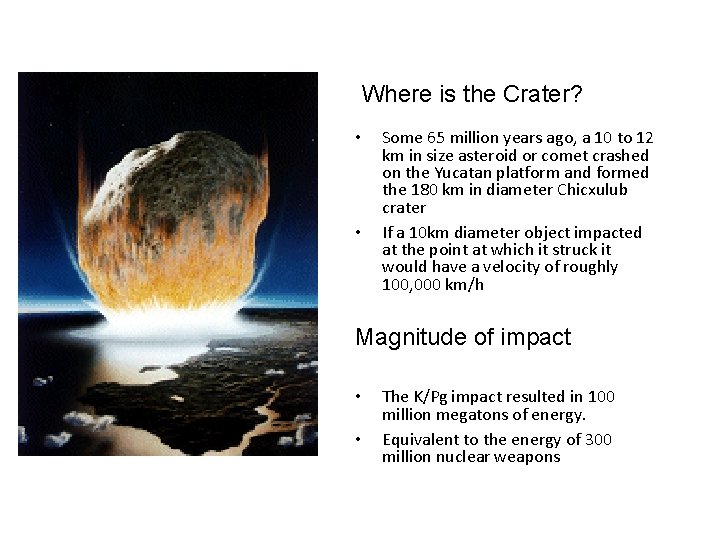
Where is the Crater? • • Some 65 million years ago, a 10 to 12 km in size asteroid or comet crashed on the Yucatan platform and formed the 180 km in diameter Chicxulub crater If a 10 km diameter object impacted at the point at which it struck it would have a velocity of roughly 100, 000 km/h Magnitude of impact • • The K/Pg impact resulted in 100 million megatons of energy. Equivalent to the energy of 300 million nuclear weapons
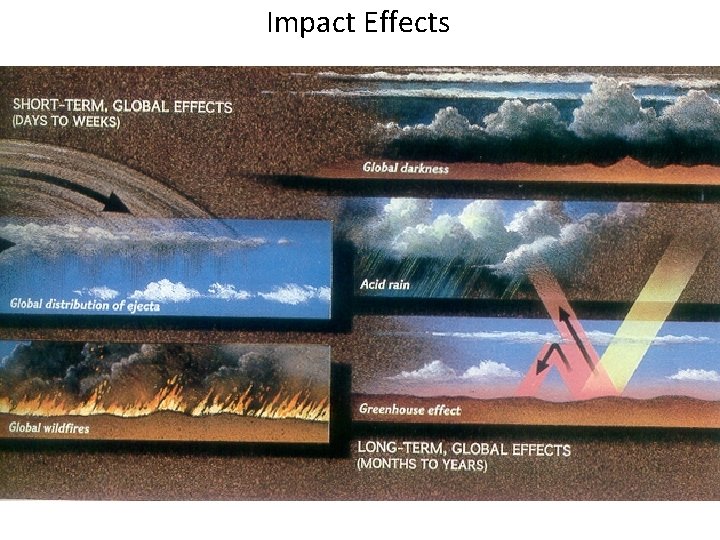
Impact Effects
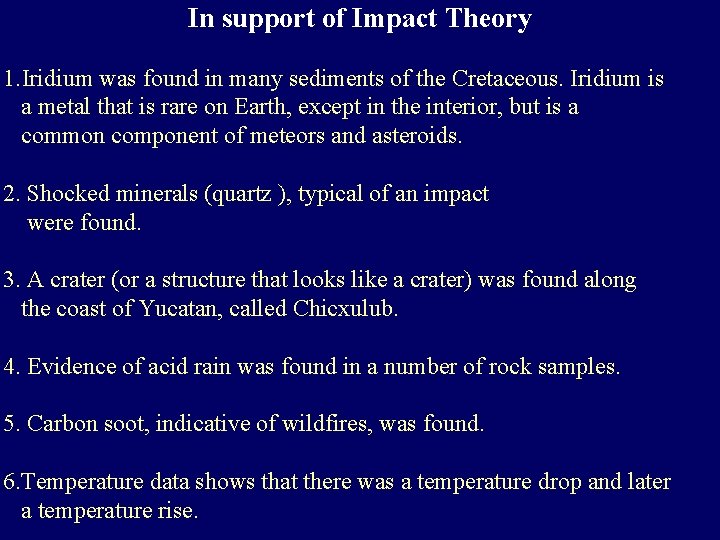
In support of Impact Theory 1. Iridium was found in many sediments of the Cretaceous. Iridium is a metal that is rare on Earth, except in the interior, but is a common component of meteors and asteroids. 2. Shocked minerals (quartz ), typical of an impact were found. 3. A crater (or a structure that looks like a crater) was found along the coast of Yucatan, called Chicxulub. 4. Evidence of acid rain was found in a number of rock samples. 5. Carbon soot, indicative of wildfires, was found. 6. Temperature data shows that there was a temperature drop and later a temperature rise.
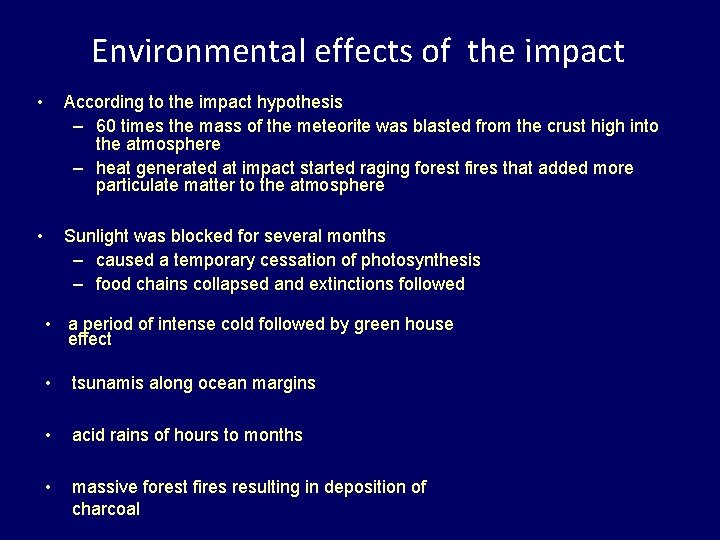
Environmental effects of the impact • According to the impact hypothesis – 60 times the mass of the meteorite was blasted from the crust high into the atmosphere – heat generated at impact started raging forest fires that added more particulate matter to the atmosphere • Sunlight was blocked for several months – caused a temporary cessation of photosynthesis – food chains collapsed and extinctions followed • a period of intense cold followed by green house effect • tsunamis along ocean margins • acid rains of hours to months • massive forest fires resulting in deposition of charcoal
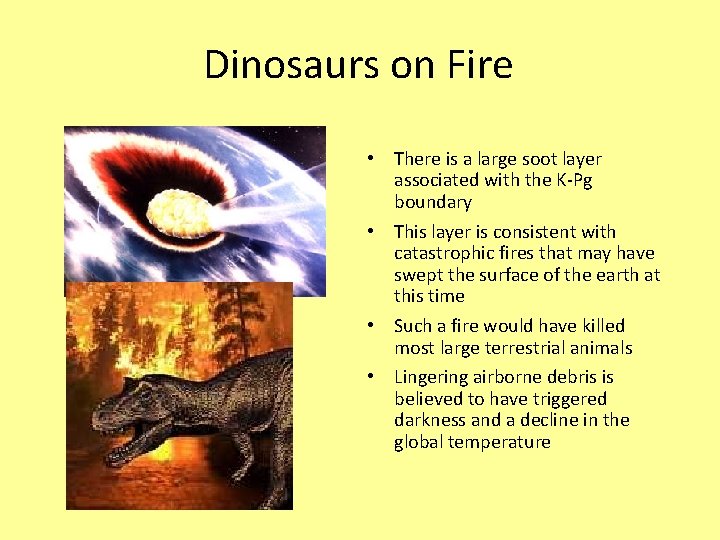
Dinosaurs on Fire • There is a large soot layer associated with the K-Pg boundary • This layer is consistent with catastrophic fires that may have swept the surface of the earth at this time • Such a fire would have killed most large terrestrial animals • Lingering airborne debris is believed to have triggered darkness and a decline in the global temperature
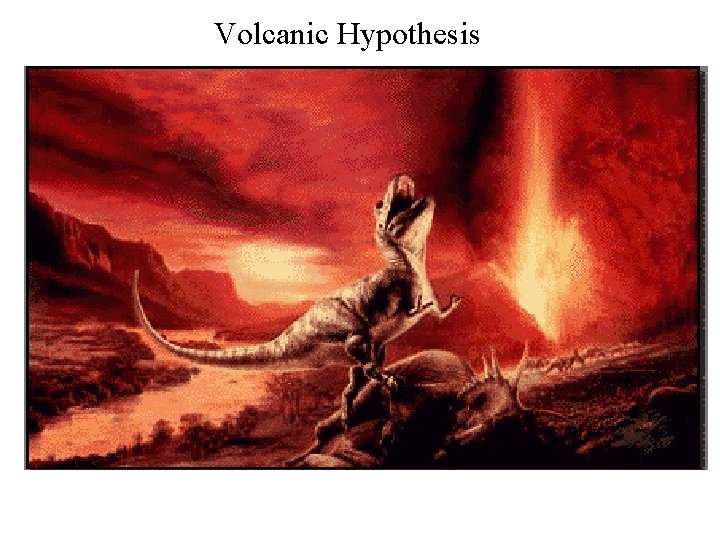
Volcanic Hypothesis
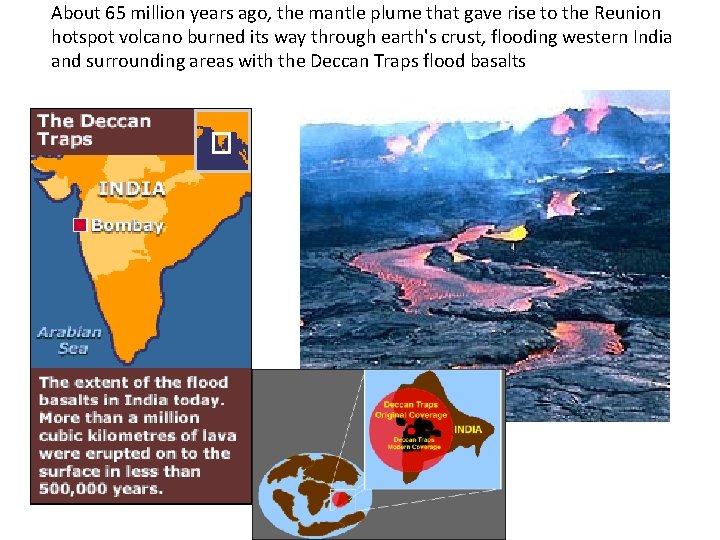
About 65 million years ago, the mantle plume that gave rise to the Reunion hotspot volcano burned its way through earth's crust, flooding western India and surrounding areas with the Deccan Traps flood basalts
Deccan Traps Volcanism • Rapid eruption of the vast Deccan Traps lava fields would have flooded earth's surface with CO 2, triggering rapid K-Pg transition greenhouse warming, chemical changes in the oceans (Mc. Lean, 1985 a, b, c; 1988, 1995), and the K-Pg mass extinctions. • This increased volcanism could have created enough dust and soot to block out sunlight; contributing to the climatic change. • Source of Iridium; can explain iridium spike • Source of tektites • Shocked quartz; maybe a source
Terrestrial and Marine Extinctions • Even if a meteorite did hit Earth, did it lead to these extinctions? • If so, both terrestrial and marine extinctions must have occurred at the same time • To date, strict time equivalence between terrestrial and marine extinctions has not been demonstrated • The selective nature of the extinctions is also a problem
K-Pg extinction - Cause resolved? • In the final analysis, Mesozoic extinctions have not been explained to everyone’s satisfaction • Most geologists now concede that a large meteorite impact occurred, but we also know that vast outpourings of lava were taking place in what is now India • Perhaps these brought about detrimental atmospheric changes
Common Ground • There was global climatic change; the environment changed from a warm, mild one in the Mesozoic to a cooler, more varied one in the Cenozoic • Many organisms; both marine and terrestrial, vertebrate and invertebrate; went extinct • At or near the K-Pg boundary, there was iridium, shocked quartz, tektites, and a soot layer was found in many areas (evidence for widespread forest fires), all consistent with a catastrophic event
CONCLUSIONS • There has been no settlement to the issue so far, and no clear one is foreseeable. Both sides claim to hold the majority of proponents in science; • it seems that many paleontologists lean towards the intrinsic side, • while many astronomers and physicists favor the extrinsic side, and geologists are probably evenly split between the two.