
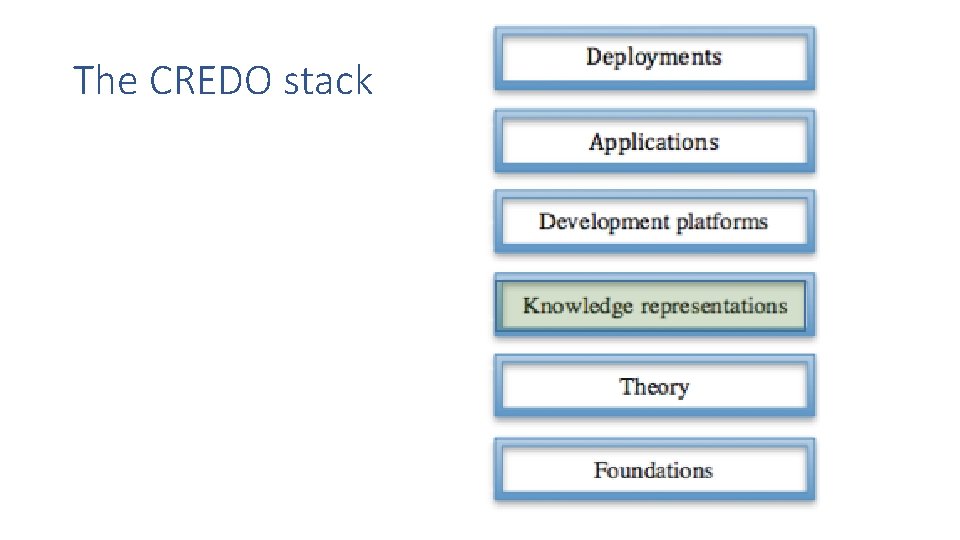
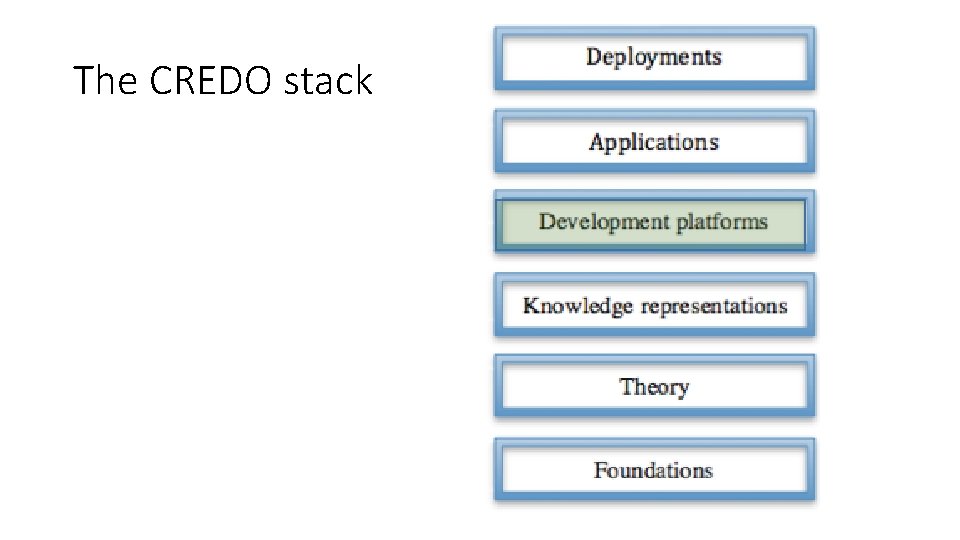
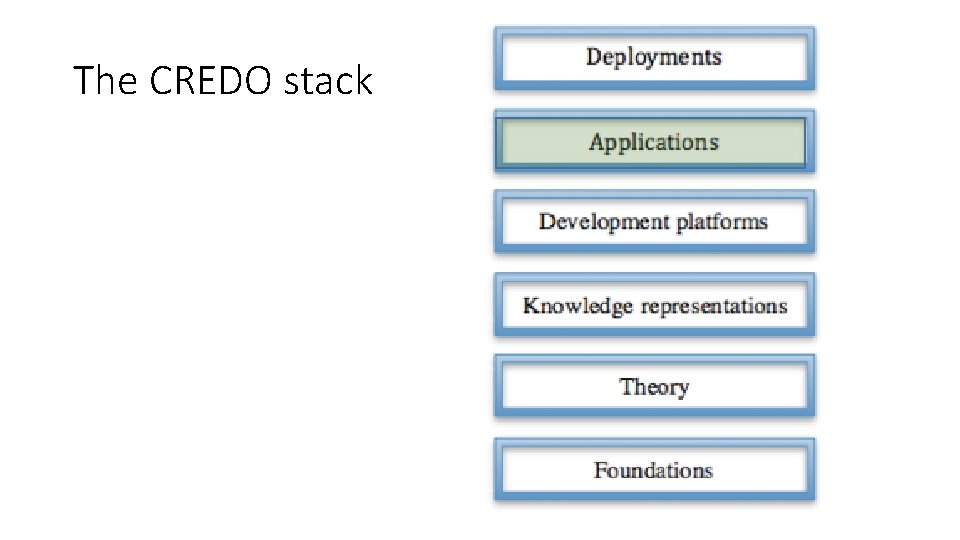
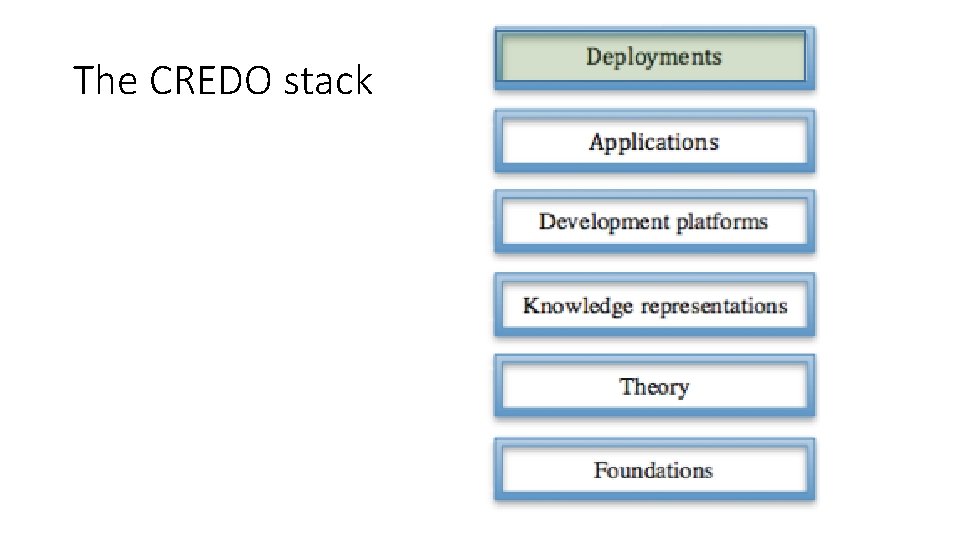
The CREDO stack from arguments to decisions to

- Slides: 25
The CREDO stack: from arguments to decisions to cognitive agents John Fox and many friends, including Mike Clark, Subrata Das, David Glasspool, Paul Krause, Simon Parsons, Simon Ambler, Morten Elvang. Goransson, Elizabeth Black … Rick Cooper, Peter Yule … Andrzej Glowinski, Vivek Patkar, Mike O’Neil … and mentors Allen Newell, Herb Simon, John Morton, Donald E Broadbent, Ulric Neisser
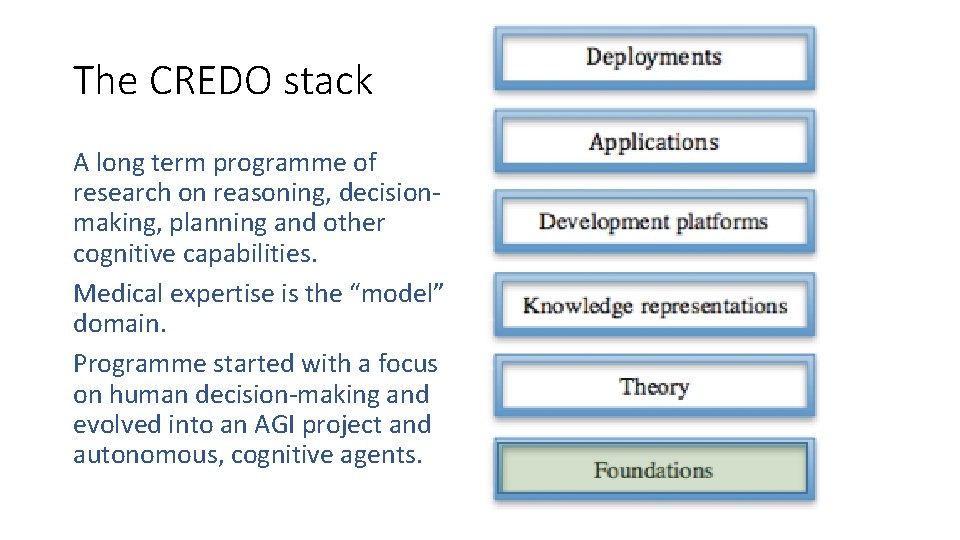
The CREDO stack A long term programme of research on reasoning, decisionmaking, planning and other cognitive capabilities. Medical expertise is the “model” domain. Programme started with a focus on human decision-making and evolved into an AGI project and autonomous, cognitive agents.
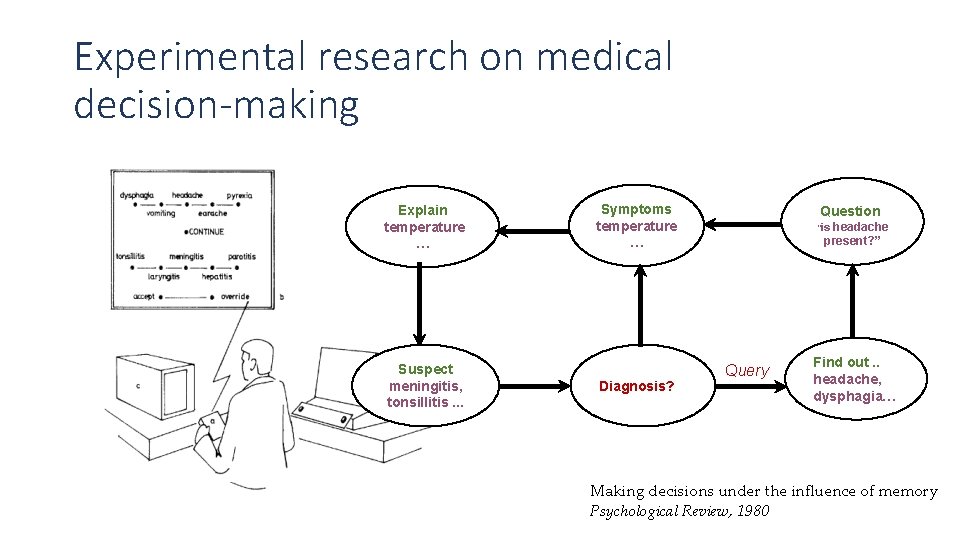
Experimental research on medical decision-making Explain temperature … Suspect meningitis, tonsillitis. . . Symptoms temperature … Diagnosis? Question: headache present? ” “is Query Find out. . headache, dysphagia… Making decisions under the influence of memory Psychological Review, 1980
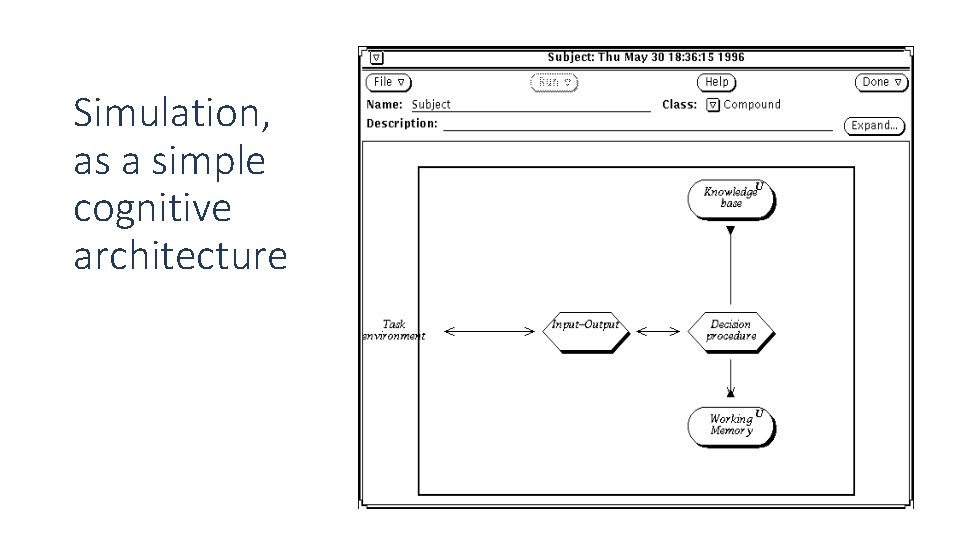
Simulation, as a simple cognitive architecture
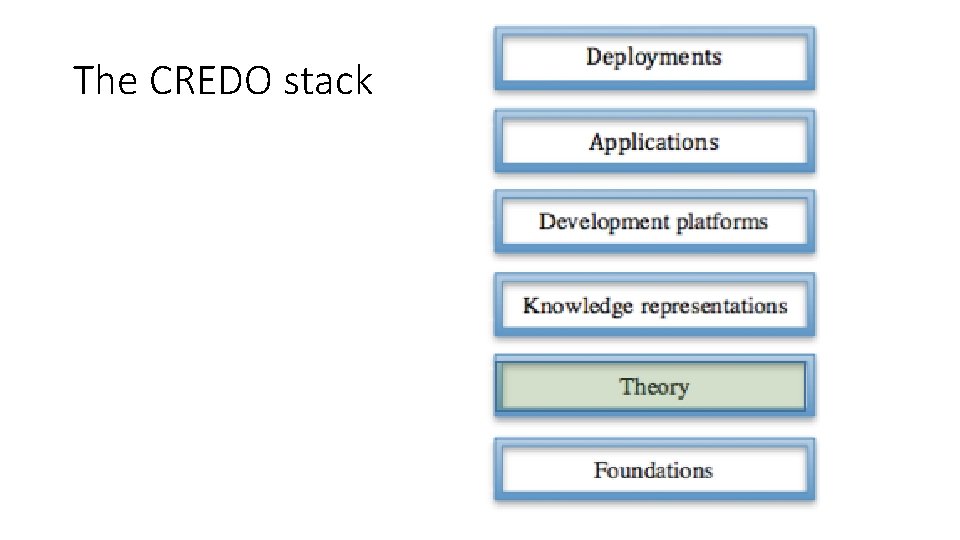
The CREDO stack
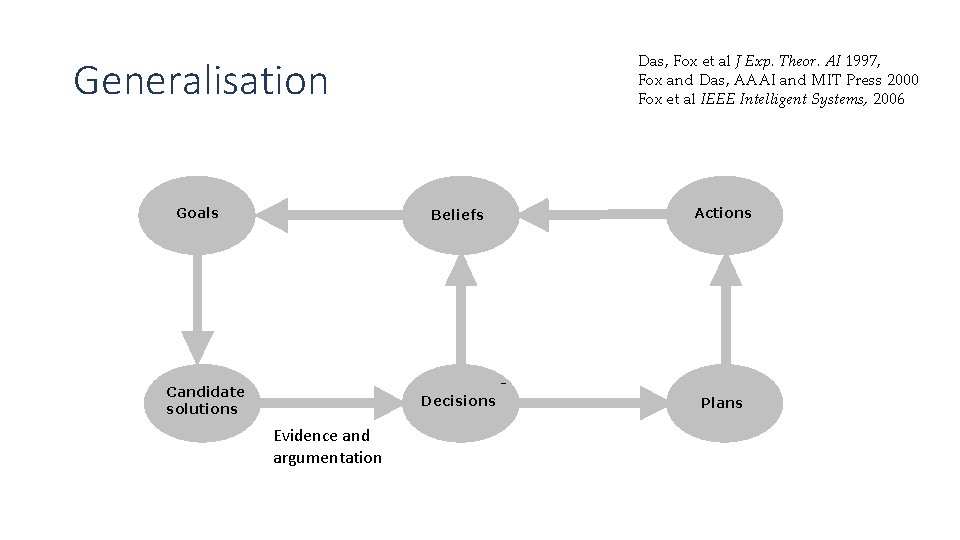
Das, Fox et al J Exp. Theor. AI 1997, Fox and Das, AAAI and MIT Press 2000 Fox et al IEEE Intelligent Systems, 2006 Generalisation Goals Actions Beliefs Candidate solutions Decisions Evidence and argumentation Plans
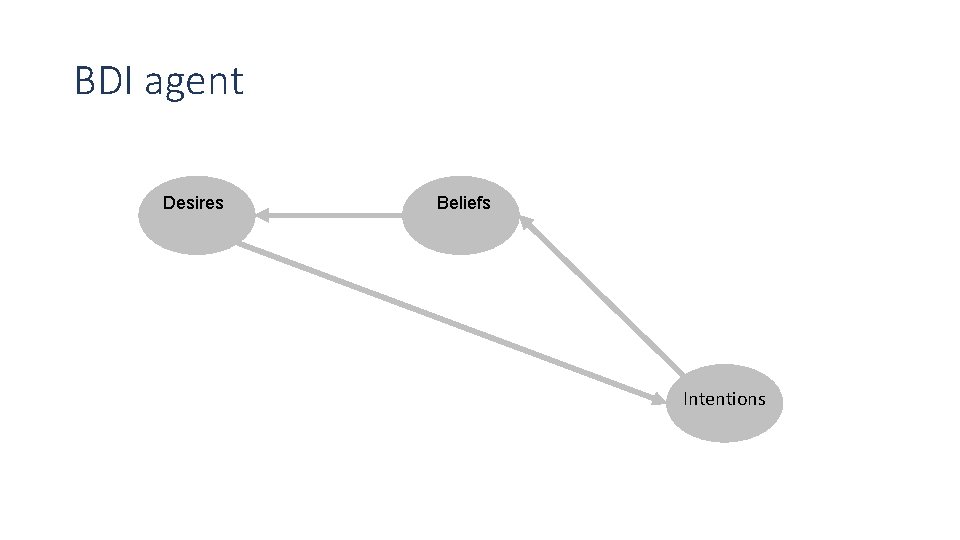
BDI agent Desires Beliefs Intentions
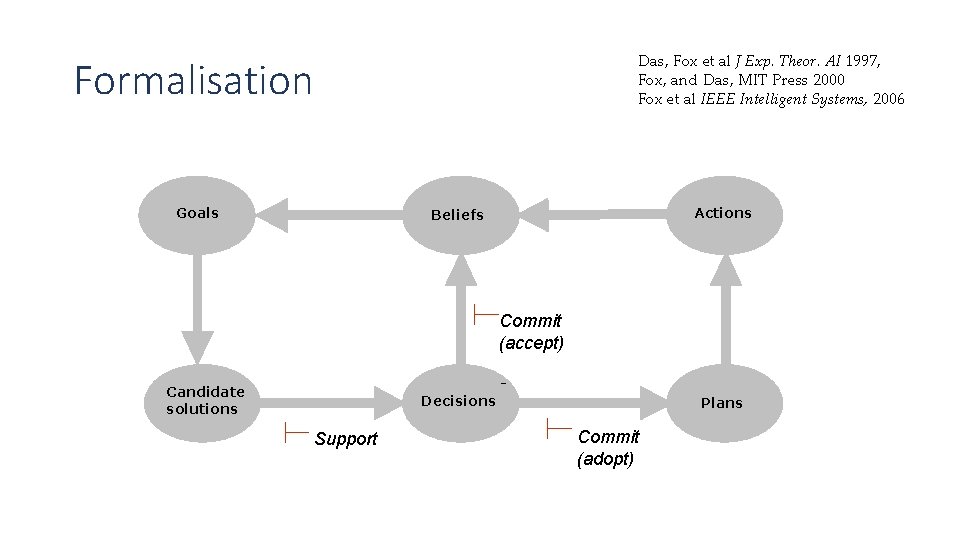
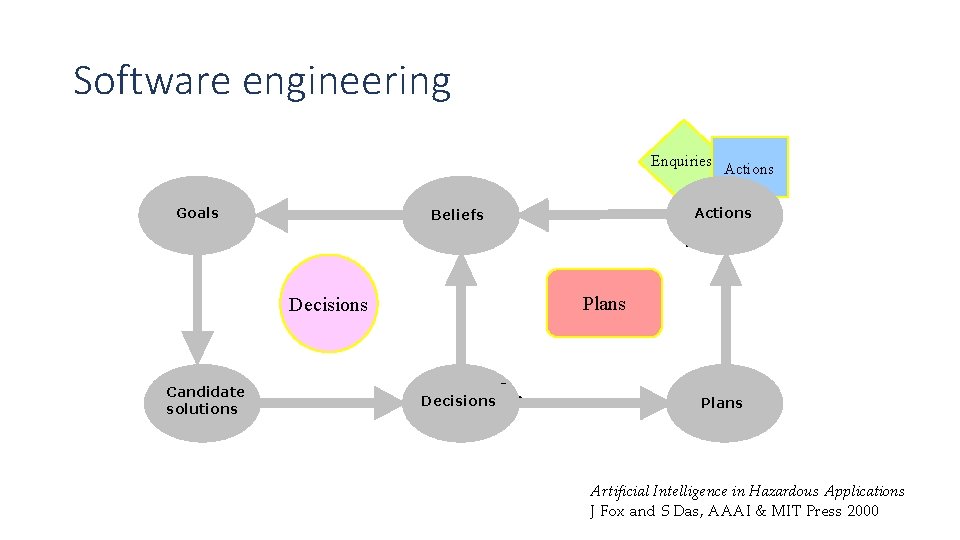
Das, Fox et al J Exp. Theor. AI 1997, Fox, and Das, MIT Press 2000 Fox et al IEEE Intelligent Systems, 2006 Formalisation Goals Actions Beliefs Commit (accept) Candidate solutions Decisions Support Plans Commit (adopt)
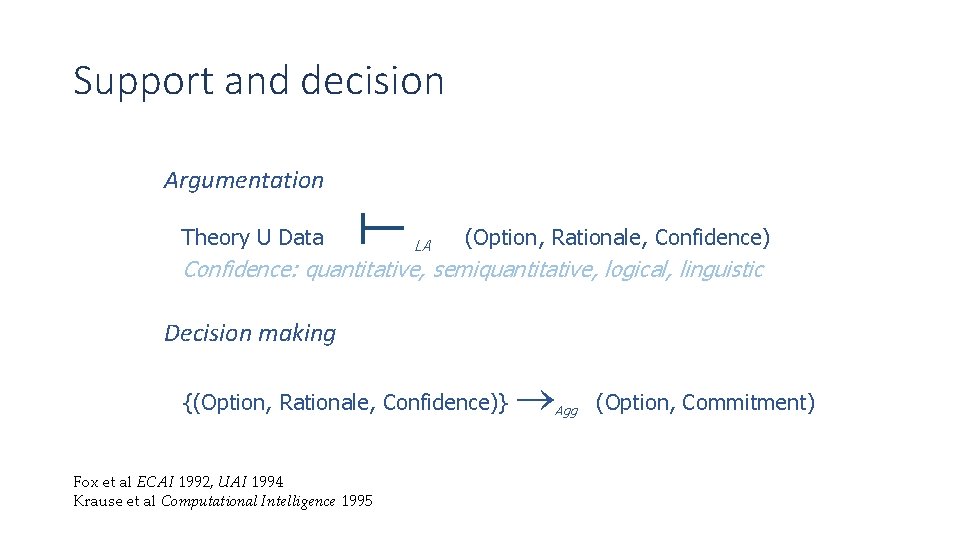
Support and decision Argumentation Theory U Data LA (Option, Rationale, Confidence) Confidence: quantitative, semiquantitative, logical, linguistic Decision making {(Option, Rationale, Confidence)} Fox et al ECAI 1992, UAI 1994 Krause et al Computational Intelligence 1995 Agg (Option, Commitment)
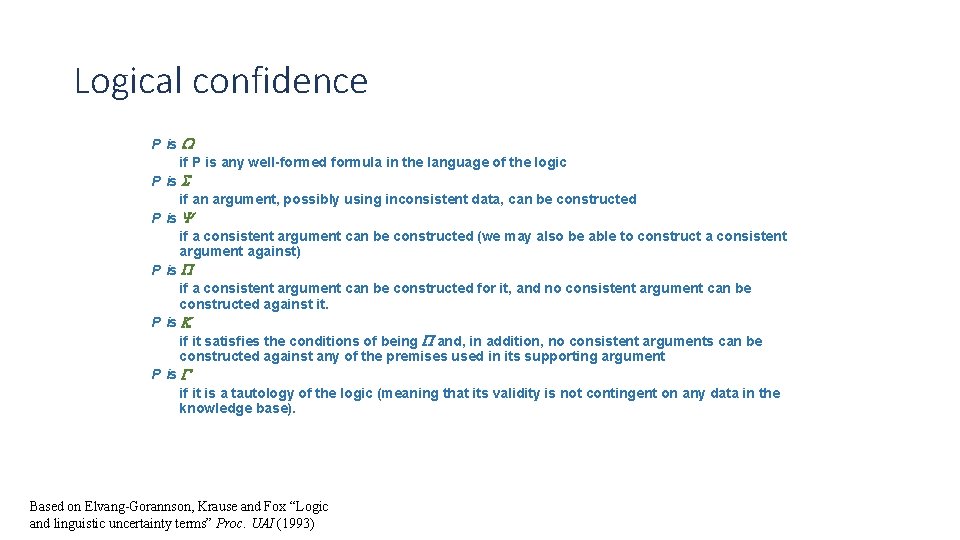
Logical confidence P is if P is any well-formed formula in the language of the logic P is if an argument, possibly using inconsistent data, can be constructed P is if a consistent argument can be constructed (we may also be able to construct a consistent argument against) P is if a consistent argument can be constructed for it, and no consistent argument can be constructed against it. P is if it satisfies the conditions of being and, in addition, no consistent arguments can be constructed against any of the premises used in its supporting argument P is if it is a tautology of the logic (meaning that its validity is not contingent on any data in the knowledge base). Based on Elvang-Gorannson, Krause and Fox “Logic and linguistic uncertainty terms” Proc. UAI (1993)
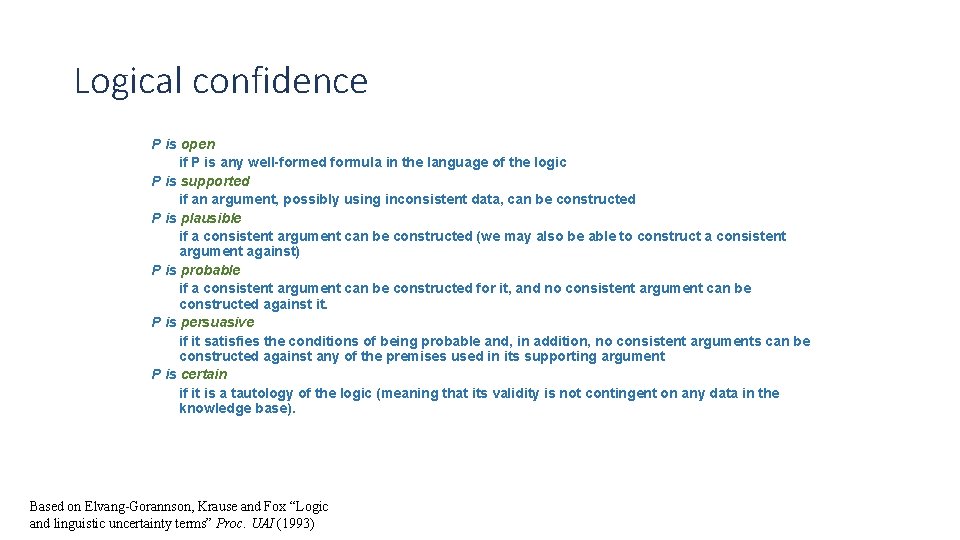
Logical confidence P is open if P is any well-formed formula in the language of the logic P is supported if an argument, possibly using inconsistent data, can be constructed P is plausible if a consistent argument can be constructed (we may also be able to construct a consistent argument against) P is probable if a consistent argument can be constructed for it, and no consistent argument can be constructed against it. P is persuasive if it satisfies the conditions of being probable and, in addition, no consistent arguments can be constructed against any of the premises used in its supporting argument P is certain if it is a tautology of the logic (meaning that its validity is not contingent on any data in the knowledge base). Based on Elvang-Gorannson, Krause and Fox “Logic and linguistic uncertainty terms” Proc. UAI (1993)
The CREDO stack
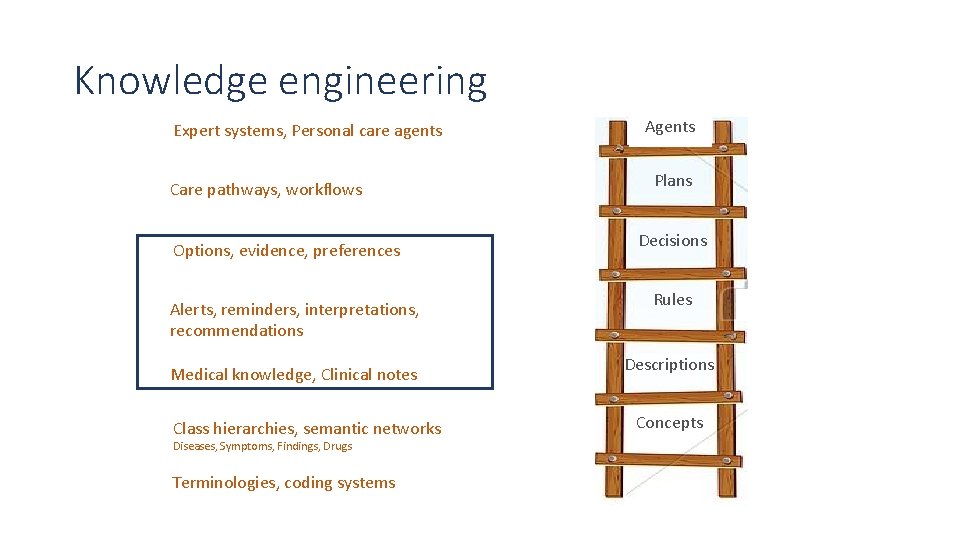
Knowledge engineering Expert systems, Personal care agents Care pathways, workflows Options, evidence, preferences Alerts, reminders, interpretations, recommendations Medical knowledge, Clinical notes Class hierarchies, semantic networks Diseases, Symptoms, Findings, Drugs Terminologies, coding systems Agents Plans Decisions Rules Descriptions Concepts
Software engineering Enquiries Goals Actions Beliefs Actions Plans Decisions Candidate solutions Commitments Decisions Plans Artificial Intelligence in Hazardous Applications J Fox and S Das, AAAI & MIT Press 2000
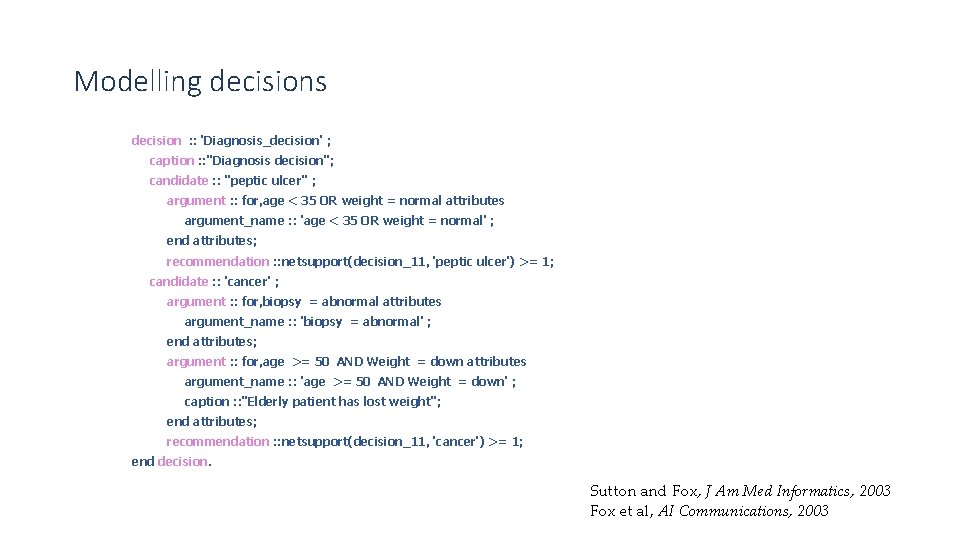
Modelling decisions decision : : 'Diagnosis_decision' ; caption : : "Diagnosis decision"; candidate : : ''peptic ulcer'' ; argument : : for, age < 35 OR weight = normal attributes argument_name : : 'age < 35 OR weight = normal' ; end attributes; recommendation : : netsupport(decision_11, 'peptic ulcer') >= 1; candidate : : 'cancer' ; argument : : for, biopsy = abnormal attributes argument_name : : 'biopsy = abnormal' ; end attributes; argument : : for, age >= 50 AND Weight = down attributes argument_name : : 'age >= 50 AND Weight = down' ; caption : : "Elderly patient has lost weight"; end attributes; recommendation : : netsupport(decision_11, 'cancer') >= 1; end decision. Sutton and Fox, J Am Med Informatics, 2003 Fox et al, AI Communications, 2003
Modelling plans plan : : 'Simple_plan_example' ; caption : : "Example of a plan with 4 components"; abort : : patient_discharged = yes; terminate : : patient_recovered = yes; component : : 'Diagnosis_decision' ; schedule_constraint : : completed('Patient_history') ; number_of_cycles : : 1; component : : 'Patient_history' ; number_of_cycles : : 1; component : : 'Pathway_1' ; schedule_constraint : : completed('Diagnosis_decision') ; number_of_cycles : : 1; component : : 'Pathway_2' ; schedule_constraint : : completed('Diagnosis_decision') ; number_of_cycles : : 1; end plan. Sutton and Fox, J Am Med Informatics, 2003 Fox et al, AI Communications, 2003
The CREDO stack
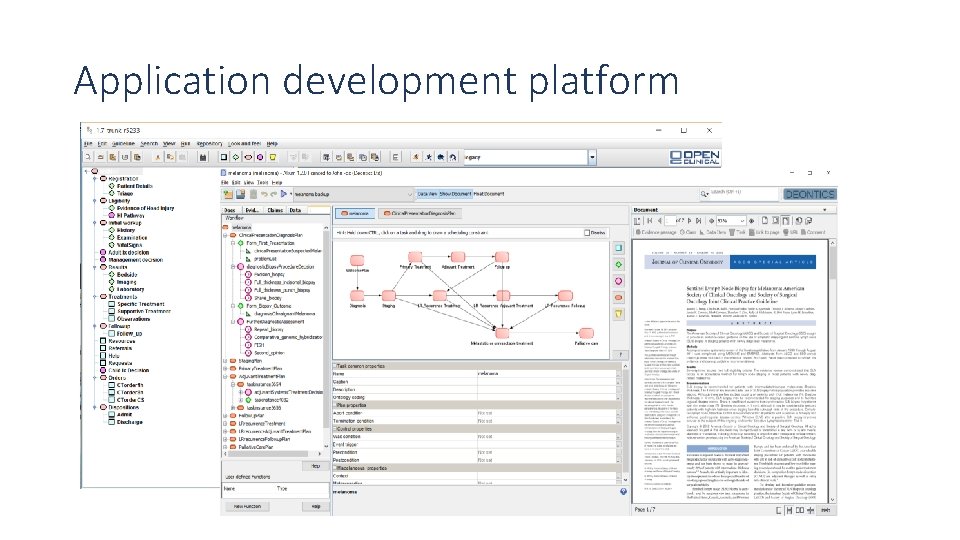
Application development platform
The CREDO stack
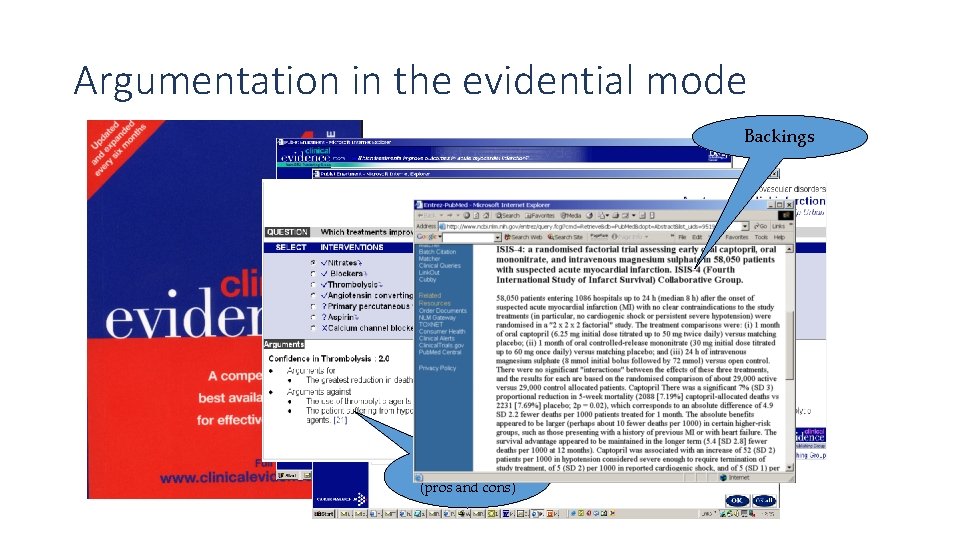
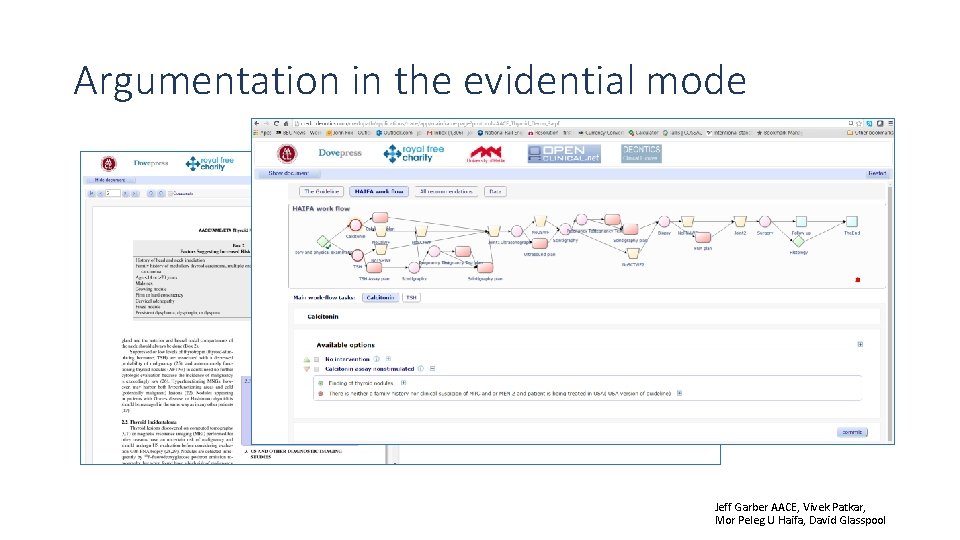
Argumentation in the evidential mode Backings Claims Rationale (pros and cons)
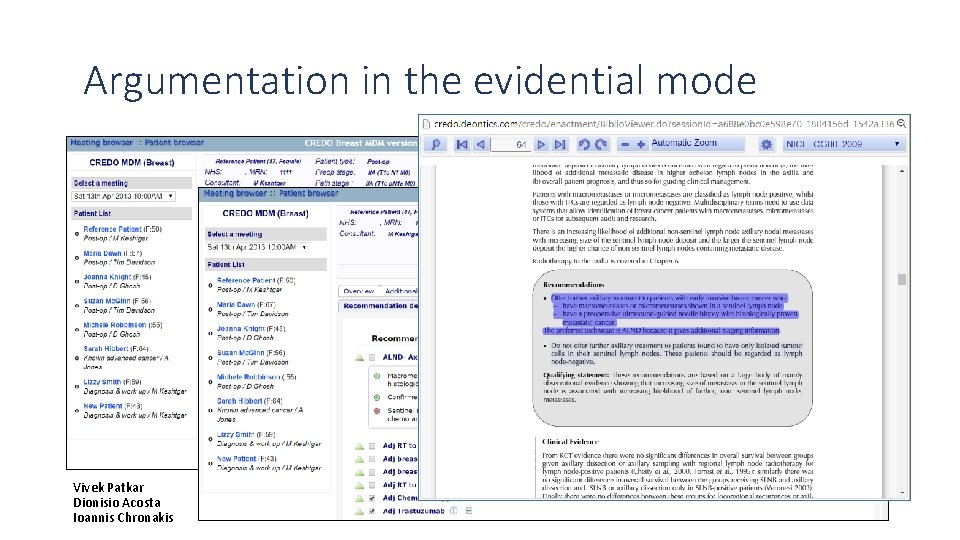
Argumentation in the evidential mode Vivek Patkar Dionisio Acosta Ioannis Chronakis
Argumentation in the evidential mode Jeff Garber AACE, Vivek Patkar, Mor Peleg U Haifa, David Glasspool
The CREDO stack
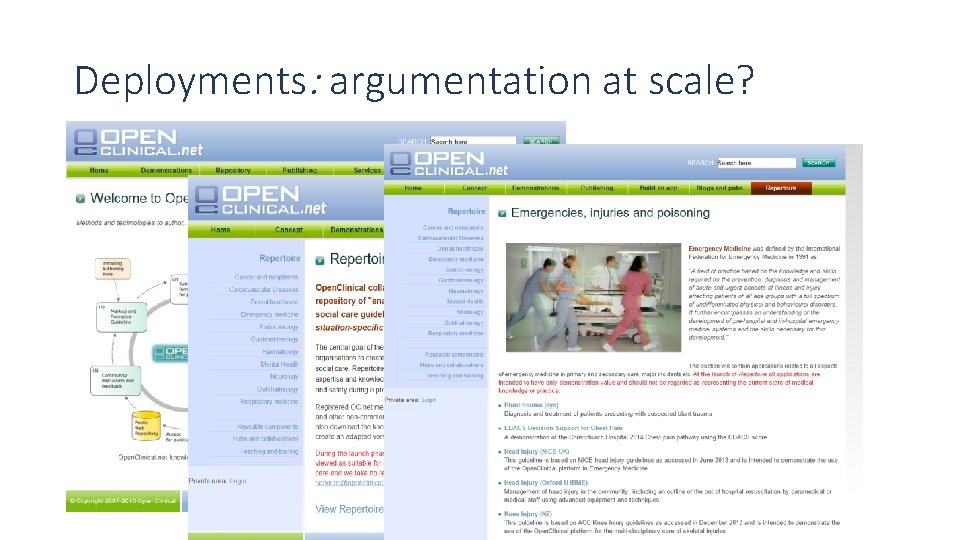
Deployments: argumentation at scale?
CREDO on argumentation • What is an argument? • A process in which an agent applies its knowledge to reasoning about beliefs, goals, options, commitments, plans, actions … • What is the form of an argument? • Claim + Rationale + Confidence • What is a good argument? • Soundness + veracity + provenance • What modes of argumentation are there? • Dialectical, Evidential, …?