
The creative process is a collective work ESR
- Slides: 1
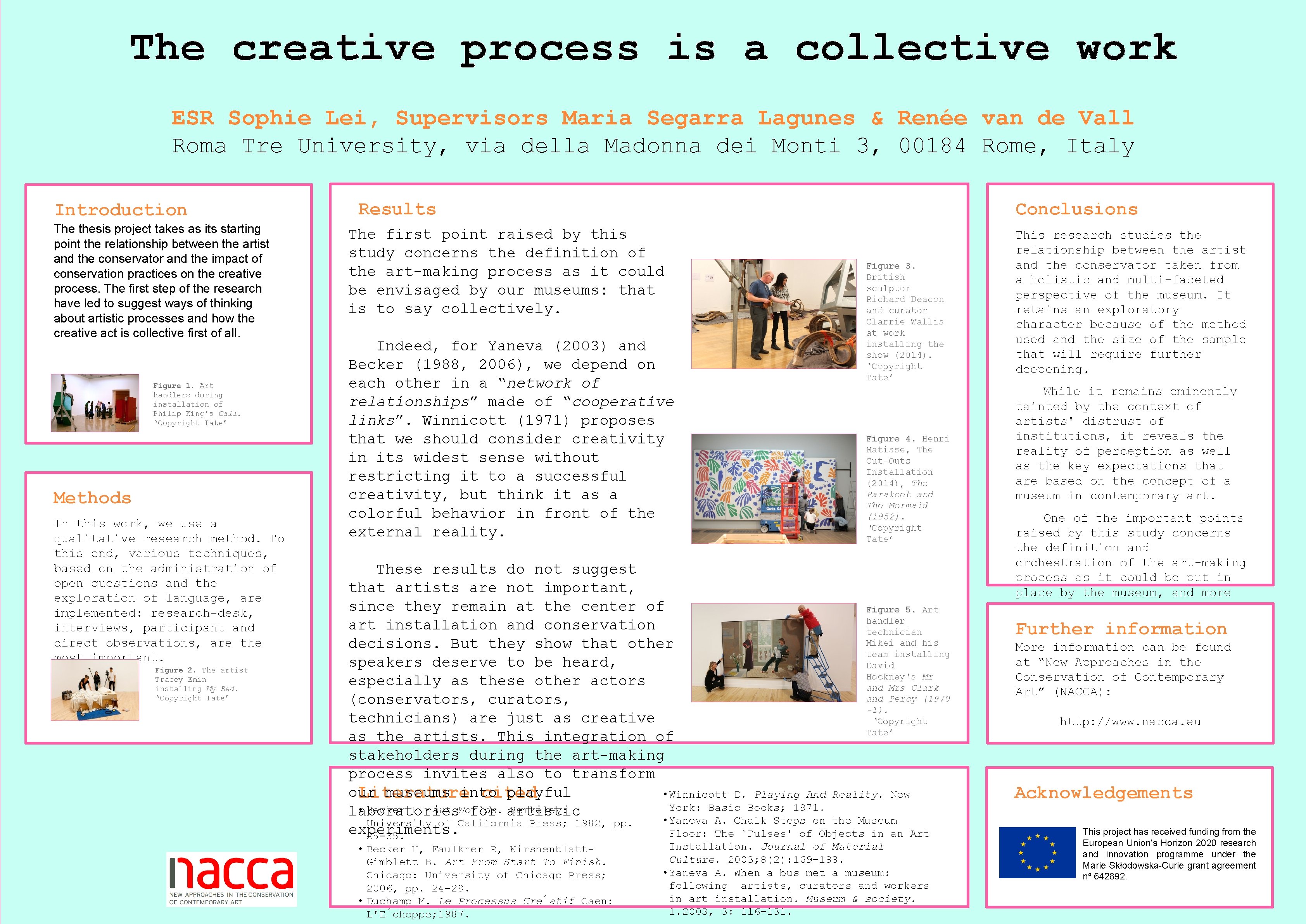
The creative process is a collective work ESR Sophie Lei, Supervisors Maria Segarra Lagunes & Renée van de Vall Roma Tre University, via della Madonna dei Monti 3, 00184 Rome, Italy Introduction The thesis project takes as its starting point the relationship between the artist and the conservator and the impact of conservation practices on the creative process. The first step of the research have led to suggest ways of thinking about artistic processes and how the creative act is collective first of all. Figure 1. Art handlers during installation of Philip King's Call. ‘Copyright Tate’ Methods In this work, we use a qualitative research method. To this end, various techniques, based on the administration of open questions and the exploration of language, are implemented: research-desk, interviews, participant and direct observations, are the most important. Figure 2. The artist Tracey Emin installing My Bed. ‘Copyright Tate’ Conclusions Results The first point raised by this study concerns the definition of the art-making process as it could be envisaged by our museums: that is to say collectively. Indeed, for Yaneva (2003) and Becker (1988, 2006), we depend on each other in a “network of relationships” made of “cooperative links”. Winnicott (1971) proposes that we should consider creativity in its widest sense without restricting it to a successful creativity, but think it as a colorful behavior in front of the external reality. Figure 3. British sculptor Richard Deacon and curator Clarrie Wallis at work installing the show (2014). ‘Copyright Tate’ Figure 4. Henri Matisse, The Cut-Outs Installation (2014), The Parakeet and The Mermaid (1952). ‘Copyright Tate’ These results do not suggest that artists are not important, since they remain at the center of Figure 5. Art handler art installation and conservation technician Mikei and his decisions. But they show that other team installing speakers deserve to be heard, David Hockney's Mr especially as these other actors and Mrs Clark and Percy (1970 (conservators, curators, -1). technicians) are just as creative ‘Copyright Tate’ as the artists. This integration of stakeholders during the art-making process invites also to transform our museums into playful • Winnicott D. Playing And Reality. New Literature cited York: Basic Books; 1971. • Becker H. Art Worlds. Berkeley: laboratories for artistic • Yaneva A. Chalk Steps on the Museum University of California Press; 1982, pp. experiments. Floor: The `Pulses' of Objects in an Art 25 -35. • Becker H, Faulkner R, Kirshenblatt. Gimblett B. Art From Start To Finish. Chicago: University of Chicago Press; 2006, pp. 24 -28. • Duchamp M. Le Processus Cre atif. Caen: L'E choppe; 1987. Installation. Journal of Material Culture. 2003; 8(2): 169 -188. • Yaneva A. When a bus met a museum: following artists, curators and workers in art installation. Museum & society. 1. 2003, 3: 116 -131. This research studies the relationship between the artist and the conservator taken from a holistic and multi-faceted perspective of the museum. It retains an exploratory character because of the method used and the size of the sample that will require further deepening. While it remains eminently tainted by the context of artists' distrust of institutions, it reveals the reality of perception as well as the key expectations that are based on the concept of a museum in contemporary art. One of the important points raised by this study concerns the definition and orchestration of the art-making process as it could be put in place by the museum, and more particularly the strategic and unifying role of the artist's Further information function. More information can be found at “New Approaches in the Conservation of Contemporary Art” (NACCA): http: //www. nacca. eu Acknowledgements This project has received funding from the European Union’s Horizon 2020 research and innovation programme under the Marie Skłodowska-Curie grant agreement nº 642892.