
The CrankNicolson Method and Insulated Boundaries Douglas Wilhelm

The Crank-Nicolson Method and Insulated Boundaries Douglas Wilhelm Harder, M. Math. LEL Department of Electrical and Computer Engineering University of Waterloo, Ontario, Canada ece. uwaterloo. ca dwharder@alumni. uwaterloo. ca © 2012 by Douglas Wilhelm Harder. Some rights reserved.
The Crank-Nicolson Method Outline This topic discusses numerical approximations to solutions to the heat-conduction/diffusion equation: – Consider the Crank-Nicolson method for approximating the heatconduction/diffusion equation – This is an implicit method • Uses Matlab from Laboratories 1 and 2 • Unconditionally stable – Defines the characteristics of insulated boundaries – Implement insulated boundaries into the Crank-Nicolson method 2

The Crank-Nicolson Method Outcomes Based Learning Objectives By the end of this laboratory, you will: – Understand the Crank-Nicolson method – Understand the definition and approximations of insulated boundaries 3
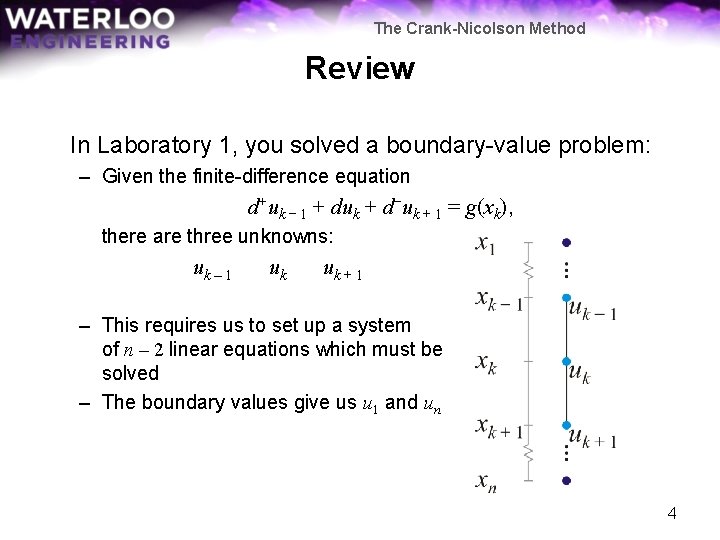
The Crank-Nicolson Method Review In Laboratory 1, you solved a boundary-value problem: – Given the finite-difference equation d+uk − 1 + duk + d−uk + 1 = g(xk), there are three unknowns: uk – 1 uk uk + 1 – This requires us to set up a system of n – 2 linear equations which must be solved – The boundary values give us u 1 and un 4
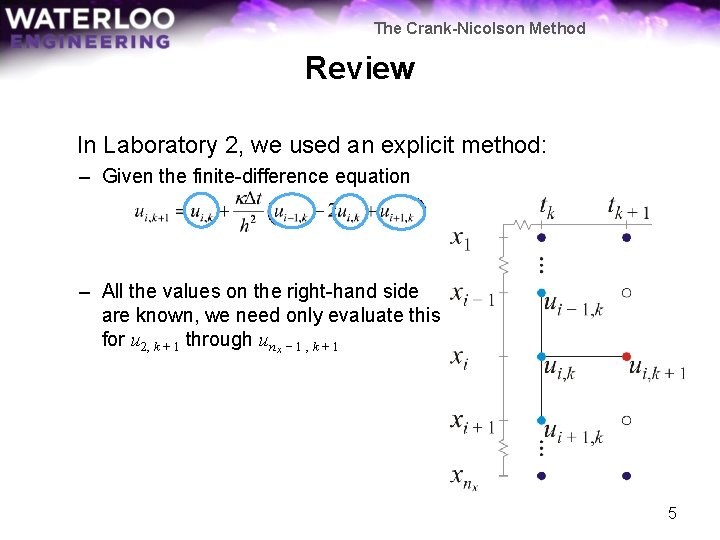
The Crank-Nicolson Method Review In Laboratory 2, we used an explicit method: – Given the finite-difference equation – All the values on the right-hand side are known, we need only evaluate this for u 2, k + 1 through un x − 1 , k + 1 5
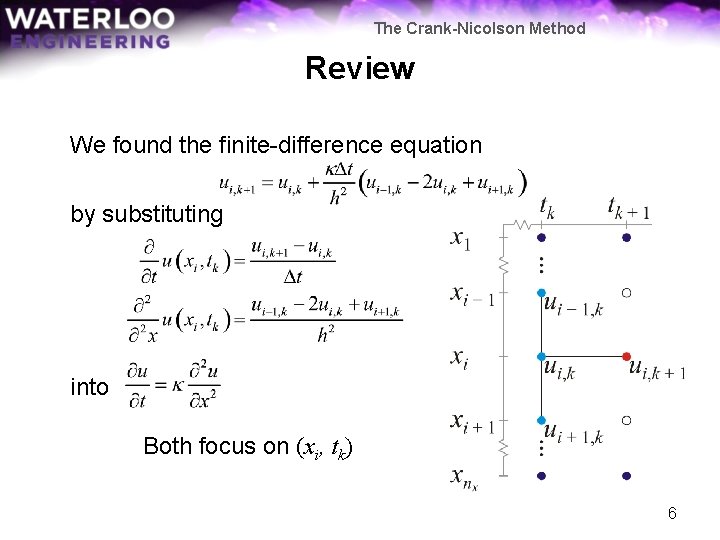
The Crank-Nicolson Method Review We found the finite-difference equation by substituting into Both focus on (xi, tk) 6

The Crank-Nicolson Method What happens if we focus on the point (xi, tk + 1)? These focus on (xi, tk + 1) 7
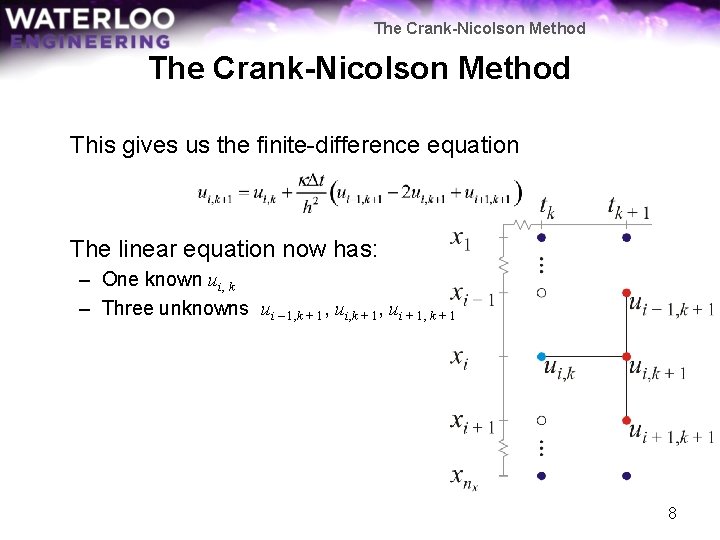
The Crank-Nicolson Method This gives us the finite-difference equation The linear equation now has: – One known ui, k – Three unknowns ui – 1, k + 1, ui + 1, k + 1 8
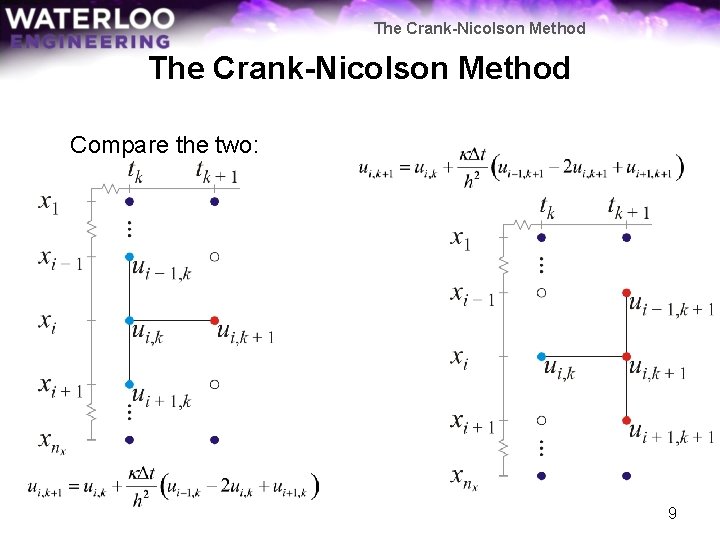
The Crank-Nicolson Method Compare the two: 9
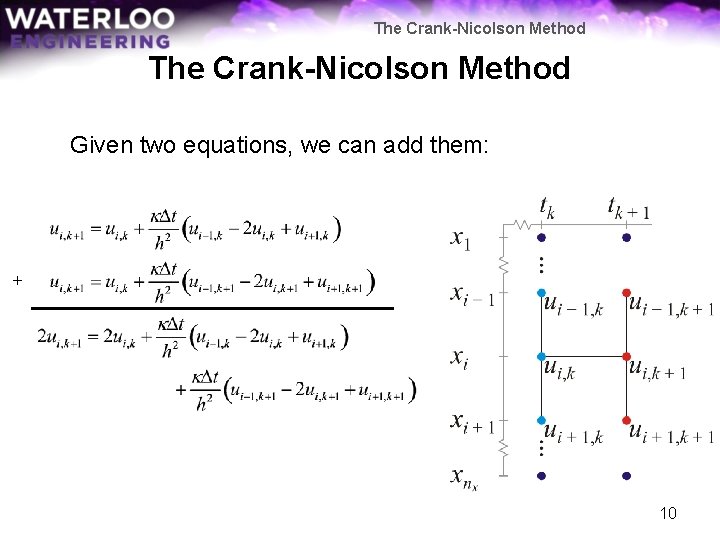
The Crank-Nicolson Method Given two equations, we can add them: + 10
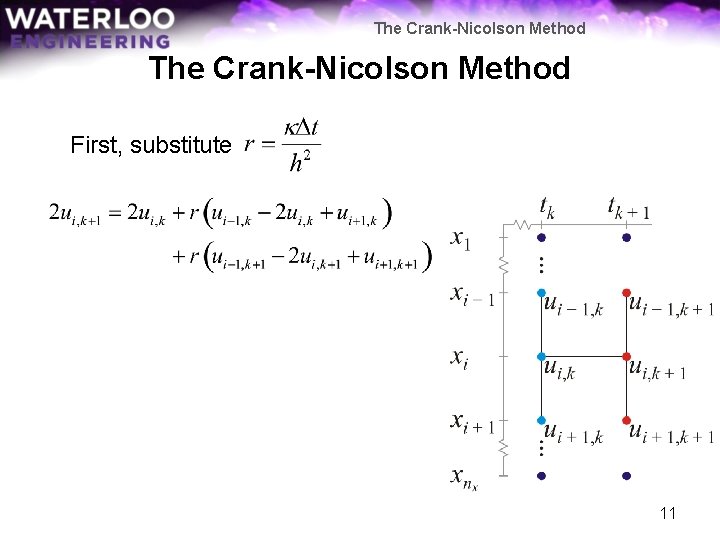
The Crank-Nicolson Method First, substitute 11
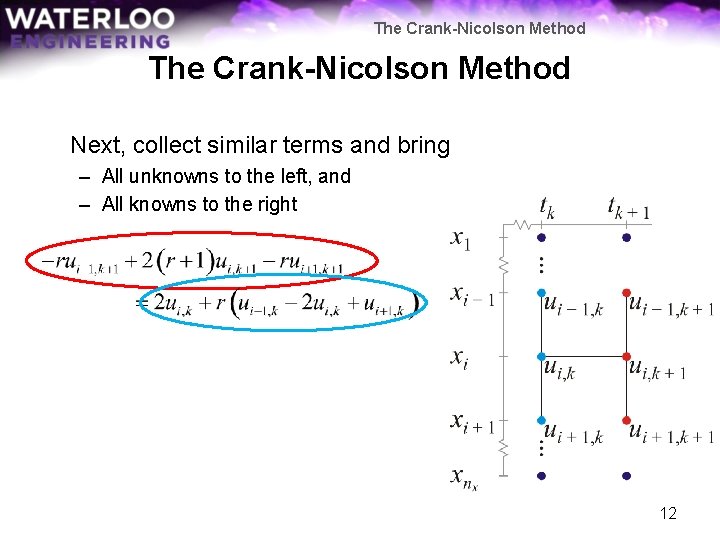
The Crank-Nicolson Method Next, collect similar terms and bring – All unknowns to the left, and – All knowns to the right 12
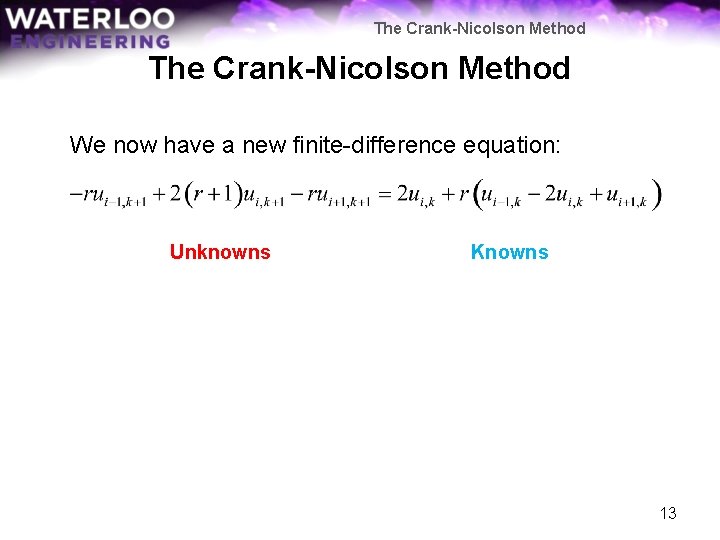
The Crank-Nicolson Method We now have a new finite-difference equation: Unknowns Knowns 13

The Crank-Nicolson Method As we did in Laboratory 1, we could then write nx – 2 equations . . . Unknowns nx – 2 Knowns 14
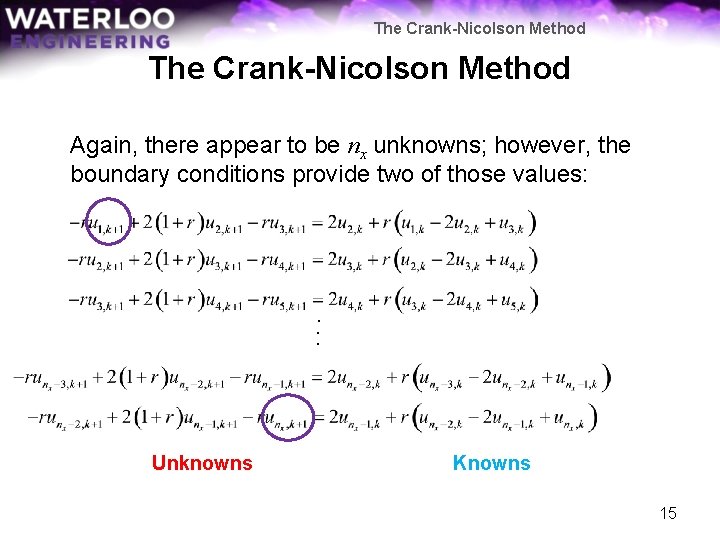
The Crank-Nicolson Method Again, there appear to be nx unknowns; however, the boundary conditions provide two of those values: . . . Unknowns Knowns 15
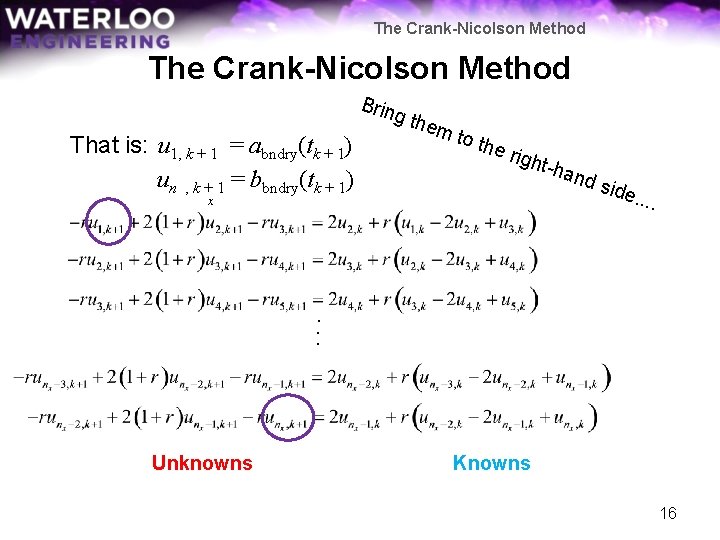
The Crank-Nicolson Method Brin That is: u 1, k + 1 = abndry(tk + 1) un , k + 1 = bbndry(tk + 1) g th em to th e rig ht-h x and side . . . . Unknowns Knowns 16
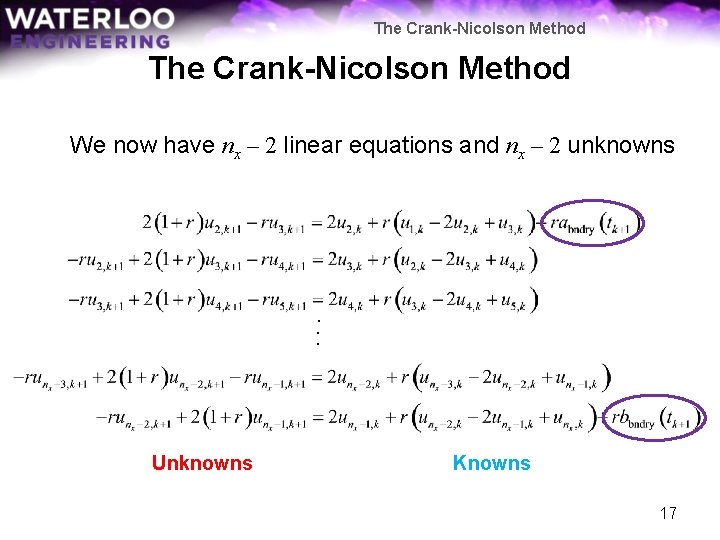
The Crank-Nicolson Method We now have nx – 2 linear equations and nx – 2 unknowns . . . Unknowns Knowns 17
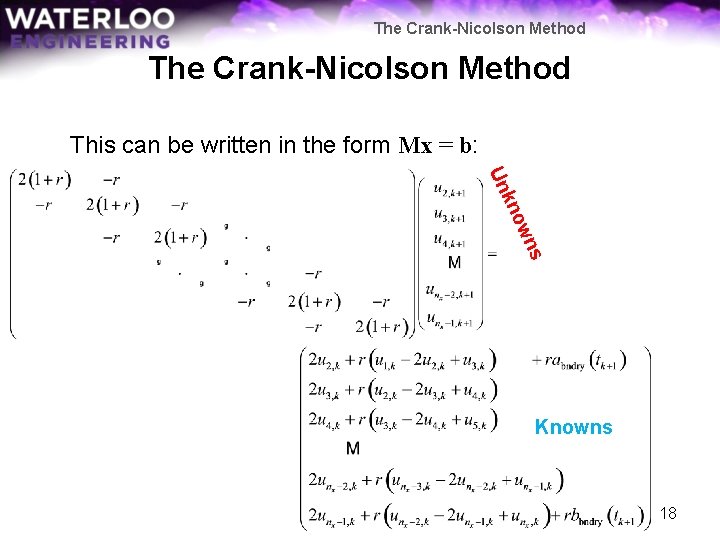
The Crank-Nicolson Method This can be written in the form Mx = b: ns ow kn Un Knowns 18
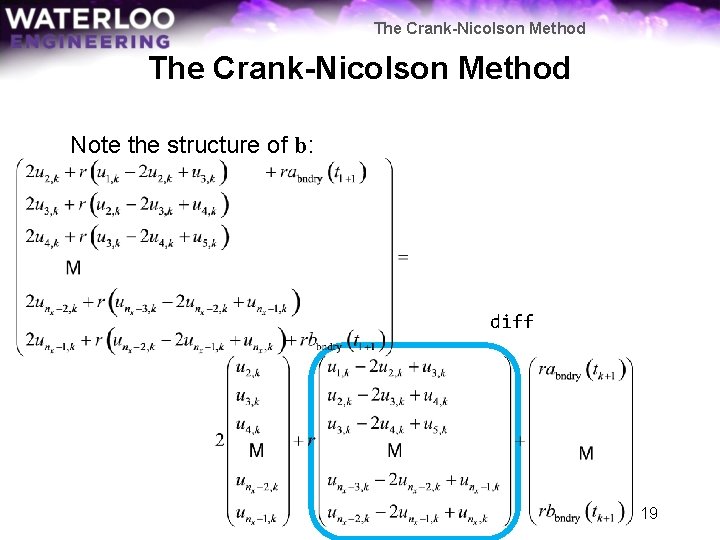
The Crank-Nicolson Method Note the structure of b: diff 19
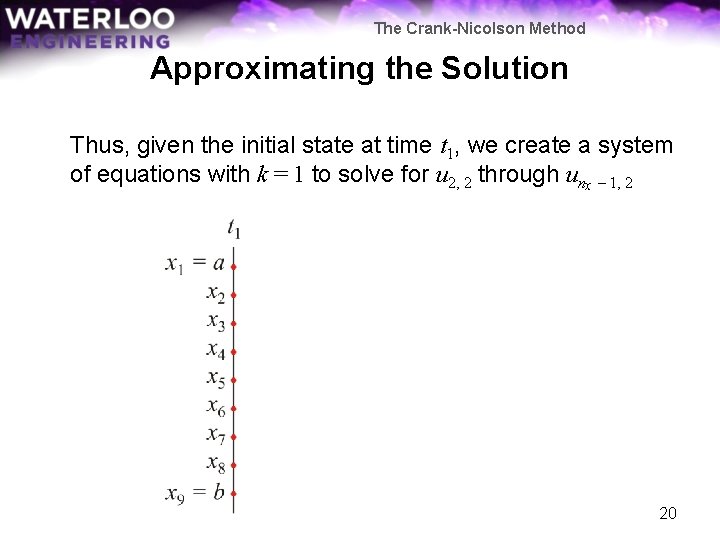
The Crank-Nicolson Method Approximating the Solution Thus, given the initial state at time t 1, we create a system of equations with k = 1 to solve for u 2, 2 through unx – 1, 2 20

The Crank-Nicolson Method Approximating the Solution We will simultaneously solve for these values and assign them to our solution matrix U 21
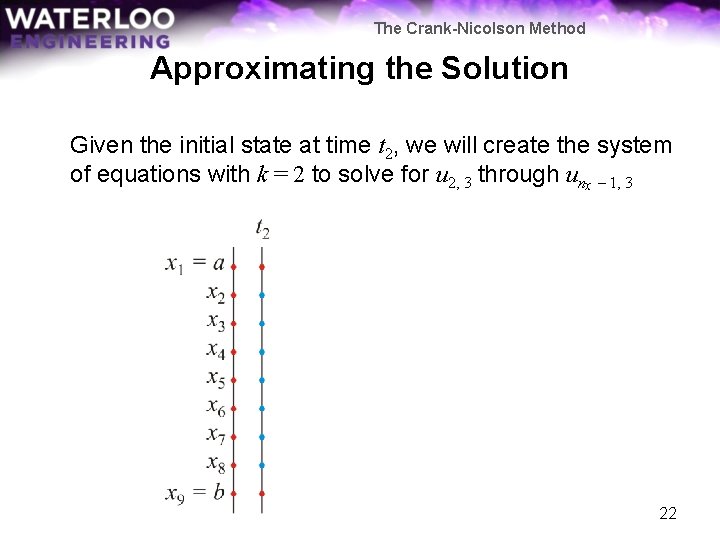
The Crank-Nicolson Method Approximating the Solution Given the initial state at time t 2, we will create the system of equations with k = 2 to solve for u 2, 3 through unx – 1, 3 22

The Crank-Nicolson Method Approximating the Solution Again, having solved for the values u 2, 3 through unx – 1, 3, we assign those entries to our matrix U 23
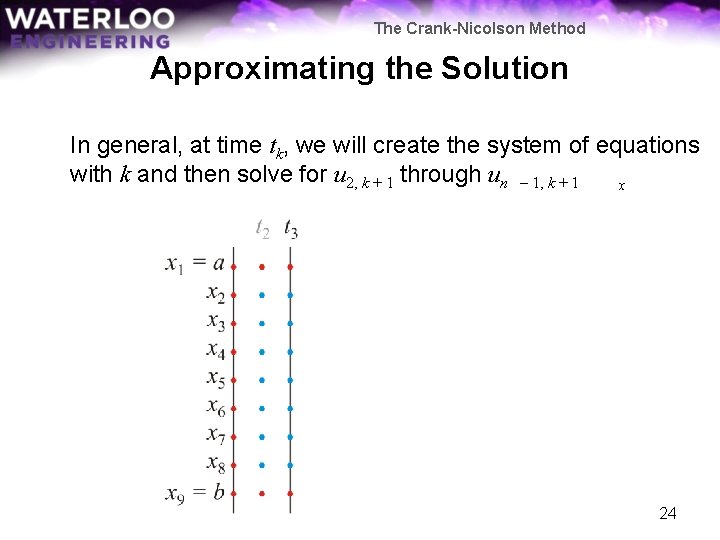
The Crank-Nicolson Method Approximating the Solution In general, at time tk, we will create the system of equations with k and then solve for u 2, k + 1 through un – 1, k + 1 x 24
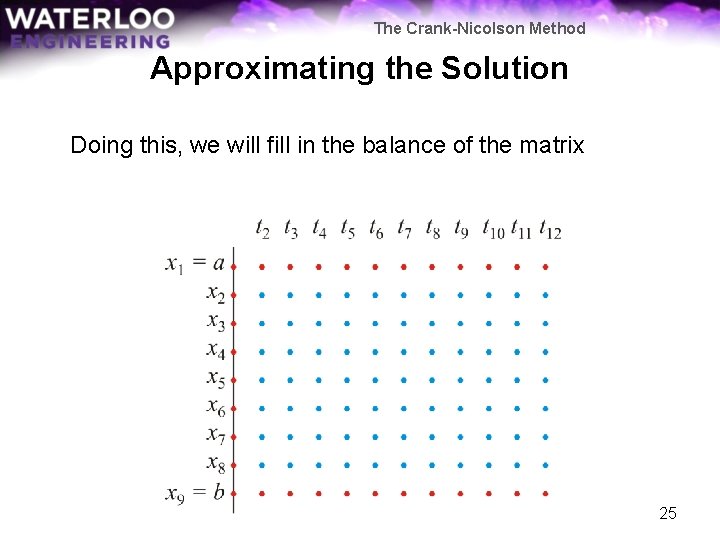
The Crank-Nicolson Method Approximating the Solution Doing this, we will fill in the balance of the matrix 25

The Crank-Nicolson Method The diffusion 1 d Function The signature will be function [x_out, t_out, U_out] =. . . crank_nicolson 1 d( kappa, x_rng, nx, t_rng, nt, u_init, u_bndry ) where kappa x_rng nx t_rng nt u_init u_bndry the diffusivity coefficient the space range [a, b] the number of points into which we will divide [a, b] the time interval [t 0, tfinal] the number of points into which we will divide [t 0, tfinal] a function handle giving the initial state uinit: [a, b] → R a function handle giving the two boundary conditions ubndry: [t 0, tfinal] → R 2 where 26
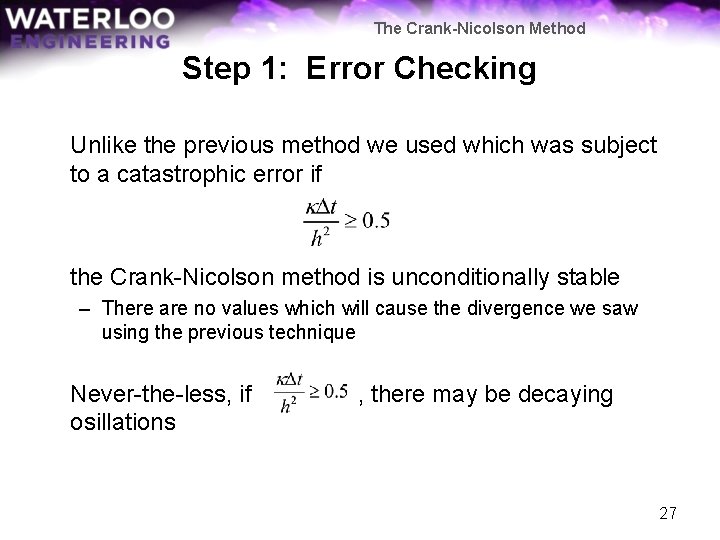
The Crank-Nicolson Method Step 1: Error Checking Unlike the previous method we used which was subject to a catastrophic error if the Crank-Nicolson method is unconditionally stable – There are no values which will cause the divergence we saw using the previous technique Never-the-less, if osillations , there may be decaying 27
The Crank-Nicolson Method Step 1: Error Checking Rather than throwing an exception, issue a warning: warning( 'MATLAB: questionable_argument', . . . 'the arguments of %d and %d are sub-optimal', . . . a, b ) This warning will be seen by the user; however, it will not terminate the execution of the function 28
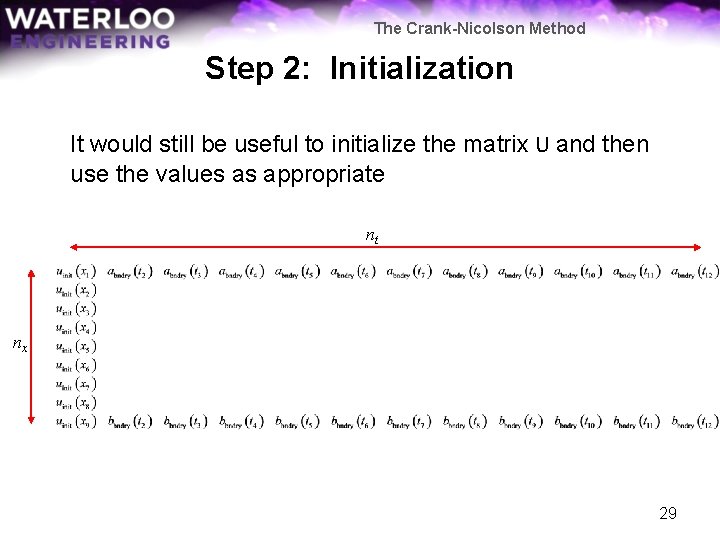
The Crank-Nicolson Method Step 2: Initialization It would still be useful to initialize the matrix U and then use the values as appropriate nt nx 29
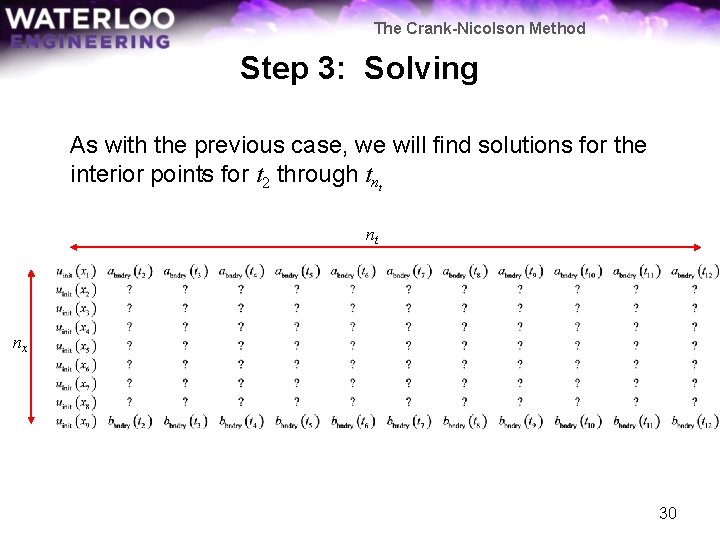
The Crank-Nicolson Method Step 3: Solving As with the previous case, we will find solutions for the t for t through t interior points nt 2 nt nx 30
The Crank-Nicolson Method Step 3: Solving For each time step from 1 to nt – 1, we will, however, have to perform the following: 3 a. Set up the system of linear equations 3 b. Solve the system of linear equations, and 3 c. Assign the values to the next column of the solution matrix 31
The Crank-Nicolson Method Useful Matlab Commands There are no new additional Matlab commands for the Crank-Nicolson method that you have not already been introduced to in Laboratories 1 and 2 32
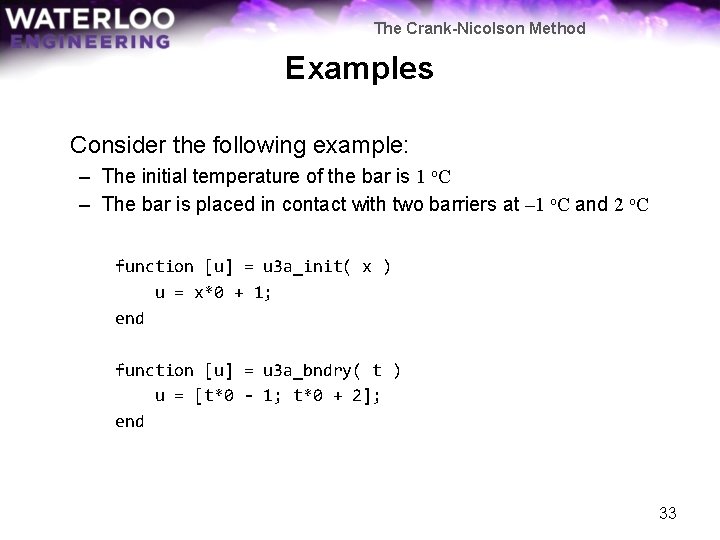
The Crank-Nicolson Method Examples Consider the following example: – The initial temperature of the bar is 1 o. C – The bar is placed in contact with two barriers at – 1 o. C and 2 o. C function [u] = u 3 a_init( x ) u = x*0 + 1; end function [u] = u 3 a_bndry( t ) u = [t*0 - 1; t*0 + 2]; end 33
![The Crank-Nicolson Method Examples [xs, ts, Us] = crank_nicolson 1 d( 1. 5, [0](http://slidetodoc.com/presentation_image/09a02947c5dfc537d01d335014dc3ba9/image-34.jpg "The Crank-Nicolson Method Examples [xs, ts, Us] = crank_nicolson 1 d( 1. 5, [0")
The Crank-Nicolson Method Examples [xs, ts, Us] = crank_nicolson 1 d( 1. 5, [0 1], mesh( ts, xs, Us ) 6, [0 1], 21, @u 3 a_init, @u 3 a_bndry ); 34
![The Crank-Nicolson Method Examples [xs, ts, Us] = crank_nicolson 1 d( 1. 5, [0](http://slidetodoc.com/presentation_image/09a02947c5dfc537d01d335014dc3ba9/image-35.jpg "The Crank-Nicolson Method Examples [xs, ts, Us] = crank_nicolson 1 d( 1. 5, [0")
The Crank-Nicolson Method Examples [xs, ts, Us] = crank_nicolson 1 d( 1. 5, [0 1], 41, [0 1], mesh( ts, xs, Us ) 11, @u 3 a_init, @u 3 a_bndry ); Note the transient oscillations 35
![The Crank-Nicolson Method Examples [xs, ts, Us] = crank_nicolson 1 d( 1. 5, [0](http://slidetodoc.com/presentation_image/09a02947c5dfc537d01d335014dc3ba9/image-36.jpg "The Crank-Nicolson Method Examples [xs, ts, Us] = crank_nicolson 1 d( 1. 5, [0")
The Crank-Nicolson Method Examples [xs, ts, Us] = crank_nicolson 1 d( 1. 5, [0 1], 41, [0 1], mesh( ts, xs, Us ) 41, @u 3 a_init, @u 3 a_bndry ); Note the transient oscillations 36
![The Crank-Nicolson Method Examples [xs, ts, Us] = crank_nicolson 1 d( 1. 5, [0](http://slidetodoc.com/presentation_image/09a02947c5dfc537d01d335014dc3ba9/image-37.jpg "The Crank-Nicolson Method Examples [xs, ts, Us] = crank_nicolson 1 d( 1. 5, [0")
The Crank-Nicolson Method Examples [xs, ts, Us] = crank_nicolson 1 d( 1. 5, [0 1], 21, [0 1], 301, @u 3 a_init, @u 3 a_bndry ); mesh( ts, xs, Us ) 37
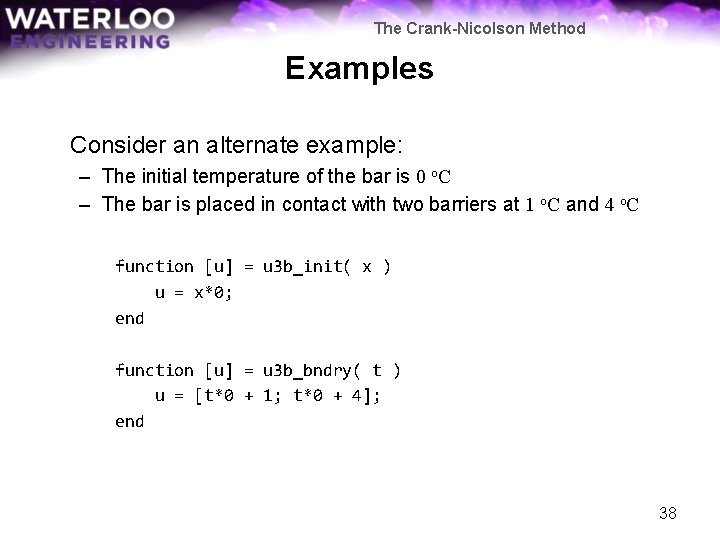
The Crank-Nicolson Method Examples Consider an alternate example: – The initial temperature of the bar is 0 o. C – The bar is placed in contact with two barriers at 1 o. C and 4 o. C function [u] = u 3 b_init( x ) u = x*0; end function [u] = u 3 b_bndry( t ) u = [t*0 + 1; t*0 + 4]; end 38
![The Crank-Nicolson Method Examples [x 3 b, t 3 b, U 3 b] =](http://slidetodoc.com/presentation_image/09a02947c5dfc537d01d335014dc3ba9/image-39.jpg "The Crank-Nicolson Method Examples [x 3 b, t 3 b, U 3 b] =")
The Crank-Nicolson Method Examples [x 3 b, t 3 b, U 3 b] = crank_nicolson 1 d( 0. 25, [0 1], 11, [0 1], mesh( t 3 b, x 3 b, U 3 b ); frames 3 b = animate( U 3 b ); frames 2 gif( frames 3 b, 'plot 3 b. i. gif' ); 11, @u 3 b_init, @u 3 b_bndry ); 39
![The Crank-Nicolson Method Examples [x 3 b, t 3 b, U 3 b] =](http://slidetodoc.com/presentation_image/09a02947c5dfc537d01d335014dc3ba9/image-40.jpg "The Crank-Nicolson Method Examples [x 3 b, t 3 b, U 3 b] =")
The Crank-Nicolson Method Examples [x 3 b, t 3 b, U 3 b] = crank_nicolson 1 d( 0. 25, [0 1], 41, [0 1], 161, @u 3 b_init, @u 3 b_bndry ); mesh( t 3 b, x 3 b, U 3 b ); frames 3 b = animate( U 3 b ); frames 2 gif( frames 3 b, 'plot 3 b. ii. gif' ); 40

The Crank-Nicolson Method Insulated Boundaries We have looked at situations where we have known temperatures or concentrations at each end of the bar; however, what happens if one end of the bar is insulated? 41

The Crank-Nicolson Method Terminology Up to this point, we have discussed boundary values where the value of the function is specified – These are termed Dirichlet boundary condition Alternatively, one can specify the value of the derivative at the boundary points – These are termed Neumann boundary conditions Specifically, we will focus on insulated boundary conditions where the derivative at the boundaries are zero 42
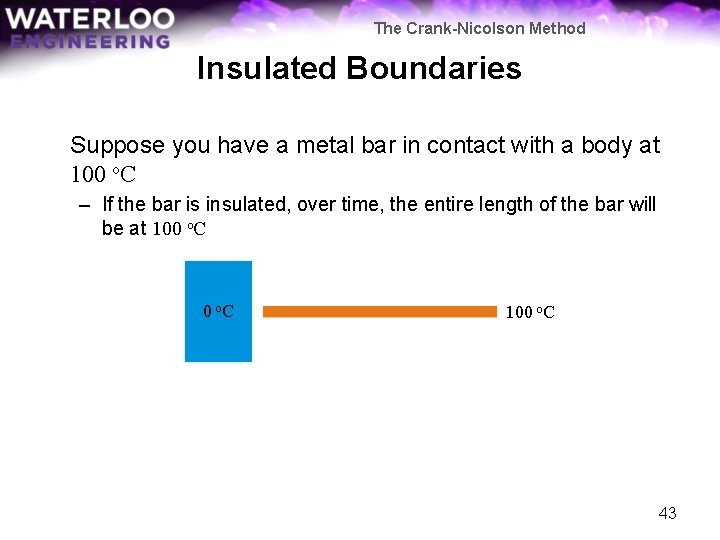
The Crank-Nicolson Method Insulated Boundaries Suppose you have a metal bar in contact with a body at 100 o. C – If the bar is insulated, over time, the entire length of the bar will be at 100 o. C 43
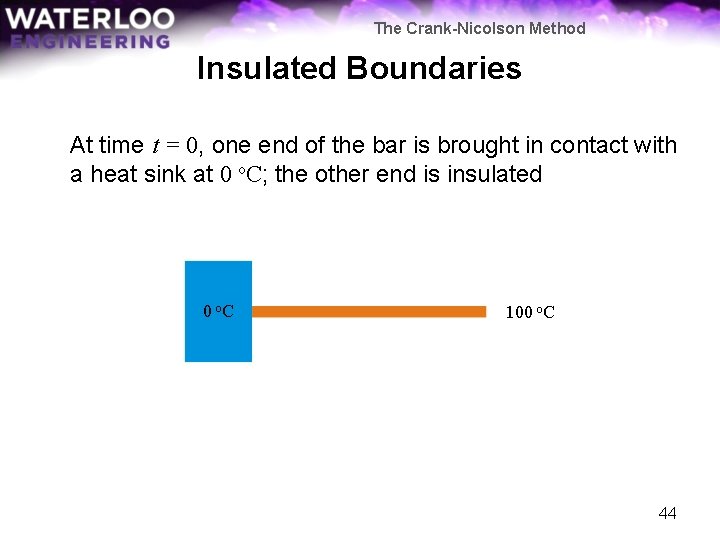
The Crank-Nicolson Method Insulated Boundaries At time t = 0, one end of the bar is brought in contact with a heat sink at 0 o. C; the other end is insulated 0 o. C 100 o. C 44
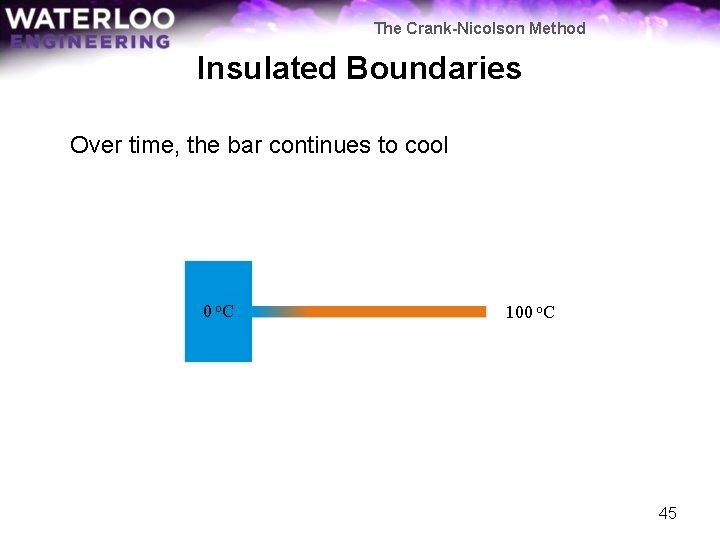
The Crank-Nicolson Method Insulated Boundaries Over time, the bar continues to cool 0 o. C 100 o. C 45
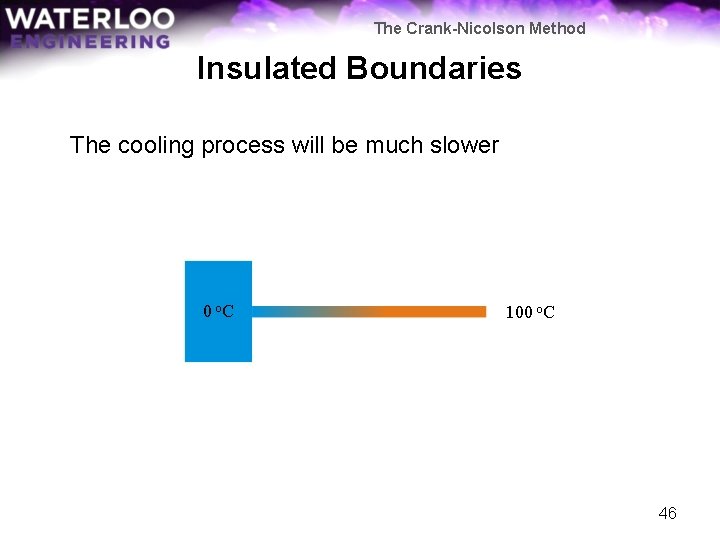
The Crank-Nicolson Method Insulated Boundaries The cooling process will be much slower 0 o. C 100 o. C 46
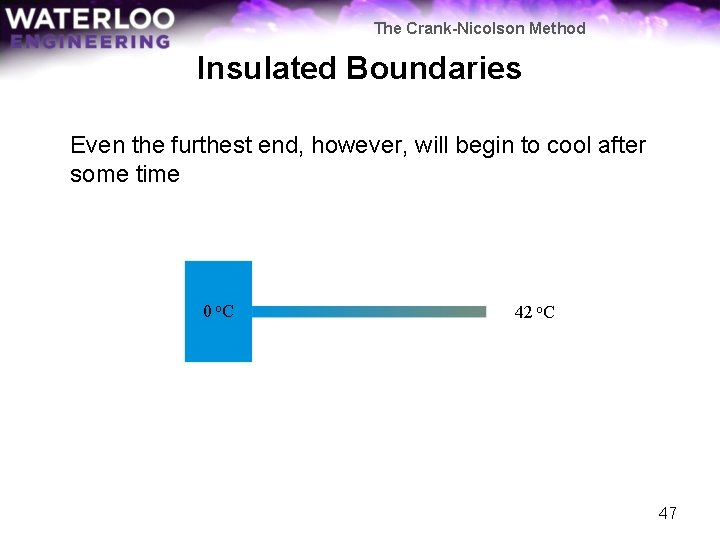
The Crank-Nicolson Method Insulated Boundaries Even the furthest end, however, will begin to cool after some time 0 o. C 42 o. C 47
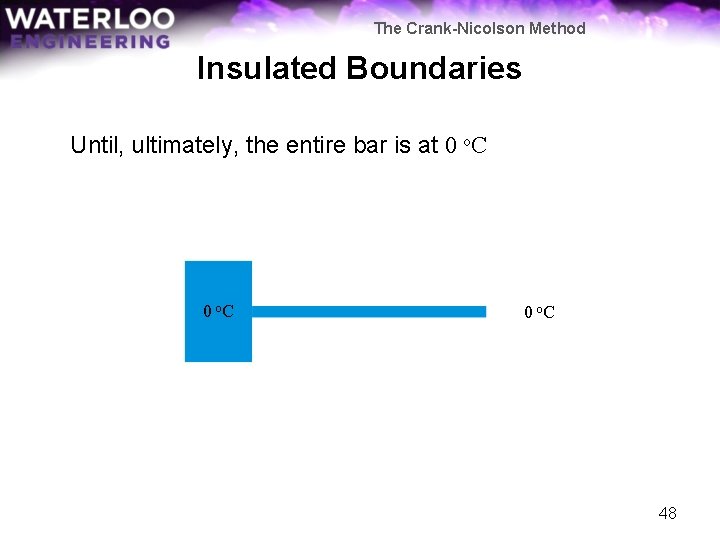
The Crank-Nicolson Method Insulated Boundaries Until, ultimately, the entire bar is at 0 o. C 48
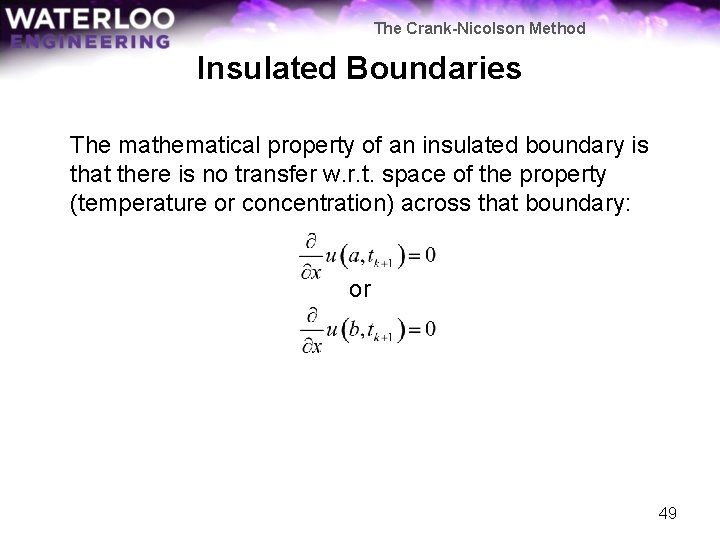
The Crank-Nicolson Method Insulated Boundaries The mathematical property of an insulated boundary is that there is no transfer w. r. t. space of the property (temperature or concentration) across that boundary: or 49
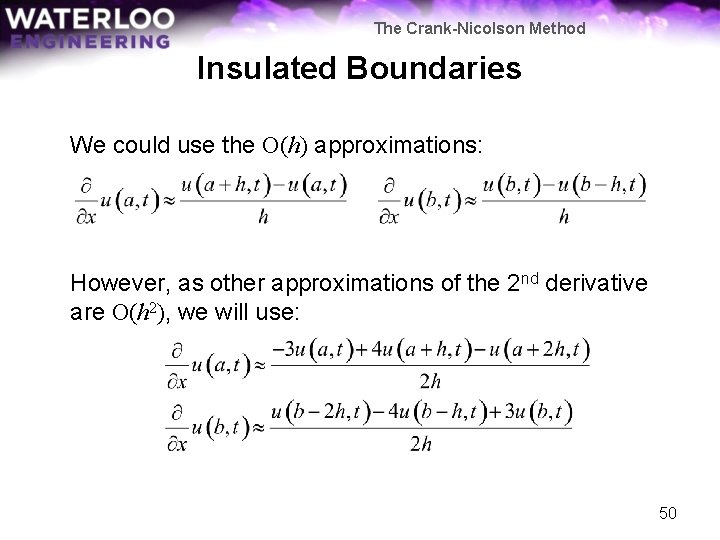
The Crank-Nicolson Method Insulated Boundaries We could use the O(h) approximations: However, as other approximations of the 2 nd derivative are O(h 2), we will use: 50
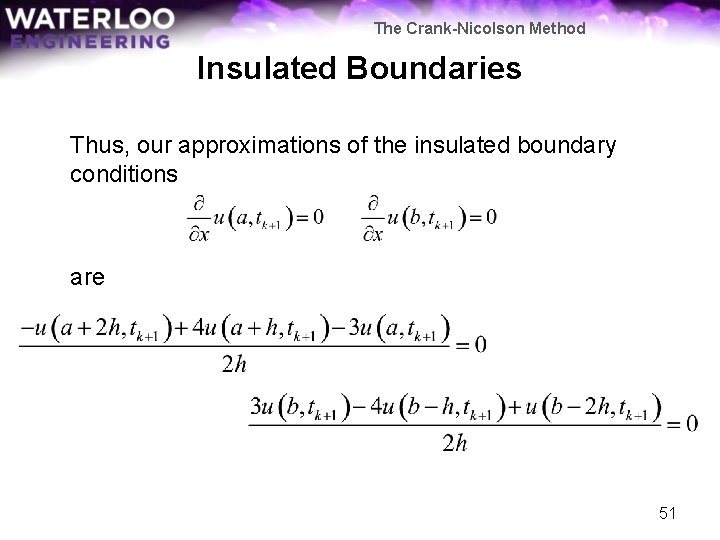
The Crank-Nicolson Method Insulated Boundaries Thus, our approximations of the insulated boundary conditions are 51
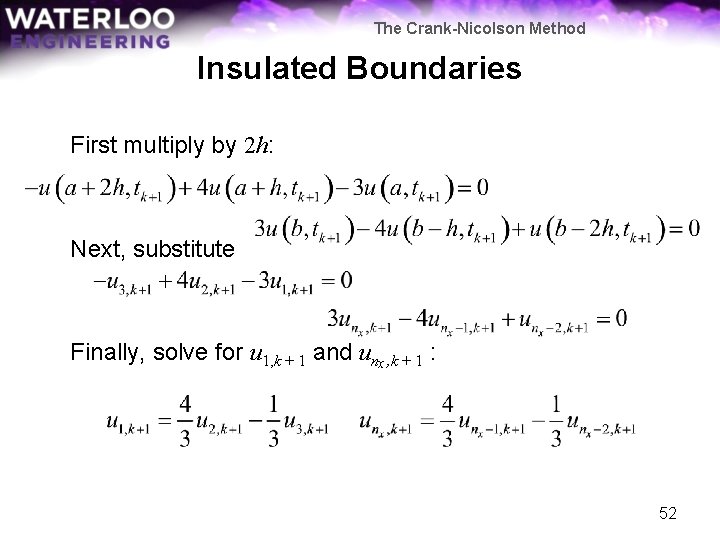
The Crank-Nicolson Method Insulated Boundaries First multiply by 2 h: Next, substitute Finally, solve for u 1, k + 1 and unx , k + 1 : 52
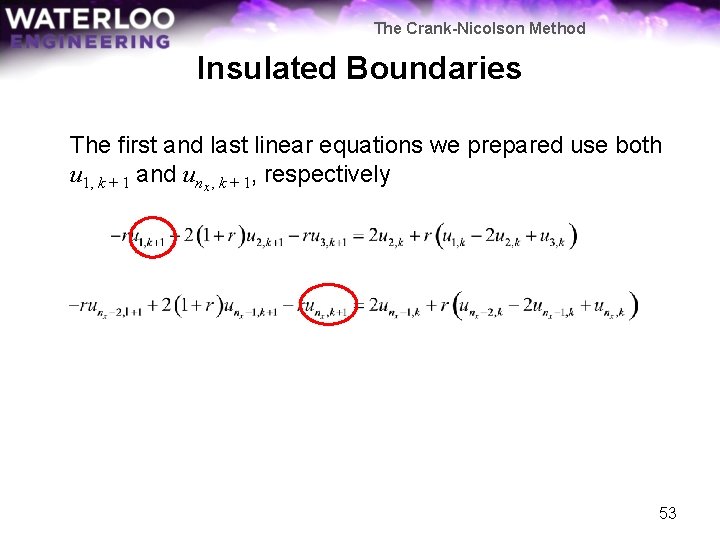
The Crank-Nicolson Method Insulated Boundaries The first and last linear equations we prepared use both u 1, k + 1 and un x , k + 1, respectively 53
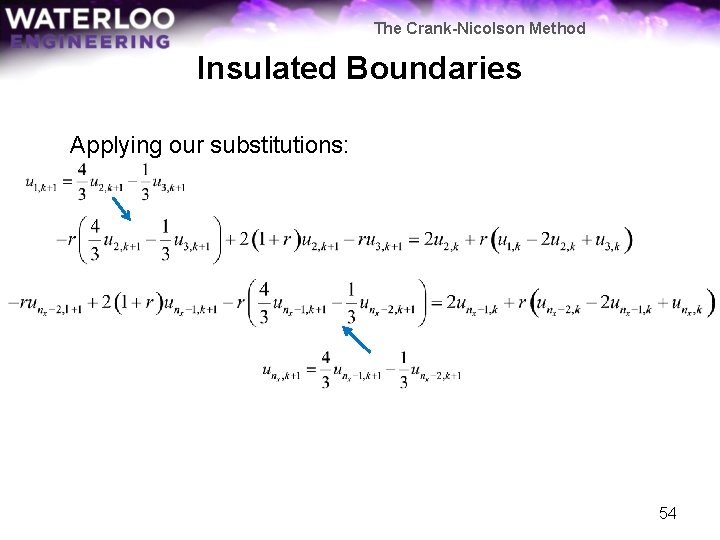
The Crank-Nicolson Method Insulated Boundaries Applying our substitutions: 54
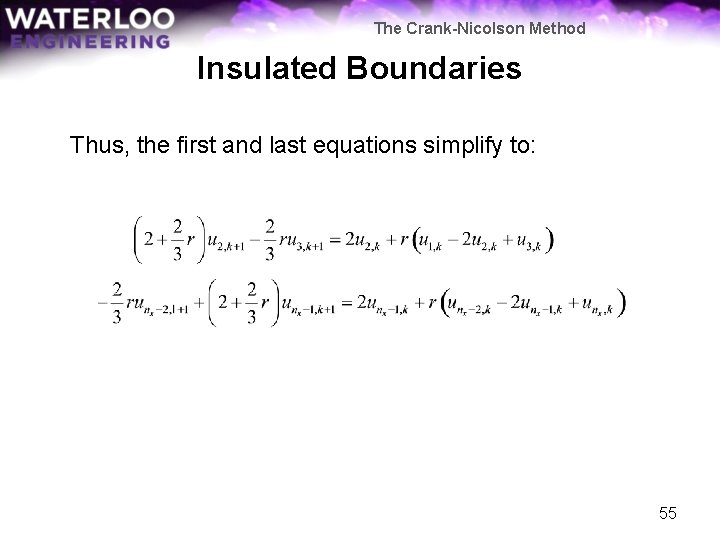
The Crank-Nicolson Method Insulated Boundaries Thus, the first and last equations simplify to: 55
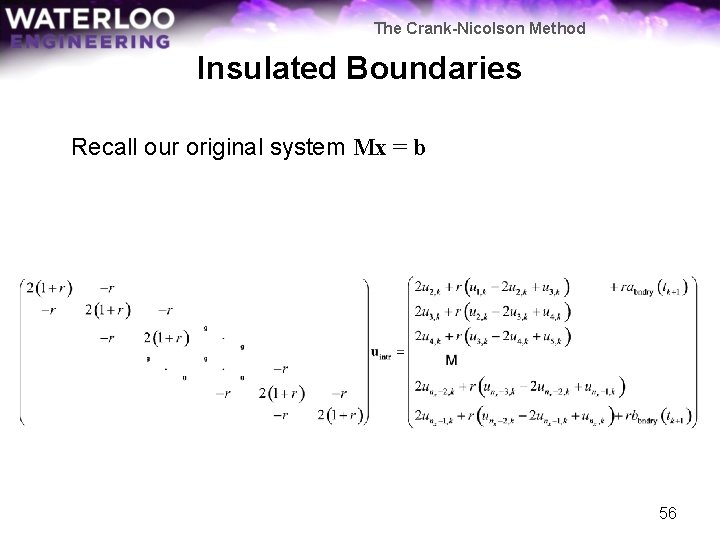
The Crank-Nicolson Method Insulated Boundaries Recall our original system Mx = b 56
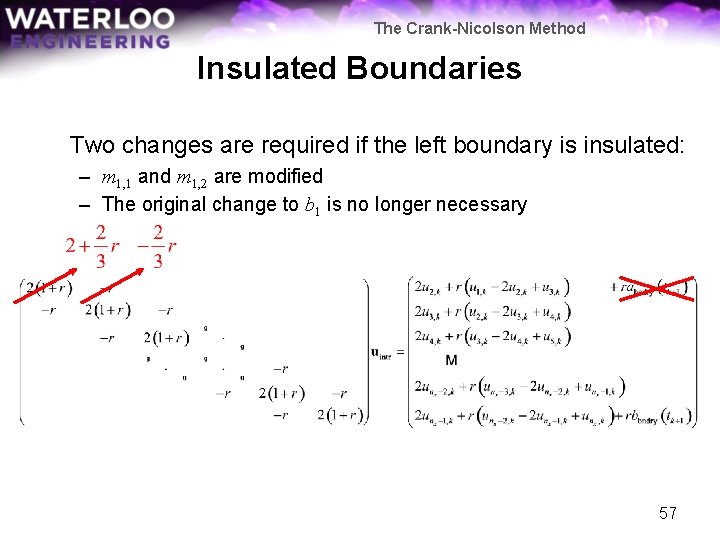
The Crank-Nicolson Method Insulated Boundaries Two changes are required if the left boundary is insulated: – m 1, 1 and m 1, 2 are modified – The original change to b 1 is no longer necessary 57
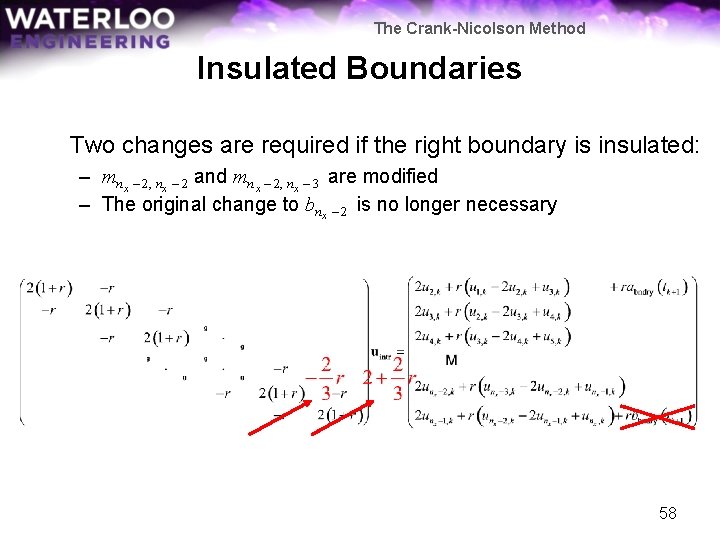
The Crank-Nicolson Method Insulated Boundaries Two changes are required if the right boundary is insulated: – mn x – 2, nx – 2 and mn x – 2, n x – 3 are modified – The original change to bnx – 2 is no longer necessary 58
The Crank-Nicolson Method Insulated Boundaries How do we indicate an insulated boundary? – One of the best ideas I have found is to have the boundary function return Na. N – Recall that Na. N is the result of floating-point operations such as 0/0: >> 0/0 ans = Na. N – It is also appropriate: an insulated boundary has an undefined temperature 59
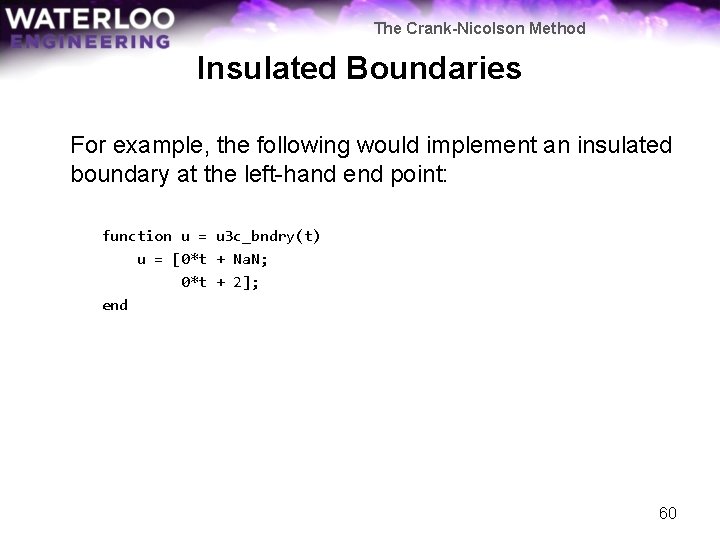
The Crank-Nicolson Method Insulated Boundaries For example, the following would implement an insulated boundary at the left-hand end point: function u = u 3 c_bndry(t) u = [0*t + Na. N; 0*t + 2]; end 60
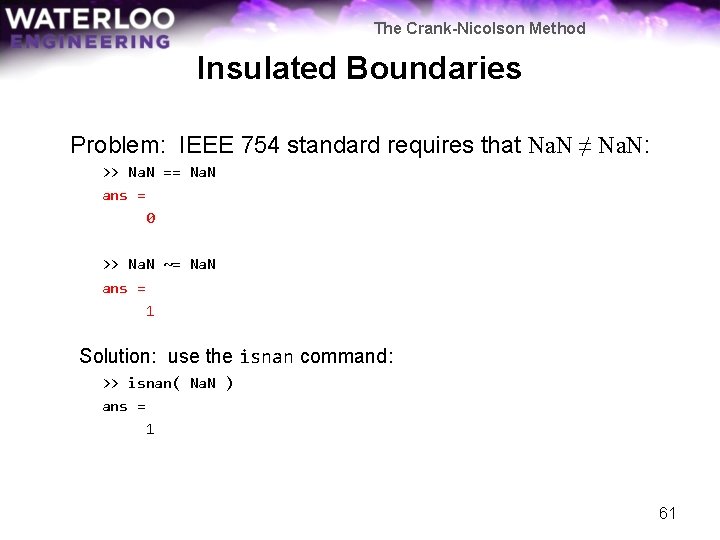
The Crank-Nicolson Method Insulated Boundaries Problem: IEEE 754 standard requires that Na. N ≠ Na. N: >> Na. N == Na. N ans = 0 >> Na. N ~= Na. N ans = 1 Solution: use the isnan command: >> isnan( Na. N ) ans = 1 61
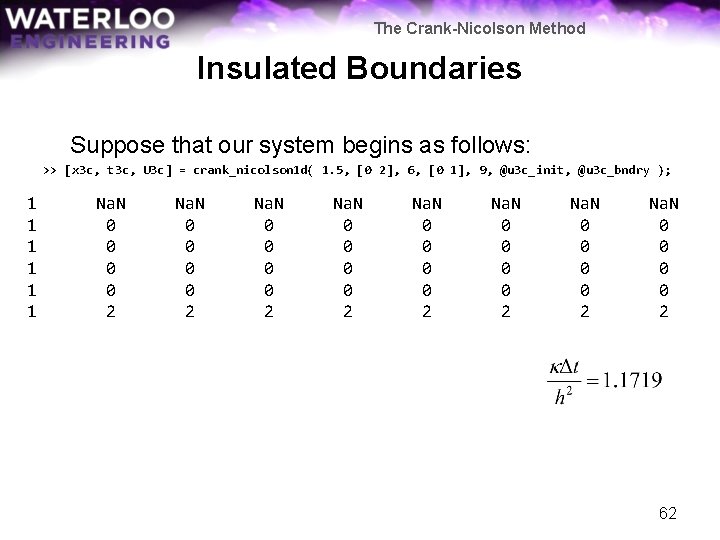
The Crank-Nicolson Method Insulated Boundaries Suppose that our system begins as follows: >> [x 3 c, t 3 c, U 3 c] = crank_nicolson 1 d( 1. 5, [0 2], 6, [0 1], 9, @u 3 c_init, @u 3 c_bndry ); 1 1 1 Na. N 0 0 0 0 2 Na. N 0 0 0 0 2 62
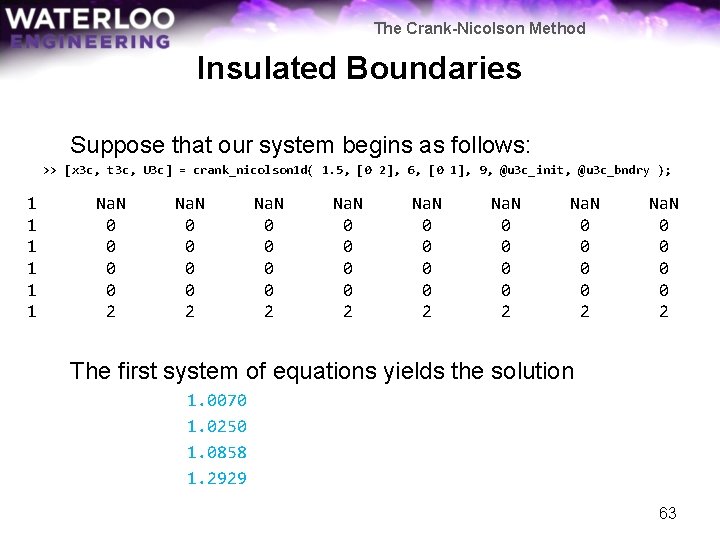
The Crank-Nicolson Method Insulated Boundaries Suppose that our system begins as follows: >> [x 3 c, t 3 c, U 3 c] = crank_nicolson 1 d( 1. 5, [0 2], 6, [0 1], 9, @u 3 c_init, @u 3 c_bndry ); 1 1 1 Na. N 0 0 0 0 2 Na. N 0 0 0 0 2 The first system of equations yields the solution 1. 0070 1. 0250 1. 0858 1. 2929 63
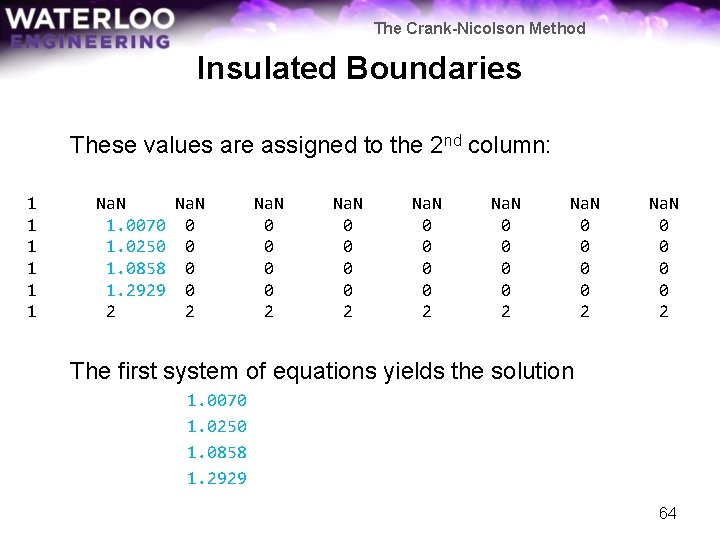
The Crank-Nicolson Method Insulated Boundaries These values are assigned to the 2 nd column: 1 1 1 Na. N 1. 0070 0 1. 0250 0 1. 0858 0 1. 2929 0 2 2 Na. N 0 0 0 0 2 The first system of equations yields the solution 1. 0070 1. 0250 1. 0858 1. 2929 64
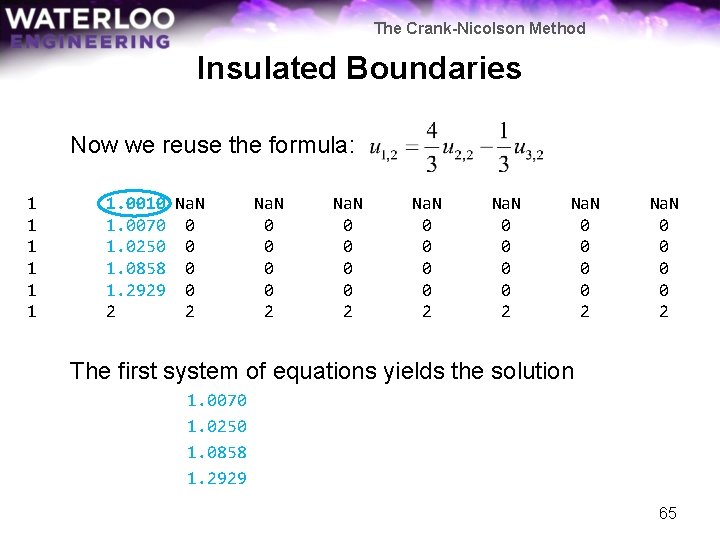
The Crank-Nicolson Method Insulated Boundaries Now we reuse the formula: 1 1 1 1. 0010 Na. N 1. 0070 0 1. 0250 0 1. 0858 0 1. 2929 0 2 2 Na. N 0 0 0 0 2 The first system of equations yields the solution 1. 0070 1. 0250 1. 0858 1. 2929 65
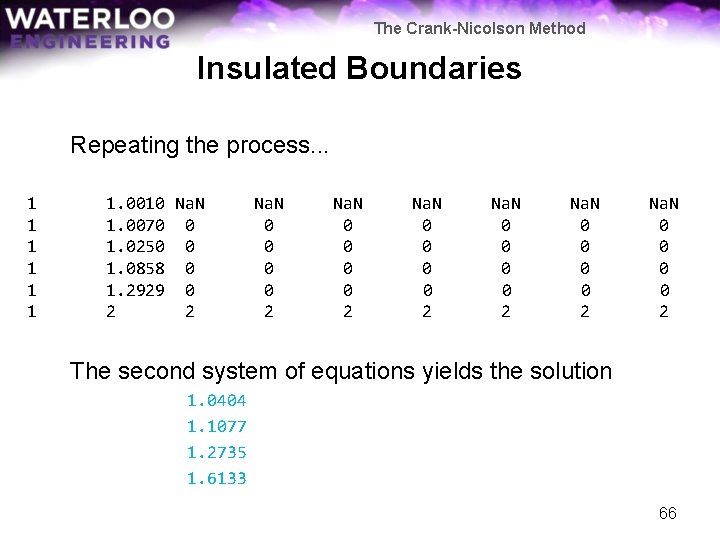
The Crank-Nicolson Method Insulated Boundaries Repeating the process. . . 1 1 1 1. 0010 Na. N 1. 0070 0 1. 0250 0 1. 0858 0 1. 2929 0 2 2 Na. N 0 0 0 0 2 The second system of equations yields the solution 1. 0404 1. 1077 1. 2735 1. 6133 66
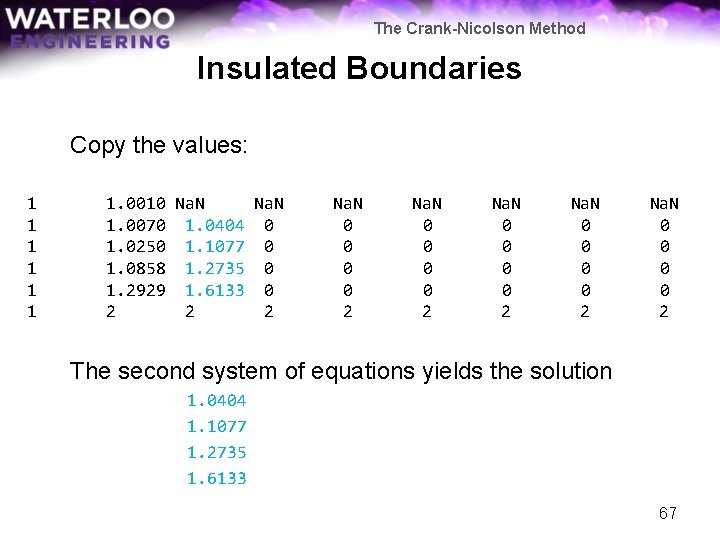
The Crank-Nicolson Method Insulated Boundaries Copy the values: 1 1 1 1. 0010 Na. N 1. 0070 1. 0404 0 1. 0250 1. 1077 0 1. 0858 1. 2735 0 1. 2929 1. 6133 0 2 2 2 Na. N 0 0 0 0 2 Na. N 0 0 2 The second system of equations yields the solution 1. 0404 1. 1077 1. 2735 1. 6133 67
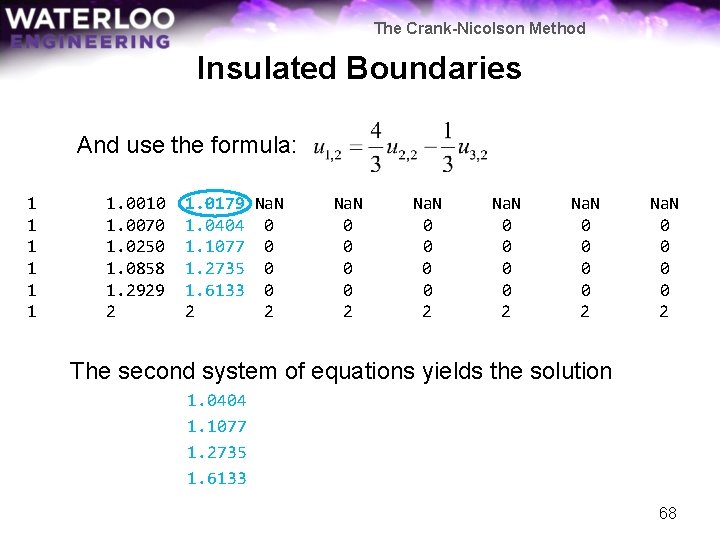
The Crank-Nicolson Method Insulated Boundaries And use the formula: 1 1 1 1. 0010 1. 0070 1. 0250 1. 0858 1. 2929 2 1. 0179 Na. N 1. 0404 0 1. 1077 0 1. 2735 0 1. 6133 0 2 2 Na. N 0 0 0 0 2 Na. N 0 0 2 The second system of equations yields the solution 1. 0404 1. 1077 1. 2735 1. 6133 68
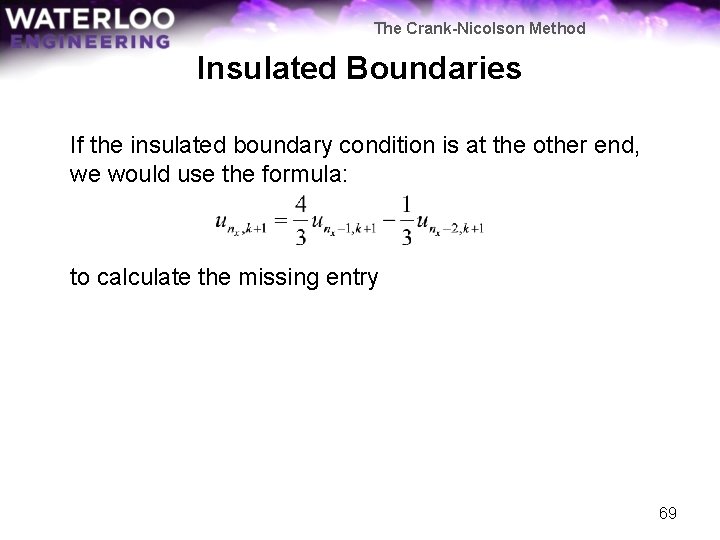
The Crank-Nicolson Method Insulated Boundaries If the insulated boundary condition is at the other end, we would use the formula: to calculate the missing entry 69
The Crank-Nicolson Method Step 3: Solving We only need two small changes: – First, in the argument checking, nx ≥ 4 – Second, for each time step from 1 to nt – 1, we will, however, have to perform the following: 3 a. Set up the system of linear equations and modify: – The vector if it is a Dirichlet boundary condition – The matrix if it is an insulated boundaries 3 b. Solve the system, and 3 c. Copy the values back to U in the next column – If the boundaries are insulated in that column, use the appropriate formula to find the end points 70
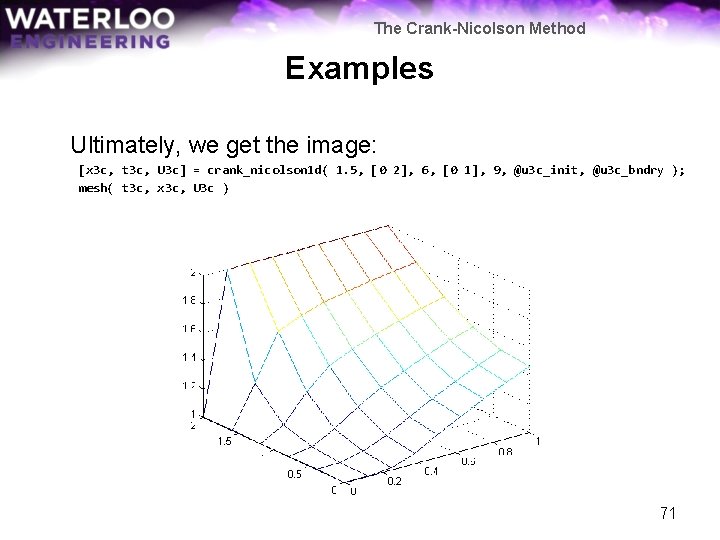
The Crank-Nicolson Method Examples Ultimately, we get the image: [x 3 c, t 3 c, U 3 c] = crank_nicolson 1 d( 1. 5, [0 2], 6, [0 1], 9, @u 3 c_init, @u 3 c_bndry ); mesh( t 3 c, x 3 c, U 3 c ) 71
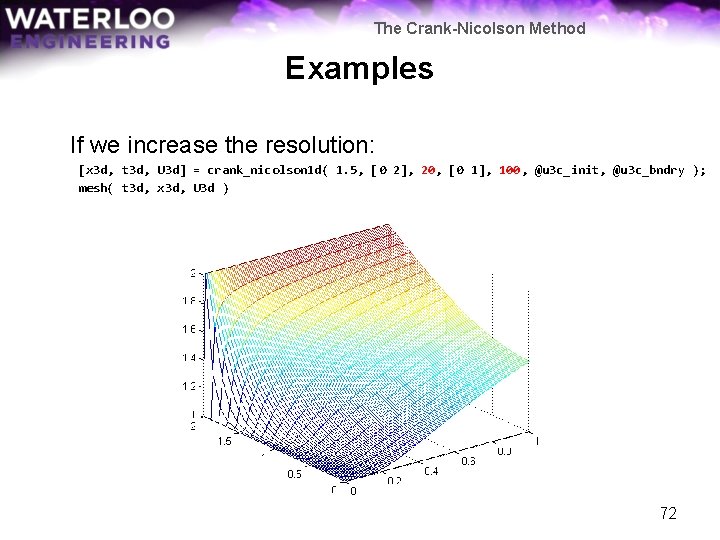
The Crank-Nicolson Method Examples If we increase the resolution: [x 3 d, t 3 d, U 3 d] = crank_nicolson 1 d( 1. 5, [0 2], 20, [0 1], 100, @u 3 c_init, @u 3 c_bndry ); mesh( t 3 d, x 3 d, U 3 d ) 72
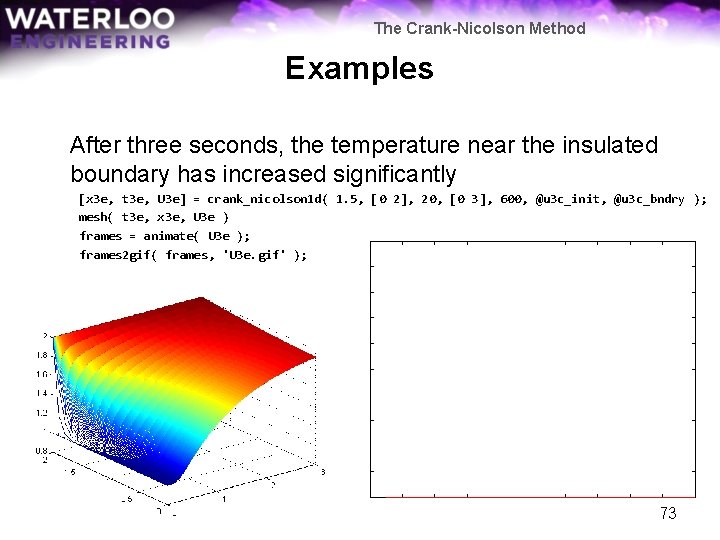
The Crank-Nicolson Method Examples After three seconds, the temperature near the insulated boundary has increased significantly [x 3 e, t 3 e, U 3 e] = crank_nicolson 1 d( 1. 5, [0 2], 20, [0 3], 600, @u 3 c_init, @u 3 c_bndry ); mesh( t 3 e, x 3 e, U 3 e ) frames = animate( U 3 e ); frames 2 gif( frames, 'U 3 e. gif' ); 73
The Crank-Nicolson Method Summary We have looked at the heat-conduction/diffusion equation – We developed the Crank-Nicolson method – You will implement the algorithm – Unlike the previous implementation, there are less restrictions on • Large values of this ratio may cause transient oscillations – We defined insulated boundaries • Considered their approximation using Matlab 74
![The Crank-Nicolson Method References [1] Glyn James, Modern Engineering Mathematics, 4 th Ed. ,](http://slidetodoc.com/presentation_image/09a02947c5dfc537d01d335014dc3ba9/image-75.jpg "The Crank-Nicolson Method References [1] Glyn James, Modern Engineering Mathematics, 4 th Ed. ,")
The Crank-Nicolson Method References [1] Glyn James, Modern Engineering Mathematics, 4 th Ed. , Prentice Hall, 2007, p. 782. [2] Glyn James, Advanced Modern Engineering Mathematics, 4 th Ed. , Prentice Hall, 2011, p. 164. 75
- Slides: 75