
The Cranial Cavity Vault Sutures Coronal Sagittal Lambdoid

The Cranial Cavity • Vault Sutures: (Coronal, Sagittal & Lambdoid) -Impressions: arachnoid granulations, middle meningeal aa. , and superior sagittal sinus.
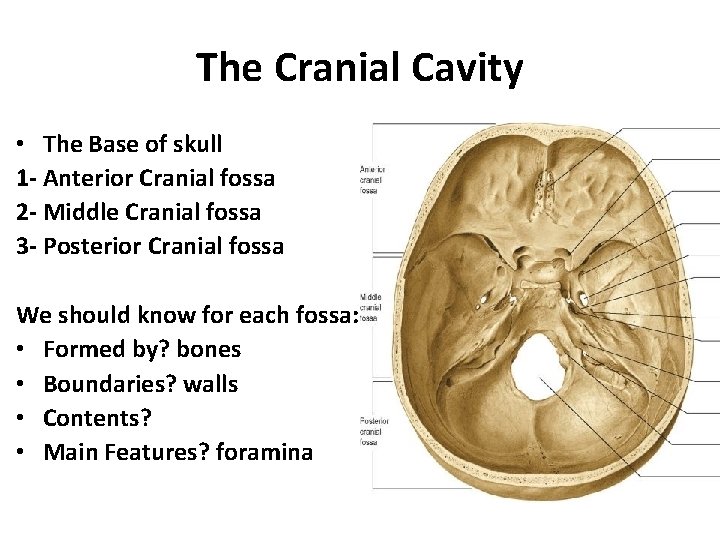
The Cranial Cavity • The Base of skull 1 - Anterior Cranial fossa 2 - Middle Cranial fossa 3 - Posterior Cranial fossa We should know for each fossa: • Formed by? bones • Boundaries? walls • Contents? • Main Features? foramina
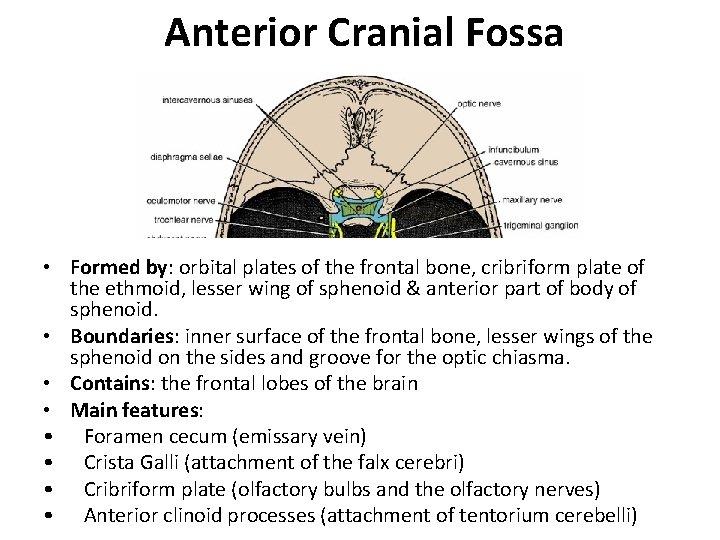
Anterior Cranial Fossa • Formed by: orbital plates of the frontal bone, cribriform plate of the ethmoid, lesser wing of sphenoid & anterior part of body of sphenoid. • Boundaries: inner surface of the frontal bone, lesser wings of the sphenoid on the sides and groove for the optic chiasma. • Contains: the frontal lobes of the brain • Main features: • Foramen cecum (emissary vein) • Crista Galli (attachment of the falx cerebri) • Cribriform plate (olfactory bulbs and the olfactory nerves) • Anterior clinoid processes (attachment of tentorium cerebelli)
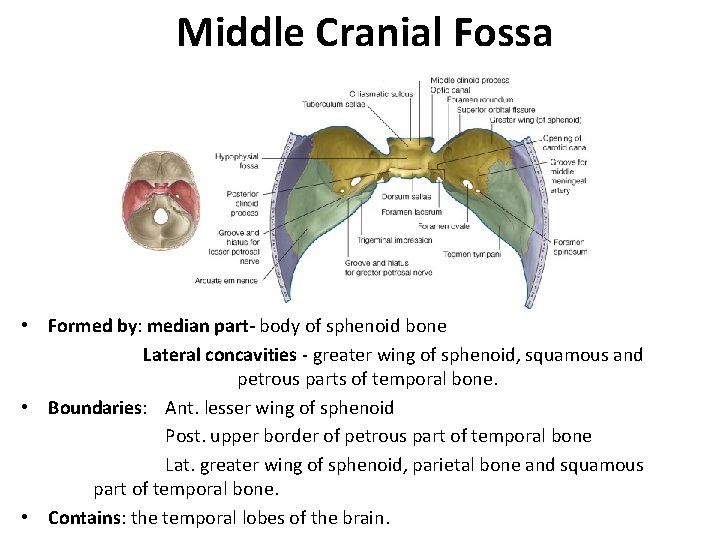
Middle Cranial Fossa • Formed by: median part- body of sphenoid bone Lateral concavities - greater wing of sphenoid, squamous and petrous parts of temporal bone. • Boundaries: Ant. lesser wing of sphenoid Post. upper border of petrous part of temporal bone Lat. greater wing of sphenoid, parietal bone and squamous part of temporal bone. • Contains: the temporal lobes of the brain.

Middle Cranial Fossa • Features: (7 foramina, median part, petrous part of temporal bone) 1 - Optic Canal: (ophthalmic a. & optic nerve) ―→ to the orbit. 2 - Superior orbital fissure: (superior ophthalmic vein, lacrimal, frontal, nasocilliary, Abducent, Oclomotor & Trochlear nerves) ―→ to the orbital cavity. 3 - Foramen rotundum: (maxillary branch of Trigeminal (V) nerve) ―→ to the pterygo-palatine fossa. 4 - Foramen ovale: (mandibular branch (sensory & motor) of trigeminal (V) nerve & the lesser petrosal nerve) ―→ to the infratemporal fossa.
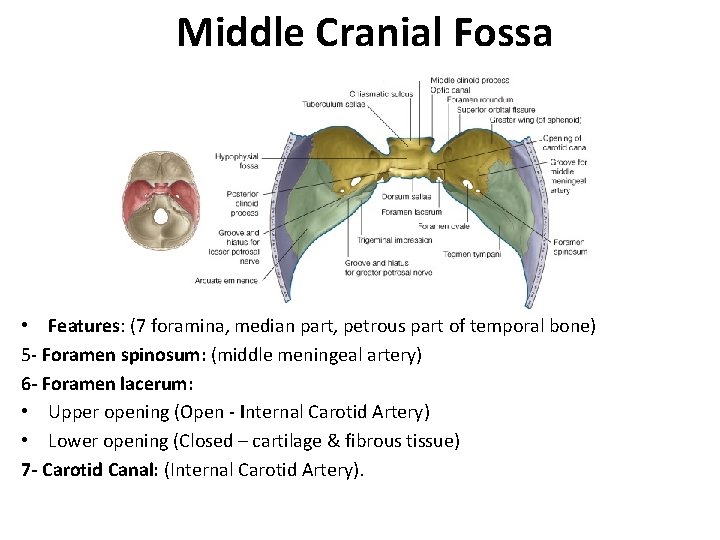
Middle Cranial Fossa • Features: (7 foramina, median part, petrous part of temporal bone) 5 - Foramen spinosum: (middle meningeal artery) 6 - Foramen lacerum: • Upper opening (Open - Internal Carotid Artery) • Lower opening (Closed – cartilage & fibrous tissue) 7 - Carotid Canal: (Internal Carotid Artery).
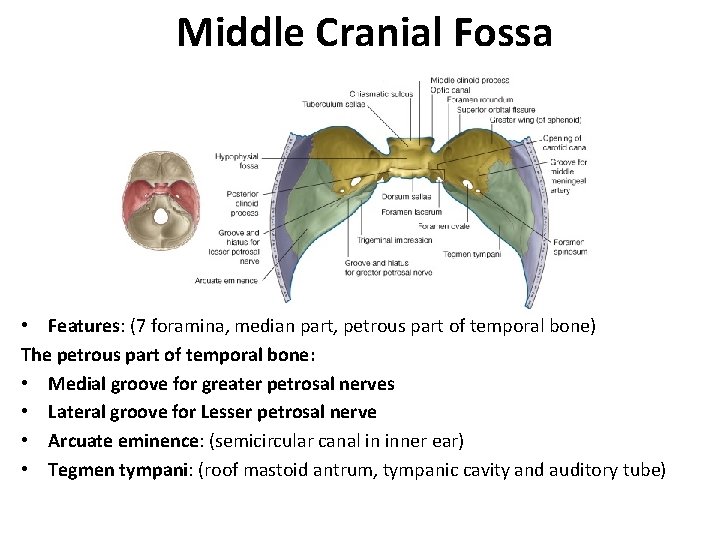
Middle Cranial Fossa • Features: (7 foramina, median part, petrous part of temporal bone) The petrous part of temporal bone: • Medial groove for greater petrosal nerves • Lateral groove for Lesser petrosal nerve • Arcuate eminence: (semicircular canal in inner ear) • Tegmen tympani: (roof mastoid antrum, tympanic cavity and auditory tube)
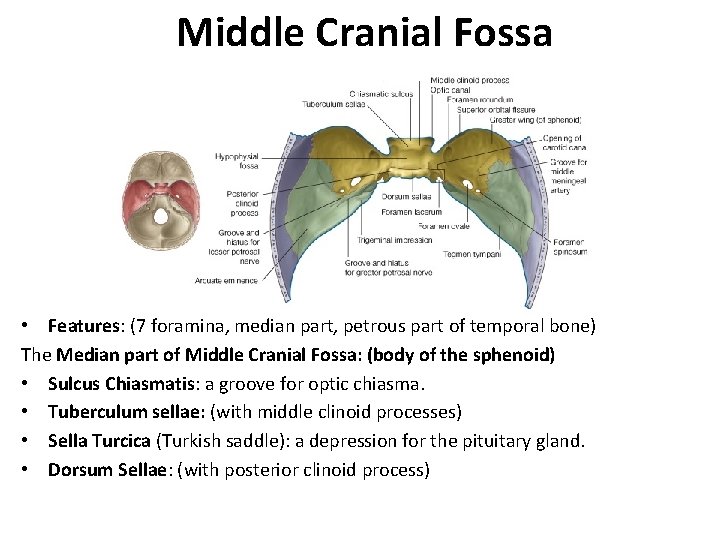
Middle Cranial Fossa • Features: (7 foramina, median part, petrous part of temporal bone) The Median part of Middle Cranial Fossa: (body of the sphenoid) • Sulcus Chiasmatis: a groove for optic chiasma. • Tuberculum sellae: (with middle clinoid processes) • Sella Turcica (Turkish saddle): a depression for the pituitary gland. • Dorsum Sellae: (with posterior clinoid process)
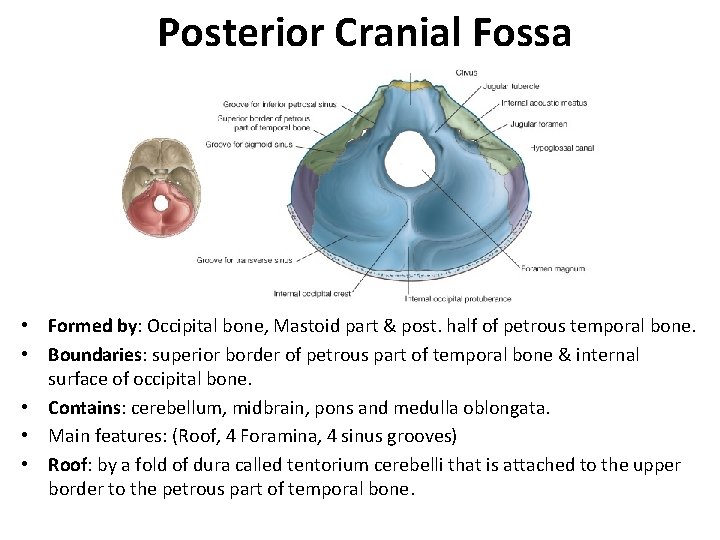
Posterior Cranial Fossa • Formed by: Occipital bone, Mastoid part & post. half of petrous temporal bone. • Boundaries: superior border of petrous part of temporal bone & internal surface of occipital bone. • Contains: cerebellum, midbrain, pons and medulla oblongata. • Main features: (Roof, 4 Foramina, 4 sinus grooves) • Roof: by a fold of dura called tentorium cerebelli that is attached to the upper border to the petrous part of temporal bone.

Posterior Cranial Fossa • Foramina: 1 - Foramen Magnum: (Medulla Oblongata, Vertebral arteries and ascending roots of accessary cranial nerve). 2 - Hypoglossal canal: (Hypoglossal nerve) 3 - Jugular foramen: (Inferior petrosal sinus, cranial nerves 9, 10 & 11 and sigmoid sinus). 4 - Internal acoustic canal : (Vestibulo-cochlear nerve & Facial nerve)
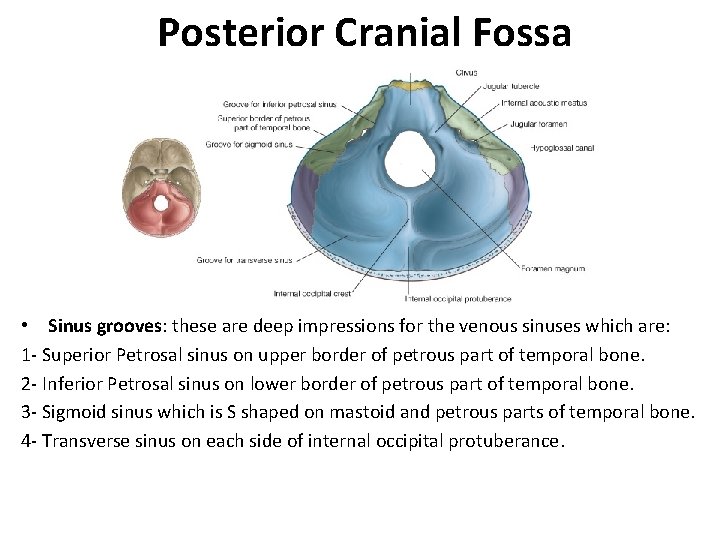
Posterior Cranial Fossa • Sinus grooves: these are deep impressions for the venous sinuses which are: 1 - Superior Petrosal sinus on upper border of petrous part of temporal bone. 2 - Inferior Petrosal sinus on lower border of petrous part of temporal bone. 3 - Sigmoid sinus which is S shaped on mastoid and petrous parts of temporal bone. 4 - Transverse sinus on each side of internal occipital protuberance.

Bones of the Neck 1 - Cervical Vertebrae (Spines) 2 - Hyoid bone:
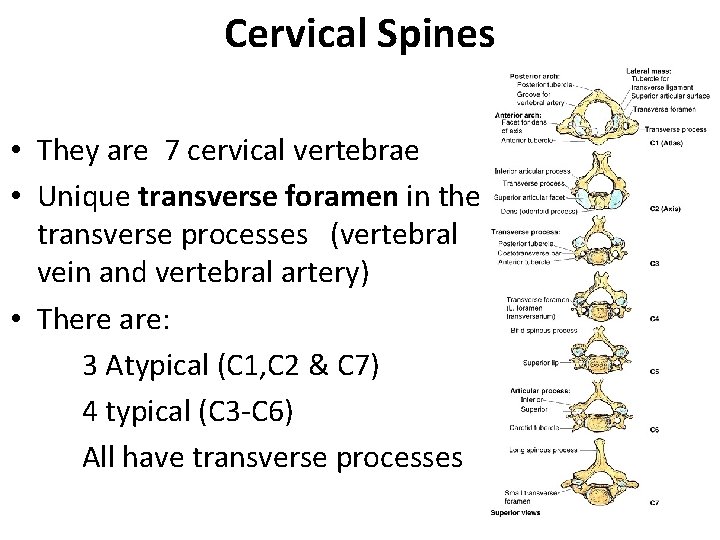
Cervical Spines • They are 7 cervical vertebrae • Unique transverse foramen in the transverse processes (vertebral vein and vertebral artery) • There are: 3 Atypical (C 1, C 2 & C 7) 4 typical (C 3 -C 6) All have transverse processes
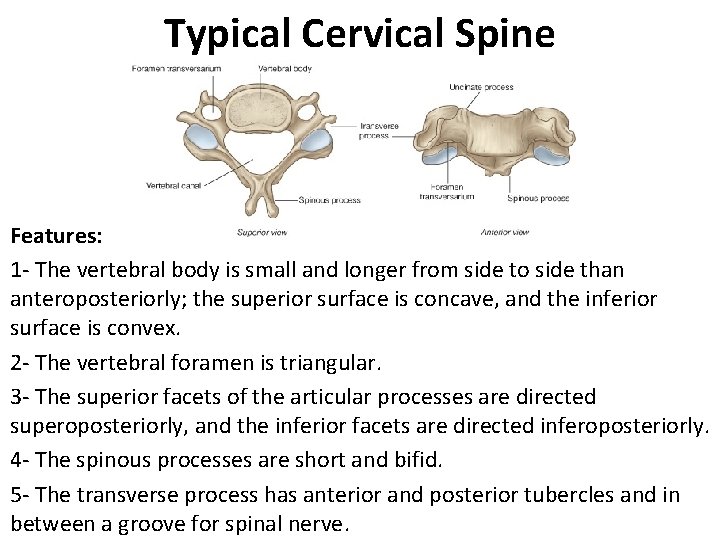
Typical Cervical Spine Features: 1 - The vertebral body is small and longer from side to side than anteroposteriorly; the superior surface is concave, and the inferior surface is convex. 2 - The vertebral foramen is triangular. 3 - The superior facets of the articular processes are directed superoposteriorly, and the inferior facets are directed inferoposteriorly. 4 - The spinous processes are short and bifid. 5 - The transverse process has anterior and posterior tubercles and in between a groove for spinal nerve.
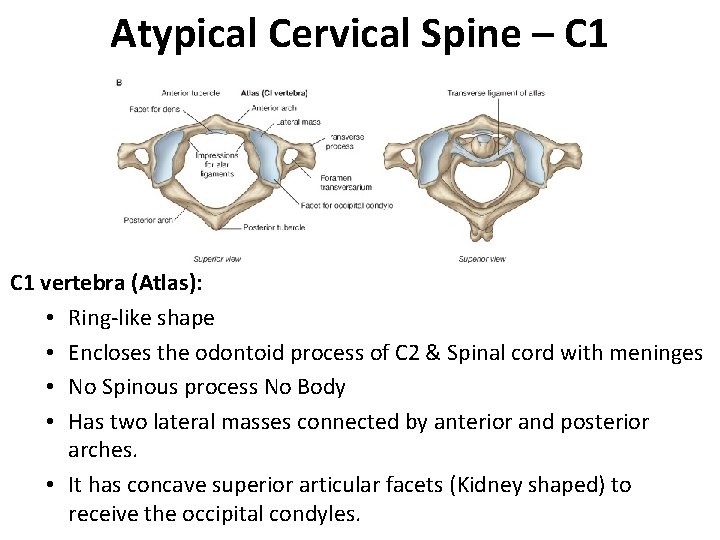
Atypical Cervical Spine – C 1 vertebra (Atlas): • Ring-like shape • Encloses the odontoid process of C 2 & Spinal cord with meninges • No Spinous process No Body • Has two lateral masses connected by anterior and posterior arches. • It has concave superior articular facets (Kidney shaped) to receive the occipital condyles.
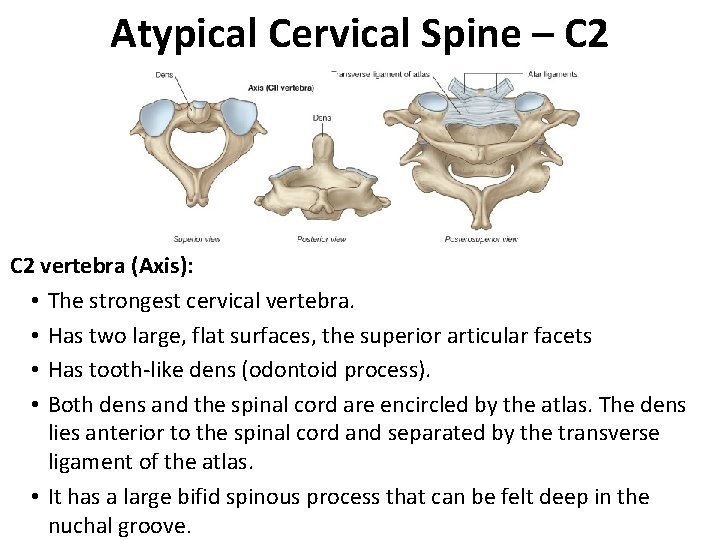
Atypical Cervical Spine – C 2 vertebra (Axis): • The strongest cervical vertebra. • Has two large, flat surfaces, the superior articular facets • Has tooth-like dens (odontoid process). • Both dens and the spinal cord are encircled by the atlas. The dens lies anterior to the spinal cord and separated by the transverse ligament of the atlas. • It has a large bifid spinous process that can be felt deep in the nuchal groove.

Atypical Cervical Spine – C 7 vertebra: – It has long spinous process, which is not bifid. – Its transverse processes are large and directed downward which allow differentiation from T 1 Spine that has upward directed transverse process.

Hyoid Bone • It is a U-shaped bone that lies in the anterior part of the neck (@ level of the C 3) • It is suspended by muscles that connect it to: • Mandible by mylohyoid, genohyoid &digastric muscles • Styloid processes by stylohyoid muscle and ligament • Thyroid cartilage by thyrohyoid muscle • Manubrium by sternohyoid muscle • Scapulae by omohyoid muscle • The hyoid does not articulate with any other bone. • The hyoid consists of a body, greater and lesser horns. • Functionally, the hyoid serves as an attachment for anterior neck muscles and a prop to keep the airway open.
Good Luck
- Slides: 20