
The Craft of Scientific Writing Michael Alley Springer

- Slides: 17
The Craft of Scientific Writing Michael Alley Springer, 3 rd edition, 1996 Summary by: Jay Fenwick
Outline • Difficulties – Complexity of subject and language • Constraints – Audience, Format, Mechanics, Politics • Tools – Structure • Organization: Beginnings, Middles, Ends • Transitions, Depth – Language • Being Precise, Clear, Fluid, Straightforward – Illustration
Difficulties • Complexity of subject matter • Circuit board construction • Virtual memory mechanism • Data link network layer protocols • Complexity of language • TCP • Page fault • Finite state machine
Constraints • Audience dictates: • Words you define, illustrations you use, depth • YOUR AUDIENCE: CS major ready for 3481 • Format • 7 -10 double spaced pages, 1” margins • Cover & bibliography pages (not part of page limit) • At least 5 references (numerical reference in text) – Example: This can result in exponential growth. [1]
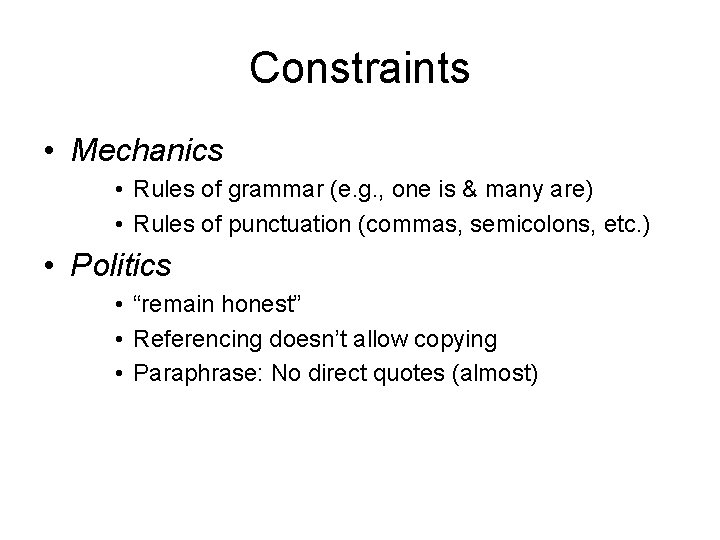
Constraints • Mechanics • Rules of grammar (e. g. , one is & many are) • Rules of punctuation (commas, semicolons, etc. ) • Politics • “remain honest” • Referencing doesn’t allow copying • Paraphrase: No direct quotes (almost)
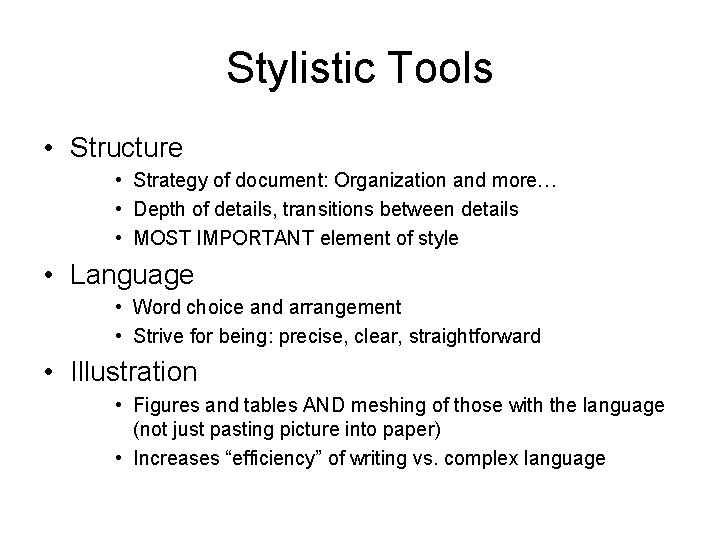
Stylistic Tools • Structure • Strategy of document: Organization and more… • Depth of details, transitions between details • MOST IMPORTANT element of style • Language • Word choice and arrangement • Strive for being: precise, clear, straightforward • Illustration • Figures and tables AND meshing of those with the language (not just pasting picture into paper) • Increases “efficiency” of writing vs. complex language
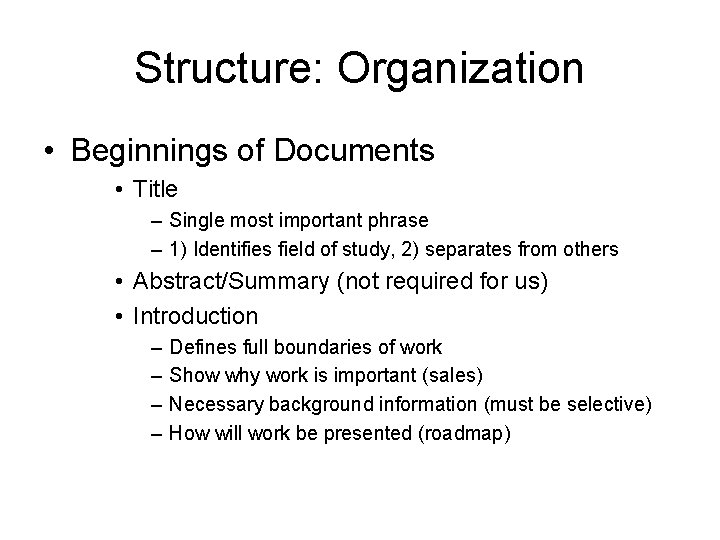
Structure: Organization • Beginnings of Documents • Title – Single most important phrase – 1) Identifies field of study, 2) separates from others • Abstract/Summary (not required for us) • Introduction – – Defines full boundaries of work Show why work is important (sales) Necessary background information (must be selective) How will work be presented (roadmap)
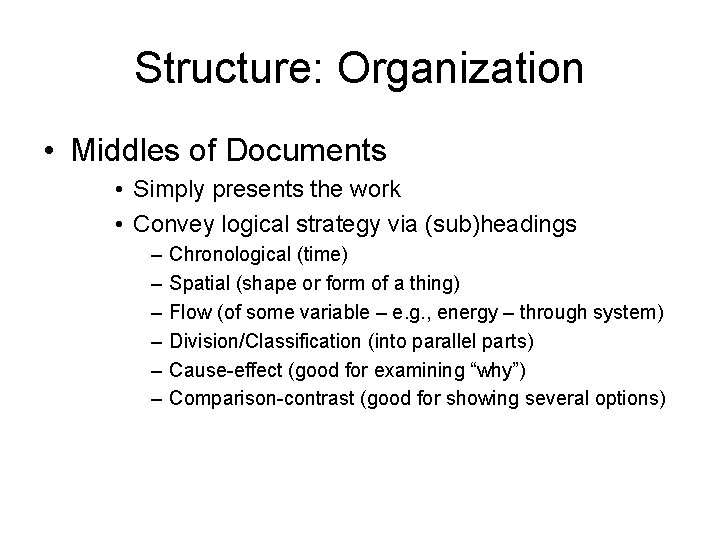
Structure: Organization • Middles of Documents • Simply presents the work • Convey logical strategy via (sub)headings – – – Chronological (time) Spatial (shape or form of a thing) Flow (of some variable – e. g. , energy – through system) Division/Classification (into parallel parts) Cause-effect (good for examining “why”) Comparison-contrast (good for showing several options)
Structure: Organization • Ends of Documents • Analyze key results (from middle!) – Results as a whole, not individually (that’s in middle) – No new findings!! • Perspective of future impacts/work • Bibliography: – Author(s), “Title, ” Publication, detail (e. g. , pages, dates, etc. )
Structure: Transition, Depth, Emphasis • Handling of details – Handout – A sentence is a single statement; a paragraph is a logical ordering of related statements; a section is a logical ordering of related paragraphs, etc. – Sentences have to transition well from one to the next. So do paragraphs. So do sections.
Language: Being Precise • Choosing the right word • • its/it’s: it’s = it is; its = possessive (e. g. , its height) exponential: not all rapid growth is exponential “centers around”: an oxymoron Beware overuse of synonyms (dictionary preferred over thesaurus!) • Level of Detail • Balance between general statements and specific details • Don’t overwhelm with details, select details that inform.
Language: Being Clear • Needless Complexity • Words: utilize vs. use • Phrases: too many adjectives • Sentences: too long (beware Dick & Jane though!) • Ambiguity • Word placement: Only I tested the bell jar for leaks today. • Pronouns: There should be NO DOUBT as to what the pronoun refers. • Punctuation (esp. comma)
Language: Being Fluid • Vary sentence “rhythms” • Avoid sentences that: all begin the same way, have the same length, have same arrangement of nouns, verbs, phrases. • Vary sentence structure: • Simple sentences • Compound sentences (2 independent parts) … and … • “Complex” sentences (1 independent, 1 dependent part): “Although …, the …”
Language: Being Fluid • Transitions between ideas: • Same direction: also, moreover, first-second-third • Pause: for instance, for example, in other words • Opposite direction: however, on the other hand • Vary sentence and paragraph length
Language: Being Straightforward • Purpose is to inform – be sincere • Simple, not pretentious, words and phrases: dihydrogen monoxide, “of course” • Avoid silliness and cliches: “come up to speed” • Use concrete nouns and active verbs; • • avoid noun and verb “phrases” “computer modeling capabilities” (computer models) “made the decision” (decided) Passive-to-active: flip subject and object “The voltage was displayed on the oscilloscope. ”
Summary • Difficulties: Complexity of subject and language • Constraints: Audience, Format, Mechanics, Politics • Tools – Structure: Organization • Beginnings: full scope, sales title • Middles: logical strategy (e. g. , chronological, cause-effect) • Ends: no new results, future – Structure: Transitions: Handout, s 2 s, p 2 p – Language • Needless complexity, right word, detail level/balance, sentence rhythms/structure/transition, straightforward – Illustration