
The CPR Life Links Implementation Toolkit CPR LIFELINKS

- Slides: 23
The CPR Life. Links Implementation Toolkit
CPR LIFELINKS A national initiative to unite EMS and 9 -1 -1 agencies to improve survival rates in their communities by implementing Telecommunicator CPR and High Performance CPR
EARLY INTERVENTION SAVES LIVES Out-of-hospital cardiac arrest (OHCA) is the severe malfunction or cessation of the electrical and mechanical activity of the heart. • 250, 000 estimated OHCAs in the U. S. every year • Likelihood of patient survival decreases 7 -10% per minute without CPR. • • The average national survival rate hovers around 10% and increases to 30% in cases when first responders find patient in ventricular fibrillation (VF), the shockable rhythm usually associated with arrest onset.
“Benchmark communities and healthcare systems demonstrate that the ability to save more lives is possible. ” National Academy of Medicine
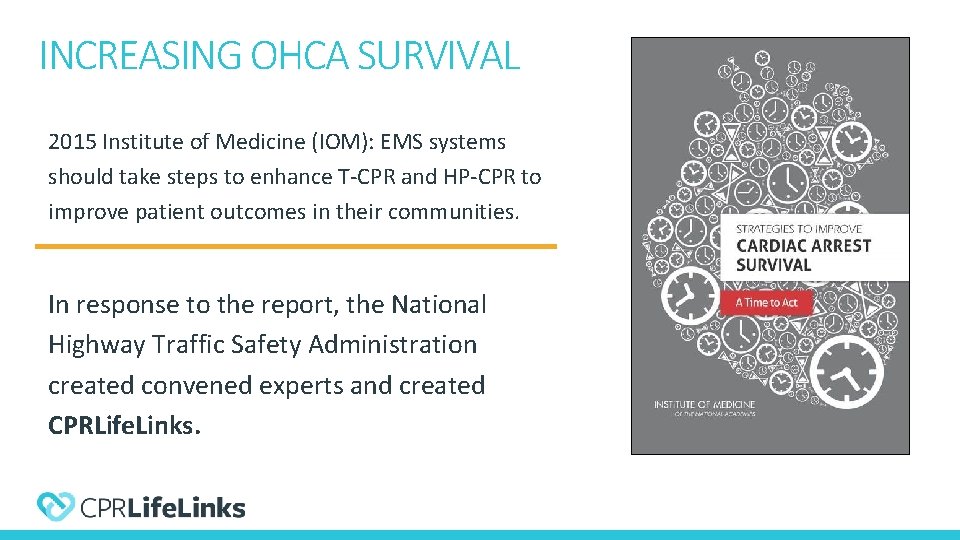
INCREASING OHCA SURVIVAL 2015 Institute of Medicine (IOM): EMS systems should take steps to enhance T-CPR and HP-CPR to improve patient outcomes in their communities. In response to the report, the National Highway Traffic Safety Administration created convened experts and created CPRLife. Links. 9 -1 -1 and EMS United to Save More Lives ems. gov | 911. gov
RECOMMENDATION #3 • Enhance the Capabilities and Performance of EMS Systems • NHTSA should coordinate with other federal agencies and representatives from private industry, states, professional organizations, first responders, EMS systems, and nonprofit organizations to convene interested stakeholders: • To develop standardized Telecommunicator-Assisted CPR protocols and national educational standards for use by all PSAPs • To establish a standardized definition and training curriculum for High-Performance CPR to be used in basic emergency medical technician training and certification
IMPLEMENTATIO N TOOLKIT Complete package of cognitive and hands-on training and assessment tools with audiovisual demonstrations and case studies. The CPR Life. Links Implementation Toolkit is a how-to guide for EMS and 911 agencies interested in implementing programs to improve cardiac arrest survival rates in communities across the nation. A practical roadmap to help: ü 9 -1 -1 agencies implement Telecommunicator-CPR protocols, training and QI ü EMS agencies implement High-Performance CPR programs 9 -1 -1 and EMS United to Save More Lives ems. gov | 911. gov
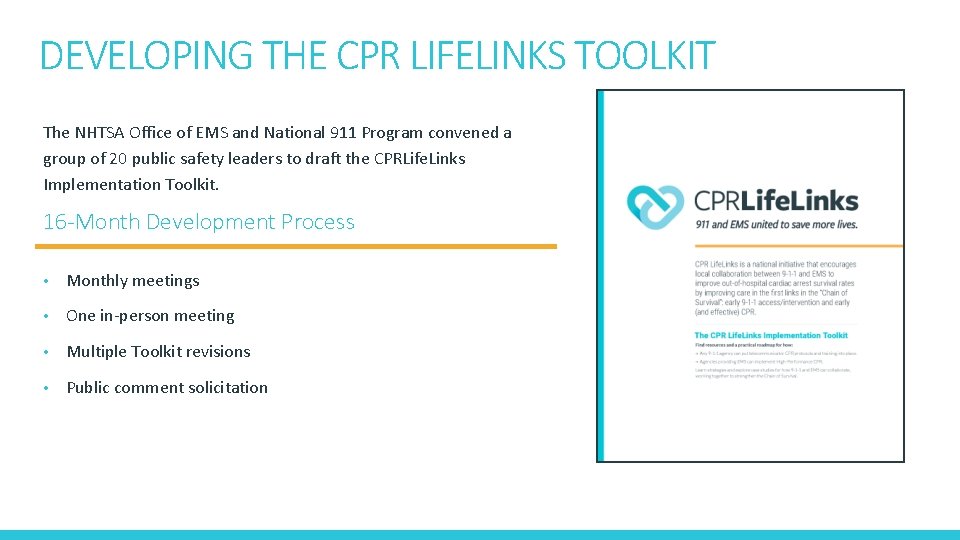
DEVELOPING THE CPR LIFELINKS TOOLKIT The NHTSA Office of EMS and National 911 Program convened a group of 20 public safety leaders to draft the CPRLife. Links Implementation Toolkit. 16 -Month Development Process • Monthly meetings • One in-person meeting • Multiple Toolkit revisions • Public comment solicitation
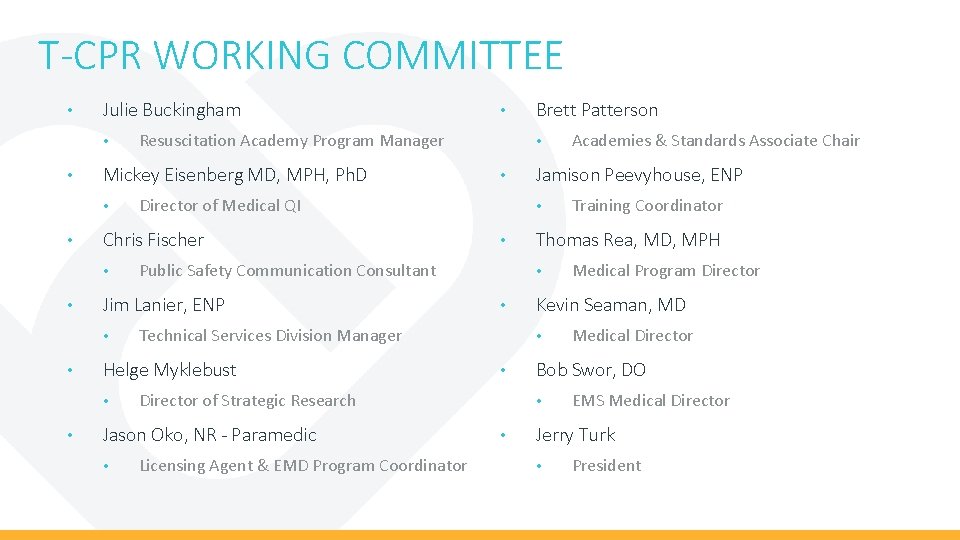
T-CPR WORKING COMMITTEE • Julie Buckingham • • Licensing Agent & EMD Program Coordinator Medical Director Bob Swor, DO • • Medical Program Director Kevin Seaman, MD • • Training Coordinator Thomas Rea, MD, MPH • Director of Strategic Research Jason Oko, NR - Paramedic • • Academies & Standards Associate Chair Jamison Peevyhouse, ENP • Technical Services Division Manager Helge Myklebust • • Public Safety Communication Consultant Jim Lanier, ENP Brett Patterson • Director of Medical QI Chris Fischer • • Resuscitation Academy Program Manager Mickey Eisenberg MD, MPH, Ph. D • • EMS Medical Director Jerry Turk • President
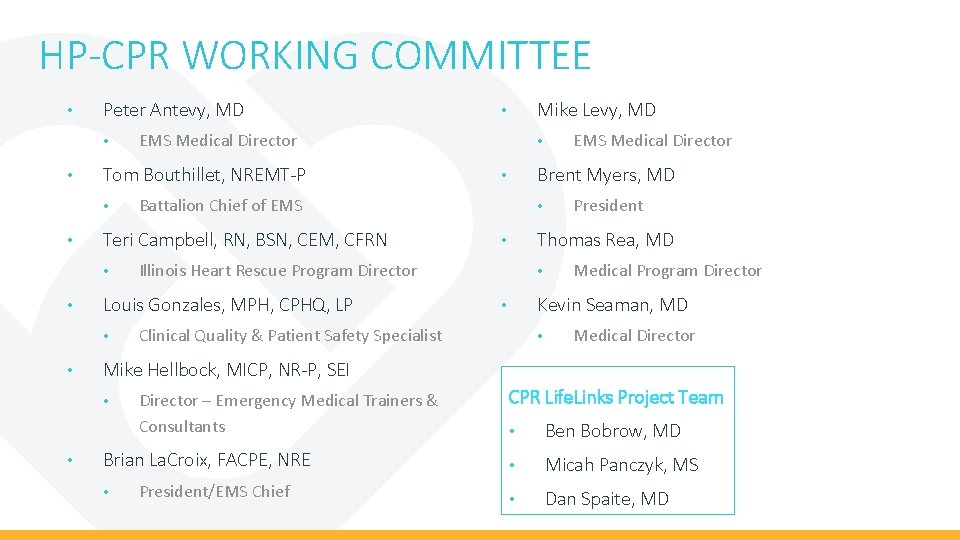
HP-CPR WORKING COMMITTEE • Peter Antevy, MD • • • President Thomas Rea, MD • • Medical Program Director Kevin Seaman, MD • Clinical Quality & Patient Safety Specialist • Medical Director Mike Hellbock, MICP, NR-P, SEI • • EMS Medical Director Brent Myers, MD • Illinois Heart Rescue Program Director Louis Gonzales, MPH, CPHQ, LP • • Battalion Chief of EMS Teri Campbell, RN, BSN, CEM, CFRN • • EMS Medical Director Tom Bouthillet, NREMT-P • Mike Levy, MD • Director – Emergency Medical Trainers & Consultants Brian La. Croix, FACPE, NRE • President/EMS Chief CPR Life. Links Project Team • Ben Bobrow, MD • Micah Panczyk, MS • Dan Spaite, MD
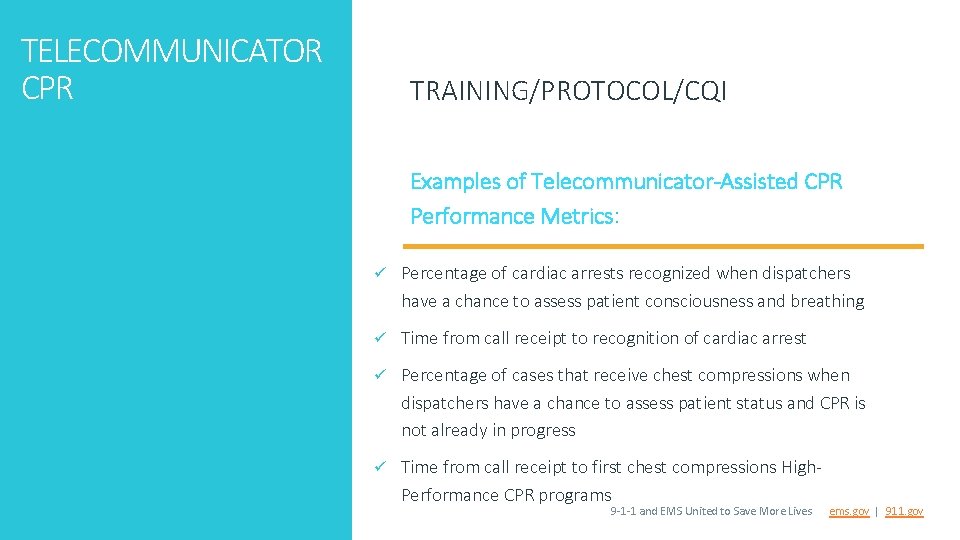
TELECOMMUNICATOR CPR TRAINING/PROTOCOL/CQI Examples of Telecommunicator-Assisted CPR Performance Metrics: ü Percentage of cardiac arrests recognized when dispatchers have a chance to assess patient consciousness and breathing ü Time from call receipt to recognition of cardiac arrest ü Percentage of cases that receive chest compressions when dispatchers have a chance to assess patient status and CPR is not already in progress ü Time from call receipt to first chest compressions High. Performance CPR programs 9 -1 -1 and EMS United to Save More Lives ems. gov | 911. gov
WHAT’S INSIDE: Two “Linked” Training Chapters PART 1: Telecommunicator CPR (T-CPR) • Section 1: Overview • Section 2: The Commitment to Act: Challenges and Perspectives • Section 3: AHA T-CPR Program and Performance Recommendations • Section 4: Protocols • Section 5: Telecommunicator Training • Section 6: Achieving a T-CPR Culture of Excellence PART 2: High-Performance CPR (HP-CPR) • Section 1: Overview • Section 2: The Commitment to Act: Challenges and Perspectives • Section 3: Performance Recommendations • Section 4: Common CPR Quality Issues • Section 5: Training • Section 6: Achieving a HP-CPR Culture of Excellence
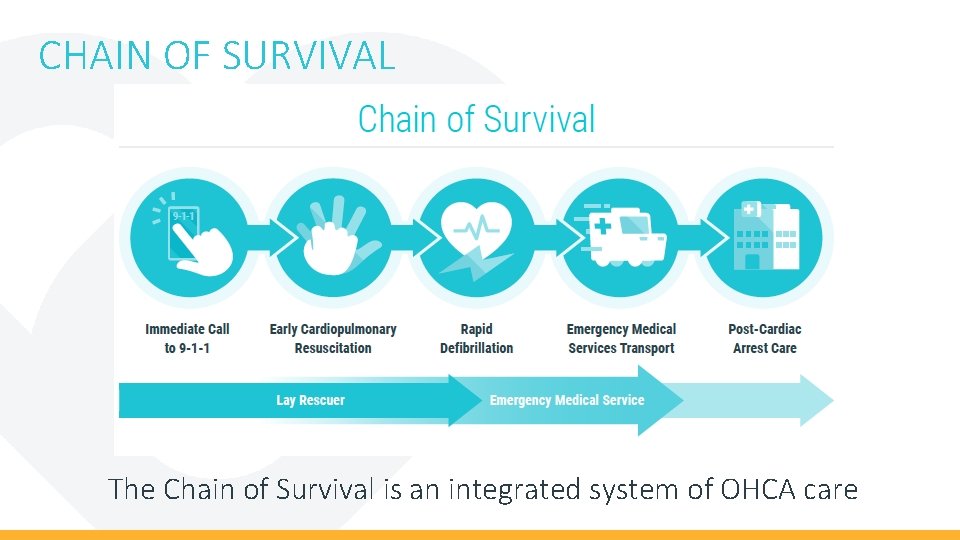
CHAIN OF SURVIVAL The Chain of Survival is an integrated system of OHCA care
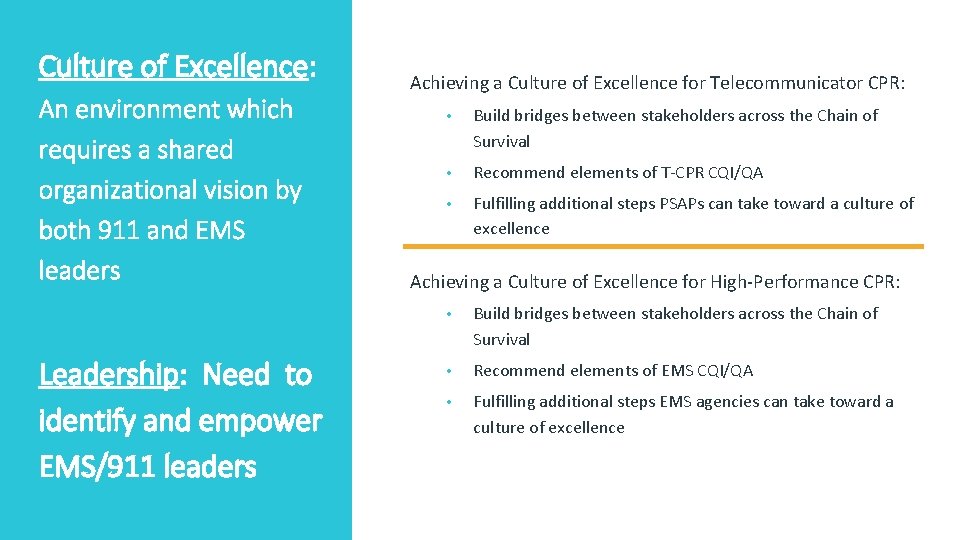
Culture of Excellence: An environment which requires a shared organizational vision by both 911 and EMS leaders Leadership: Need to identify and empower EMS/911 leaders Achieving a Culture of Excellence for Telecommunicator CPR: • Build bridges between stakeholders across the Chain of Survival • Recommend elements of T-CPR CQI/QA • Fulfilling additional steps PSAPs can take toward a culture of excellence Achieving a Culture of Excellence for High-Performance CPR: • Build bridges between stakeholders across the Chain of Survival • Recommend elements of EMS CQI/QA • Fulfilling additional steps EMS agencies can take toward a culture of excellence 9 -1 -1 and EMS United to Save More Lives ems. gov | 911. gov
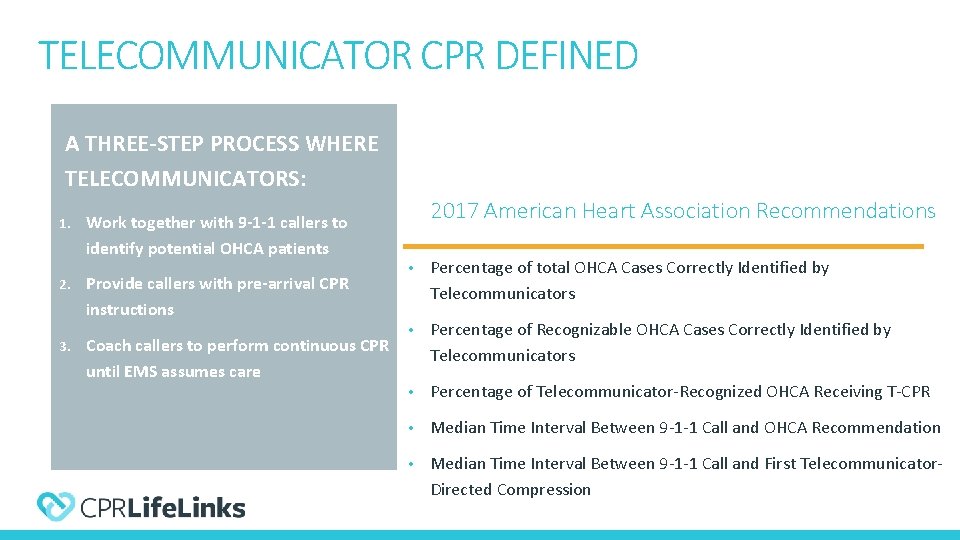
TELECOMMUNICATOR CPR DEFINED A THREE-STEP PROCESS WHERE TELECOMMUNICATORS: 1. 2. 3. 2017 American Heart Association Recommendations Work together with 9 -1 -1 callers to identify potential OHCA patients Provide callers with pre-arrival CPR instructions Coach callers to perform continuous CPR until EMS assumes care • Percentage of total OHCA Cases Correctly Identified by Telecommunicators • Percentage of Recognizable OHCA Cases Correctly Identified by Telecommunicators • Percentage of Telecommunicator-Recognized OHCA Receiving T-CPR • Median Time Interval Between 9 -1 -1 Call and OHCA Recommendation • Median Time Interval Between 9 -1 -1 Call and First Telecommunicator. Directed Compression 9 -1 -1 and EMS United to Save More Lives ems. gov | 911. gov
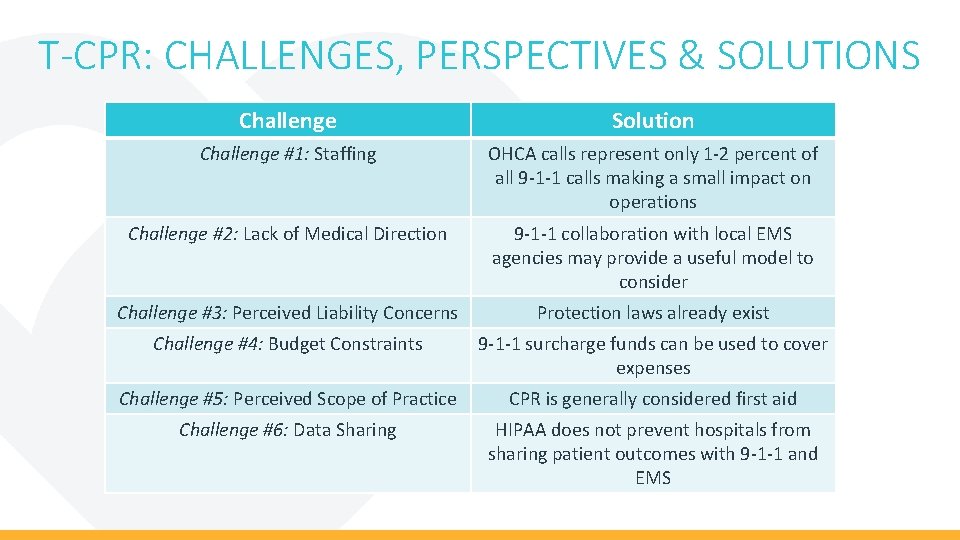
T-CPR: CHALLENGES, PERSPECTIVES & SOLUTIONS Challenge Solution Challenge #1: Staffing OHCA calls represent only 1 -2 percent of all 9 -1 -1 calls making a small impact on operations Challenge #2: Lack of Medical Direction 9 -1 -1 collaboration with local EMS agencies may provide a useful model to consider Challenge #3: Perceived Liability Concerns Protection laws already exist Challenge #4: Budget Constraints 9 -1 -1 surcharge funds can be used to cover expenses Challenge #5: Perceived Scope of Practice CPR is generally considered first aid Challenge #6: Data Sharing HIPAA does not prevent hospitals from sharing patient outcomes with 9 -1 -1 and EMS
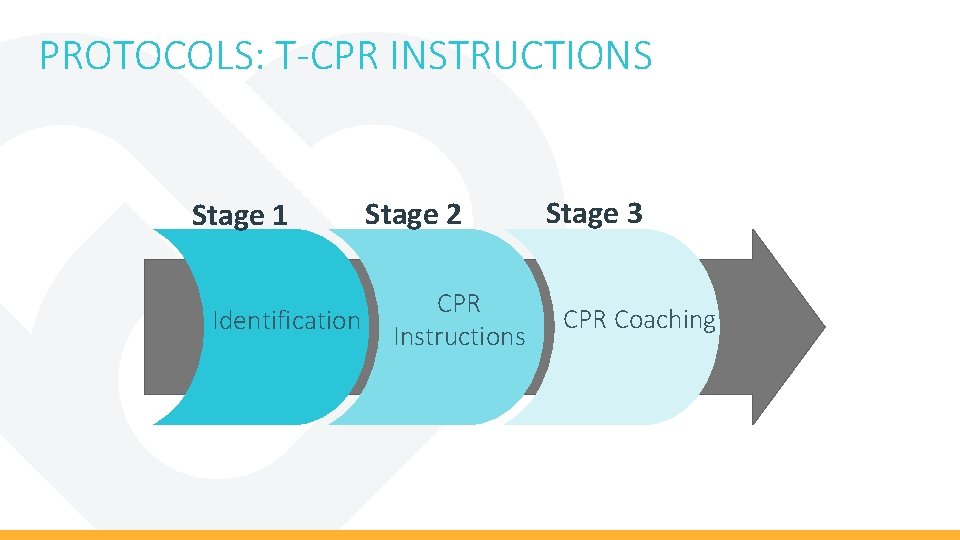
PROTOCOLS: T-CPR INSTRUCTIONS Stage 1 Identification Stage 2 CPR Instructions Stage 3 CPR Coaching
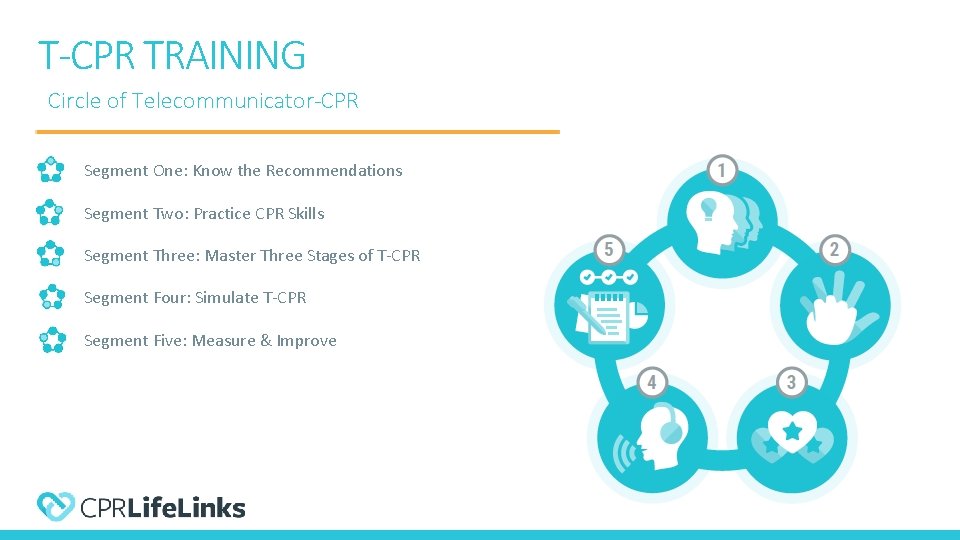
T-CPR TRAINING Circle of Telecommunicator-CPR • Segment One: Know the Recommendations • Segment Two: Practice CPR Skills • Segment Three: Master Three Stages of T-CPR • Segment Four: Simulate T-CPR • Segment Five: Measure & Improve 9 -1 -1 and EMS United to Save More Lives ems. gov | 911. gov
HIGH-PERFORMANCE CPR DEFINED An expertly performed, choreographed and measured OHCA response consisting of individual and team performance that meets or exceeds current evidence-based performance recommendations. GUIDELINE RECOMMENDATIONS Should all be optimized for ALL adult and pediatric resuscitations • Chest compression fraction • Compression depth • Compression rate • Compression release • Compression pauses 9 -1 -1 and EMS United to Save More Lives ems. gov | 911. gov
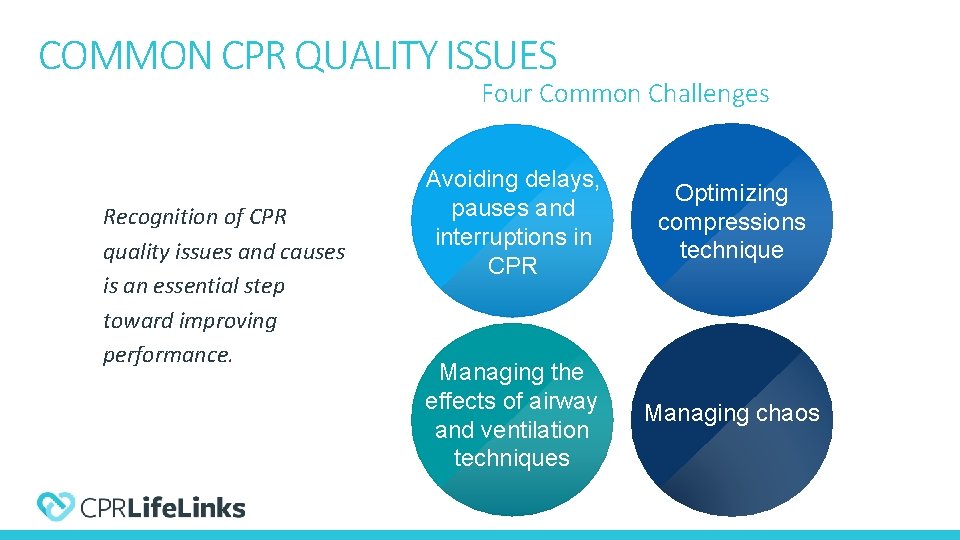
COMMON CPR QUALITY ISSUES Four Common Challenges Recognition of CPR quality issues and causes is an essential step toward improving performance. Avoiding delays, pauses and interruptions in CPR Optimizing compressions technique Managing the effects of airway and ventilation techniques Managing chaos 9 -1 -1 and EMS United to Save More Lives ems. gov | 911. gov
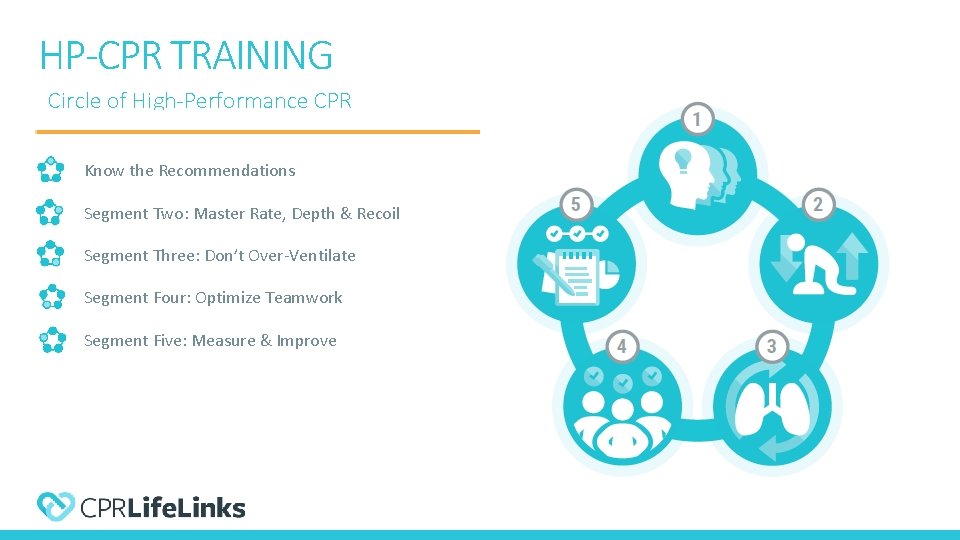
HP-CPR TRAINING Circle of High-Performance CPR • Know the Recommendations • Segment Two: Master Rate, Depth & Recoil • Segment Three: Don’t Over-Ventilate • Segment Four: Optimize Teamwork • Segment Five: Measure & Improve 9 -1 -1 and EMS United to Save More Lives ems. gov | 911. gov
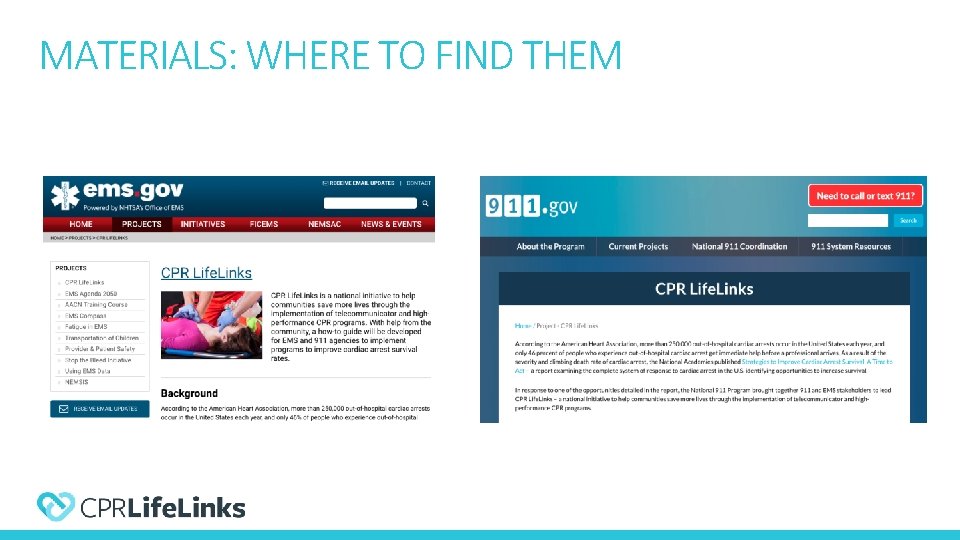
MATERIALS: WHERE TO FIND THEM 9 -1 -1 and EMS United to Save More Lives ems. gov | 911. gov
WHAT YOU CAN DO • Build a relationship between your 911 center and EMS agency – start the CPR dialogue. • Download the CPR Life. Links Toolkit – available on ems. gov and 911. gov in Spring 2018. • Share the word about CPRLife. Links and the resources available. They can help any agency get started, regardless of size or location.