
The Course Outline of Record COR The Basics
The Course Outline of Record (COR): The Basics
Introductions Jim Bowen, Antelope Valley College, CTE Faculty, ASCCC Curriculum Committee Stephanie Curry, ASCCC North Representative Lisa Saperston, LACCD ESL Faculty, ASCCC Curriculum Committee 2

Breakout Summary The Course Outline of Record (COR) is the backbone of instruction in the California Community College system. This breakout will demystify all the elements of the COR, with information on which elements are required by California Education Code, California Code of Regulations (Title 5) and/or Code of Federal Regulations (and why) as well as suggestions about those elements that may not be required but which greatly enhance the quality and utility of your curriculum. This breakout is designed for people who are new to the curriculum process. 3
Importance of the COR: From ASCCC's 2017 paper, The Course Outline of Record: A Curriculum Reference Guide Revisited: "The course outline of record (COR) is a document with defined legal standing that plays a critical role in the curriculum of the California community colleges. " The COR "has both internal and external influences that impact all aspects of its content, from outcomes to teaching methodology, which, by extension, impact program development and program evaluation. "
Why is the COR so Important? • It is by reviewing the course outline that the various instructors, both full - and part-time, may clearly identify the standards and content of the course they are to teach. In addition, the course outline plays a critical role in the on-going process of program review by which a college seeks to keep its curriculum relevant and to allocate its resources sufficiently to maintain its programs. • Although the outline is not intended to dictate instructional methods and materials, it should delineate an agreed upon set of learning objectives which are central to the course in that they (1) determine the desired student learning outcomes of the course and (2) establish a basis for evaluating and assessing student performance. The Course Outline of Record is used for all courses. 5 5
Equity and the COR • • • Curriculum review and revision should be at the heart of equity work since is the foundation of the courses we teach Train and review curriculum through and equity minded framework Ask questions or dialog about textbooks, objectives, outcomes, content outlines, and sample assignments. Make disaggregated equity data part of your curricular review Support and provide professional development in culturally responsive teaching
Regulations and Resources Title 5 55002 Program and Course Approval Handbook (PCAH) 7 th edition ACCJC Standards C-ID Transfer institutions • CSU GE Articulation • UC Articulation
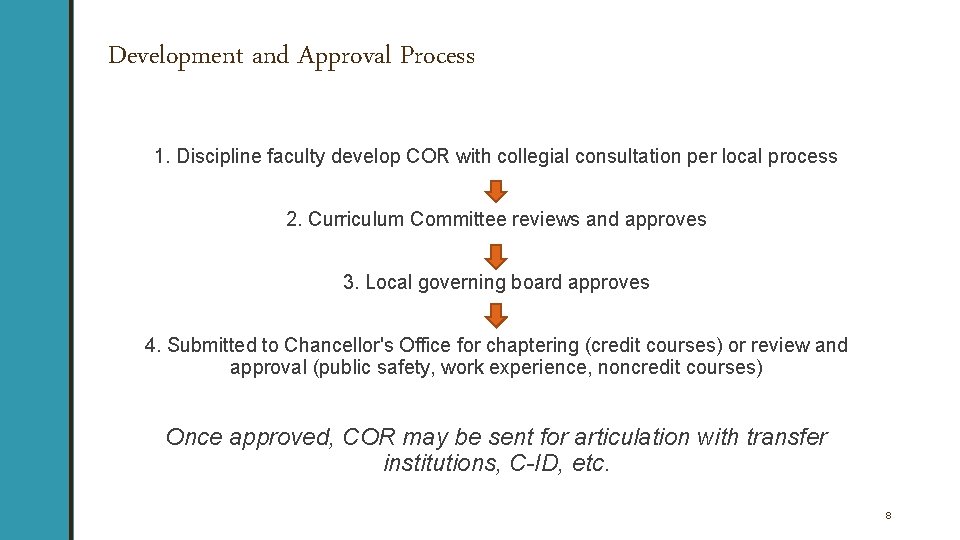
Development and Approval Process 1. Discipline faculty develop COR with collegial consultation per local process 2. Curriculum Committee reviews and approves 3. Local governing board approves 4. Submitted to Chancellor's Office for chaptering (credit courses) or review and approval (public safety, work experience, noncredit courses) Once approved, COR may be sent for articulation with transfer institutions, C-ID, etc. 8
Intended Audience • • Discipline faculty Curriculum committee and local Board College administration (program review and scheduling/assignment) Faculty and articulation officers from other institutions Employers, regional consortia, advisory boards ACCJC visiting teams CCCCO Students and the public
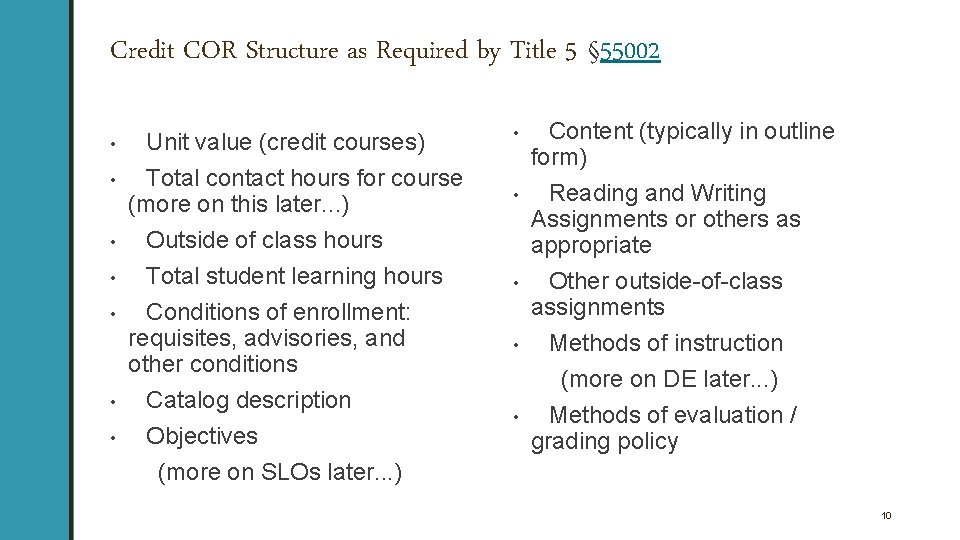
Credit COR Structure as Required by Title 5 § 55002 • • Unit value (credit courses) Total contact hours for course (more on this later. . . ) Outside of class hours Total student learning hours Conditions of enrollment: requisites, advisories, and other conditions Catalog description Objectives (more on SLOs later. . . ) • • • Content (typically in outline form) Reading and Writing Assignments or others as appropriate Other outside-of-class assignments Methods of instruction (more on DE later. . . ) Methods of evaluation / grading policy 10
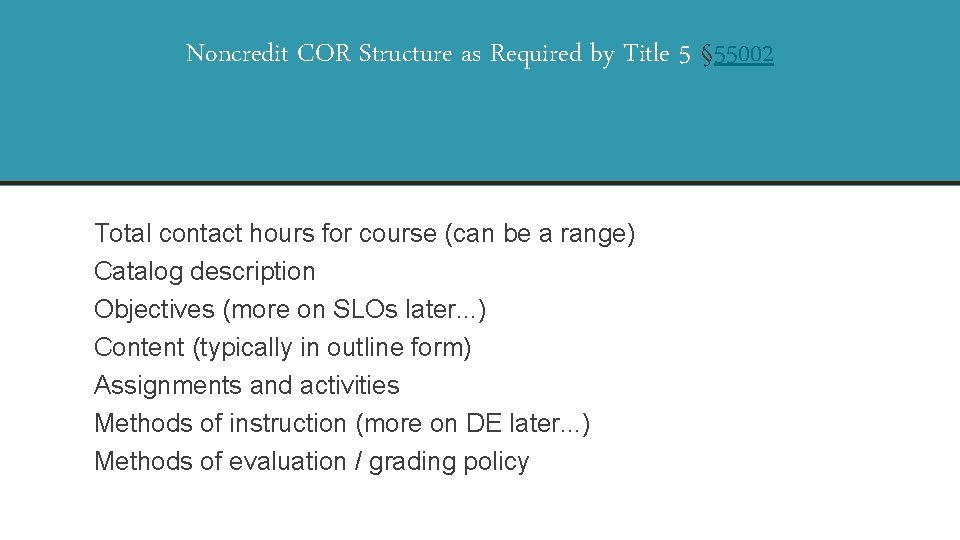
Noncredit COR Structure as Required by Title 5 § 55002 Total contact hours for course (can be a range) Catalog description Objectives (more on SLOs later. . . ) Content (typically in outline form) Assignments and activities Methods of instruction (more on DE later. . . ) Methods of evaluation / grading policy
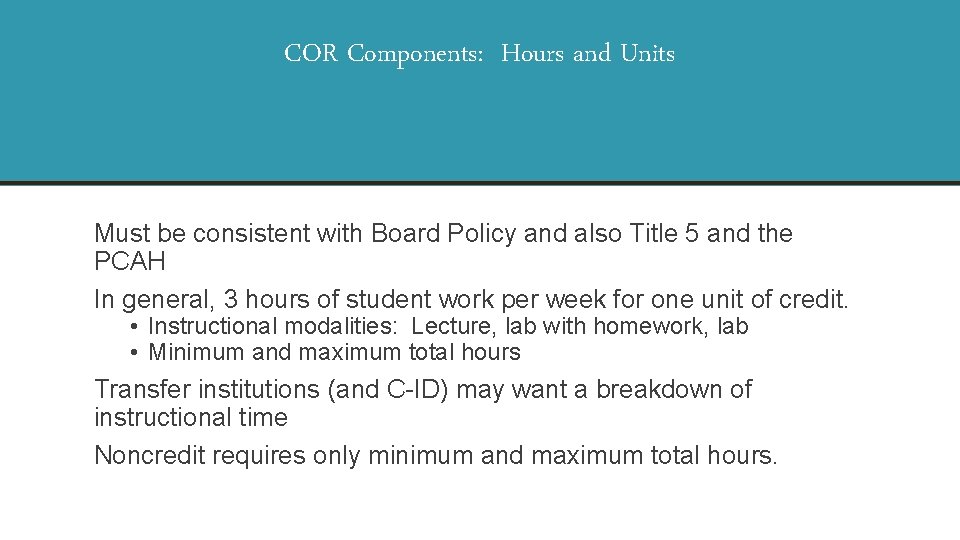
COR Components: Hours and Units Must be consistent with Board Policy and also Title 5 and the PCAH In general, 3 hours of student work per week for one unit of credit. • Instructional modalities: Lecture, lab with homework, lab • Minimum and maximum total hours Transfer institutions (and C-ID) may want a breakdown of instructional time Noncredit requires only minimum and maximum total hours.
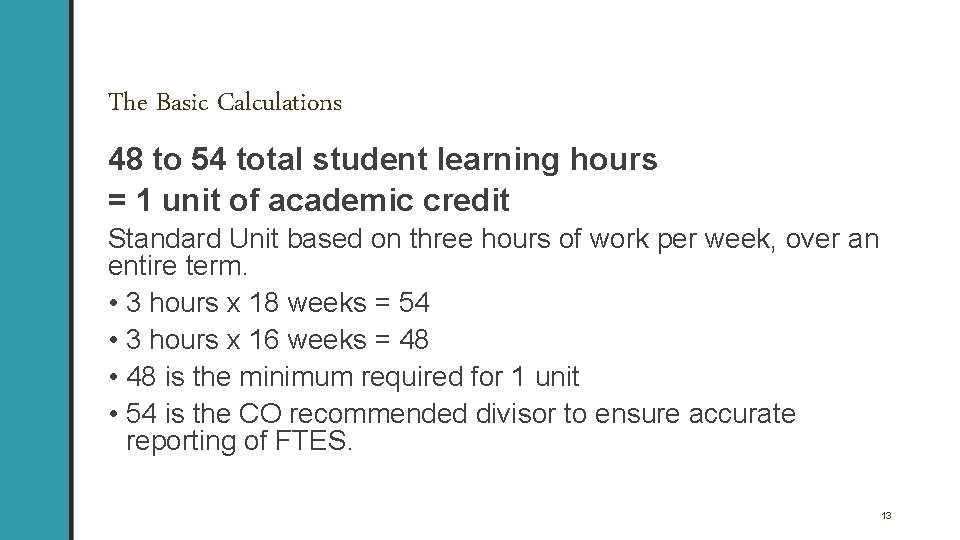
The Basic Calculations 48 to 54 total student learning hours = 1 unit of academic credit Standard Unit based on three hours of work per week, over an entire term. • 3 hours x 18 weeks = 54 • 3 hours x 16 weeks = 48 • 48 is the minimum required for 1 unit • 54 is the CO recommended divisor to ensure accurate reporting of FTES. 13
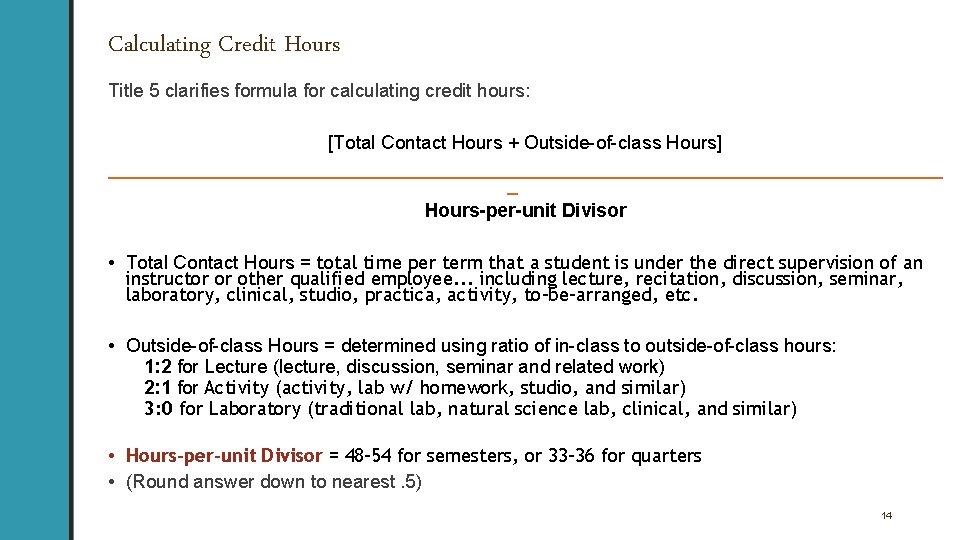
Calculating Credit Hours Title 5 clarifies formula for calculating credit hours: [Total Contact Hours + Outside-of-class Hours] ________________________________________ _ Hours-per-unit Divisor • Total Contact Hours = total time per term that a student is under the direct supervision of an instructor or other qualified employee. . . including lecture, recitation, discussion, seminar, laboratory, clinical, studio, practica, activity, to-be-arranged, etc. • Outside-of-class Hours = determined using ratio of in-class to outside-of-class hours: 1: 2 for Lecture (lecture, discussion, seminar and related work) 2: 1 for Activity (activity, lab w/ homework, studio, and similar) 3: 0 for Laboratory (traditional lab, natural science lab, clinical, and similar) • Hours-per-unit Divisor = 48 -54 for semesters, or 33 -36 for quarters • (Round answer down to nearest. 5) 14
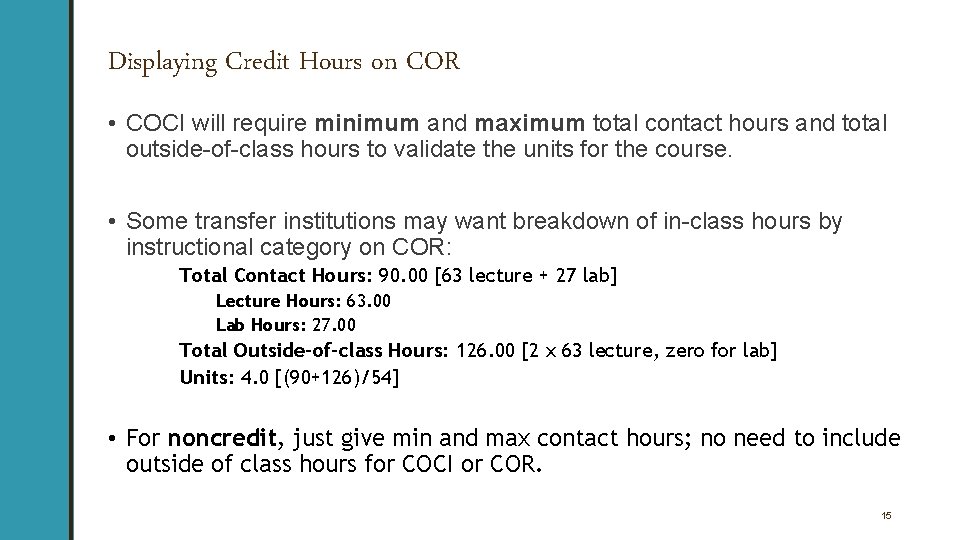
Displaying Credit Hours on COR • COCI will require minimum and maximum total contact hours and total outside-of-class hours to validate the units for the course. • Some transfer institutions may want breakdown of in-class hours by instructional category on COR: Total Contact Hours: 90. 00 [63 lecture + 27 lab] Lecture Hours: 63. 00 Lab Hours: 27. 00 Total Outside-of-class Hours: 126. 00 [2 x 63 lecture, zero for lab] Units: 4. 0 [(90+126)/54] • For noncredit, just give min and max contact hours; no need to include outside of class hours for COCI or COR. 15
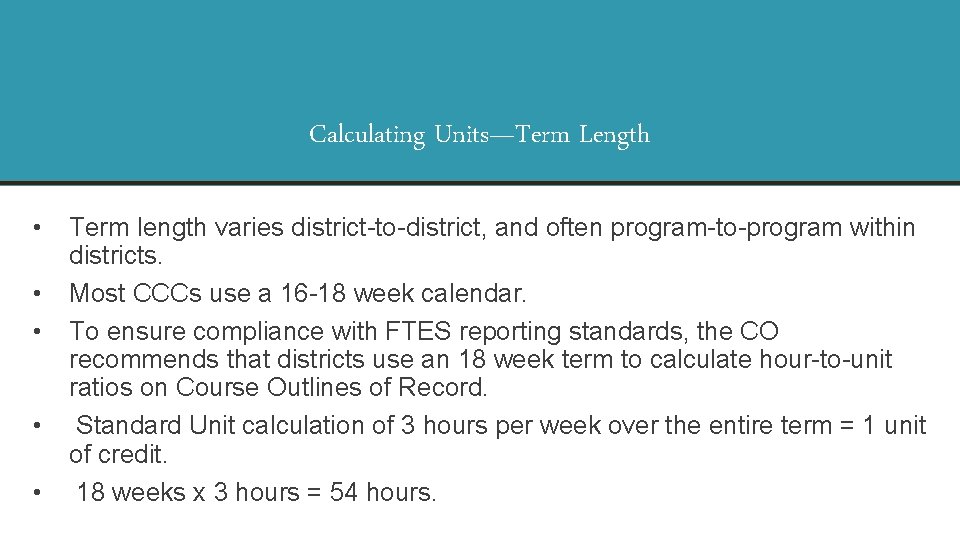
Calculating Units—Term Length • • • Term length varies district-to-district, and often program-to-program within districts. Most CCCs use a 16 -18 week calendar. To ensure compliance with FTES reporting standards, the CO recommends that districts use an 18 week term to calculate hour-to-unit ratios on Course Outlines of Record. Standard Unit calculation of 3 hours per week over the entire term = 1 unit of credit. 18 weeks x 3 hours = 54 hours.
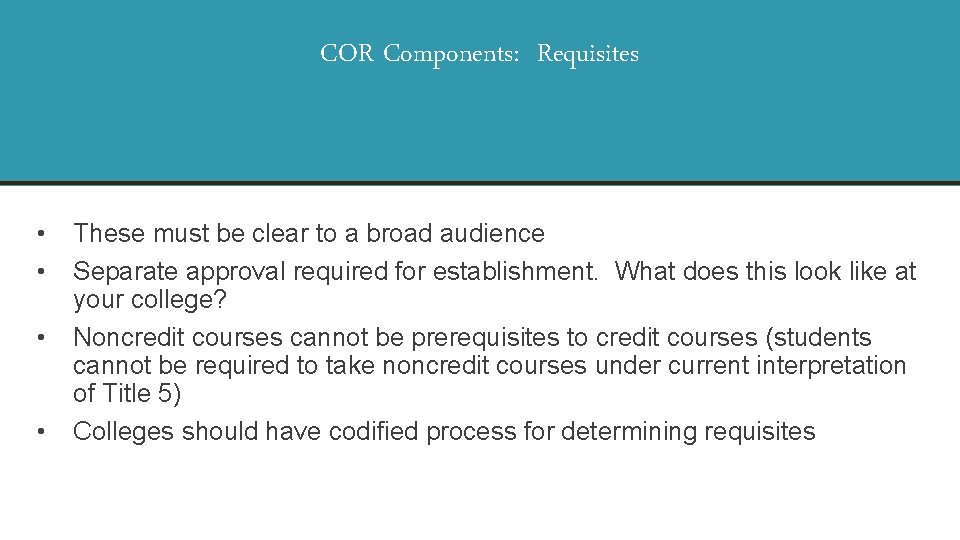
COR Components: Requisites • • These must be clear to a broad audience Separate approval required for establishment. What does this look like at your college? Noncredit courses cannot be prerequisites to credit courses (students cannot be required to take noncredit courses under current interpretation of Title 5) Colleges should have codified process for determining requisites
COR Components: Content / Objectives • • • Balance between flexibility and specificity Evidence of college-level rigor and critical thinking Consider breaking down by hours Lab course specificity Integrate content with description, SLOs, assessments, and assignments.
COR Components: SLOs • • Required by the ACCJC Can be an addendum to the COR The number of SLOs is a local decision. Should differ from the Objectives/Content • Most should be at higher levels of Bloom’s Taxonomy (Analysis, Synthesis, Evaluation) • Objectives/content describe what students learn during the course • SLOs describe what students can do after completing the course
Components: Assignments • • Related to objectives and SLOs Specific enough to show rigor These justify the total student work and the unit value How does your college include assignments in the COR?
COR Components: Methods of Instruction • How is the content delivered, how is student learning facilitated during scheduled class time? • Examples: Lecture, discussion, lab, studio, performance, student presentations, field trips, intercollegiate athletics competition, etc…. • Distance Education (DE) Modality • Requires a separate approval (Title 5 § 55206). • Does the COR need to specify how DE modality and in-person differ? • How is DE approval documented at your college? 21
Other COR Components to Consider: • • Textbooks Faculty discipline(s) Materials or field trip fees Repeatability Transferability and C-ID applicability Degree/Certificate applicability Links to other courses (cross-listing, prereq to. . , etc…) Effective term
COR and Academic Freedom Title 5 § 55002 requires that a qualified instructor teaches the course in accordance with the objectives and other details in the COR. Flexibility in: • Instructional methods • Assessments/Evaluation • Assignments • Textbooks
Resources The Course Outline of Record: A Curriculum Reference Guide Revisited Culturally Responsive & Inclusive Curriculum Resources: Creating Culturally Responsive Curriculum Program and Course Approval Handbook (PCAH) CCCCO Hours and Units Calculations 24
Questions info@asccc. org 25
- Slides: 25