
The Cost of Fixing Hold Time Violations in
- Slides: 1
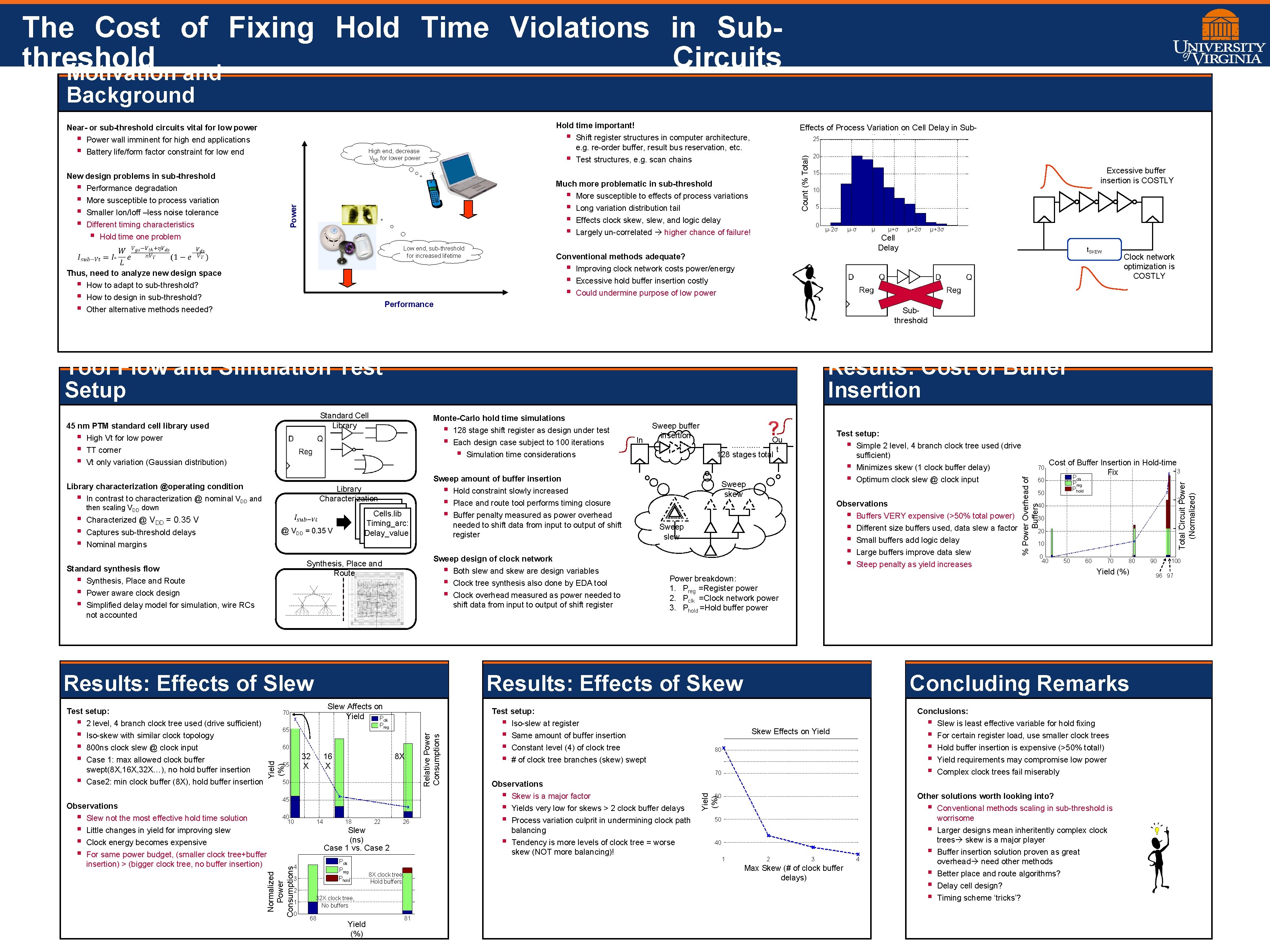
The Cost of Fixing Hold Time Violations in Subthreshold Circuits Motivation and Background Hold time important! § Shift register structures in computer architecture, e. g. re-order buffer, result bus reservation, etc. § Test structures, e. g. scan chains High end, decrease VDD for lower power Much more problematic in sub-threshold § More susceptible to effects of process variations § Long variation distribution tail § Effects clock skew, slew, and logic delay § Largely un-correlated higher chance of failure! Power Low end, sub-threshold for increased lifetime 10 5 0 Conventional methods adequate? § Improving clock network costs power/energy § Excessive hold buffer insertion costly § Could undermine purpose of low power Cells. lib Timing_arc: Delay_value @ VDD = 0. 35 V Captures sub-threshold delays Nominal margins Sweep amount of buffer insertion § Hold constraint slowly increased § Place and route tool performs timing closure § Buffer penalty measured as power overhead needed to shift data from input to output of shift register Sweep design of clock network § Both slew and skew are design variables § Clock tree synthesis also done by EDA tool § Clock overhead measured as power needed to shift data from input to output of shift register Synthesis, Place and Route Standard synthesis flow § Synthesis, Place and Route § Power aware clock design § Simplified delay model for simulation, wire RCs not accounted Results: Effects of Slew Preg 65 60 32 X Yield (%) § Slew Affects on Yield Pclk 70 55 16 X 8 X 50 45 40 10 14 18 22 26 Slew (ns) Case 1 vs. Case 2 Pclk Preg Phold 4 Normalized Power Consumptions Observations § Slew not the most effective hold time solution § Little changes in yield for improving slew § Clock energy becomes expensive § For same power budget, (smaller clock tree+buffer insertion) > (bigger clock tree, no buffer insertion) 3 0 Ou. . . t 128 stages total § Sweep skew 8 X clock tree, Hold buffers 32 X clock tree, No buffers 68 Yield (%) µ+3σ t. SKEW Optimum clock slew @ clock input Observations § Buffers VERY expensive (>50% total power) § Different size buffers used, data slew a factor § Small buffers add logic delay § Large buffers improve data slew § Steep penalty as yield increases Sweep slew Clock network optimization is COSTLY 81 Cost of Buffer Insertion in Hold-time 3 Fix Pclk Preg Phold 60 2 40 30 1 20 10 0 40 50 Power breakdown: 1. Preg =Register power 2. Pclk =Clock network power 3. Phold =Hold buffer power Test setup: § Iso-slew at register § Same amount of buffer insertion § Constant level (4) of clock tree § 70 50 70 Skew Effects on Yield 80 § § 70 Yield requirements may compromise low power Complex clock trees fail miserably Other solutions worth looking into? § Conventional methods scaling in sub-threshold is worrisome § Larger designs mean inheritently complex clock trees skew is a major player 60 50 40 1 80 Yield (%) Conclusions: § Slew is least effective variable for hold fixing § For certain register load, use smaller clock trees § Hold buffer insertion is expensive (>50% total!) # of clock tree branches (skew) swept Observations § Skew is a major factor § Yields very low for skews > 2 clock buffer delays § Process variation culprit in undermining clock path balancing § Tendency is more levels of clock tree = worse skew (NOT more balancing)! 60 Concluding Remarks 2 3 Max Skew (# of clock buffer delays) 2 1 µ+2σ Test setup: § Simple 2 level, 4 branch clock tree used (drive sufficient) § Minimizes skew (1 clock buffer delay) Results: Effects of Skew Relative Power Consumptions Test setup: § 2 level, 4 branch clock tree used (drive sufficient) § Iso-skew with similar clock topology § 800 ns clock slew @ clock input In Sweep buffer insertion Yield (%) Characterized @ VDD = 0. 35 V µ+σ Subthreshold Monte-Carlo hold time simulations § 128 stage shift register as design under test § Each design case subject to 100 iterations § Simulation time considerations Library Characterization then scaling VDD down µ Results: Cost of Buffer Insertion Standard Cell Library characterization @operating condition § In contrast to characterization @ nominal VDD and Case 1: max allowed clock buffer swept(8 X, 16 X, 32 X…), no hold buffer insertion Case 2: min clock buffer (8 X), hold buffer insertion µ-σ Performance 45 nm PTM standard cell library used § High Vt for low power § TT corner § Vt only variation (Gaussian distribution) § µ-2σ Cell Delay Tool Flow and Simulation Test Setup § § § Excessive buffer insertion is COSTLY 15 Total Circuit Power (Normalized) Thus, need to analyze new design space § How to adapt to sub-threshold? § How to design in sub-threshold? § Other alternative methods needed? 20 % Power Overhead of Buffers New design problems in sub-threshold § Performance degradation § More susceptible to process variation § Smaller Ion/Ioff –less noise tolerance § Different timing characteristics § Hold time one problem Effects of Process Variation on Cell Delay in Subthreshold 25 Count (% Total) Near- or sub-threshold circuits vital for low power § Power wall imminent for high end applications § Battery life/form factor constraint for low end 4 § Buffer insertion solution proven as great overhead need other methods § § § Better place and route algorithms? Delay cell design? Timing scheme ‘tricks’? 90 100 96 97