
The Cosmological Model an overview and an outlook
![Neutrinos p Should be strongly constrained by Planck p With Ly , σ[Σmν] <](https://slidetodoc.com/presentation_image/b3301267c13b3a8bb08146c4afc6747d/image-41.jpg "Neutrinos p Should be strongly constrained by Planck p With Ly , σ[Σmν] <")
- Slides: 42
The Cosmological Model: an overview and an outlook Alan Heavens University of Edinburgh TAUP 2007, Sendai, Japan 11/09/07
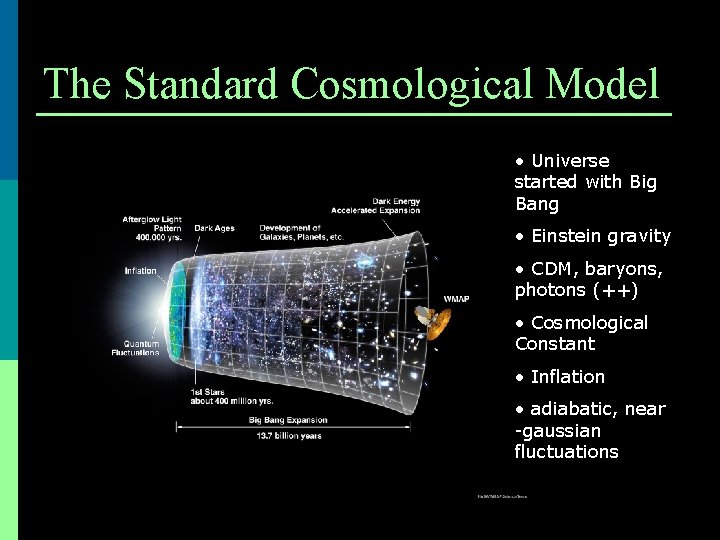
The Standard Cosmological Model • Universe started with Big Bang • Einstein gravity • CDM, baryons, photons (++) • Cosmological Constant • Inflation • adiabatic, near -gaussian fluctuations
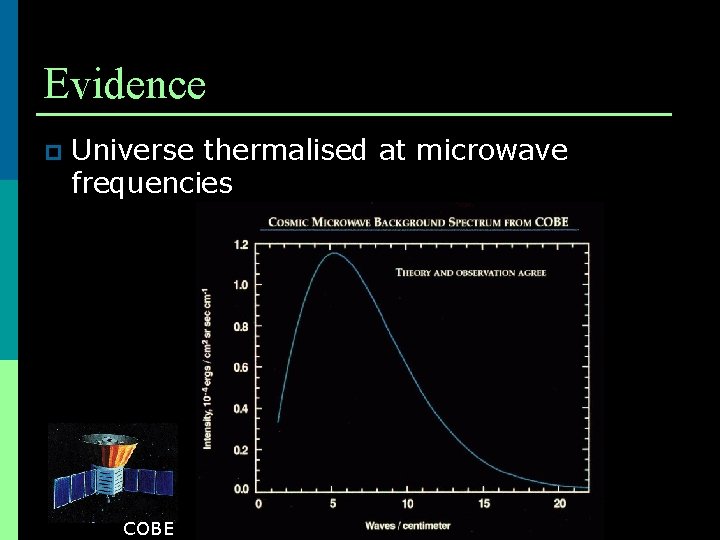
Evidence p Universe thermalised at microwave frequencies COBE
Cosmological Parameters and Effects p Cosmological Parameters: n n n p Matter density m Baryon density b Hubble parameter h (= H 0/100 km s-1 Mpc-1) H=d(lna)/dt Cosmological constant Λ Initial amplitude σ8 and slope n of power spectrum of fluctuations +… but 6 parameter model is a reasonably good fit Affect many observables, through n n n Geometry of Universe Power spectrum of fluctuations Light element abundances
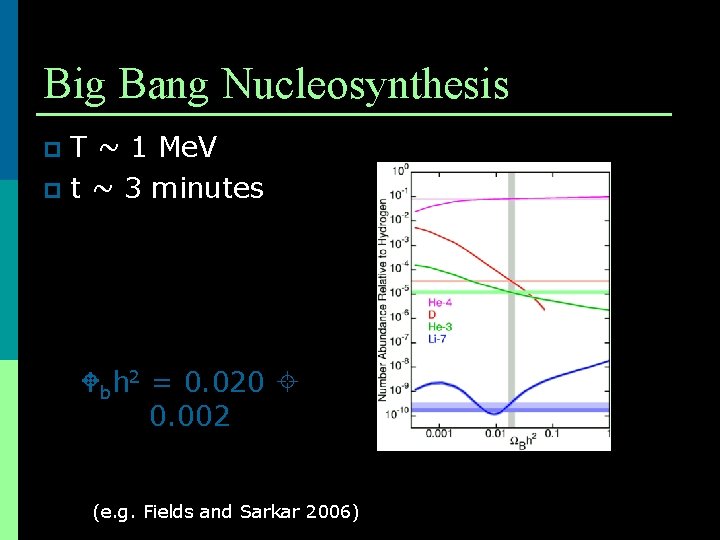
Big Bang Nucleosynthesis T ~ 1 Me. V p t ~ 3 minutes p bh 2 = 0. 020 0. 002 (e. g. Fields and Sarkar 2006)
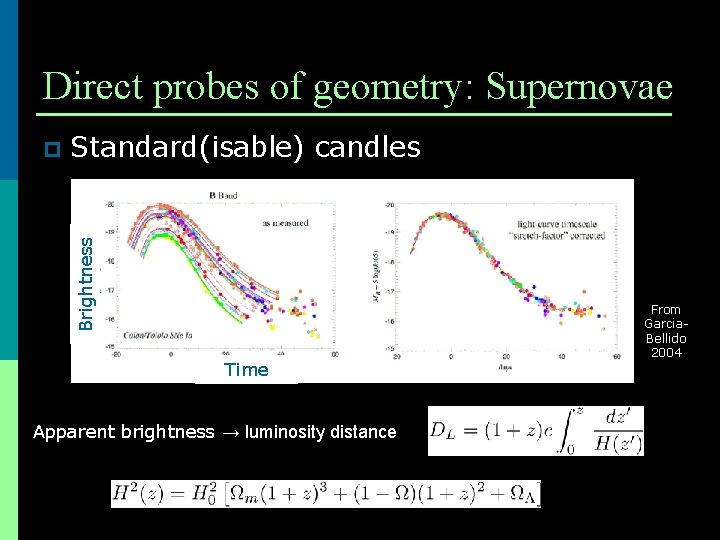
Direct probes of geometry: Supernovae Standard(isable) candles Brightness p Time Apparent brightness → luminosity distance From Garcia. Bellido 2004
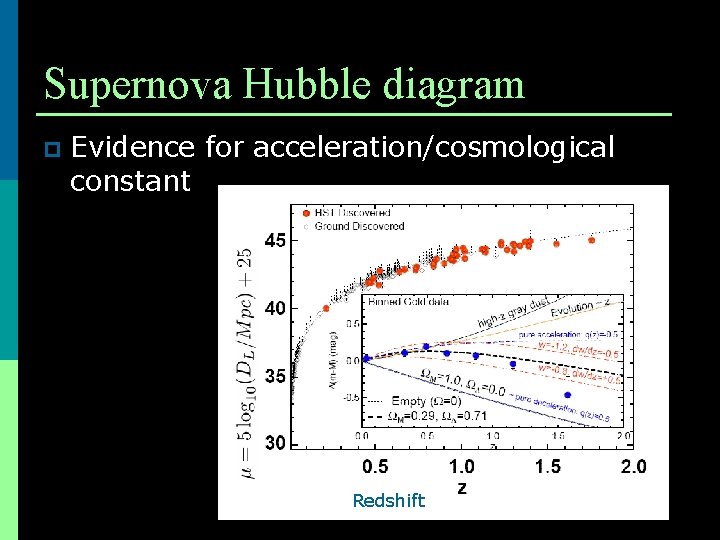
Supernova Hubble diagram p Evidence for acceleration/cosmological constant Redshift
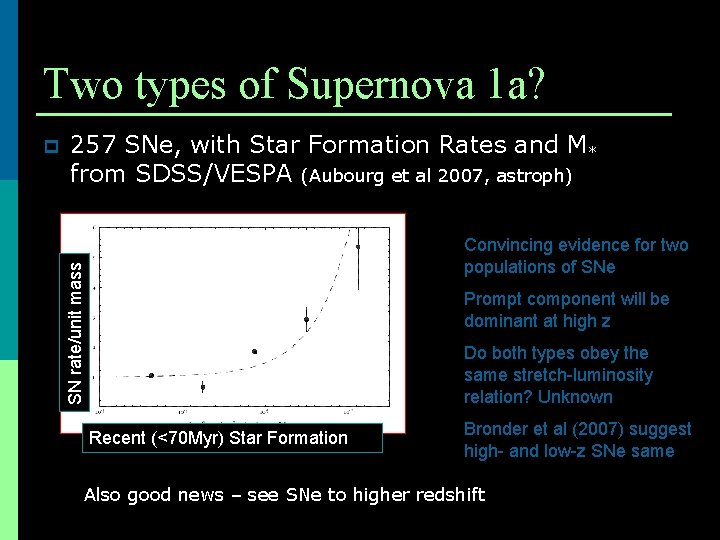
Two types of Supernova 1 a? 257 SNe, with Star Formation Rates and M* from SDSS/VESPA (Aubourg et al 2007, astroph) Convincing evidence for two populations of SNe SN rate/unit mass p Prompt component will be dominant at high z Do both types obey the same stretch-luminosity relation? Unknown Recent (<70 Myr) Star Formation Bronder et al (2007) suggest high- and low-z SNe same Also good news – see SNe to higher redshift
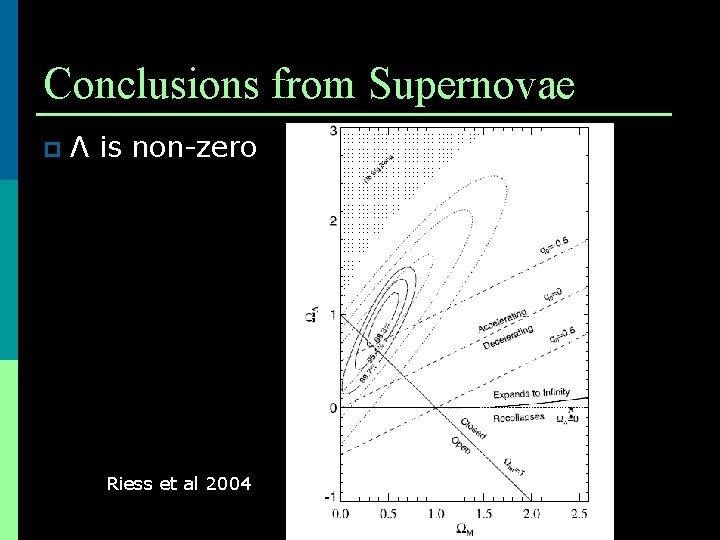
Conclusions from Supernovae p Λ is non-zero Riess et al 2004
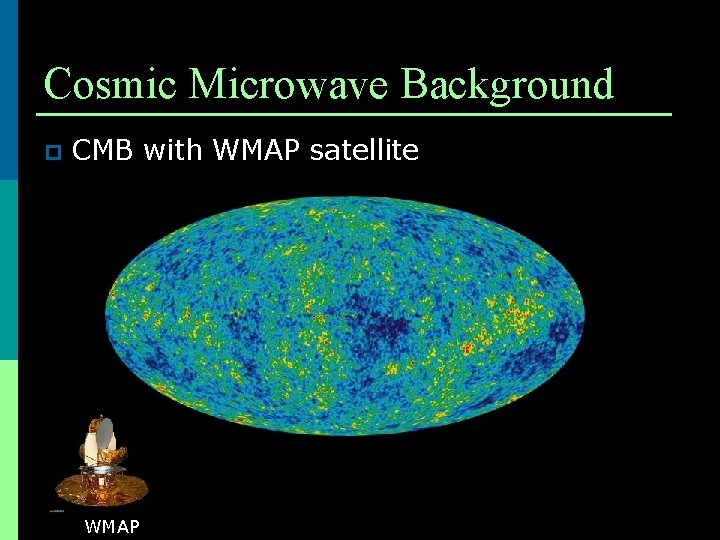
Cosmic Microwave Background p CMB with WMAP satellite WMAP
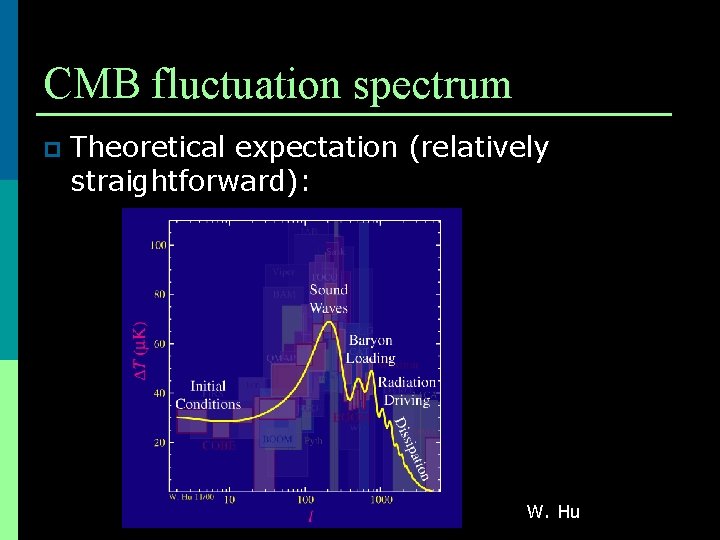
CMB fluctuation spectrum p Theoretical expectation (relatively straightforward): W. Hu
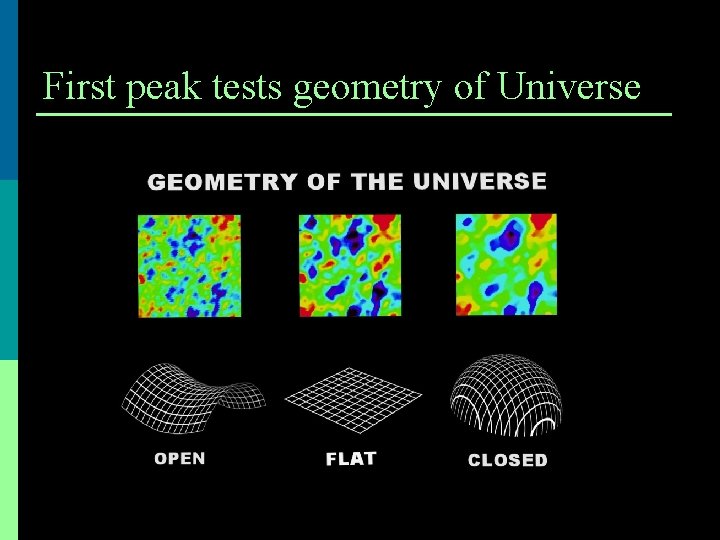
First peak tests geometry of Universe
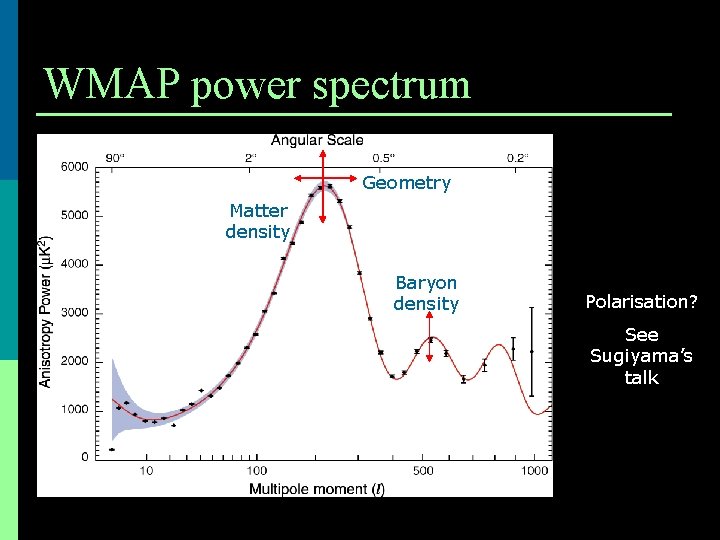
WMAP power spectrum Geometry Matter density Baryon density Polarisation? See Sugiyama’s talk
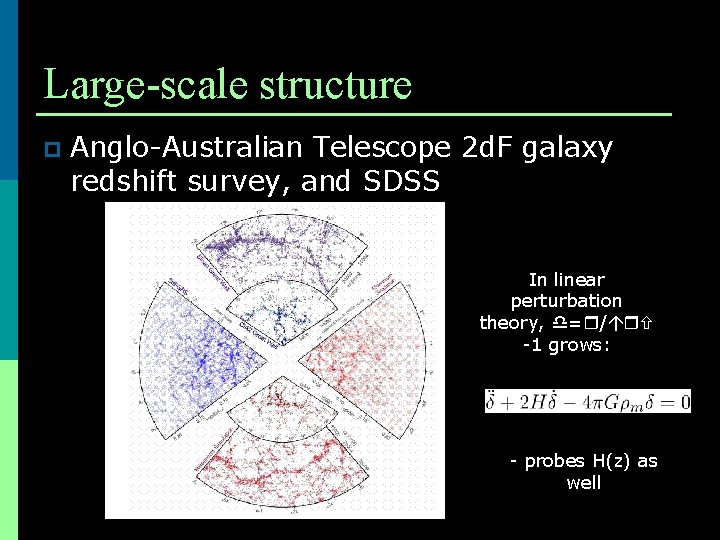
Large-scale structure p Anglo-Australian Telescope 2 d. F galaxy redshift survey, and SDSS In linear perturbation theory, = / -1 grows: - probes H(z) as well
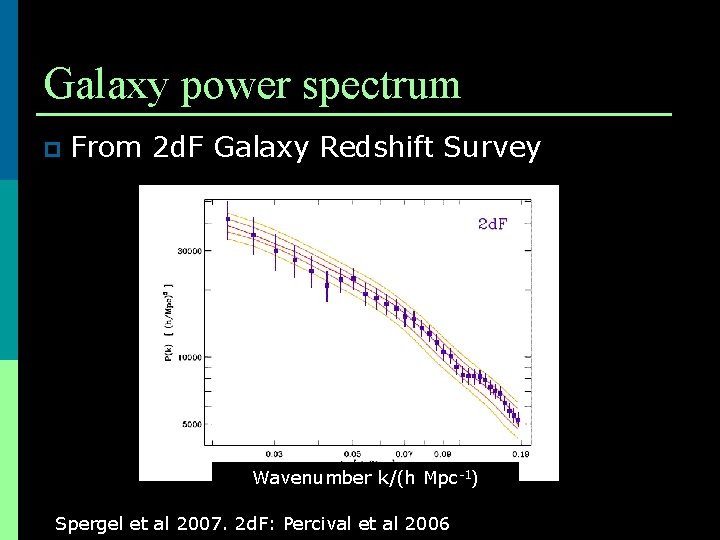
Galaxy power spectrum p From 2 d. F Galaxy Redshift Survey Wavenumber k/(h Mpc-1) Spergel et al 2007. 2 d. F: Percival et al 2006
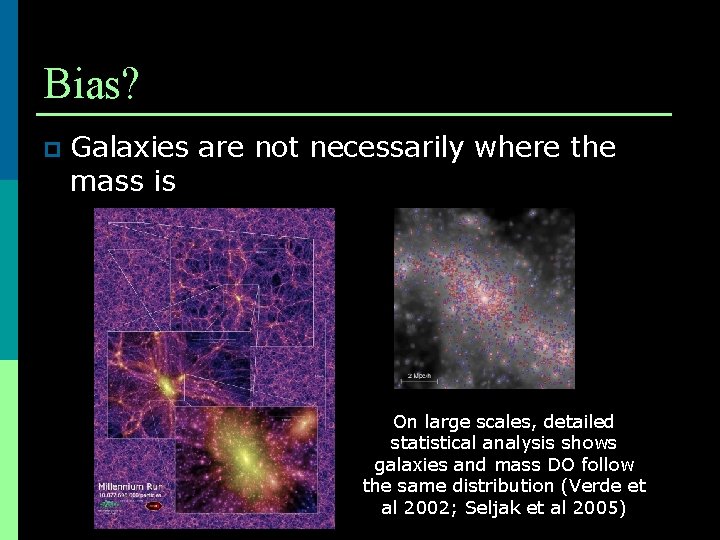
Bias? p Galaxies are not necessarily where the mass is On large scales, detailed statistical analysis shows galaxies and mass DO follow the same distribution (Verde et al 2002; Seljak et al 2005)
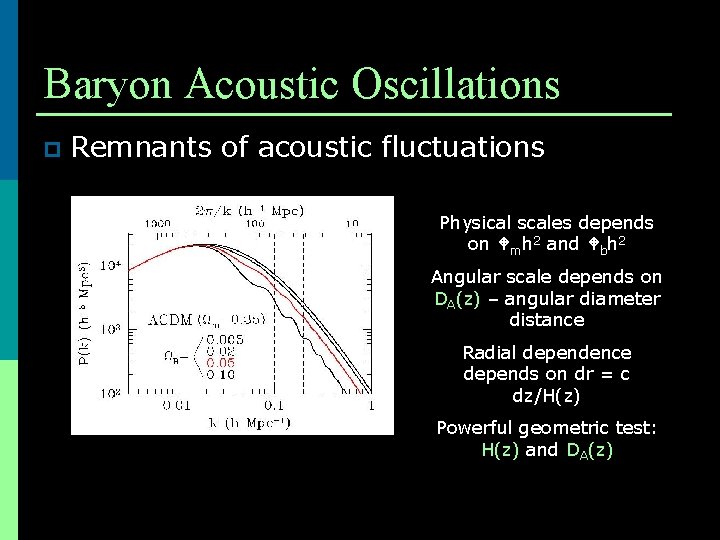
Baryon Acoustic Oscillations p Remnants of acoustic fluctuations Physical scales depends on mh 2 and bh 2 Angular scale depends on DA(z) – angular diameter distance Radial dependence depends on dr = c dz/H(z) Powerful geometric test: H(z) and DA(z)
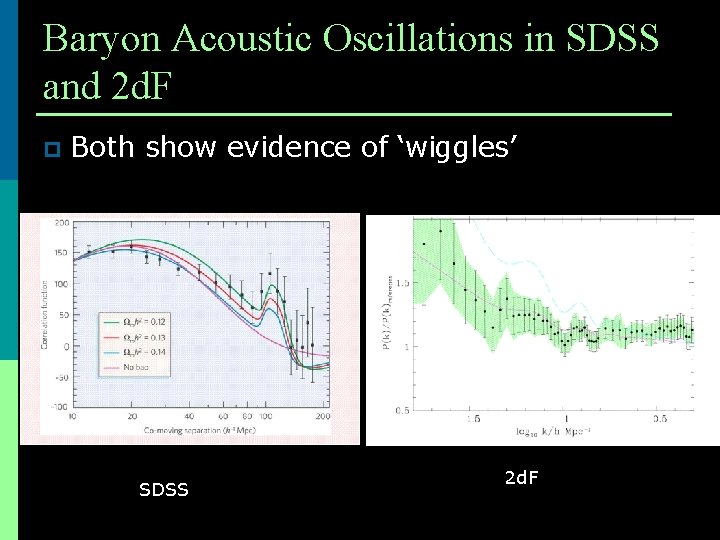
Baryon Acoustic Oscillations in SDSS and 2 d. F p Both show evidence of ‘wiggles’ SDSS 2 d. F
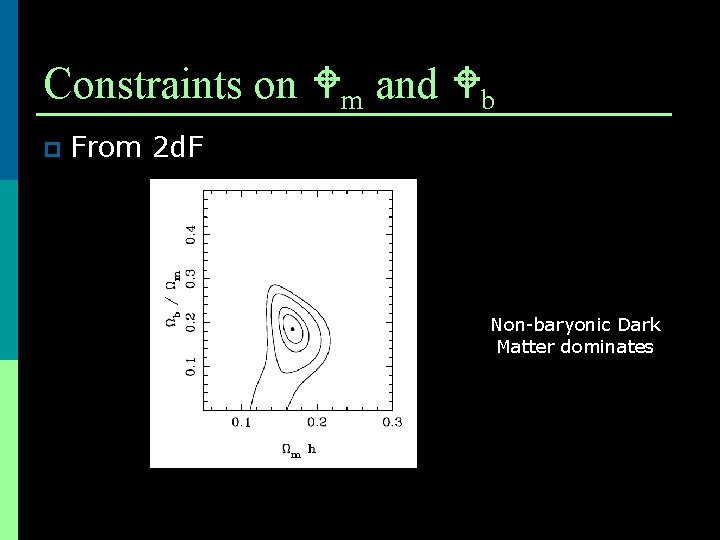
Constraints on m and b p From 2 d. F Non-baryonic Dark Matter dominates
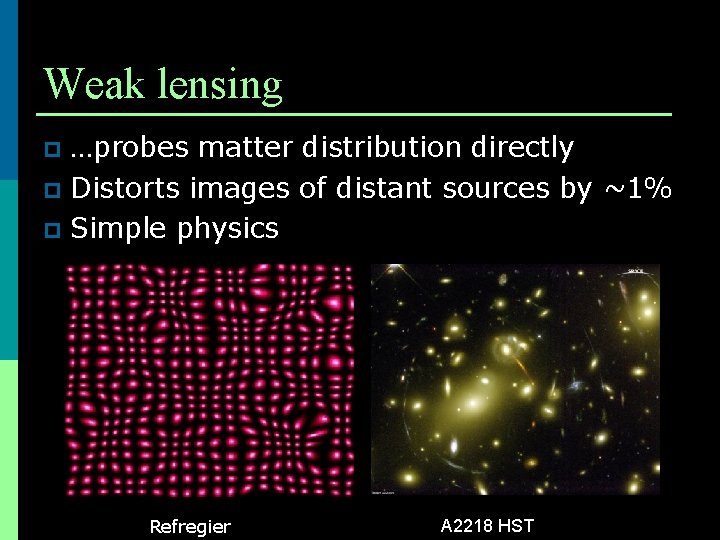
Weak lensing …probes matter distribution directly p Distorts images of distant sources by ~1% p Simple physics p Refregier A 2218 HST
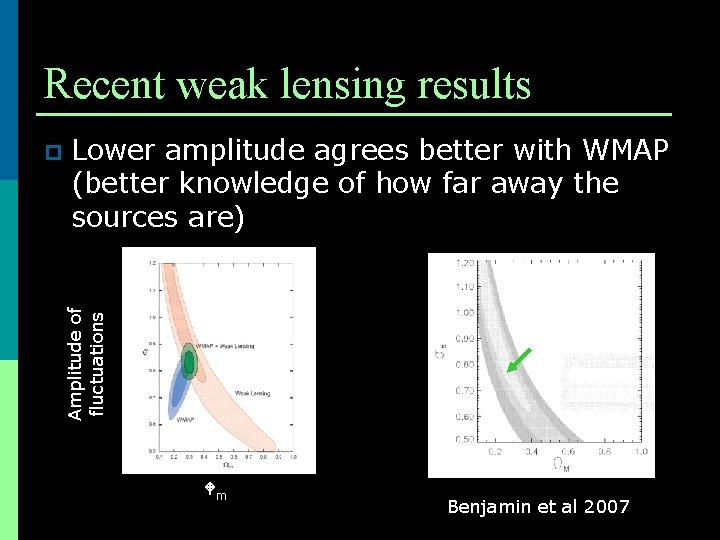
Recent weak lensing results Lower amplitude agrees better with WMAP (better knowledge of how far away the sources are) Amplitude of fluctuations p m Benjamin et al 2007
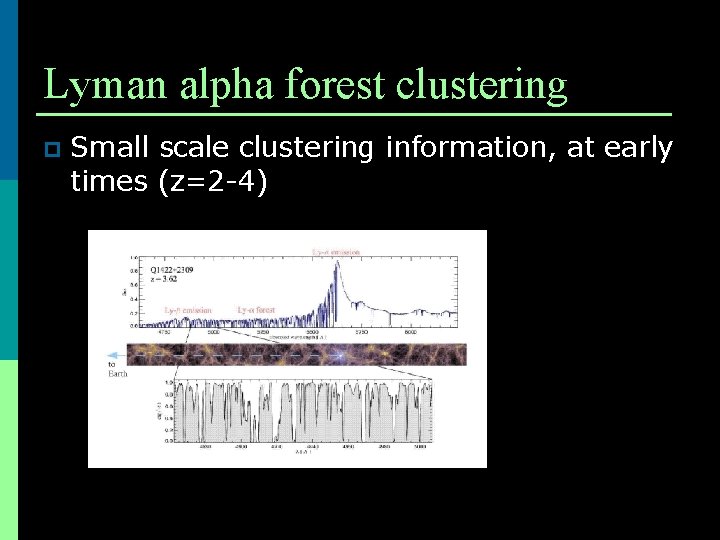
Lyman alpha forest clustering p Small scale clustering information, at early times (z=2 -4)
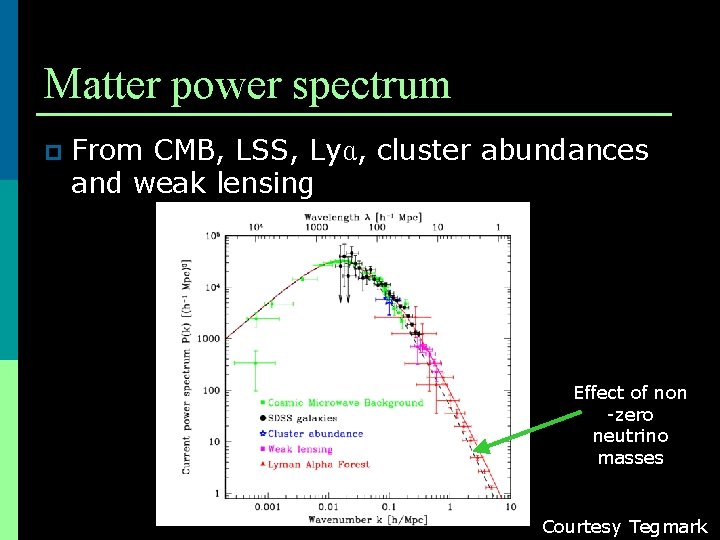
Matter power spectrum p From CMB, LSS, Lyα, cluster abundances and weak lensing Effect of non -zero neutrino masses Courtesy Tegmark
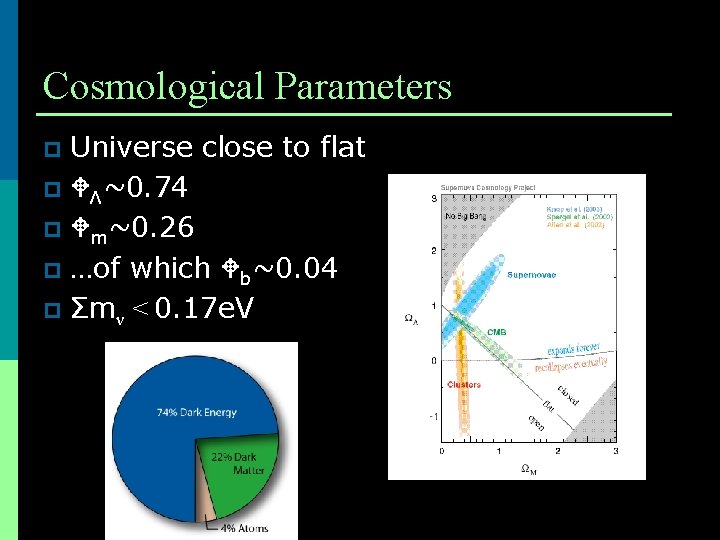
Cosmological Parameters Universe close to flat p Λ~0. 74 p m~0. 26 p …of which b~0. 04 p Σmν < 0. 17 e. V p
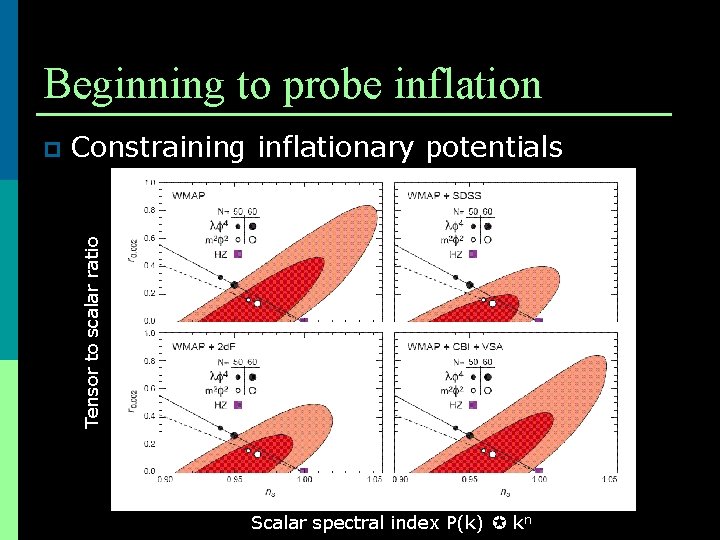
Beginning to probe inflation Constraining inflationary potentials Tensor to scalar ratio p Scalar spectral index P(k) kn
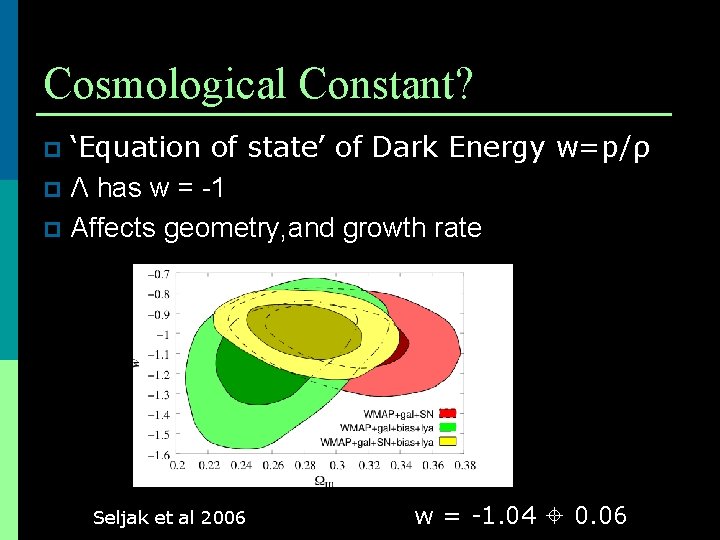
Cosmological Constant? ‘Equation of state’ of Dark Energy w=p/ρ p Λ has w = -1 p Affects geometry, and growth rate p Seljak et al 2006 w = -1. 04 0. 06
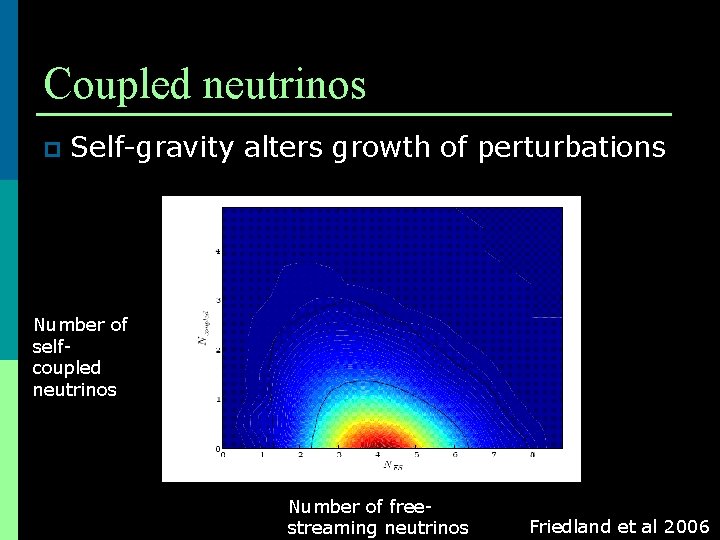
Coupled neutrinos p Self-gravity alters growth of perturbations Number of selfcoupled neutrinos Number of freestreaming neutrinos Friedland et al 2006
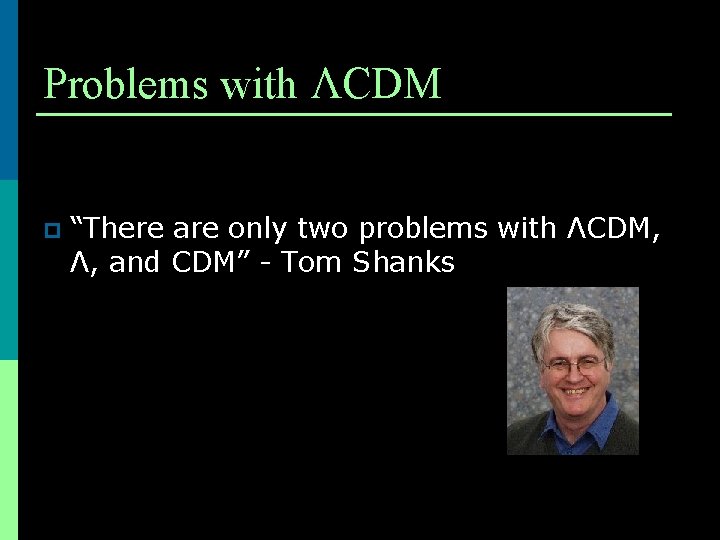
Problems with ΛCDM p “There are only two problems with ΛCDM, Λ, and CDM” - Tom Shanks
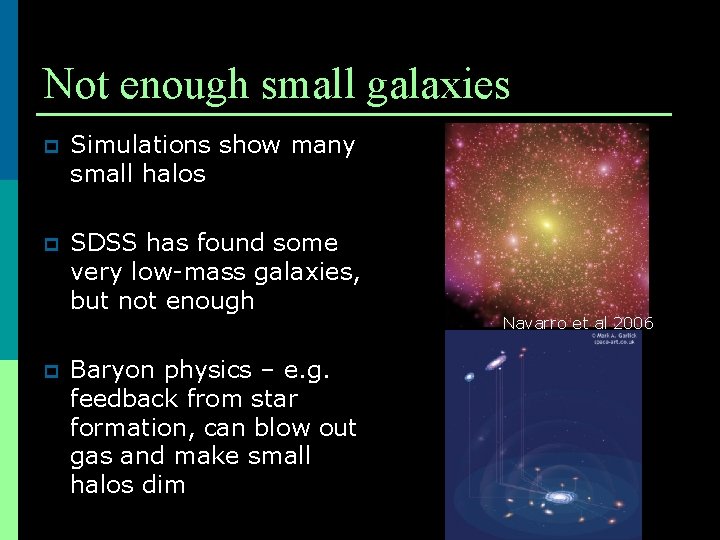
Not enough small galaxies p Simulations show many small halos p SDSS has found some very low-mass galaxies, but not enough p Baryon physics – e. g. feedback from star formation, can blow out gas and make small halos dim Navarro et al 2006
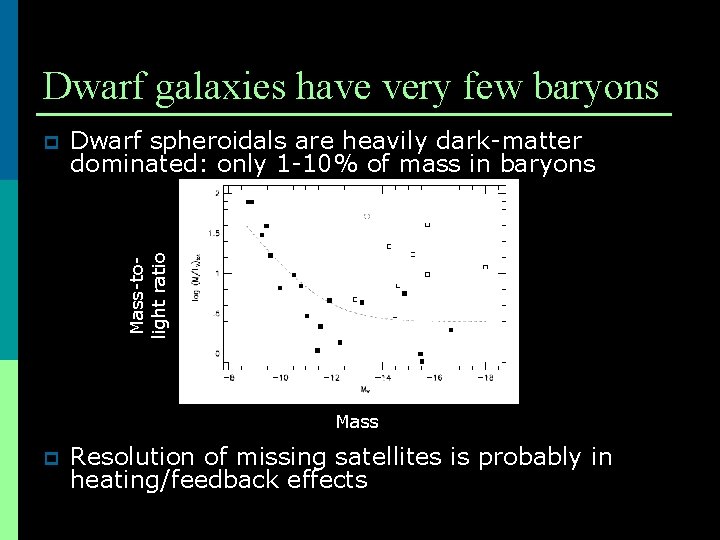
Dwarf galaxies have very few baryons Dwarf spheroidals are heavily dark-matter dominated: only 1 -10% of mass in baryons Mass-tolight ratio p Mass p Resolution of missing satellites is probably in heating/feedback effects
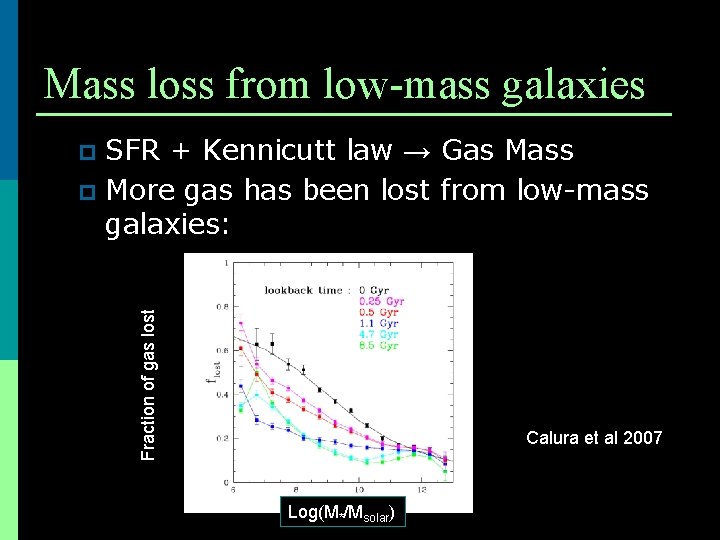
Mass loss from low-mass galaxies SFR + Kennicutt law → Gas Mass p More gas has been lost from low-mass galaxies: Fraction of gas lost p Calura et al 2007 Log(M*/Msolar)
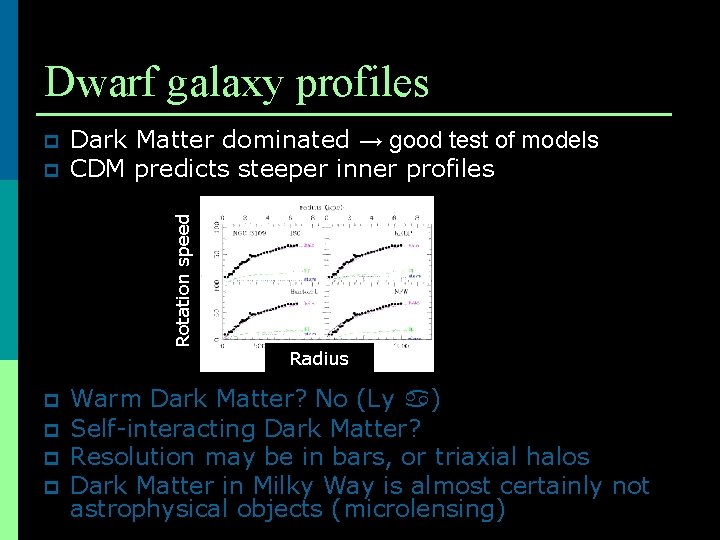
Dwarf galaxy profiles p Rotation speed p Dark Matter dominated → good test of models CDM predicts steeper inner profiles p p Radius Warm Dark Matter? No (Ly ) Self-interacting Dark Matter? Resolution may be in bars, or triaxial halos Dark Matter in Milky Way is almost certainly not astrophysical objects (microlensing)
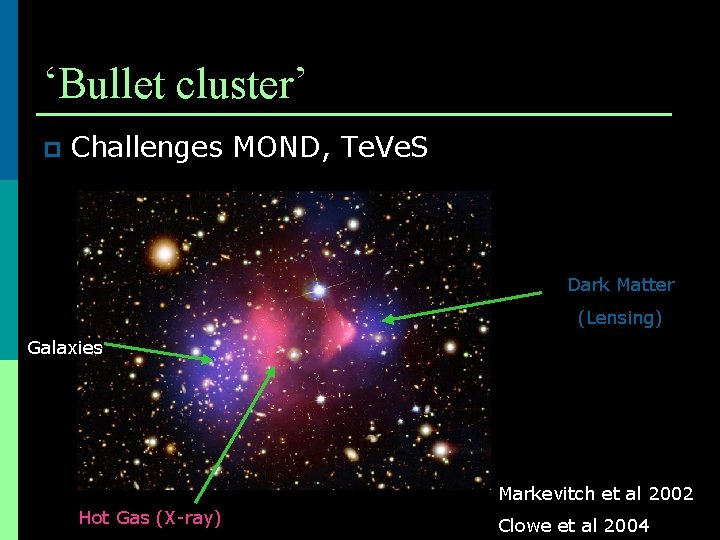
‘Bullet cluster’ p Challenges MOND, Te. Ve. S Dark Matter (Lensing) Galaxies Markevitch et al 2002 Hot Gas (X-ray) Clowe et al 2004
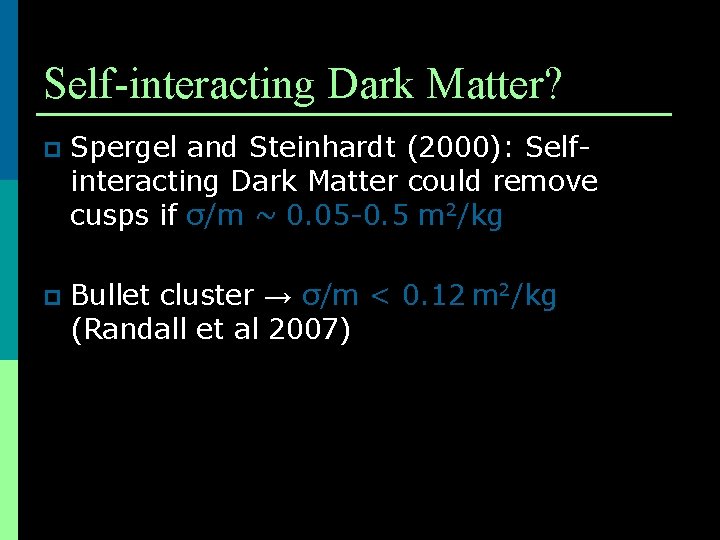
Self-interacting Dark Matter? p Spergel and Steinhardt (2000): Selfinteracting Dark Matter could remove cusps if σ/m ~ 0. 05 -0. 5 m 2/kg p Bullet cluster → σ/m < 0. 12 m 2/kg (Randall et al 2007)
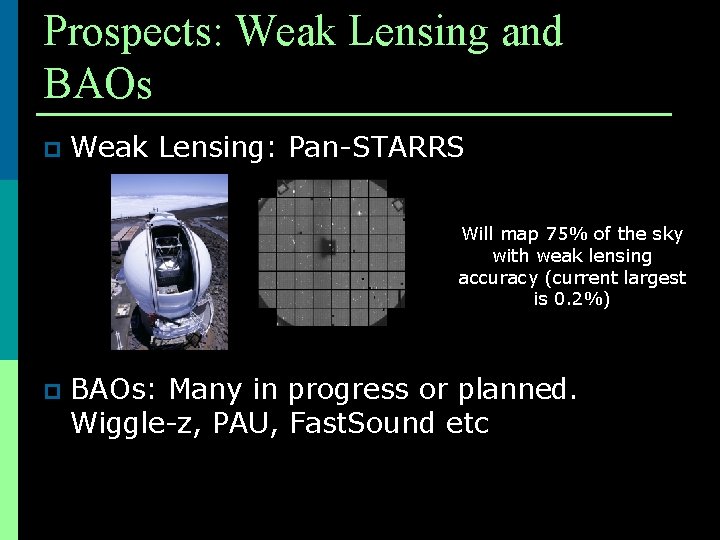
Prospects: Weak Lensing and BAOs p Weak Lensing: Pan-STARRS Will map 75% of the sky with weak lensing accuracy (current largest is 0. 2%) p BAOs: Many in progress or planned. Wiggle-z, PAU, Fast. Sound etc
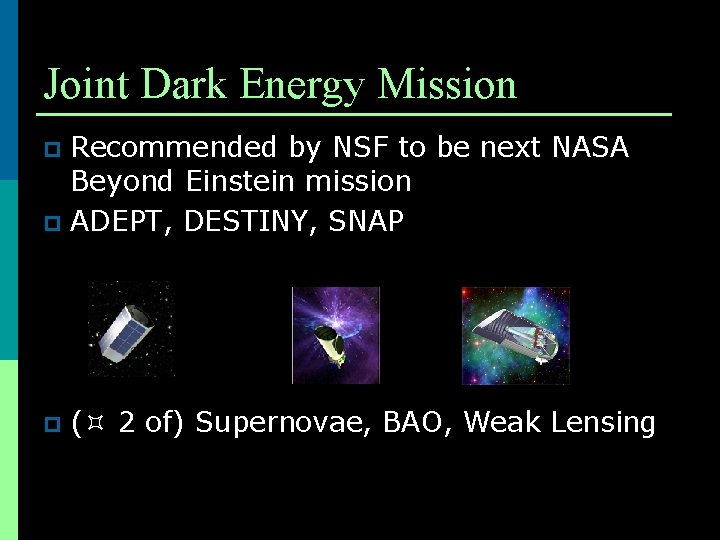
Joint Dark Energy Mission Recommended by NSF to be next NASA Beyond Einstein mission p ADEPT, DESTINY, SNAP p p ( 2 of) Supernovae, BAO, Weak Lensing
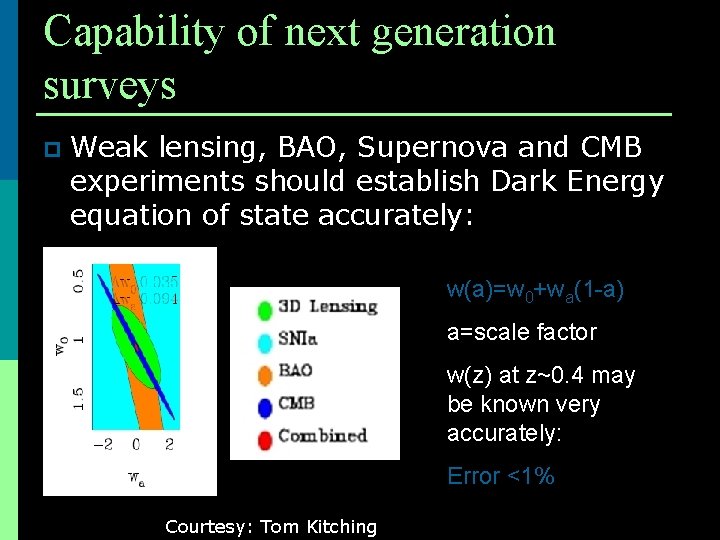
Capability of next generation surveys p Weak lensing, BAO, Supernova and CMB experiments should establish Dark Energy equation of state accurately: w(a)=w 0+wa(1 -a) a=scale factor w(z) at z~0. 4 may be known very accurately: Error <1% Courtesy: Tom Kitching
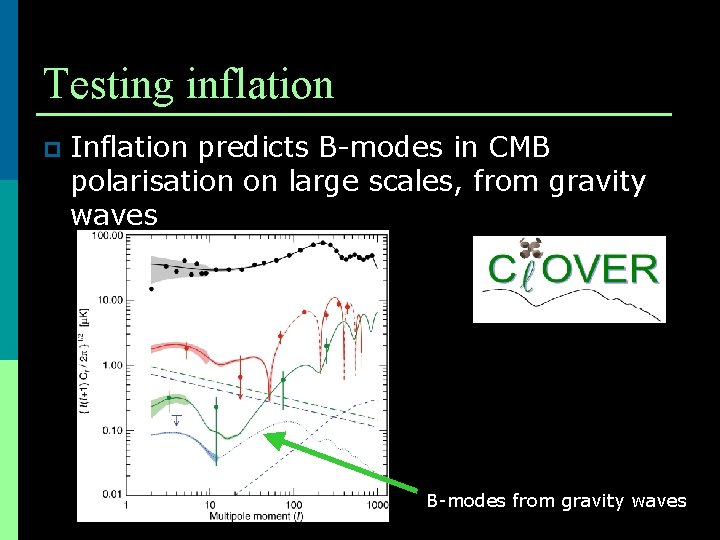
Testing inflation p Inflation predicts B-modes in CMB polarisation on large scales, from gravity waves B-modes from gravity waves
Beyond Einstein Gravity? Next generation experiments can also address qualitatively different questions: p Is there evidence for gravity beyond Einstein’s General Relativity (e. g. Braneworld Gravity)? p Growth rate of perturbations is altered p Weak Lensing probes this p
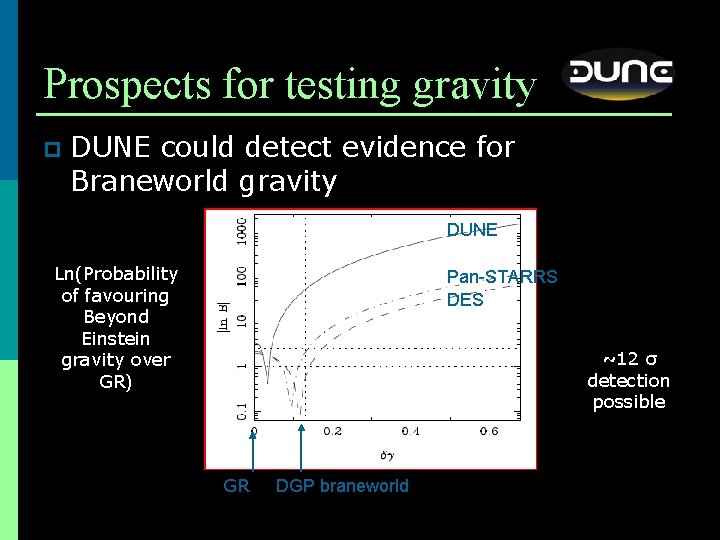
Prospects for testing gravity p DUNE could detect evidence for Braneworld gravity DUNE Ln(Probability of favouring Beyond Einstein gravity over GR) Pan-STARRS DES ~12 σ detection possible GR DGP braneworld
Neutrinos p Should be strongly constrained by Planck p With Ly , σ[Σmν] < 0. 06 e. V (Gratton et al 2007) or 0. 05 e. V with weak lensing (Hannestad et al 2006) or 0. 025 e. V with high-z clustering (Takada et al 2007) Strong constraints on self-coupled ν p Number of selfcoupled neutrinos 0. 2 Number of free-streaming neutrinos Friedland et al 2006
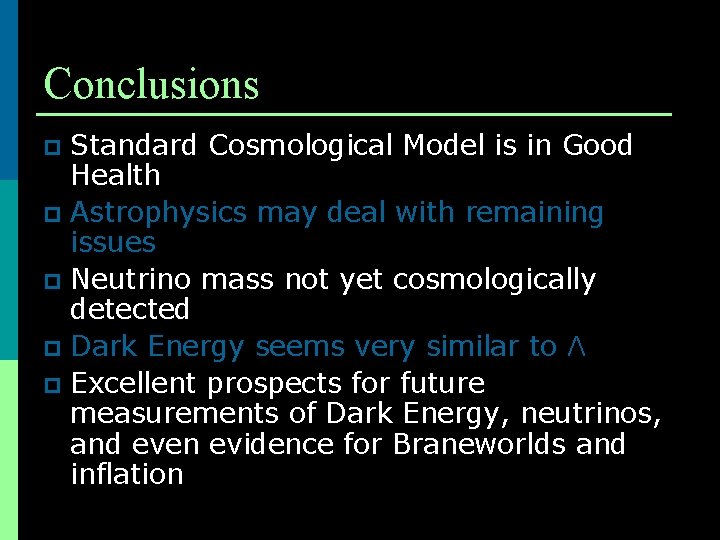
Conclusions Standard Cosmological Model is in Good Health p Astrophysics may deal with remaining issues p Neutrino mass not yet cosmologically detected p Dark Energy seems very similar to Λ p Excellent prospects for future measurements of Dark Energy, neutrinos, and even evidence for Braneworlds and inflation p