
The Cosine Rule B Pythagoras Theorem allows us
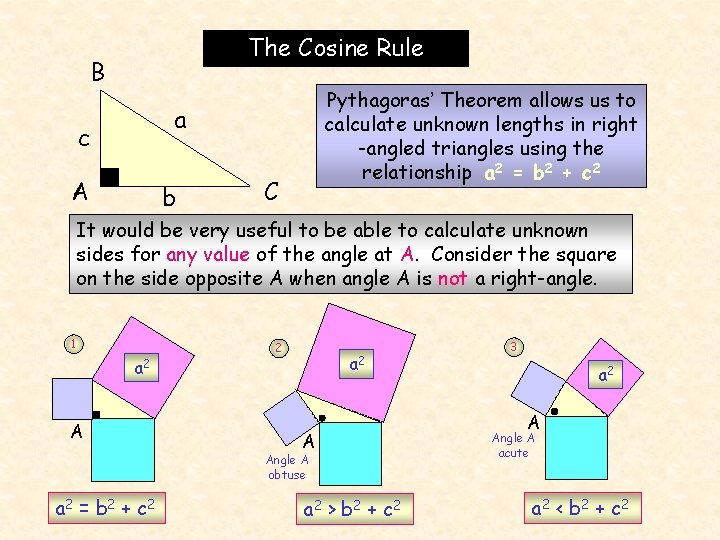
The Cosine Rule B Pythagoras’ Theorem allows us to calculate unknown lengths in right -angled triangles using the relationship a 2 = b 2 + c 2 a c A b C It would be very useful to be able to calculate unknown sides for any value of the angle at A. Consider the square on the side opposite A when angle A is not a right-angle. 1 a 2 A 2 a 2 A Angle A obtuse a 2 = b 2 + c 2 a 2 > b 2 + c 2 3 a 2 A Angle A acute a 2 < b 2 + c 2
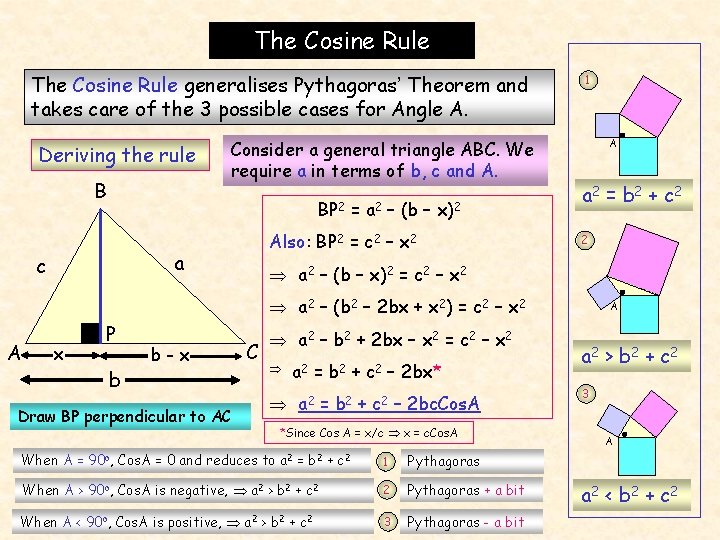
The Cosine Rule generalises Pythagoras’ Theorem and takes care of the 3 possible cases for Angle A. Deriving the rule B Consider a general triangle ABC. We require a in terms of b, c and A. BP 2 – (b – x)2 Also: BP 2 = c 2 – x 2 a c = a 2 1 A a 2 = b 2 + c 2 2 a 2 – (b – x)2 = c 2 – x 2 a 2 – (b 2 – 2 bx + x 2) = c 2 – x 2 A x P b b b-x Draw BP perpendicular to AC C a 2 – b 2 + 2 bx – x 2 = c 2 – x 2 a 2 = b 2 + c 2 – 2 bx* a 2 = b 2 + c 2 – 2 bc. Cos. A *Since Cos A = x/c x = c. Cos. A When A = 90 o, Cos. A = 0 and reduces to a 2 = b 2 + c 2 1 Pythagoras When A > 90 o, Cos. A is negative, a 2 > b 2 + c 2 2 Pythagoras + a bit When A < 90 o, Cos. A is positive, a 2 > b 2 + c 2 3 Pythagoras - a bit A a 2 > b 2 + c 2 3 A a 2 < b 2 + c 2
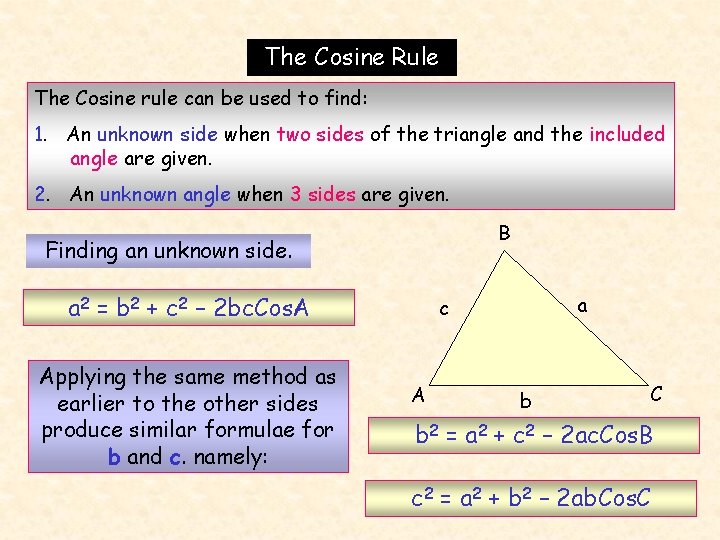
The Cosine Rule The Cosine rule can be used to find: 1. An unknown side when two sides of the triangle and the included angle are given. 2. An unknown angle when 3 sides are given. B Finding an unknown side. a 2 = b 2 + c 2 – 2 bc. Cos. A Applying the same method as earlier to the other sides produce similar formulae for b and c. namely: a c A b C b 2 = a 2 + c 2 – 2 ac. Cos. B c 2 = a 2 + b 2 – 2 ab. Cos. C
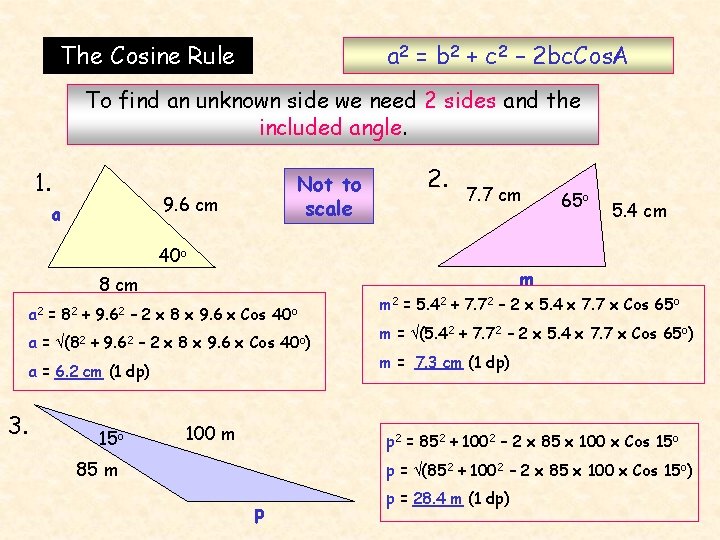
The Cosine Rule a 2 = b 2 + c 2 – 2 bc. Cos. A To find an unknown side we need 2 sides and the included angle. 1. Not to scale 9. 6 cm a 2. 7. 7 cm 40 o a 2 = 82 + 9. 62 – 2 x 8 x 9. 6 x Cos 40 o a= + 9. 62 – 2 x 8 x 9. 6 x Cos a = 6. 2 cm (1 dp) 3. 15 o 5. 4 cm m 8 cm (82 65 o 100 m 40 o) m 2 = 5. 42 + 7. 72 – 2 x 5. 4 x 7. 7 x Cos 65 o m = (5. 42 + 7. 72 – 2 x 5. 4 x 7. 7 x Cos 65 o) m = 7. 3 cm (1 dp) p 2 = 852 + 1002 – 2 x 85 x 100 x Cos 15 o 85 m p = (852 + 1002 – 2 x 85 x 100 x Cos 15 o) p p = 28. 4 m (1 dp)
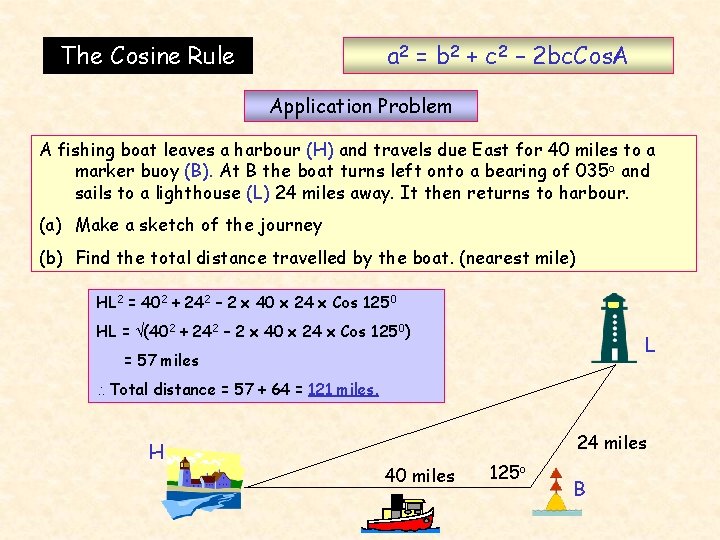
The Cosine Rule a 2 = b 2 + c 2 – 2 bc. Cos. A Application Problem A fishing boat leaves a harbour (H) and travels due East for 40 miles to a marker buoy (B). At B the boat turns left onto a bearing of 035 o and sails to a lighthouse (L) 24 miles away. It then returns to harbour. (a) Make a sketch of the journey (b) Find the total distance travelled by the boat. (nearest mile) HL 2 = 402 + 242 – 2 x 40 x 24 x Cos 1250 HL = (402 + 242 – 2 x 40 x 24 x Cos 1250) L = 57 miles Total distance = 57 + 64 = 121 miles. H 24 miles 40 miles 125 o B
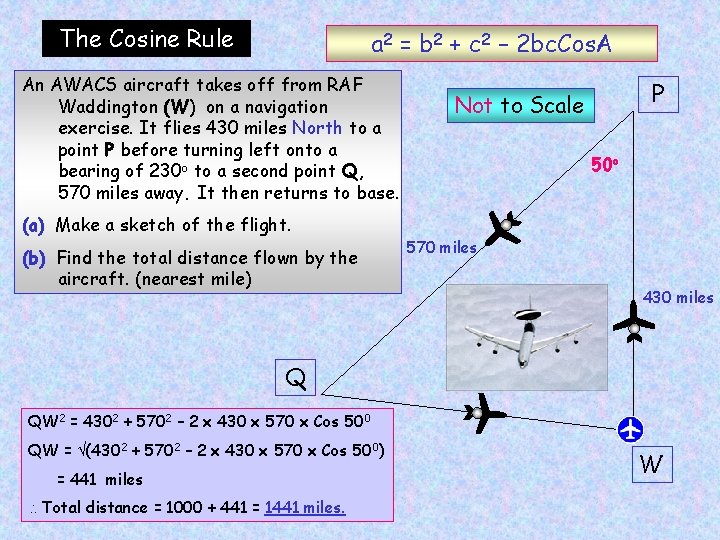
The Cosine Rule a 2 = b 2 + c 2 – 2 bc. Cos. A An AWACS aircraft takes off from RAF Waddington (W) on a navigation exercise. It flies 430 miles North to a point P before turning left onto a bearing of 230 o to a second point Q, 570 miles away. It then returns to base. (a) Make a sketch of the flight. (b) Find the total distance flown by the aircraft. (nearest mile) P Not to Scale 50 o 570 miles 430 miles Q QW 2 = 4302 + 5702 – 2 x 430 x 570 x Cos 500 QW = (4302 + 5702 – 2 x 430 x 570 x Cos 500) = 441 miles Total distance = 1000 + 441 = 1441 miles. W
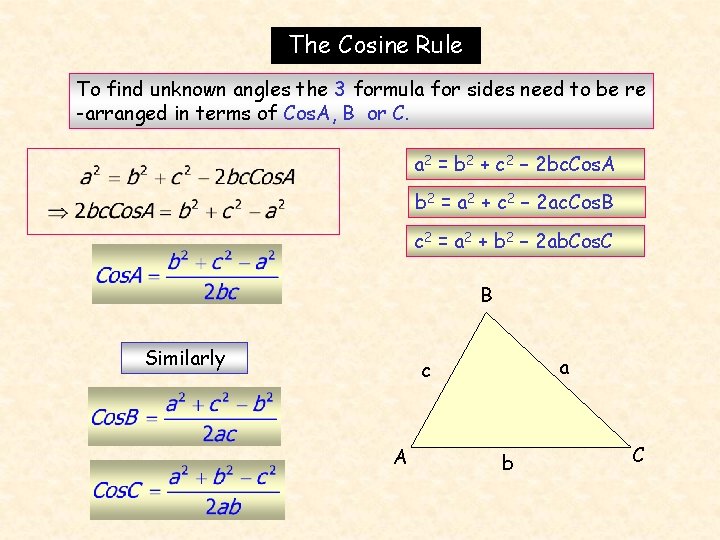
The Cosine Rule To find unknown angles the 3 formula for sides need to be re -arranged in terms of Cos. A, B or C. a 2 = b 2 + c 2 – 2 bc. Cos. A b 2 = a 2 + c 2 – 2 ac. Cos. B c 2 = a 2 + b 2 – 2 ab. Cos. C B Similarly a c A b C
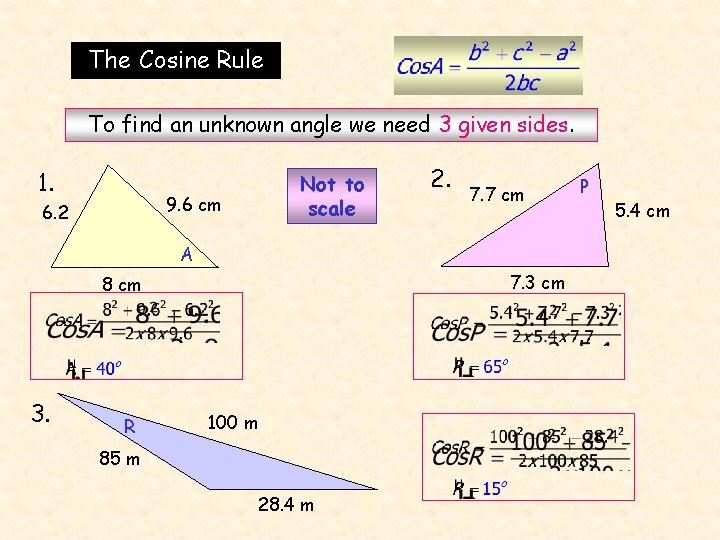
The Cosine Rule To find an unknown angle we need 3 given sides. 1. 9. 6 cm 6. 2 Not to scale 2. 7. 7 cm A 7. 3 cm 8 cm 3. R 100 m 85 m 28. 4 m P 5. 4 cm
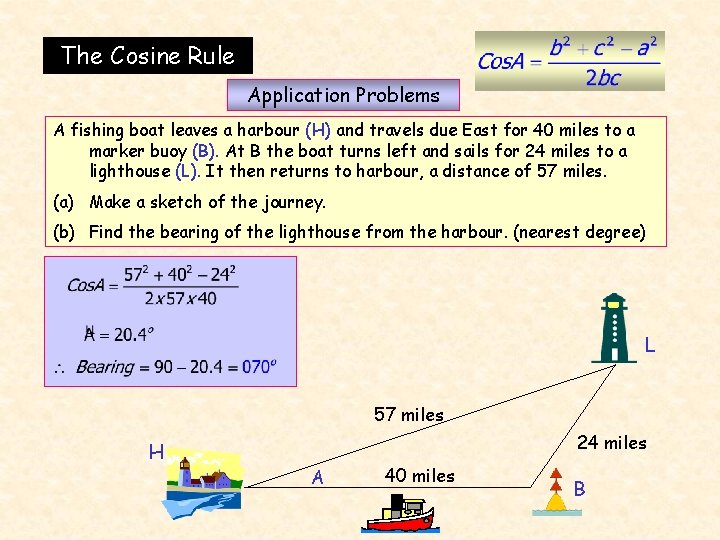
The Cosine Rule Application Problems A fishing boat leaves a harbour (H) and travels due East for 40 miles to a marker buoy (B). At B the boat turns left and sails for 24 miles to a lighthouse (L). It then returns to harbour, a distance of 57 miles. (a) Make a sketch of the journey. (b) Find the bearing of the lighthouse from the harbour. (nearest degree) L 57 miles H 24 miles A 40 miles B
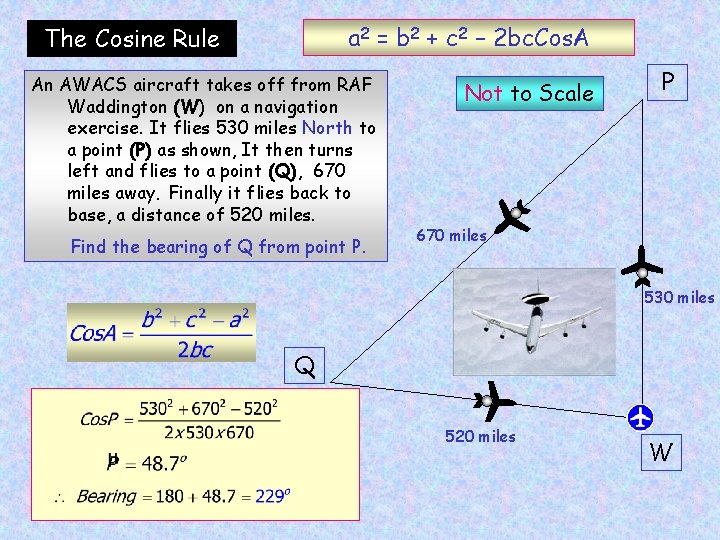
a 2 = b 2 + c 2 – 2 bc. Cos. A The Cosine Rule An AWACS aircraft takes off from RAF Waddington (W) on a navigation exercise. It flies 530 miles North to a point (P) as shown, It then turns left and flies to a point (Q), 670 miles away. Finally it flies back to base, a distance of 520 miles. Find the bearing of Q from point P. Not to Scale P 670 miles 530 miles Q 520 miles W
- Slides: 10