
THE CORRELATION BETWEEN POVERTY AND READING ON GRADE
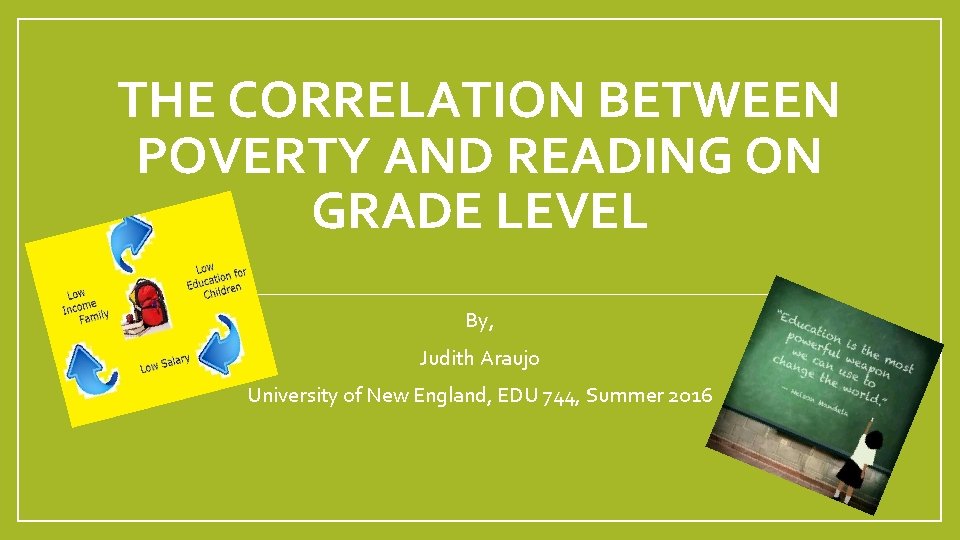
THE CORRELATION BETWEEN POVERTY AND READING ON GRADE LEVEL By, Judith Araujo University of New England, EDU 744, Summer 2016
INTRODUCTION The Number of Children Living in Poverty in the United States is Increasing According to the National Center for Educational Statistics (2011), during the 20092010 school year, 47. 5 percent of all K-12 public school students in the United States were eligible for free or reduced lunch compared to 38. 3 percent in the 2000 -2001 school year (Tienken, 2012, p. 105). Research shows children from high poverty environments enter school less ready to learn, and they lag behind their more-affluent classmates in their ability to use language to solve problems (Milne & Plourde, 2006, p. 183). What factors contribute to academic success despite low SES status? Researchers have set out to explain causes of failure among low SES students as well as factors possibly contributing to success despite low SES status. SUMMARIES TO FOLLOW. . .
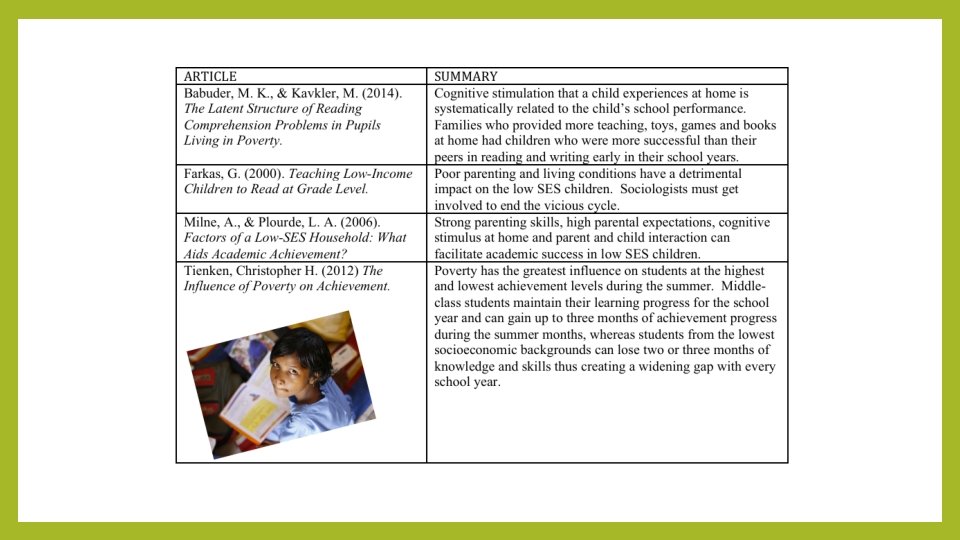
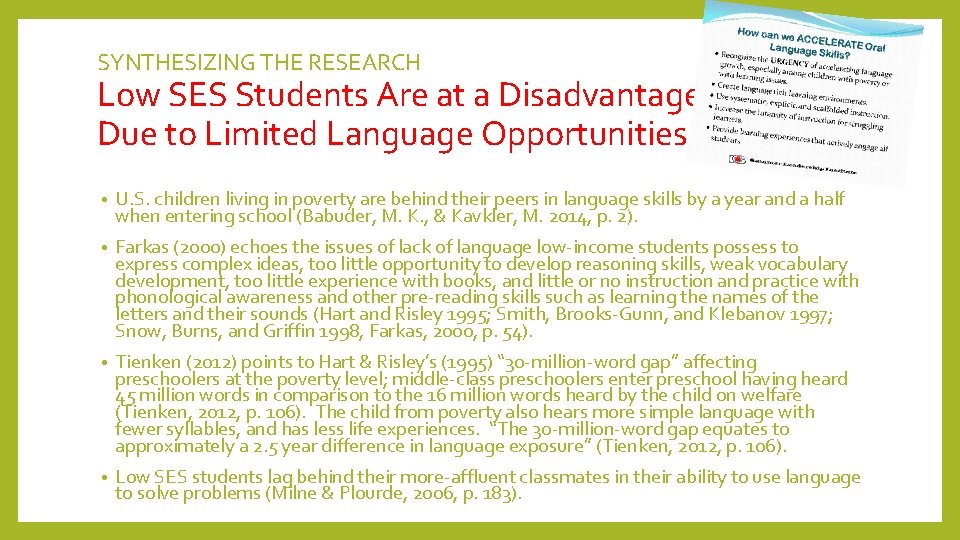
SYNTHESIZING THE RESEARCH Low SES Students Are at a Disadvantage Due to Limited Language Opportunities • U. S. children living in poverty are behind their peers in language skills by a year and a half when entering school (Babuder, M. K. , & Kavkler, M. 2014, p. 2). • Farkas (2000) echoes the issues of lack of language low-income students possess to express complex ideas, too little opportunity to develop reasoning skills, weak vocabulary development, too little experience with books, and little or no instruction and practice with phonological awareness and other pre-reading skills such as learning the names of the letters and their sounds (Hart and Risley 1995; Smith, Brooks-Gunn, and Klebanov 1997; Snow, Burns, and Griffin 1998, Farkas, 2000, p. 54). • Tienken (2012) points to Hart & Risley’s (1995) “ 30 -million-word gap” affecting preschoolers at the poverty level; middle-class preschoolers enter preschool having heard 45 million words in comparison to the 16 million words heard by the child on welfare (Tienken, 2012, p. 106). The child from poverty also hears more simple language with fewer syllables, and has less life experiences. “The 30 -million-word gap equates to approximately a 2. 5 year difference in language exposure” (Tienken, 2012, p. 106). • Low SES students lag behind their more-affluent classmates in their ability to use language to solve problems (Milne & Plourde, 2006, p. 183).
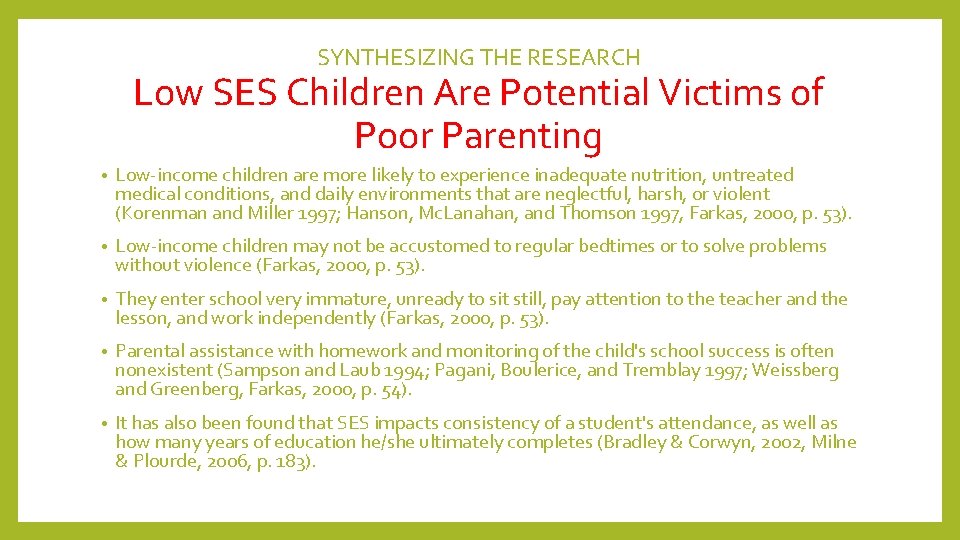
SYNTHESIZING THE RESEARCH Low SES Children Are Potential Victims of Poor Parenting • Low-income children are more likely to experience inadequate nutrition, untreated medical conditions, and daily environments that are neglectful, harsh, or violent (Korenman and Miller 1997; Hanson, Mc. Lanahan, and Thomson 1997, Farkas, 2000, p. 53). • Low-income children may not be accustomed to regular bedtimes or to solve problems without violence (Farkas, 2000, p. 53). • They enter school very immature, unready to sit still, pay attention to the teacher and the lesson, and work independently (Farkas, 2000, p. 53). • Parental assistance with homework and monitoring of the child's school success is often nonexistent (Sampson and Laub 1994; Pagani, Boulerice, and Tremblay 1997; Weissberg and Greenberg, Farkas, 2000, p. 54). • It has also been found that SES impacts consistency of a student's attendance, as well as how many years of education he/she ultimately completes (Bradley & Corwyn, 2002, Milne & Plourde, 2006, p. 183).
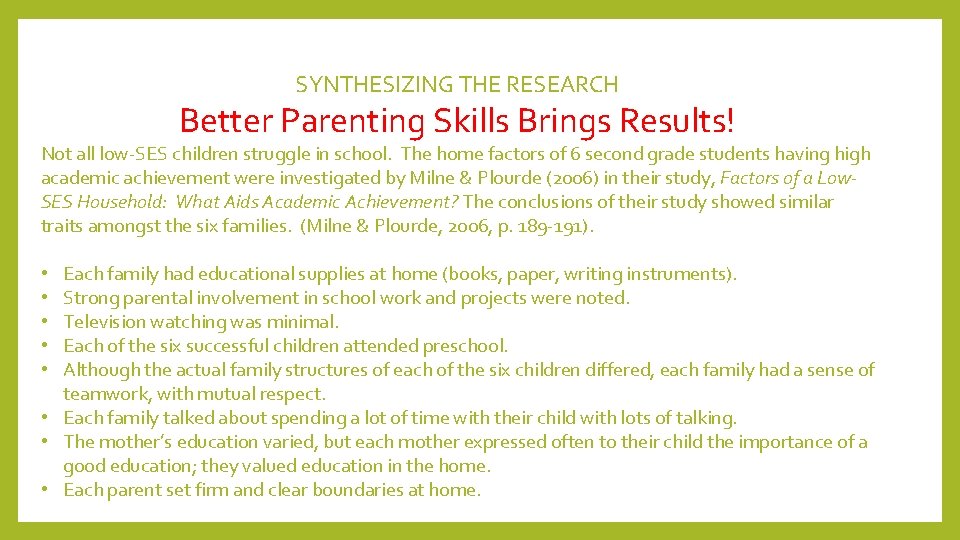
SYNTHESIZING THE RESEARCH Better Parenting Skills Brings Results! Not all low-SES children struggle in school. The home factors of 6 second grade students having high academic achievement were investigated by Milne & Plourde (2006) in their study, Factors of a Low. SES Household: What Aids Academic Achievement? The conclusions of their study showed similar traits amongst the six families. (Milne & Plourde, 2006, p. 189 -191). Each family had educational supplies at home (books, paper, writing instruments). Strong parental involvement in school work and projects were noted. Television watching was minimal. Each of the six successful children attended preschool. Although the actual family structures of each of the six children differed, each family had a sense of teamwork, with mutual respect. • Each family talked about spending a lot of time with their child with lots of talking. • The mother’s education varied, but each mother expressed often to their child the importance of a good education; they valued education in the home. • Each parent set firm and clear boundaries at home. • • •
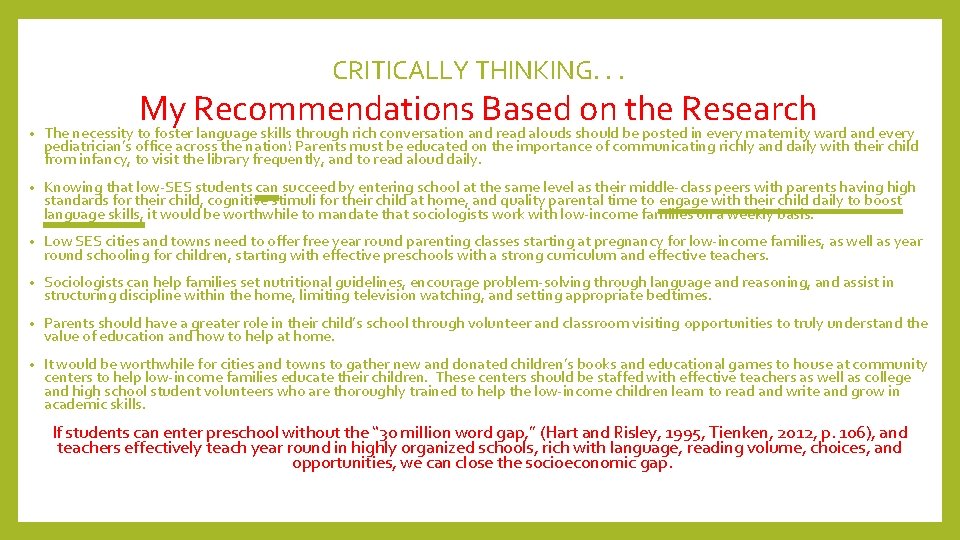
CRITICALLY THINKING. . . • My Recommendations Based on the Research The necessity to foster language skills through rich conversation and read alouds should be posted in every maternity ward and every pediatrician’s office across the nation! Parents must be educated on the importance of communicating richly and daily with their child from infancy, to visit the library frequently, and to read aloud daily. • Knowing that low-SES students can succeed by entering school at the same level as their middle-class peers with parents having high standards for their child, cognitive stimuli for their child at home, and quality parental time to engage with their child daily to boost language skills, it would be worthwhile to mandate that sociologists work with low-income families on a weekly basis. • Low SES cities and towns need to offer free year round parenting classes starting at pregnancy for low-income families, as well as year round schooling for children, starting with effective preschools with a strong curriculum and effective teachers. • Sociologists can help families set nutritional guidelines, encourage problem-solving through language and reasoning, and assist in structuring discipline within the home, limiting television watching, and setting appropriate bedtimes. • Parents should have a greater role in their child’s school through volunteer and classroom visiting opportunities to truly understand the value of education and how to help at home. • It would be worthwhile for cities and towns to gather new and donated children’s books and educational games to house at community centers to help low-income families educate their children. These centers should be staffed with effective teachers as well as college and high school student volunteers who are thoroughly trained to help the low-income children learn to read and write and grow in academic skills. If students can enter preschool without the “ 30 million word gap, ” (Hart and Risley, 1995, Tienken, 2012, p. 106), and teachers effectively teach year round in highly organized schools, rich with language, reading volume, choices, and opportunities, we can close the socioeconomic gap.
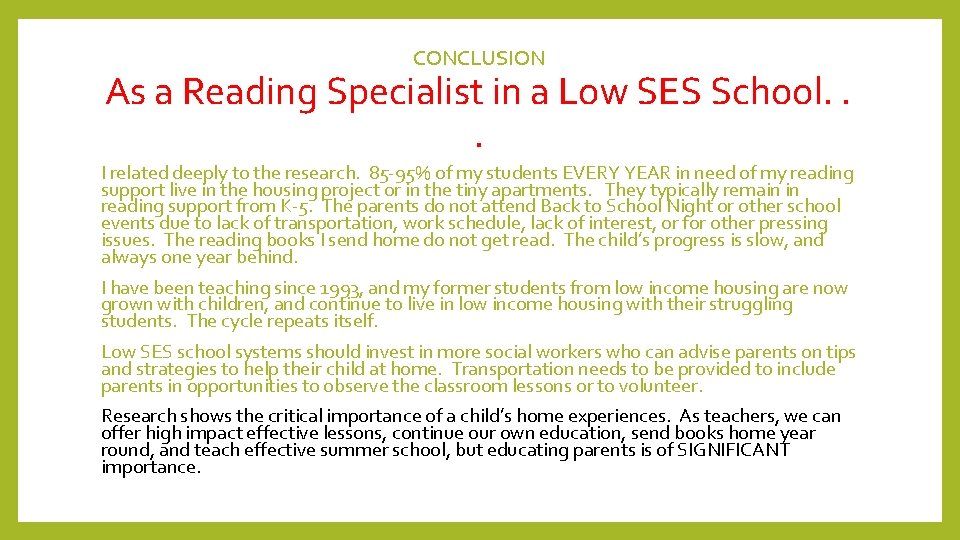
CONCLUSION As a Reading Specialist in a Low SES School. . . I related deeply to the research. 85 -95% of my students EVERY YEAR in need of my reading support live in the housing project or in the tiny apartments. They typically remain in reading support from K-5. The parents do not attend Back to School Night or other school events due to lack of transportation, work schedule, lack of interest, or for other pressing issues. The reading books I send home do not get read. The child’s progress is slow, and always one year behind. I have been teaching since 1993, and my former students from low income housing are now grown with children, and continue to live in low income housing with their struggling students. The cycle repeats itself. Low SES school systems should invest in more social workers who can advise parents on tips and strategies to help their child at home. Transportation needs to be provided to include parents in opportunities to observe the classroom lessons or to volunteer. Research shows the critical importance of a child’s home experiences. As teachers, we can offer high impact effective lessons, continue our own education, send books home year round, and teach effective summer school, but educating parents is of SIGNIFICANT importance.

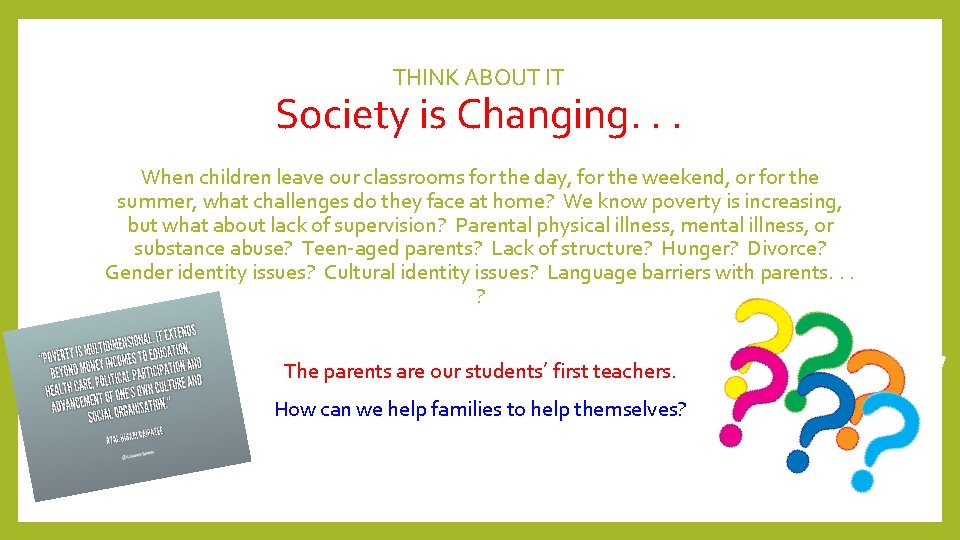
THINK ABOUT IT Society is Changing. . . When children leave our classrooms for the day, for the weekend, or for the summer, what challenges do they face at home? We know poverty is increasing, but what about lack of supervision? Parental physical illness, mental illness, or substance abuse? Teen-aged parents? Lack of structure? Hunger? Divorce? Gender identity issues? Cultural identity issues? Language barriers with parents. . . ? The parents are our students’ first teachers. How can we help families to help themselves?
Works Cited Babuder, M. K. , & Kavkler, M. (2014). THE LATENT STRUCTURE OF READING COMPREHENSION PROBLEMS IN PUPILS LIVING IN POVERTY. Hrvatska Revija Za Rehabilitacijska Istrazivanja, 50(1), 1 -12. Retrieved from https: //une. idm. oclc. org/login? url=http: //search. proquest. com. une. idm. oclc. org/docview/1556059785? accountid=1 2756 Farkas, G. (2000). Teaching low-income children to read at grade level. Contemporary Sociology, 29(1), 53 -62. Retrieved from https: //une. idm. oclc. org/login? url=http: //search. proquest. com. une. idm. oclc. org/docview/233594081? accountid=12 756 Milne, A. , & Plourde, L. A. (2006). Factors of a low-SES household: What aids academic achievement? Journal of Instructional Psychology, 33(3), 183 -193. Retrieved from https: //une. idm. oclc. org/login? url=http: //search. proquest. com. une. idm. oclc. org/docview/213905363? accountid=12 756 Tienken, Christopher H. “The Influence of Poverty on Achievement. ” Kappa Delta Pi Record 48. 3 (2012): 105 -07. Web. All images are from Google Images.
- Slides: 11