
THE COPING STRATEGY INDEX CSI Tools and Methodology
- Slides: 19
THE COPING STRATEGY INDEX (CSI) Tools and Methodology Sentinel Site Training- Kabul, Afghanistan May 20 -22 2012 Aida Ndiaye
OVERVIEW CSI – basic LOGIC CSI – basic question CSI (reduced)– the indicator (or index) CSI – utility and utilization CSI – the tool CSI – computing the index CSI –understanding CSI scores Exercises
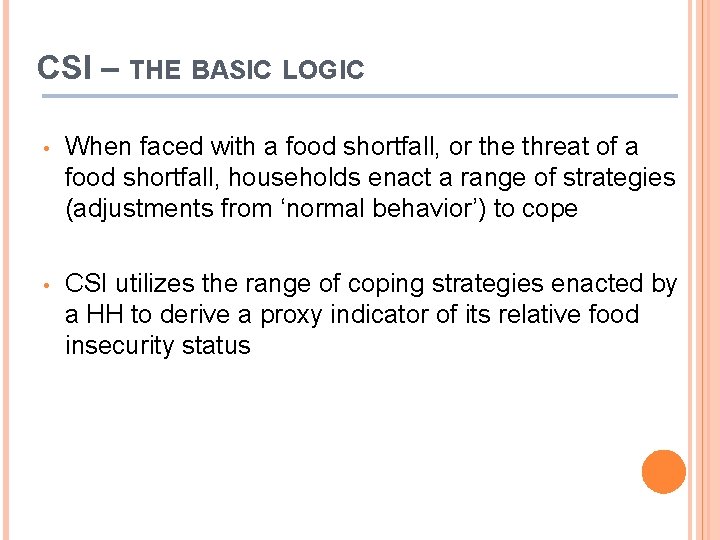
CSI – THE BASIC LOGIC • When faced with a food shortfall, or the threat of a food shortfall, households enact a range of strategies (adjustments from ‘normal behavior’) to cope • CSI utilizes the range of coping strategies enacted by a HH to derive a proxy indicator of its relative food insecurity status
CSI – BASIC QUESTION ‘What do you do when you don’t have enough food and don’t have enough money to buy food? ’
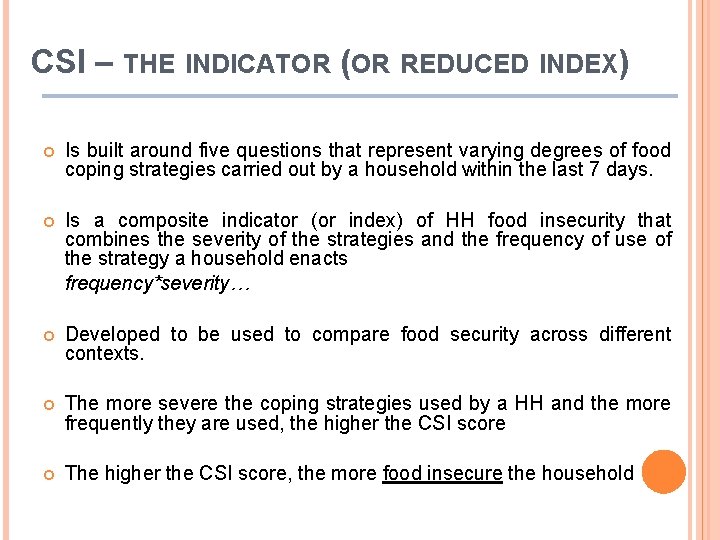
CSI – THE INDICATOR (OR REDUCED INDEX) Is built around five questions that represent varying degrees of food coping strategies carried out by a household within the last 7 days. Is a composite indicator (or index) of HH food insecurity that combines the severity of the strategies and the frequency of use of the strategy a household enacts frequency*severity… Developed to be used to compare food security across different contexts. The more severe the coping strategies used by a HH and the more frequently they are used, the higher the CSI score The higher the CSI score, the more food insecure the household
CSI – UTILITY AND UTILIZATION Useful as both current (situation analysis) & leading indicator (early warning) HH can be compared within and between contexts
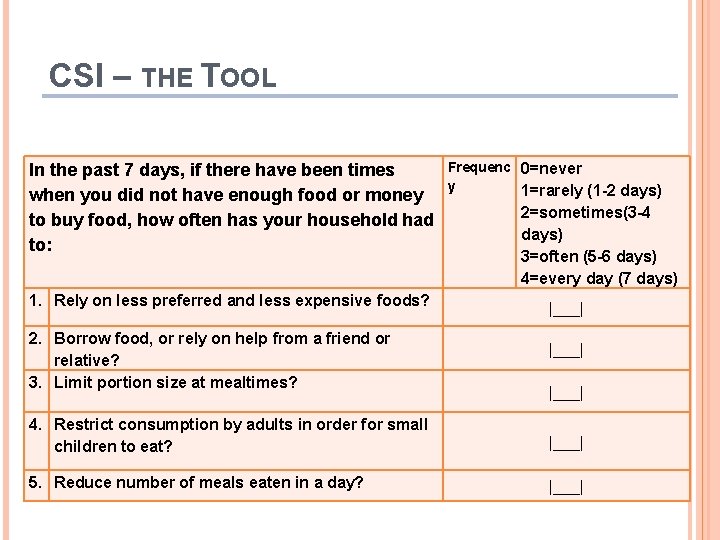
CSI – THE TOOL In the past 7 days, if there have been times when you did not have enough food or money to buy food, how often has your household had to: 1. Rely on less preferred and less expensive foods? 2. Borrow food, or rely on help from a friend or relative? 3. Limit portion size at mealtimes? Frequenc 0=never y 1=rarely (1 -2 days) 2=sometimes(3 -4 days) 3=often (5 -6 days) 4=every day (7 days) |___| 4. Restrict consumption by adults in order for small children to eat? |___| 5. Reduce number of meals eaten in a day? |___|
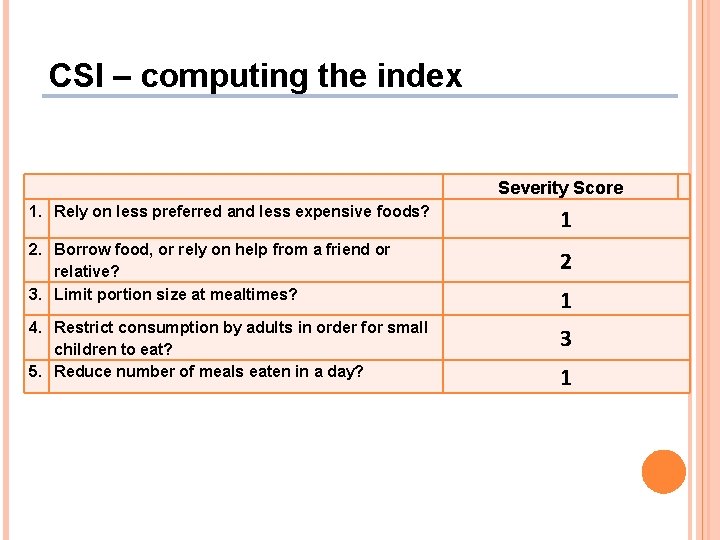
CSI – computing the index Severity Score 1. Rely on less preferred and less expensive foods? 1 2. Borrow food, or rely on help from a friend or relative? 3. Limit portion size at mealtimes? 2 4. Restrict consumption by adults in order for small children to eat? 5. Reduce number of meals eaten in a day? 3 1 1
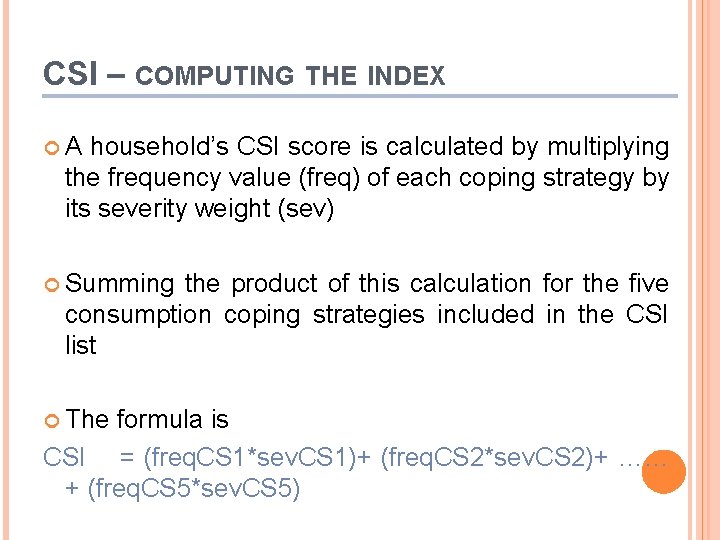
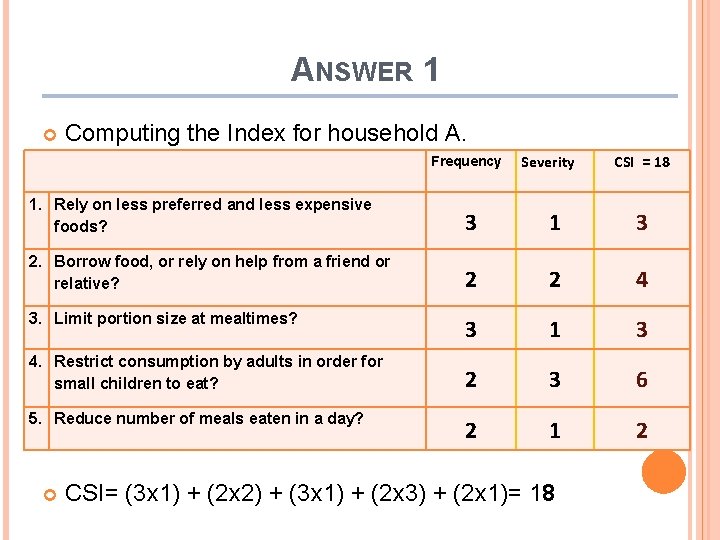
CSI – COMPUTING THE INDEX A household’s CSI score is calculated by multiplying the frequency value (freq) of each coping strategy by its severity weight (sev) Summing the product of this calculation for the five consumption coping strategies included in the CSI list The formula is CSI = (freq. CS 1*sev. CS 1)+ (freq. CS 2*sev. CS 2)+ …… + (freq. CS 5*sev. CS 5)
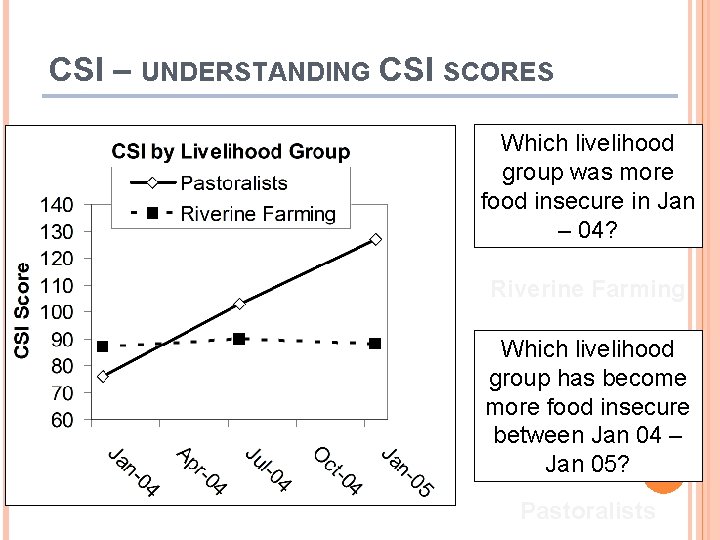
CSI – UNDERSTANDING CSI SCORES Which livelihood group was more food insecure in Jan – 04? Riverine Farming Which livelihood group has become more food insecure between Jan 04 – Jan 05? Pastoralists
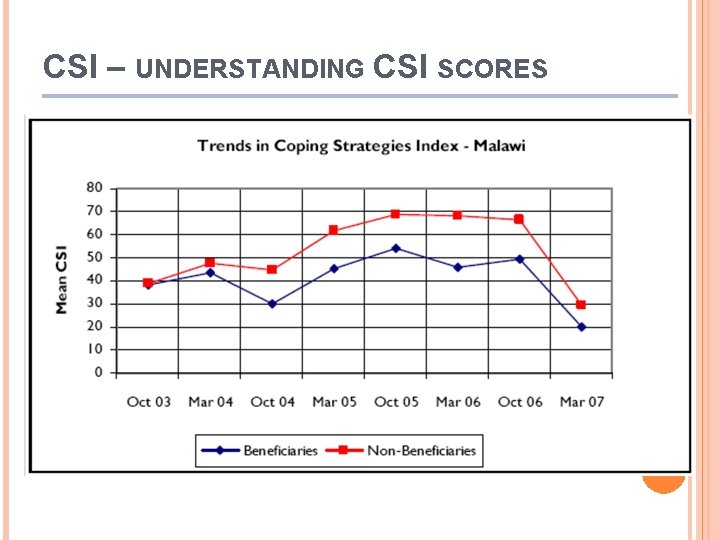
CSI – UNDERSTANDING CSI SCORES
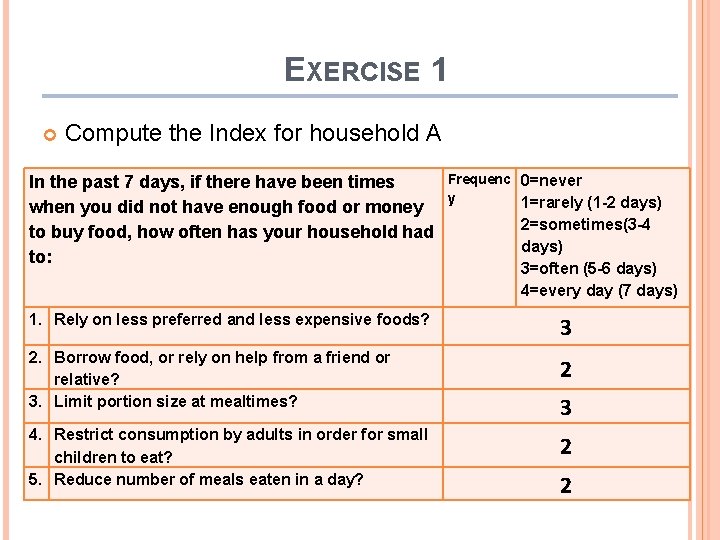
EXERCISE 1 Compute the Index for household A In the past 7 days, if there have been times when you did not have enough food or money to buy food, how often has your household had to: Frequenc 0=never y 1=rarely (1 -2 days) 2=sometimes(3 -4 days) 3=often (5 -6 days) 4=every day (7 days) 1. Rely on less preferred and less expensive foods? 3 2. Borrow food, or rely on help from a friend or relative? 3. Limit portion size at mealtimes? 2 4. Restrict consumption by adults in order for small children to eat? 5. Reduce number of meals eaten in a day? 2 3 2
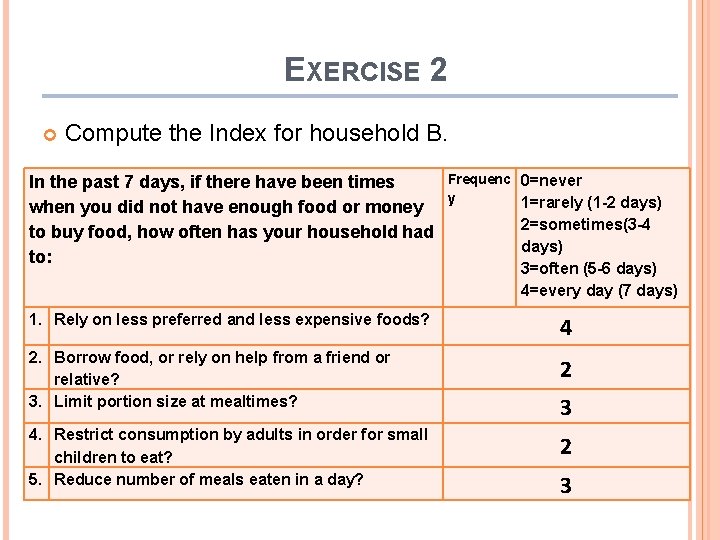
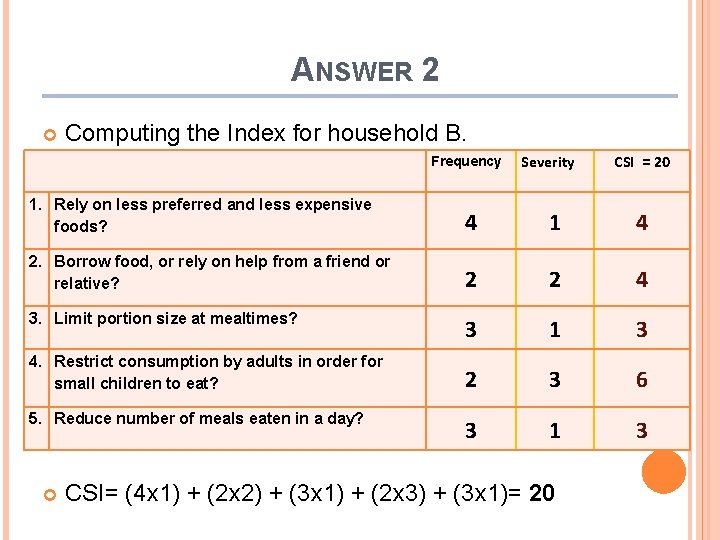
EXERCISE 2 Compute the Index for household B. In the past 7 days, if there have been times when you did not have enough food or money to buy food, how often has your household had to: Frequenc 0=never y 1=rarely (1 -2 days) 2=sometimes(3 -4 days) 3=often (5 -6 days) 4=every day (7 days) 1. Rely on less preferred and less expensive foods? 4 2. Borrow food, or rely on help from a friend or relative? 3. Limit portion size at mealtimes? 2 4. Restrict consumption by adults in order for small children to eat? 5. Reduce number of meals eaten in a day? 2 3 3
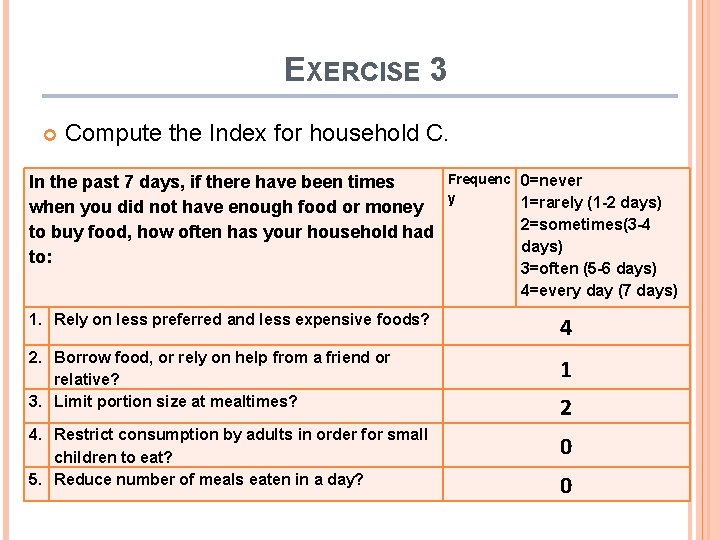
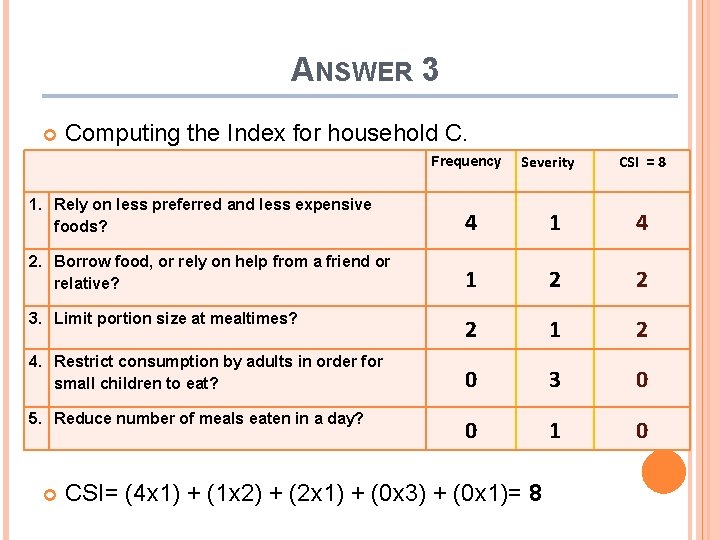
EXERCISE 3 Compute the Index for household C. In the past 7 days, if there have been times when you did not have enough food or money to buy food, how often has your household had to: Frequenc 0=never y 1=rarely (1 -2 days) 2=sometimes(3 -4 days) 3=often (5 -6 days) 4=every day (7 days) 1. Rely on less preferred and less expensive foods? 4 2. Borrow food, or rely on help from a friend or relative? 3. Limit portion size at mealtimes? 1 4. Restrict consumption by adults in order for small children to eat? 5. Reduce number of meals eaten in a day? 0 2 0
QUESTIONS Which household is the most food insecure? Which household is least food insecure?
ANSWER 1 Computing the Index for household A. Frequency Severity CSI = 18 1. Rely on less preferred and less expensive foods? 3 1 3 2. Borrow food, or rely on help from a friend or relative? 2 2 4 3 1 3 2 3 6 2 1 2 3. Limit portion size at mealtimes? 4. Restrict consumption by adults in order for small children to eat? 5. Reduce number of meals eaten in a day? CSI= (3 x 1) + (2 x 2) + (3 x 1) + (2 x 3) + (2 x 1)= 18
ANSWER 2 Computing the Index for household B. Frequency Severity CSI = 20 1. Rely on less preferred and less expensive foods? 4 1 4 2. Borrow food, or rely on help from a friend or relative? 2 2 4 3 1 3 2 3 6 3 1 3 3. Limit portion size at mealtimes? 4. Restrict consumption by adults in order for small children to eat? 5. Reduce number of meals eaten in a day? CSI= (4 x 1) + (2 x 2) + (3 x 1) + (2 x 3) + (3 x 1)= 20
ANSWER 3 Computing the Index for household C. Frequency Severity CSI = 8 1. Rely on less preferred and less expensive foods? 4 1 4 2. Borrow food, or rely on help from a friend or relative? 1 2 2 2 1 2 0 3 0 0 1 0 3. Limit portion size at mealtimes? 4. Restrict consumption by adults in order for small children to eat? 5. Reduce number of meals eaten in a day? CSI= (4 x 1) + (1 x 2) + (2 x 1) + (0 x 3) + (0 x 1)= 8
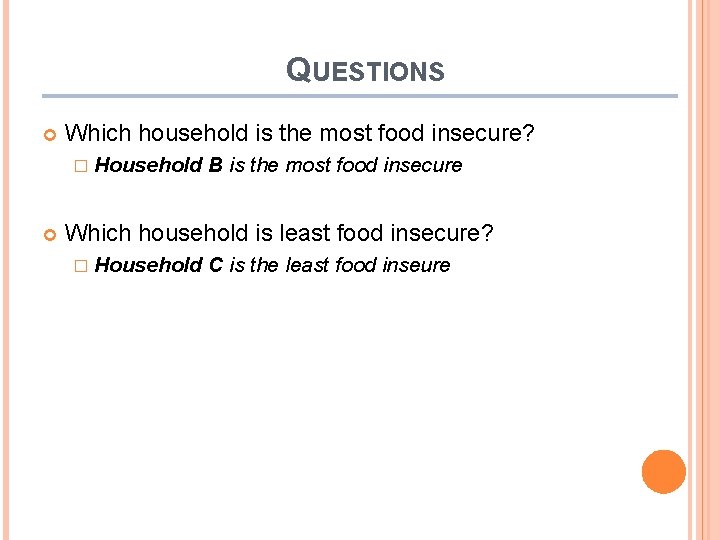
QUESTIONS Which household is the most food insecure? � Household B is the most food insecure Which household is least food insecure? � Household C is the least food inseure