
The Cooling System What does it do w


- Slides: 20
The Cooling System
What does it do? w Maintains a constant engine operating temperature w It removes excess combustion heat to prevent engine damage w Also speeds engine warm-up w Lubricates water pump
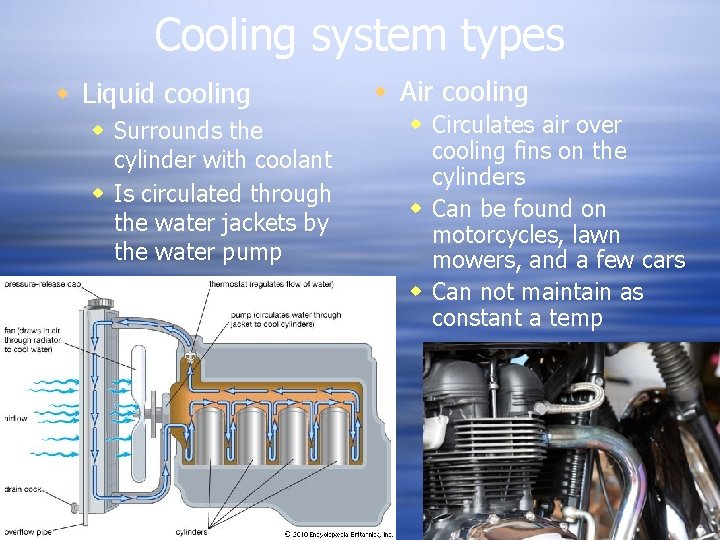
Cooling system types w Liquid cooling w Surrounds the cylinder with coolant w Is circulated through the water jackets by the water pump w Air cooling w Circulates air over cooling fins on the cylinders w Can be found on motorcycles, lawn mowers, and a few cars w Can not maintain as constant a temp
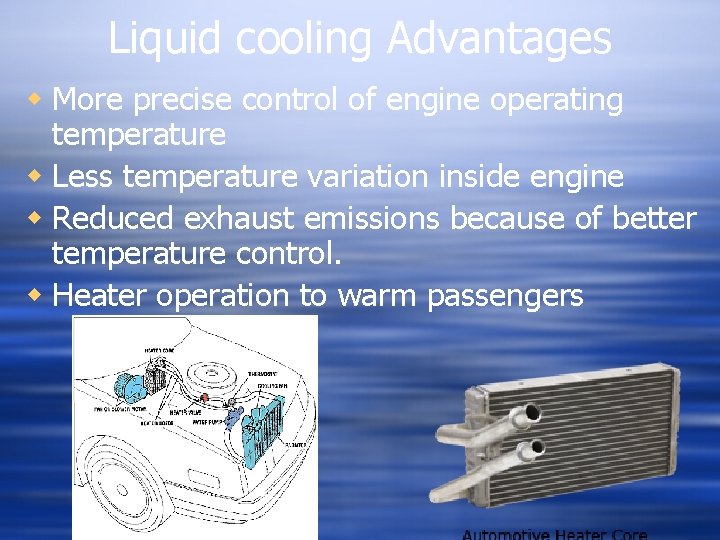
Liquid cooling Advantages w More precise control of engine operating temperature w Less temperature variation inside engine w Reduced exhaust emissions because of better temperature control. w Heater operation to warm passengers
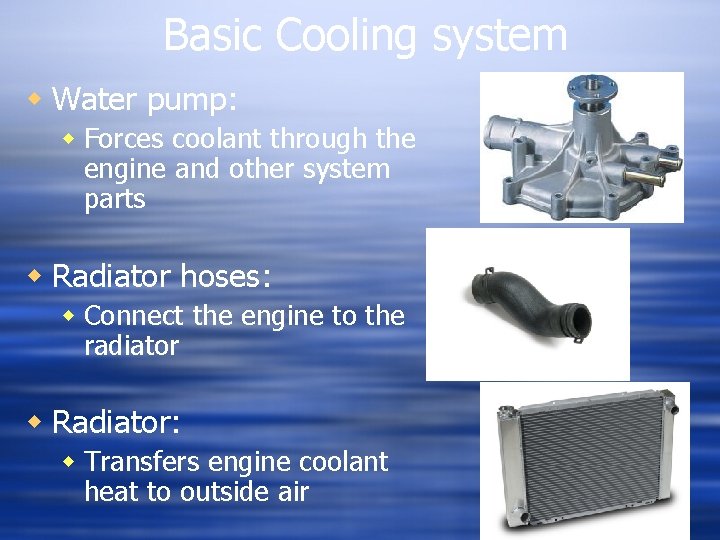
Basic Cooling system w Water pump: w Forces coolant through the engine and other system parts w Radiator hoses: w Connect the engine to the radiator w Radiator: w Transfers engine coolant heat to outside air
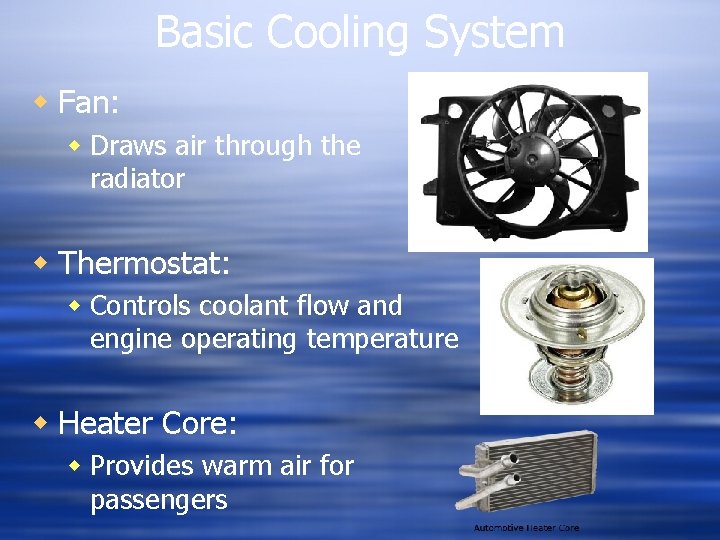
Basic Cooling System w Fan: w Draws air through the radiator w Thermostat: w Controls coolant flow and engine operating temperature w Heater Core: w Provides warm air for passengers
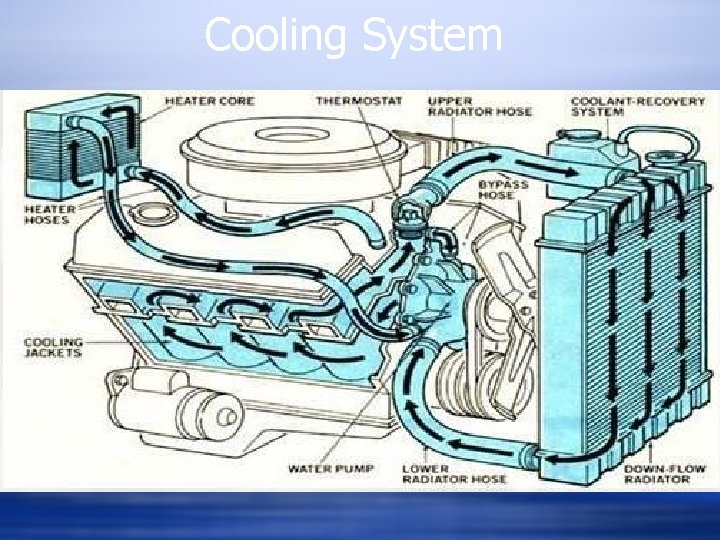
Cooling System
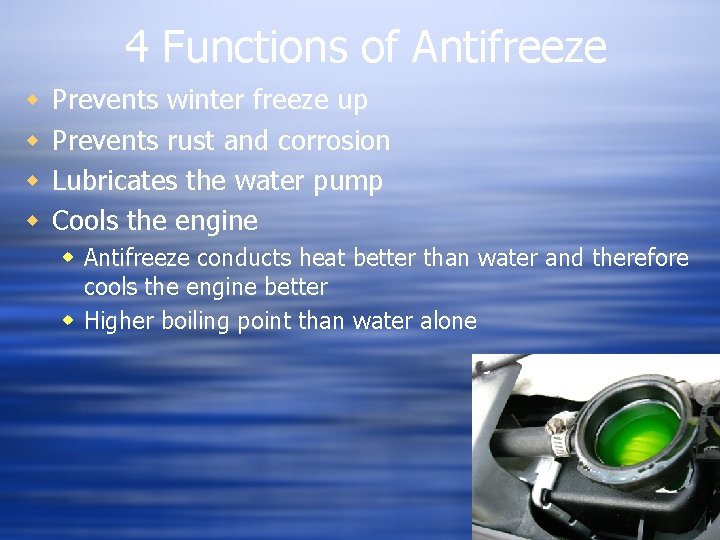
4 Functions of Antifreeze w w Prevents winter freeze up Prevents rust and corrosion Lubricates the water pump Cools the engine w Antifreeze conducts heat better than water and therefore cools the engine better w Higher boiling point than water alone
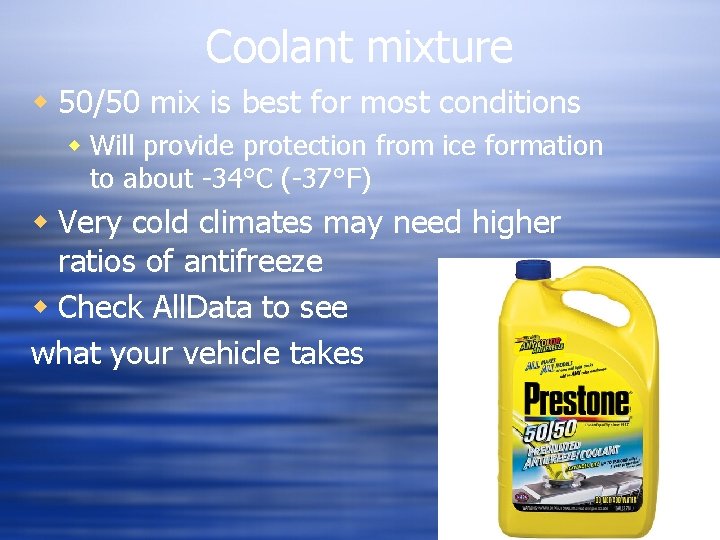
Coolant mixture w 50/50 mix is best for most conditions w Will provide protection from ice formation to about -34°C (-37°F) w Very cold climates may need higher ratios of antifreeze w Check All. Data to see what your vehicle takes
Reaching operating temperature quickly… or else! w Poor combustion w Part wear w Oil contamination w Reduced fuel economy w Increased emissions
The Thermostat w Senses engine temperature and controls coolant flow through the radiator. w It reduces coolant flow when the engine is cold w It increases coolant flow when the engine is hot
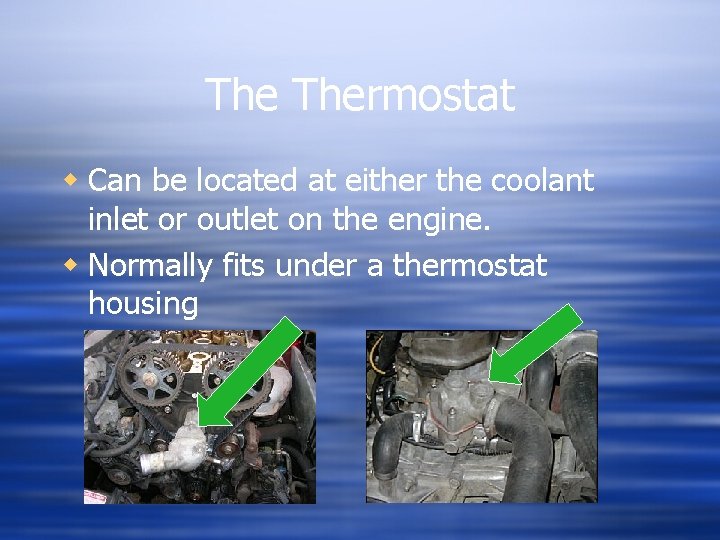
The Thermostat w Can be located at either the coolant inlet or outlet on the engine. w Normally fits under a thermostat housing
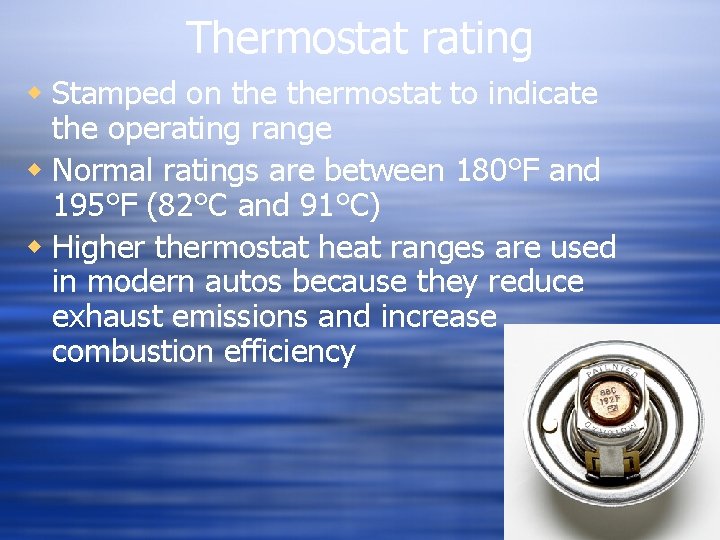
Thermostat rating w Stamped on thermostat to indicate the operating range w Normal ratings are between 180°F and 195°F (82°C and 91°C) w Higher thermostat heat ranges are used in modern autos because they reduce exhaust emissions and increase combustion efficiency
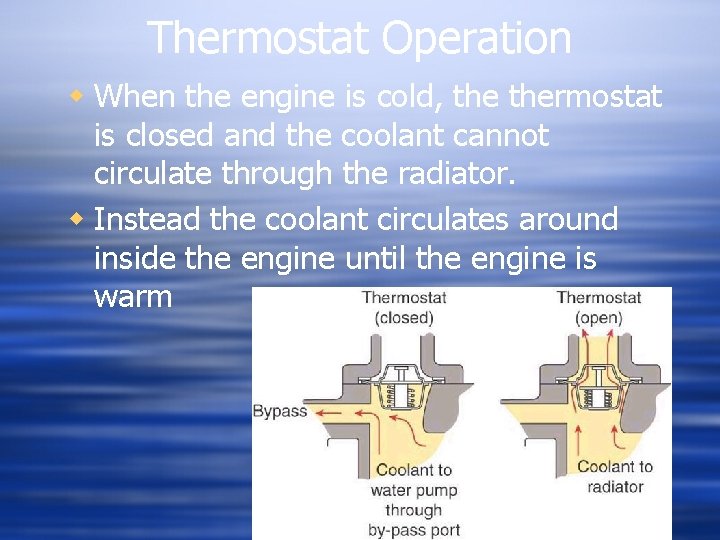
Thermostat Operation w When the engine is cold, thermostat is closed and the coolant cannot circulate through the radiator. w Instead the coolant circulates around inside the engine until the engine is warm
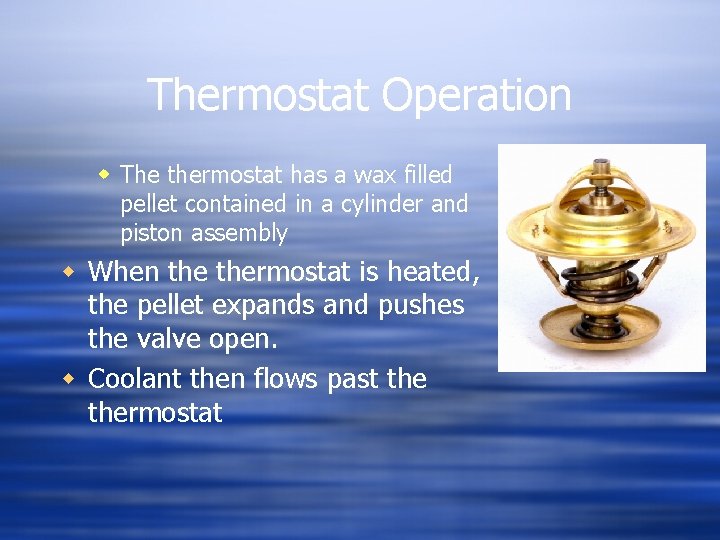
Thermostat Operation w The thermostat has a wax filled pellet contained in a cylinder and piston assembly w When thermostat is heated, the pellet expands and pushes the valve open. w Coolant then flows past thermostat
Wax pellet cut away
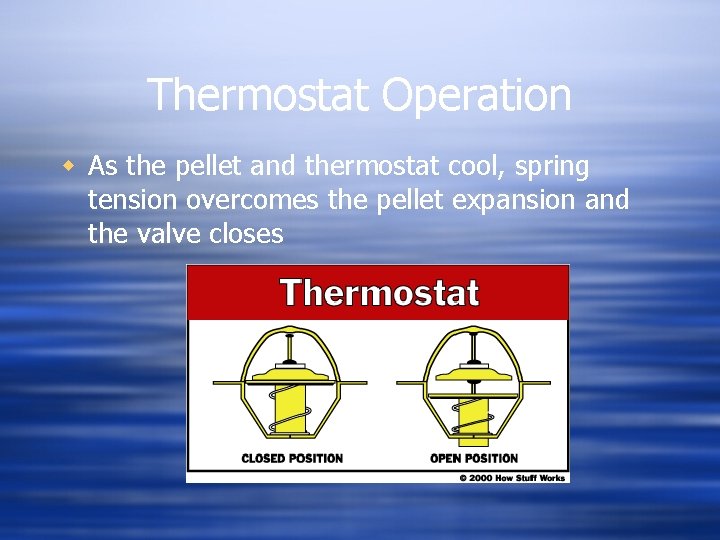
Thermostat Operation w As the pellet and thermostat cool, spring tension overcomes the pellet expansion and the valve closes
w The thermostat will open gradually as the heat melts the wax pellet w This gives a the engine a very consistent operating temperature w Usually between 180°F and 210°F
Chapter 39 p. 711 Review Questions #1 -20 p. 728