
The contribution of ICT in achieving the new
The contribution of ICT in achieving the new Lisbon Agenda Puntoit/Key 4 Biz Workshop 7 th June 2005 Brian Williamson David Lewin +44 207 324 1800 www. indepen. co. uk 1
Agenda 1. The challenge – a productivity problem in Europe 2. Market context to 2010 – regulation is not keeping pace 3. Allowing “creative destruction” to revitalise Europe 4. Moving forward 2
1. The Challenge A productivity problem in Europe 3
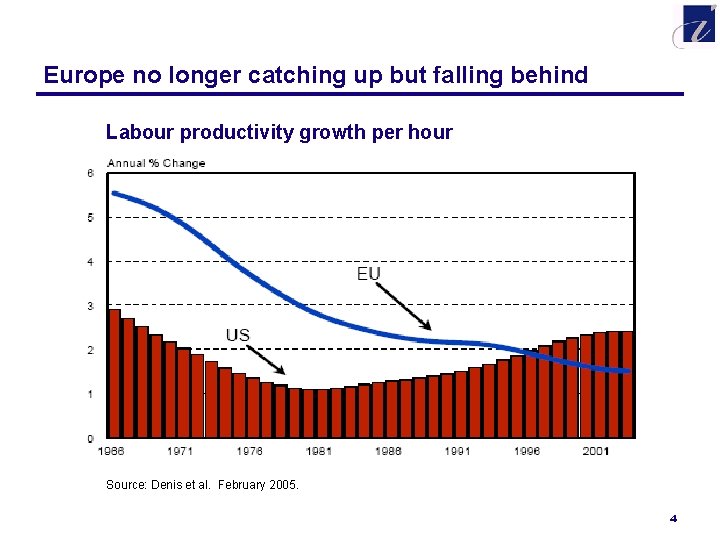
Europe no longer catching up but falling behind Labour productivity growth per hour Source: Denis et al. February 2005. 4
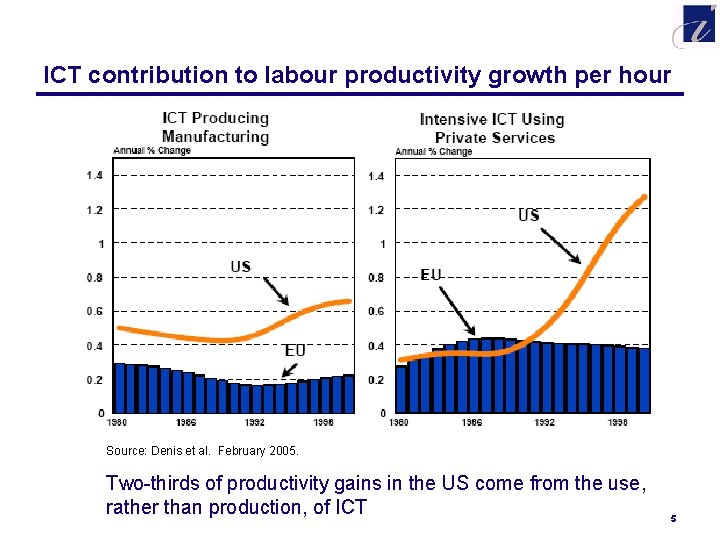
ICT contribution to labour productivity growth per hour Source: Denis et al. February 2005. Two-thirds of productivity gains in the US come from the use, rather than production, of ICT 5
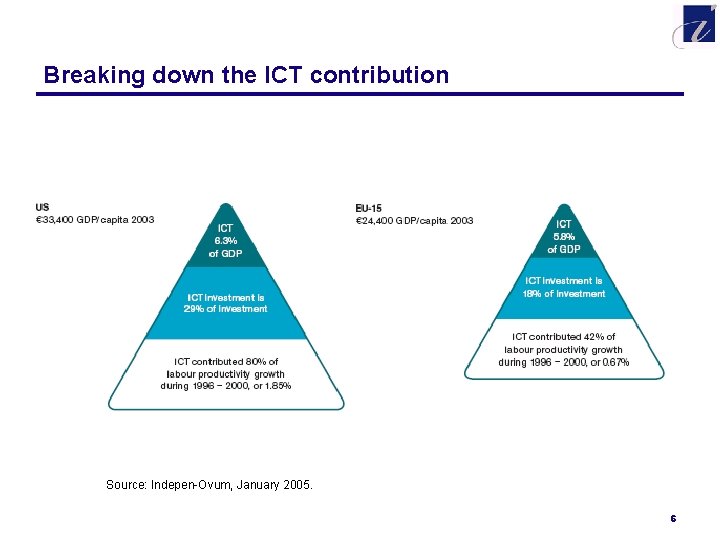
Breaking down the ICT contribution Source: Indepen-Ovum, January 2005. 6
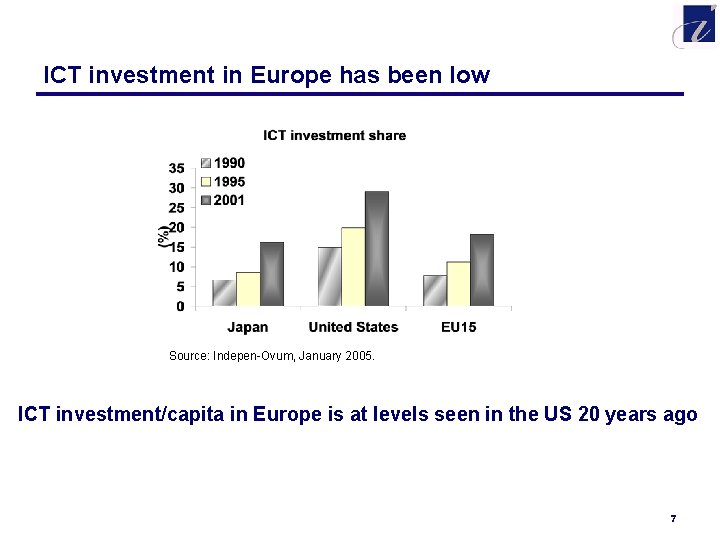
ICT investment in Europe has been low Source: Indepen-Ovum, January 2005. ICT investment/capita in Europe is at levels seen in the US 20 years ago 7
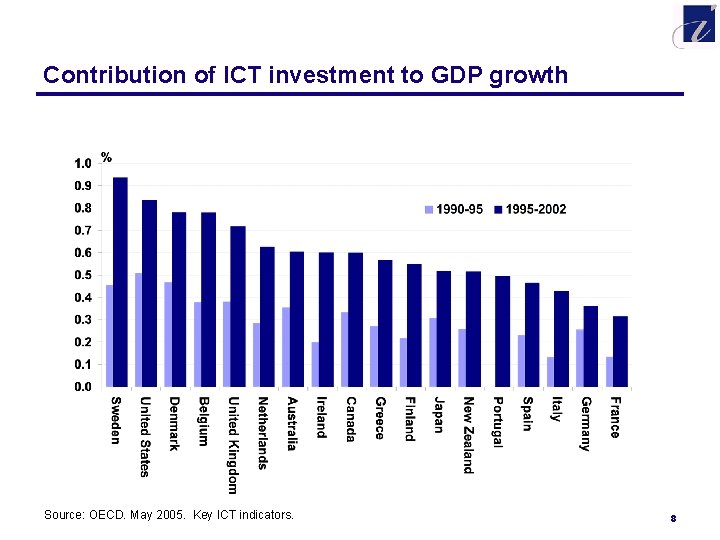
Contribution of ICT investment to GDP growth Source: OECD. May 2005. Key ICT indicators. 8
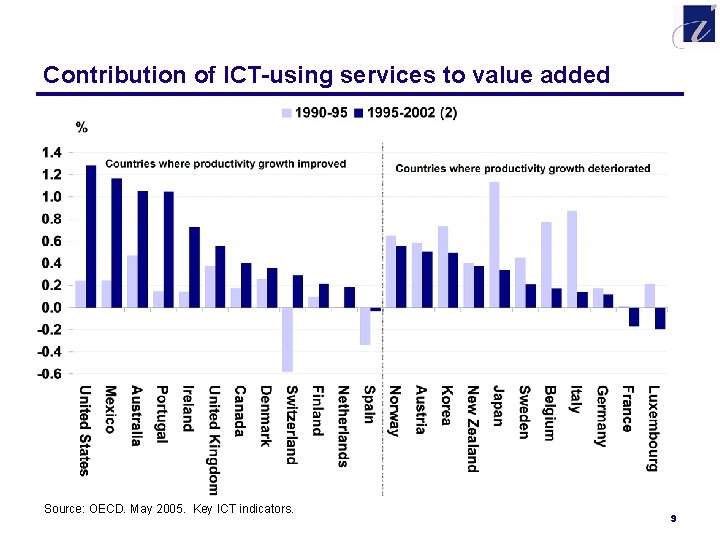
Contribution of ICT-using services to value added Source: OECD. May 2005. Key ICT indicators. 9
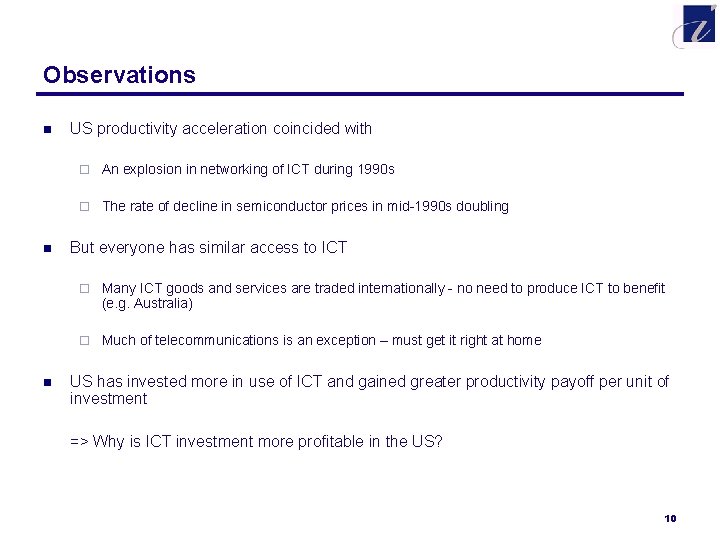
Observations n n n US productivity acceleration coincided with ¨ An explosion in networking of ICT during 1990 s ¨ The rate of decline in semiconductor prices in mid-1990 s doubling But everyone has similar access to ICT ¨ Many ICT goods and services are traded internationally - no need to produce ICT to benefit (e. g. Australia) ¨ Much of telecommunications is an exception – must get it right at home US has invested more in use of ICT and gained greater productivity payoff per unit of investment => Why is ICT investment more profitable in the US? 10
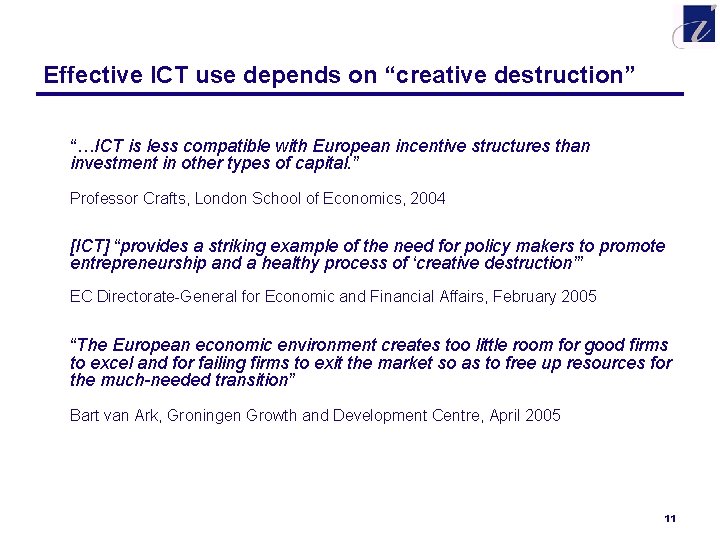
Effective ICT use depends on “creative destruction” “…ICT is less compatible with European incentive structures than investment in other types of capital. ” Professor Crafts, London School of Economics, 2004 [ICT] “provides a striking example of the need for policy makers to promote entrepreneurship and a healthy process of ‘creative destruction’” EC Directorate-General for Economic and Financial Affairs, February 2005 “The European economic environment creates too little room for good firms to excel and for failing firms to exit the market so as to free up resources for the much-needed transition” Bart van Ark, Groningen Growth and Development Centre, April 2005 11
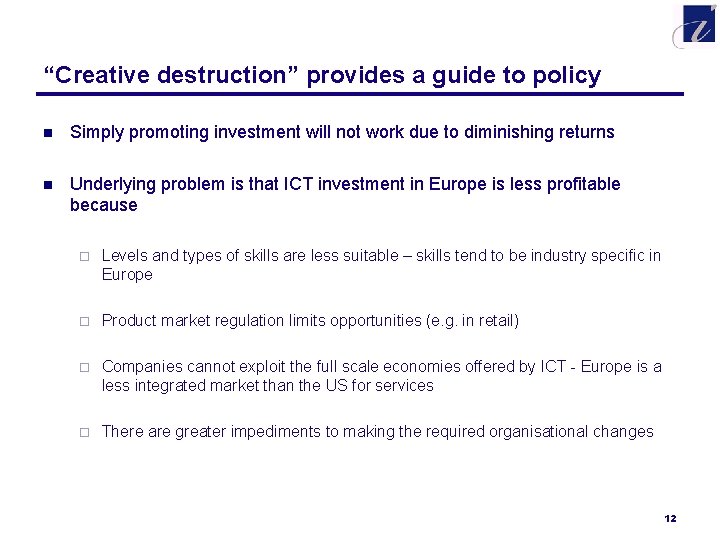
“Creative destruction” provides a guide to policy n Simply promoting investment will not work due to diminishing returns n Underlying problem is that ICT investment in Europe is less profitable because ¨ Levels and types of skills are less suitable – skills tend to be industry specific in Europe ¨ Product market regulation limits opportunities (e. g. in retail) ¨ Companies cannot exploit the full scale economies offered by ICT - Europe is a less integrated market than the US for services ¨ There are greater impediments to making the required organisational changes 12
2. Market context to 2010 Regulation is not keeping pace 13
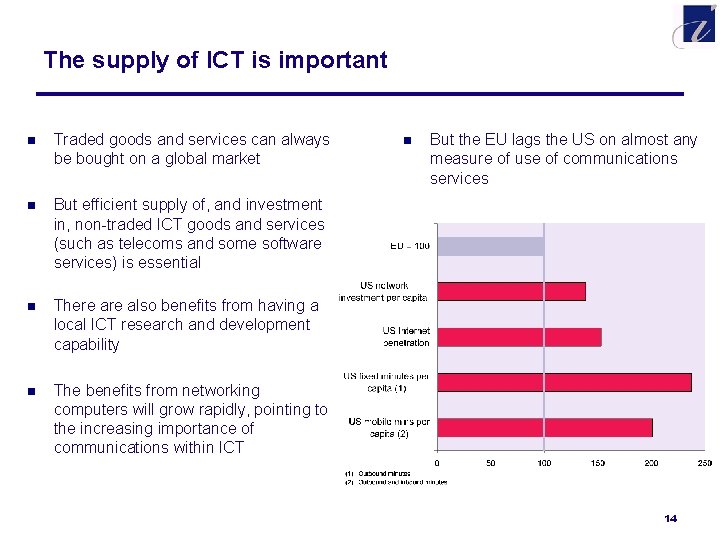
The supply of ICT is important n Traded goods and services can always be bought on a global market n But efficient supply of, and investment in, non-traded ICT goods and services (such as telecoms and some software services) is essential n There also benefits from having a local ICT research and development capability n The benefits from networking computers will grow rapidly, pointing to the increasing importance of communications within ICT n But the EU lags the US on almost any measure of use of communications services 14
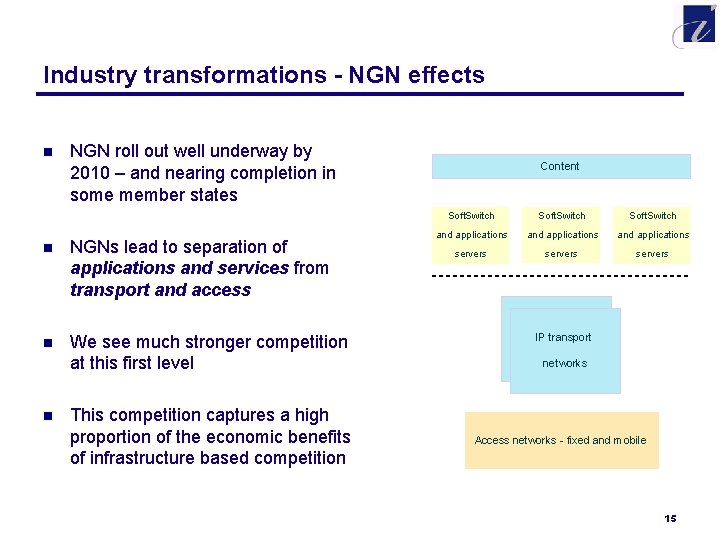
Industry transformations - NGN effects n NGN roll out well underway by 2010 – and nearing completion in some member states n NGNs lead to separation of applications and services from transport and access n We see much stronger competition at this first level n This competition captures a high proportion of the economic benefits of infrastructure based competition Content Soft. Switch and applications servers IP transport networks Access networks - fixed and mobile 15
Industry transformations - other n Slow down in market growth (<1% pa in real terms) will push operators into value added and content based services n Growing cross platform competition: between fixed and mobile operators for voice calls ¨ fixed incumbent will compete vigorously with CATV operators for triple play consumer spend in most EU countries ¨ n Substantial consolidation: carrier selection based Alt. Nets will disappear (or become ISPs) ¨ altnets with directly connected customers will merge for greater economies of scale ¨ corporate Altnets will reposition themselves or disappear ¨ 16
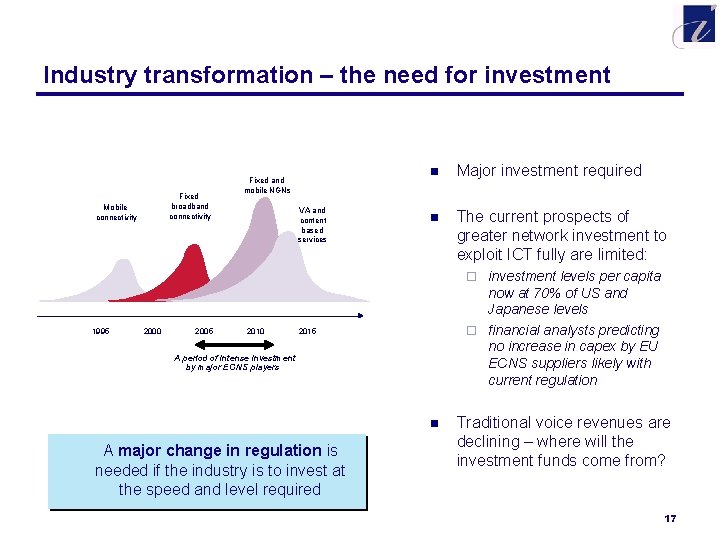
Industry transformation – the need for investment Fixed broadband connectivity Mobile connectivity Fixed and mobile NGNs VA and content based services n Major investment required n The current prospects of greater network investment to exploit ICT fully are limited: investment levels per capita now at 70% of US and Japanese levels ¨ financial analysts predicting no increase in capex by EU ECNS suppliers likely with current regulation ¨ 1995 2000 2005 2010 2015 A period of intense investment by major ECNS players n A major change in regulation is needed if the industry is to invest at the speed and level required Traditional voice revenues are declining – where will the investment funds come from? 17
Industry transformation and regulation n Current regulation is backward focussed – on declining fixed voice markets n Current regulation does not work well with new multi-service platforms: ¨ ¨ ¨ lots of uncertainty over which services will work on these platforms not enough information to apply the NRF big economies of scope between supply of services so… …bundles of services rather than individual services could form the new markets eg triple play high risk investment but potential for major dynamic efficiency gains New regulatory imperative – a need to encourage investment and innovation through the new multi service platforms 18
3. Allowing “creative destruction” to revitalise Europe 19
Make ICT use more productive and profitable n Greater human capital and labour market flexibility n Greater product and service market flexibility and integration n Enable better use of ICT in the public sector Switch from targets to proper assessment of costs and benefits ¨ Benchmark against international best practice ¨ Target funding on e-policy projects that cross traditional boundaries ¨ Develop budgetary processes and policies that are ICT capital friendly ¨ n A new (and necessary? ) means of achieving European “social model” 20
Rethink general policy approach n Take account of the spillover benefits from ICT – as is done with environmental impacts n Focus on the dynamic gains from market expansion - more weight on innovation and investment versus short term price objectives n Do not apply any sector specific taxes to ICT (e. g. sector funded universal service obligations, levies on devices etc) n Eliminate regulatory approaches that cannot keep pace with technological and market developments n Improve access to premium content and do not extend scope of content and advertising regulation to services offered over new platforms n Use European Communications Framework review to shift ex ante regulation of telecoms from one based on power in markets to one based on non replicable assets 21
A possible new regulatory framework Now Post 2006? n Markets focus for both ex ante sector specific regulation and competition law n Competition law focussed on markets and ex ante sector specific regulation focussed on non replicable assets n 18 pre-defined markets for possible ex ante regulation n Market conduct left to competition law n SMP assessment followed by imposition of obligations n Obligations imposed on supply of non replicable assets n Obligations lifted when SMP disappears n Set market triggers in advance and lift obligations to supply non replicable assets when trigger is pulled 22

4. Moving forward 23
Challenges to reform n Re-branding the Lisbon Strategy as i 2010 is not a substitute for reform n Five years after Lisbon the wording of i 2010 is complacent and short on specifics relative to the challenge n ¨ “The European electronic communications framework, in force since 2003, is an example of best practice ¨ “Businesses… still face… difficulties to reorganise and integrate ICT into the workplace” French ‘Non’ and Dutch ‘Nee’ 24
So, to move the debate forward… n Explain that the terms of the trade-off between productivity growth and ‘traditional’ social protection shifted abruptly in the mid-1990 s n Be honest about major policy change required to allow “creative destruction” on ICT supply & demand side in Europe n Develop innovative policy approaches that allow “creative destruction” consistent with the European social model 25
“…implementation of the needed reforms will be the litmus test of whether the future will bring a substantial improvement in the EU’s productivity fortunes or will confirm the EU’s ongoing decline as a global economic power. ” EC Directorate-General for Economic and Financial Affairs, February 2005 26
Bibliography n David Lewin and Brian Williamson. May 2005. “Regulating emerging markets. ” OPTA Economic Policy Note, no 5. http: //www. opta. nl/download/EPN 05_uk. pdf n OECD. May 2005. Key ICT Indicators. http: //www. oecd. org/document/23/0, 2340, en_2649_34223_33987543_1_1, 00. html n Denis, Mc. Morrow, Roger and Veugelers. February 2005. “The Lisbon strategy and the EU’s structural productivity problem. ” Economic Papers 221. EC Directorate-General for Economic and Financial Affairs. http: //europa. eu. int/comm/economy_finance/publications/economic_papers/economicpapers 221_ en. htm n Indepen and Ovum. January 2005. “Achieving the Lisbon Agenda: the contribution of ICT. A report for the Brussels Round Table. http: //www. indepen. co. uk/panda/docs/achieving_the_lisbon_agenda-fullreport. pdf n Marcello M. Estevão. October 2004. “Why Is Productivity Growth in the Euro Area So Sluggish? ” Working Paper No. 04/200. International Monetary Fund. http: //www. imf. org/external/pubs/cat/longres. cfm? sk=17757. 0 27
- Slides: 27