
The Continuum of Book Levels How Book Bands
The Continuum of Book Levels How Book Bands Can Help
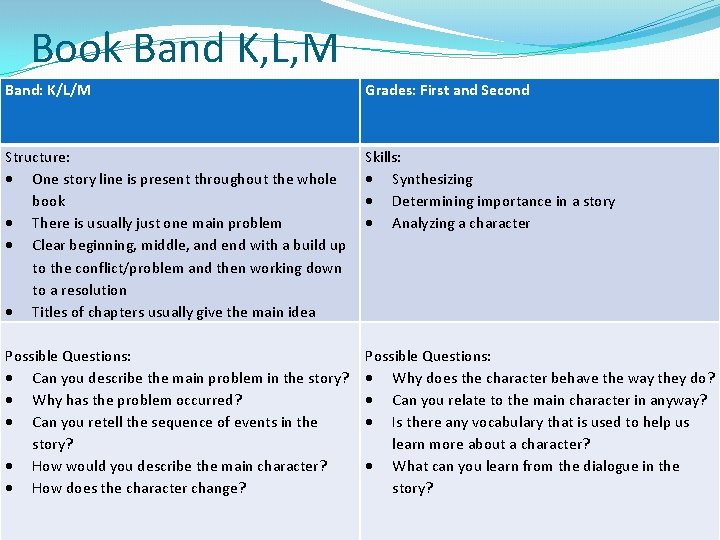
Book Band K, L, M Band: K/L/M Grades: First and Second Structure: One story line is present throughout the whole book There is usually just one main problem Clear beginning, middle, and end with a build up to the conflict/problem and then working down to a resolution Titles of chapters usually give the main idea Skills: Synthesizing Determining importance in a story Analyzing a character Possible Questions: Can you describe the main problem in the story? Why has the problem occurred? Can you retell the sequence of events in the story? How would you describe the main character? How does the character change? Possible Questions: Why does the character behave the way they do? Can you relate to the main character in anyway? Is there any vocabulary that is used to help us learn more about a character? What can you learn from the dialogue in the story?
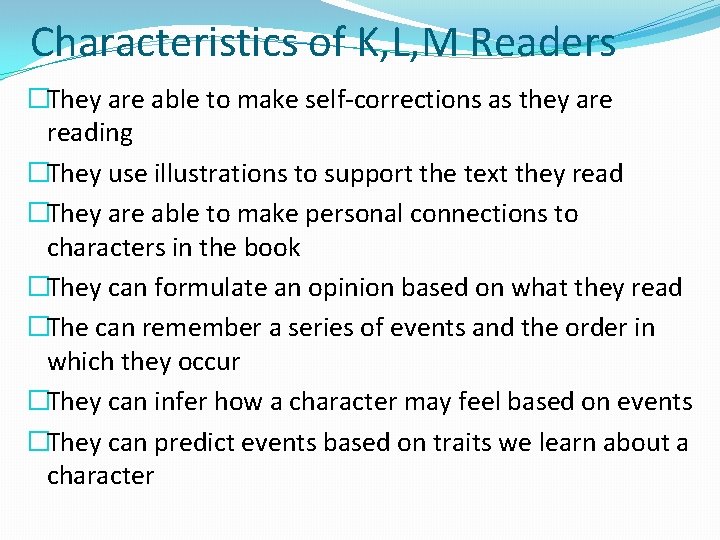
Characteristics of K, L, M Readers �They are able to make self-corrections as they are reading �They use illustrations to support the text they read �They are able to make personal connections to characters in the book �They can formulate an opinion based on what they read �The can remember a series of events and the order in which they occur �They can infer how a character may feel based on events �They can predict events based on traits we learn about a character
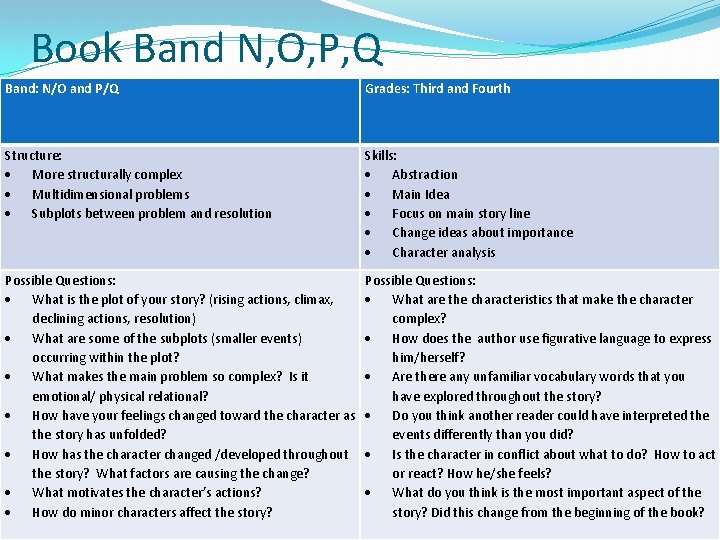
Book Band N, O, P, Q Band: N/O and P/Q Grades: Third and Fourth Structure: More structurally complex Multidimensional problems Subplots between problem and resolution Skills: Abstraction Main Idea Focus on main story line Change ideas about importance Character analysis Possible Questions: What is the plot of your story? (rising actions, climax, declining actions, resolution) What are some of the subplots (smaller events) occurring within the plot? What makes the main problem so complex? Is it emotional/ physical relational? How have your feelings changed toward the character as the story has unfolded? How has the character changed /developed throughout the story? What factors are causing the change? What motivates the character’s actions? How do minor characters affect the story? Possible Questions: What are the characteristics that make the character complex? How does the author use figurative language to express him/herself? Are there any unfamiliar vocabulary words that you have explored throughout the story? Do you think another reader could have interpreted the events differently than you did? Is the character in conflict about what to do? How to act or react? How he/she feels? What do you think is the most important aspect of the story? Did this change from the beginning of the book?
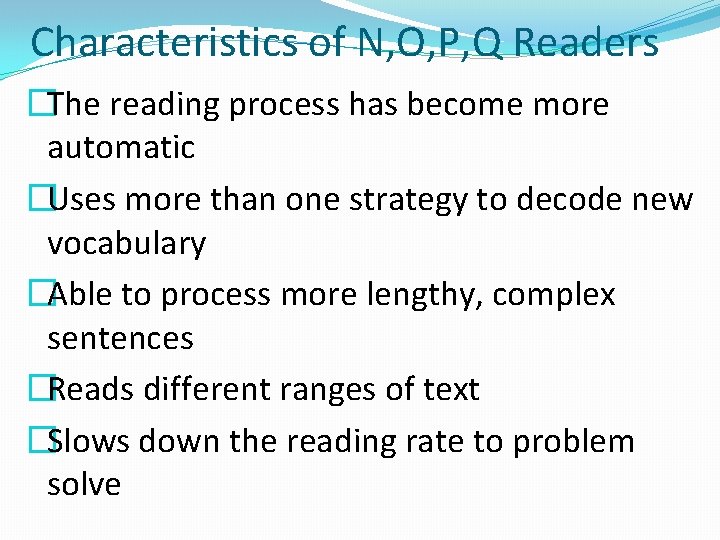
Characteristics of N, O, P, Q Readers �The reading process has become more automatic �Uses more than one strategy to decode new vocabulary �Able to process more lengthy, complex sentences �Reads different ranges of text �Slows down the reading rate to problem solve
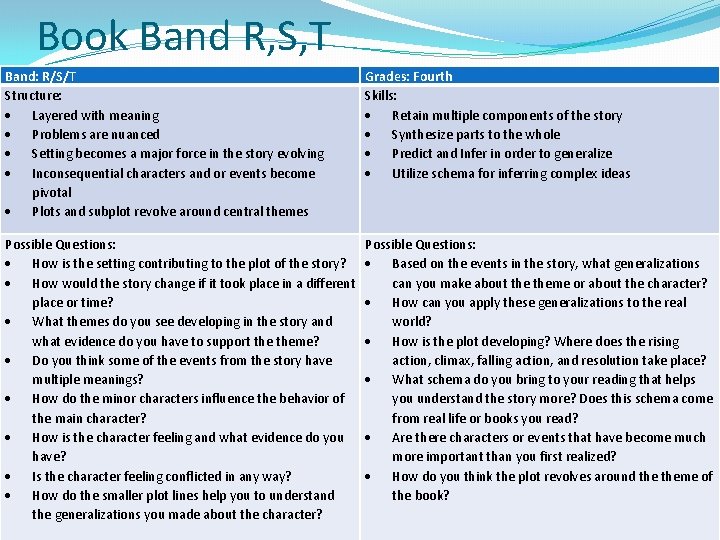
Book Band R, S, T Band: R/S/T Structure: Layered with meaning Problems are nuanced Setting becomes a major force in the story evolving Inconsequential characters and or events become pivotal Plots and subplot revolve around central themes Grades: Fourth Skills: Retain multiple components of the story Synthesize parts to the whole Predict and Infer in order to generalize Utilize schema for inferring complex ideas Possible Questions: How is the setting contributing to the plot of the story? How would the story change if it took place in a different place or time? What themes do you see developing in the story and what evidence do you have to support theme? Do you think some of the events from the story have multiple meanings? How do the minor characters influence the behavior of the main character? How is the character feeling and what evidence do you have? Is the character feeling conflicted in any way? How do the smaller plot lines help you to understand the generalizations you made about the character? Possible Questions: Based on the events in the story, what generalizations can you make about theme or about the character? How can you apply these generalizations to the real world? How is the plot developing? Where does the rising action, climax, falling action, and resolution take place? What schema do you bring to your reading that helps you understand the story more? Does this schema come from real life or books you read? Are there characters or events that have become much more important than you first realized? How do you think the plot revolves around theme of the book?
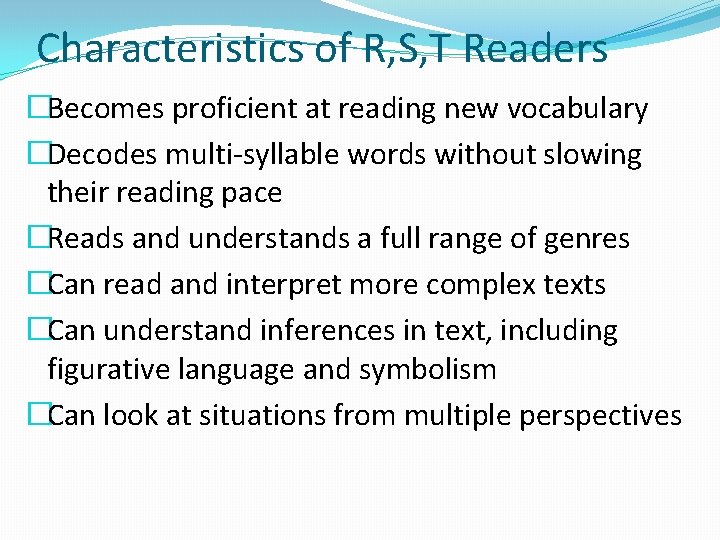
Characteristics of R, S, T Readers �Becomes proficient at reading new vocabulary �Decodes multi-syllable words without slowing their reading pace �Reads and understands a full range of genres �Can read and interpret more complex texts �Can understand inferences in text, including figurative language and symbolism �Can look at situations from multiple perspectives
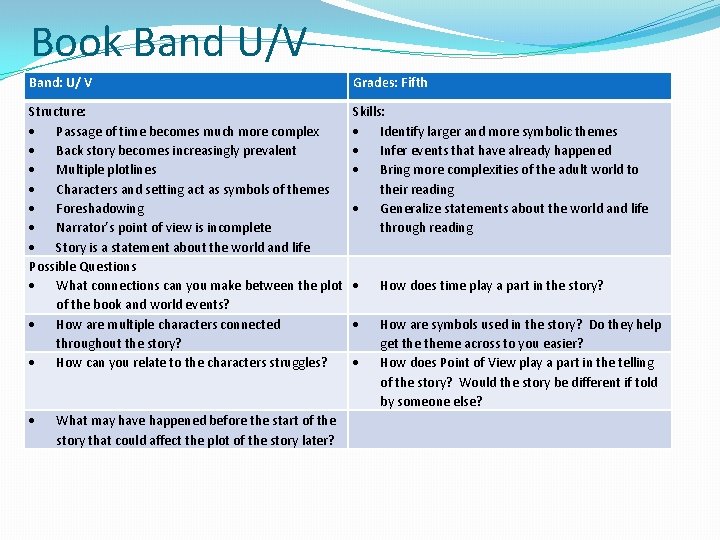
Book Band U/V Band: U/ V Grades: Fifth Structure: Passage of time becomes much more complex Back story becomes increasingly prevalent Multiple plotlines Characters and setting act as symbols of themes Foreshadowing Narrator’s point of view is incomplete Story is a statement about the world and life Possible Questions What connections can you make between the plot of the book and world events? How are multiple characters connected throughout the story? How can you relate to the characters struggles? Skills: Identify larger and more symbolic themes Infer events that have already happened Bring more complexities of the adult world to their reading Generalize statements about the world and life through reading What may have happened before the start of the story that could affect the plot of the story later? How does time play a part in the story? How are symbols used in the story? Do they help get theme across to you easier? How does Point of View play a part in the telling of the story? Would the story be different if told by someone else?
Characteristics of U/V Readers �Reading is automatic �Read a wide range of genres �Interpret complex texts including fantasy, myths and legends �Will be able to read and interpret more abstract forms of literature including satire �Highly refined skill set to take apart multi-syllable words �Uses full range of word solving skills
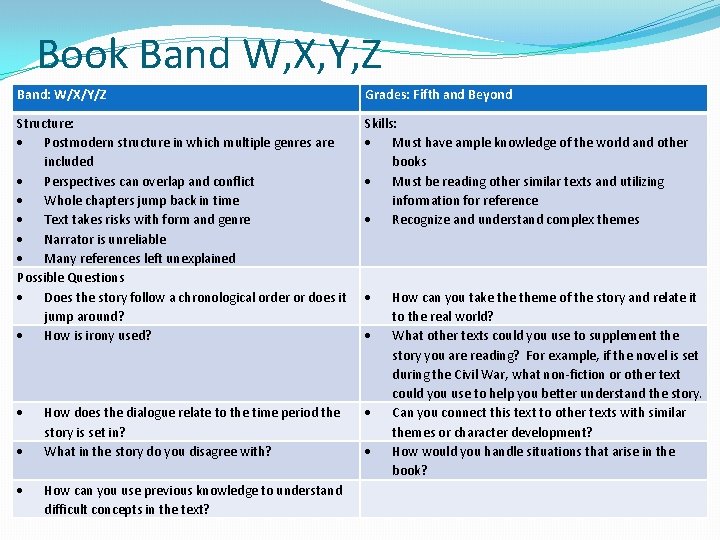
Book Band W, X, Y, Z Band: W/X/Y/Z Grades: Fifth and Beyond Structure: Postmodern structure in which multiple genres are included Perspectives can overlap and conflict Whole chapters jump back in time Text takes risks with form and genre Narrator is unreliable Many references left unexplained Possible Questions Does the story follow a chronological order or does it jump around? How is irony used? Skills: Must have ample knowledge of the world and other books Must be reading other similar texts and utilizing information for reference Recognize and understand complex themes How does the dialogue relate to the time period the story is set in? What in the story do you disagree with? How can you use previous knowledge to understand difficult concepts in the text? How can you take theme of the story and relate it to the real world? What other texts could you use to supplement the story you are reading? For example, if the novel is set during the Civil War, what non-fiction or other text could you use to help you better understand the story. Can you connect this text to other texts with similar themes or character development? How would you handle situations that arise in the book?
Characteristics of W, X, Y, Z Readers �Consistently automatic in reading complex sentences and paragraphs �Well developed reading stamina �Reads and understands texts from a full range of genres, including historical fiction written in historical linguistic style �Understands and responds to mature themes such as poverty, war, and social issues �Understands multi-dimensional themes �Assimilates settings and cultures into their comprehension �Can apply prior understandings in a critical way
- Slides: 12