
The Continuous Time Fourier Transform CTFT Extending the
![CTFS-to-CTFT Transition Below are plots of the magnitude of X[k] for 50% and 10%](https://slidetodoc.com/presentation_image_h/f8bc3e96e3a6fc8b4db647d67ab65423/image-5.jpg "CTFS-to-CTFT Transition Below are plots of the magnitude of X[k] for 50% and 10%")
- Slides: 26
The Continuous - Time Fourier Transform (CTFT)
Extending the CTFS • The CTFS is a good analysis tool for systems with periodic excitation but the CTFS cannot represent an aperiodic signal for all time • The continuous-time Fourier transform (CTFT) can represent an aperiodic signal for all time
Objective • To generalize the Fourier series to include aperiodic signals by defining the Fourier transform • To establish which type of signals can or cannot be described by a Fourier transform • To derive and demonstrate the properties of the Fourier transform
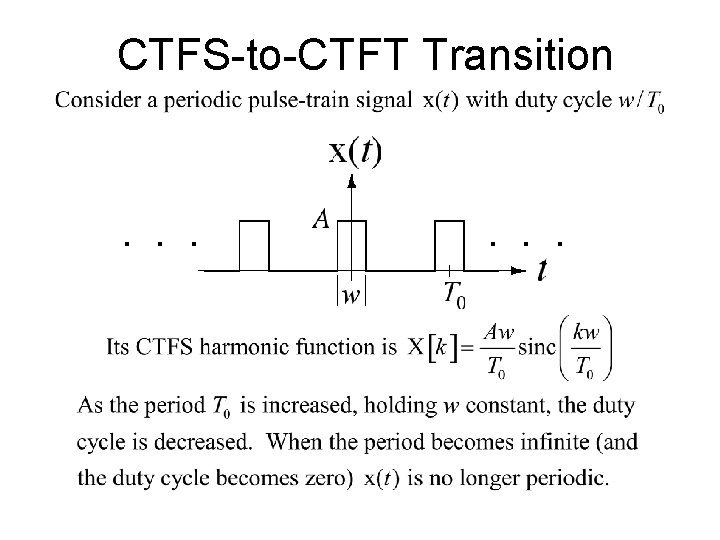
CTFS-to-CTFT Transition . . .
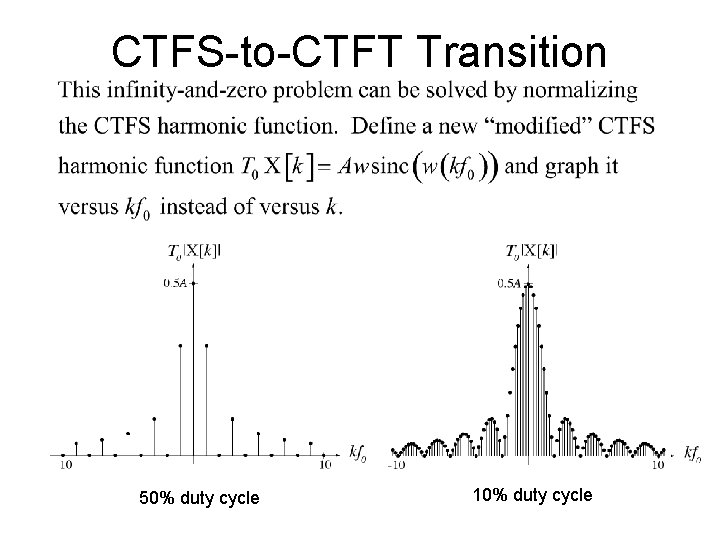
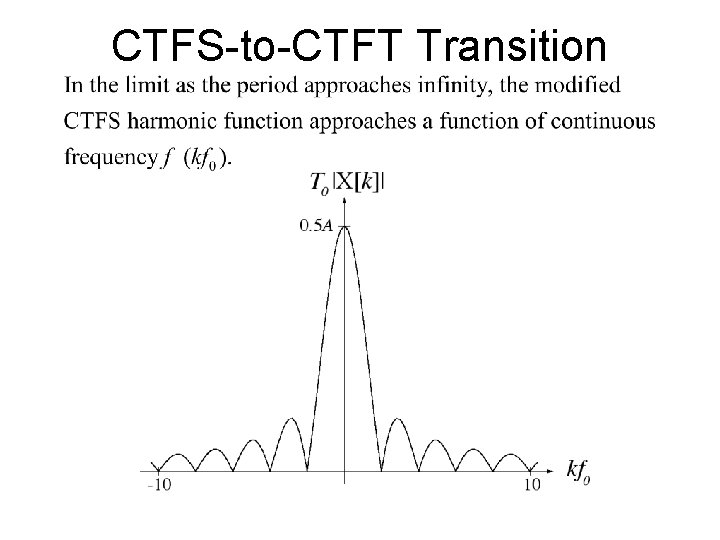
CTFS-to-CTFT Transition Below are plots of the magnitude of X[k] for 50% and 10% duty cycles. As the period increases the sinc function widens and its magnitude falls. As the period approaches infinity, the CTFS harmonic function becomes an infinitely-wide sinc function with zero amplitude.
CTFS-to-CTFT Transition 50% duty cycle 10% duty cycle
CTFS-to-CTFT Transition
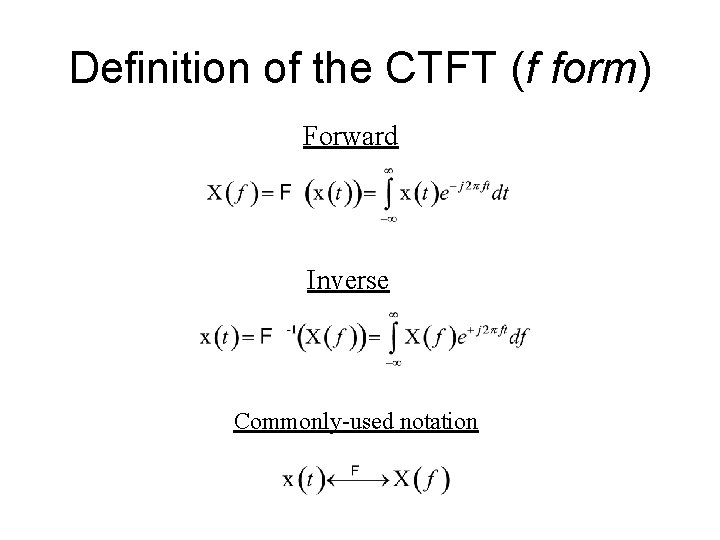
Definition of the CTFT (f form) Forward Inverse Commonly-used notation
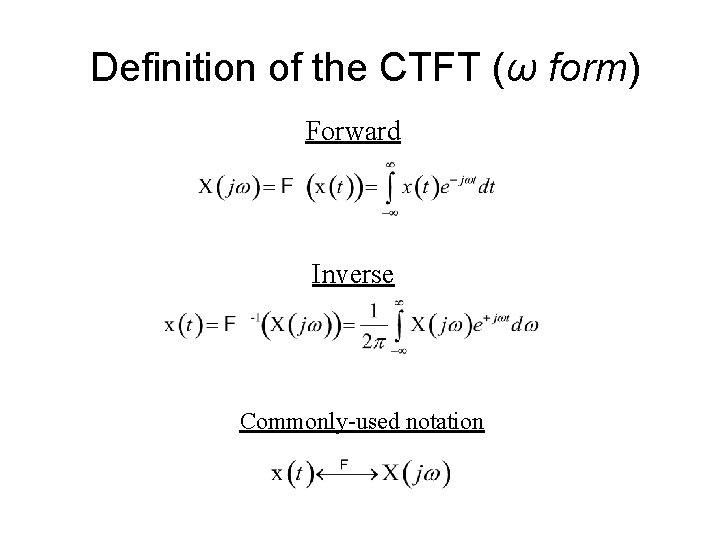
Definition of the CTFT (ω form) Forward Inverse Commonly-used notation
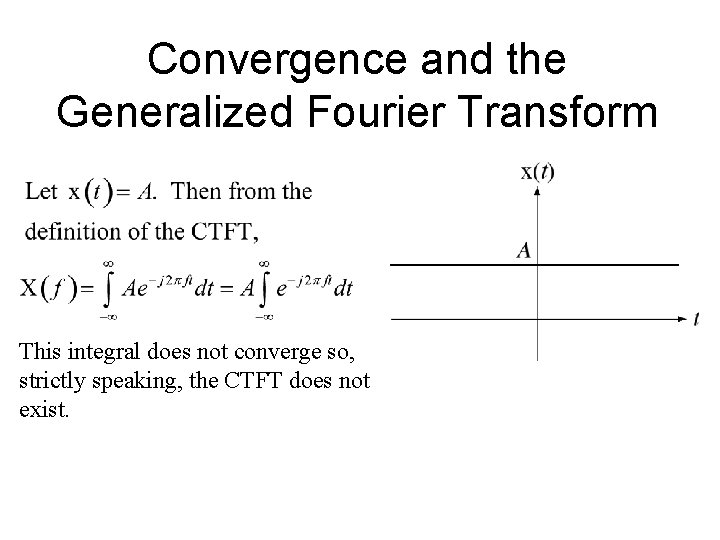
Convergence and the Generalized Fourier Transform This integral does not converge so, strictly speaking, the CTFT does not exist.
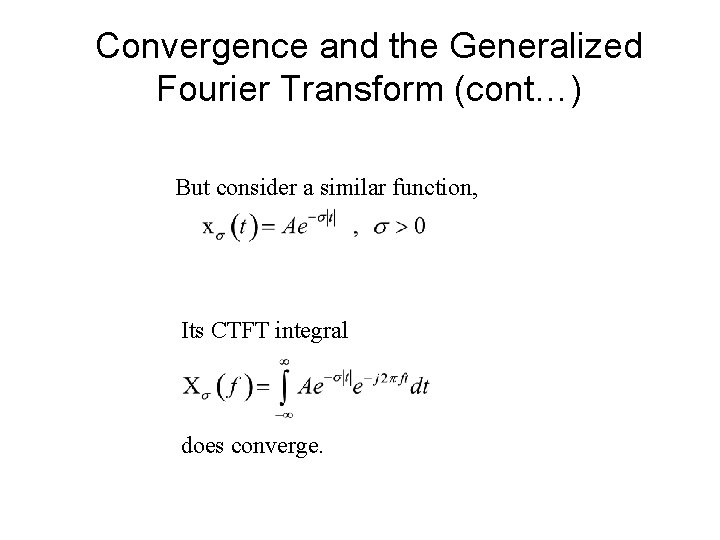
Convergence and the Generalized Fourier Transform (cont…) But consider a similar function, Its CTFT integral does converge.
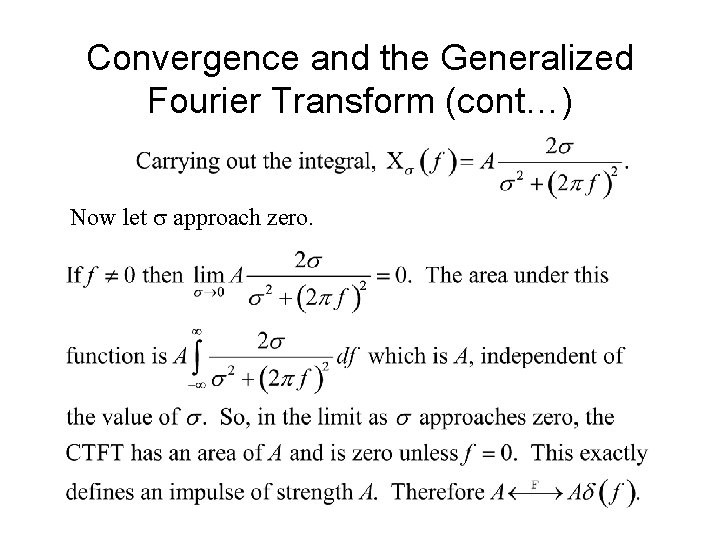
Convergence and the Generalized Fourier Transform (cont…) Now let s approach zero.
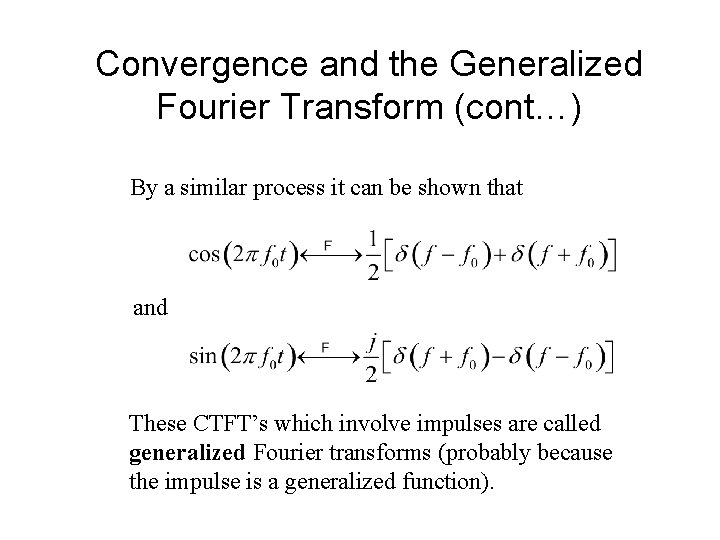
Convergence and the Generalized Fourier Transform (cont…) By a similar process it can be shown that and These CTFT’s which involve impulses are called generalized Fourier transforms (probably because the impulse is a generalized function).
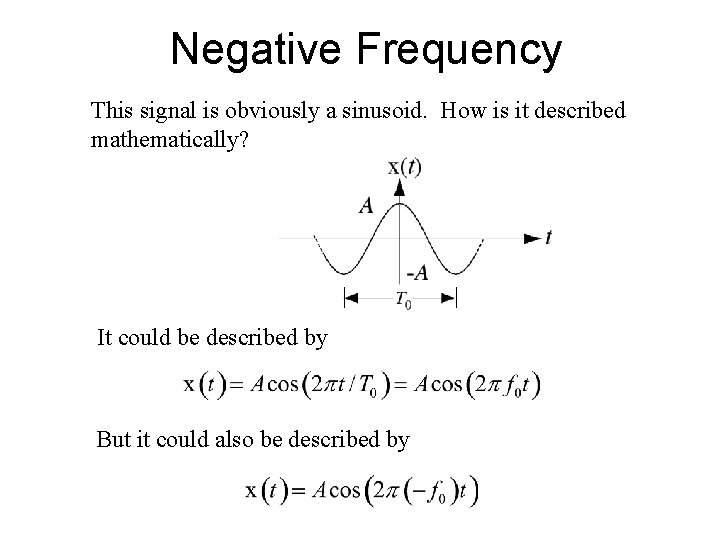
Negative Frequency This signal is obviously a sinusoid. How is it described mathematically? It could be described by But it could also be described by
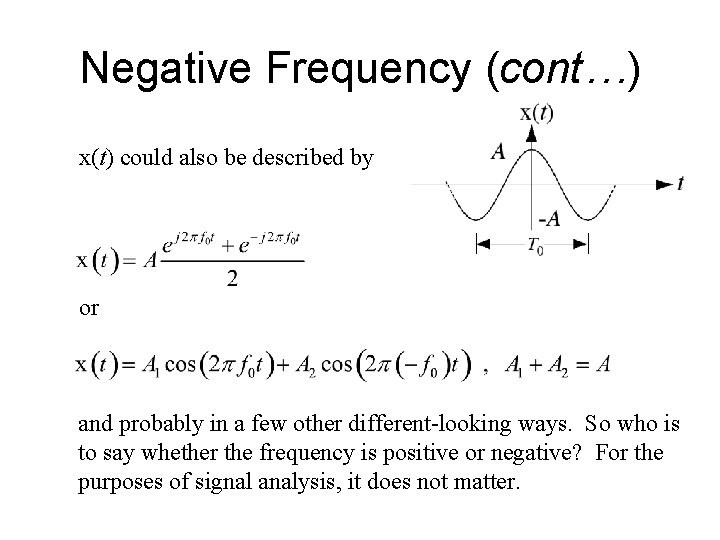
Negative Frequency (cont…) x(t) could also be described by or and probably in a few other different-looking ways. So who is to say whether the frequency is positive or negative? For the purposes of signal analysis, it does not matter.
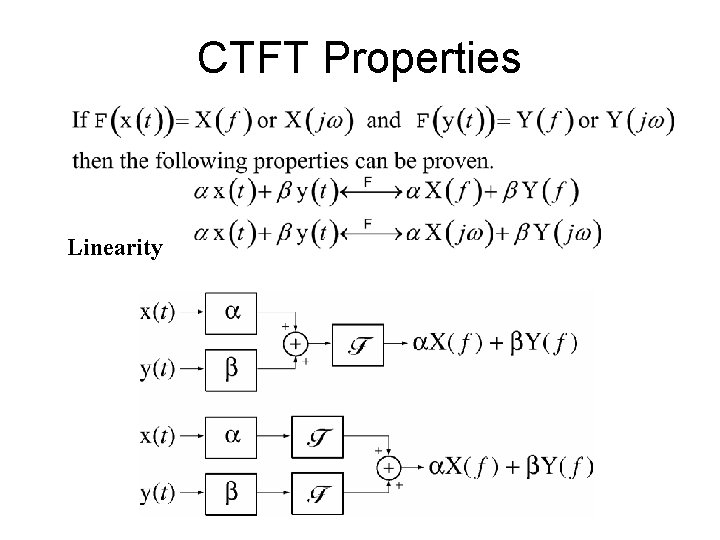
CTFT Properties Linearity
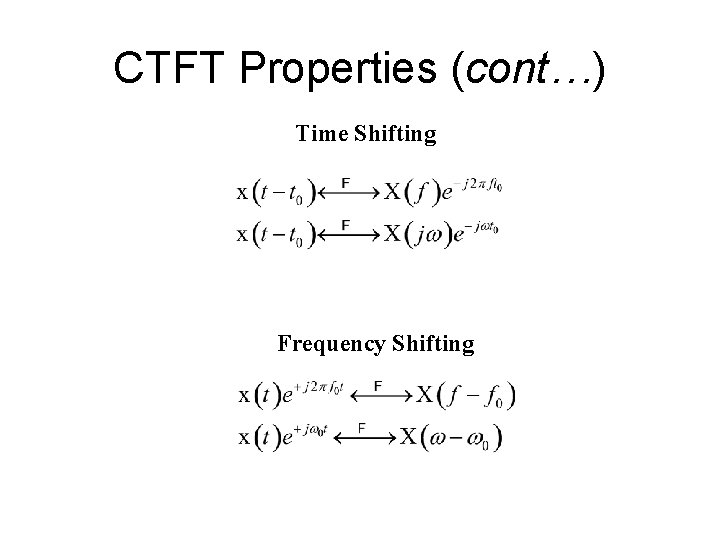
CTFT Properties (cont…) Time Shifting Frequency Shifting
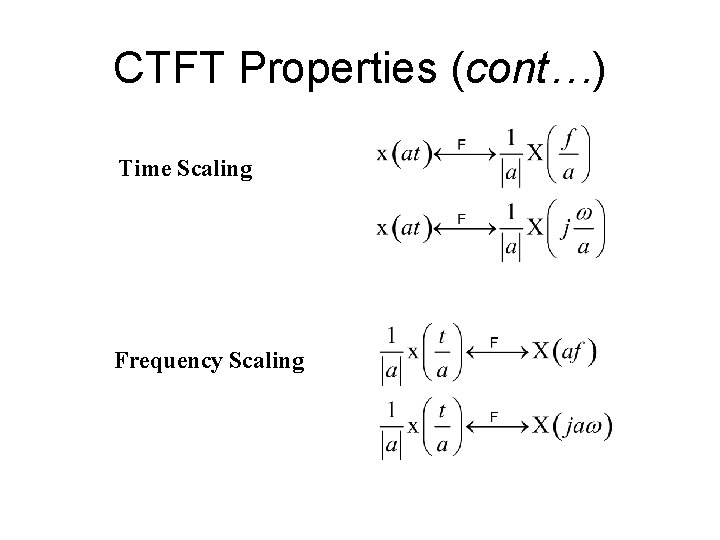
CTFT Properties (cont…) Time Scaling Frequency Scaling
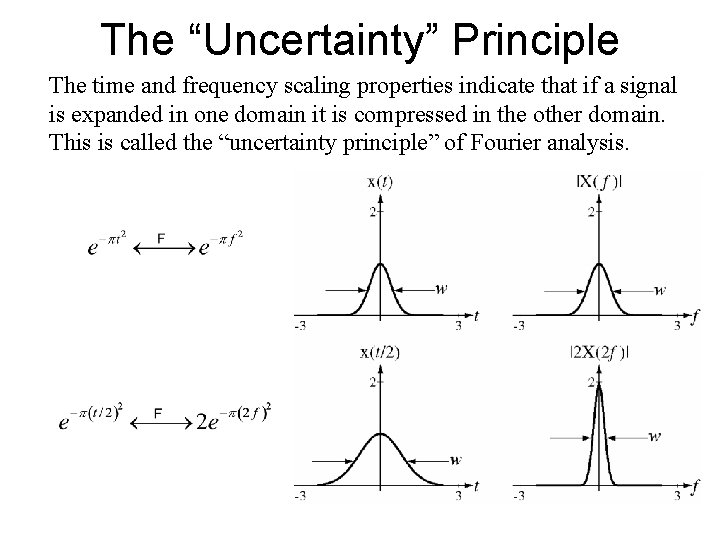
The “Uncertainty” Principle The time and frequency scaling properties indicate that if a signal is expanded in one domain it is compressed in the other domain. This is called the “uncertainty principle” of Fourier analysis.
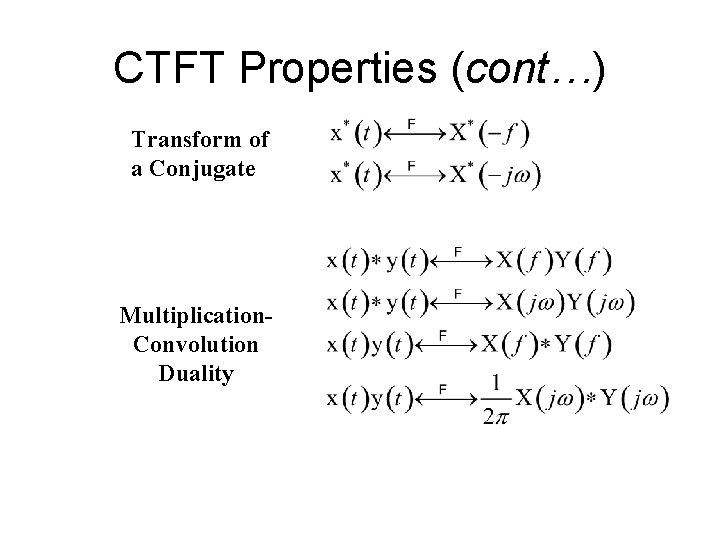
CTFT Properties (cont…) Transform of a Conjugate Multiplication. Convolution Duality
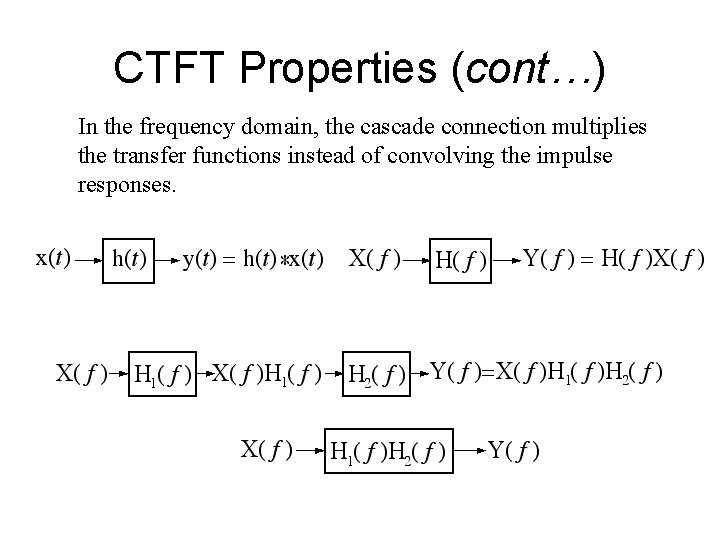
CTFT Properties (cont…) In the frequency domain, the cascade connection multiplies the transfer functions instead of convolving the impulse responses.
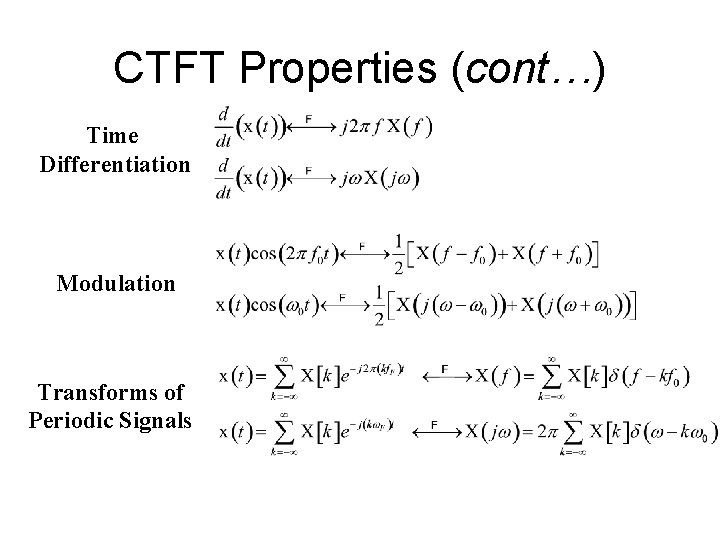
CTFT Properties (cont…) Time Differentiation Modulation Transforms of Periodic Signals
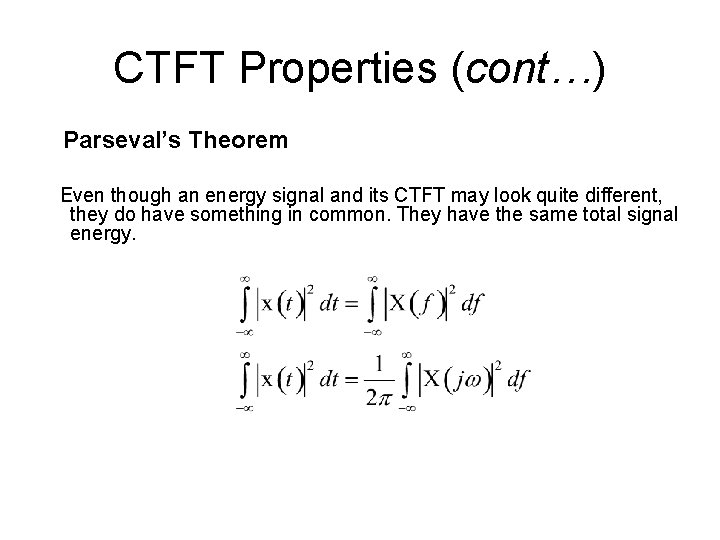
CTFT Properties (cont…) Parseval’s Theorem Even though an energy signal and its CTFT may look quite different, they do have something in common. They have the same total signal energy.
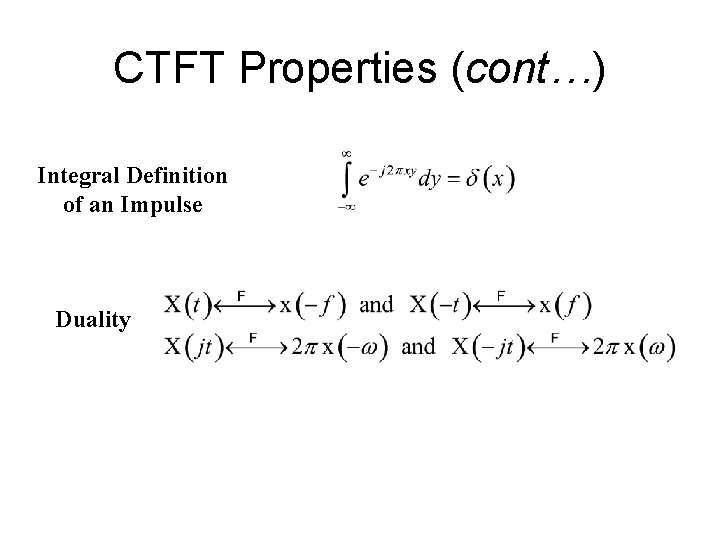
CTFT Properties (cont…) Integral Definition of an Impulse Duality
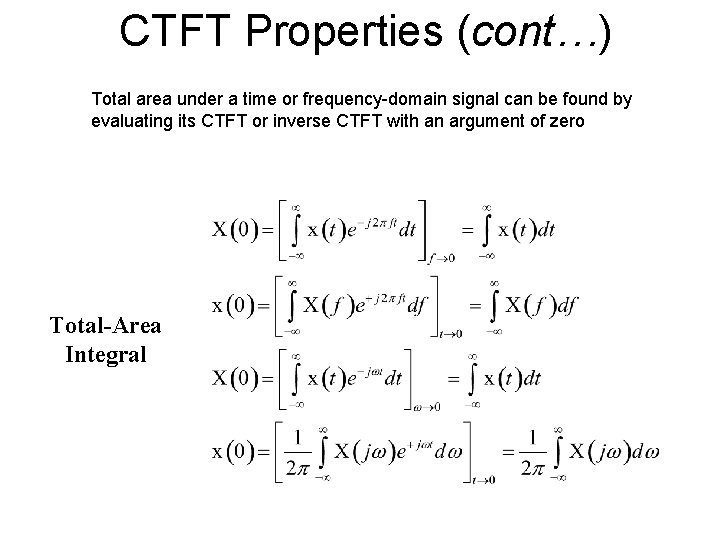
CTFT Properties (cont…) Total area under a time or frequency-domain signal can be found by evaluating its CTFT or inverse CTFT with an argument of zero Total-Area Integral
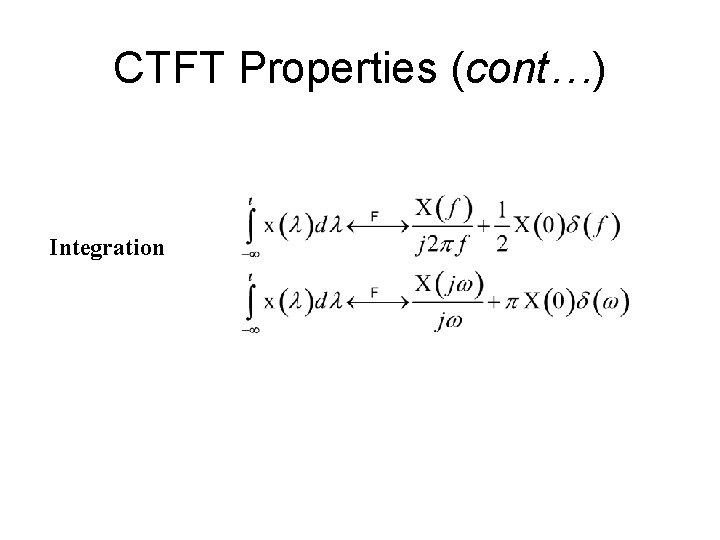
CTFT Properties (cont…) Integration