
The continuous spectrum of light Astrophysics Ch 3
- Slides: 8
The continuous spectrum of light Astrophysics Ch. 3 Physics of Astronomy, winter week 5 • • Star Date Light tells us everything about stars Parallax Magnitude, luminosity, flux (3. 2, 3. 5) Light as particles and waves Blackbody radiation (3. 11) Spectra workshop: Ferguson Ex. 19
Light tells us everything about stars* • Color (wavelength) temperature, power output, absolute brightness… • Apparent vs absolute brightness distance • Spectral lines composition & atmosphere, stellar type and age, • Shifts in spectral lines proper motion, rotation, magnetic fields, oscillations internal structure, internal rotation, planets… * (Light, plus neutrinos & gravity waves, if we’re lucky)
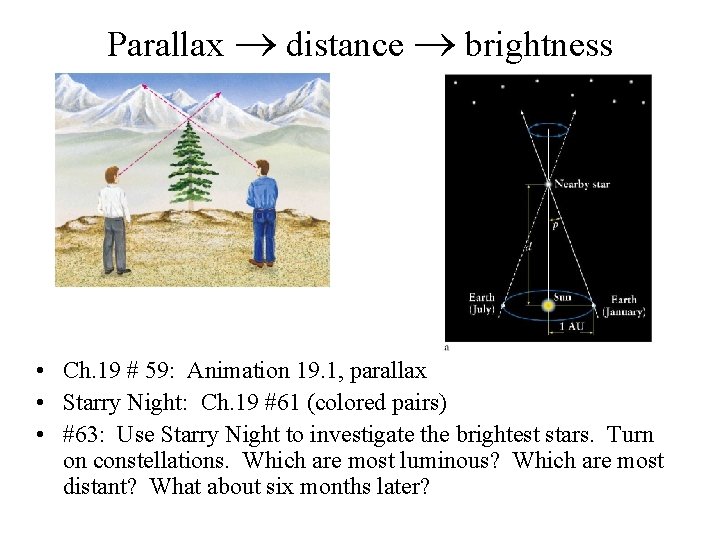
Parallax distance brightness • Ch. 19 # 59: Animation 19. 1, parallax • Starry Night: Ch. 19 #61 (colored pairs) • #63: Use Starry Night to investigate the brightest stars. Turn on constellations. Which are most luminous? Which are most distant? What about six months later?
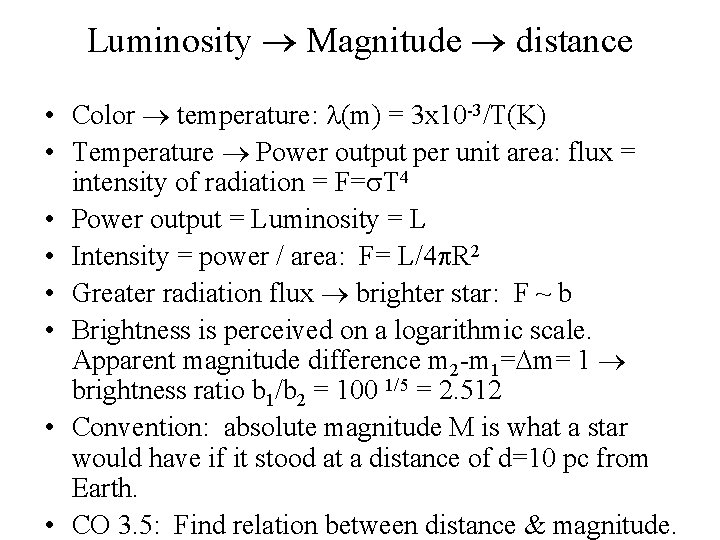
Luminosity Magnitude distance • Color temperature: l(m) = 3 x 10 -3/T(K) • Temperature Power output per unit area: flux = intensity of radiation = F=s. T 4 • Power output = Luminosity = L • Intensity = power / area: F= L/4 p. R 2 • Greater radiation flux brighter star: F ~ b • Brightness is perceived on a logarithmic scale. Apparent magnitude difference m 2 -m 1=Dm= 1 brightness ratio b 1/b 2 = 100 1/5 = 2. 512 • Convention: absolute magnitude M is what a star would have if it stood at a distance of d=10 pc from Earth. • CO 3. 5: Find relation between distance & magnitude.
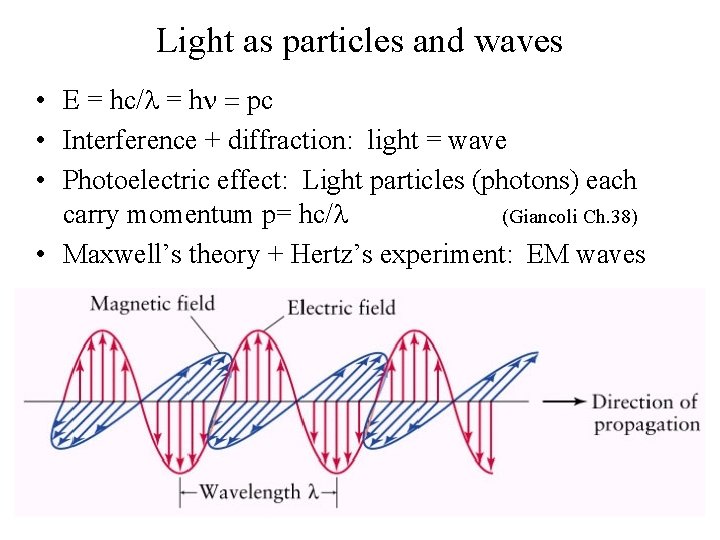
Light as particles and waves • E = hc/l = hn = pc • Interference + diffraction: light = wave • Photoelectric effect: Light particles (photons) each carry momentum p= hc/l (Giancoli Ch. 38) • Maxwell’s theory + Hertz’s experiment: EM waves
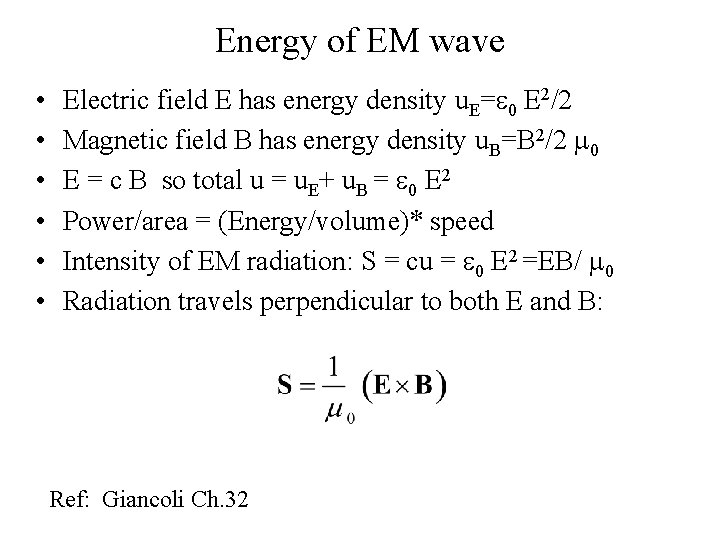
Energy of EM wave • • • Electric field E has energy density u. E=e 0 E 2/2 Magnetic field B has energy density u. B=B 2/2 m 0 E = c B so total u = u. E+ u. B = e 0 E 2 Power/area = (Energy/volume)* speed Intensity of EM radiation: S = cu = e 0 E 2 =EB/ m 0 Radiation travels perpendicular to both E and B: Ref: Giancoli Ch. 32
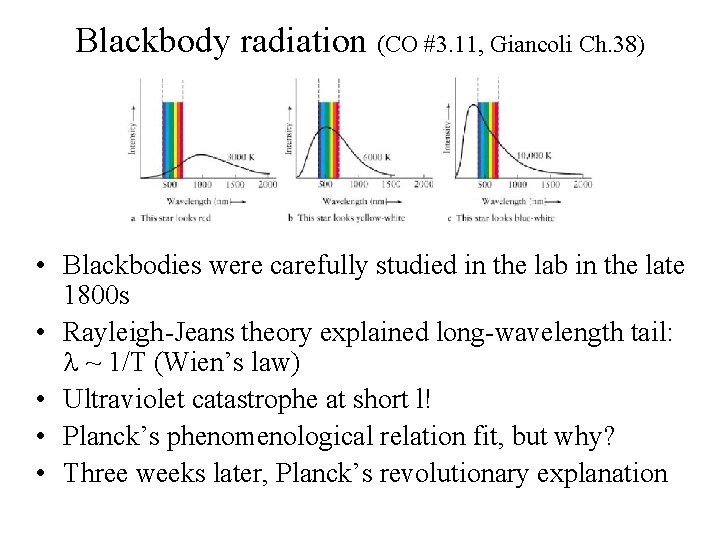
Blackbody radiation (CO #3. 11, Giancoli Ch. 38) • Blackbodies were carefully studied in the lab in the late 1800 s • Rayleigh-Jeans theory explained long-wavelength tail: l ~ 1/T (Wien’s law) • Ultraviolet catastrophe at short l! • Planck’s phenomenological relation fit, but why? • Three weeks later, Planck’s revolutionary explanation
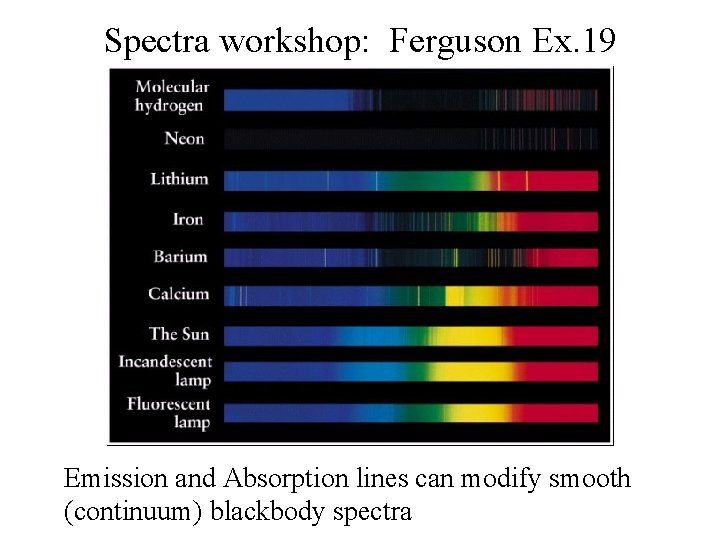
Spectra workshop: Ferguson Ex. 19 Emission and Absorption lines can modify smooth (continuum) blackbody spectra