
The Contiguity Effect SplitAttention Effect The Contiguity Effect



- Slides: 18
The Contiguity Effect/ Split-Attention Effect The Contiguity Effect – Theoretical Implications and Empirical Data Mareike Florax, Shah Jamal Alam, Joaquim Silva Tübingen, 21/22. 04. 2005 VGK- VDS workshop
The Contiguity Effect/ Split-Attention Effect Overview • The basic idea of the principle; • Theoretical explanation, - Cognitive Load Theory (Sweller, 1999) - Model of Working Memory (Baddley, 2003) - Theory of Multimedial Learning (Mayer, 2001) • Empirical Findings; • Discussion. VGK- VDS workshop
The Contiguity Effect/ Split-Attention Effect The basic idea of the principle • Realm: - different sources of information, - e. g. written text and/or mathematical equation and/or pictures and/or spoken word. . . (Ayres & Sweller, in press; Mayer, 2001), - that are intelligible in isolation. VGK- VDS workshop
The Contiguity Effect/ Split-Attention Effect The basic idea of the principle • Phenomenon: Learning with integrated sources of information leads to better learning results than learning with seperated sources of information (Ayres & Sweller, in press; Mayer, 2001). VGK- VDS workshop
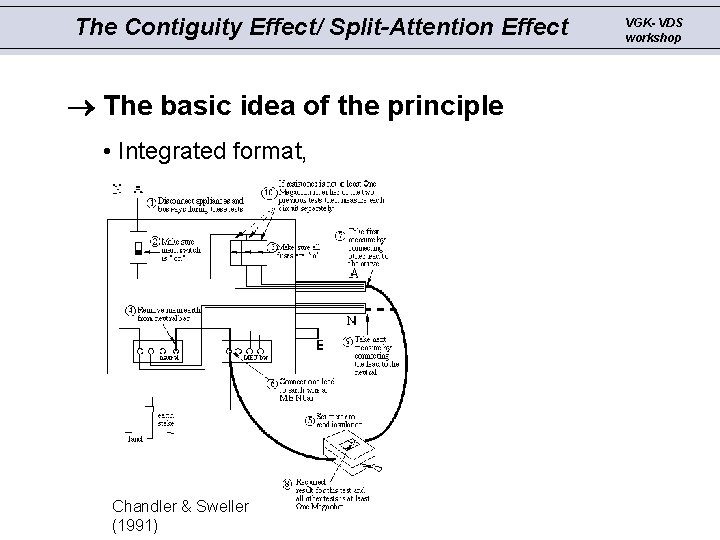
The Contiguity Effect/ Split-Attention Effect The basic idea of the principle • Integrated format, Chandler & Sweller (1991) VGK- VDS workshop
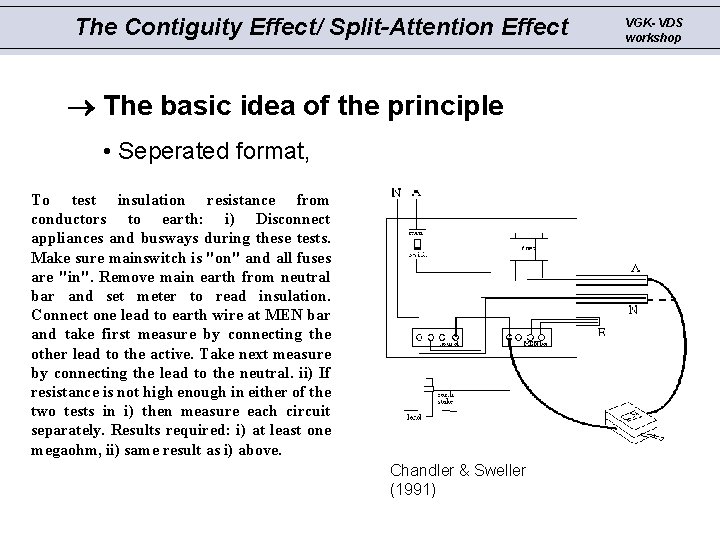
The Contiguity Effect/ Split-Attention Effect The basic idea of the principle • Seperated format, To test insulation resistance from conductors to earth: i) Disconnect appliances and busways during these tests. Make sure mainswitch is "on" and all fuses are "in". Remove main earth from neutral bar and set meter to read insulation. Connect one lead to earth wire at MEN bar and take first measure by connecting the other lead to the active. Take next measure by connecting the lead to the neutral. ii) If resistance is not high enough in either of the two tests in i) then measure each circuit separately. Results required: i) at least one megaohm, ii) same result as i) above. Chandler & Sweller (1991) VGK- VDS workshop
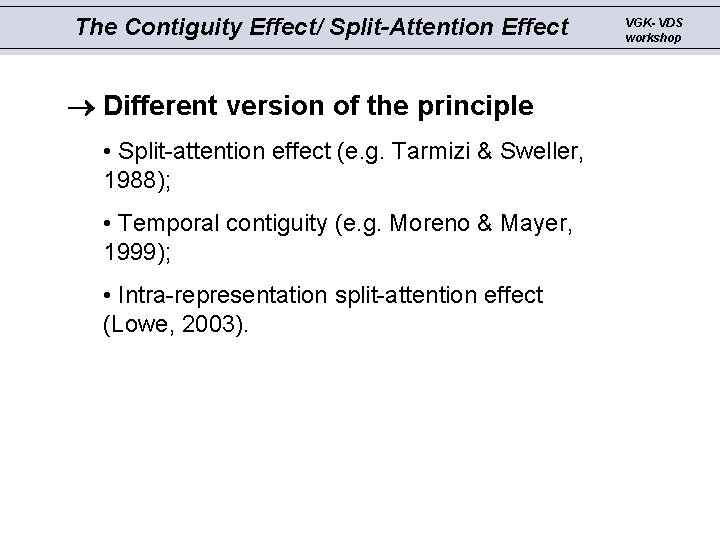
The Contiguity Effect/ Split-Attention Effect Different version of the principle • Split-attention effect (e. g. Tarmizi & Sweller, 1988); • Temporal contiguity (e. g. Moreno & Mayer, 1999); • Intra-representation split-attention effect (Lowe, 2003). VGK- VDS workshop
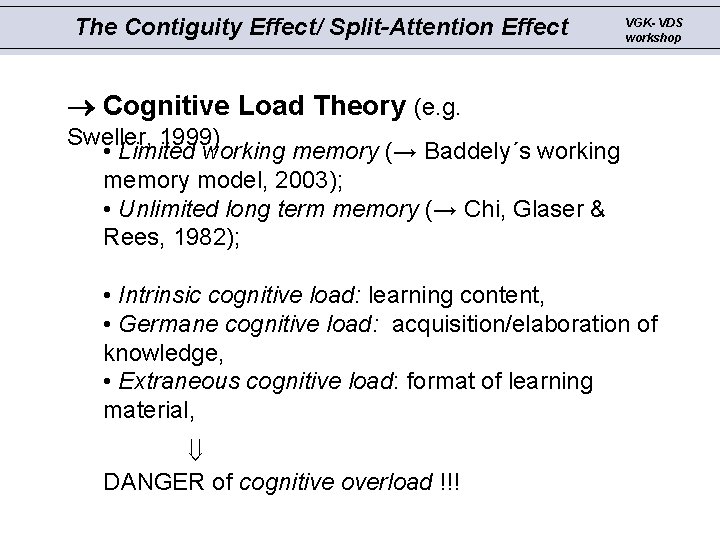
The Contiguity Effect/ Split-Attention Effect VGK- VDS workshop Cognitive Load Theory (e. g. Sweller, 1999) • Limited working memory (→ Baddely´s working memory model, 2003); • Unlimited long term memory (→ Chi, Glaser & Rees, 1982); • Intrinsic cognitive load: learning content, • Germane cognitive load: acquisition/elaboration of knowledge, • Extraneous cognitive load: format of learning material, DANGER of cognitive overload !!!
The Contiguity Effect/ Split-Attention Effect VGK- VDS workshop „Cognitive Load -Explanation“ To test insulation resistance from conductors to earth: i) Disconnect appliances and busways during these tests. Make sure mainswitch is "on" and all fuses are "in". Remove main earth from neutral bar and set meter to read insulation. Connect one lead to earth wire at MEN bar and take first measure by connecting the other lead to the active. Take next measure by connecting the lead to the neutral. ii) If resistance is not high enough in either of the two tests in i) then measure each circuit separately. Results required: i) at least one megaohm, ii) same result as i) above. intrinsic CL extraneous CL = intrinsic CL > extraneous CL split of attention and “eliminates the need to “search-and-match processes” (Kalyuga, Ayres, Chandler & mentally integrate multiple Sweller, 2003, p. 25) sources of germane CL < germane(Ayres & information” CL Learning results < Sweller, learning in press, p. 2)
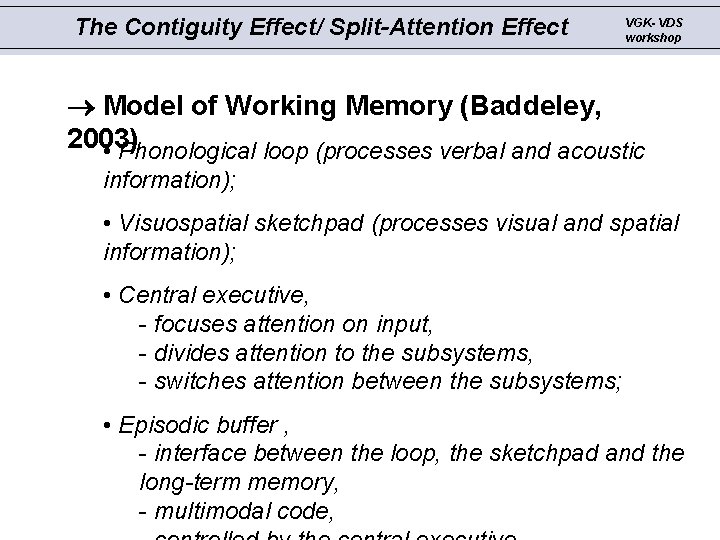
The Contiguity Effect/ Split-Attention Effect VGK- VDS workshop Model of Working Memory (Baddeley, 2003) • Phonological loop (processes verbal and acoustic information); • Visuospatial sketchpad (processes visual and spatial information); • Central executive, - focuses attention on input, - divides attention to the subsystems, - switches attention between the subsystems; • Episodic buffer , - interface between the loop, the sketchpad and the long-term memory, - multimodal code,
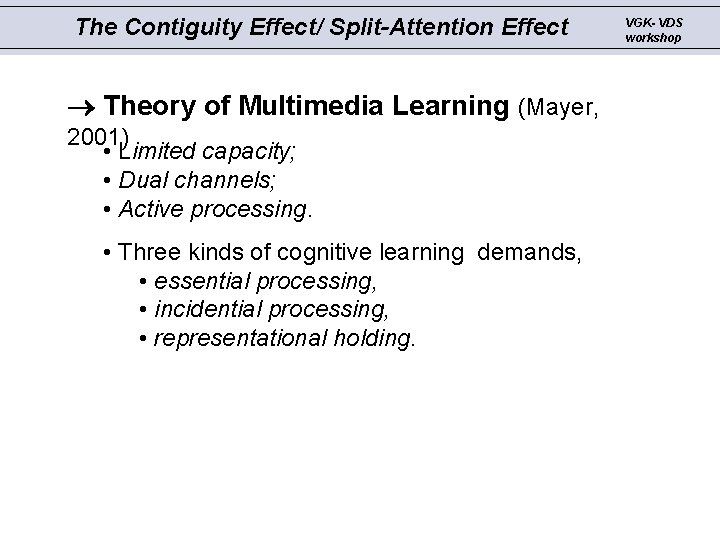
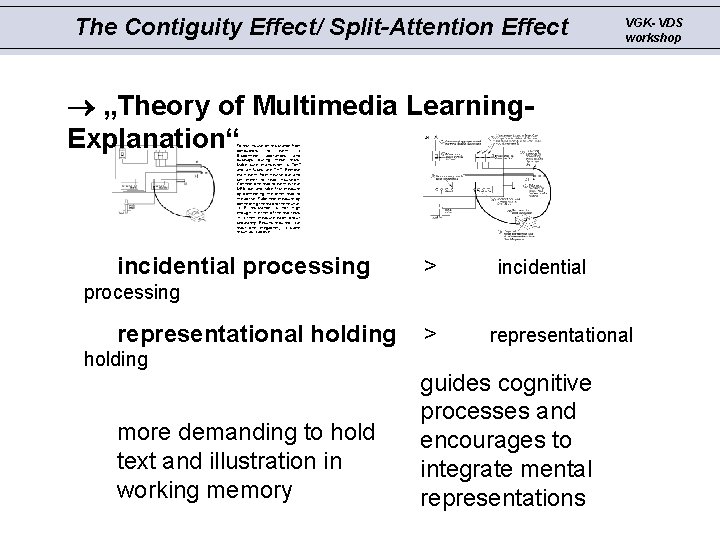
The Contiguity Effect/ Split-Attention Effect Theory of Multimedia Learning (Mayer, 2001) • Limited capacity; • Dual channels; • Active processing. • Three kinds of cognitive learning demands, • essential processing, • incidential processing, • representational holding. VGK- VDS workshop
The Contiguity Effect/ Split-Attention Effect VGK- VDS workshop „Theory of Multimedia Learning. Explanation“ To test insulation resistance from conductors to earth: i) Disconnect appliances and busways during these tests. Make sure mainswitch is "on" and all fuses are "in". Remove main earth from neutral bar and set meter to read insulation. Connect one lead to earth wire at MEN bar and take first measure by connecting the other lead to the active. Take next measure by connecting the lead to the neutral. ii) If resistance is not high enough in either of the two tests in i) then measure each circuit separately. Results required: i) at least one megaohm, ii) same result as i) above. incidential processing > incidential processing representational holding more demanding to hold text and illustration in working memory > representational guides cognitive processes and encourages to integrate mental representations
The Contiguity Effect/ Split-Attention Effect Different reasons for the contiguity effect • Split of attention; • Memory demands; • Visual search processes; • mental integration processes; • Time loss. VGK- VDS workshop
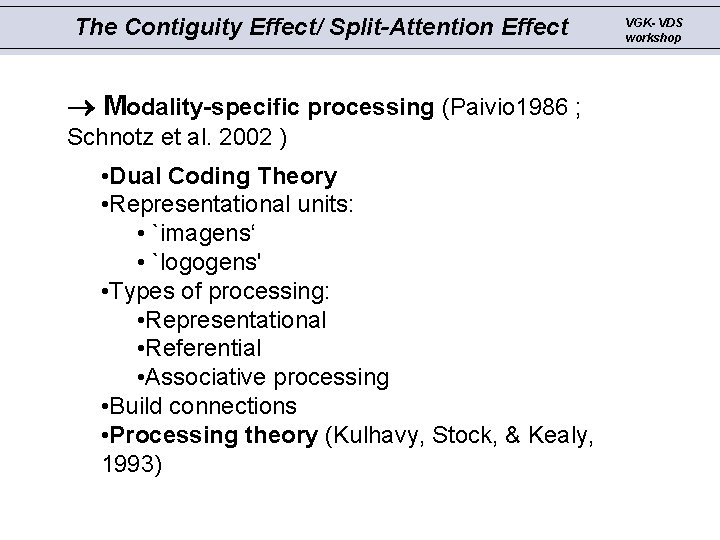
The Contiguity Effect/ Split-Attention Effect Modality-specific processing (Paivio 1986 ; Schnotz et al. 2002 ) • Dual Coding Theory • Representational units: • `imagens‘ • `logogens' • Types of processing: • Representational • Referential • Associative processing • Build connections • Processing theory (Kulhavy, Stock, & Kealy, 1993) VGK- VDS workshop
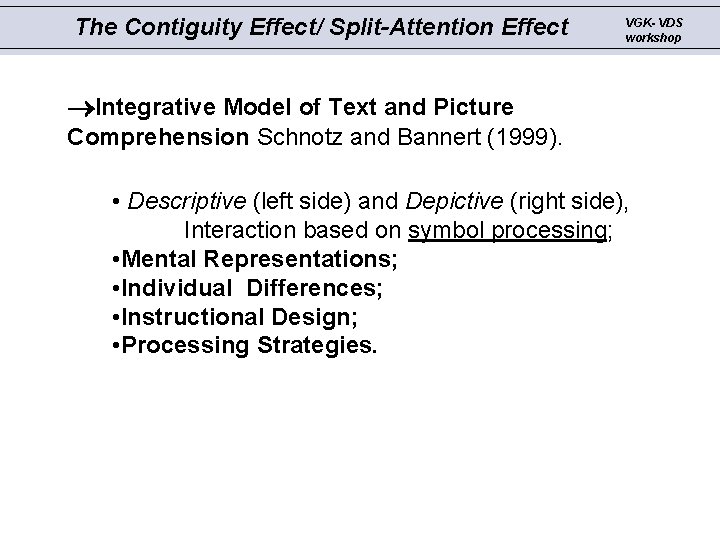
The Contiguity Effect/ Split-Attention Effect VGK- VDS workshop Integrative Model of Text and Picture Comprehension Schnotz and Bannert (1999). • Descriptive (left side) and Depictive (right side), Interaction based on symbol processing; • Mental Representations; • Individual Differences; • Instructional Design; • Processing Strategies.
The Contiguity Effect/ Split-Attention Effect VGK- VDS workshop Empirical Support • Learning results from learning with spatial/ temporal separated material are compared to results from learning with integrated material; • Domains such as mathematics, physics, technical skills (car brakes, pumps), meteorology (lightning formation) or biology (human respiratory system), language acquisition.
The Contiguity Effect/ Split-Attention Effect VGK- VDS workshop Points of criticism • Definition separated vs. integrated material; • No objective measures of cognitive load, element interactivity, prior knowledge… • Visualizer/verbalizer the omnipotenz of the principles (if it is not split-attention, it is redundancy, or modality. . .
The Contiguity Effect/ Split-Attention Effect New helpful developments • Cognitive load measurement helpful ; • Eye tracking methods; • Investigation of the central executive. VGK- VDS workshop