
The Contemporary Transformation of the International System Professor
- Slides: 11
The Contemporary Transformation of the International System Professor John Wilton Lecture 6 The impact of the global network society on the contemporary international system: technology, inequality and social networks
Lecture 6 CASTELLS, Manuel. "Communication, Power and Counter-power in the Network Society". International Journal of Communication, Vol. 1, 2007, pp. 238 -266. Also available along with various other resources on his web site: http: //www. manuelcastells. info/en/index. htm
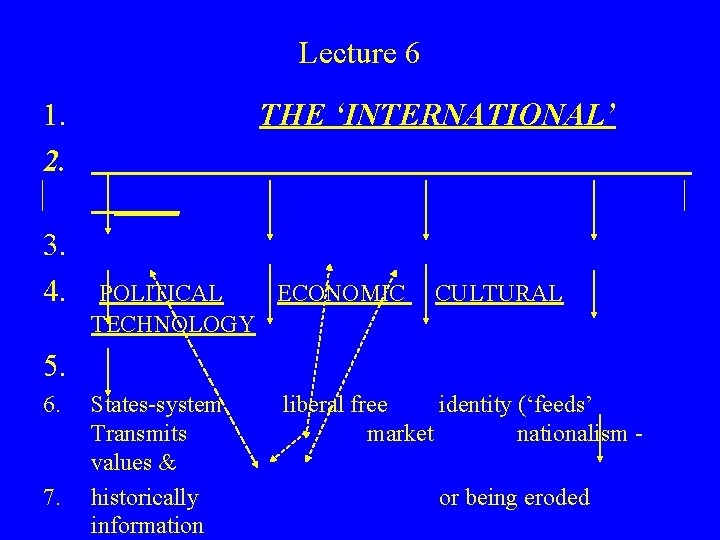
Lecture 6 1) The processes through which political, economic, cultural and rights issues are transmitted within the international system; 2) social networks (non-governmental, non-state)
Lecture 6 - - - rapid development and growth of ICTs has facilitated different and wider forms of international interaction growth of social networks created communities operating within and across territories of states = challenge to ability of states to order international system ‘networks of dissent’ challenge existing social, political and economic arrangements + seek to influence governance of international system
Lecture 6 ‘Global Network Society’ (Manuel Castells, The Information Age, 3 volumes, 1996 -98) - 2 main modes/forms of historical development in international system: a) Agrarian mode/form: economic growth through increasing amount of labour devoted to production based bon the land; b) Industrial mode/form: economic growth through wider and more efficient use of energy sources to produce mechanisation of production + technological innovation
Lecture 6 - witnessing third mode of historical development in international system: c) The Information Age mode/form: economic growth from generation of new knowledge as key source of productivity - social order in international system today based on new technological information knowledge systems (not confined to national boundaries)
Lecture 6 - for Castells, international order today should be understood as a GLOBAL NETWORKED ORDER - if Industrial capitalism gave rise to national economies and the nation-state - THEN, Informational capitalism gives rise to networks and globalisation
Lecture 6 ‘Networks of Dissent’ - ‘positive networks’ (global inequality, human rights, debt cancellation) a) transnational; b) organised around shared values; c) express disagreement from established systems; d) have an influence on international system - ‘negative networks’ (political violence, terrorism)
Lecture 6 Example of ‘Positive Network of Dissent’ and impact of ICT : Peretti, J. (2001) ‘USA: my Nike media adventure’, The Nation, 9 April (online). Available from http: //www. thenation. com/doc. mhtml? i=2001040 9&s=peretti
Lecture 6 2 further areas where networks have had a growing effect on international system through ICT development: a) private financial institutions; b) military and terrorism
Lecture 6 1. 2. THE ‘INTERNATIONAL’ ____ 3. 4. POLITICAL ECONOMIC TECHNOLOGY CULTURAL 5. 6. 7. States-system Transmits values & historically information liberal free identity (‘feeds’ market nationalism or being eroded