
The Constitutional Convention was a large meeting held
- Slides: 36
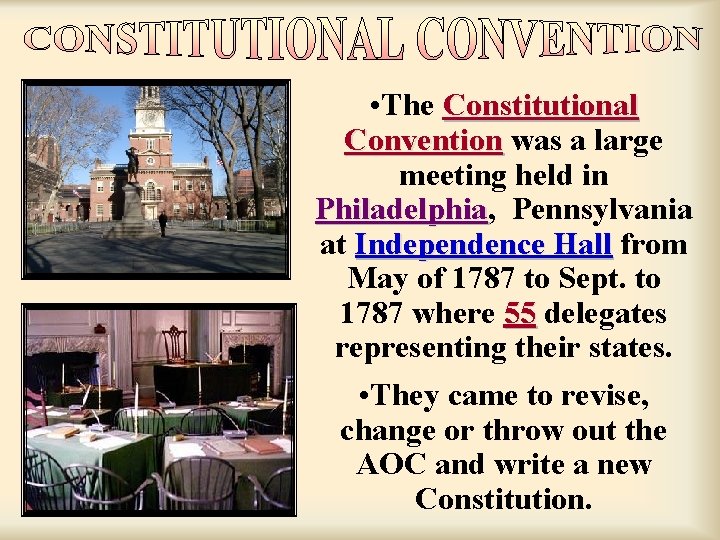
• The Constitutional Convention was a large meeting held in Philadelphia, Philadelphia Pennsylvania at Independence Hall from May of 1787 to Sept. to 1787 where 55 delegates representing their states. • They came to revise, change or throw out the AOC and write a new Constitution.
GOAL of the Constitutional Convention was how to create a government that did not resemble King George but create a govt. that was powerful enough • to tax • regulate trade • protect private property • enforce its laws without taking away the rights that were fought for in the American Revolution
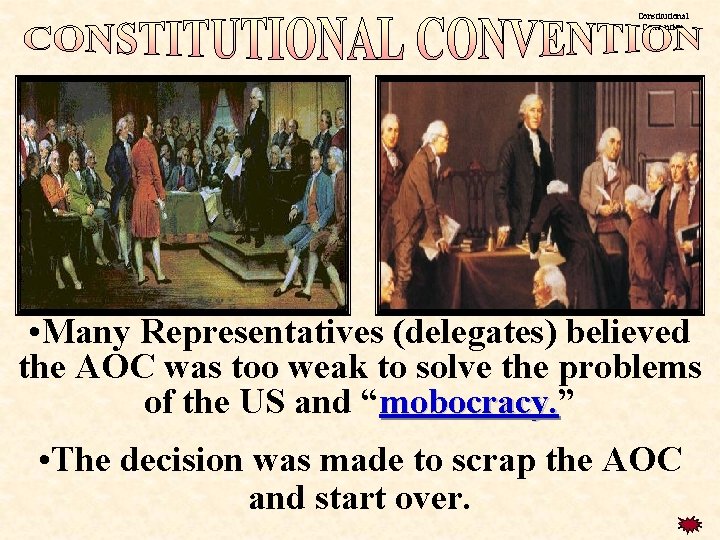
Constitutional Convention • Many Representatives (delegates) believed the AOC was too weak to solve the problems of the US and “mobocracy. ” • The decision was made to scrap the AOC and start over.
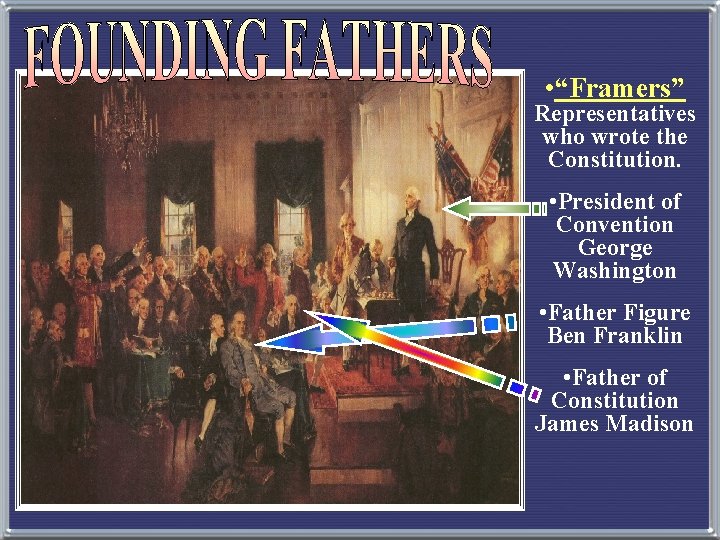
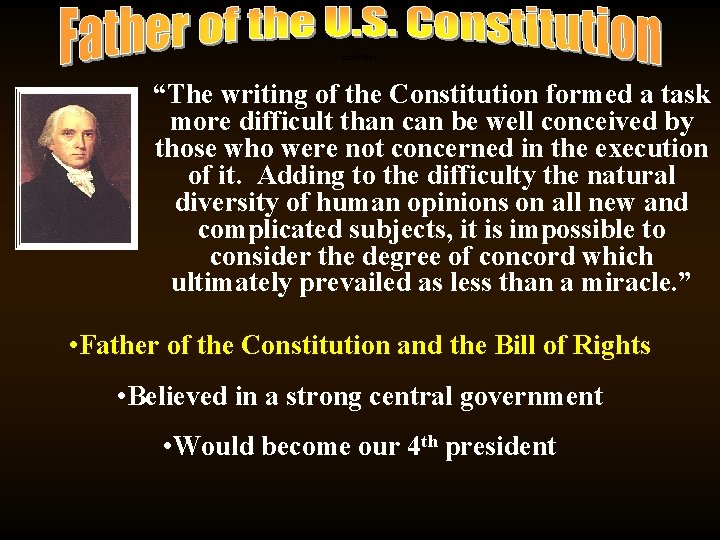
• “Framers” Representatives who wrote the Constitution. • President of Convention George Washington • Father Figure Ben Franklin • Father of Constitution James Madison
madconst “The writing of the Constitution formed a task more difficult than can be well conceived by those who were not concerned in the execution of it. Adding to the difficulty the natural diversity of human opinions on all new and complicated subjects, it is impossible to consider the degree of concord which ultimately prevailed as less than a miracle. ” • Father of the Constitution and the Bill of Rights • Believed in a strong central government • Would become our 4 th president
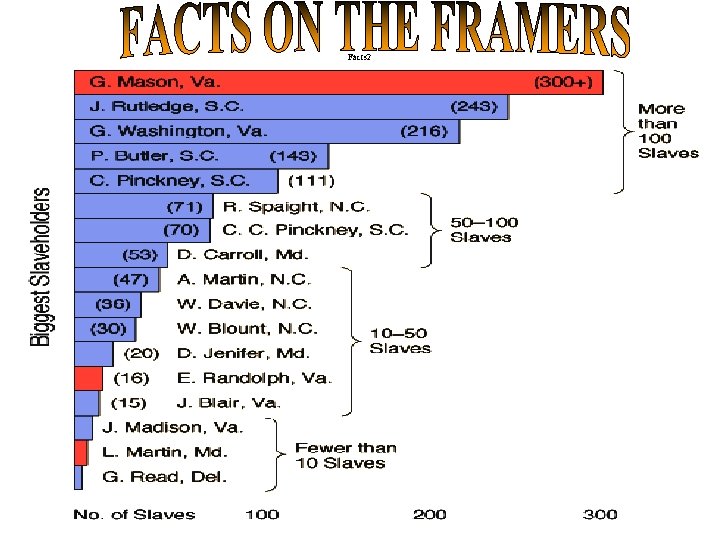
Facts 2
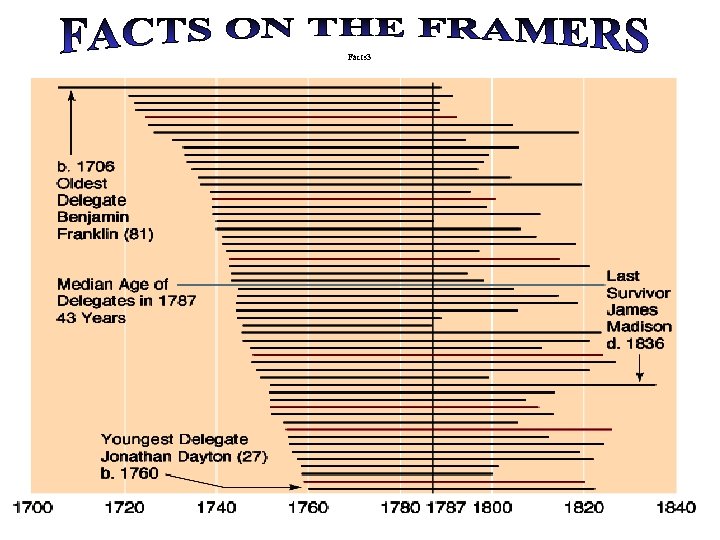
Facts 3
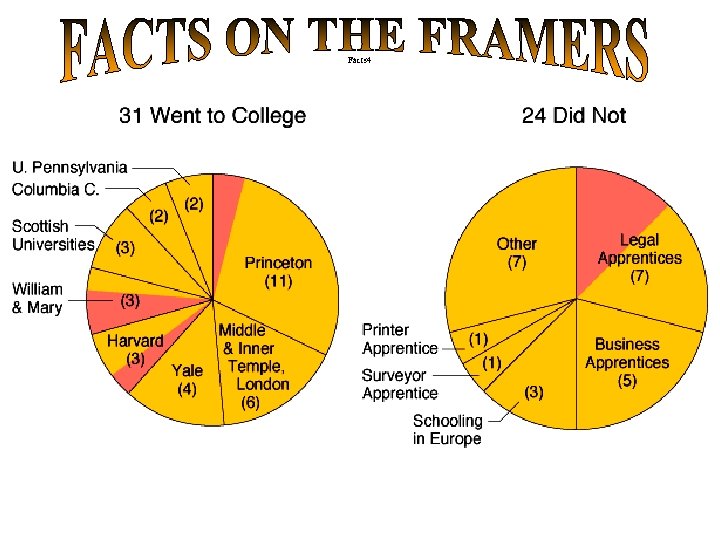
Facts 4
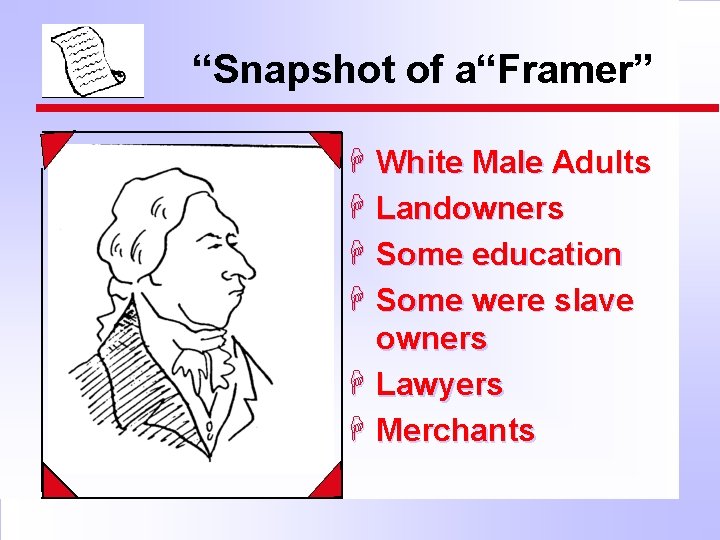
“Snapshot of a“Framer” H White Male Adults H Landowners H Some education H Some were slave owners H Lawyers H Merchants
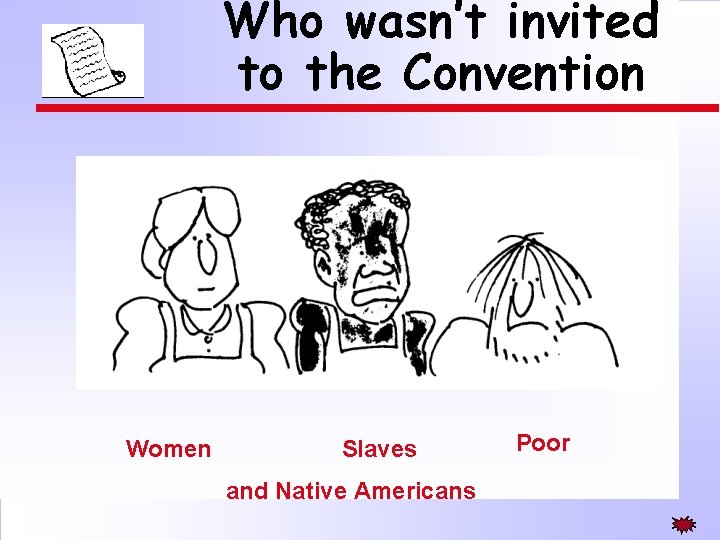
Who wasn’t invited to the Convention Women Slaves and Native Americans Poor
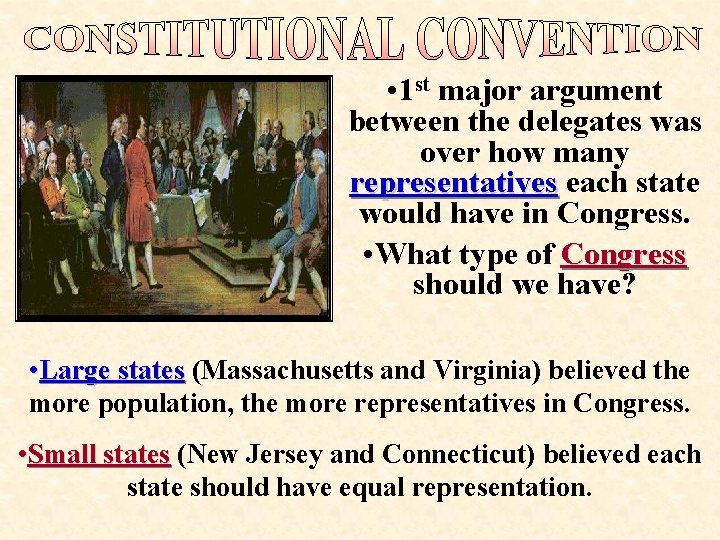
• 1 st major argument between the delegates was over how many representatives each state would have in Congress. • What type of Congress should we have? • Large states (Massachusetts and Virginia) believed the more population, the more representatives in Congress. • Small states (New Jersey and Connecticut) believed each state should have equal representation.
Issues of representative government would be argued at Constitutional Convention • Virginia Plan proposed • New Jersey plan by the larger states proposed by small states – Establish a national government with 3 branches. – Establish a bicameral Congress. • People elect 1 house • That house elects 2 nd house – Establish a unicameral Congress • Each state to have 1 vote • Equal representation – States equally represented similar to the Articles of Confederation – Representation in both houses based on state population Vir vs NJ
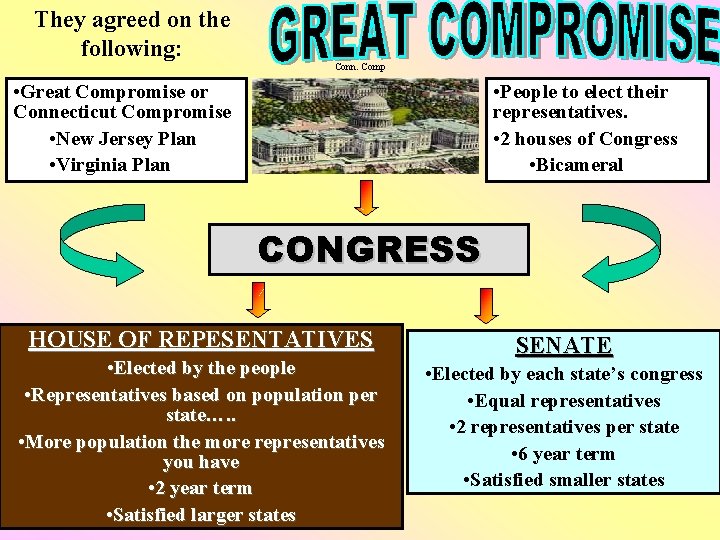
They agreed on the following: Conn. Comp • Great Compromise or Connecticut Compromise • New Jersey Plan • Virginia Plan • People to elect their representatives. • 2 houses of Congress • Bicameral CONGRESS HOUSE OF REPESENTATIVES • Elected by the people • Representatives based on population per state…. . • More population the more representatives you have • 2 year term • Satisfied larger states SENATE • Elected by each state’s congress • Equal representatives • 2 representatives per state • 6 year term • Satisfied smaller states
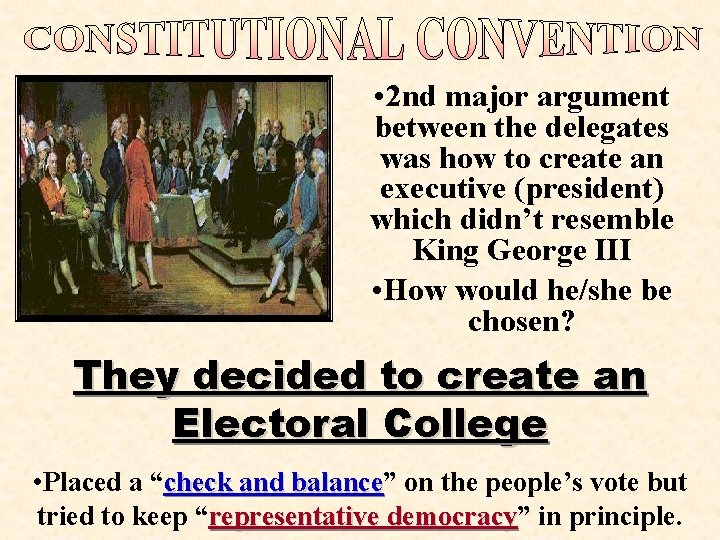
• 2 nd major argument between the delegates was how to create an executive (president) which didn’t resemble King George III • How would he/she be chosen? They decided to create an Electoral College • Placed a “check and balance” balance on the people’s vote but tried to keep “representative democracy” democracy in principle.
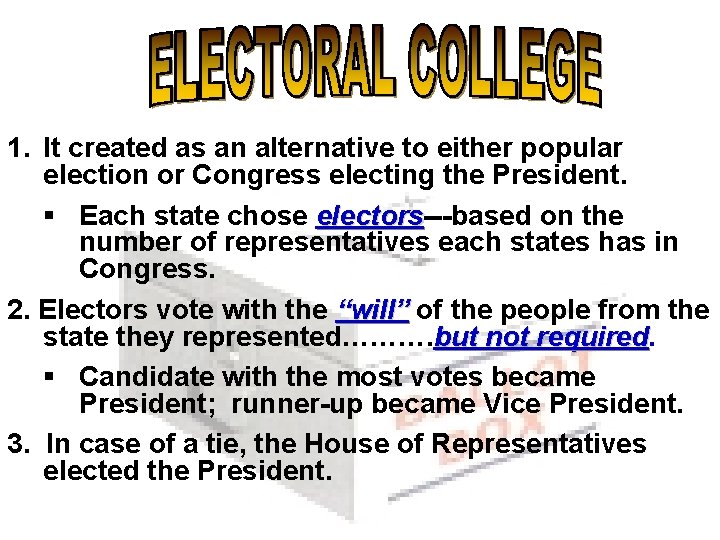
1. It created as an alternative to either popular election or Congress electing the President. § Each state chose electors---based on the electors number of representatives each states has in Congress. 2. Electors vote with the “will” of the people from the state they represented………. but not required § Candidate with the most votes became President; runner-up became Vice President. 3. In case of a tie, the House of Representatives elected the President.
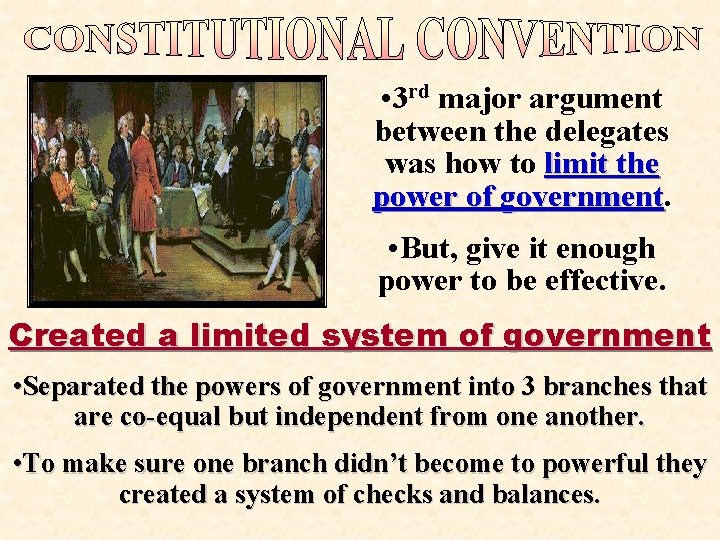
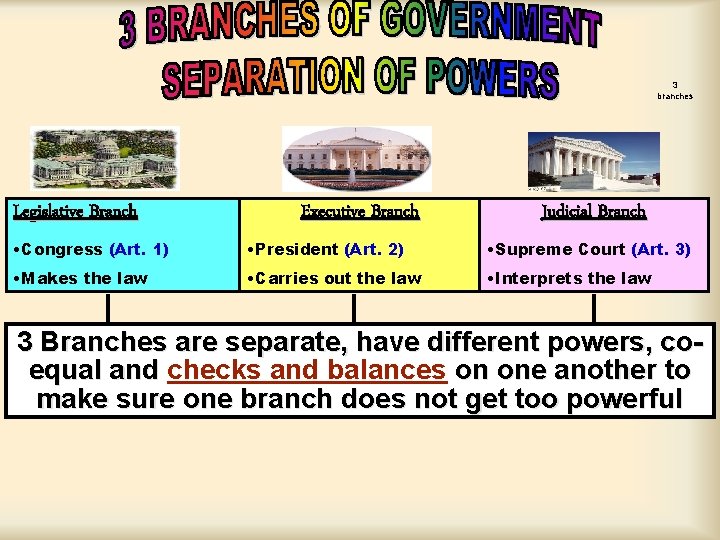
• 3 rd major argument between the delegates was how to limit the power of government • But, give it enough power to be effective. Created a limited system of government • Separated the powers of government into 3 branches that are co-equal but independent from one another. • To make sure one branch didn’t become to powerful they created a system of checks and balances.
3 branches Legislative Branch Executive Branch Judicial Branch • Congress (Art. 1) • President (Art. 2) • Supreme Court (Art. 3) • Makes the law • Carries out the law • Interprets the law 3 Branches are separate, have different powers, coequal and checks and balances on one another to make sure one branch does not get too powerful
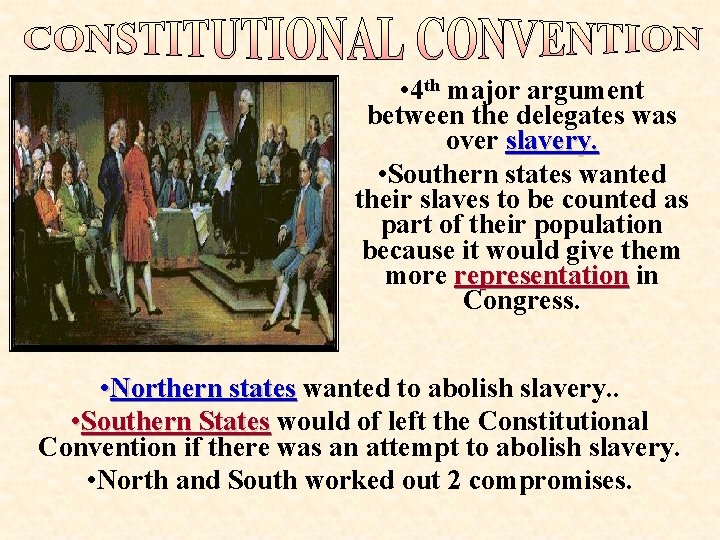
• 4 th major argument between the delegates was over slavery. • Southern states wanted their slaves to be counted as part of their population because it would give them more representation in Congress. • Northern states wanted to abolish slavery. . • Southern States would of left the Constitutional Convention if there was an attempt to abolish slavery. • North and South worked out 2 compromises.
• Southern states wanted their slaves to be counted as part of the total population of their state. Why? • This would give them more representatives in Congress. • Thus giving them more voting power in Congress and protecting their self-interest of slavery.
• Northern states objected to the South’s proposal and would only agree to compromise. • So it was decided that 3 of every 5 slaves would be counted as part of a state’s total population. • It was supported by both North and South
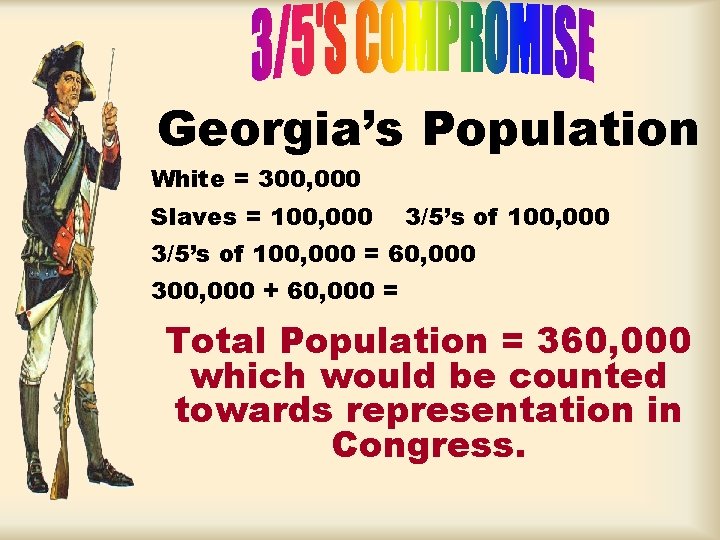
Georgia’s Population White = 300, 000 Slaves = 100, 000 3/5’s of 100, 000 = 60, 000 300, 000 + 60, 000 = Total Population = 360, 000 which would be counted towards representation in Congress.
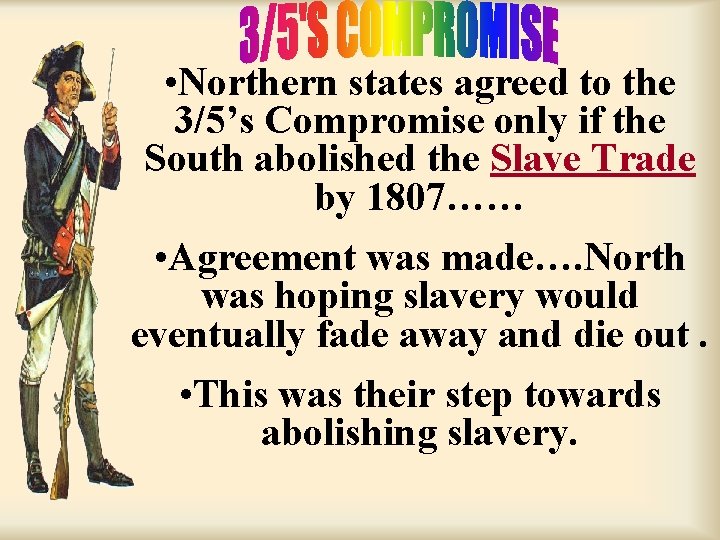
• Northern states agreed to the 3/5’s Compromise only if the South abolished the Slave Trade by 1807…… • Agreement was made…. North was hoping slavery would eventually fade away and die out. • This was their step towards abolishing slavery.
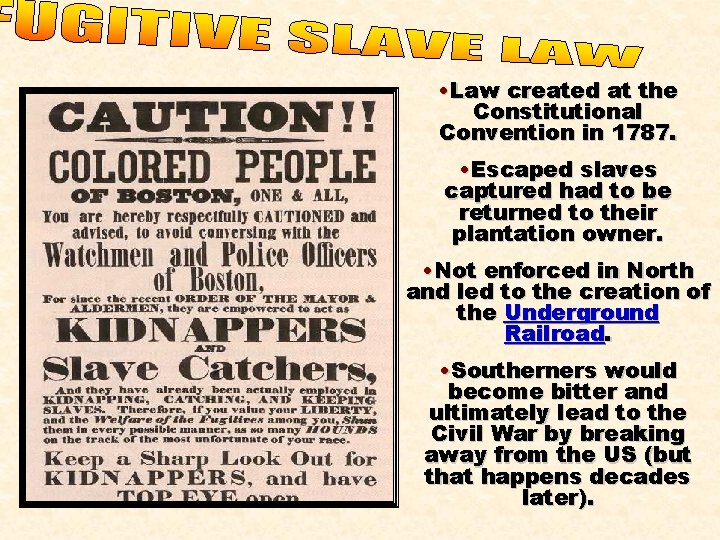
• Law created at the Constitutional Convention in 1787. • Escaped slaves captured had to be returned to their plantation owner. • Not enforced in North and led to the creation of the Underground Railroad. • Southerners would become bitter and ultimately lead to the Civil War by breaking away from the US (but that happens decades later).
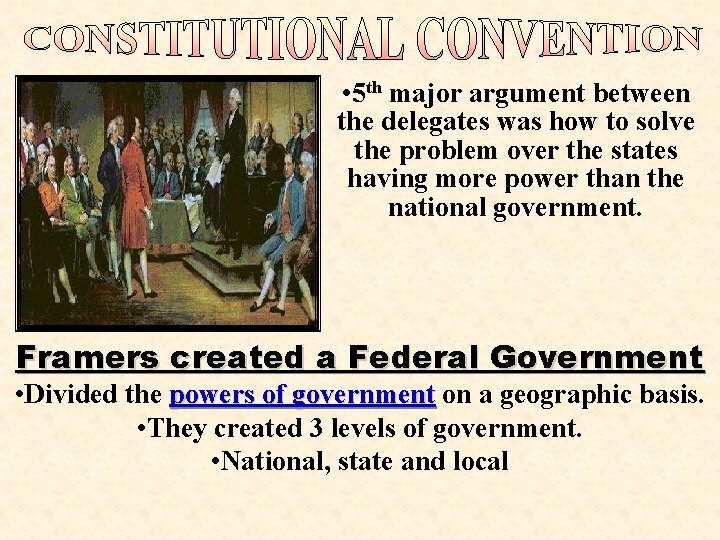
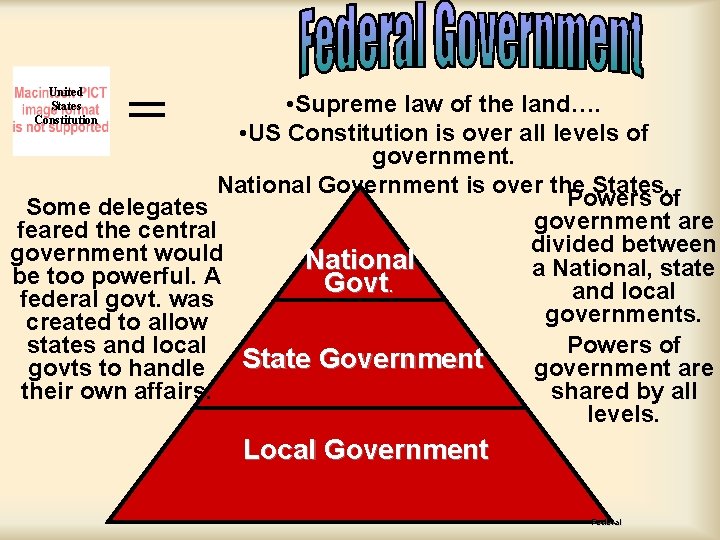
• 5 th major argument between the delegates was how to solve the problem over the states having more power than the national government. Framers created a Federal Government • Divided the powers of government on a geographic basis. • They created 3 levels of government. • National, state and local
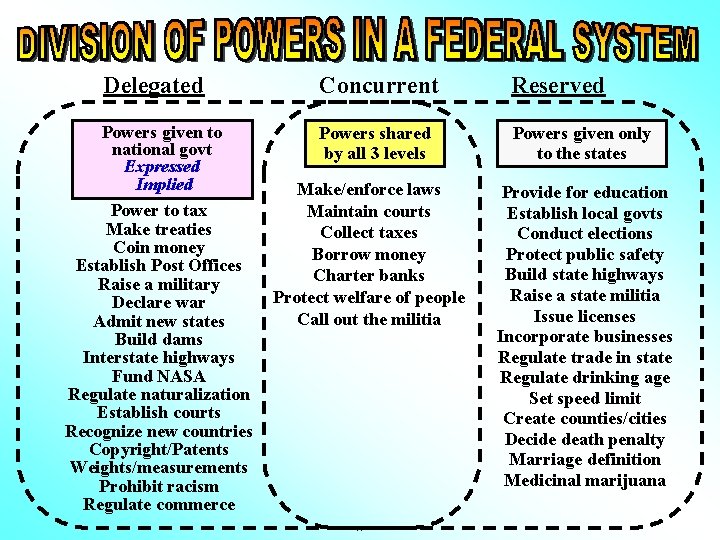
Delegated Concurrent Reserved Powers given to national govt Expressed Implied Power to tax Make treaties Coin money Establish Post Offices Raise a military Declare war Admit new states Build dams Interstate highways Fund NASA Regulate naturalization Establish courts Recognize new countries Copyright/Patents Weights/measurements Prohibit racism Regulate commerce Powers shared by all 3 levels Powers given only to the states Make/enforce laws Maintain courts Collect taxes Borrow money Charter banks Protect welfare of people Call out the militia Div of powers Provide for education Establish local govts Conduct elections Protect public safety Build state highways Raise a state militia Issue licenses Incorporate businesses Regulate trade in state Regulate drinking age Set speed limit Create counties/cities Decide death penalty Marriage definition Medicinal marijuana
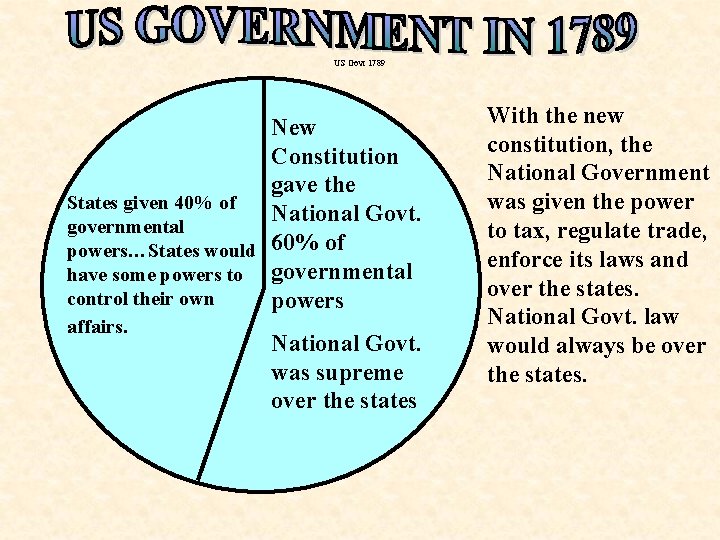
US Govt 1789 New Constitution gave the States given 40% of National Govt. governmental powers…States would 60% of have some powers to governmental control their own powers affairs. National Govt. was supreme over the states With the new constitution, the National Government was given the power to tax, regulate trade, enforce its laws and over the states. National Govt. law would always be over the states.
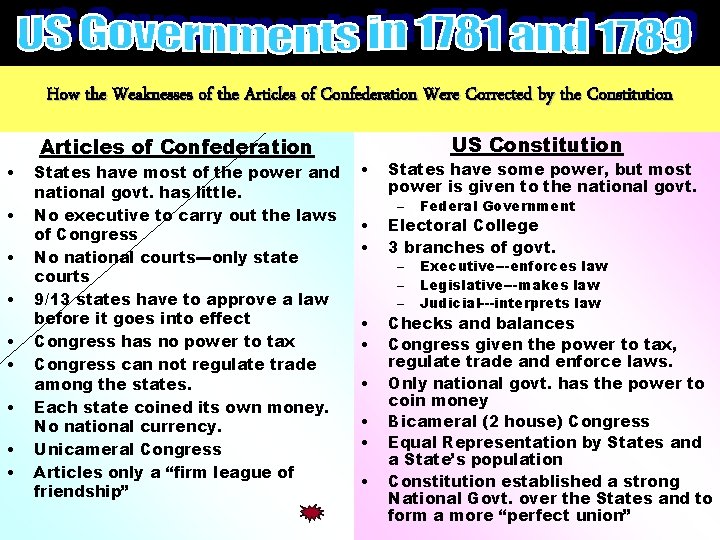
How the Weaknesses of the Articles of Confederation Were Corrected by the Constitution • • • Articles of Confederation States have most of the power and national govt. has little. No executive to carry out the laws of Congress No national courts---only state courts 9/13 states have to approve a law before it goes into effect Congress has no power to tax Congress can not regulate trade among the states. Each state coined its own money. No national currency. Unicameral Congress Articles only a “firm league of friendship” • US Constitution States have some power, but most power is given to the national govt. – Federal Government – – – Executive---enforces law Legislative---makes law Judicial---interprets law • • Electoral College 3 branches of govt. • • Checks and balances Congress given the power to tax, regulate trade and enforce laws. Only national govt. has the power to coin money Bicameral (2 house) Congress Equal Representation by States and a State’s population Constitution established a strong National Govt. over the States and to form a more “perfect union” • •
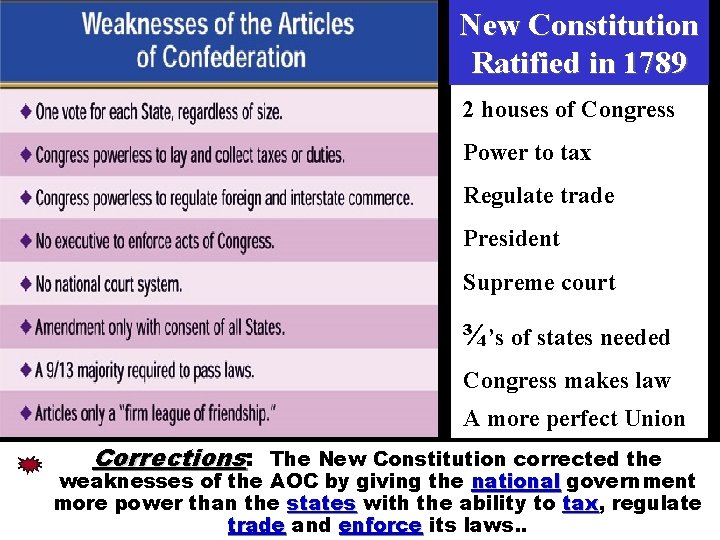
New Constitution Ratified in 1789 2 houses of Congress Power to tax Regulate trade President Supreme court ¾’s of states needed Congress makes law A more perfect Union Corrections: The New Constitution corrected the weaknesses of the AOC by giving the national government more power than the states with the ability to tax, tax regulate Chapter 2, Section 3 1 trade 2 and enforce 4 5 its laws. .
United States Constitution = • Supreme law of the land…. • US Constitution is over all levels of government. National Government is over the States. Powers of Some delegates government are feared the central divided between government would National a National, state be too powerful. A Govt. and local federal govt. was governments. created to allow states and local Powers of State Government govts to handle government are their own affairs. shared by all levels. Local Government Federal
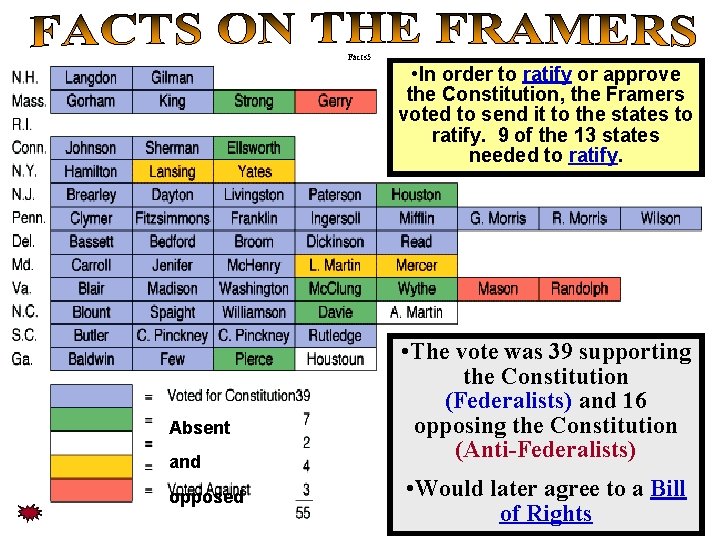
Facts 5 Absent and opposed • In order to ratify or approve the Constitution, the Framers voted to send it to the states to ratify. 9 of the 13 states needed to ratify. • The vote was 39 supporting the Constitution (Federalists) and 16 opposing the Constitution (Anti-Federalists) • Would later agree to a Bill of Rights
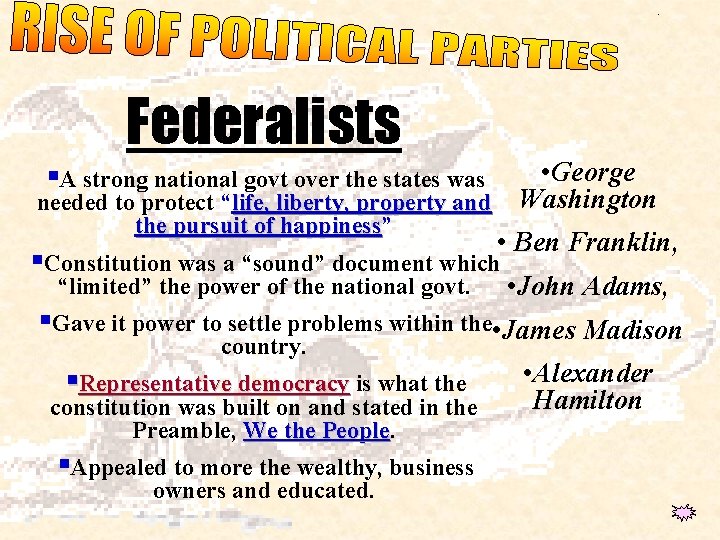
Art. 5, 6, 7 Federalists • George needed to protect “life, liberty, property and Washington the pursuit of happiness” happiness • Ben Franklin, §A strong national govt over the states was §Constitution was a “sound” document which “limited” the power of the national govt. • John Adams, §Gave it power to settle problems within the • James Madison country. §Representative democracy is what the constitution was built on and stated in the Preamble, We the People §Appealed to more the wealthy, business owners and educated. • Alexander Hamilton
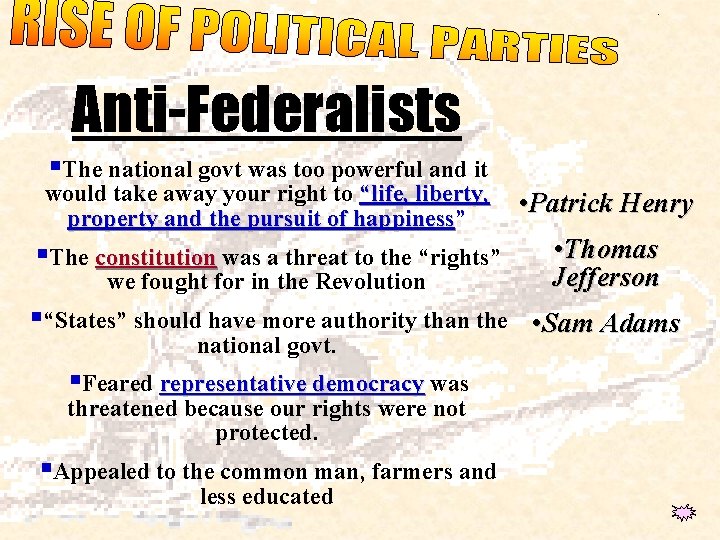
Art. 5, 6, 7 Anti-Federalists §The national govt was too powerful and it would take away your right to “life, liberty, property and the pursuit of happiness” happiness • Patrick Henry §The constitution was a threat to the “rights” • Thomas Jefferson we fought for in the Revolution §“States” should have more authority than the • Sam Adams national govt. §Feared representative democracy was threatened because our rights were not protected. §Appealed to the common man, farmers and less educated
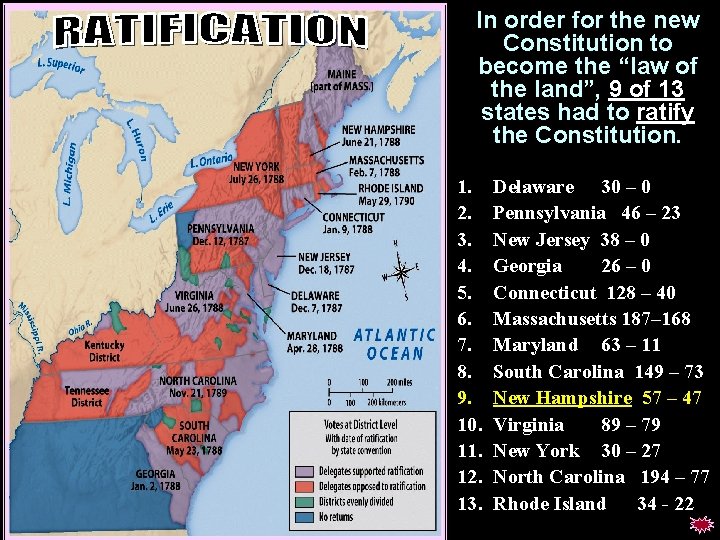
Ratif y strug gle In order for the new Constitution to become the “law of the land”, 9 of 13 states had to ratify the Constitution. 1. 2. 3. 4. 5. 6. 7. 8. 9. 10. 11. 12. 13. Delaware 30 – 0 Pennsylvania 46 – 23 New Jersey 38 – 0 Georgia 26 – 0 Connecticut 128 – 40 Massachusetts 187– 168 Maryland 63 – 11 South Carolina 149 – 73 New Hampshire 57 – 47 Virginia 89 – 79 New York 30 – 27 North Carolina 194 – 77 Rhode Island 34 - 22
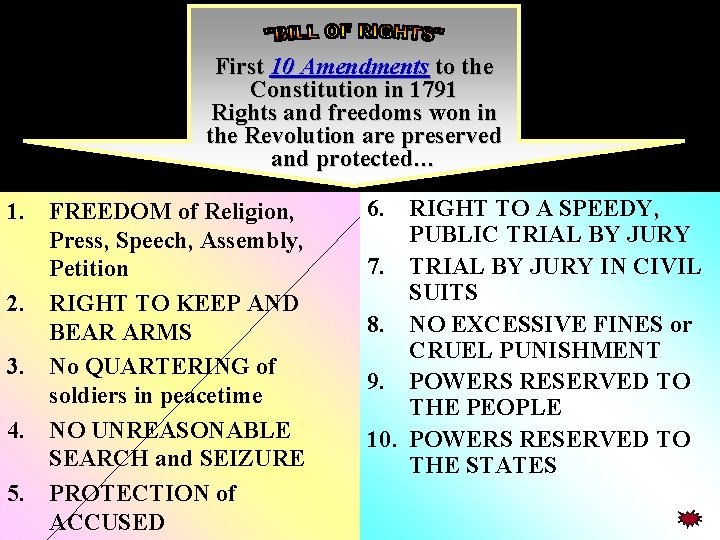
First 10 Amendments to the Constitution in 1791 Rights and freedoms won in the Revolution are preserved and protected… 1. FREEDOM of Religion, Press, Speech, Assembly, Petition 2. RIGHT TO KEEP AND BEAR ARMS 3. No QUARTERING of soldiers in peacetime 4. NO UNREASONABLE SEARCH and SEIZURE 5. PROTECTION of ACCUSED Bill of rights 6. RIGHT TO A SPEEDY, PUBLIC TRIAL BY JURY 7. TRIAL BY JURY IN CIVIL SUITS 8. NO EXCESSIVE FINES or CRUEL PUNISHMENT 9. POWERS RESERVED TO THE PEOPLE 10. POWERS RESERVED TO THE STATES
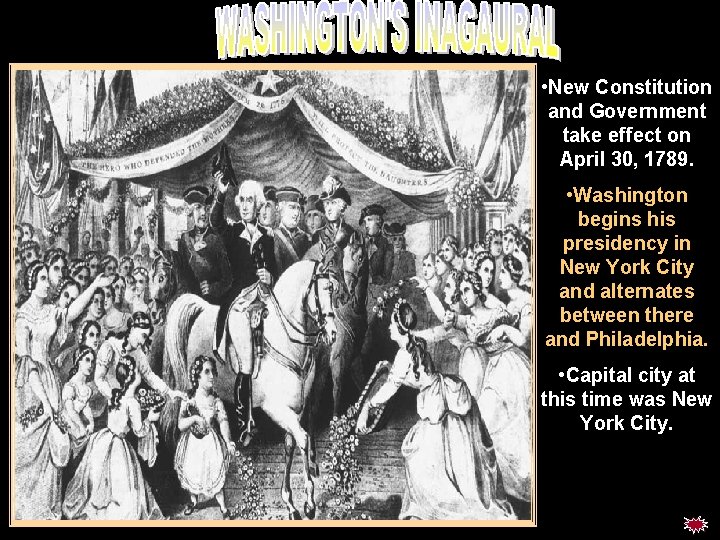
Wash inaugural • New Constitution and Government take effect on April 30, 1789. • Washington begins his presidency in New York City and alternates between there and Philadelphia. • Capital city at this time was New York City.
SUPREME LAW OF THE LAND It represents our belief in • Power of govt. comes from the people • Government power is limited • Ordered, organized and structured govt. • Representative democracy • Written, May 1787 to Sept. 1787 • 7, 000 words • Longest lasting constitution in history • Greatest symbol of democracy in the world