
The Constitutional Convention Explain the challenges in writing
- Slides: 32
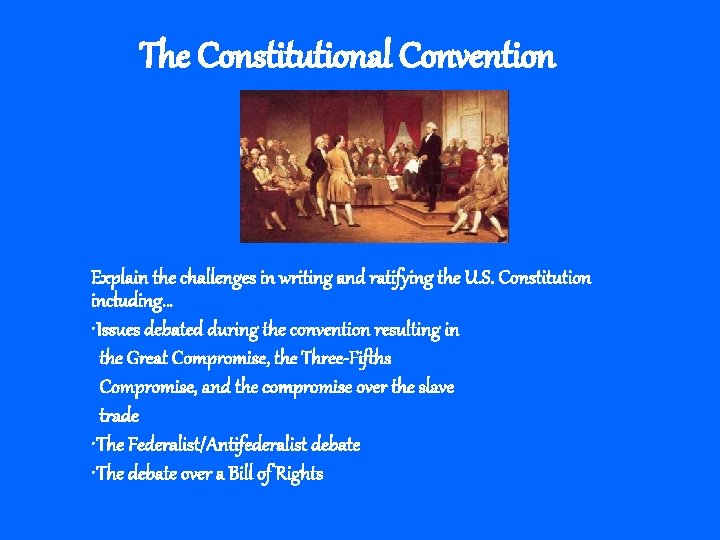
The Constitutional Convention Explain the challenges in writing and ratifying the U. S. Constitution including… • Issues debated during the convention resulting in the Great Compromise, the Three-Fifths Compromise, and the compromise over the slave trade • The Federalist/Antifederalist debate • The debate over a Bill of Rights
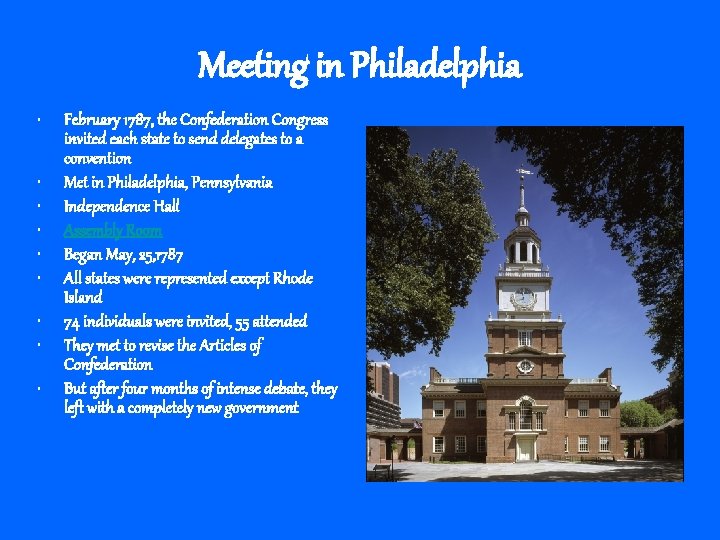
Meeting in Philadelphia • • • February 1787, the Confederation Congress invited each state to send delegates to a convention Met in Philadelphia, Pennsylvania Independence Hall Assembly Room Began May, 25, 1787 All states were represented except Rhode Island 74 individuals were invited, 55 attended They met to revise the Articles of Confederation But after four months of intense debate, they left with a completely new government
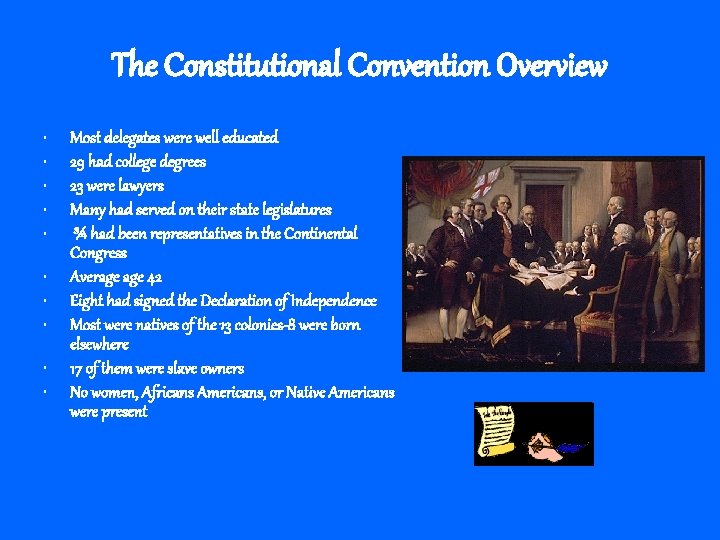
The Constitutional Convention Overview • • • Most delegates were well educated 29 had college degrees 23 were lawyers Many had served on their state legislatures ¾ had been representatives in the Continental Congress Average 42 Eight had signed the Declaration of Independence Most were natives of the 13 colonies-8 were born elsewhere 17 of them were slave owners No women, Africans Americans, or Native Americans were present
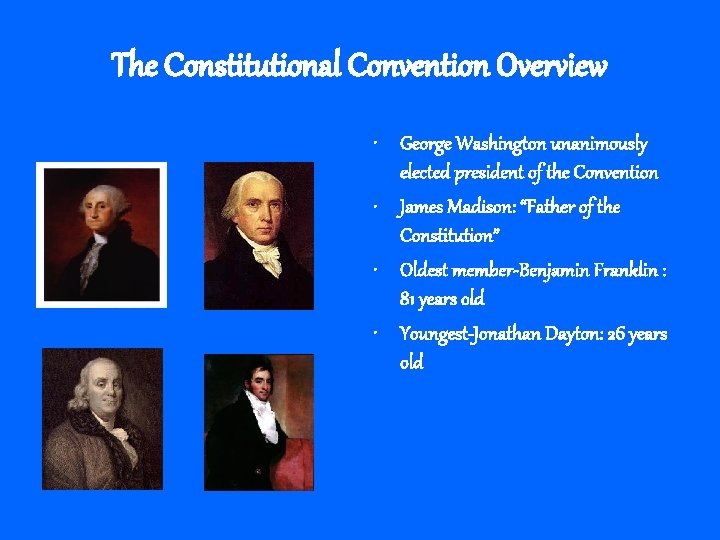
The Constitutional Convention Overview • George Washington unanimously elected president of the Convention • James Madison: “Father of the Constitution” • Oldest member-Benjamin Franklin : 81 years old • Youngest-Jonathan Dayton: 26 years old
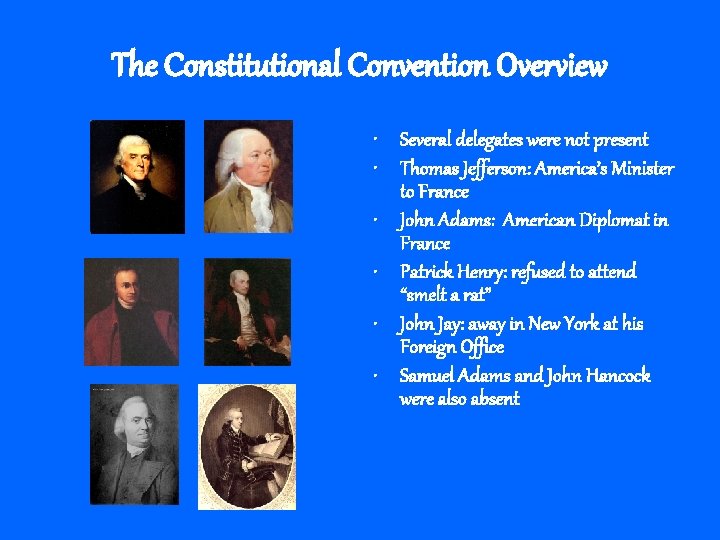
The Constitutional Convention Overview • Several delegates were not present • Thomas Jefferson: America’s Minister to France • John Adams: American Diplomat in France • Patrick Henry: refused to attend “smelt a rat” • John Jay: away in New York at his Foreign Office • Samuel Adams and John Hancock were also absent
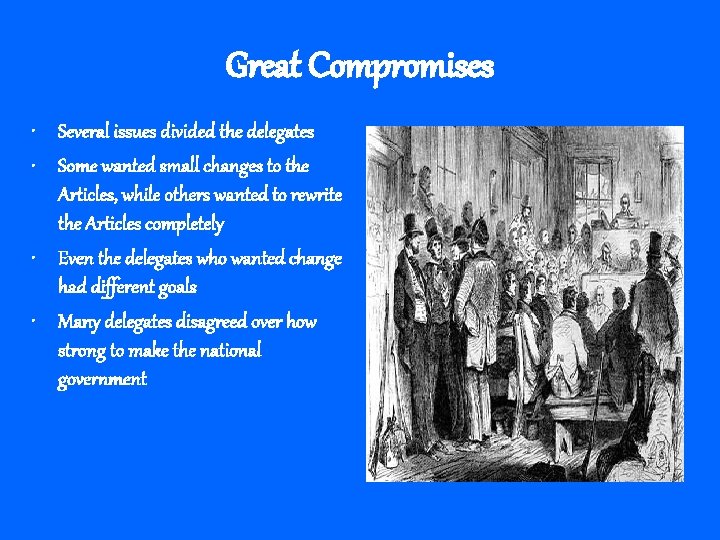
Great Compromises • Several issues divided the delegates • Some wanted small changes to the Articles, while others wanted to rewrite the Articles completely • Even the delegates who wanted change had different goals • Many delegates disagreed over how strong to make the national government
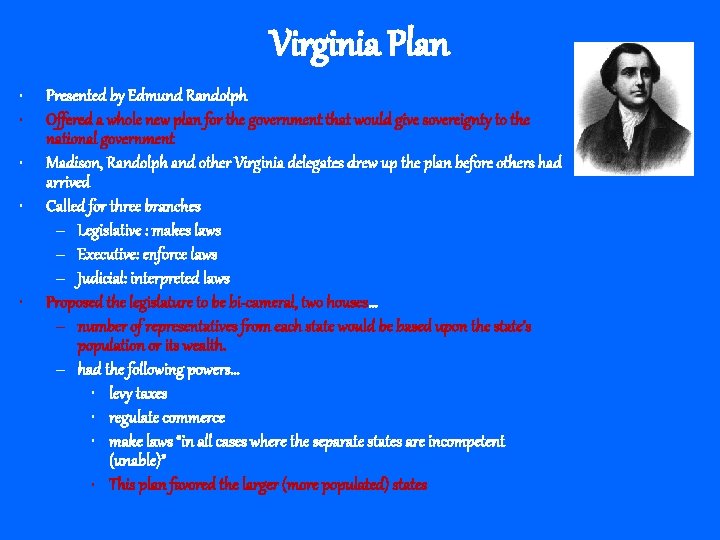
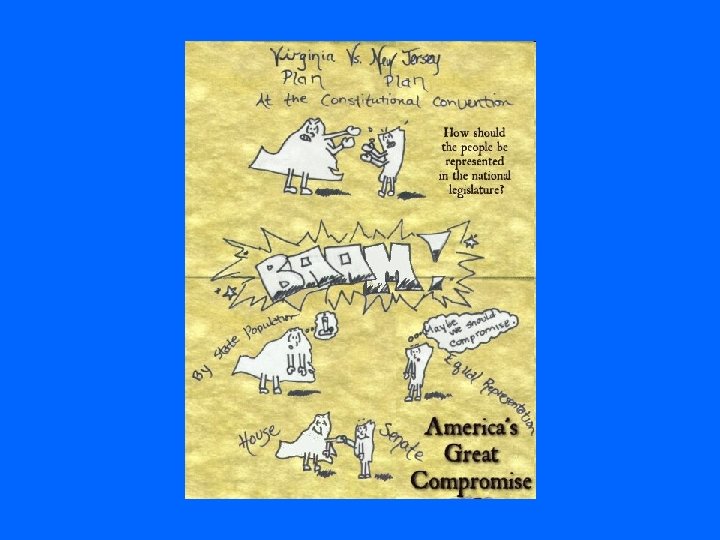
Virginia Plan • • • Presented by Edmund Randolph Offered a whole new plan for the government that would give sovereignty to the national government Madison, Randolph and other Virginia delegates drew up the plan before others had arrived Called for three branches – Legislative : makes laws – Executive: enforce laws – Judicial: interpreted laws Proposed the legislature to be bi-cameral, two houses… – number of representatives from each state would be based upon the state’s population or its wealth. – had the following powers… • levy taxes • regulate commerce • make laws “in all cases where the separate states are incompetent (unable)” • This plan favored the larger (more populated) states
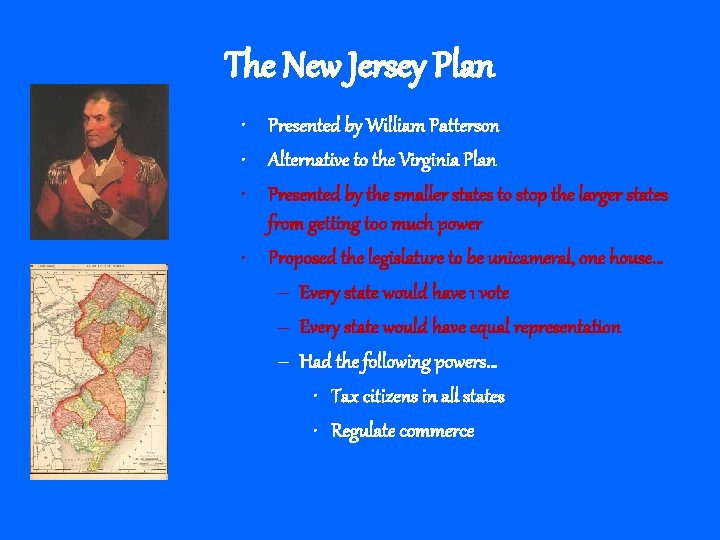
The New Jersey Plan • Presented by William Patterson • Alternative to the Virginia Plan • Presented by the smaller states to stop the larger states from getting too much power • Proposed the legislature to be unicameral, one house… – Every state would have 1 vote – Every state would have equal representation – Had the following powers… • Tax citizens in all states • Regulate commerce
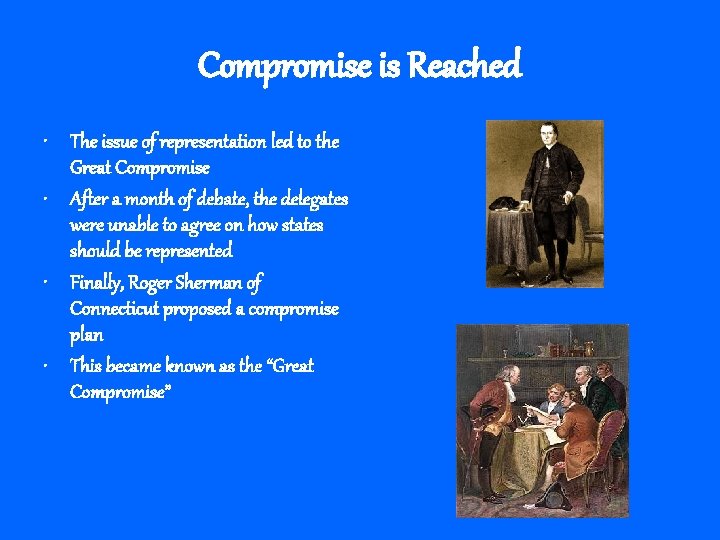
Compromise is Reached • The issue of representation led to the Great Compromise • After a month of debate, the delegates were unable to agree on how states should be represented • Finally, Roger Sherman of Connecticut proposed a compromise plan • This became known as the “Great Compromise”
The Great Compromise • This plan gave sovereignty (supreme power) to the central government • Set up a bicameral legislature • Upper House- Senate: Equal representation-pleasing the small states (2 from each state) • Lower House- House of Representatives: (435 today) representation would be based upon the state’s populationpleasing the large states • Allowed the Constitutional Convention to move ahead
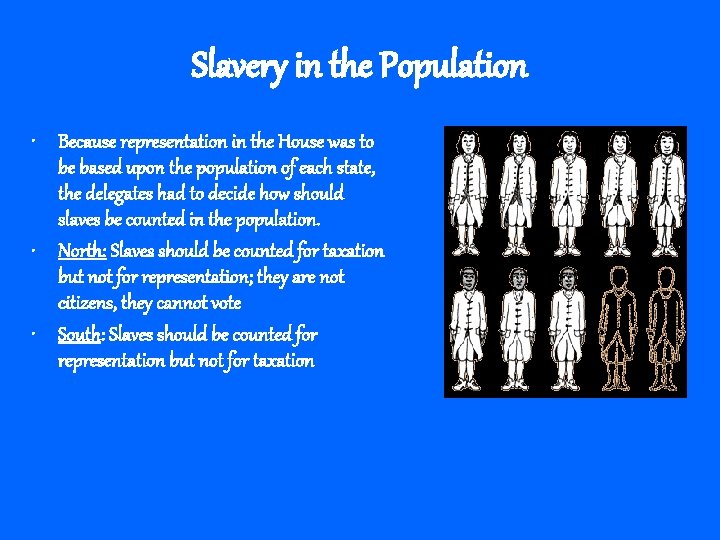
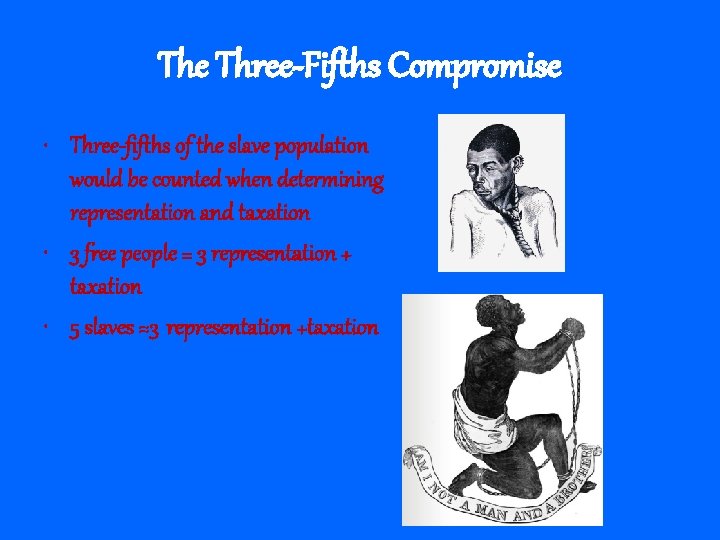
Slavery in the Population • Because representation in the House was to be based upon the population of each state, the delegates had to decide how should slaves be counted in the population. • North: Slaves should be counted for taxation but not for representation; they are not citizens, they cannot vote • South: Slaves should be counted for representation but not for taxation
The Three-Fifths Compromise • Three-fifths of the slave population would be counted when determining representation and taxation • 3 free people = 3 representation + taxation • 5 slaves =3 representation +taxation
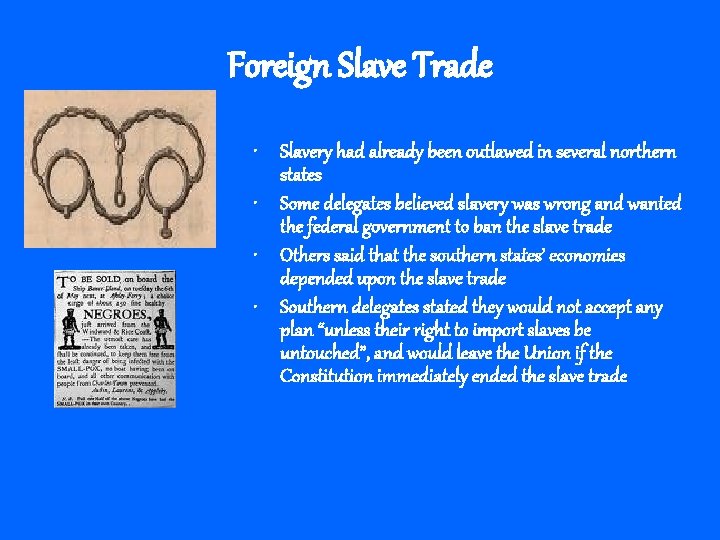
Foreign Slave Trade • Slavery had already been outlawed in several northern states • Some delegates believed slavery was wrong and wanted the federal government to ban the slave trade • Others said that the southern states’ economies depended upon the slave trade • Southern delegates stated they would not accept any plan “unless their right to import slaves be untouched”, and would leave the Union if the Constitution immediately ended the slave trade
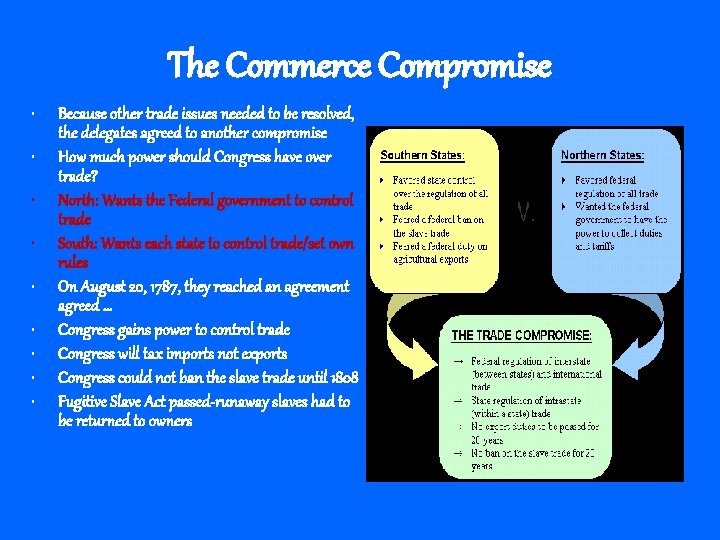
The Commerce Compromise • • • Because other trade issues needed to be resolved, the delegates agreed to another compromise How much power should Congress have over trade? North: Wants the Federal government to control trade South: Wants each state to control trade/set own rules On August 20, 1787, they reached an agreement agreed … Congress gains power to control trade Congress will tax imports not exports Congress could not ban the slave trade until 1808 Fugitive Slave Act passed-runaway slaves had to be returned to owners
The Executive Compromise • How should the Executive Branch be run? • Delegates decide 1 person will head the Executive Branch • What safeguard will be built in to make certain this person doesn’t become too powerful? • Congress has the ability to impeach the President • Definition impeach: bring an official to trial for misconduct in office • How should the President be chosen? • Some delegates believe the Congress should choose the President • Others believed there should be a direct election
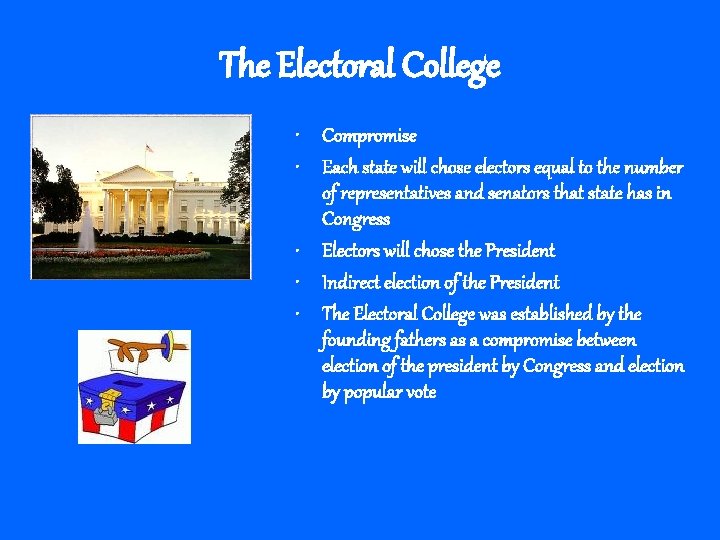
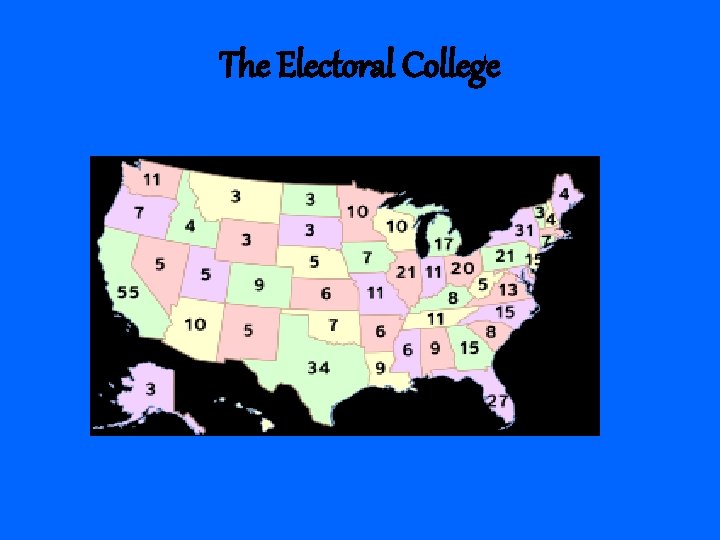
The Electoral College • Compromise • Each state will chose electors equal to the number of representatives and senators that state has in Congress • Electors will chose the President • Indirect election of the President • The Electoral College was established by the founding fathers as a compromise between election of the president by Congress and election by popular vote
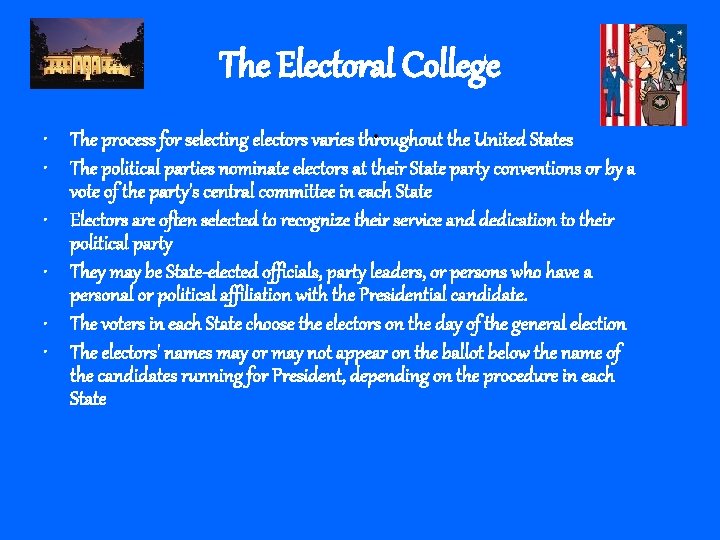
The Electoral College • • The process for selecting electors varies throughout the United States • The political parties nominate electors at their State party conventions or by a vote of the party's central committee in each State • Electors are often selected to recognize their service and dedication to their political party • They may be State-elected officials, party leaders, or persons who have a personal or political affiliation with the Presidential candidate. • The voters in each State choose the electors on the day of the general election • The electors' names may or may not appear on the ballot below the name of the candidates running for President, depending on the procedure in each State
The Electoral College
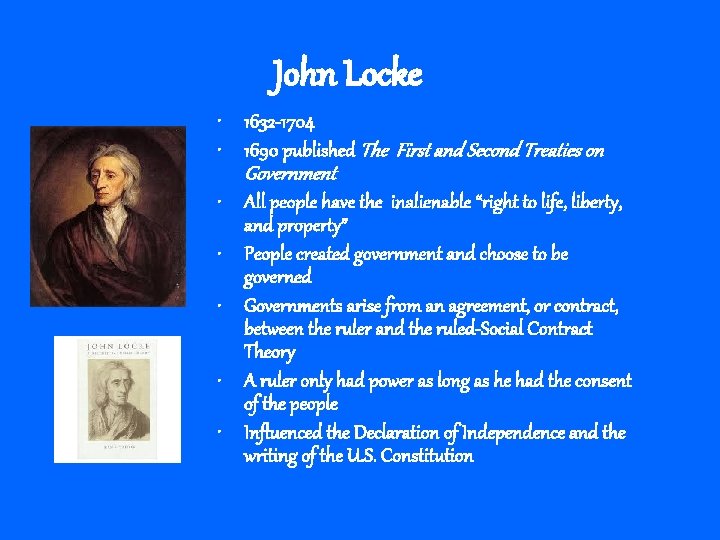
John Locke • 1632 -1704 • 1690 published The First and Second Treaties on Government • All people have the inalienable “right to life, liberty, and property” • People created government and choose to be governed • Governments arise from an agreement, or contract, between the ruler and the ruled-Social Contract Theory • A ruler only had power as long as he had the consent of the people • Influenced the Declaration of Independence and the writing of the U. S. Constitution
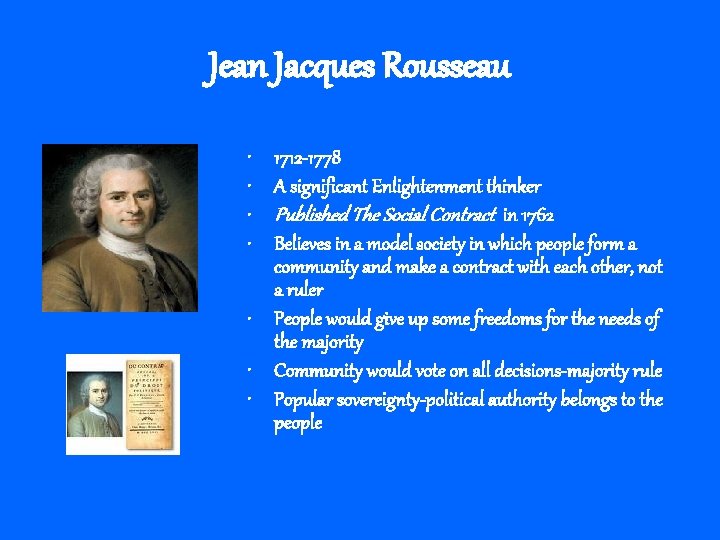
Jean Jacques Rousseau • • 1712 -1778 A significant Enlightenment thinker Published The Social Contract in 1762 Believes in a model society in which people form a community and make a contract with each other, not a ruler • People would give up some freedoms for the needs of the majority • Community would vote on all decisions-majority rule • Popular sovereignty-political authority belongs to the people
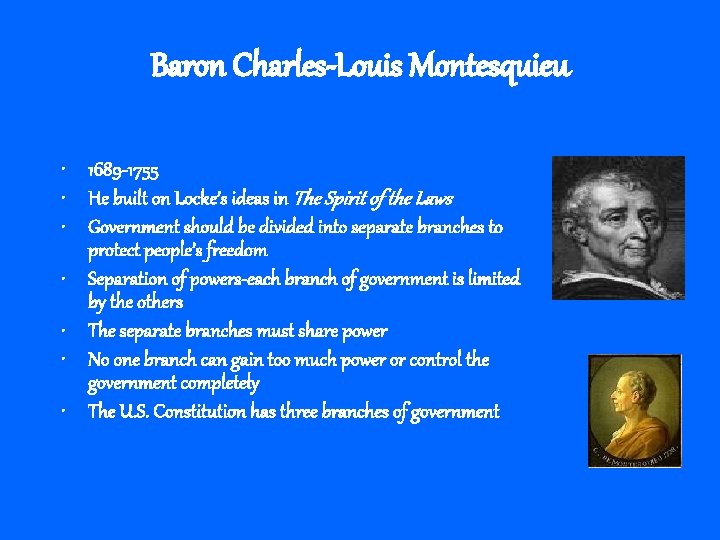
Baron Charles-Louis Montesquieu • 1689 -1755 • He built on Locke’s ideas in The Spirit of the Laws • Government should be divided into separate branches to protect people’s freedom • Separation of powers-each branch of government is limited by the others • The separate branches must share power • No one branch can gain too much power or control the government completely • The U. S. Constitution has three branches of government
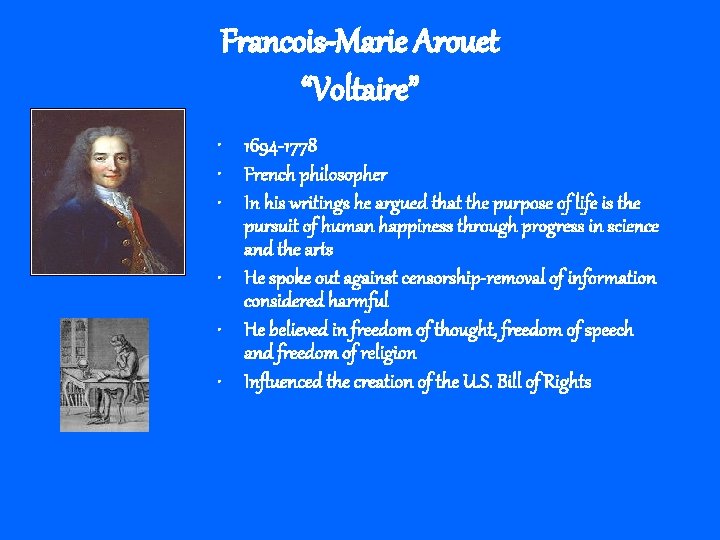
Francois-Marie Arouet “Voltaire” • 1694 -1778 • French philosopher • In his writings he argued that the purpose of life is the pursuit of human happiness through progress in science and the arts • He spoke out against censorship-removal of information considered harmful • He believed in freedom of thought, freedom of speech and freedom of religion • Influenced the creation of the U. S. Bill of Rights
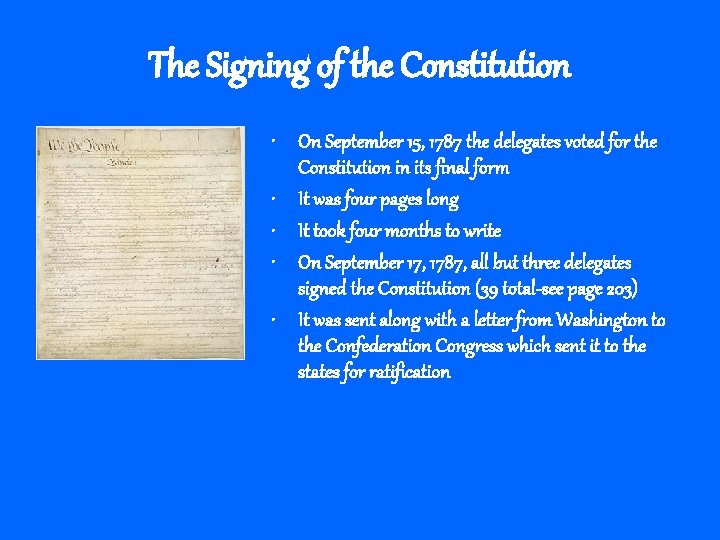
The Signing of the Constitution • On September 15, 1787 the delegates voted for the Constitution in its final form • It was four pages long • It took four months to write • On September 17, 1787, all but three delegates signed the Constitution (39 total-see page 203) • It was sent along with a letter from Washington to the Confederation Congress which sent it to the states for ratification
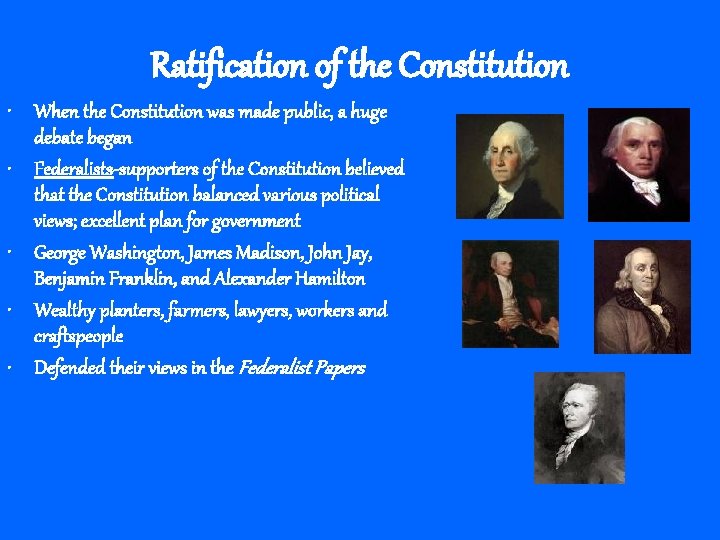
Ratification of the Constitution • When the Constitution was made public, a huge debate began • Federalists-supporters of the Constitution believed that the Constitution balanced various political views; excellent plan for government • George Washington, James Madison, John Jay, Benjamin Franklin, and Alexander Hamilton • Wealthy planters, farmers, lawyers, workers and craftspeople • Defended their views in the Federalist Papers
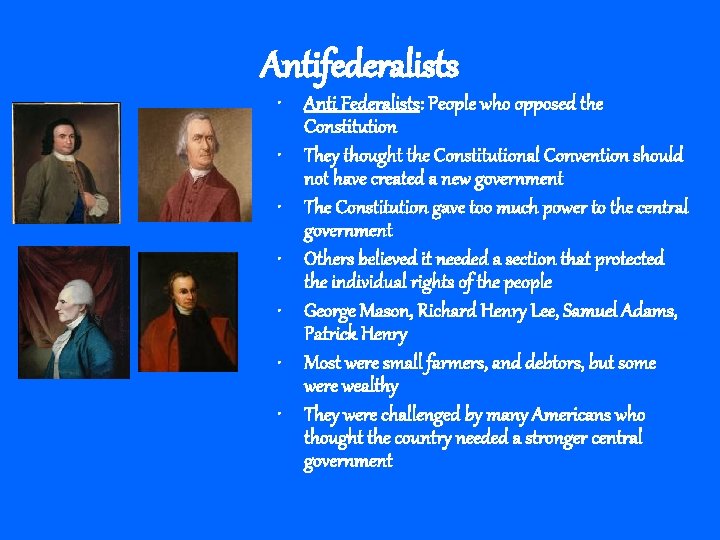
Antifederalists • Anti Federalists: People who opposed the Constitution • They thought the Constitutional Convention should not have created a new government • The Constitution gave too much power to the central government • Others believed it needed a section that protected the individual rights of the people • George Mason, Richard Henry Lee, Samuel Adams, Patrick Henry • Most were small farmers, and debtors, but some were wealthy • They were challenged by many Americans who thought the country needed a stronger central government
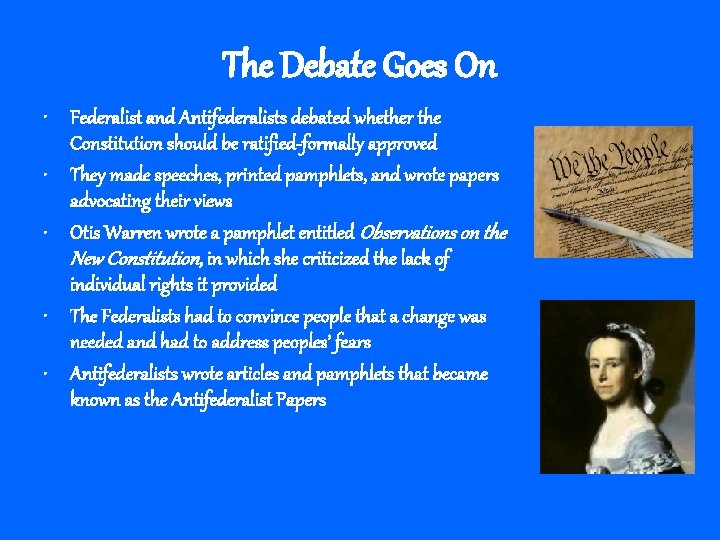
The Debate Goes On • Federalist and Antifederalists debated whether the Constitution should be ratified-formally approved • They made speeches, printed pamphlets, and wrote papers advocating their views • Otis Warren wrote a pamphlet entitled Observations on the New Constitution, in which she criticized the lack of individual rights it provided • The Federalists had to convince people that a change was needed and had to address peoples’ fears • Antifederalists wrote articles and pamphlets that became known as the Antifederalist Papers
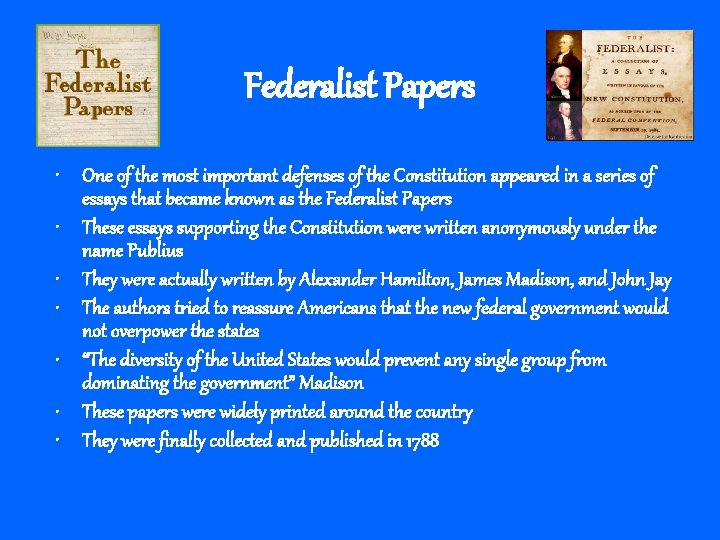
Federalist Papers • One of the most important defenses of the Constitution appeared in a series of essays that became known as the Federalist Papers • These essays supporting the Constitution were written anonymously under the name Publius • They were actually written by Alexander Hamilton, James Madison, and John Jay • The authors tried to reassure Americans that the new federal government would not overpower the states • “The diversity of the United States would prevent any single group from dominating the government” Madison • These papers were widely printed around the country • They were finally collected and published in 1788
Ratification Debate • The Constitution needed only 9 states to pass, but needed all states to establish and preserve national unity • Every state except Rhode Island held special state conventions that gave citizens the chance to discuss and vote on the Constitution • On December 7, 1787, Delaware became the first state to ratify the Constitution • New Hampshire became the 9 th state to ratify and the document went into effect in July 1788 • Problem: The new government did not have the support of New York and Virginia • Madison convinced the delegates of Virginia to ratify in mid 1788 • New York after much debate also ratified that same year • Rhode Island was the last to ratify in May 1790
The Bill of Rights • Several states ratified the U. S. Constitution only after they were promised the addition of a Bill of Rights • Many Federalists argued that the nation did not need a federal bill of rights, because the Constitution itself was a bill of rights • It was written to protect the liberty of the U. S. citizens • Madison wanted to make the bill of rights one of the nation’s first priorities • In Congress’s first session, Madison encouraged the legislators to put together a bill of rights that would then be added to the Constitution as amendments or official changes
Article V • In article V of the U. S. Constitution, the founders had provided a way to change the document when necessary in order to reflect the will of the people • The process requires that proposed amendments must be approved by a two-thirds majority vote of both houses of Congress • Then the proposed amendment must be ratified by three-fourths of the states before taking effect
The Bill of Rights • • Legislators took ideas from the following when creating a bill of rights… state ratifying conventions the Virginia Declaration of Rights The English Bill of Rights The Declaration of Independence They wanted to make sure that the abuses (Tyrannical Acts of the British King) listed in the Declaration of Independence were illegal under the new government In September 1789 Congress proposed 12 amendments and sent them to the states for ratification By December 1791 the states had ratified the Bill of Rights-the first 10 amendments of the United States Constitution This list of proposed amendments were intended to protect the rights of the people These set a clear example of how to amend the Constitution to fit the need of a changing nation Making the United States Constitution a “living breathing” document still surviving over 200 years