
The Constitution Fundamental Principles of the Constitution Popular

- Slides: 47
The Constitution
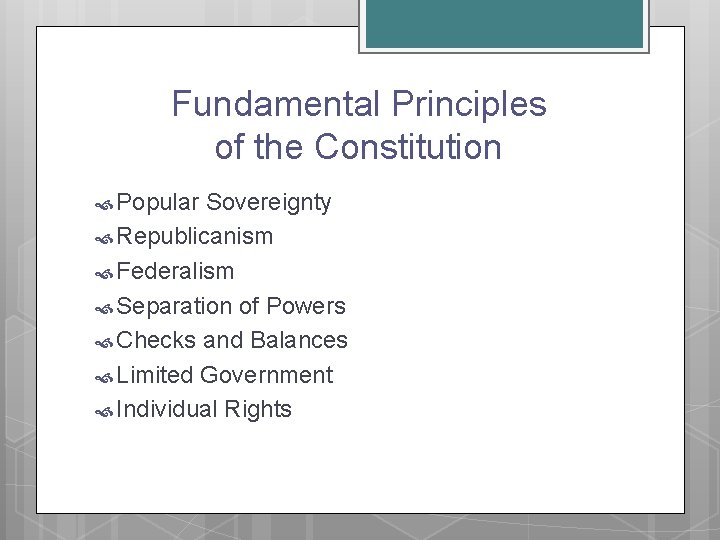
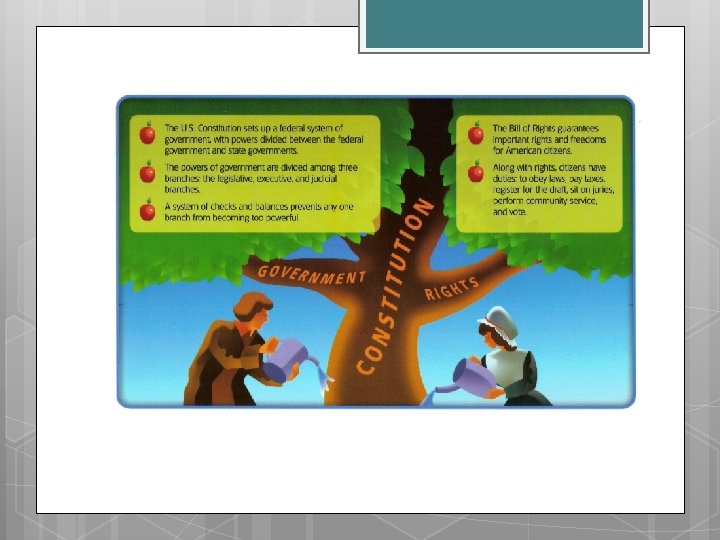
Fundamental Principles of the Constitution Popular Sovereignty Republicanism Federalism Separation of Powers Checks and Balances Limited Government Individual Rights
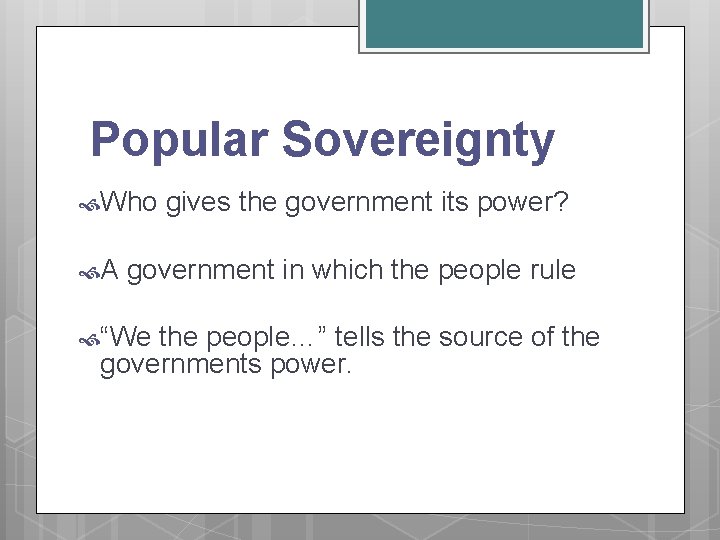
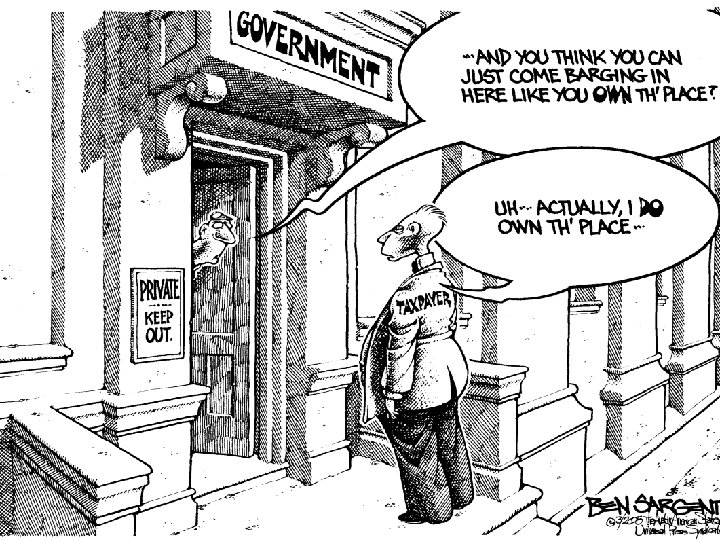
Popular Sovereignty Who A gives the government its power? government in which the people rule “We the people…” tells the source of the governments power.
4 December 15, 2021
Republicanism How are people’s views represented in Government? Based on this belief: The people exercise their power by voting for their political representatives. Article 4, Section 4, calls for every state to have a “republican form of Govt. ”
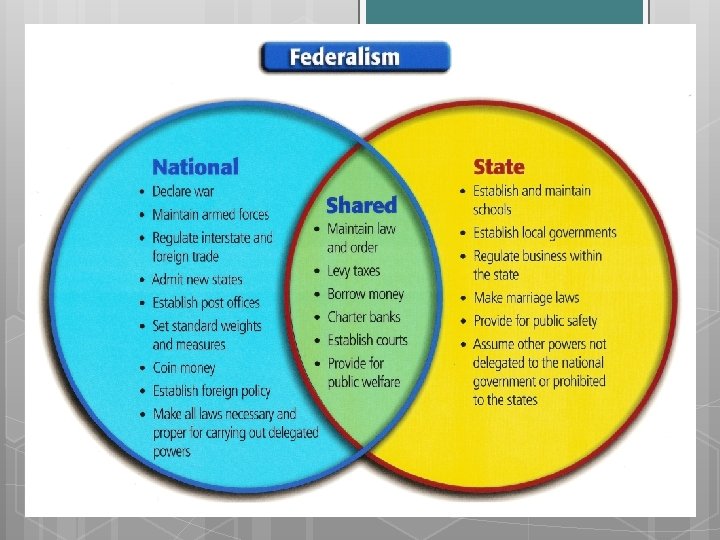
Federalism How is the power shared? Form of government in which power is divided between a central government and smaller political units, such as states.
Separation of Powers How is power divided? Framers were concerned that too much power might fall into the hands of a single group. Articles 1, 2, and 3 explain how powers are split among the 3 branches.
Checks and Balances How is power evenly distributed? Though the branches are separate, they rely on each other to perform the work of the government. The system makes sure that the branches work together fairly.
Limited Government How is abuse of power prevented? All citizens and leaders must obey the law.
Individual Rights How are personal freedoms protected? These are personal liberties and privileges. The Bill of Rights protect people from an overly powerful government.
The Three Branches of Government and the Separation of Power Main Idea: The framers of the Constitution devised the federal system They wanted to create a govt. powerful enough to protect the rights of citizens and defend the country against enemies.
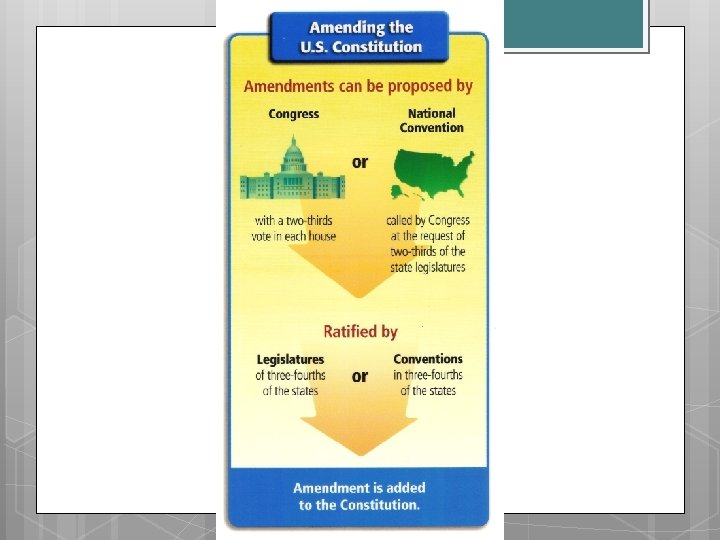
THE FEDERAL SYSTEM Federal System (federalism); a system that divided powers between the states and the federal govt. DELEGATED RIGHTS Constitution assigns certain powers to the national govt. – Coin money Regulate trade
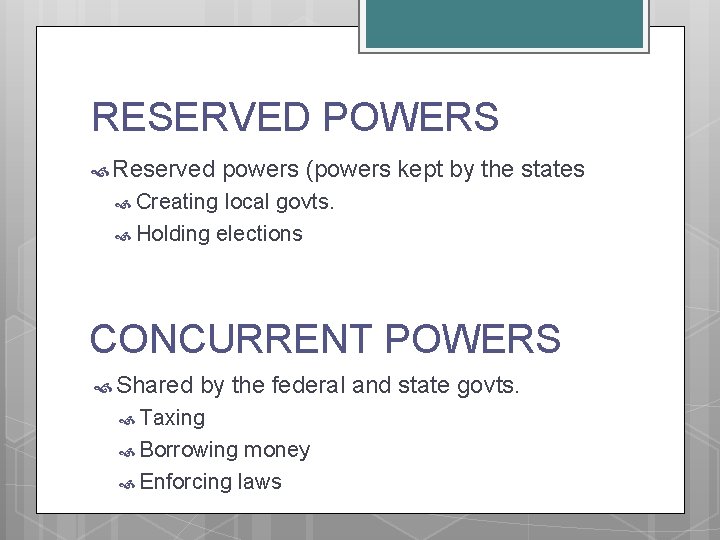
RESERVED POWERS Reserved powers (powers kept by the states Creating local govts. Holding elections CONCURRENT POWERS Shared by the federal and state govts. Taxing Borrowing money Enforcing laws
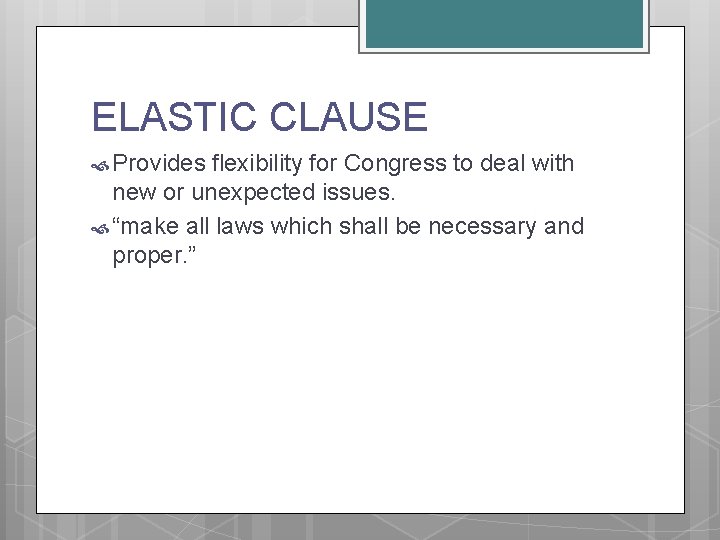
ELASTIC CLAUSE Provides flexibility for Congress to deal with new or unexpected issues. “make all laws which shall be necessary and proper. ”
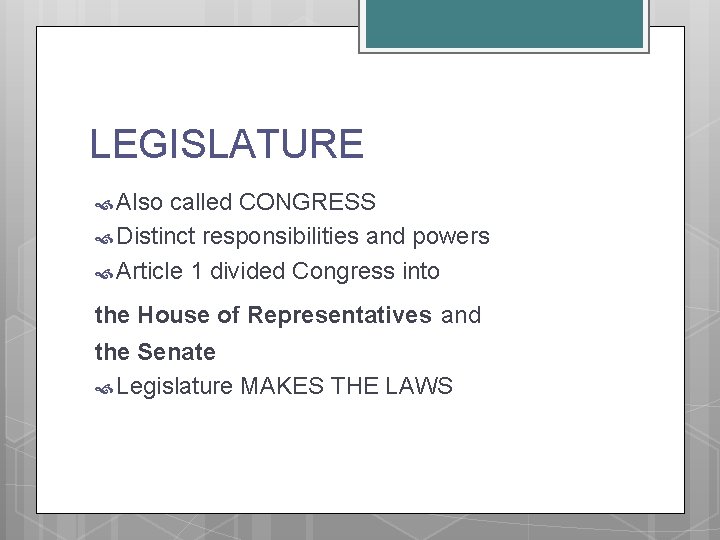
LEGISLATURE Also called CONGRESS Distinct responsibilities and powers Article 1 divided Congress into the House of Representatives and the Senate Legislature MAKES THE LAWS
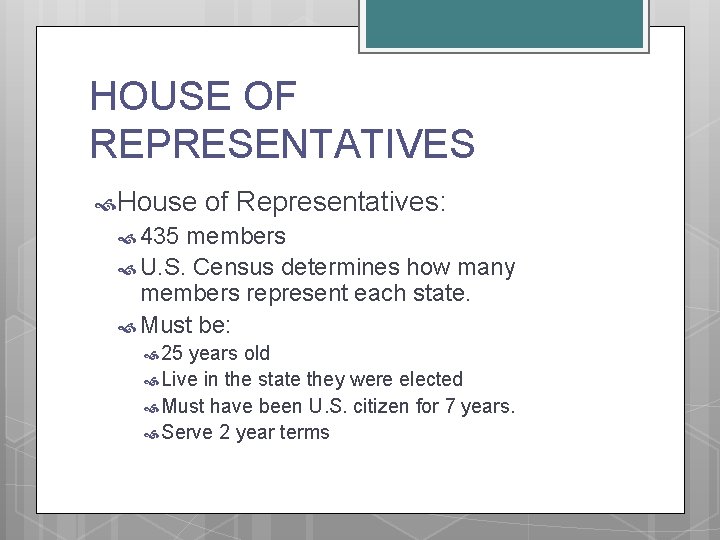
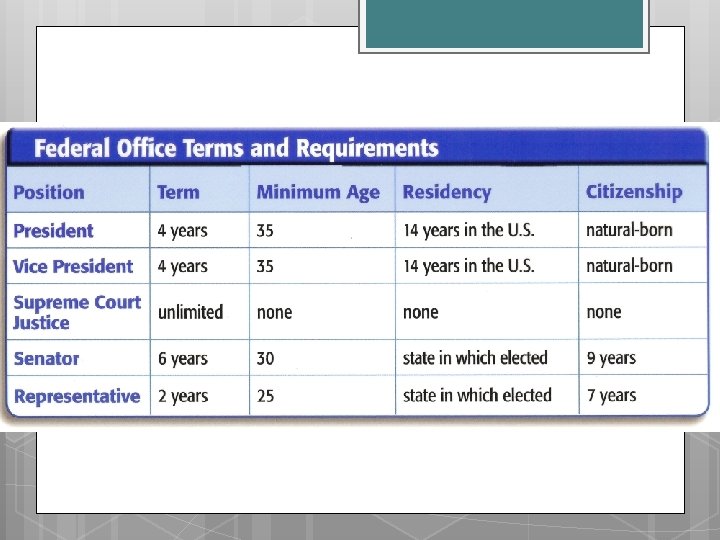
HOUSE OF REPRESENTATIVES House of Representatives: 435 members U. S. Census determines how many members represent each state. Must be: 25 years old Live in the state they were elected Must have been U. S. citizen for 7 years. Serve 2 year terms
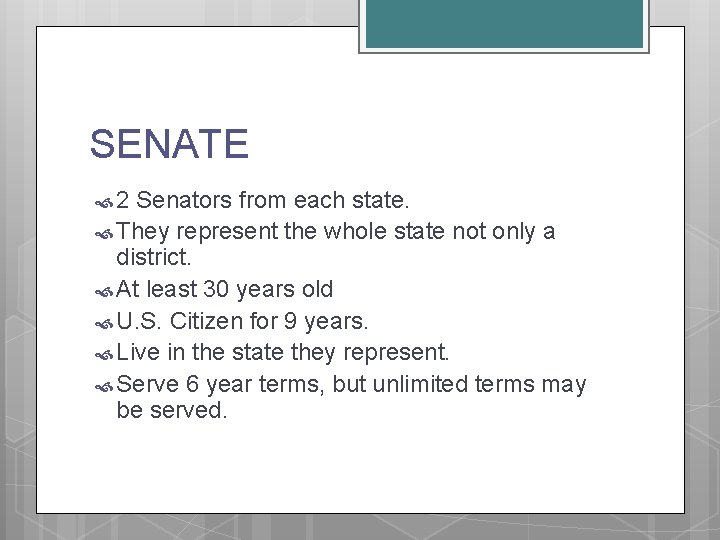
SENATE 2 Senators from each state. They represent the whole state not only a district. At least 30 years old U. S. Citizen for 9 years. Live in the state they represent. Serve 6 year terms, but unlimited terms may be served.
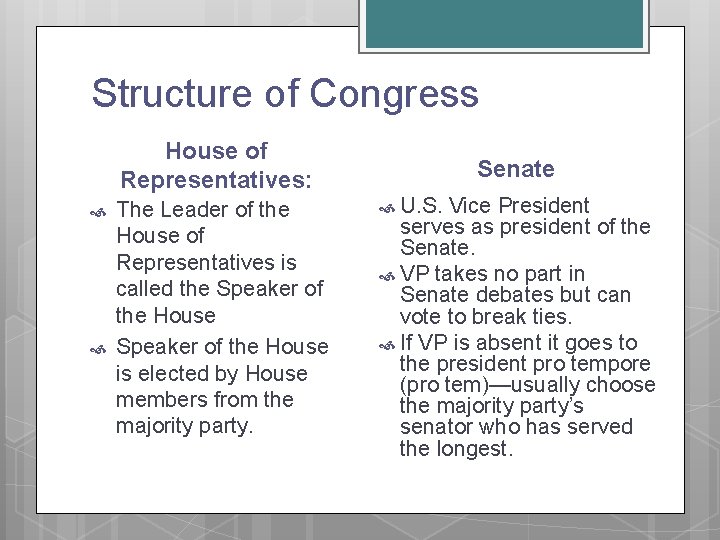
Structure of Congress House of Representatives: The Leader of the House of Representatives is called the Speaker of the House is elected by House members from the majority party. Senate U. S. Vice President serves as president of the Senate. VP takes no part in Senate debates but can vote to break ties. If VP is absent it goes to the president pro tempore (pro tem)—usually choose the majority party’s senator who has served the longest.
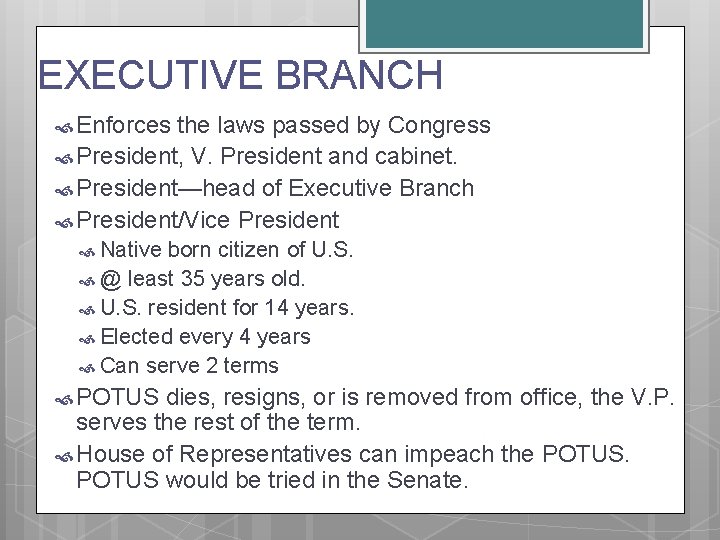
EXECUTIVE BRANCH Enforces the laws passed by Congress President, V. President and cabinet. President—head of Executive Branch President/Vice President Native born citizen of U. S. @ least 35 years old. U. S. resident for 14 years. Elected every 4 years Can serve 2 terms POTUS dies, resigns, or is removed from office, the V. P. serves the rest of the term. House of Representatives can impeach the POTUS would be tried in the Senate.
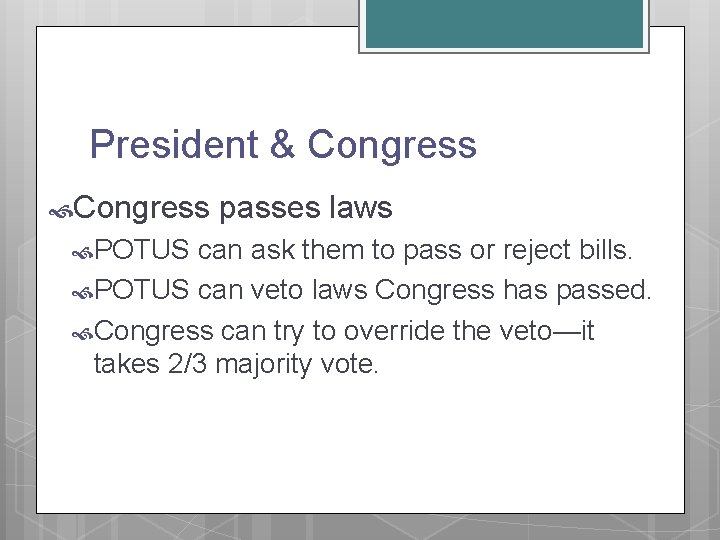
President & Congress POTUS passes laws can ask them to pass or reject bills. POTUS can veto laws Congress has passed. Congress can try to override the veto—it takes 2/3 majority vote.
Laws affecting the Constitution, treaties, and statutes the president issues executive orders these commands have the power of the law. President may grant pardons to persons convicted of federal crimes or facing criminal charges. President: Forces. Only Commander-in-Chief of the Armed Congress can declare war.
JUDICIAL BRANCH Made up of a system of federal courts headed by the U. S. Supreme Court. Constitution created the Supreme Court. Judiciary Act of 1789 created the system of lower district and circuit courts. Article III outlines courts’ duties. Federal law can strike down a state or federal law if the court finds a law unconstitutional. Congress can try to revise the law to make it constitutional.
District Courts President makes appointments to federal courts— they are given for life. Each state has at least one of the 94 district courts. Courts of Appeals If you believe your trial was unfair—you can take the case to the Court of Appeals. 13 Court of Appeals. Panel of judges make the decisions If they agree— stands disagree— maybe retried.
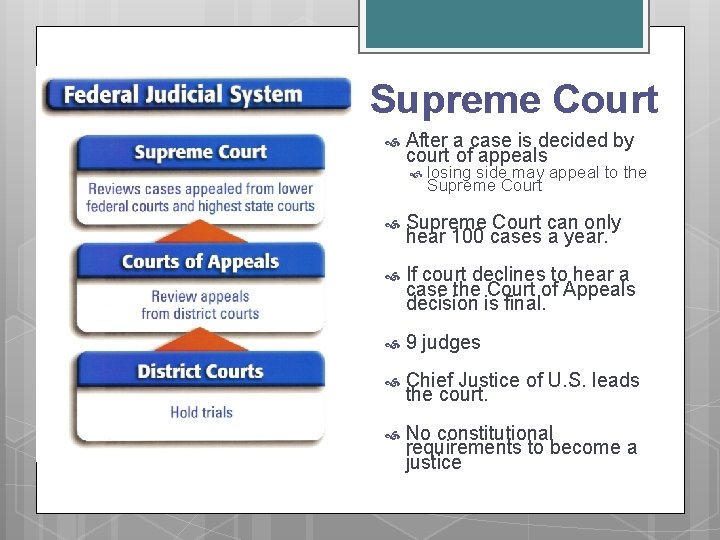
Supreme Court After a case is decided by court of appeals losing side may appeal to the Supreme Court can only hear 100 cases a year. If court declines to hear a case the Court of Appeals decision is final. 9 judges Chief Justice of U. S. leads the court. No constitutional requirements to become a justice
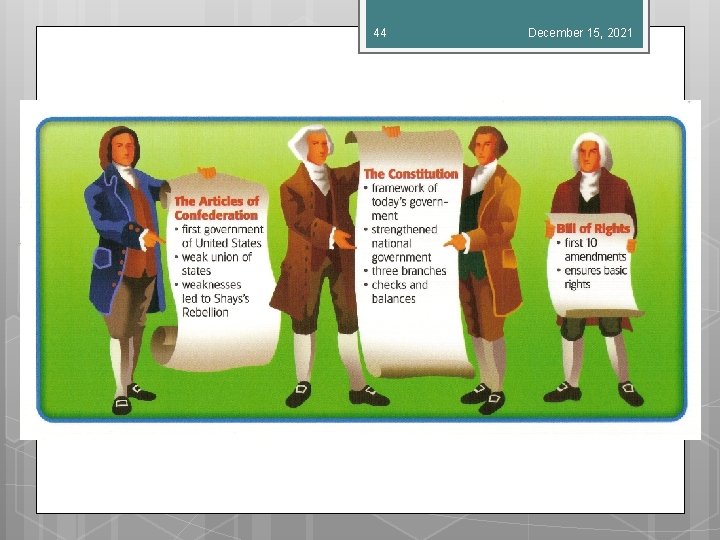
Bill of Rights 10 amendments intended to protect the individual rights of citizens Several states would not ratify until a Bill of Rights was added Written by James Madison with changes from congress
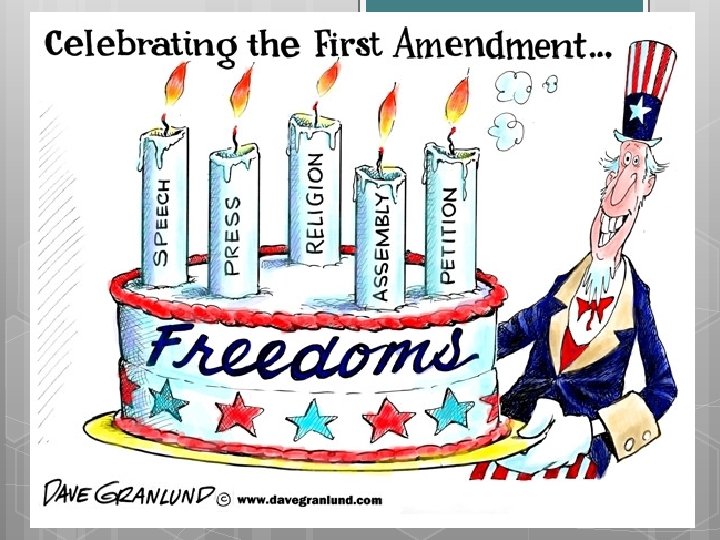
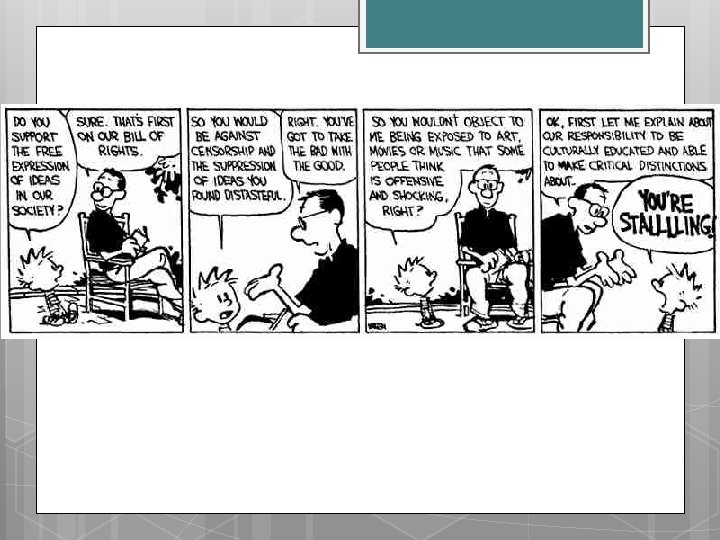
1 st Amendment Congress shall make no law respecting an establishment of religion, or prohibiting the free exercise thereof; or abridging the freedom of speech, or of the press; or the right of the people peaceably to assemble, and to petition the Government for a redress of grievances. Religious and political freedom Forms the foundation of the government Includes 5 freedoms: religion, speech, press, assembly, and petition
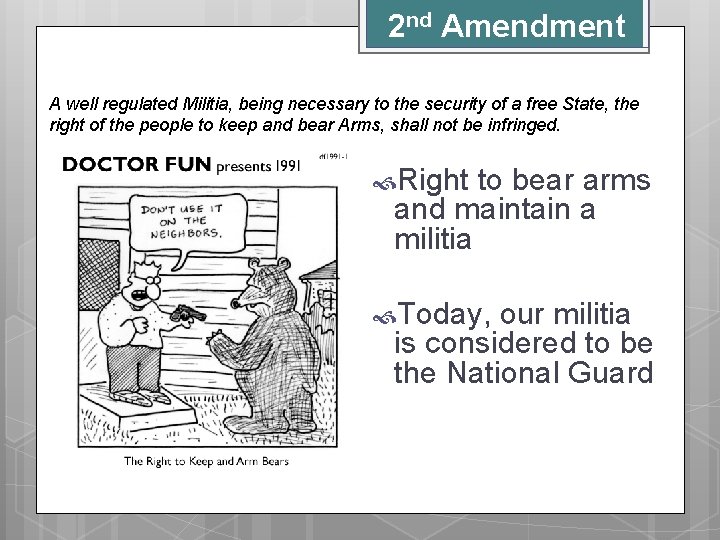
2 nd Amendment A well regulated Militia, being necessary to the security of a free State, the right of the people to keep and bear Arms, shall not be infringed. Right to bear arms and maintain a militia Today, our militia is considered to be the National Guard
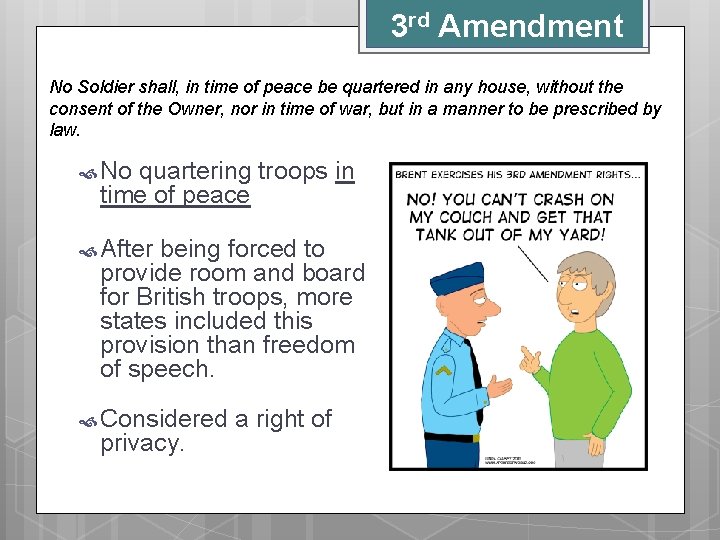
3 rd Amendment No Soldier shall, in time of peace be quartered in any house, without the consent of the Owner, nor in time of war, but in a manner to be prescribed by law. No quartering troops in time of peace After being forced to provide room and board for British troops, more states included this provision than freedom of speech. Considered privacy. a right of
4 th Amendment The right of the people to be secure in their persons, houses, papers, and effects, against unreasonable searches and seizures, shall not be violated, and no warrants shall issue, but upon probable cause, supported by Oath or affirmation, and particularly describing the place to be searched, and the persons or things to be seized. No unreasonable search and seizure The British ransacked homes and arrested Americans without warrants Again, protecting privacy
5 th Amendment No person shall be held to answer for a capital, or otherwise infamous crime, unless on a presentment or indictment of a Grand Jury, except in cases arising in the land or naval forces, or in the Militia, when in actual service in time of War or public danger; nor shall any person be subject for the same offence to be twice put in jeopardy of life or limb; nor shall be compelled in any criminal case to be a witness against himself, nor be deprived of life, liberty, or property, without due process of law; nor shall private property be taken for public use, without just compensation.
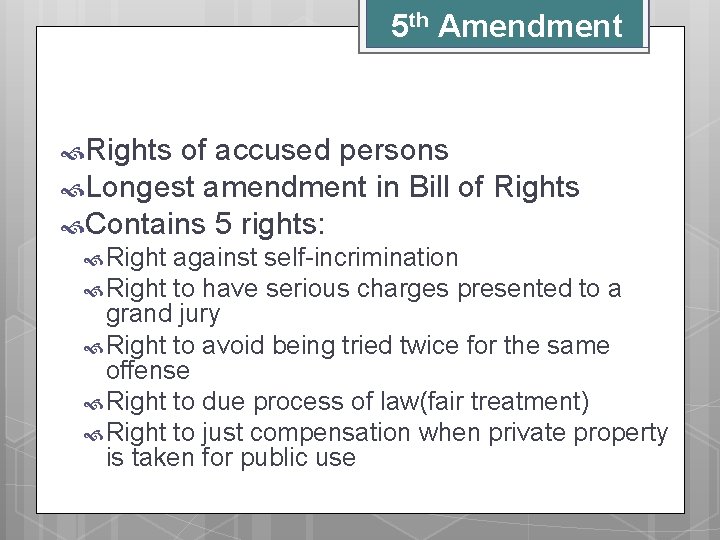
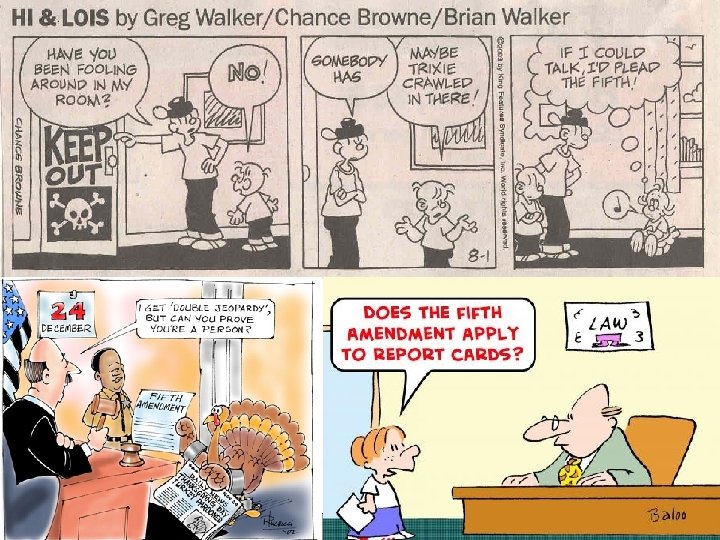
5 th Amendment Rights of accused persons Longest amendment in Bill of Rights Contains 5 rights: Right against self-incrimination Right to have serious charges presented to a grand jury Right to avoid being tried twice for the same offense Right to due process of law(fair treatment) Right to just compensation when private property is taken for public use
35 December 15, 2021
6 th Amendment In all criminal prosecutions, the accused shall enjoy the right to a speedy and public trial, by an impartial jury of the State and district wherein the crime shall have been committed, which district shall have been previously ascertained by law, and to be informed of the nature and cause of the accusation; to be confronted with the witnesses against him; to have compulsory process for obtaining witnesses in his favor, and to have the Assistance of Counsel for his defence. Right to a speedy, public trial Added to ensure that criminal defendants received a fair trial
7 th Amendment In suits at common law, where the value in controversy shall exceed twenty dollars, the right of trial by jury shall be preserved, and no fact tried by a jury, shall be otherwise re-examined in any court of the United States, than according to the rules of the common law. Trial by jury in civil cases Right to a jury in non-criminal matters, such as personal injuries or contracts Limits a judge’s power to overturn factual decisions by a jury
8 th Amendment Excessive bail shall not be required, nor excessive fines imposed, nor cruel and unusual punishments inflicted. Limits of fines and punishments Prohibits excessive bail Prohibits excessive fines Prohibits cruel and unusual punishment
9 th Amendment The enumeration in the Constitution, of certain rights, shall not be construed to deny or disparage others retained by the people. Rights of People Unenumerated Rights: Those rights not specifically listed in the Constitution
10 th Amendment The powers not delegated to the United States by the Constitution, nor prohibited by it to the States, are reserved to the States respectively, or to the people. Powers of states and people Protects powers of the states, not rights of the people
41
42 December 15, 2021
44 December 15, 2021
45 December 15, 2021
46 Dump slides December 15, 2021
47 December 15, 2021