
The Constitution and the New Republic The Constitution
The Constitution and the New Republic
The Constitution and the New Republic l l By 1790, ratification was unanimous (RI last to ratify), Vermont added as a state in 1791 First Congress met 1789 – l Enacted federal bill of rights, sent to states for ratification as promised Enacted a Judiciary Act, to set up the federal court system and the Supreme Court – – 6 justices (appointed for life) System of lower court, court of appeals
The Constitution and the New Republic l l 1789: Washington inaugurated as president Set up first cabinet: – – – Alexander Hamilton, Secretary of Treasury Thomas Jefferson, Secretary of State Samuel Osgood, Postmaster General Henry Knox, Secretary of War Edmund Randolph, Attorney General
The Constitution and the New Republic l The factions that had formed over the Constitution grew into two “parties” – – – l Federalists and Republicans (who had once been called Anti-Federalists) Hamilton: spokesman for Federalists Jefferson: spokesman for Republicans Washington refused to join a party, but was Federalist in his sympathies
The New Federalist Government l Shared beliefs of most of these men: – – – People are innately selfish and lustful for power “The Better Sort” of people were best qualified to govern “Rule by the mob” (which is how they understood pure democracy) must be avoided
This Assumption Bill, costing $22 million, would benefit the wealthy because they could buy bonds at a depreciated value but the US needed good credit to be able to secure loans from British and Dutch financiers. Opposed by Jefferson and Madison. The Constitution and the New Republic l Hamilton had a program to guarantee financial stability of the new nation (Assumption Bill): – – – All war bonds (existing public debt of the Confederation) to be paid off “at par” Central government would assume all state debt Establishment of a National Bank (controversial) Fund the debt with a tax on distilled liquor and import tax (revenue tariff known as the “Whiskey Tax”) Made loans to merchants, handled government funds and issued bills of credit
The Constitution and the New Republic l l Whiskey Rebellion (1794) Pennsylvania farmers (corn, rye) refused to pay Whiskey Tax because they felt it unfairly targeted them, started terrorizing local tax collectors – – – l This was the first real challenge to federal authority Washington sent a federal militia, farmers relented First real demonstration of federal strength Allegiance won by intimidation
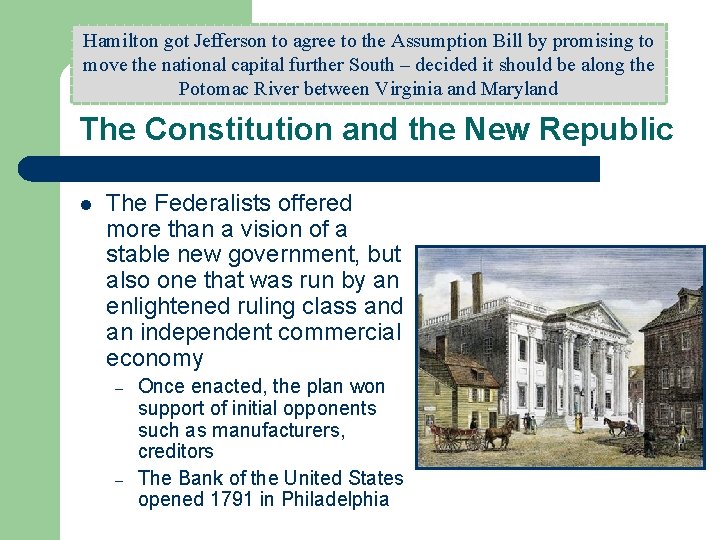
Hamilton got Jefferson to agree to the Assumption Bill by promising to move the national capital further South – decided it should be along the Potomac River between Virginia and Maryland The Constitution and the New Republic l The Federalists offered more than a vision of a stable new government, but also one that was run by an enlightened ruling class and an independent commercial economy – – Once enacted, the plan won support of initial opponents such as manufacturers, creditors The Bank of the United States opened 1791 in Philadelphia
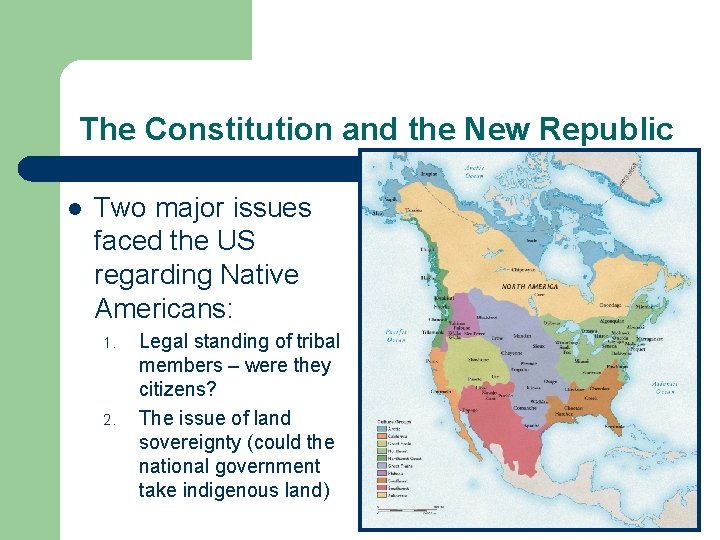
The Constitution and the New Republic l Two major issues faced the US regarding Native Americans: 1. 2. Legal standing of tribal members – were they citizens? The issue of land sovereignty (could the national government take indigenous land)
The Constitution and the New Republic l l l Washington served two terms, refused to run for a third (even though no official term limits) Felt any more than two might lead to dictatorship (concerned about setting a poor precedent) Presidents followed this custom until 1940 – now limited to two terms by Amendment XXII (1951)
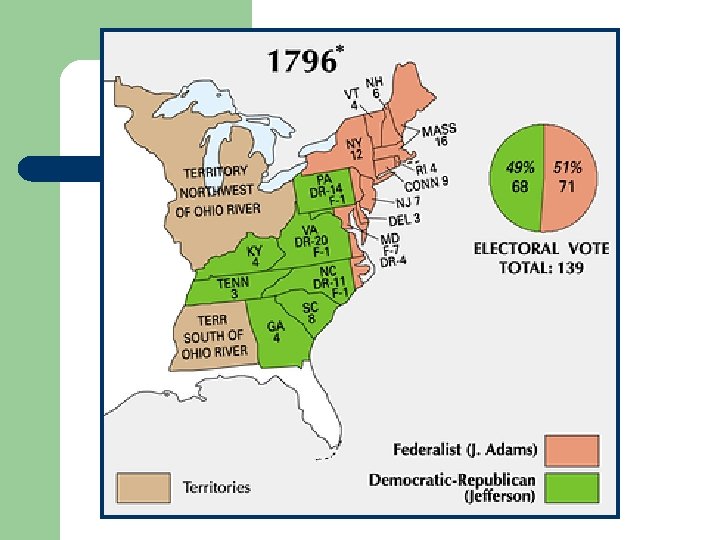
The Constitution and the New Republic l Election of 1796: John Adams (Federalist) elected 2 nd president – l Thomas Jefferson (Republican) became VP (2 nd place was VP, changed in 1804 under 12 th Amendment) Adams sided with Britain in European conflict – – This angered the French who expected repayment of their loyalty during revolution Frenchmen tried to force/bribe US to take their side (XYZ Affair)
Jay’s Treaty: settled lingering conflict with Britain (avoided a likely war) and established American control over NW Territory. Many felt like it didn’t punish Britain enough. The Constitution and the New Republic l War between Britain and France didn’t involve US, but still affected American politics: – Washington tried to stay neutral, but it was a challenge l – – Citizen Genet, seizure of US ships by Britain in West Indies Federalists tended to side with Britain (big trade partner, our “mother country, ” ruled by aristocrats, etc. ) Republicans tended to side with France (helped us during our Revolution, many French immigrants tended to vote Republican)
The Constitution and the New Republic l Adams was heavily criticized by Republicans for taking Britain’s side during “Quasi War” with France – – – l Cut off all trade to France, created a Dept. of Navy with new warships, became a close ally with Britain against French Adams’ reaction led to Alien and Sedition Acts (1798) as a way to silence Republican (French-supporting) opposition Obvious violations of Bill of Rights, confirmed worst suspicions about Federalists’ desire for power Jefferson and Madison responded with formal written complaint (Virginia and Kentucky Resolutions)
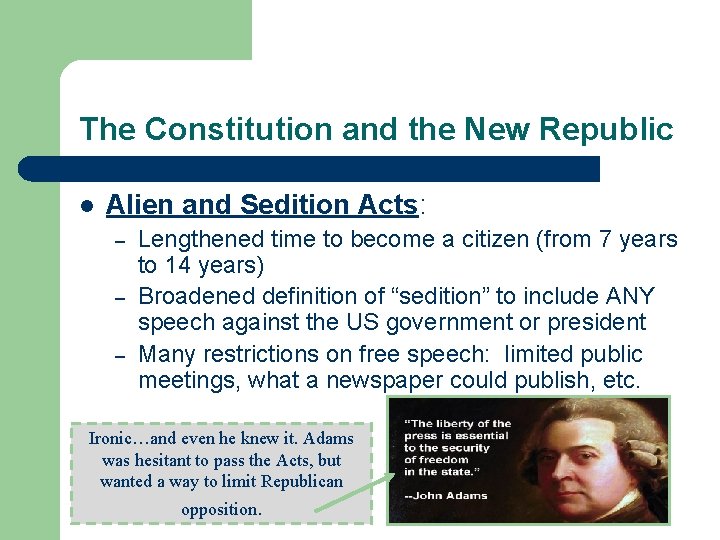
The Constitution and the New Republic l Alien and Sedition Acts: – – – Lengthened time to become a citizen (from 7 years to 14 years) Broadened definition of “sedition” to include ANY speech against the US government or president Many restrictions on free speech: limited public meetings, what a newspaper could publish, etc. Ironic…and even he knew it. Adams was hesitant to pass the Acts, but wanted a way to limit Republican opposition.
The Constitution and the New Republic l Virginia and Kentucky Resolutions – – – Written by Madison and Jefferson New doctrine of “nullification” If a state feels a federal law exceeds the power granted the federal government by the Constitution, it may refuse to obey or enforce it within its borders, and still remain loyal to the Union (only VA and KY ratified this) Went against the idea of “national supremacy” Used again in 1830 s by SC under Jackson
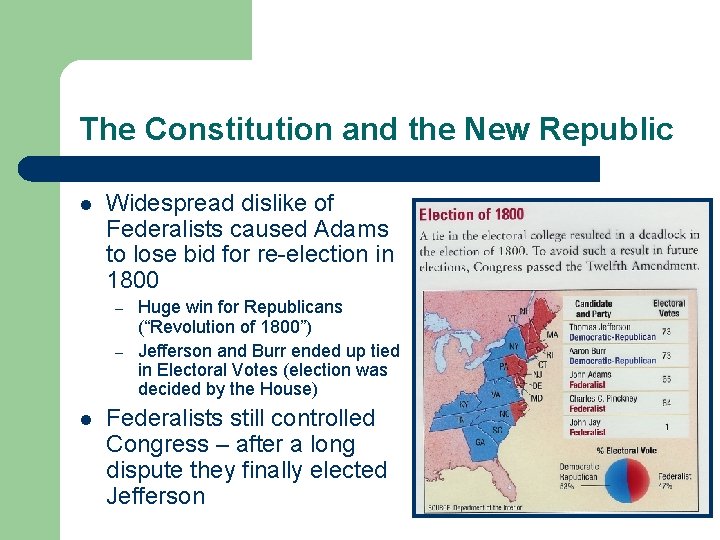
The Constitution and the New Republic l Widespread dislike of Federalists caused Adams to lose bid for re-election in 1800 – – l Huge win for Republicans (“Revolution of 1800”) Jefferson and Burr ended up tied in Electoral Votes (election was decided by the House) Federalists still controlled Congress – after a long dispute they finally elected Jefferson
The Constitution and the New Republic l Judiciary Act of 1801 passed by Federalist Congress before Jefferson (Republican) took office – l Adams moved quickly to appoint the new judges before he left office (known as “midnight appointments”) – l Reduced Supreme Court by one Justice, but greatly increased the number of federal judgeships Appointed John Marshall to Chief Justice of SC (beginning of “Marshall Court” – he served through 5 presidencies) Republicans viewed the “Revolution of 1800” as saving the nation from tyranny brought on by Federalists
- Slides: 18