
THE CONSTITUTION AND FEDERALISM Reminder Community Service Project


- Slides: 117
THE CONSTITUTION AND FEDERALISM
Reminder: Community Service Project ◦Due Date: April 15 th ◦Worth 200 points
Looking Ahead: Guest Speaker on Friday!!! ◦Stay tuned for more info
Homework: Survey five different people on modern politics ◦ Conduct a survey on at least five people about their feelings on modern politics. Ask them the following questions 1. What do you believe is the most important issue to be addressing in modern politics? Why do you think this? 2. How do you feel our government is handling this issue? Why do you think this? 3. What do you think the government is doing a good job at? 4. What do you think the government can be doing a better job of? 5. Do you watch the news? Which news station do you watch? Why do you, or do you not, watch the news?
Learning Objectives ◦Analyze the Six Basic Principles of the Constitution ◦Engage in Collaborative Learning ◦Enhance Public Speaking Skills
Six Basic Principles of The Constitution ◦ Popular Sovereignty ◦ Limited Government ◦ Separation of Powers/Checks and Balances ◦ Rule of Law ◦ Judicial Review ◦ Federalism
Six Principles of the Constitution. Review Sheet ◦ Fill out the Review Sheet on the Six Principles of the Constitution to assess how well you have retained past information, your prior knowledge of the material, and your understanding of the connection between these principles and historical examples throughout history
Warm Up ◦What are the four branches of the US Military? ◦What event showed Americans we need a centralized military and stronger central government(TAKE A GUESS)?
Homework: Survey five different people on modern politics ◦ Conduct a survey on at least five people about their feelings on modern politics. Ask them the following questions 1. What do you believe is the most important issue to be addressing in modern politics? Why do you think this? 2. How do you feel our government is handling this issue? Why do you think this? 3. What do you think the government is doing a good job at? 4. What do you think the government can be doing a better job of? 5. Do you watch the news? Which news station do you watch? Why do you, or do you not, watch the news?
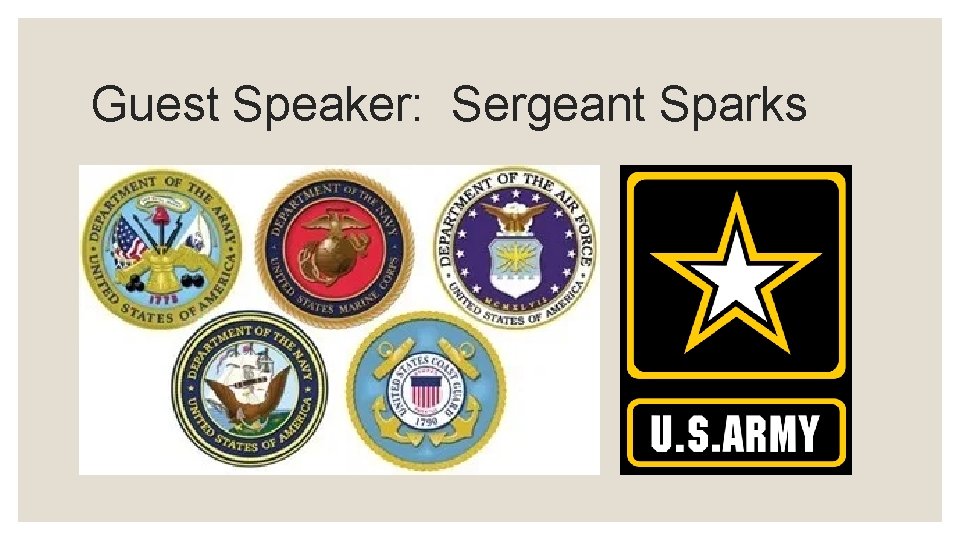
Guest Speaker: Sergeant Sparks
Blackmail ◦the action, treated as a criminal offense, of demanding payment or another benefit from someone in return for not revealing compromising or damaging information about them.
Warm Up ◦What are the Six Principles of the Constitution? ◦Define each of them
Homework: Survey five different people on modern politics Conduct a survey on at least ten people about their feelings on modern politics. Ask them the following questions ◦ What do you believe is the most important issue to be addressing in modern politics? Why do you think this? ◦ How do you feel our government is handling this issue? Why do you think this? ◦ What do you think the government is doing a good job at? ◦ What do you think the government can be doing a better job of? ◦ Do you watch the news? Which news station do you watch? Why do you, or do you not, watch the news?
Looking Ahead: BRING TEXTBOOKS IN TWO CLASSES FROM NOW ◦YOU WILL NEED YOUR TEXTBOOKS IN TWO CLASSES!!! ◦THIS WILL BE
Looking Ahead: Guest Speaker ◦Respect and best behavior ◦YOU WILL BE GRADED ◦YOU NEED TO BE HERE TO GET THE GRADE
Learning Objectives ◦Analyze the Six Basic Principles of the Constitution ◦Enhance Public Speaking Skills ◦Interpret Court Cases that threatened the First Amendment
Group Work: Create a Poster Presentation ◦ 6 Groups: Popular Sovereignty, Limited Government, Separation of Powers, Checks and Balances, Judicial Review, Federalism ◦ Each group will be given an article on one event in US history that addresses this principle ◦ The group will read the article and then prepare a poster to present to the class ◦ Each group member must have a specific role in creating the presentation and everyone must say something
Group Work: Create a Poster Presentation ◦ The presentation should include 1. An explanation of the Constitutional Principle 2. An explanation of the event that is being researched 3. The connection between the principle and the event 4. Three vocabulary words/terms/people/groups that you think the class should understand which pertains to your issue 5. Three graphics to demonstrate your understanding of the topic, as well as help your classmates understand the material 6. One discussion question for the class (APPROPRIATE!!!-IF YOU ARE NOT SURE THAN ASK ME)
Warm Up ◦What was your group’s article about? ◦Which constitutional principle did it relate to and how did it relate?
Homework: Essay on Court Cases that Threatened The First Amendment ◦ Pick one of the five court cases that we will look at this class, in which controversy erupted over whether or not the government was violating the First Amendment ◦ Be sure to explain what the court case was about and what the final ruling said about the case ◦ Give a background setting of what was going on during the time that led to this court case ◦ MAKE SURE TO INCLUDE A CLEAR THESIS STATEMENT ◦ Divide paragraphs up into Introduction, Conclusion, and Body Paragraphs
Looking Ahead: TEXTBOOKS NEXT CLASS ◦YOU WILL NEED YOUR TEXTBOOK NEXT CLASS ◦THIS WILL BE
Learning Objectives ◦Analyze Court Cases that Question the First Amendment ◦Interpret Political Cartoons about the Government/Constitution ◦Engage in Artistic Expression
Finish Poster Presentations ◦All Groups must present- it’s going into gradebook!
Threats to the 1 st Amendment: Freedom of Speech, Religion, and Press (Timeline on pg. 74 -75) ◦ -1798: Sedition Act- Illegal to criticize the government in speech or writing ◦ -1919: Schenck vs. US- Unlawful to send any written material to men eligible for the draft, that would make them want to resist being drafted ◦ -1969: Tinker vs. Des Moines School District- Constitution protects students wearing armbands to protest the Vietnam War ◦ -1971: NY Times vs. US- Supreme Court upholds the right of the paper to publicize “The Pentagon Papers” (articles about the Vietnam War) ◦ -1989: Texas vs. Johnson- Burning of the American flag is a form of political protest protected by the 1 st and 4 th amendments
Check for Understanding ◦What issue/law/policy do you see in the modern day as a threat to the First Amendment? ◦Is it okay for the US government to break the First Amendment in some cases? Why or why not?
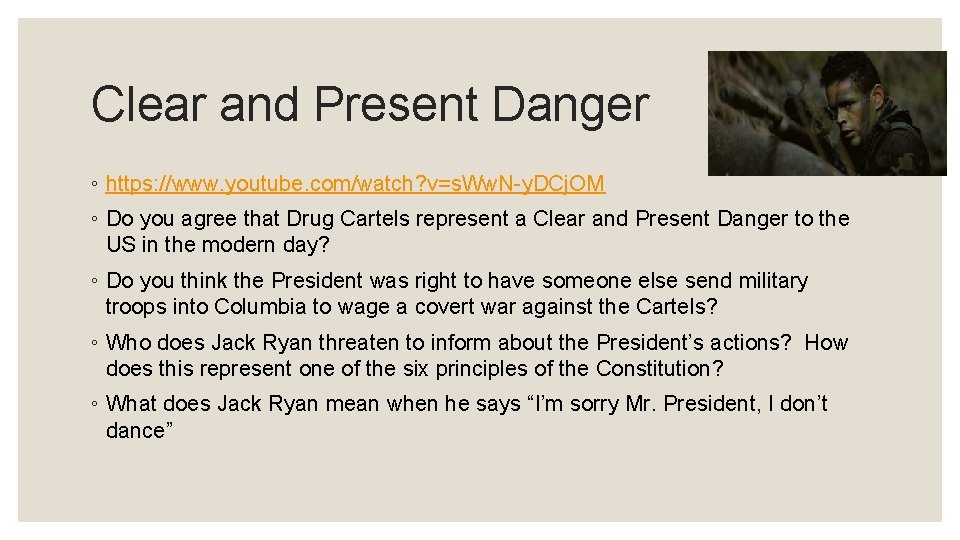
Clear and Present Danger ◦ https: //www. youtube. com/watch? v=s. Ww. N-y. DCj. OM ◦ Do you agree that Drug Cartels represent a Clear and Present Danger to the US in the modern day? ◦ Do you think the President was right to have someone else send military troops into Columbia to wage a covert war against the Cartels? ◦ Who does Jack Ryan threaten to inform about the President’s actions? How does this represent one of the six principles of the Constitution? ◦ What does Jack Ryan mean when he says “I’m sorry Mr. President, I don’t dance”
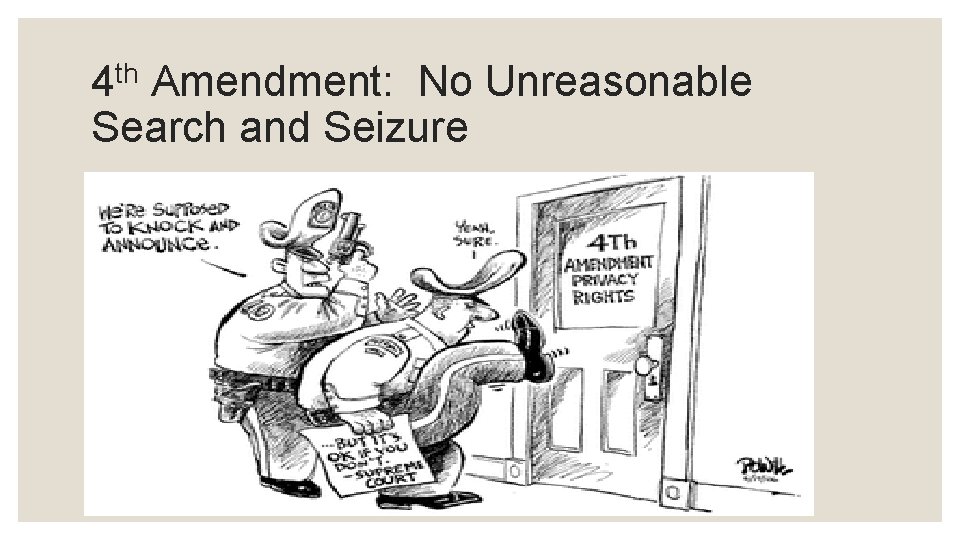
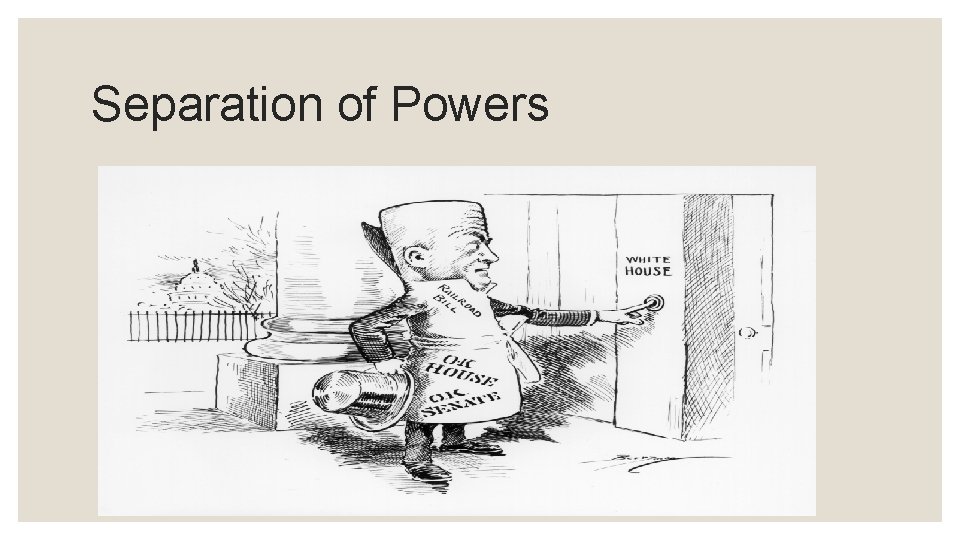
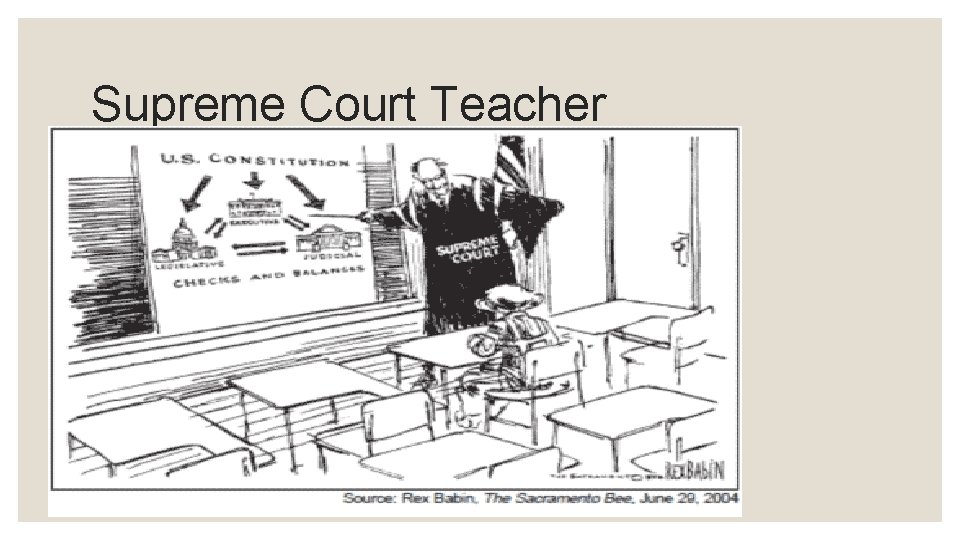
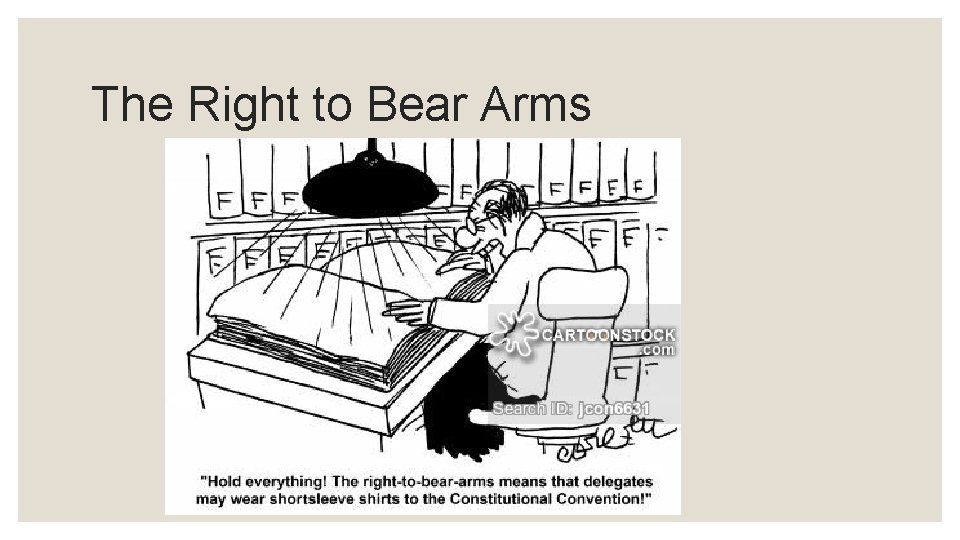
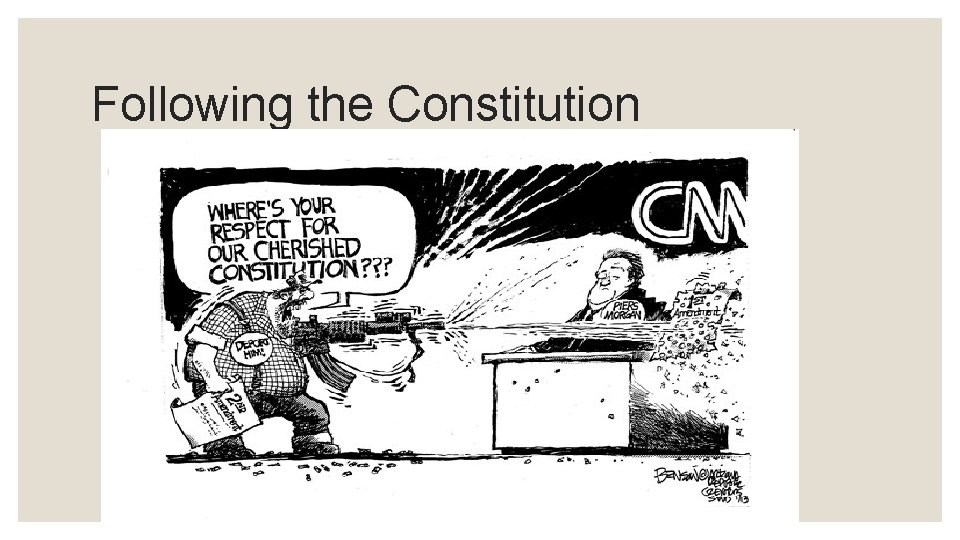
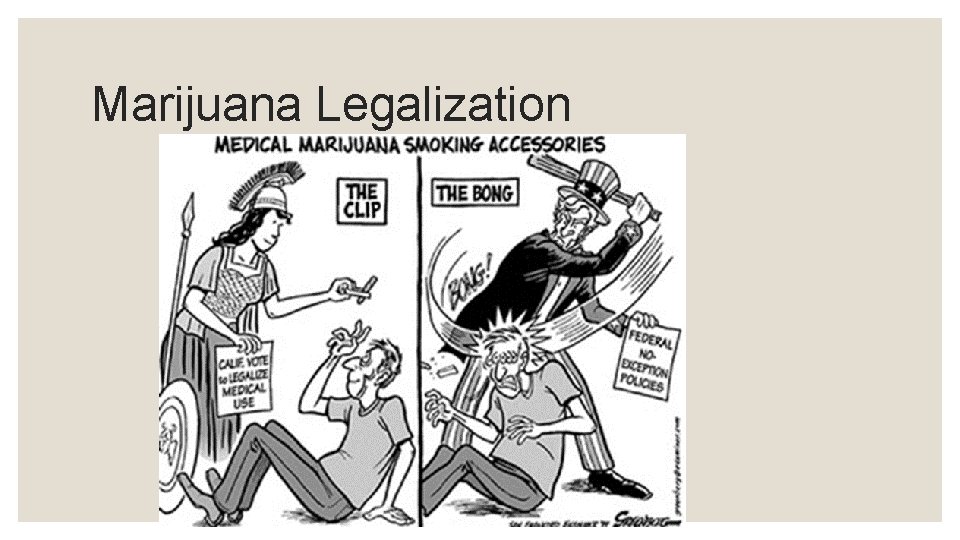
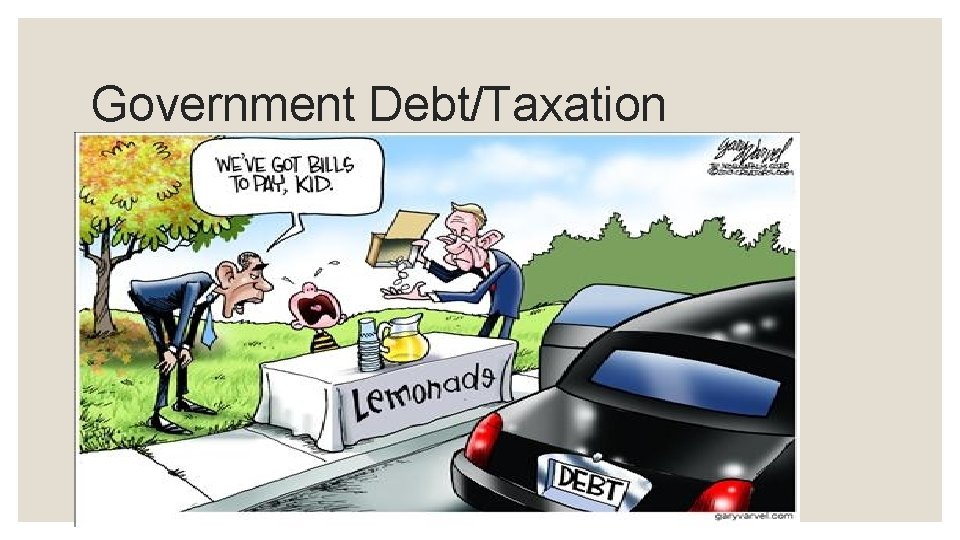
Analyzing Political Cartoons ◦ For each of the Political Cartoons, on a separate sheet of paper, write down: 1. The name of the cartoon 2. What you are seeing in the cartoon? 3. How do you interpret the meaning of this cartoon? 4. Do you agree with the perspective of the author of this cartoon?
4 th Amendment: No Unreasonable Search and Seizure
Separation of Powers
Supreme Court Teacher
The Right to Bear Arms
Following the Constitution
Warm Up ◦What does the Clear and Present Danger Clause state? ◦What does the Supremacy Clause state?
Homework: Essay on Court Case that Threatened the First Amendment ◦ Pick one of the five court cases that we will look at this class, in which controversy erupted over whether or not the government was violating the First Amendment ◦ Be sure to explain what the court case was about and what the final ruling said about the case ◦ Give a background setting of what was going on during the time that led to this court case ◦ MAKE SURE TO INCLUDE A CLEAR THESIS STATEMENT ◦ Divide paragraphs up into Introduction, Conclusion, and Body Paragraphs
Learning Objectives ◦Analyze Constitutional Vocabulary ◦Engage in Creative Expression ◦Enhance Reading and Writing Skill
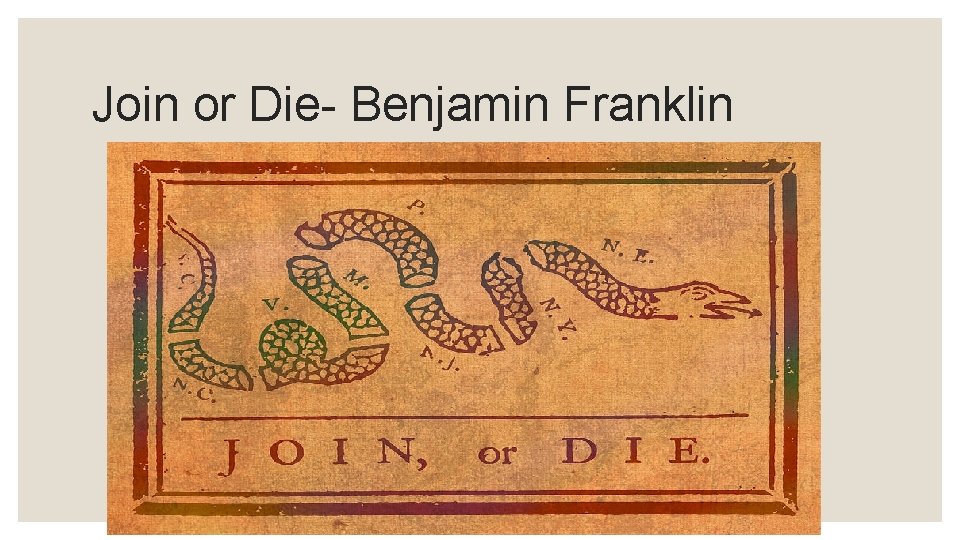
Join or Die- Benjamin Franklin
Marijuana Legalization
Government Debt/Taxation
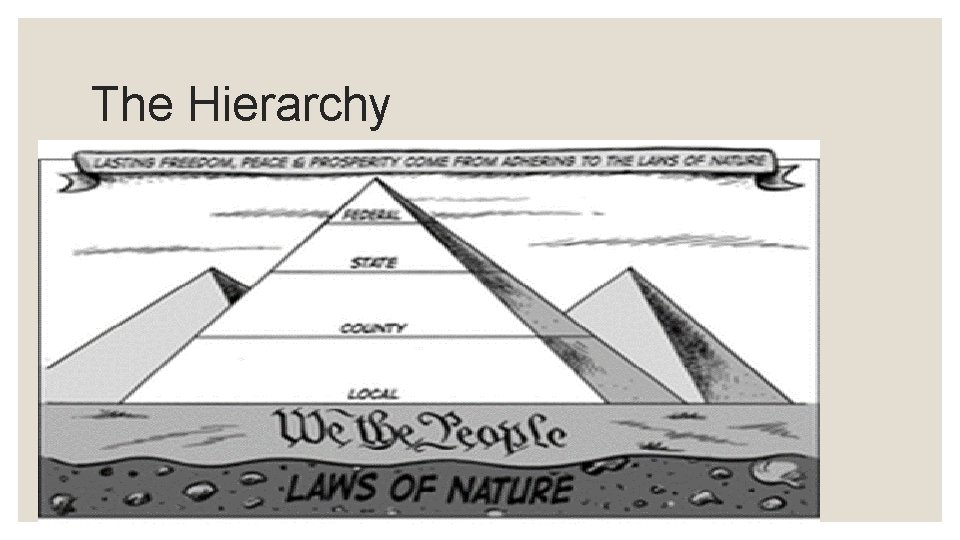
The Hierarchy
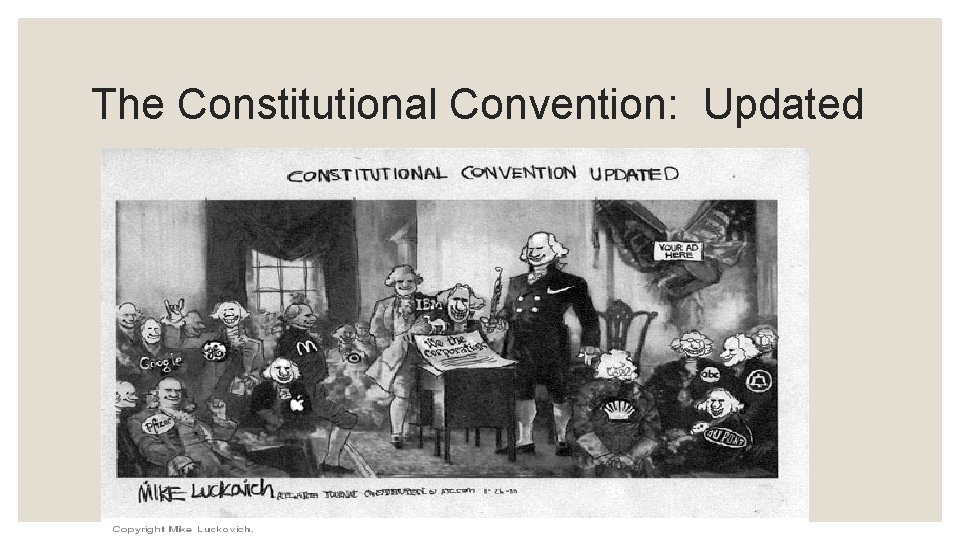
The Constitutional Convention: Updated
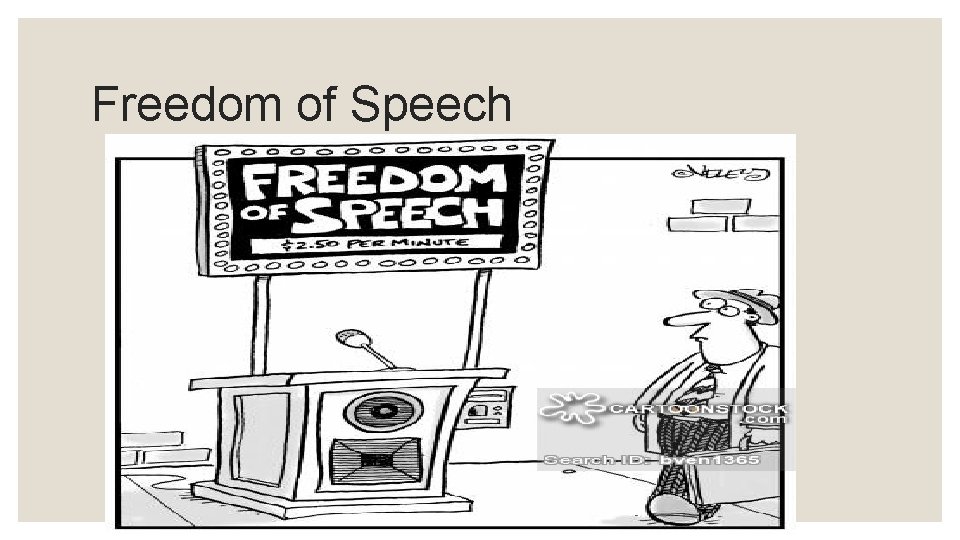
Freedom of Speech
Create Your Own Political Cartoon ◦ Pick a constitutional/government issue that you either support or disagree with ◦ Draw a Political Cartoon that expresses your perspective ◦ Below your Cartoon, write a paragraph that explains what your cartoon is addressing and your opinion on the issue ◦ Share your Cartoon with a partner and see if they can understand it ◦ See if you and your partner agree on the issue
Chapter 4, Section 1 -2 ◦Read Lesson 4, Section 1 and 2 ◦Answer the questions on the textbook worksheet
Warm Up ◦Which court case that threatened the First Amendment did you write your essay on? What happened in this court case?
Homework: Complete Study Guide ◦Complete Study Guide by fully writing out all notes and relevant material for each term/concept/word on the Study Guide
Learning Objectives ◦Analyze the US Bill of Rights ◦Enhance Writing Skills ◦Engage in Visual Learning
Homework: 1 -2 Page Essay ◦ Pick one of the five court cases that we will look at this class, in which controversy erupted over whether or not the government was violating the First Amendment ◦ Be sure to explain what the court case was about and what the final ruling said about the case ◦ Give a background setting of what was going on during the time that led to this court case ◦ MAKE SURE TO INCLUDE A CLEAR THESIS STATEMENT ◦ Divide paragraphs up into Introduction, Conclusion, and Body Paragraphs
Learning Objectives ◦-Analyze Constitutional Vocabulary ◦-Synthesize ways in which the Constitution can be changed ◦-Interpret the US Bill of Rights
New Seating Chart Stay in your seats from last semester I will tell you where you will be sitting this semester Go to your new seat AFTER I have called everyone’s name
Constitutional Vocabulary ◦ Veto: Reject ◦ Unconstitutional: To declare illegal, null, and void, due to some violation of the Constitution ◦ Due Process: The principle that no one person can be deprived of life, liberty, or property without fair legal procedures and safeguards ◦ Strict Construction: A literal approach to interpreting the Constitution, using exact words of the document ◦ Loose Construction: A flexible approach to interpreting the Constitution, taking into account current societal conditions
Check for Understanding ◦ Who in the US government has the power to veto? ◦ Who in the US government has the power to declare something unconstitutional? ◦ Why was the concept of due process to the original framers of the Constitution? ◦ Can you think of an example when people engage in strict construction? ◦ Can you think of an example when people engage in loose construction?
Brainstorming ◦ What is an amendment? ◦ Do you think that amendments are good or bad? Why do you think this? ◦ Should it be easy to amend the Constitution? Why or why not? ◦ What is the Bill of Rights? ◦ What does the First Amendment of the Bill of Rights say? ◦ What exception is there to the First Amendment?
Journal 6: The Bill of Rights ◦ Read the article on the Bill of Rights and answer the questions below in your Journal Section of your Notebook 1. Identify three main people that were involved in the creation of the Bill of Rights 2. What are Federalists and Anti-Federalists? Why did they disagree about the Bill of Rights? 3. Identify three documents that were central to the creation of the Bill of Rights 4. For each amendment in the Bill of Rights, re-write it, in your own words
Brainstorming ◦Which amendment in the Bill of Rights do you think is most important? ◦Why do you think this? ◦Do you believe we have violated the Bill of Rights in anyway in the modern day?
Group-Work: What would the US be like without the Bill of Rights ◦ Groups of 3 -4 people (10 groups total) ◦ Each group will be assigned one of the amendments in the Bill of Rights ◦ Each group will introduce their amendment by explaining what it means and why they think it is important ◦ Each group will create a skit that will demonstrate what it would look like if we didn’t have this amendment in the modern day ◦ After presenting your skit, be sure to SUMMARIZE and EXPLAIN how your skit showed what it would look like if we didn’t have this amendment ◦ Each person in the group must have a role and say something
Classwork: Community Service Check In ◦ What are you doing for Community Service? ◦ How many hours have you completed? ◦ What have you learned from doing your Community Service? ◦ Do you plan on giving back to the community after high school? Why or why not? ◦ What are ways in which you could give back to the community after high school? ◦ What do you recommend for people who are interested in/want to do community service?
Warm Up ◦Identify three amendments in the US Bill of Rights and explain what they say
Homework: 1 -2 Page Essay on Court Cases that Threatened the First Amendment ◦ Pick one of the five court cases that we will look at this class, in which controversy erupted over whether or not the government was violating the First Amendment ◦ Be sure to explain what the court case was about and what the final ruling said about the case ◦ Give a background setting of what was going on during the time that led to this court case ◦ MAKE SURE TO INCLUDE A CLEAR THESIS STATEMENT ◦ Divide paragraphs up into Introduction, Conclusion, and Body Paragraphs
Learning Objectives ◦Engage in Artistic Expression ◦Analyze ways to change the Constitution ◦Enhance visual learning abilities
Artistic Expression ◦Pick an amendment in the Bill of Rights, which is most important to you, and using pictures/imagery/symbols, show what this amendment means and why it is so important
Gallery Walk ◦ Walk around the classroom and analyze the drawings of your classmates ◦ Write the name of the classmate’s drawing that you are analyzing ◦ Identify which amendment the classmate drew ◦ Explain how the classmate showed why the amendment is important to them ◦ You must analyze the pictures of at least 10 classmates
Ways to Change the Constitution other then Amending it ◦-Basic Legislation ◦-Executive Action ◦-Court Decisions ◦-Party Practices ◦-Custom
Warm Up ◦For each of the five ways in which the Constitution can be changed, write a one sentence prediction that explains what this means
Homework: Complete Study Guide ◦Complete Study Guide by fully writing out all notes and relevant material for each term/concept/word on the Study Guide
LOOKING AHEAD: TEST= 3 CLASSES FROM NOW QUIZ ON THE CONSTITUTION WILL BE MONDAY
Learning Objectives ◦Engage in Visual Learning ◦Analyze examples of ways to change the Constitution ◦Build connections to your life
Basic Legislation ◦ Congress has passed numerous laws to clarify points of the Constitution ◦ Congress uses its powers granted by the Constitution to add to the Constitution EXAMPLE: 1. 25 th Amendment: If the Presidency becomes vacant, the Vice President succeeds to the office…but if both the Presidency and the Vice Presidency are vacant, then Congress decides who becomes President and Vice President
Executive Action ◦ Presidential actions have added to the Constitution EXAMPLE: President Bush II sent troops to Iraq without declaring war (Only Congress has the power to declare war) -Executive Agreement: Pact made by the President directly with another leader of a country -Treaty: Formal Agreement between two or more states
Check for Understanding ◦ Do you think it is good that we can change the Constitution through Basic Legislation and Executive Action? ◦ When we are talking about the Legislative Branch, who are we talking about, and what powers do they have? ◦ When we are talking about the Executive Branch, who are we talking about, and what powers do they have? ◦ What is the difference between a treaty and an Executive Agreement? Why do you think the President would use an Executive Agreement versus a treaty?
Court Decisions and Party Practices ◦ Courts, especially the Supreme Court, interpret and apply the Constitution in the cases that they hear ◦ While the Constitution doesn’t say anything political parties, political parties hold national conventions to nominate candidates for president 1. Electoral College- The group that makes the formal selection of the nation’s president
Discussion Questions ◦ How can these different ways of changing the Constitution impact the principle of Separation of Powers? ◦ Do you think that it is good to have political parties? Why or why not? ◦ What do you know about the Electoral College System? Do you think it is a good way to choose a president? Why or why not? ◦ Do you think it is good that the government is able to change the Constitution? Why do you think this?
Connecting Changing the Constitution to your life- 1 Paragraph ◦ Our Constitution has existed for over 200 years now…in those 200 years, quite a lot has changed! Think about your own life. What do you think has changed the most, and what would you be like today if you weren’t able to change ◦ Think about your favorite music style, from your first favorite band to the modern day. How have you changed in terms of music style?
Mr. Rosenberg’s Timeline of Music ◦ Childhood- Green Day/Blink 182: https: //www. youtube. com/watch? v=NUTGr 5 t 3 Mo. Y ◦ Adolescence- Rebel Bands: https: //www. youtube. com/watch? v=h. TWKbfoikeg ◦ College- Dubstep/Rave/Electronic: https: //www. youtube. com/watch? v=zf 8 SZYXRufg ◦ Now- Classics: https: //www. youtube. com/watch? v=Iwuy 4 h. HO 3 YQ&spfreload=1
Warm Up ◦Why is it important to be able to change the Constitution? ◦Other than amending the Constitution, what are the five ways in which it can be changed?
Homework: Complete Study Guide ◦Complete Study Guide by fully writing out all notes and relevant material for each term/concept/word on the Study Guide
Learning Objectives ◦Interpret Federalism Vocabulary ◦Analyze the Necessary and Proper Clause ◦Connect Federalism to your Family
Looking Ahead ◦Quiz in three classes from now
5 th Way to Change the Constitution: Custom ◦ Unwritten customs are often as strong as written laws ◦ Example: Presidential cabinet= 15 executive department heads 1. Cabinet: An advisory body to the President 2. Senatorial Courtesy: An unwritten rule in the Senate to only approve presidential appointees who are acceptable to the senators of the President’s party
Brainstorming ◦ What does it mean to delegate? Is it a good or bad thing to delegate? ◦ What does it mean for something to be implied? Give us an example of a time when you felt something was implied in your life ◦ What does it mean for something to be inherent? Give us an example of something that is inherent in you
Federalism Vocabulary ◦ Federalism: System of government in which power is divided between central, state, and local governments ◦ Delegated Powers: The powers of the national government that are granted to it by the Constitution ◦ Three types of Delegated Powers: Expressed, Implied, Inherent 1. Expressed Powers: Powers that the government has according to the Constitution 2. Implied Powers: Powers that the government has, which are not stated in the Constitution, but are suggested 3. Inherent Powers: Powers that are not expressed in the Constitution, but over time, all national governments have possessed
Check for Understanding ◦ What examples of Expressed Powers can you think of? ◦ What examples of Implied Powers can you think of? ◦ What examples of Inherent Powers can you think of? ◦ Do you see any problems with Delegated Powers?
Federalism in “A Bug’s Life” ◦ https: //www. youtube. com/watch? v=q. U 4 A 2 Zrll. No&feature=emshare_video_user ◦ How are we seeing Federalism in this video clip? ◦ Who would the Grasshoppers represent in our government ◦ Who would the Ants represent in our government? ◦ How do the Grasshoppers maintain their power over the Ants? ◦ What advantage do the Ants have over the Grasshoppers? ◦ What is the main message of this movie clip? How can you relate this to real world politics
Examples of Expressed Powers ◦Collect Taxes ◦Make Money ◦Regulate Interstate/Foreign Commerce ◦Raise/Maintain Military Forces ◦Declare War
Examples of Implied Powers ◦ Necessary and Proper Clause: Congress has the power “to make all Laws which shall be necessary and proper for carrying into Execution the foregoing Powers and all other Powers vested by this Constitution in the Government of the United States, or in any Department or Officer thereof”
Analyzing the Necessary and Proper Clause ◦Re-write the Necessary and Proper Clause in your own words ◦What other Clauses in the Constitution have we looked at which seems to give an unlimited amount of power to the central government?
Warm Up ◦What are delegated powers? ◦What are three types of delegated powers? Define each of them
Homework: Complete Study Guide ◦Complete Study Guide for Quiz by writing out all notes and relevant material for each term, word, concept, person, idea on the Study Gudie
Looking Ahead: Quiz in 2 classes from now ◦Quiz on the Constitution in 2 classes from now ◦I will be doing a Journal Check
Learning Objectives ◦Synthesize Delegated Powers ◦Analyze the connection between Federalism and your Family ◦Interpret which powers are given to state governments
Examples of Inherent Powers ◦Regulate Immigration ◦Acquire New Territory ◦Protect the nation against rebellion or other attempts to overthrow the government by force or violence
Discussion Questions ◦Do you think that any of these Implied or Inherent Powers should be Expressed? Why do you think this? ◦How would they become Expressed Powers?
Federalism in Your Family ◦ Pretend that I want to know what goes on in your house…write 1 paragraph that describes what your house-life looks like. Be sure to include -What decisions/responsibilities do you have? -What decisions/responsibilities do your parents have? -What other people live in your house? What are their decisions/responsibilities? -What connection can you make between your family life and Federalism?
Role-Playing Your Family ◦In Groups of 3 -4 people, pick one person’s family to role-play for the class ◦Every group member should be a family member ◦Be sure to explain how we see the principle of Federalism in the family
Powers Denied to the Federal Government ◦ Raise taxes on exports ◦ Prohibit freedom of religion, speech, press, assembly ◦ Conduct illegal search or seizures ◦ Deny any person accused of a crime a speedy and public trial or trial by jury ◦ Create a public school system ◦ Enact uniform marriage and divorce laws ◦ Tax state or local governments for carrying out governmental functions
Check for Understanding ◦ Do you think that the federal government has taken on any of these powers, despite being denied them? ◦ Which powers are you happy that the federal government is denied? ◦ Which powers do you wish the federal government had, which it doesn’t? ◦ What powers you can think of which are granted to the states, and not the federal government?
You Become the Lawyer…For the Government ◦ Pick a power/law/policy that the government has, which you think is questionable as to its legality ◦ An American citizen is trying to sue the government for doing something that the individual doesn’t believe the government has the power to do ◦ Pretend that you are a lawyer for the government, and write a letter to the citizen (2 paragraphs), defending the power of the government ◦ Use the following to back up your argument: -Necessary and Proper Clause -Clear and Present Danger -The Supremacy Clause
Reserved Powers for the States ◦ Reserved Powers: Those powers that the Constitution grants to the States and not the Federal Government ◦ Examples: 1. Permit some forms of gambling and prohibit others 2. Professional licenses (doctors, lawyers, hairstylists, plumbers, teachers) 3. Confiscate property used in connection with illegal activities 4. Establish public schools
Check for Understanding ◦ Why do you think the public school system and education is a power granted to the state, not the federal government? ◦ What other powers do the states have which are not listed here? ◦ What powers do the states not have?
Powers Denied to the States ◦ Can’t enter into treaty, alliance or confederation ◦ Can’t coin money ◦ Can’t deprive anyone of life, liberty, and property without due process of law ◦ Can’t tax any federal agencies
Wrap-Up ◦Who do you think has more power: the state or federal government? Why do you think this?
Warm Up ◦Write down three questions that you think will be on the quiz. Don’t answer your own questions
Homework: Complete Study Guide ◦Complete Study Guide by writing out all notes and relevant material for each term/concept/word on the Study Guide
Looking Ahead ◦Quiz Next Class on The Constitution and Federalism ◦I will be checking Journals while you are taking the quiz
Learning Objectives ◦Synthesize the Constitution and Federalism (Part 1) ◦Enhance Review Skills ◦Engage in Collaborative Learning
Pair-Share Warm-Ups ◦Switch Warm Ups with a partner ◦Answer your partner’s questions ◦Switch back and see what questions that you have for me
Kahoot. IT ◦ This is the one time that you will be allowed to use your cell phone ◦ Go to Kahoot. IT and type in the Pin Code 1 st Place= 10 points extra credit on quiz 2 nd place=7 points extra credit on quiz 3 rd place=5 points extra credit on quiz
Review Worksheet for Quiz on Federalism and the Constitution ◦Complete the Review Worksheet for the Quiz on Federalism (Part 1) and the Constitution
Jeopardy ◦ Five Categories ◦ Each team has 45 seconds to answer ◦ If the team gets the question wrong, it goes to the next team, and the next team has 30 seconds to answer the question ◦ EACH TEAM HAS ONE CAPTAIN (CHOSEN BY ME) AND THAT CAPTAIN IS THE ONLY ONE WHO CAN ANSWER THE QUESTION ◦ NO COMPLAINING or BREAKING CLASS NORMS- IF YOU DO= -100 points ◦ If your team ends up in the negative, everyone on your team will lose 3 points on the quiz
Create your Own Matching Sheet ◦ On the left side of the piece of paper, write 15 Vocabulary Words that you think will be on the quiz ◦ On the right side of the paper, write the definitions for the vocabulary words ◦ Leave a blank space to the left of the vocabulary words on the left side of the paper for your partner to fill in the corresponding letter for that word ◦ Switch Matching Sheets with a partner and fill in their matching sheet, while you fill in theirs
Warm Up ◦Get ready to take quiz ◦Have your Journals 1 -5 ready for me to check
Learning Objectives ◦Synthesize the Constitution and Federalism- Part 1 ◦Enhance Quiz-Taking Skills ◦Transition into Federalism- Part 2
Quiz on the Constitution and Federalism ◦Eyes on your own paper ◦HAVE FUN!
WARNING -Go TO THE BATHROOM AT YOUR OWN RISK: I’m not going to stop teaching or other students from learning because you were in the bathroom -STOP COMPLAINING: If it continues, I will simply revoke privileges and stop fun activities -NO KAHOOT FOR THE NEXT QUIZ -PHONES ARE BECOMING A HUGE PROBLEM!!! Two Choices: 1. We can have a folder/box where you all put your phones in before class and get them back at the end of class 2. You can show that you are responsible enough to have a phone, but if I see it, I am taking it and putting it in the folder/box
1 Paragraph Writing Assignment ◦ Write 1 Paragraph that describes a time in your life where you had to participate and cooperate with others in order to accomplish something ◦ Make sure to explain why participation and cooperation was so important in this event ◦ Be ready to share this example with your classmates
Group-Work: The Importance of Cooperation ◦ In a group of 4 -5 people, create a skit in which you show the importance of cooperation in your life ◦ Pick one of the examples that your group members wrote about and have each group member play a character in that example ◦ The skit must have at least 15 lines written out and every group member must play a role in the presentation ◦ Be sure to include a summary of how your skit showed the importance of cooperating with others
Check for Understanding ◦ What is Federalism? How can we relate the importance of cooperation to Federalism? ◦ What would happen to the national and state governments if they didn’t cooperate? ◦ Can you think of any examples of a time in US history when the state and national government didn’t cooperate with one another?
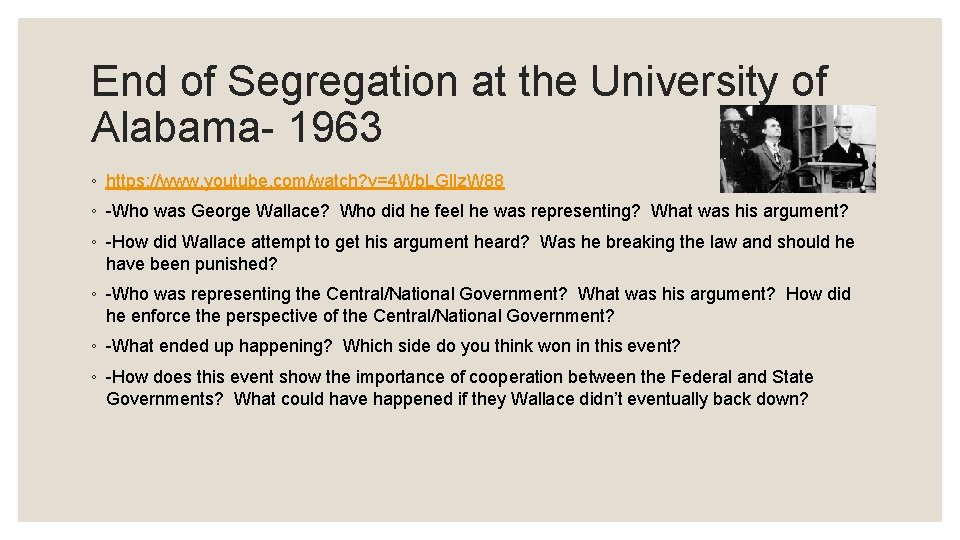
End of Segregation at the University of Alabama- 1963 ◦ https: //www. youtube. com/watch? v=4 Wb. LGl. Iz. W 88 ◦ -Who was George Wallace? Who did he feel he was representing? What was his argument? ◦ -How did Wallace attempt to get his argument heard? Was he breaking the law and should he have been punished? ◦ -Who was representing the Central/National Government? What was his argument? How did he enforce the perspective of the Central/National Government? ◦ -What ended up happening? Which side do you think won in this event? ◦ -How does this event show the importance of cooperation between the Federal and State Governments? What could have happened if they Wallace didn’t eventually back down?