
The Constitution 2 Learning Objectives 2 2 1
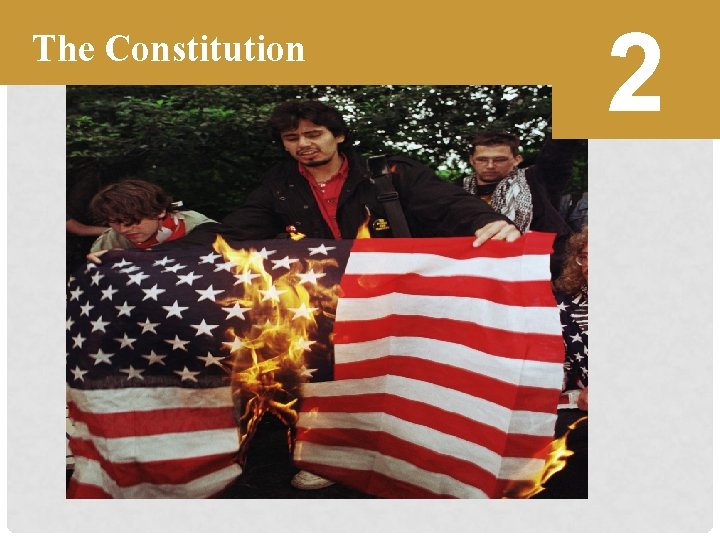
The Constitution 2
Learning Objectives 2 2. 1 Describe the ideas behind the American Revolution and their role in shaping the Constitution 2. 2 Analyze how the weaknesses of the Articles of Confederation led to its failure
Learning Objectives 2. 3 2. 4 Describe the delegates to the Constitutional Convention and the core ideas they shared Categorize the issues at the Constitutional Convention and outline the resolutions reached on each type of issue 2
Learning Objectives 2. 5 2. 6 2 Analyze how the components of the Madisonian system addressed the dilemma of reconciling majority rule with the protection of minority interests Compare and contrast the Federalists and Anti-Federalists in terms of their background and their positions regarding government
Learning Objectives 2. 7 2. 8 2 Explain how the Constitution can be formally amended and how it changes informally Understanding the Constitution Assess whether the Constitution establishes a majoritarian democracy and how it limits the scope of government
COLONIAL LIFE Life was good in the colonies n (Slaves excepted, of course) n Self-governing Irritants n New taxes to finance French and Indian War n Enforcement of trade regulations n No representation in Parliament
Origins of the Constitution 1. Road to Revolution 13 colonies established from 1607 -1775 French Indian War 1754 -1761 Leads to increase in taxes to pay for war. Sugar Act Stamp Act Boston Massacre Tea Tax Boston Tea Party 2. 1
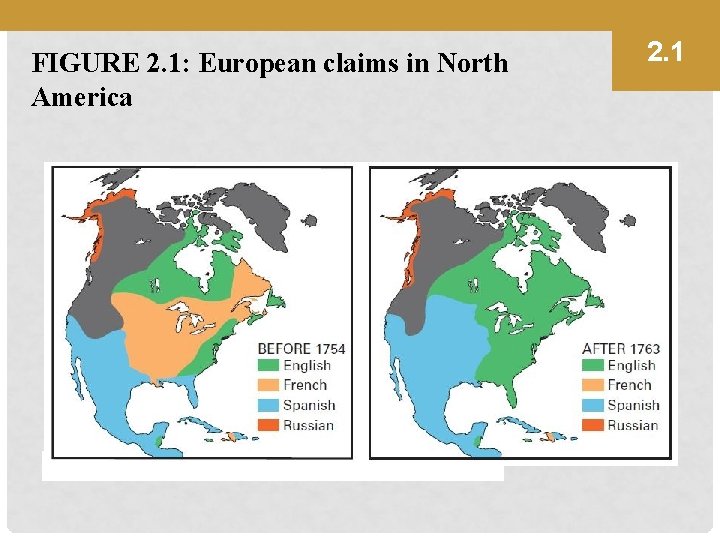
FIGURE 2. 1: European claims in North America 2. 1
ROAD TO REVOLUTION • • • 1 st Continental Congress Revolutionary War 2 nd Continental Congress Declaration of Independence Articles of Confederation End of the Revolutionary War
Declaring Independence Declaration of Independence n Thomas Jefferson n Justified revolution n Revolutionaries needed foreign assistance 2. 1
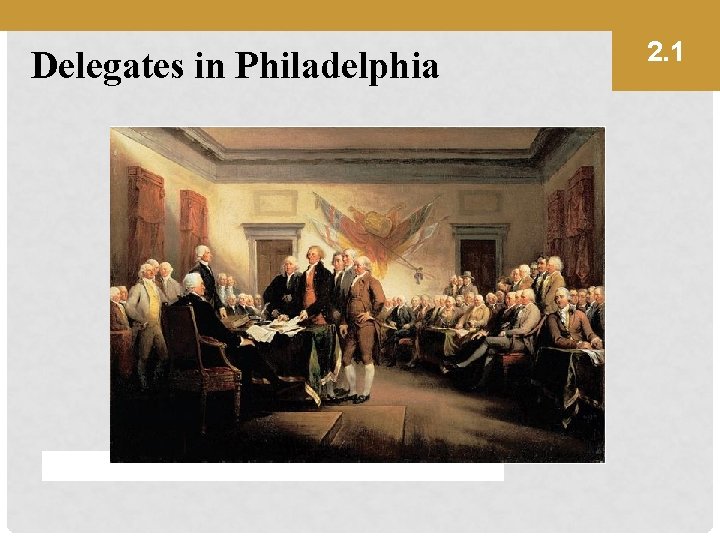
Delegates in Philadelphia 2. 1
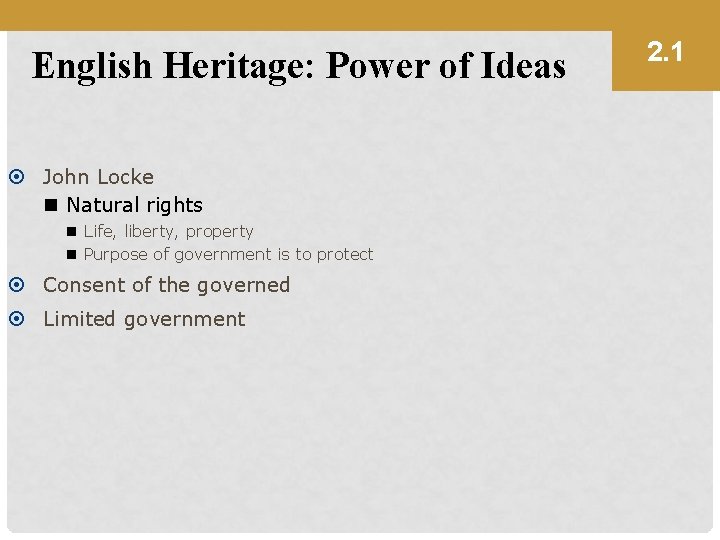
English Heritage: Power of Ideas John Locke n Natural rights n Life, liberty, property n Purpose of government is to protect Consent of the governed Limited government 2. 1
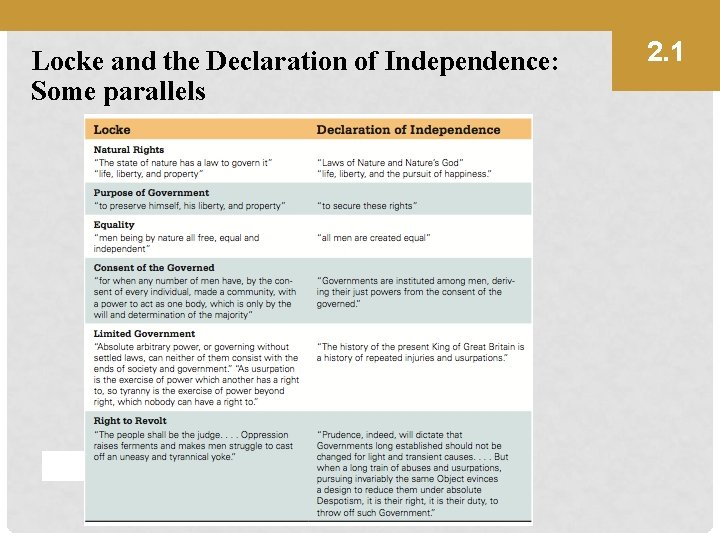
Locke and the Declaration of Independence: Some parallels 2. 1
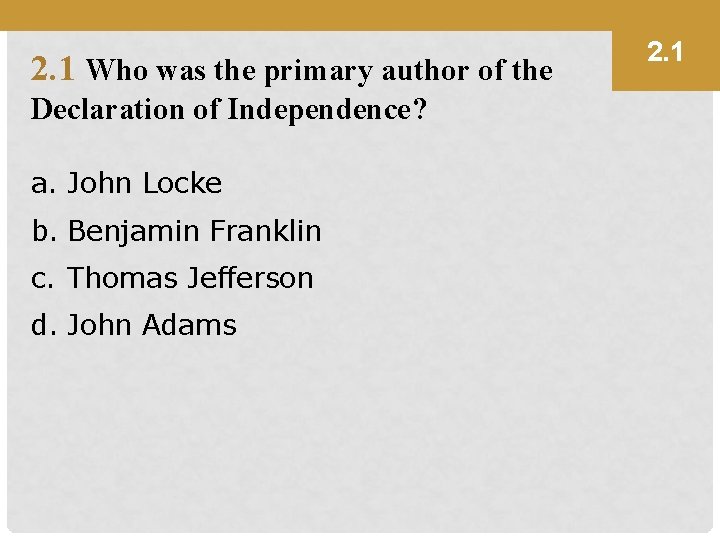
2. 1 Who was the primary author of the Declaration of Independence? a. John Locke b. Benjamin Franklin c. Thomas Jefferson d. John Adams 2. 1
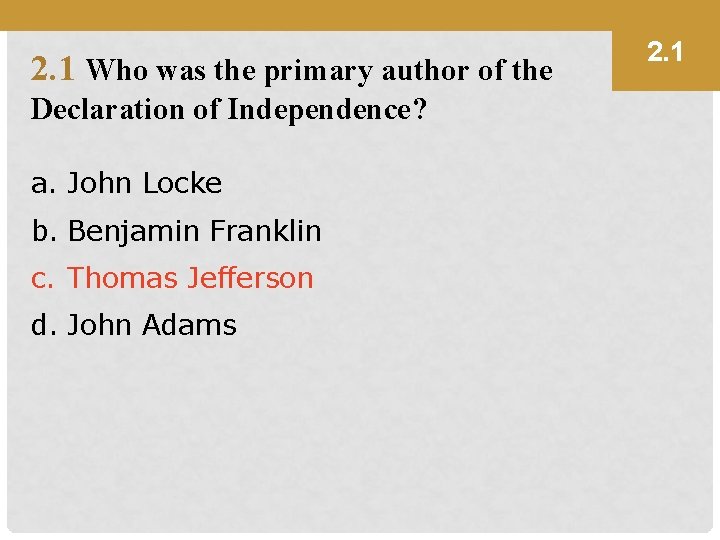
2. 1 Who was the primary author of the Declaration of Independence? a. John Locke b. Benjamin Franklin c. Thomas Jefferson d. John Adams 2. 1
GOVERNMENT THAT FAILED: 1776 -1787 Articles of Confederation Changes in the States Economic Turmoil Aborted Annapolis Meeting 2. 2
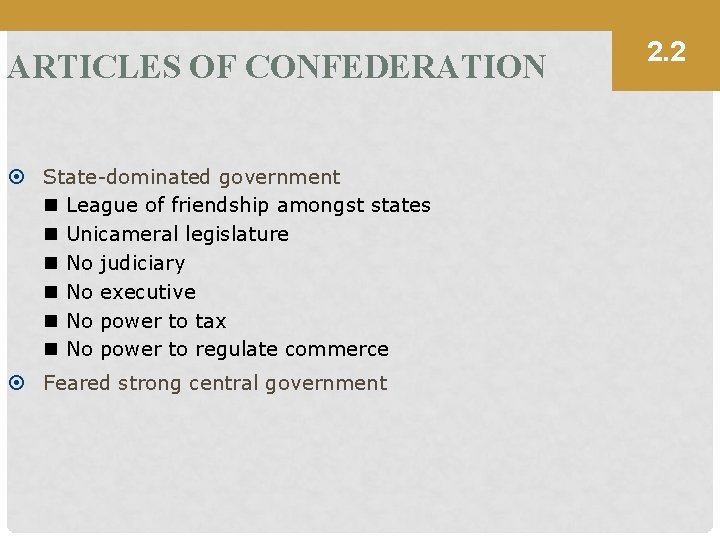
ARTICLES OF CONFEDERATION State-dominated government n League of friendship amongst states n Unicameral legislature n No judiciary n No executive n No power to tax n No power to regulate commerce Feared strong central government 2. 2
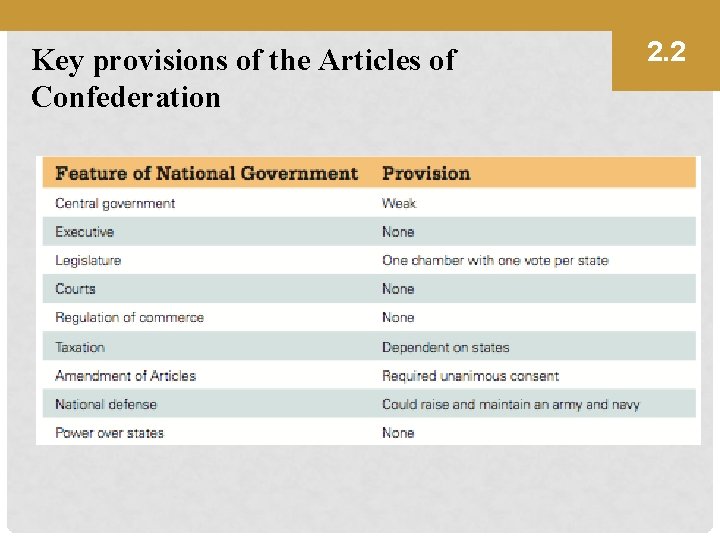
Key provisions of the Articles of Confederation 2. 2
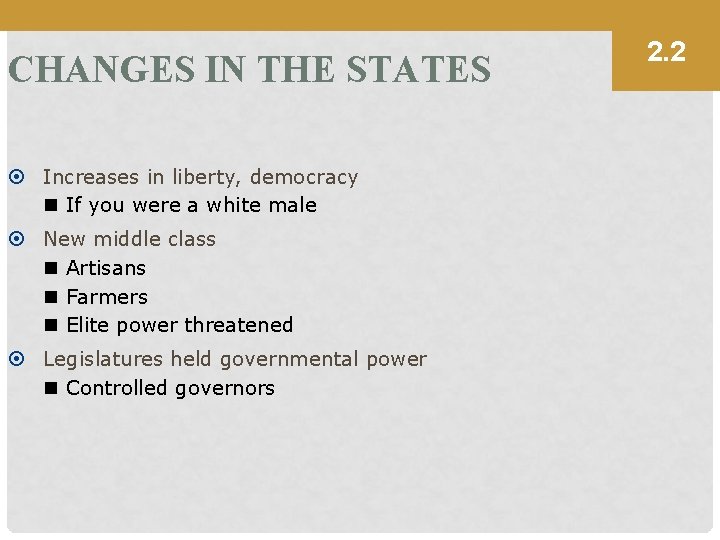
CHANGES IN THE STATES Increases in liberty, democracy n If you were a white male New middle class n Artisans n Farmers n Elite power threatened Legislatures held governmental power n Controlled governors 2. 2
ECONOMIC TURMOIL AND ABORTED ANNAPOLIS MEETING Postwar economic depression Shays’ Rebellion (1786) n Farmers attack courthouses to prevent foreclosures n Neither national nor state govt. could respond n Elites privately put down rebellion 2. 2
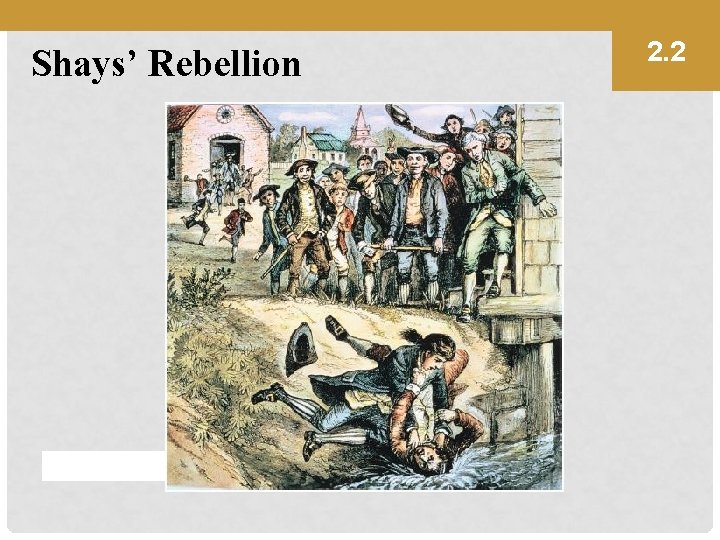
Shays’ Rebellion 2. 2
ECONOMIC TURMOIL AND ABORTED ANNAPOLIS MEETING Annapolis meeting leads to Constitutional Convention 2. 2
2. 2 What was a weakness of the Articles of Confederation? a. Weak central government b. No restraints on judiciary c. Tyrannical executive d. Legislature too large 2. 2
2. 2 What was a weakness of the Articles of Confederation? a. Weak central government b. No restraints on judiciary c. Tyrannical executive d. Legislature too large 2. 2
MAKING A CONSTITUTION: PHILADELPHIA CONVENTION Gentlemen in Philadelphia Philosophy into Action 2. 3
GENTLEMEN IN PHILADELPHIA AND PHILOSOPHY IN ACTION Who attended Constitutional Convention? n 55 delegates from 12 states n Wealthy planters, lawyers, merchants High principles versus self-interest n Human nature n Political conflict resulting from factions n Purpose of government n Nature of government 2. 3
2. 3 The Framers chose a limited government based on a. Checks b. Balances c. Separation of power d. All of the above 2. 3
2. 3 The Framers chose a limited government based on a. Checks b. Balances c. Separation of power d. All of the above 2. 3
VIDEO: IN THE REAL WORLD 2. 3 http: //media. pearsoncmg. com/ph/hss/SSA_SHARED_MED IA_1/polisci/presidency/Seg 5_Constitution_v 2. html
CRITICAL ISSUES AT THE CONVENTION Equality Issues Economic Issues Individual Rights Issues 2. 4
EQUALITY ISSUES Equality and representation of the states n New Jersey Plan n Virginia Plan n Connecticut Compromise Slavery Equality in voting 2. 4
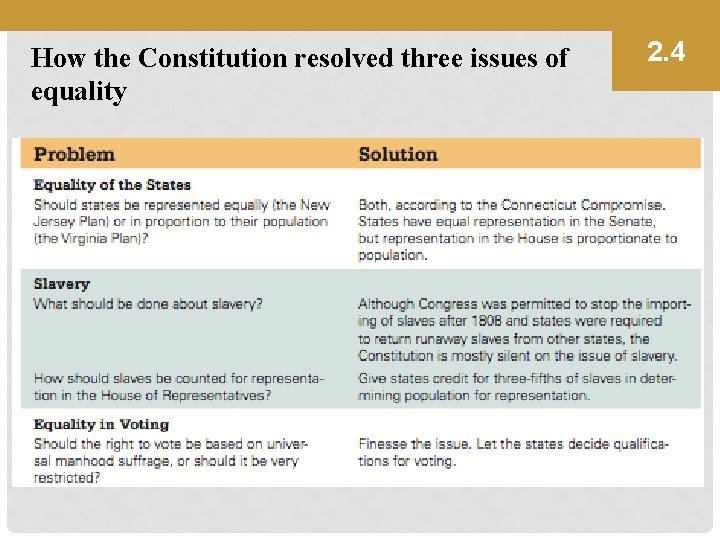
How the Constitution resolved three issues of equality 2. 4
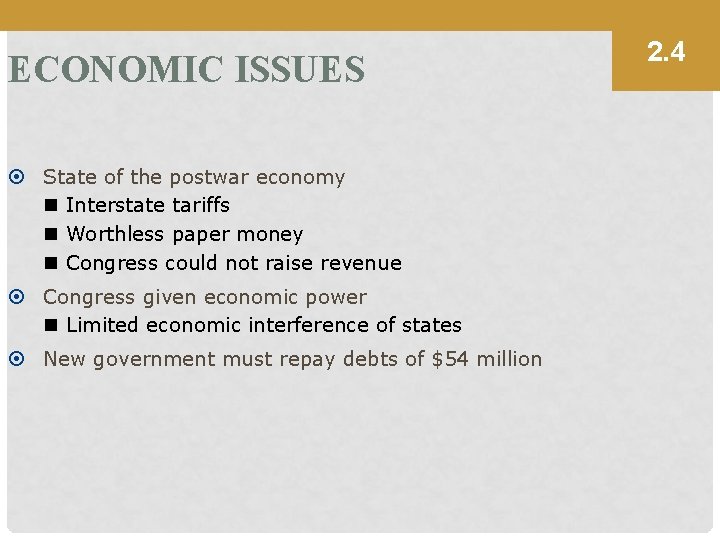
ECONOMIC ISSUES State of the postwar economy n Interstate tariffs n Worthless paper money n Congress could not raise revenue Congress given economic power n Limited economic interference of states New government must repay debts of $54 million 2. 4
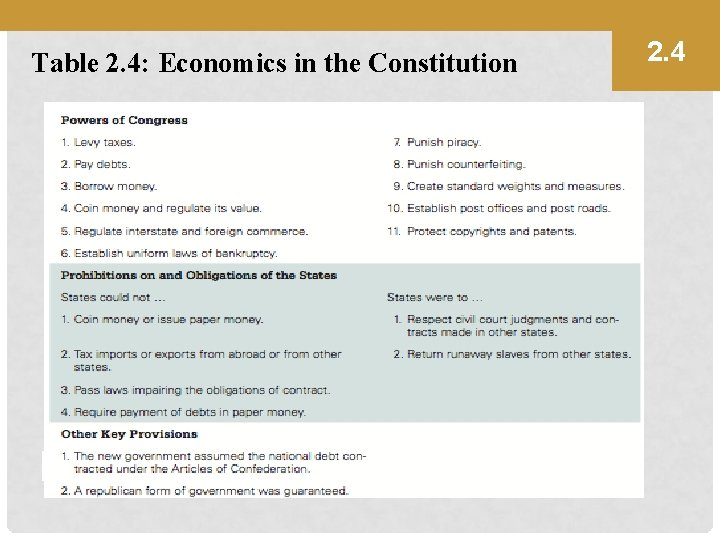
Table 2. 4: Economics in the Constitution 2. 4
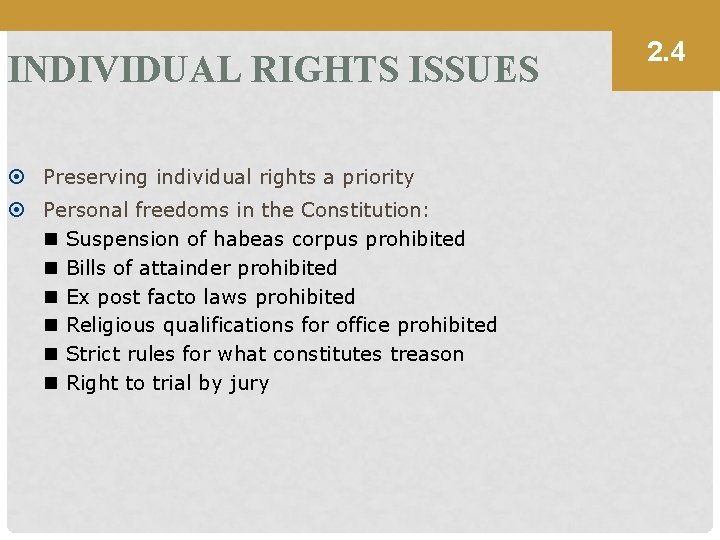
INDIVIDUAL RIGHTS ISSUES Preserving individual rights a priority Personal freedoms in the Constitution: n Suspension of habeas corpus prohibited n Bills of attainder prohibited n Ex post facto laws prohibited n Religious qualifications for office prohibited n Strict rules for what constitutes treason n Right to trial by jury 2. 4
2. 4 Which of the following is not a personal freedom protected in the original Constitution? a. Right to run for office without religious qualifications b. Right to writ of habeas corpus c. Right to trial by jury d. Right to freedom of speech 2. 4
2. 4 Which of the following is not a personal freedom protected in the original Constitution? a. Right to run for office without religious qualifications b. Right to writ of habeas corpus c. Right to trial by jury d. Right to freedom of speech 2. 4
VIDEO: IN CONTEXT 2. 4 http: //media. pearsoncmg. com/ph/hss/SSA_SHARED_MED IA_1/polisci/presidency/Seg 3_Constitution_v 2. html
MADISONIAN SYSTEM Thwarting Tyranny of the Majority Constitutional Republic End of the Beginning 2. 5
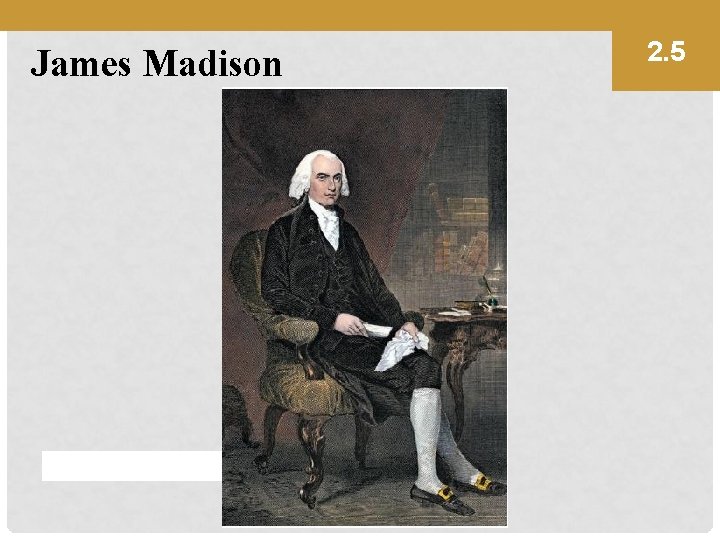
James Madison 2. 5
THWARTING TYRANNY OF THE MAJORITY Limiting majority control n James Madison’s system Separating powers Creating checks and balances Establishing a federal system 2. 5
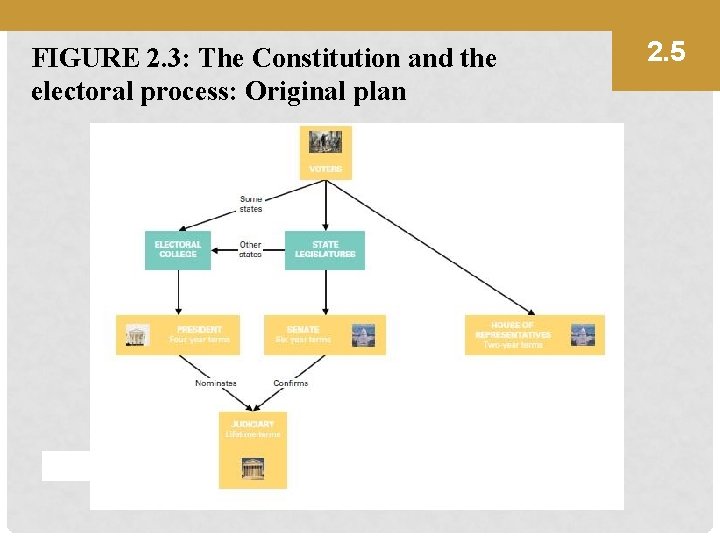
FIGURE 2. 3: The Constitution and the electoral process: Original plan 2. 5
CONSTITUTIONAL REPUBLIC AND THE END OF THE BEGINNING Creating a republic n Direct democracy not feasible n Representative democracy Separating powers and checks and balances make change slow Is policymaking inefficient? 10 states vote in favor, then dinner 2. 5
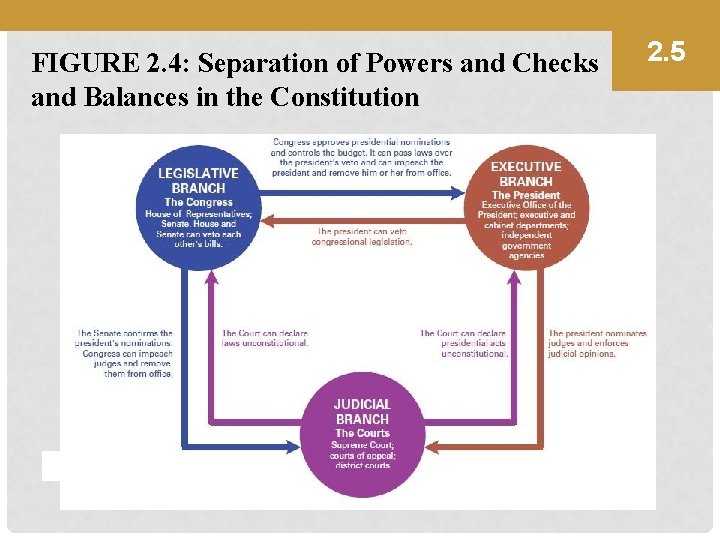
FIGURE 2. 4: Separation of Powers and Checks and Balances in the Constitution 2. 5
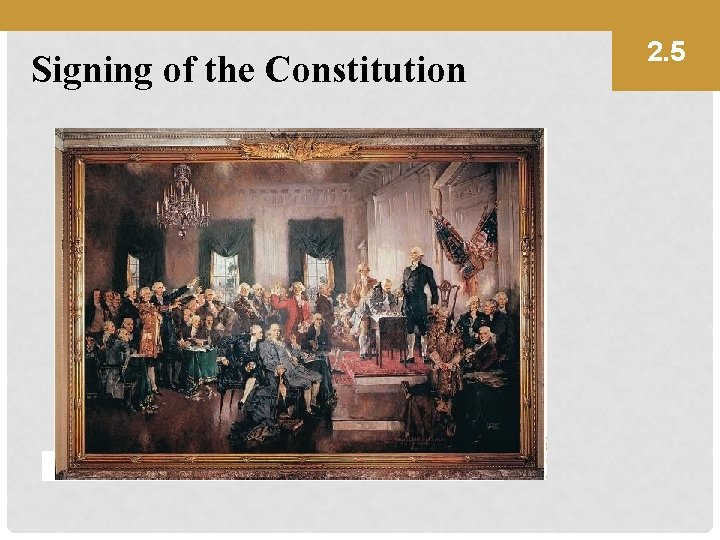
Signing of the Constitution 2. 5
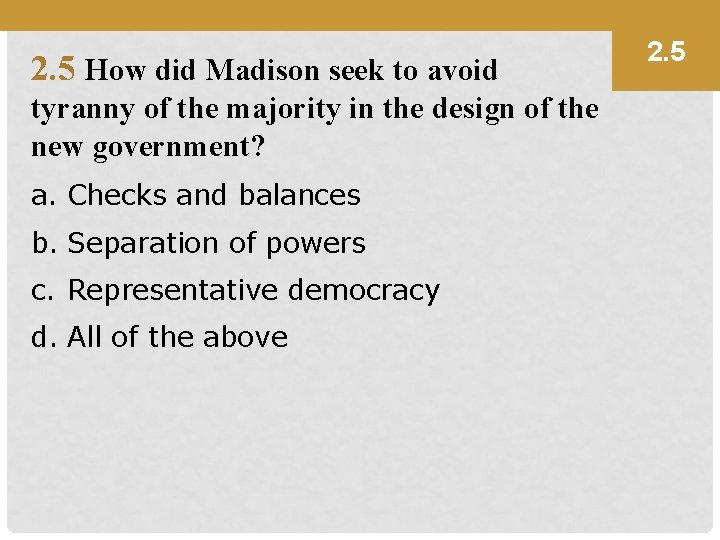
2. 5 How did Madison seek to avoid tyranny of the majority in the design of the new government? a. Checks and balances b. Separation of powers c. Representative democracy d. All of the above 2. 5
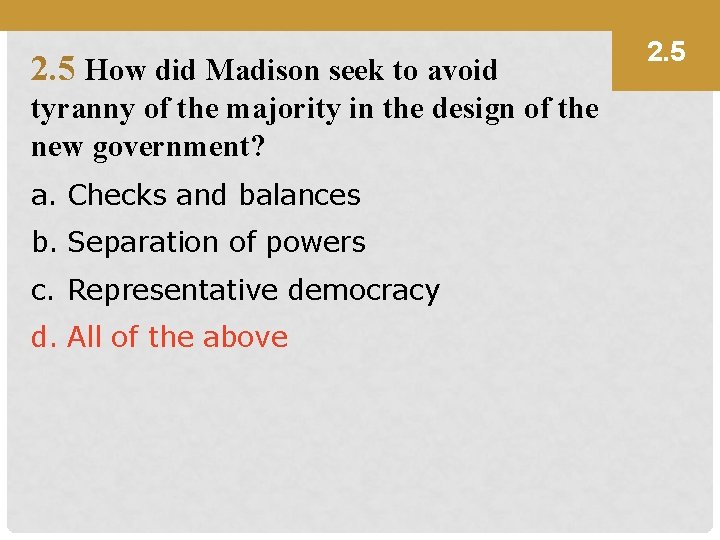
2. 5 How did Madison seek to avoid tyranny of the majority in the design of the new government? a. Checks and balances b. Separation of powers c. Representative democracy d. All of the above 2. 5
RATIFYING THE CONSTITUTION Federalists and Anti-Federalists Ratification 2. 6
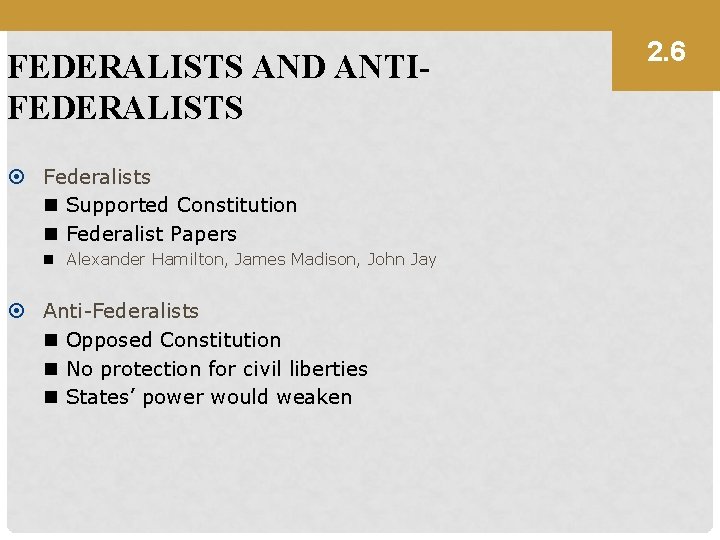
FEDERALISTS AND ANTIFEDERALISTS Federalists n Supported Constitution n Federalist Papers n Alexander Hamilton, James Madison, John Jay Anti-Federalists n Opposed Constitution n No protection for civil liberties n States’ power would weaken 2. 6
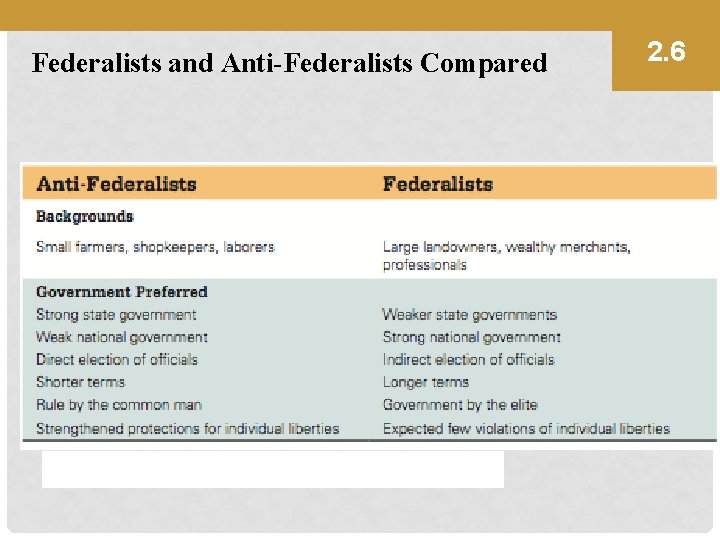
Federalists and Anti-Federalists Compared 2. 6
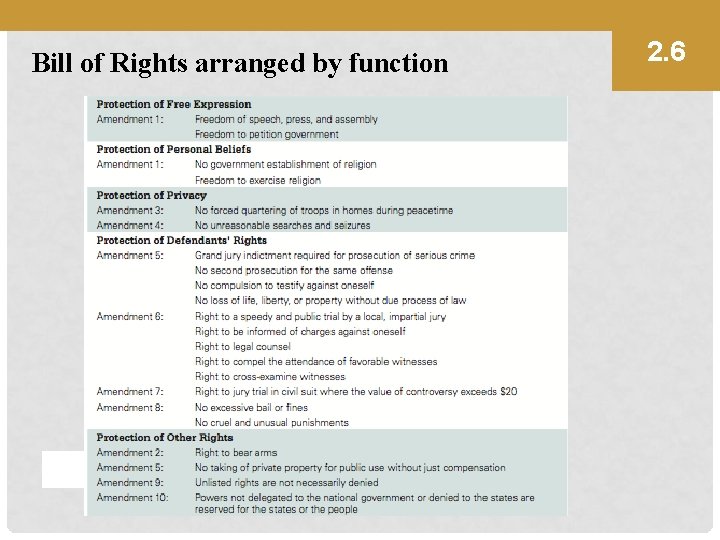
Bill of Rights arranged by function 2. 6
RATIFICATION Ratification by special convention n Got around state legislatures Delaware first to approve New Hampshire made it official New York and Virginia critical North Carolina and Rhode Island hold out 2. 6
2. 6 What was the purpose of the Federalist Papers? a. To argue against the Constitution b. To argue in support of the Constitution c. To express concerns about the intent of the Framers d. To provide a document about the creation of the Constitution 2. 6
2. 6 What was the purpose of the Federalist Papers? a. To argue against the Constitution b. To argue in support of the Constitution c. To express concerns about the intent of the Framers d. To provide a document about the creation of the Constitution 2. 6
EXPLORE THE SIMULATION: YOU ARE A FOUNDER 2. 6 http: //media. pearsoncmg. com/long_longman_media _1/2013_mpsl_sim/simulation. html? simula. URL=2
EXPLORE THE CONSTITUTION: HOW LONG DID IT TAKE TO RATIFY THE CONSTITUTION? 2. 6 http: //media. pearsoncmg. com/long_edwards_mpslgi a_16/pex 2. html
CHANGING THE CONSTITUTION Formal Amending Process Informal Processes of Constitutional Change Importance of Flexibility 2. 7
FORMAL AMENDING PROCESS Proposal n Two-thirds vote in each house n National convention called by Congress Ratification n Legislatures of three-fourths of states n Special state conventions 2. 7
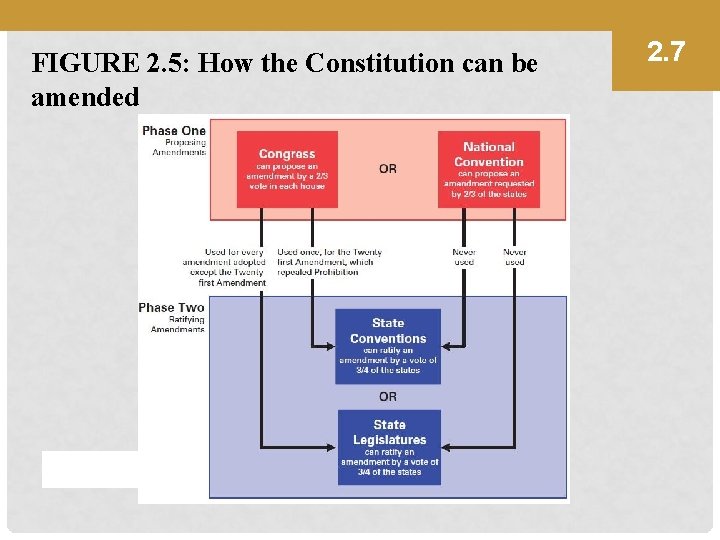
FIGURE 2. 5: How the Constitution can be amended 2. 7
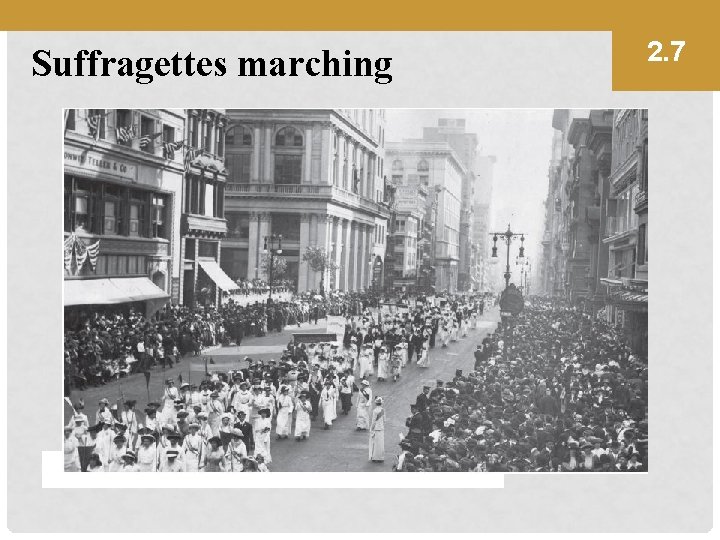
Suffragettes marching 2. 7
INFORMAL PROCESSES OF CONSTITUTIONAL CHANGE Most changes have been informal Judicial interpretation n Marbury v. Madison (1803) Changing political practice Technology Increased demands for new policy 2. 7
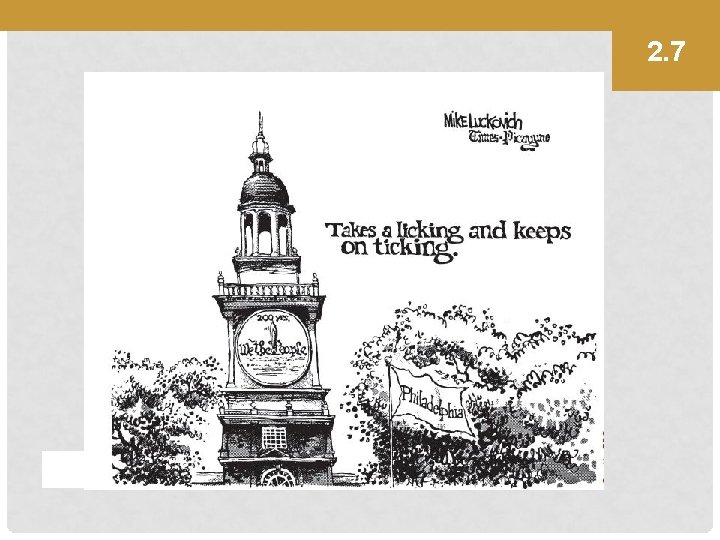
IMPORTANCE OF FLEXIBILITY Constitution meant to be flexible n Many decisions left up to Congress Flexibility key to survival n World’s oldest Constitution 2. 7
2. 7
2. 7 What is an example of an informal way the government has changed? a. There is a two-party system. b. Citizens vote directly for senators. c. The Electoral College chooses the president. d. Voting rights have been granted to everyone. 2. 7
2. 7 What is an example of an informal way the government has changed? a. There is a two-party system. b. Citizens vote directly for senators. c. The Electoral College chooses the president. d. Voting rights have been granted to everyone. 2. 7
VIDEO: THINKING LIKE A POLITICAL SCIENTIST 2. 7 http: //media. pearsoncmg. com/ph/hss/SSA_SHARED_MED IA_1/polisci/presidency/Seg 4_Constitution_v 2. html
UNDERSTANDING THE CONSTITUTION The Constitution and Democracy Constitution and the Scope of Government 2. 8
CONSTITUTION AND DEMOCRACY Original Constitution created a republic, not a democracy n Framers thought elites should govern n Representative democracy allowed Constitution to become more democratic From elitism to pluralism n Voting qualifications left up to states n 5 amendments have expanded electorate n More officials chosen by popular election 2. 8
CONSTITUTION AND THE SCOPE OF GOVERNMENT Constitution designed to limit government and protect liberties n Broad participation possible Effects of separation of powers n All groups can be heard n Encourages stalemate Effects of checks and balances n Gridlock or ineffective policy 2. 8
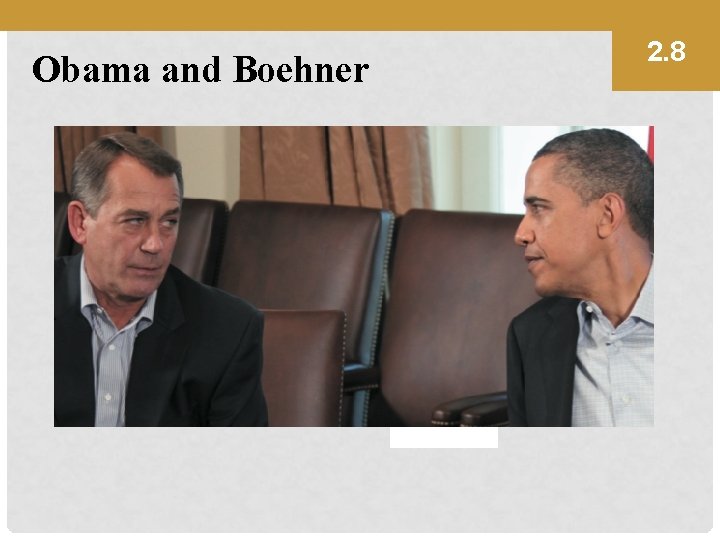
Obama and Boehner 2. 8
2. 8 The Framers chose a system of government called a republic because a. they feared the power of the majority. b. they believed in direct representation. c. they supported a two-party system. d. they wanted to establish the rights of the individual. 2. 8
2. 8 The Framers chose a system of government called a republic because a. they feared the power of the majority. b. they believed in direct representation. c. they supported a two-party system. d. they wanted to establish the rights of the individual. 2. 8
Discussion Question Did learning that the Framers were elites who feared majority rule surprise you? Does it change any ideas you had about American government and politics, and the Framers themselves? 2
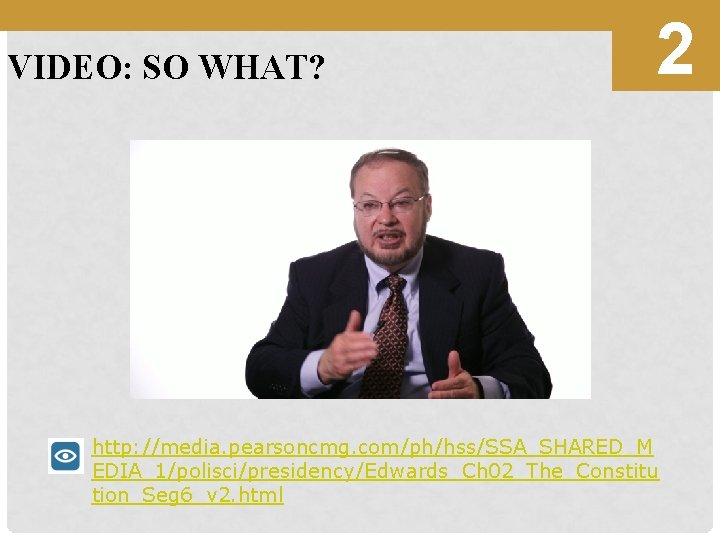
VIDEO: SO WHAT? 2 http: //media. pearsoncmg. com/ph/hss/SSA_SHARED_M EDIA_1/polisci/presidency/Edwards_Ch 02_The_Constitu tion_Seg 6_v 2. html
Further Review: On My. Poli. Sci. Lab Listen to the Chapter Study and Review the Flashcards Study and Review the Practice Tests 2
- Slides: 76