
The CONSORT Statement Consolidated Standards of Reporting Trials




- Slides: 30
The CONSORT Statement Consolidated Standards of Reporting Trials
INTRODUCTION Well designed and properly executed randomised controlled trials (RCTs) provide the most reliable evidence on the efficacy of healthcare interventions, but trials with inadequate methods are associated with bias, especially exaggerated treatment effects. The objective of CONSORT is to provide guidance to authors about how to improve the reporting of their trials. Trial reports need be clear, complete, and transparent.
The CONSORT Checklist TITLE AND ABSTRACT 1 a. Identification as a randomised trial in the title Example—“Smoking reduction with oral nicotine inhalers: double blind, randomised clinical trial of efficacy and safety. ” To help ensure that a study is appropriately indexed and easily identified, authors should use the word “randomised” in the title to indicate that the participants were randomly assigned to their comparison groups.
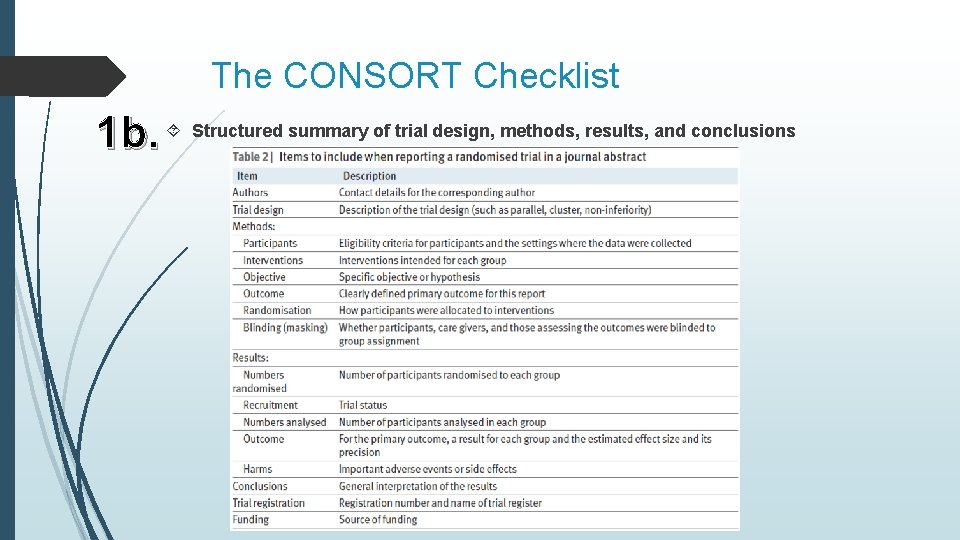
The CONSORT Checklist 1 b. Structured summary of trial design, methods, results, and conclusions
The CONSORT Checklist INTRODUCTION 2 a. Scientific background and explanation of rationale Some clinical trials have been shown to have been unnecessary because the question they addressed had been or could have been answered by a systematic review of the existing literature. Thus, the need for a new trial should be justified in the introduction. Ideally, it should include a reference to a systematic review of previous similar trials or a note of the absence of such trials 2 b. Specific objectives or hypotheses Objectives are the questions that the trial was designed to answer. They often relate to the efficacy of a particular therapeutic or preventive intervention.
The CONSORT Checklist METHODS 3 a. Description of trial design (such as parallel, factorial) including allocation ratio Example—“This was a multicenter, stratified (6 to 11 years and 12 to 17 years of age, with imbalanced randomisation [2: 1]), double-blind, placebo-controlled, parallel-group study conducted in the United States (41 sites). ” If a less common design is employed, authors are encouraged to explain their choice, especially as such designs may imply the need for a larger sample size or more complex analysis and interpretation. Although most trials use equal randomisation (such as 1: 1 for two groups), it is helpful to provide the allocation ratio explicitly. For drug trials, specifying the phase of the trial (I-IV) may also be relevant.
The CONSORT Checklist changes to methods after trial commencement (such as eligibility 3 b. Important criteria), with reasons There may be deviations from the original protocol, as it is impossible to predict every possible change in circumstances during the course of a trial. Some trials will therefore have important changes to the methods after trial commencement. Whether the modifications are explicitly part of the trial design or in response to changing circumstances, it is essential that they are fully reported to help the reader interpret the results.
The CONSORT Checklist criteria for participants 4 a. Eligibility In particular, a clear understanding of these criteria is one of several elements required to judge to whom the results of a trial apply—that is, the trial’s generalisability (applicability) and relevance to clinical or public health practice. A description of the method of recruitment, such as by referral or self selection (for example, through advertisements), is also important in this context. 4 b. Settings and locations where the data were collected Authors should report the number and type of settings and describe the care providers involved. They should report the locations in which the study was carried out, including the country, city if applicable, and immediate environment (for example, community, office practice, hospital clinic, or inpatient unit). In particular, it should be clear whether the trial was carried out in one or several centres (“multicentre trials”).
The CONSORT Checklist 5. The interventions for each group with sufficient details to allow replication, including how and when they were actually administered Authors should describe each intervention thoroughly, including control interventions. The description should allow a clinician wanting to use the intervention to know exactly how to administer the intervention that was evaluated in the trial. For a drug intervention, information would include the drug name, dose, method of administration (such as oral, intravenous), timing and duration of administration, conditions under which interventions are withheld, and titration regimen if applicable.
The CONSORT Checklist defined pre-specified primary and secondary outcome measures, 6 a. Completely including how and when they were assessed The primary outcome measure is the pre-specified outcome considered to be of greatest importance to relevant stakeholders (such a patients, policy makers, clinicians, funders) and is usually the one used in the sample size calculation. Other outcomes of interest are secondary outcomes (additional outcomes). There may be several secondary outcomes, which often include unanticipated or unintended effects of the intervention, although harms should always be viewed as important whether they are labelled primary or secondary. All outcome measures, whether primary or secondary, should be identified and completely defined. 6 b. Any changes to trial outcomes after the trial commenced, with reasons Authors should report all major changes to the protocol, including unplanned changes to eligibility criteria, interventions, examinations, data collection, methods of analysis, and outcomes.
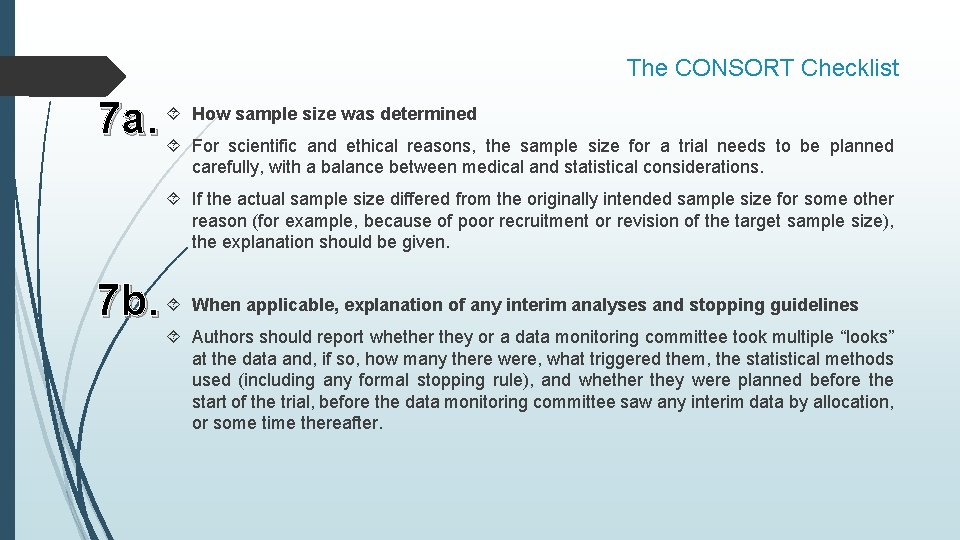
The CONSORT Checklist sample size was determined 7 a. How For scientific and ethical reasons, the sample size for a trial needs to be planned carefully, with a balance between medical and statistical considerations. If the actual sample size differed from the originally intended sample size for some other reason (for example, because of poor recruitment or revision of the target sample size), the explanation should be given. 7 b. When applicable, explanation of any interim analyses and stopping guidelines Authors should report whether they or a data monitoring committee took multiple “looks” at the data and, if so, how many there were, what triggered them, the statistical methods used (including any formal stopping rule), and whether they were planned before the start of the trial, before the data monitoring committee saw any interim data by allocation, or some time thereafter.
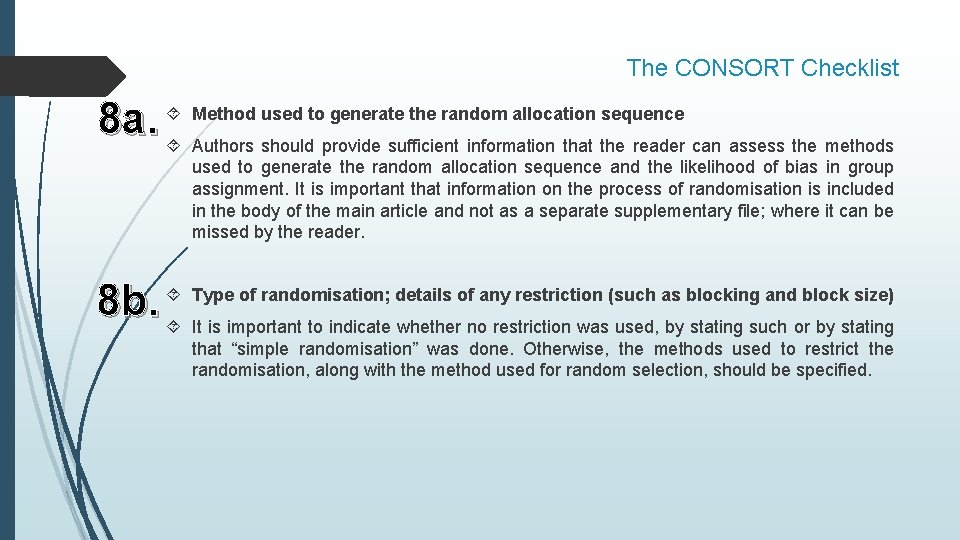
The CONSORT Checklist used to generate the random allocation sequence 8 a. Method Authors should provide sufficient information that the reader can assess the methods used to generate the random allocation sequence and the likelihood of bias in group assignment. It is important that information on the process of randomisation is included in the body of the main article and not as a separate supplementary file; where it can be missed by the reader. of randomisation; details of any restriction (such as blocking and block size) 8 b. Type It is important to indicate whether no restriction was used, by stating such or by stating that “simple randomisation” was done. Otherwise, the methods used to restrict the randomisation, along with the method used for random selection, should be specified.
AABB ABAB BABA BBAA ABBA BAAB
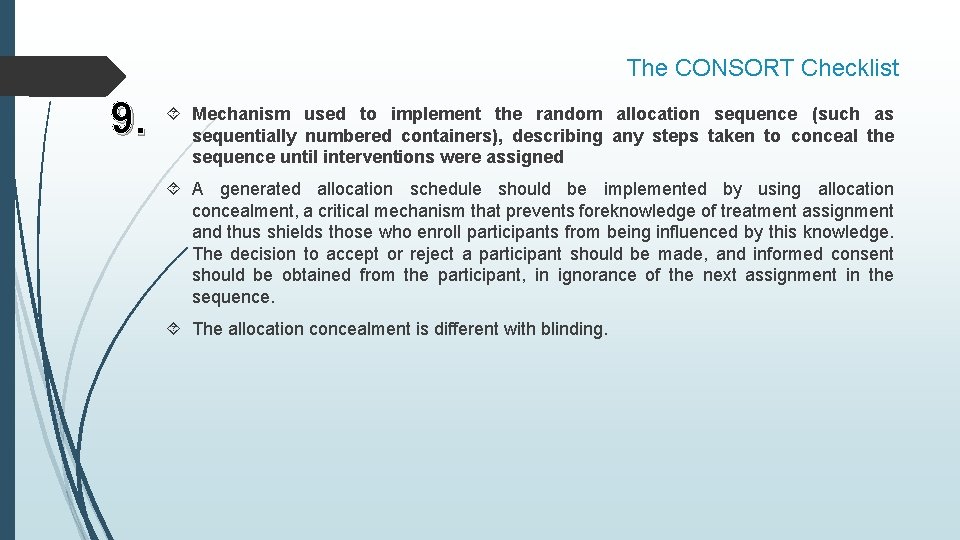
The CONSORT Checklist 9. Mechanism used to implement the random allocation sequence (such as sequentially numbered containers), describing any steps taken to conceal the sequence until interventions were assigned A generated allocation schedule should be implemented by using allocation concealment, a critical mechanism that prevents foreknowledge of treatment assignment and thus shields those who enroll participants from being influenced by this knowledge. The decision to accept or reject a participant should be made, and informed consent should be obtained from the participant, in ignorance of the next assignment in the sequence. The allocation concealment is different with blinding.
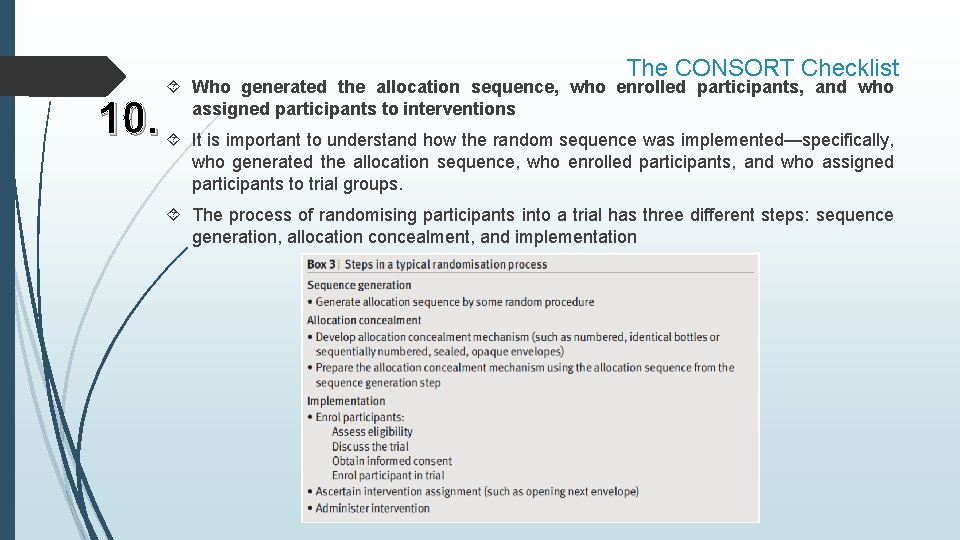
The CONSORT Checklist Who generated the allocation sequence, who enrolled participants, and who assigned participants to interventions 10. It is important to understand how the random sequence was implemented—specifically, who generated the allocation sequence, who enrolled participants, and who assigned participants to trial groups. The process of randomising participants into a trial has three different steps: sequence generation, allocation concealment, and implementation
The CONSORT Checklist done, who was blinded after assignment to interventions 11 a. Ifparticipants, care providers, those assessing outcomes) and how (for example, The term “blinding” or “masking” refers to withholding information about the assigned interventions from people involved in the trial who may potentially be influenced by this knowledge. Blinding is an important safeguard against bias, particularly when assessing subjective outcomes, such as assessment of pain. In certain trials, especially surgical trials, blinding of participants and surgeons is often difficult or impossible, but blinding of data collectors and outcome adjudicators is often achievable. description of the similarity of interventions 11 b. If. Inrelevant, trials withblinding of participants or healthcare providers, authors should state the similarity of the characteristics of the interventions (such as appearance, taste, smell, and method of administration).
The CONSORT Checklist methods used to compare groups for primary and secondary outcomes 12 a. Statistical The principle to follow is to, “Describe statistical methods with enough detail to enable a knowledgeable reader with access to the original data to verify the reported results” (www. icmje. org). It is also important to describe details of the statistical analysis such as intention-to-treat analysis. Methods for additional analyses, such as subgroup analyses and adjusted analyses 12 b. As is the case for primary analyses, the method of subgroup analysis should be clearly specified. Authors should clarify the choice of variables that were adjusted for, indicate how continuous variables were handled, and specify whether the analysis was planned or suggested by the data.
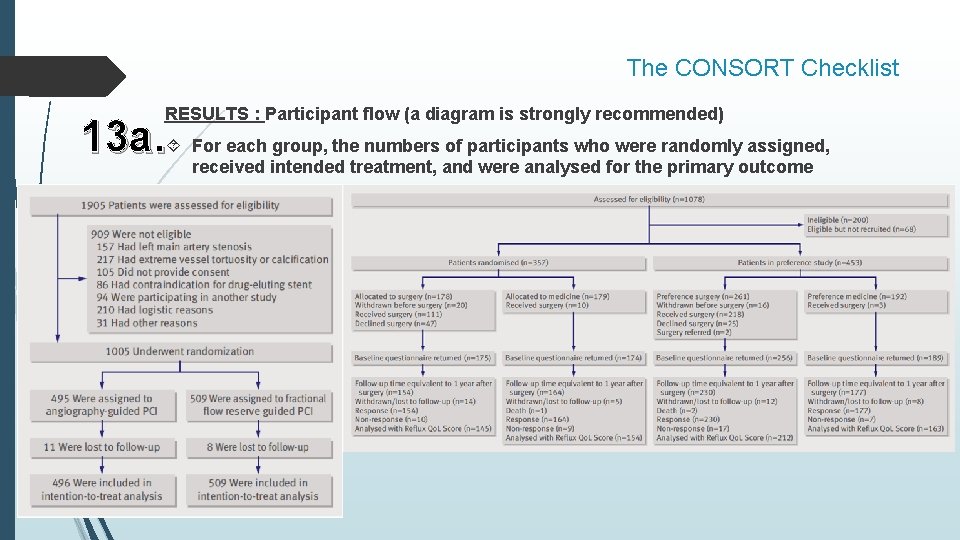
The CONSORT Checklist RESULTS : Participant flow (a diagram is strongly recommended) 13 a. For each group, the numbers of participants who were randomly assigned, received intended treatment, and were analysed for the primary outcome
The CONSORT Checklist 13 b. For each group, losses and exclusions after randomisation, together with reasons If participants were excluded after randomisation (contrary to the intention-to-treat principle) because they were found not to meet eligibility criteria (see item 16), they should be included in the flow diagram. Use of the term “protocol deviation” in published articles is not sufficient to justify exclusion of participants after randomisation. The nature of the protocol deviation and the exact reason for excluding participants after randomisation should always be reported.
The CONSORT Checklist defining the periods of recruitment and follow-up 14 a. Dates Medical and surgical therapies, including concurrent therapies, evolve continuously and may affect the routine care given to participants during a trial. Knowing the rate at which participants were recruited may also be useful, especially to other investigators. The length of follow-up is not always a fixed period after randomisation. In many RCTs in which the outcome is time to an event, follow-up of all participants is ended on a specific date. This date should be given, and it is also useful to report the minimum, maximum, and median duration of follow-up.
14 b. Why the trial ended or was stopped The CONSORT Checklist RCTs should indicate why the trial came to an end. The report should also disclose factors extrinsic to the trial that affected the decision to stop the trial, and who made the decision to stop the trial, including reporting the role the funding agency played in the deliberations and in the decision to stop the trial. RCTs can end when they reach their sample size goal, their event count goal, their length of follow-up goal, or when they reach their scheduled date of closure. Alternatively, RCTs can stop earlier than planned because of the result of an interim analysis showing larger than expected benefit or harm on the experimental intervention. Also RCTs can stop earlier than planned when investigators find evidence of no important difference between experimental and control interventions (that is, stopping for futility). In addition, trials may stop early because the trial becomes unviable: funding vanishes, researchers cannot access eligible patients or study interventions, or the results of other studies make the research question irrelevant.
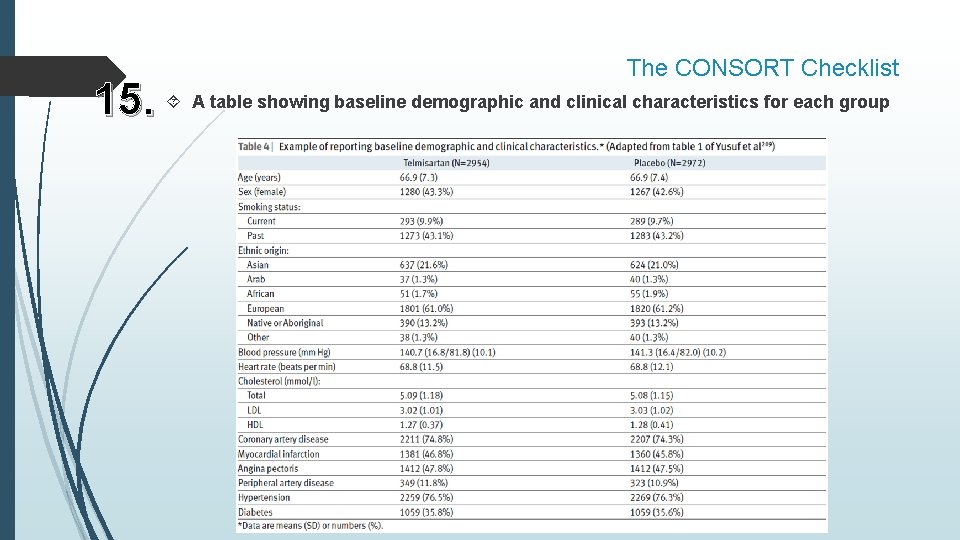
The CONSORT Checklist 15. A table showing baseline demographic and clinical characteristics for each group
The CONSORT Checklist each group, number of participants (denominator) included in each analysis 16. For and whether the analysis was by original assigned groups The number of participants per group should be given for all analyses. For binary outcomes, (such as risk ratio and risk difference) the denominators or event rates should also be reported. Participants may sometimes not receive the full intervention, or some ineligible patients may have been randomly allocated in error. One widely recommended way to handle such issues is to analyse all participants according to their original group assignment, regardless of what subsequently occurred. This “intention-to-treat” strategy is not always straightforward to implement. Conversely, analysis can be restricted to only participants who fulfil the protocol in terms of eligibility, interventions, and outcome assessment. This analysis is known as an “ontreatment” or “per protocol” analysis.
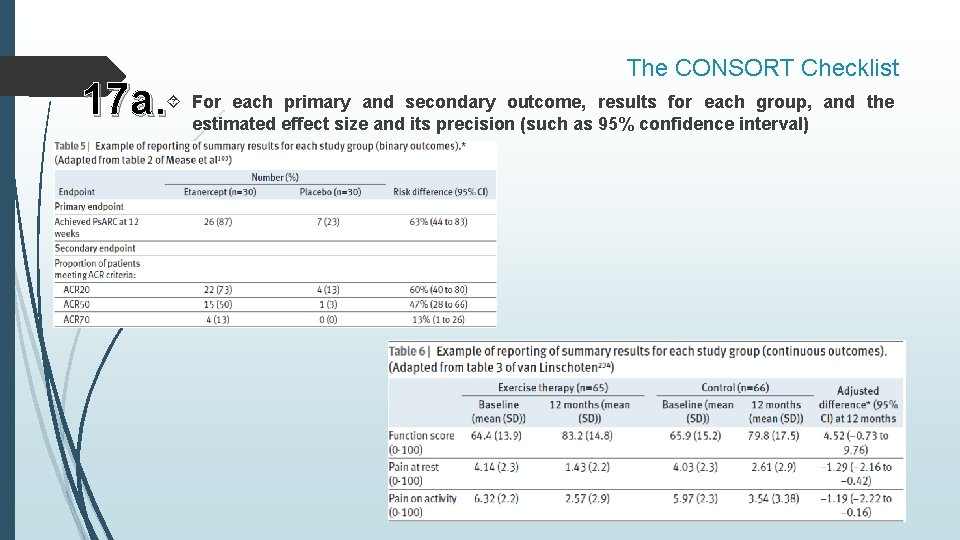
The CONSORT Checklist each primary and secondary outcome, results for each group, and the 17 a. For estimated effect size and its precision (such as 95% confidence interval)
The CONSORT Checklist binary outcomes, presentation of both absolute and relative effect sizes is 17 b. For recommended When the primary outcome is binary, both the relative effect (risk ratio (relative risk) or odds ratio) and the absolute effect (risk difference) should be reported (with confidence intervals), as neither the relative measure nor the absolute measure alone gives a complete picture of the effect and its implications. For diseases where the outcome is common, a relative risk near unity might indicate clinically important differences in public health terms. In contrast, a large relative risk when the outcome is rare may not be so important for public health (although it may be important to an individual in a high risk category).
The CONSORT Checklist 18. Results of any other analyses performed, including subgroup analyses and adjusted analyses, distinguishing pre-specified from exploratory Multiple analyses of the same data create a risk for false positive findings. Authors should resist the temptation to perform many subgroup analyses. If subgroup analyses were undertaken, authors should report which subgroups were examined, why, if they were prespecified, and how many were prespecified. Selective reporting of subgroup analyses could lead to bias. important harms or unintended effects in each group (For specific guidance see 19. All CONSORT for harms) The existence and nature of adverse effects can have a major impact on whether a particular intervention will be deemed acceptable and useful. Not all reported adverse events observed during a trial are necessarily a consequence of the intervention; some may be a consequence of the condition being treated.
The CONSORT Checklist 20. Trial limitations, addressing sources of potential bias, imprecision, and, if relevant, DISCUSSION multiplicity of analyses Although discussion of limitations is frequently omitted from research reports, 257 identification and discussion of the weaknesses of a study have particular importance. Authors should also discuss any imprecision of the results. Imprecision may arise in connection with several aspects of a study, including measurement of a primary outcome (see item 6 a) or diagnosis (see item 4 a).
The CONSORT Checklist 21. External validity, also called generalisability or applicability, is the extent to which the Generalisability (external validity, applicability) of the trial findings results of a study can be generalised to other circumstances. Internal validity, the extent to which the design and conduct of the trial eliminate the possibility of bias, is a prerequisite for external validity: the results of a flawed trial are invalid and the question of its external validity becomes irrelevant. consistent with results, balancing benefits and harms, and 22. Interpretation considering other relevant evidence Readers will want to know how the present trial’s results relate to those of other RCTs. This can best be achieved by including a formal systematic review in the results or discussion section of the report. At a minimum, the discussion should be as systematic as possible and be based on a comprehensive search, rather than being limited to studies that support the results of the current trial.
The CONSORT Checklist OTHER INFORMATION 23. Registration number and name of trial registry Example—“The trial is registered at Clinical. Trials. gov, number NCT 00244842. ” Authors should provide the name of the register and the trial’s unique registration number. If authors had not registered their trial they should explicitly state this and give the reason. the full trial protocol can be accessed, if available 24. Where Example—“Full details of the trial protocol can be found in the Supplementary Appendix, available with the full text of this article at www. nejm. org. ” Having a protocol can help to restrict the likelihood of undeclared post hoc changes to the trial methods and selective outcome reporting. 25. Sources of funding and other support (such as supply of drugs), role of funders The level of involvement by a funder and their influence on the design, conduct, analysis, and reporting of a trial varies. It is therefore important that authors describe in detail the role of the funders.
THANK YOU