
The Connotation and Embodiment of Thailands Soft Power
The Connotation and Embodiment of Thailand’s Soft Power and Its Enlightenment to China’s Soft Power Construction Lin Zhiliang, Director of Southeast Asian Language Department, School of Foreign Languages, Guangxi University According to the Global Soft Power Report 2018 published by the Foreign Affairs Research Center of the University of Southern California and the Portland Public Relations Company, Thailand ranks fifth in Asia and 36 th in the world, behind Japan, Korea, Singapore and China. Thai people have proudly declared that there are some in the world, there all in Thailand, but there are some in Thailand there are not necessarily some in the world. Thai culture, Thai smiles, Thai food, Thai boxing, Thai opera and Thai etiquette have become part of Thailand’s soft power; Thai diplomacy, the way Thai people deal with the world, the tolerance of grassroots strata, the way Thailand resolves contradictions and conflicts, etc. , are also worth studying in the outside world,
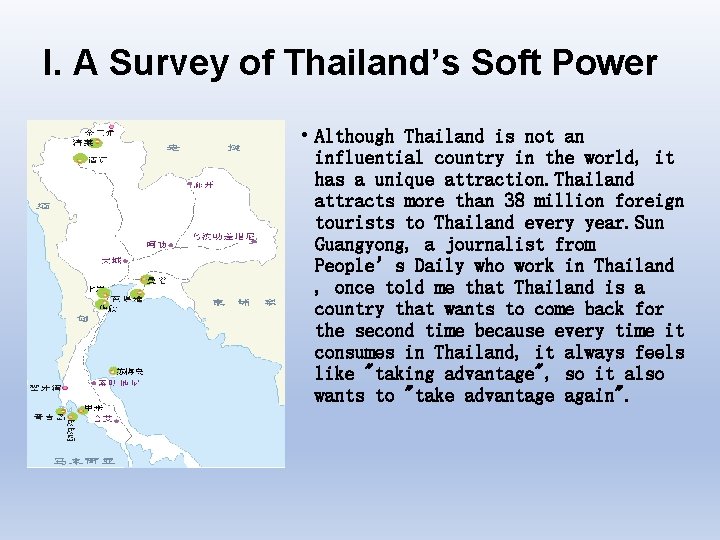
I. A Survey of Thailand’s Soft Power • Although Thailand is not an influential country in the world, it has a unique attraction. Thailand attracts more than 38 million foreign tourists to Thailand every year. Sun Guangyong, a journalist from People’s Daily who work in Thailand , once told me that Thailand is a country that wants to come back for the second time because every time it consumes in Thailand, it always feels like "taking advantage", so it also wants to "take advantage again".
I. A Survey of Thailand’s Soft Power • In terms of foreign relations, Thailand is the only country in the modern history of Southeast Asia that has not been colonized, which makes Thailand in the eyes of the world a country without Sad feeling in the modern history. Many Chinese staff engaged in Foreign Affairs reception always lamented that Thai people are born optimists because they "have not experienced war" and do not know what "heavy(sad)" is. They always believe that "there is a way to the bridge when the ship arrives". Thailand is good at making use of the contradictions between the powers to create its international image as a "buffer country", and has good relations with all the powers in the world. In addition to maintaining close ties with economic and military powers, Thailand also maintains close ties with distant countries such as Germany and Sweden. Thailand has close contacts with the Swedish Royal family. Thai military delegations often visit and study in Germany.
I. A Survey of Thailand’s Soft Power • Thailand Russia maintain special friendship. As early as 1893, when Czar Nicholas II was crown prince, he traveled to Vladivostok via Singapore. When King Chulalongkorn of Thailand learned the news, he was keenly aware that it was a golden opportunity to draw closer ties with Russia because European powers launched colonial wars in Asia at that time, while Russia was rising to become a world power and was able to achieve peace. To weigh the strength of other European powers. So Thailand expressed to Russia its wish to invite Prince Nicholas to visit Thailand through its ambassador to Germany. Later, King Chulalongkorn received Crown Prince Nicholas in Thailand. After returning to Russia, Crown Prince Nicholas began to promote the establishment of diplomatic relations between Russia and Thailand. In 1897, King Chulalongkorn visited Russia and signed diplomatic relations with Russia. At that time, there was basically no trade between Russia and Thailand, which was very rare in world history. Since then, the two countries have developed friendship for more than a century.
I. A Survey of Thailand’s Soft Power • The purpose of Thailand’s invitation to Nicholas II to visit Thailand is to ask Russia to help Thailand negotiate with France and ask France to withdraw from the Thai government of Chanthaburi, which borders Cambodia. Thailand believes that Thailand has signed an agreement with France in 2436 and is willing to abandon Thailand’s territory on the West Bank of the Mekong River. France should not make excessive territorial claims to Thailand. Ultimately, Russia sent ambassadors to Thailand to help Thailand negotiate with France withdrew its troops from Chanthaburi Prefecture, and Thailand achieved its goal of countering France. According to the analysis, the reason why France suddenly became awed of Thailand is that it saw a photo of King Chulalongkorn of Thailand Czar Nicholas II of Russia when he visited Europe, which was published in newspapers.
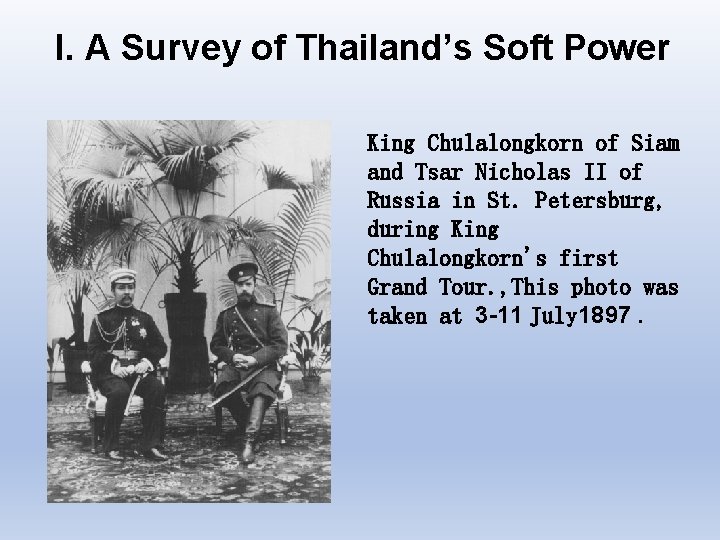
I. A Survey of Thailand’s Soft Power King Chulalongkorn of Siam and Tsar Nicholas II of Russia in St. Petersburg, during King Chulalongkorn's first Grand Tour. , This photo was taken at 3 -11 July 1897.
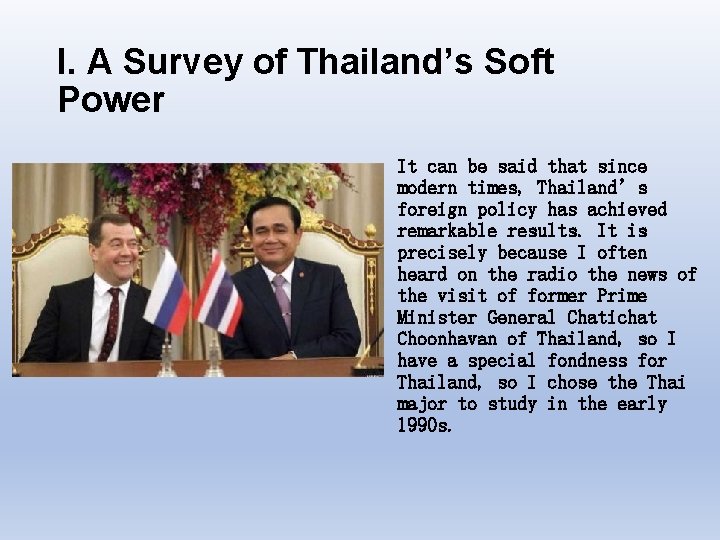
I. A Survey of Thailand’s Soft Power It can be said that since modern times, Thailand’s foreign policy has achieved remarkable results. It is precisely because I often heard on the radio the news of the visit of former Prime Minister General Chatichat Choonhavan of Thailand, so I have a special fondness for Thailand, so I chose the Thai major to study in the early 1990 s.
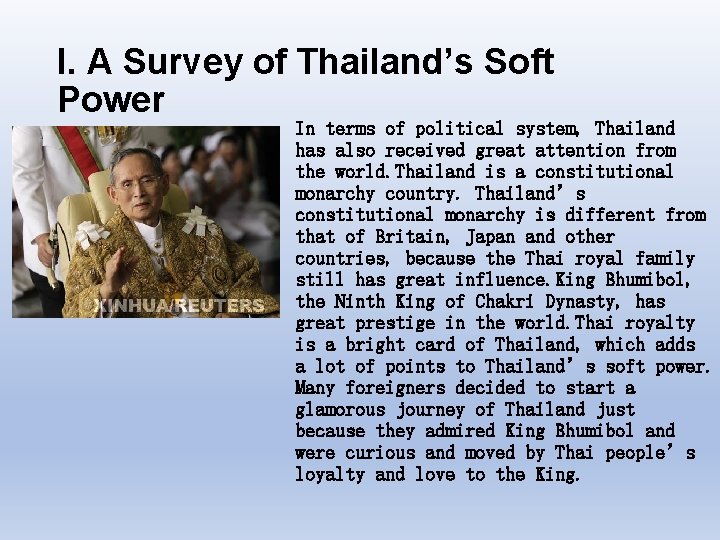
I. A Survey of Thailand’s Soft Power In terms of political system, Thailand has also received great attention from the world. Thailand is a constitutional monarchy country. Thailand’s constitutional monarchy is different from that of Britain, Japan and other countries, because the Thai royal family still has great influence. King Bhumibol, the Ninth King of Chakri Dynasty, has great prestige in the world. Thai royalty is a bright card of Thailand, which adds a lot of points to Thailand’s soft power. Many foreigners decided to start a glamorous journey of Thailand just because they admired King Bhumibol and were curious and moved by Thai people’s loyalty and love to the King.
II. The Connotation and Embodiment of Thailand’s Soft Power • 1. Cultural Confidence: Thai culture consists of four parts: Indian culture, Chinese culture, Western culture and indigenous culture. • 2. National mental health: There are many outlets for social vention, easy to forgive others, easy to forget, with a humorous and entertaining mentality. • 3. Respect for Western-style social etiquette, easy to be accepted by the international community. • 4. patronage: a relationship-based and ritualized society with orderly dignity and inferiority, distinction between children and elders, respect for teachers and doctors; Thai society is an "acquaintance society" with affinity and grounding spirit • 5. High aesthetic taste: high pursuit of product quality, more developed cultural and creative industries
II. The Connotation and Embodiment of Thailand’s Soft Power • 6. No matter culture: every thing is ok, easy going • 7. Understand the way of liberation: not too persistent in anything, is a Unworldliness society. • 8. win advantage from both sides: has made great achievements in diplomacy in modern history. • 9. Popular culture is developed and has great cultural influence. • 10. With pragmatism as the guide, everything can be entertained • 11. Understanding the Art of Euphemistic Rejection • 12. They know how to share and give, always have compassion, live in poverty and enjoy life and death.
II. The Connotation and Embodiment of Thailand’s Soft Power • 13. Social inclusion is strong, especially for the lower class. • 14. Respect for everything, neither force others, nor like others to force themselves, self-esteem is strong • 15. Have a good sense of food and service • 16. Pay attention to environmental protection and be in line with international standards. • 17. With powerful courts and the Food and Drug Administration • 18. Supporting the King, Supporting the Constitutional Monarchy
III. The Enlightenment of China’s Soft Power Development from Thailand’s Soft Power • First of all, if we want to improve soft power, we must have cultural self-confidence, but cultural self-confidence should also be grounded. It should be embodied in daily life. We should not shout slogans in an empty way, let alone live out of life. Life consists of work, food, clothing, housing, transportation, leisure, entertainment and safety. For some major countries, security is no longer a big problem, but foreign tourists, what they first contact should be a country’s food, housing and entertainment. Thai cuisine is easy to make. It is mainly made of Thai seasonings. It is easy to spread all over the world. In addition, Thai management of foreigners is very loose. Foreigners can easily to stay in the residential quarters for a long time. Thai entertainment is also rich and colorful. Many Westerners live in Thailand to learn Thai boxing. Thailand is also one of the favorite countries for backpackers from the West. All these show that Thai culture is very grounded and international, which is worth learning.
III. The Enlightenment of China’s Soft Power Development from Thailand’s Soft Power • For a long time, people in Southeast Asian countries often complain that their ordinary people are difficult to be allowed to work in China because China only needs "experts". Many Southeast Asian people who want to do housework, such as Filipino and Thai domestic servants, are very difficult to obtain work permits from China. In fact, there is a large demand for such services along the southeast coast of China can open this kind of service market appropriately so as to enhance its soft power in Southeast Asian countries. In addition, relaxing the restrictions on accommodation of foreign tourists is also a factor to be considered. Many Thai friends often complain about the restrictions imposed by "non-foreign hotels" on hosting foreigners in China, which bring them many inconveniences.
III. The Enlightenment of China’s Soft Power Development from Thailand’s Soft Power • Secondly, we have a lot of propaganda in the form of Sino-Christian propaganda in the development of soft power abroad. Our understanding of the national conditions and cultures of ASEAN countries is not deep enough. Some cultural exchanges are still in the line. For example, we can see that the promotion of Chinese culture abroad in China must be the promotion of calligraphy, Peking Opera, traditional Chinese painting and other content, but it is not known that although these projects are the essence of traditional Chinese culture, they are after all small projects in the international community, unable to attract public participation, so they have returned to the old road of traditional government diplomacy, did not turn to real public relations. Our foreign exchanges have not formed such well-known effects as the "cute culture" of Japan, the "Korean Wave" culture of Korea, the "pop music" of the United States, and the "Thai TV series" of Thailand. That is to say, our cultural construction is not grounded enough.
III. The Enlightenment of China’s Soft Power Development from Thailand’s Soft Power • In addition, when we publicize China’s foreign policy, sometimes we are too straightforward and appear too strong, which leads to the vigilance of ASEAN countries. For example, according to the insiders, there was a time when a Chinese Think Tank wanted to cooperate with a famous University in Thailand to hold academic conferences. The leader of the company must add the word "one belt and one road" to the name of the conference, but the Thai counterpart told us that if we add "one belt and one road", the number of people who will attend the meeting will be affected, because many Thailand scholars say that "one belt and one road" is to be said too much. It’s a disgusting word. They think we’re making a cultural invasion. 图为泼水节。
III. The Enlightenment of China’s Soft Power Development from Thailand’s Soft Power • Thirdly, because Thailand is a country that is very tolerant of the underprivileged, when we develop large-scale projects in Thailand, we must benefit the local people’s livelihood. When investing in largescale projects, the goal should not only focus on the compatibility of project construction, but also bring job opportunities to the people along the project. In addition, we should keep a good bottom line in environmental protection and other aspects.
III. The Enlightenment of China’s Soft Power Development from Thailand’s Soft Power • Finally, our strong point is the culture of governing our country. The book Xi Jinping Talks about governing our country is a popular book in Southeast Asia, which can allow more people to participate in exchanges, not only among experts with government background. In addition, we should strengthen the study of foreign counterparts’experience. Some cultural powers do not play the government’s role in developing soft power. On the contrary, a movie and several TV series play a stronger role than public diplomacy. American movies, music, Korean Tv series, Thai Tv series and other popular cultural works have greatly enhanced the soft power of these countries.
III. The Enlightenment of China’s Soft Power Development from Thailand’s Soft Power Therefore, in order to build China’s soft power in Thailand even in ASEAN, we should take Thai culture as a mirror, learn from Japan’s successful experience, strive for good publicity in Thailand, and gain the general recognition of Thai society. Only in this way can we build a good social atmosphere for Chinese products and Chinese railways to go to the world better and to Southeast Asia. In terms of propaganda, we should avoid rigid and preaching propaganda. Thai society likes entertainment and does not like preaching. We should publicize ourselves in a form that we like to hear and see. We should ask for more opinions in everything, and we should not always take ourselves as a big brother.
III. The Enlightenment of China’s Soft Power Development from Thailand’s Soft Power • Besides, we should read more books about Thailand written by Japanese. Many people think that China’s understanding of Thailand is not as thorough as that of the Japanese. Japan and Thailand are both constitutional monarchy countries. The monarchy culture between the two countries is similar, and the people’s hearts of 。 the two countries are easier to connect. In addition, the early integration of the two countries into the international community is also conducive to mutual understanding between the two countries. The most important thing is that for hundreds of years, the Chinese immigrants to Thailand were mainly poor people, while Japan was the first Samurai class. The starting point and level of the Chinese and Japanese people stepping on Thailand were different, which made the understanding of Thailand between China and Japan not on the same level.
III. The Enlightenment of China’s Soft Power Development from Thailand’s Soft Power • Of course, different people have different opinions on whether Thailand’s soft power can inspire China to develop soft power. One view is that the national conditions are different and there is no reference significance. However, this paper holds that internationalization must have its convergence. From the setbacks encountered in the process of China’s entry into the international community, Thailand's experience in developing soft power is of great significance to China. •

- Slides: 21