
The Conditional Tense Using one of the easiest
- Slides: 9
The Conditional Tense Using one of the easiest tenses to siphon points from on any free response question in French
In English • Usually formed with the syntax if p, then q, where p is in the imperfect and q is in the conditional mood. • Example: If I weren’t doing this Power. Point, I would be in bed right now. • Any instance in which the auxiliary verb “would” is included uses the conditional mood
In French • Similar if p, then q syntax known as a “si” clause where “si” functions as “if” • Example: Si je ne faisais pas ce Power. Point, je me coucherais maintenant. • Perfect translation between English and French, where all conditional mood verbs are the same as saying “would + verb” in English. • Example: Il ferait ses devoirs s’il avait le temps translates literally to “He would do his homework if he had the time. ” Very simple.
Forming Conditional Stems • For –er and –ir verbs: – Use the infinitive form. That’s all. … No, seriously. That’s it. • For –re verbs: – Just drop the e and use that.
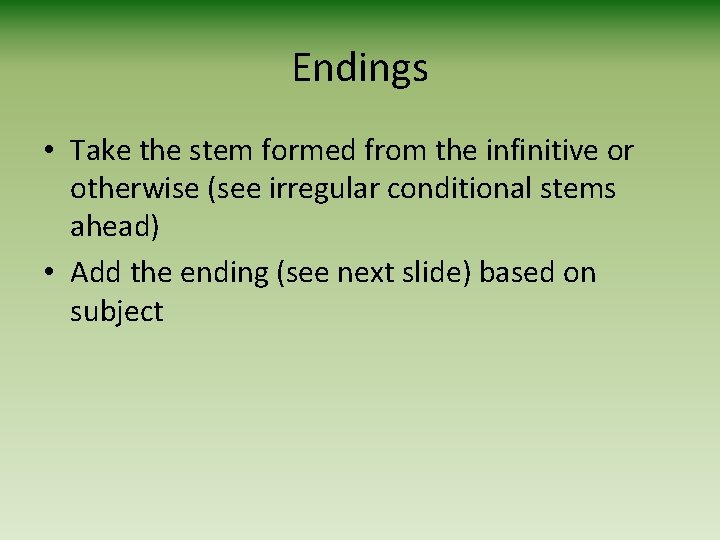
Endings • Take the stem formed from the infinitive or otherwise (see irregular conditional stems ahead) • Add the ending (see next slide) based on subject
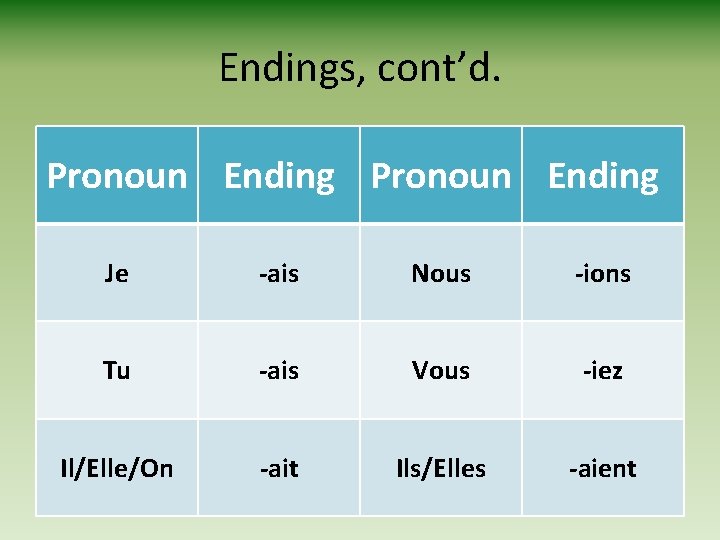
Endings, cont’d. Pronoun Ending Je -ais Nous -ions Tu -ais Vous -iez Il/Elle/On -ait Ils/Elles -aient
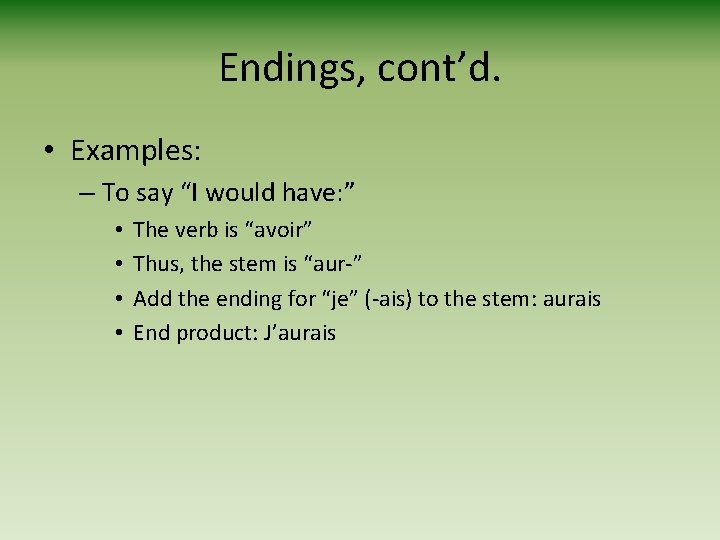
Endings, cont’d. • Examples: – To say “I would have: ” • • The verb is “avoir” Thus, the stem is “aur-” Add the ending for “je” (-ais) to the stem: aurais End product: J’aurais
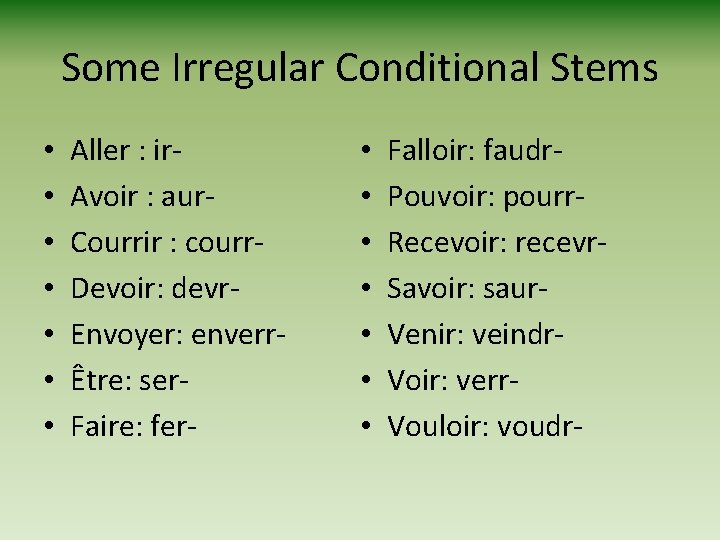
Some Irregular Conditional Stems • • Aller : ir. Avoir : aur. Courrir : courr. Devoir: devr. Envoyer: enverrÊtre: ser. Faire: fer- • • Falloir: faudr. Pouvoir: pourr. Recevoir: recevr. Savoir: saur. Venir: veindr. Voir: verr. Vouloir: voudr-
Endings, cont’d • Hopefully you noticed, but the endings are exactly the same as those for the imperfect. … BOOM! This should have gotten even easier.