
The Condensed Phase The kinetic theory of gases

- Slides: 28
The Condensed Phase The kinetic theory of gases presents a microscopic model for the behavior of gases. As pressure increases or temperature decreases, gas molecules begin to feel the presence of other gas molecules and interactions between them cannot be ignored. As pressure on a gas is increased, or the temperature of the gas is decreased, the gas liquefies forming a more ordered phase, the liquid phase. Further increase in P or drop in T results in a still more ordered solid phase.
Non-bonding Interactions between molecules: Intermolecular interactions NON-BONDING interactions are weaker than bonding interactions (covalent and ionic) Yet, these interactions are critical in defining physical properties of compounds.
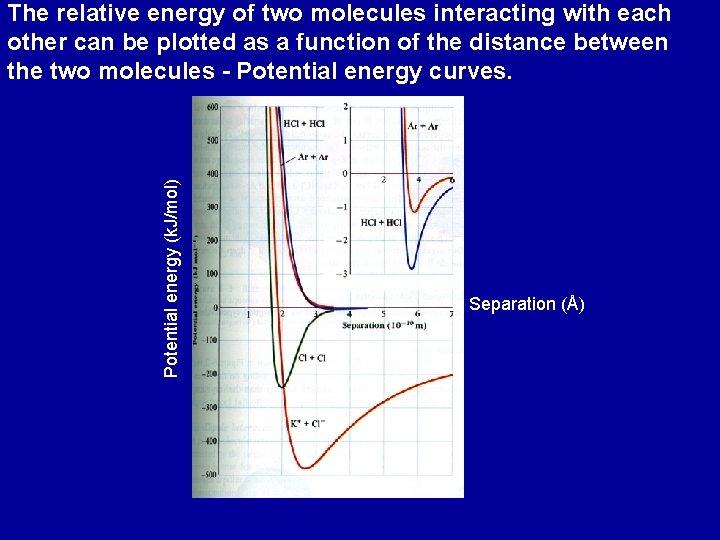
Potential energy (k. J/mol) The relative energy of two molecules interacting with each other can be plotted as a function of the distance between the two molecules - Potential energy curves. Separation (Å)
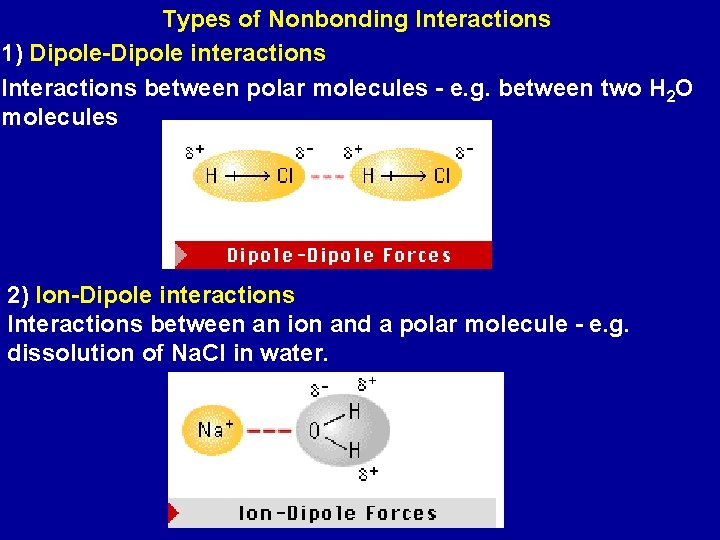
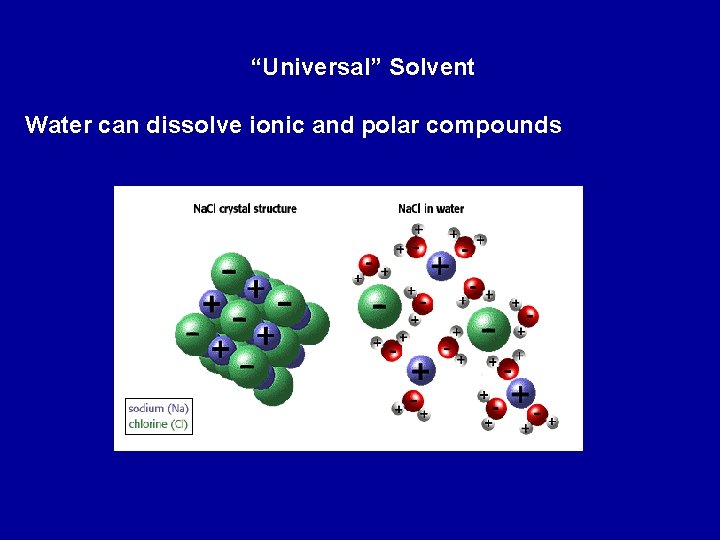
Types of Nonbonding Interactions 1) Dipole-Dipole interactions Interactions between polar molecules - e. g. between two H 2 O molecules 2) Ion-Dipole interactions Interactions between an ion and a polar molecule - e. g. dissolution of Na. Cl in water.
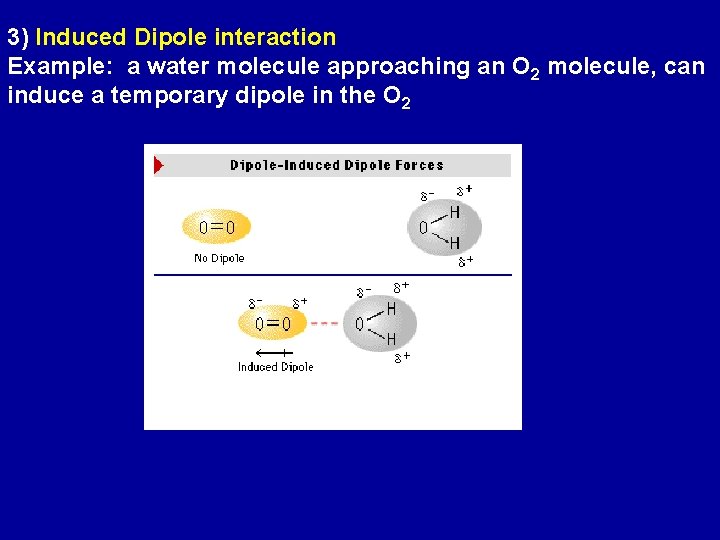
3) Induced Dipole interaction Example: a water molecule approaching an O 2 molecule, can induce a temporary dipole in the O 2
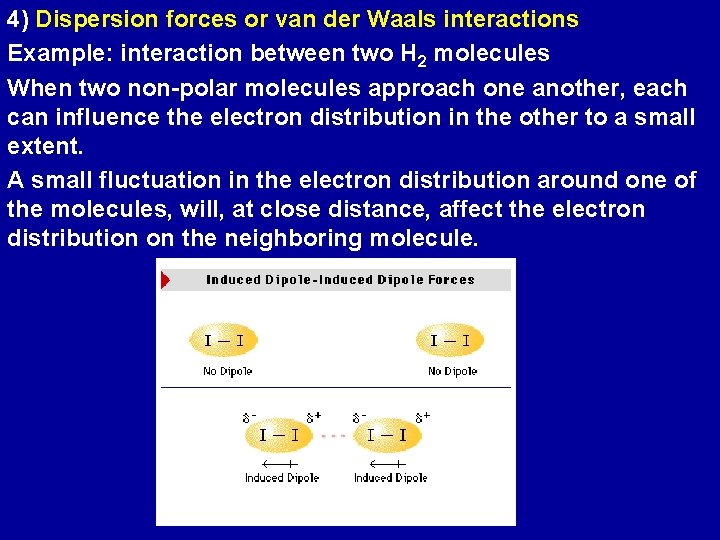
4) Dispersion forces or van der Waals interactions Example: interaction between two H 2 molecules When two non-polar molecules approach one another, each can influence the electron distribution in the other to a small extent. A small fluctuation in the electron distribution around one of the molecules, will, at close distance, affect the electron distribution on the neighboring molecule.
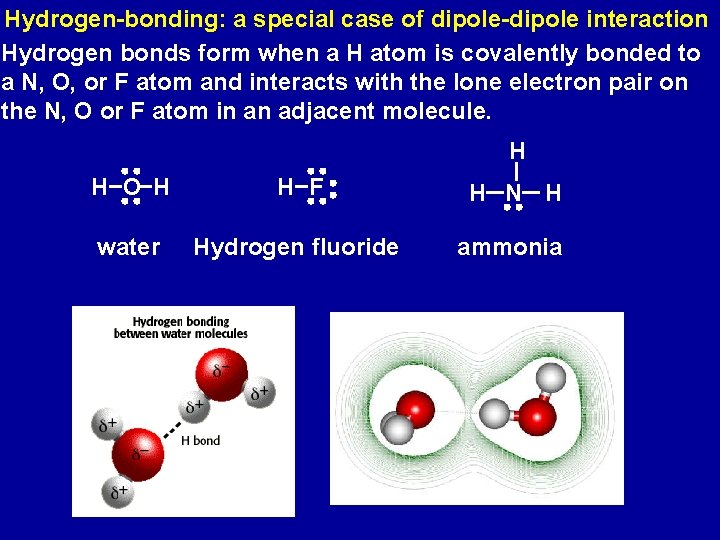
Hydrogen-bonding: a special case of dipole-dipole interaction Hydrogen bonds form when a H atom is covalently bonded to a N, O, or F atom and interacts with the lone electron pair on the N, O or F atom in an adjacent molecule. H H O H H F H N H water Hydrogen fluoride ammonia
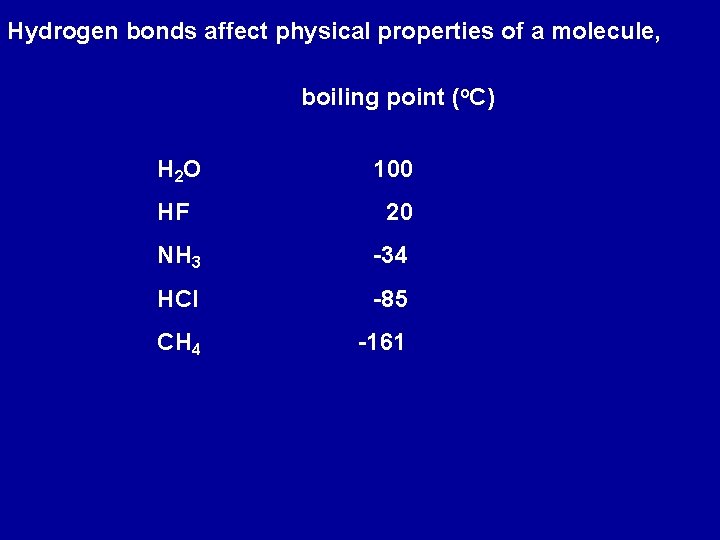
Hydrogen bonds affect physical properties of a molecule, boiling point (o. C) H 2 O 100 HF 20 NH 3 -34 HCl -85 CH 4 -161
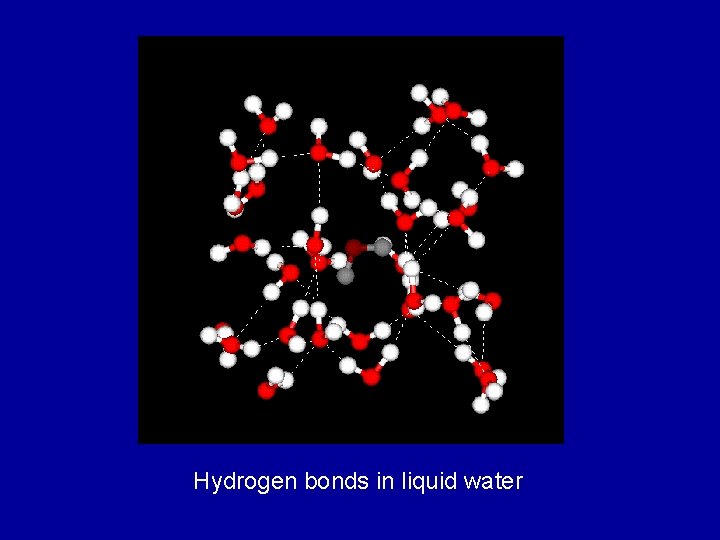
Hydrogen bonds in liquid water
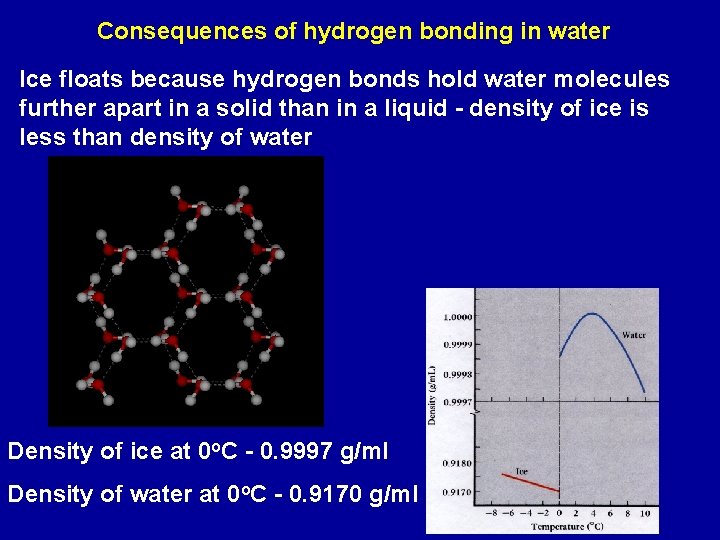
Consequences of hydrogen bonding in water Ice floats because hydrogen bonds hold water molecules further apart in a solid than in a liquid - density of ice is less than density of water Density of ice at 0 o. C - 0. 9997 g/ml Density of water at 0 o. C - 0. 9170 g/ml
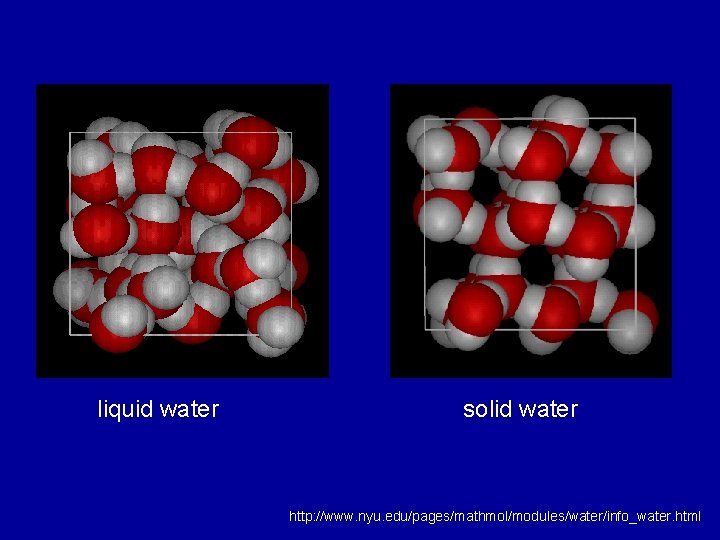
liquid water solid water http: //www. nyu. edu/pages/mathmol/modules/water/info_water. html
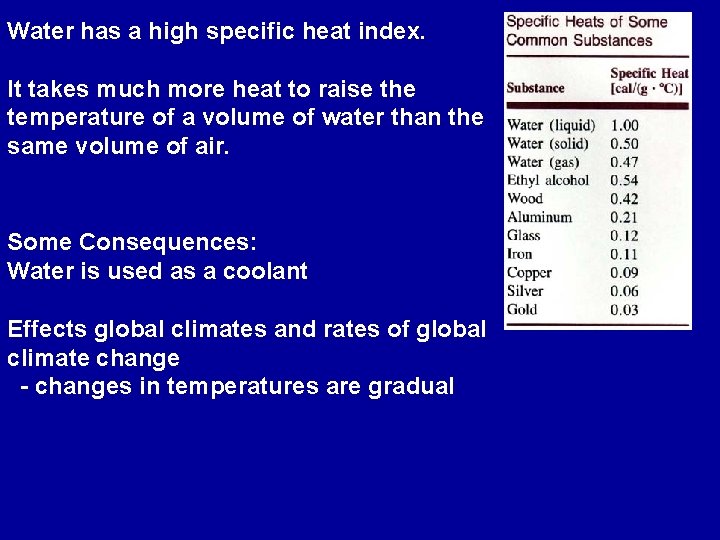
Water has a high specific heat index. It takes much more heat to raise the temperature of a volume of water than the same volume of air. Some Consequences: Water is used as a coolant Effects global climates and rates of global climate change - changes in temperatures are gradual
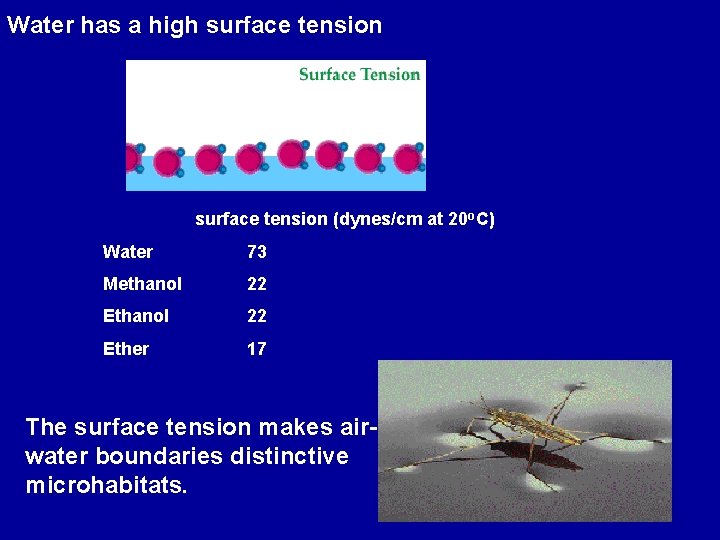
Water has a high surface tension (dynes/cm at 20 o. C) Water 73 Methanol 22 Ether 17 The surface tension makes airwater boundaries distinctive microhabitats.
“Universal” Solvent Water can dissolve ionic and polar compounds
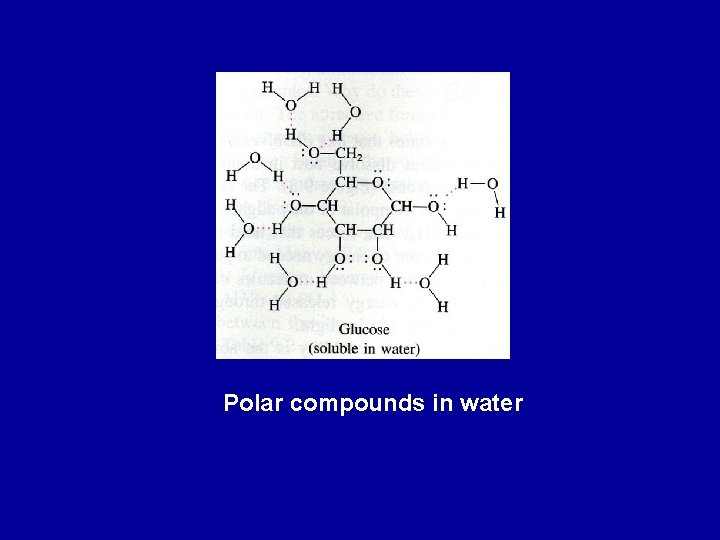
Polar compounds in water
H-bonding defines the shape of the molecule for example, the overall shape of proteins, the doublehelix in DNA. H-bonding in DNA http: //michele. usc. edu/105 b/biochemistry/dna. html http: //www. umass. edu/microbio/chime/dna/fs_pairs. htm
Liquid Crystals http: //invsee. asu. edu/nmodules/liquidmod/spatial. html
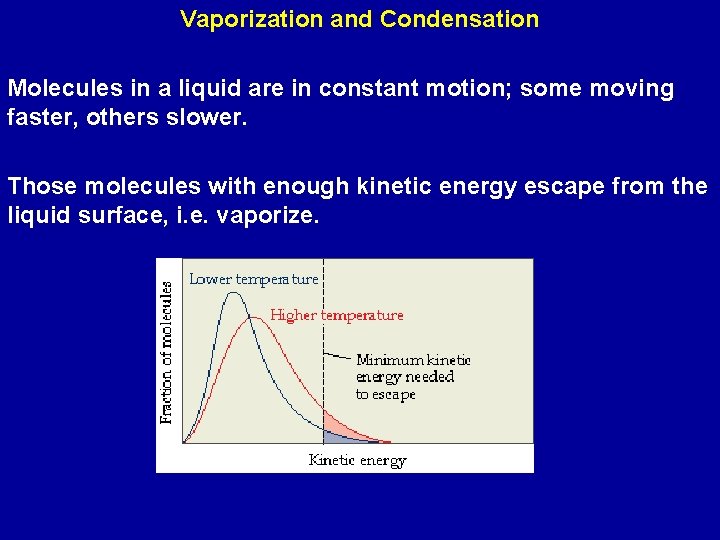
Vaporization and Condensation Molecules in a liquid are in constant motion; some moving faster, others slower. Those molecules with enough kinetic energy escape from the liquid surface, i. e. vaporize.
Molecules with higher energy are able to overcome interactions between other molecules If the container is kept open, vaporization continues until no more liquid remains; molecules escape from the liquid and heat flows in from the surroundings, replacing the energy lost to vaporization and maintaining the rate of vaporization.
Condensation: When molecules in the gas phase collide with the liquid surface, they loose energy and return to the liquid. At some point the rate of vaporization and the rate of condensation become equal and the system is at equilibrium (a dynamic equilibrium) The partial pressure of the vapor above the liquid established at equilibrium is called the equilibrium vapor pressure or the vapor pressure.
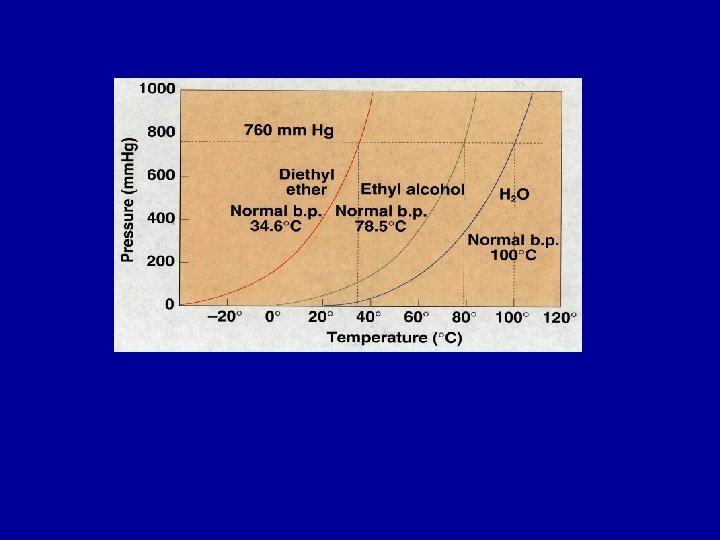
Boiling Point - the temperature at which the vapor pressure of the liquid equals the atmospheric pressure. Normal boiling point - temperature at which the vapor pressure equals 1 atm. If the external pressure is reduced, the boiling point decreases (e. g. at high altitudes). If the external pressure increases, the boiling point increases (e. g. a pressure cooker). Melting point - temperature at which a substance turns from solid to liquid. At the melting point, the solid and liquid are in equilibrium and co-exist at this temperature
Phase Transitions When a compound changes its state from a solid to a liquid or a liquid to a gas, it is said to have undergone a phase change or a phase transition. Changes in temperature and pressure cause phase transitions
Fusion or melting Vaporization Sublimation solid --> liquid --> gas solid --> gas At the melting point, boiling point or sublimation point of the substance, temperature remains the same even if the sample is heated These points correspond to phase changes, and the energy supplied is being used by the substance to undergo the phase change. Once the phase change is complete, and if heat is still applied, then the temperature increases.
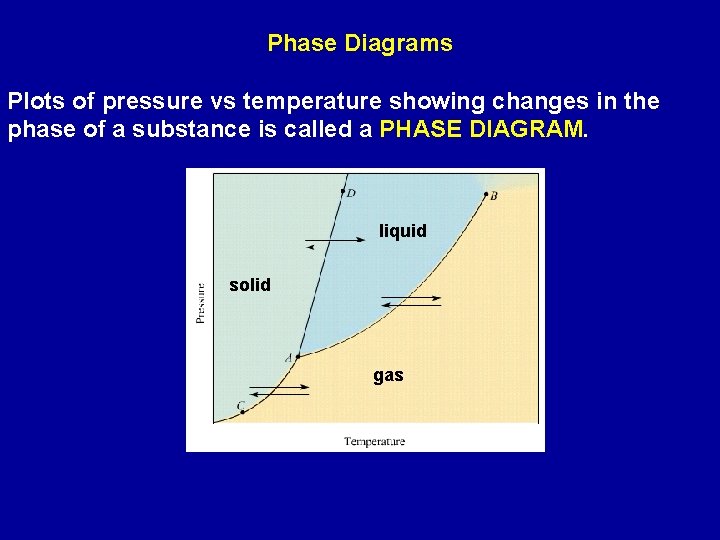
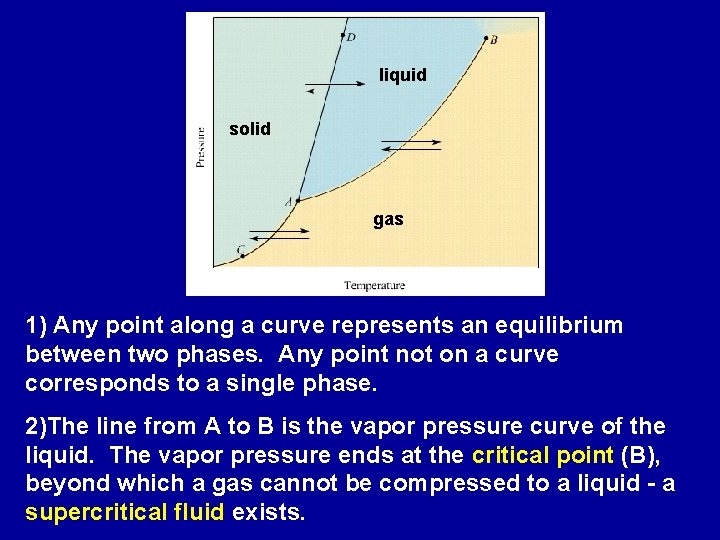
Phase Diagrams Plots of pressure vs temperature showing changes in the phase of a substance is called a PHASE DIAGRAM. liquid solid gas
liquid solid gas 1) Any point along a curve represents an equilibrium between two phases. Any point not on a curve corresponds to a single phase. 2)The line from A to B is the vapor pressure curve of the liquid. The vapor pressure ends at the critical point (B), beyond which a gas cannot be compressed to a liquid - a supercritical fluid exists.
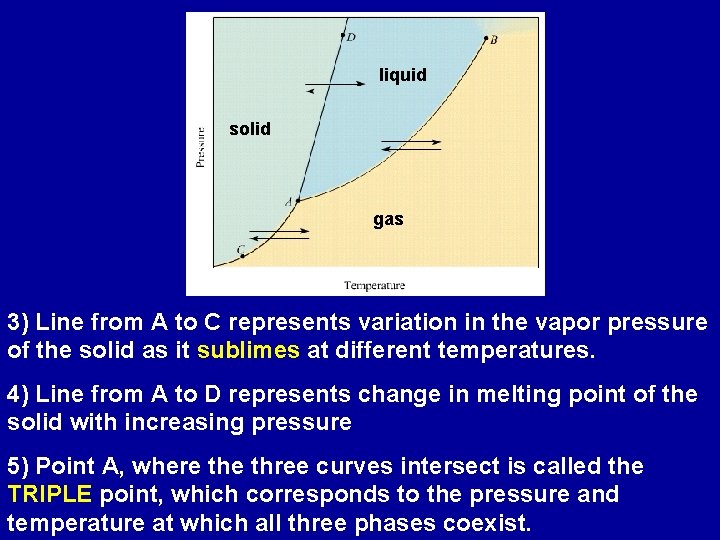
liquid solid gas 3) Line from A to C represents variation in the vapor pressure of the solid as it sublimes at different temperatures. 4) Line from A to D represents change in melting point of the solid with increasing pressure 5) Point A, where three curves intersect is called the TRIPLE point, which corresponds to the pressure and temperature at which all three phases coexist.
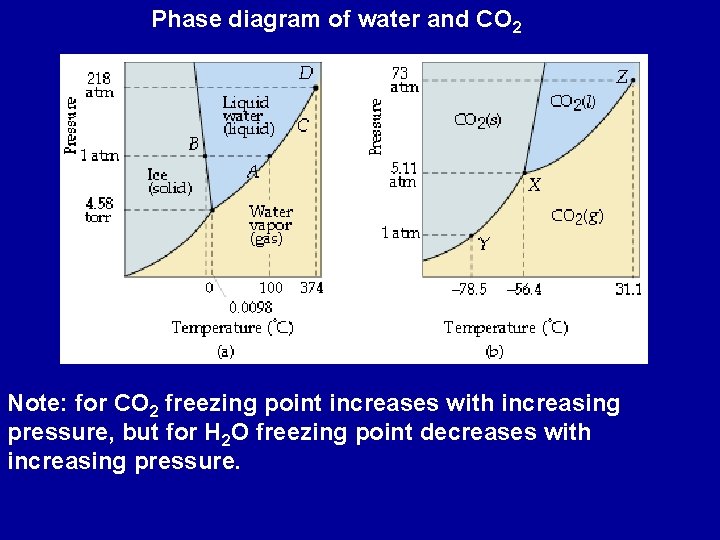
Phase diagram of water and CO 2 Note: for CO 2 freezing point increases with increasing pressure, but for H 2 O freezing point decreases with increasing pressure.