
The conclusion section is about answering the question
The conclusion section is about answering the question in the problem section and providing reasons based on our analysis
Conclusion - structure 1. 2. 3. 4. Answer your question Provide supporting statistics Discuss sampling variability Sample representativeness and context
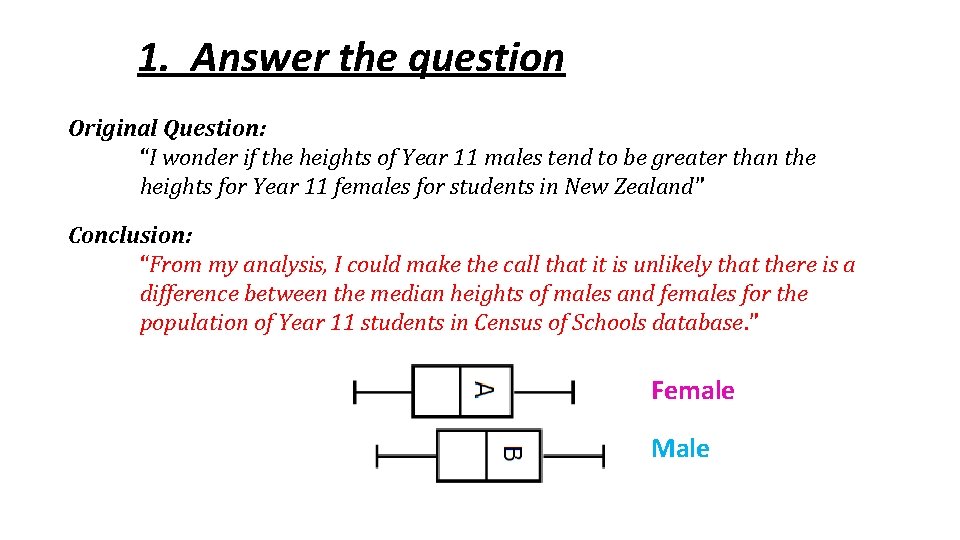
1. Answer the question Original Question: “I wonder if the heights of Year 11 males tend to be greater than the heights for Year 11 females for students in New Zealand” Conclusion: “From my analysis, I could make the call that it is unlikely that there is a difference between the median heights of males and females for the population of Year 11 students in Census of Schools database. ” Female Male
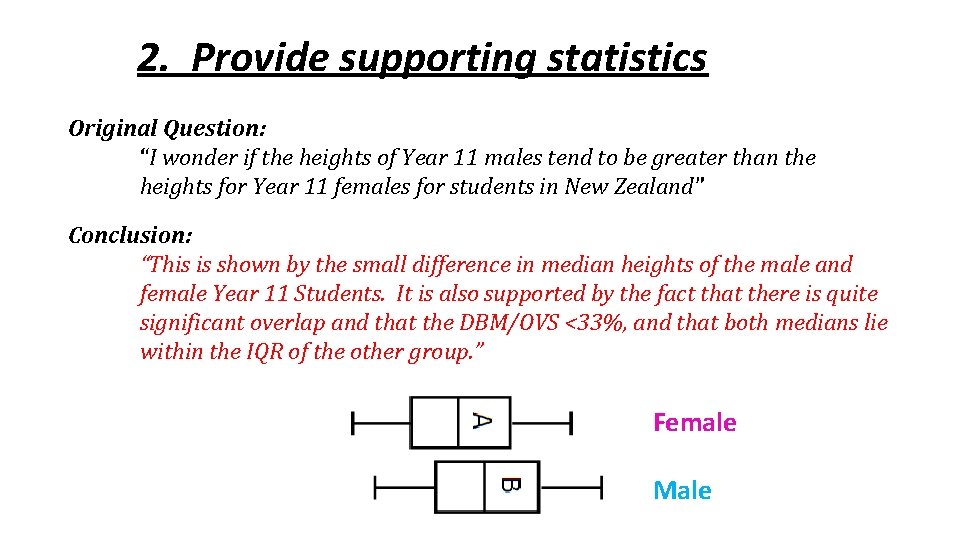
2. Provide supporting statistics Original Question: “I wonder if the heights of Year 11 males tend to be greater than the heights for Year 11 females for students in New Zealand” Conclusion: “This is shown by the small difference in median heights of the male and female Year 11 Students. It is also supported by the fact that there is quite significant overlap and that the DBM/OVS <33%, and that both medians lie within the IQR of the other group. ” Female Male
Remember, our data is just a sample We are working with a sample (not the population), and for a sample size of 30 or above, this median will vary, but not by a considerable amount. Note: - one samples results will differ to another samples results (the median will vary from sample to sample) From our sample, can we make a decision about our population? The difference in our sample must be significant enough, that we are confident that there is a difference in the population!
3. Discuss sampling variability Original Question: “I wonder if the heights of Year 11 males tend to be greater than the heights for Year 11 females for students in New Zealand” Conclusion: “If this sample was taken again in a similar manner, then it is most likely that the results would end up being similar. Although there was a greater range in heights for males, the data is unimodal, symmetrical, and clustered between 160 -175 cm. This tends to suggest that another sample would unlikely show any difference in heights. ”
4. Sample representativeness and context Original Question: “I wonder if the heights of Year 11 males tend to be greater than the heights for Year 11 females for students in New Zealand” Conclusion: “I would like to think that my sample is a fair representation of the main population of Year 11 students. My sample size of 30 students should provide me with enough confidence that it is, and I cannot think of any other reason why it wouldn’t be, and therefore I can safely assume that the results of my investigation would accurately reflect those back in the population.
Final Statement - Evaluation As a way of ending the investigation, you could mention the following • A general reflection of the investigation – were you surprised by the result? Ø Can you offer any other explanation for the results you got? • What could you do next? Ø i. e. if you looked at comparative year levels – break into male/female results Ø i. e. if you have two age groups – could you break it into more • Answer to your initial prediction – did you prove yourself right or wrong? • Think CONTEXT – the results you gained, what affect do they have
- Slides: 8