
The conceptual basis for skyhook control Ag M

The conceptual basis for skyhook control Ag M A Neptun
Content • MR-Fluid • Overview • Characteristics • Utilisations • Passive and Active suspension • Skyhook control
Overview – MR fluid • The discovery of MR fluids is credited to Jacob Rabinow in 1940’ • damper filled with magnetorheological fluid, which is controlled by a magnetic field, usually using an electromagnet. Continuously controlled by varying the power of the electromagnet
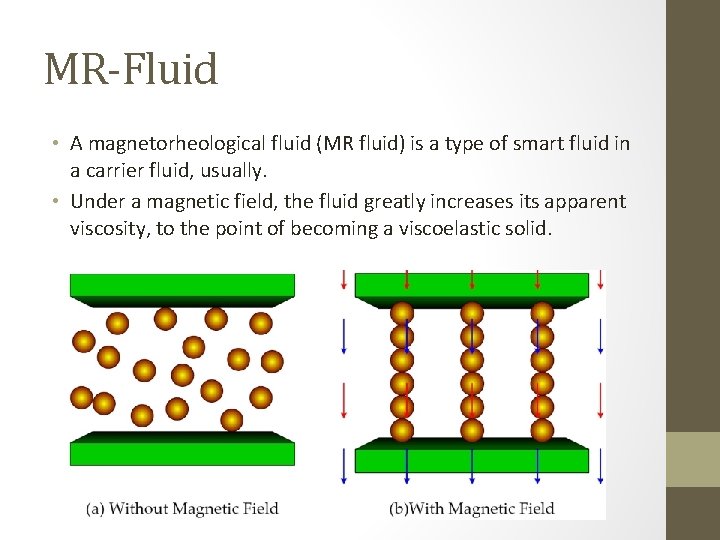
MR-Fluid • A magnetorheological fluid (MR fluid) is a type of smart fluid in a carrier fluid, usually. • Under a magnetic field, the fluid greatly increases its apparent viscosity, to the point of becoming a viscoelastic solid.
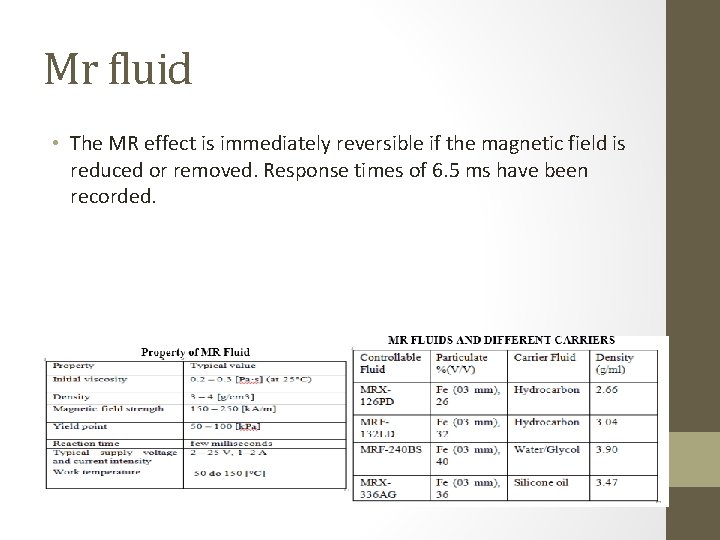
Mr fluid • The MR effect is immediately reversible if the magnetic field is reduced or removed. Response times of 6. 5 ms have been recorded.
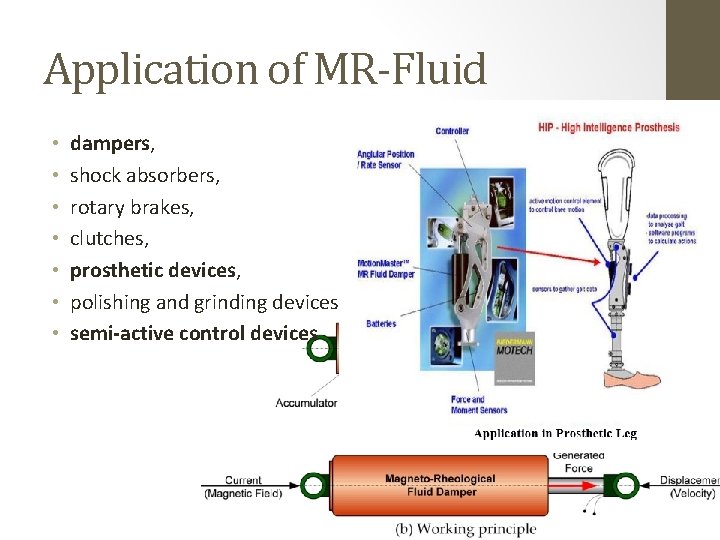
Application of MR-Fluid • • dampers, shock absorbers, rotary brakes, clutches, prosthetic devices, polishing and grinding devices semi-active control devices
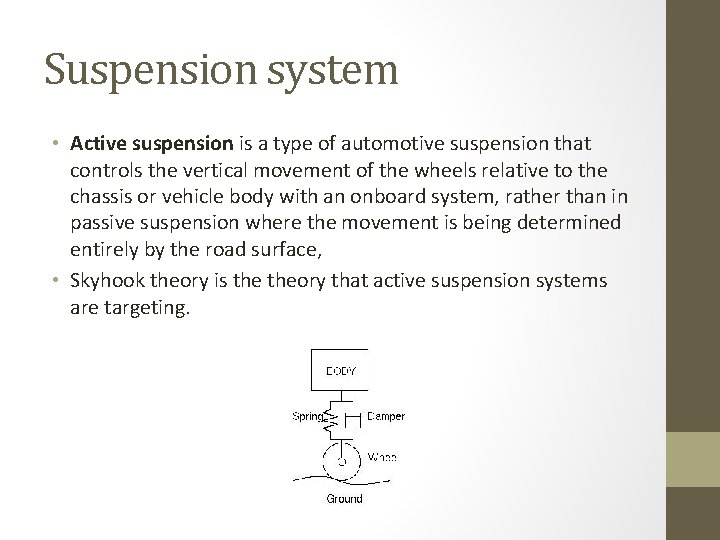
Suspension system • Active suspension is a type of automotive suspension that controls the vertical movement of the wheels relative to the chassis or vehicle body with an onboard system, rather than in passive suspension where the movement is being determined entirely by the road surface, • Skyhook theory is theory that active suspension systems are targeting.
Active vs Passive suspension • https: //www. youtube. com/watch? v=ket 6 b. Duzo. VQ
Skyhook damper • While the vehicle is in motion, the sensors supply all the information including braking and road speed signals which the ECU needs in order to produce optimum damping effort. • The ECU then controls individual damping action to each wheel separately in accordance with parameters stored in the software. • https: //www. youtube. com/watch? v=W 5 zbl. LY 4 R 3 Y
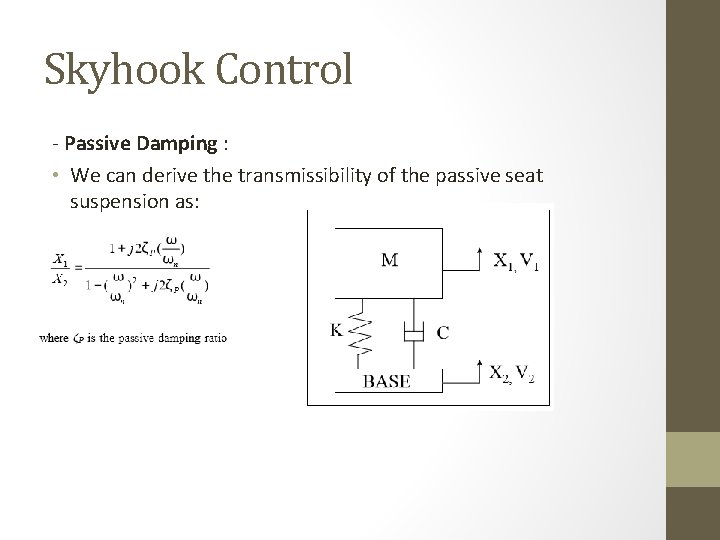
Skyhook Control - Passive Damping : • We can derive the transmissibility of the passive seat suspension as:
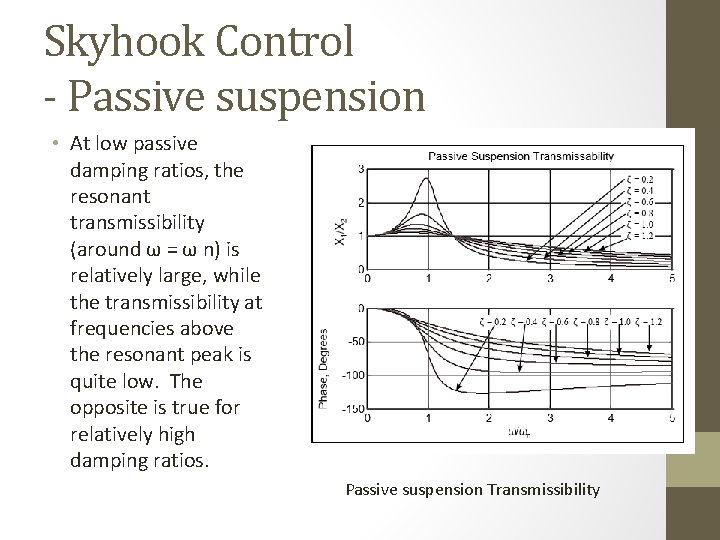
Skyhook Control - Passive suspension • At low passive damping ratios, the resonant transmissibility (around ω = ω n) is relatively large, while the transmissibility at frequencies above the resonant peak is quite low. The opposite is true for relatively high damping ratios. Passive suspension Transmissibility
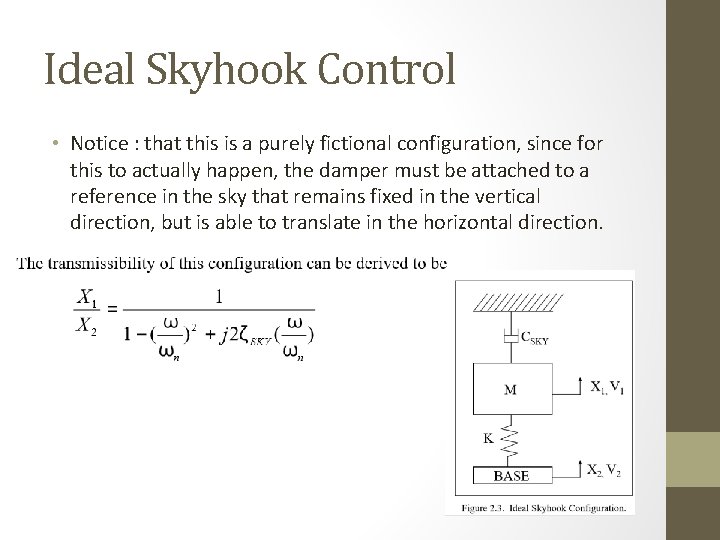
Ideal Skyhook Control • Notice : that this is a purely fictional configuration, since for this to actually happen, the damper must be attached to a reference in the sky that remains fixed in the vertical direction, but is able to translate in the horizontal direction.
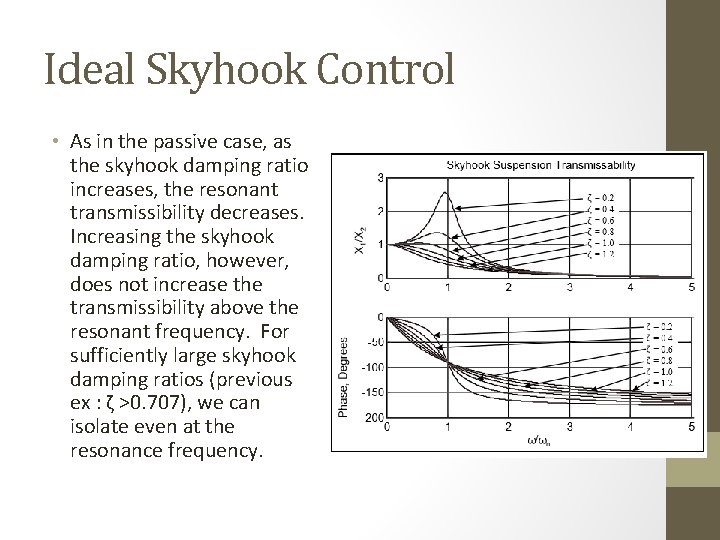
Ideal Skyhook Control • As in the passive case, as the skyhook damping ratio increases, the resonant transmissibility decreases. Increasing the skyhook damping ratio, however, does not increase the transmissibility above the resonant frequency. For sufficiently large skyhook damping ratios (previous ex : ζ >0. 707), we can isolate even at the resonance frequency.
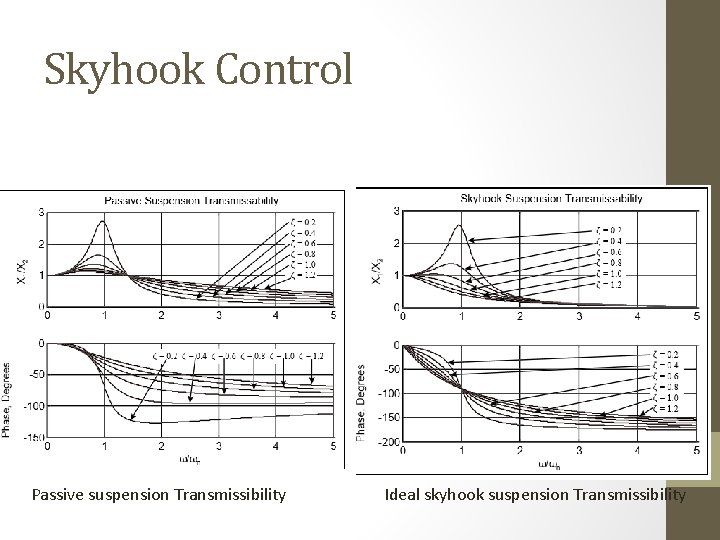
Skyhook Control Passive suspension Transmissibility Ideal skyhook suspension Transmissibility
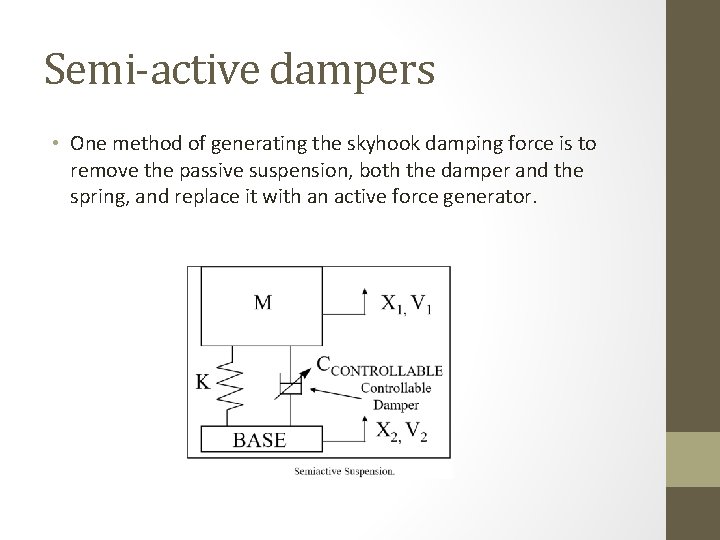
Semi-active dampers • One method of generating the skyhook damping force is to remove the passive suspension, both the damper and the spring, and replace it with an active force generator.
Conclusion • MR dampers offer an attractive solution to energy absorption in mechanical systems and structures and can be considered as “fail-safe” devices
- Slides: 16