
The Concepts of Control and Single Economic Entity


- Slides: 23
The Concepts of ‘Control’ and ‘Single Economic Entity’ Revisited: The Case of Overseas Acquisitions of Chinese State-Owned Enterprises in the European Union Alexandr SVETLICINII Assistant Professor, Faculty of Law Asian Competition Forum 13 th Annual Conference “Asian Regional Competition Issues: Corruption, Communications, Nationalism: Globalization in Reverse? ” Hong Kong, 11 December 2017
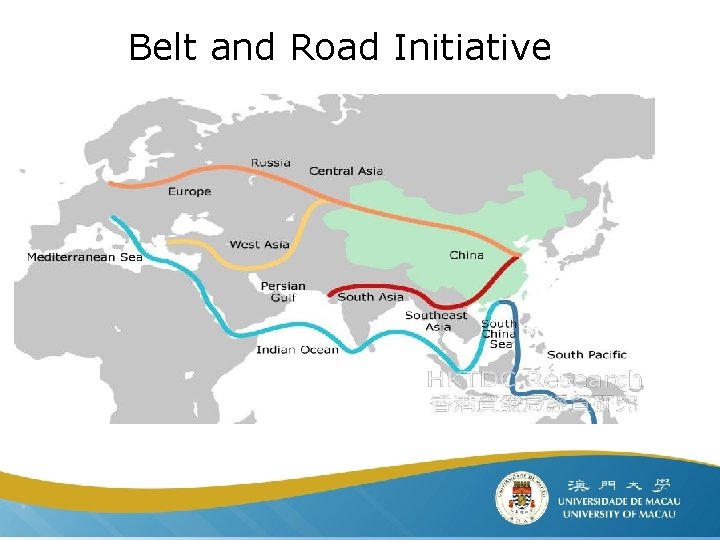
Belt and Road Initiative
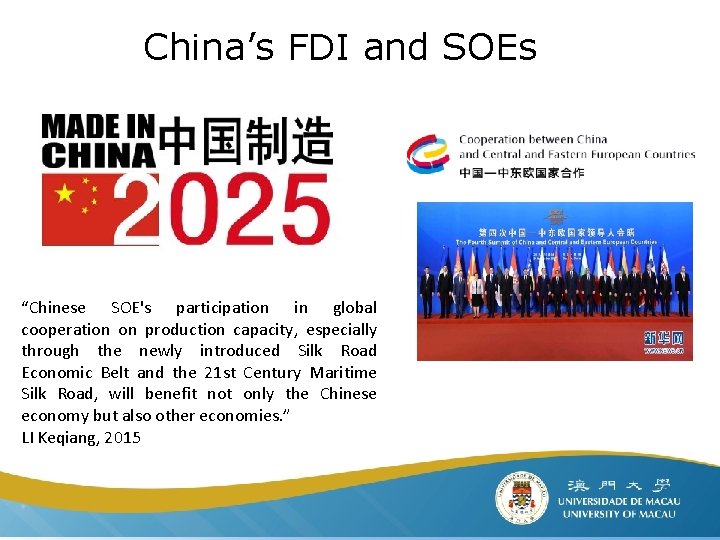
China’s FDI and SOEs “Chinese SOE's participation in global cooperation on production capacity, especially through the newly introduced Silk Road Economic Belt and the 21 st Century Maritime Silk Road, will benefit not only the Chinese economy but also other economies. ” LI Keqiang, 2015
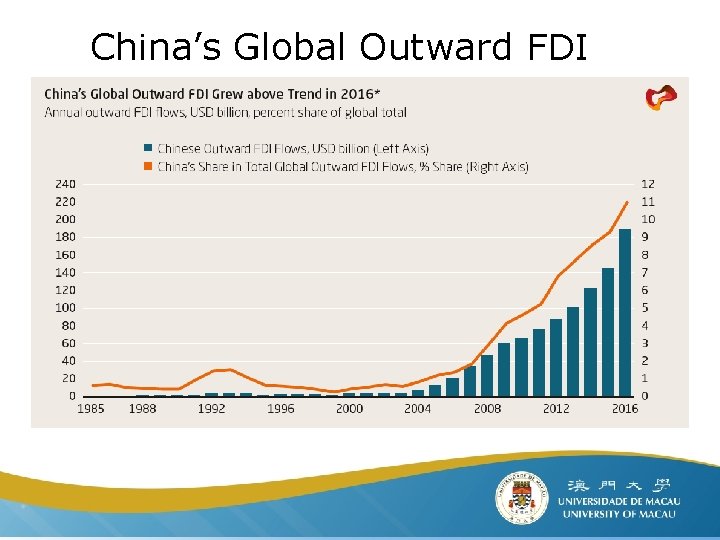
China’s Global Outward FDI
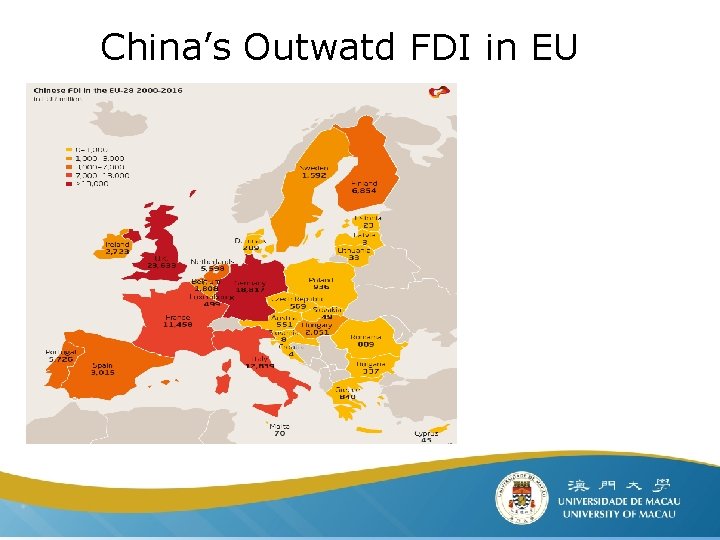
China’s Outwatd FDI in EU
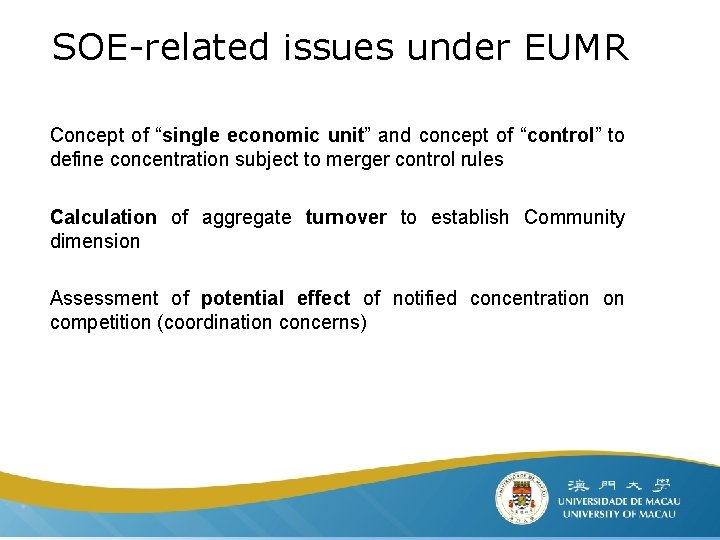
SOE-related issues under EUMR Concept of “single economic unit” and concept of “control” to define concentration subject to merger control rules Calculation of aggregate turnover to establish Community dimension Assessment of potential effect of notified concentration on competition (coordination concerns)
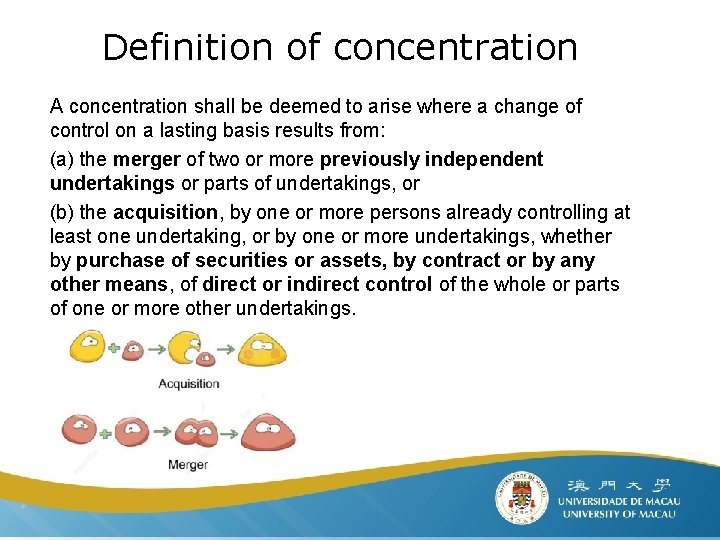
Definition of concentration A concentration shall be deemed to arise where a change of control on a lasting basis results from: (a) the merger of two or more previously independent undertakings or parts of undertakings, or (b) the acquisition, by one or more persons already controlling at least one undertaking, or by one or more undertakings, whether by purchase of securities or assets, by contract or by any other means, of direct or indirect control of the whole or parts of one or more other undertakings.
Community dimension A concentration has a Community dimension where: (a) the combined aggregate worldwide turnover of all the undertakings concerned is more than EUR 5000 million; and (b) the aggregate Community-wide turnover of each of at least two of the undertakings concerned is more than EUR 250 million, unless each of the undertakings concerned achieves more than two-thirds of its aggregate Community-wide turnover within one and the same Member State.
Calculation of turnover the aggregate turnover of an undertaking concerned within the meaning of this Regulation shall be calculated by adding together the respective turnovers of the following: (a) the undertaking concerned; (b) those undertakings in which the undertaking concerned, directly or indirectly: (i) owns more than half the capital or business assets, or (ii) has the power to exercise more than half the voting rights, or (iii) has the power to appoint more than half the members of the supervisory board, the administrative board or bodies legally representing the undertakings, or (iv) has the right to manage the undertakings' affairs;
Substantive assessment: SIEC test Concentrations within the scope of this Regulation shall be appraised in accordance with the objectives of this Regulation and the following provisions with a view to establishing whether or not they are compatible with the common market. A concentration which would significantly impede effective competition, in the common market or in a substantial part of it, in particular as a result of the creation or strengthening of a dominant position, shall be declared incompatible with the common market.
SOEs under EUMR: principle of non-discrimination Recital (22) The arrangements to be introduced for the control of concentrations should respect the principle of nondiscrimination between the public and the private sectors. In the public sector, calculation of the turnover of an undertaking concerned in a concentration needs, therefore, to take account of undertakings making up an economic unit with an independent power of decision, irrespective of the way in which their capital is held or of the rules of administrative supervision applicable to them.
Merger of SOEs, a concentration? (52) An exceptional situation exists where both the acquiring and acquired undertakings are companies owned by the same State (or by the same public body or municipality). In this case, whether the operation is to be regarded as an internal restructuring depends in turn on the question whether both undertakings were formerly part of the same economic unit. Where the undertakings were formerly part of different economic units having an independent power of decision, the operation will be deemed to constitute a concentration and not an internal restructuring. However, where the different economic units will continue to have an independent power of decision also after the operation, the operation is only to be regarded as an internal restructuring, even if the shares of the undertakings, constituting different economic units, should be held by a single entity, such as a pure holding company.
Merger of SOEs, a concentration? (53) However, the prerogatives exercised by a State acting as a public authority rather than as a shareholder, in so far as they are limited to the protection of the public interest, do not constitute control within the meaning of the Merger Regulation to the extent that they have neither the aim nor the effect of enabling the State to exercise a decisive influence over the activity of the undertaking. (153) As described above, a merger or an acquisition of control arising between two undertakings owned by the same State (or the same public body) may constitute a concentration if the undertakings were formerly part of different economic units having an independent power of decision. If this is the case, both of them will qualify as undertakings concerned although both are owned by the same State.
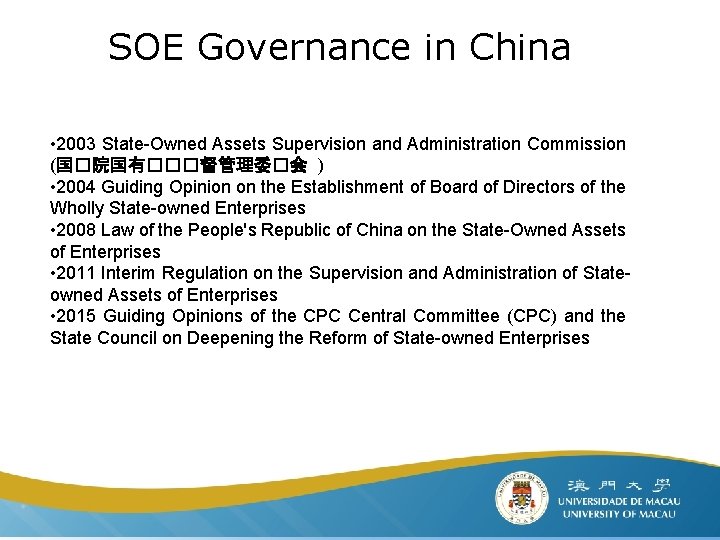
SOE Governance in China • 2003 State-Owned Assets Supervision and Administration Commission (国�院国有���督管理委�会 ) • 2004 Guiding Opinion on the Establishment of Board of Directors of the Wholly State-owned Enterprises • 2008 Law of the People's Republic of China on the State-Owned Assets of Enterprises • 2011 Interim Regulation on the Supervision and Administration of Stateowned Assets of Enterprises • 2015 Guiding Opinions of the CPC Central Committee (CPC) and the State Council on Deepening the Reform of State-owned Enterprises
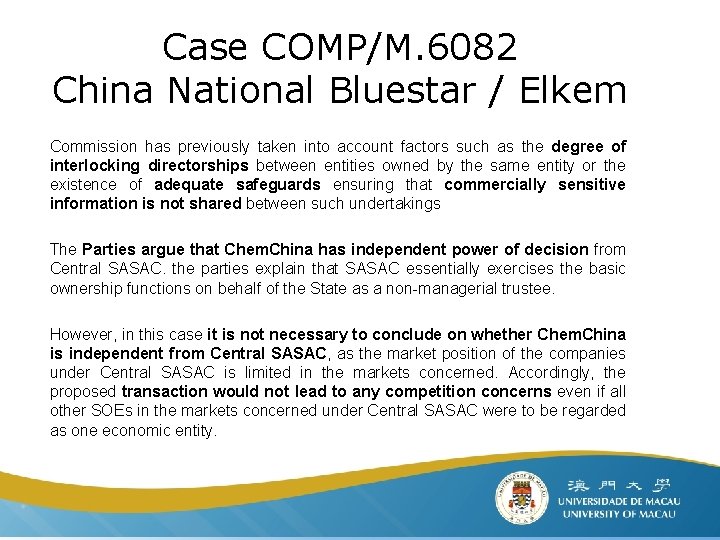
Case COMP/M. 6082 China National Bluestar / Elkem Commission has previously taken into account factors such as the degree of interlocking directorships between entities owned by the same entity or the existence of adequate safeguards ensuring that commercially sensitive information is not shared between such undertakings The Parties argue that Chem. China has independent power of decision from Central SASAC. the parties explain that SASAC essentially exercises the basic ownership functions on behalf of the State as a non-managerial trustee. However, in this case it is not necessary to conclude on whether Chem. China is independent from Central SASAC, as the market position of the companies under Central SASAC is limited in the markets concerned. Accordingly, the proposed transaction would not lead to any competition concerns even if all other SOEs in the markets concerned under Central SASAC were to be regarded as one economic entity.
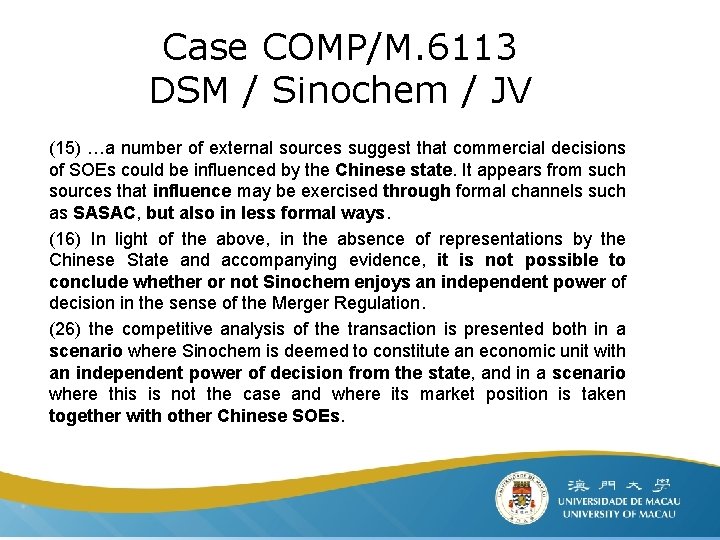
Case COMP/M. 6113 DSM / Sinochem / JV (15) …a number of external sources suggest that commercial decisions of SOEs could be influenced by the Chinese state. It appears from such sources that influence may be exercised through formal channels such as SASAC, but also in less formal ways. (16) In light of the above, in the absence of representations by the Chinese State and accompanying evidence, it is not possible to conclude whether or not Sinochem enjoys an independent power of decision in the sense of the Merger Regulation. (26) the competitive analysis of the transaction is presented both in a scenario where Sinochem is deemed to constitute an economic unit with an independent power of decision from the state, and in a scenario where this is not the case and where its market position is taken together with other Chinese SOEs.
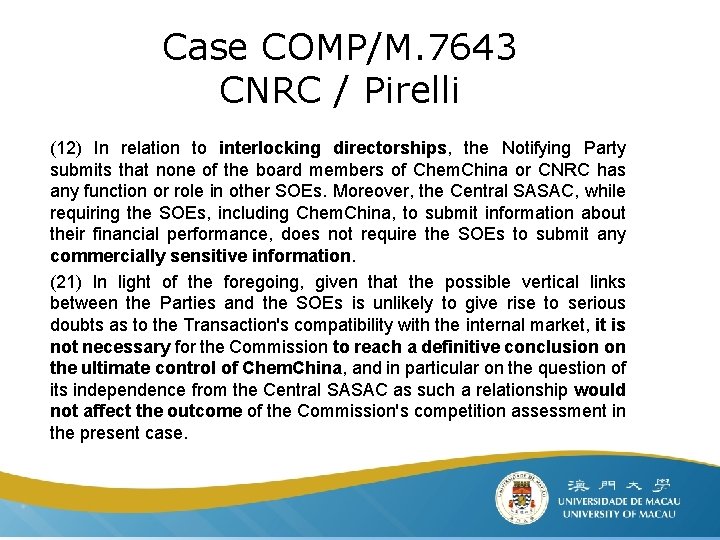
Case COMP/M. 7643 CNRC / Pirelli (12) In relation to interlocking directorships, the Notifying Party submits that none of the board members of Chem. China or CNRC has any function or role in other SOEs. Moreover, the Central SASAC, while requiring the SOEs, including Chem. China, to submit information about their financial performance, does not require the SOEs to submit any commercially sensitive information. (21) In light of the foregoing, given that the possible vertical links between the Parties and the SOEs is unlikely to give rise to serious doubts as to the Transaction's compatibility with the internal market, it is not necessary for the Commission to reach a definitive conclusion on the ultimate control of Chem. China, and in particular on the question of its independence from the Central SASAC as such a relationship would not affect the outcome of the Commission's competition assessment in the present case.
Case COMP/M. 7850 EDF / CGN / NNB (37) There are however a number of provisions in the PRC law on SOEs and the Interim Measures for the Supervision and Administration of the Investments by Central Enterprises released in May 2003 which support the fact that Central SASAC has influence on CGN's major decision making and therefore CGN does not enjoy autonomy from the State in deciding major matters like strategy, business plan or budget. (42) The absence of cross-directorships with other SOEs and the existence of confidentiality provisions do not preclude Central SASAC from influencing CGN's commercial strategy in light of the different powers mentioned above. (44) A number of other elements show that the Chinese State via Central SASAC has the power to influence coordination between companies active in the energy industry and in the nuclear industry in particular. (49) the Commission concludes in the case at hand that CGN and other Chinese SOEs in that industry should not be deemed to have an independent power of decision from Central SASAC. The turnover of all companies controlled by Central SASAC that are active in the energy industry should therefore be aggregated.
Case COMP/M. 7962 Chem. China/Syngenta (1) SASAC is required to respect the principles of separation between government and enterprise and non-intervention in the legitimate and independent business operations of SOEs; (2) SASAC’s rights are restricted by law and “do not go beyond typical minority shareholders protection rights”; (3) Chem. China has the independent authority to decide its budget, business plan and commercial strategies; (4) there are no interlocking competition between directorships in Chem. China and other SOEs and Chinese competition law prohibits the exchange of competitively sensitive information
Steps forward EU Commission, Proposal for a Regulation establishing a framework for screening of foreign direct investments into the European Union Article 9 Where the Commission considers that a foreign direct investment is likely to affect projects or programmes of Union interest on grounds of security or public order, the Commission may issue an opinion addressed to the Member State where the foreign direct investment is planned or has been completed. The Member States where the foreign direct investment is planned or has been completed shall take utmost account of the Commission's opinion and provide an explanation to the Commission in case its opinion is not followed.
Steps forward EU Commission, Proposal for a Regulation establishing a framework for screening of foreign direct investments into the European Union Article 4 In screening a foreign direct investment on the grounds of security or public order, Member States and the Commission may consider the potential effects on, inter alia: – critical infrastructure, including energy, transport, communications, data storage, space or financial infrastructure, as well as sensitive facilities; – critical technologies, including artificial intelligence, robotics, semiconductors, technologies with potential dual use applications, cybersecurity, space or nuclear technology; – the security of supply of critical inputs; or – access to sensitive information or the ability to control sensitive information
Conclusions Concepts to revisit: “concentration”, “control”, “single economic unit”, “decisive influence” (1) determination whether the notified transaction constitutes a concentration (of previously independent undertakings) or an internal reorganization; (2) calculation of the turnover for the purpose of ascertaining the existence of “Community dimension”; (3) substantive assessment of the notified concentration on compatibility with the internal market
Thank You! Your feedback is welcome! Faculty of Law, University of Macau, E 32 Avenida da Universidade, Taipa, Macao SAR, (China) Tel : (853) 8822 4072 Fax : (853) 8822 4776 Email : Alexandr. S@umac. mo Website : www. umac. mo/fll