
THE CONCEPT OF TRINITY John 17 1 3
- Slides: 14
THE CONCEPT OF TRINITY John 17: 1 -3
THESIS 1. THERE ARE MULTIPLE PERSONS IN THE GODHEAD 2. JESUS AND THE HOLY SPIRIT ARE PERSONS IN THE GODHEAD 3. DISTINCTIONS IN THE GOD.
ØThe word “God” is not the name of a personality but it is the name of a nature. Galatians 4: 8 ØThe word “Trinity” is not found in the pages of the Bible. ØThe first time the word “Trinity” was used was by Theophilus of Antioch around 181 AD
ØThe word “Godhead” occurs 3 times in the Bible Acts 17: 29; Romans 1: 20; Colossians 2: 9
VIEWS OF GOD ØModalism- “God is a single person who manifest himself throughout human history in three modes” Ø Sabellianism- “The father, son and the Holy Spirit are three names of the one personal God who manifest Himself” (Ibid, 69 -70) Ø Arianism- “the son and the Holy Spirit had a beginning, but God the father is without beginning. ” (Ibid, 107)
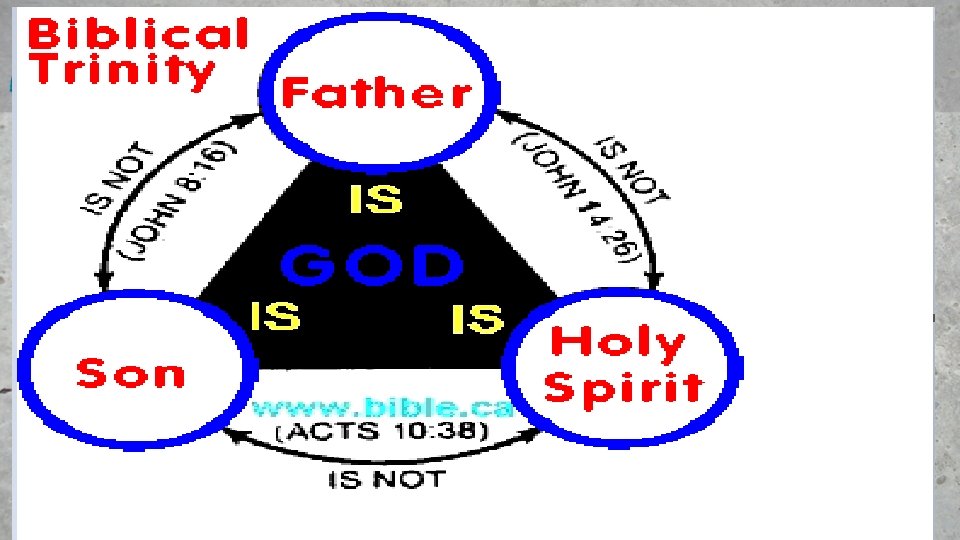
VIEWS OF GOD ØNicene Trinitarianism- Denied Subordination of the persons in the God ; Affirmed eternal sonship of Jesus Christ. ØBiblical Trinity- there is one only and true God, but in the unity of the Godhead there are three coeternal and coequal Persons, the same in substance but distinct in subsistence
“When we say that there are three persons in the Godhead, we mean to deny Unitarianism is the belief that God is one essence or being without distinction in the mode of His being; that He is a monad in every sense-a unit and not a unity. Again, when we affirm that there are three persons in the Godhead we mean to deny Sabellianism is the doctrine that Father, Son and Spirit are names not of three persons, but of three relations or functions of one and the same person. We are not tritheists, as the Unitarians affirm and the Sabellians fear. We are monontheists. We are as monotheistic as the Unitarians or the Sabellians. We believe in one God, but in a God whose mode of being is such that He can say with reference to Himself, “I”, “Thou”, “He”. The Father can say, “I will send Him, the Spirit, through Thee, the
PLURALITY IN GODHEAD Ø Genesis 1: 1 - “elohyim”(God) and with a singular verb “bara”(created) ØGenesis 1: 26, 27 The usage of plural pronouns, Our and Us suggesting plurality Ø Genesis 3: 22 ; Genesis 11: 7
Ø Deut. 6: 4, 5 The word which translates “one” is from the Hebrew word “echad” - Genesis 2: 24
DEITY OF CHRIST Ø John 5: 17, 18 ØJohn 8: 24 ; The word “He” is not in the text- it is a translators addition. Ø John 1: 1 -2, 14 The word ‘was’ in this passage is in the imperfect tense and describes a continuous timeless existence
Ø Philippians 2: 5 -7 Being -this word is a present active participle JESUS DID NOT GIVE UP DIVINITY BUT RANK ØHebrews 1: 1 -3 The word is ‘charakter’ means a stamp or sculptured figure. Ø Hebrews 1: 6 -8
• Titus 2: 13 ; 2 Peter 1: 1; John 20: 28; Romans 9: 5; • Isaiah 6: 1 -3 ; Isaiah 44: 6 ; Micah 5: 2 ; Isaiah 9: 6, 7
DISTINCTION IN THE GODHEAD
Matthew 3: 16 -17; Matthew 12: 31 -32 ; Matthew 28: 20; John 1: 1 -2; John 8: 16; John 14: 26 ; Acts 10: 38 ; 2 Corinthians 13: 14