
THE CONCEPT OF MONOPOLY DEFINITION CHARACTERISTICS A monopoly
- Slides: 6
THE CONCEPT OF MONOPOLY
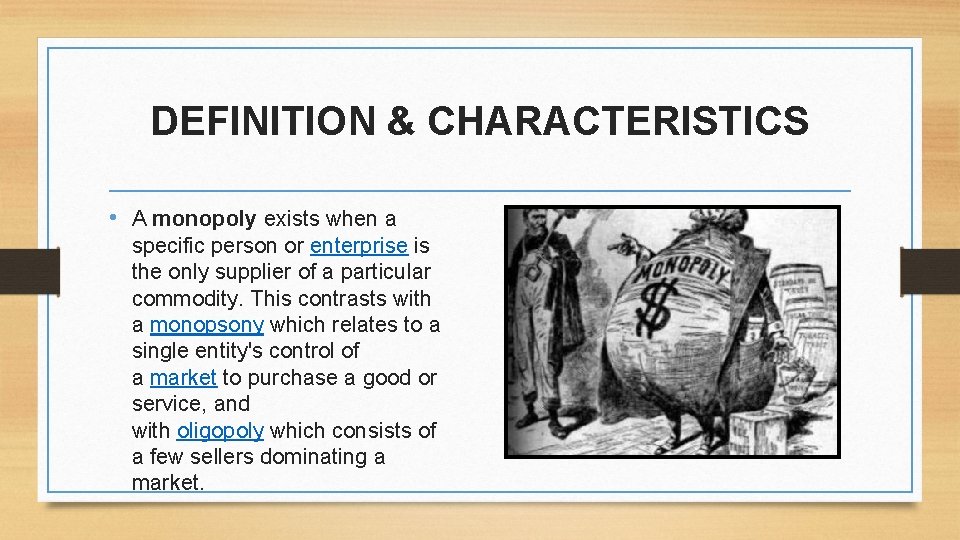
DEFINITION & CHARACTERISTICS • A monopoly exists when a specific person or enterprise is the only supplier of a particular commodity. This contrasts with a monopsony which relates to a single entity's control of a market to purchase a good or service, and with oligopoly which consists of a few sellers dominating a market.
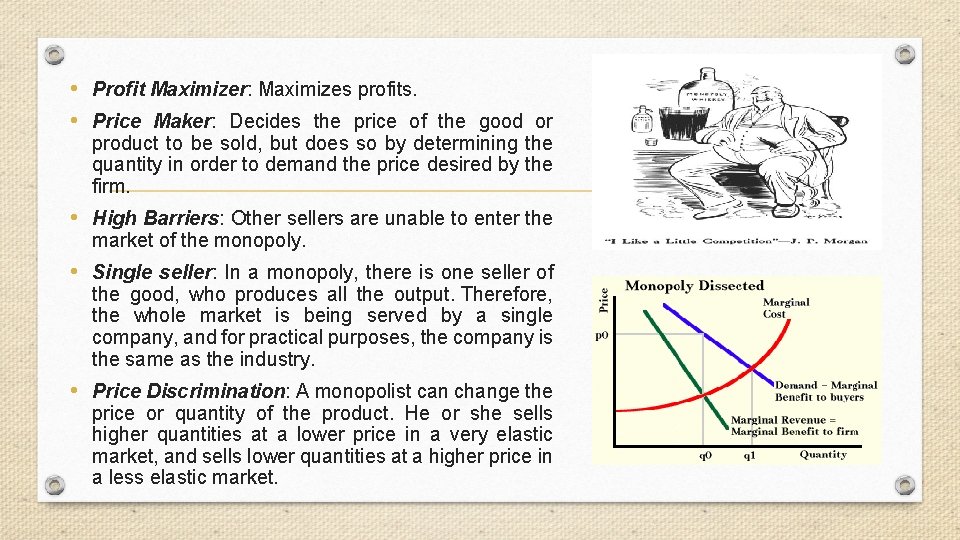
• Profit Maximizer: Maximizes profits. • Price Maker: Decides the price of the good or product to be sold, but does so by determining the quantity in order to demand the price desired by the firm. • High Barriers: Other sellers are unable to enter the market of the monopoly. • Single seller: In a monopoly, there is one seller of the good, who produces all the output. Therefore, the whole market is being served by a single company, and for practical purposes, the company is the same as the industry. • Price Discrimination: A monopolist can change the price or quantity of the product. He or she sells higher quantities at a lower price in a very elastic market, and sells lower quantities at a higher price in a less elastic market.
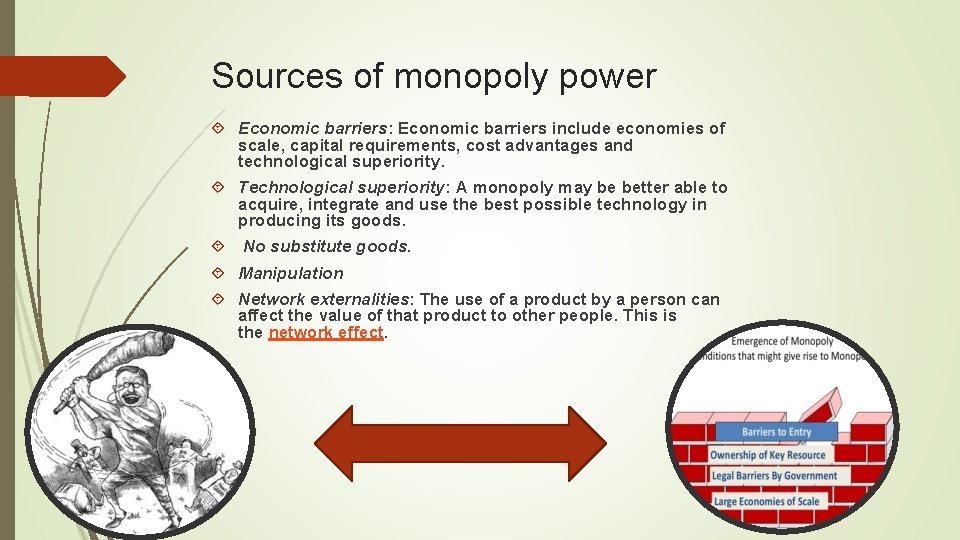
Sources of monopoly power Economic barriers: Economic barriers include economies of scale, capital requirements, cost advantages and technological superiority. Technological superiority: A monopoly may be better able to acquire, integrate and use the best possible technology in producing its goods. No substitute goods. Manipulation Network externalities: The use of a product by a person can affect the value of that product to other people. This is the network effect.
MONOPOLY VS COMPETITIVE MARKETS v There are distinctions, some of the more important of which are as follows: v Marginal revenue and price: In a perfectly competitive market, price equals marginal cost. In a monopolistic market, however, price is set above marginal cost. v Product differentiation v Number of competitors: PC markets are populated by an infinite number of buyers and sellers. Monopoly involves a single seller. v Barriers to Entry v Elasticity of Demand
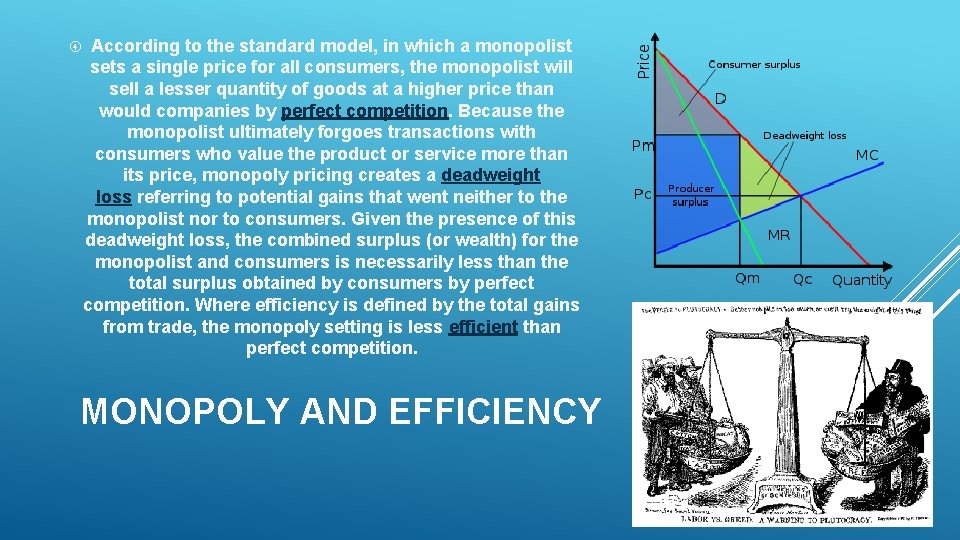
According to the standard model, in which a monopolist sets a single price for all consumers, the monopolist will sell a lesser quantity of goods at a higher price than would companies by perfect competition. Because the monopolist ultimately forgoes transactions with consumers who value the product or service more than its price, monopoly pricing creates a deadweight loss referring to potential gains that went neither to the monopolist nor to consumers. Given the presence of this deadweight loss, the combined surplus (or wealth) for the monopolist and consumers is necessarily less than the total surplus obtained by consumers by perfect competition. Where efficiency is defined by the total gains from trade, the monopoly setting is less efficient than perfect competition. MONOPOLY AND EFFICIENCY