
The Concept of Fraternity in the French Law




- Slides: 16
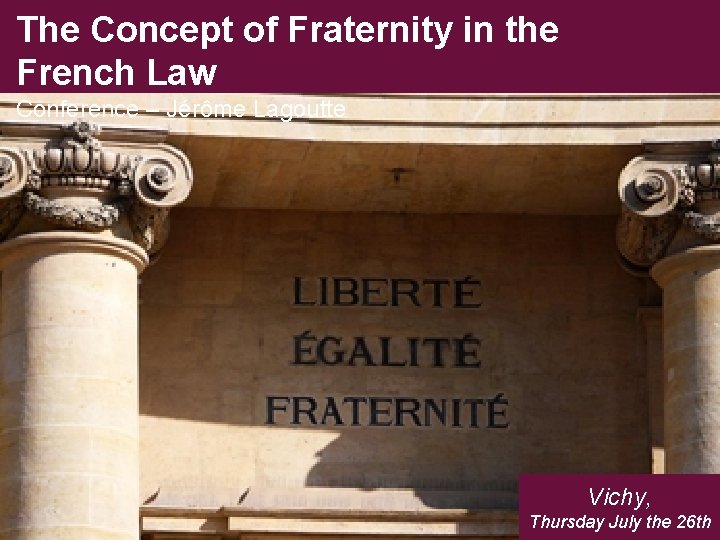
The Concept of Fraternity in the French Law Conference – Jérôme Lagoutte Vichy, Thursday July the 26 th 1
The concept of « fraternity » in the French law system Executive Summary 1 A brief history of fraternity in France and its consequences on the law 2 The concept of fraternity in the written law 3 A concept extended and strengthened by the French jurisprudence 2
The concept of « fraternity » in the French law system Executive Summary 1 A brief history of fraternity in France and its consequences on the law 3
The concept of « fraternity » in the French law system A concept deeply rooted in the France’s republican history • Welcome to France ! As many of you have probably seen, 3 words are widely visible in the public space : « Liberté, Egalité, Fraternité » , « Liberty, Equality, Fraternity » . • Those 3 words compose the motto of the French Republic, as you can see below on its logo : Official logo of the French Republic Okay, this concept of Fraternity seems quite important for French people and the public institutions… but why ? Let’s take a look on French history ! The republican motto written on the wall of schools, city halls, tribunals 4
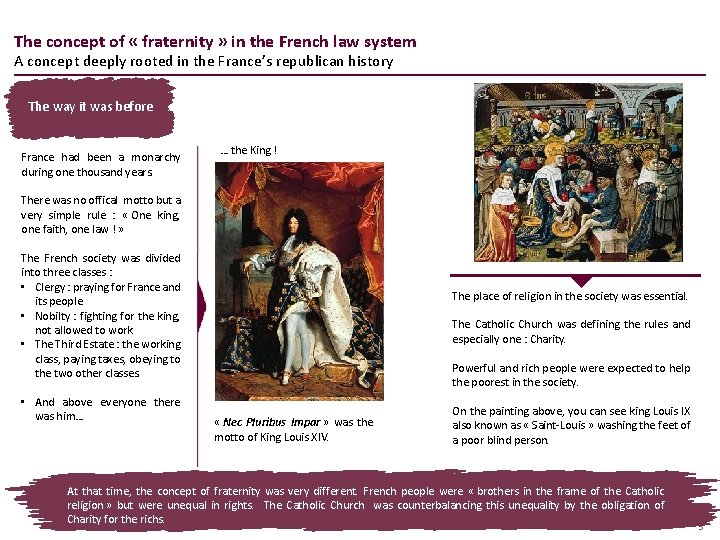
The concept of « fraternity » in the French law system A concept deeply rooted in the France’s republican history The way it was before France had been a monarchy during one thousand years. … the King ! There was no offical motto but a very simple rule : « One king, one faith, one law ! » The French society was divided into three classes : • Clergy : praying for France and its people • Nobilty : fighting for the king, not allowed to work • The Third Estate : the working class, paying taxes, obeying to the two other classes. • And above everyone there was him… The place of religion in the society was essential. The Catholic Church was defining the rules and especially one : Charity. Powerful and rich people were expected to help the poorest in the society. « Nec Pluribus Impar » was the motto of King Louis XIV. On the painting above, you can see king Louis IX also known as « Saint-Louis » washing the feet of a poor blind person. At that time, the concept of fraternity was very different. French people were « brothers in the frame of the Catholic religion » but were unequal in rights. The Catholic Church was counterbalancing this unequality by the obligation of Charity for the richs. 5
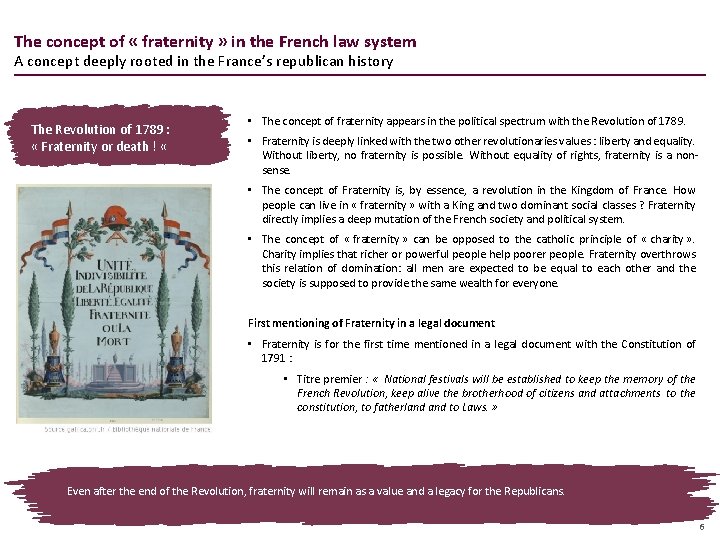
The concept of « fraternity » in the French law system A concept deeply rooted in the France’s republican history The Revolution of 1789 : « Fraternity or death ! « • The concept of fraternity appears in the political spectrum with the Revolution of 1789. • Fraternity is deeply linked with the two other revolutionaries values : liberty and equality. Without liberty, no fraternity is possible. Without equality of rights, fraternity is a nonsense. • The concept of Fraternity is, by essence, a revolution in the Kingdom of France. How people can live in « fraternity » with a King and two dominant social classes ? Fraternity directly implies a deep mutation of the French society and political system. • The concept of « fraternity » can be opposed to the catholic principle of « charity » . Charity implies that richer or powerful people help poorer people. Fraternity overthrows this relation of domination: all men are expected to be equal to each other and the society is supposed to provide the same wealth for everyone. First mentioning of Fraternity in a legal document • Fraternity is for the first time mentioned in a legal document with the Constitution of 1791 : • Titre premier : « National festivals will be established to keep the memory of the French Revolution, keep alive the brotherhood of citizens and attachments to the constitution, to fatherland to Laws. » Even after the end of the Revolution, fraternity will remain as a value and a legacy for the Republicans. 6
The concept of « fraternity » in the French law system A concept deeply rooted in the France’s republican history A concept used by every republican regime • The French Revolution of 1848 establishes the 2 nd Republic. • The purpose of this revolution is more social than political. Protesters issued from a new working class emerged with the industrial revolution are fighting for a better situation. • As a consequence, the 2 nd Republic revived the concept of fraternity. The Constitution of the new regime states that «the motto of the French Republic is liberty, equality, fraternity » . It is the first time that this motto is mentioned in a French constitution. Abolition of slavery in 1848 A decree precises that « Fraternity is the reign of love » and sates : « The abolition of all privileges , the sharing of income taxes, a proportional and progressive right on inheritance, . . . equal military service for all, equal Education for all, an ensured work for all. » . • As an immediate consequence, the Republic decides several measures in the name of fraternity : • The Abolition of Slavery (Law of 27 April 1848) • The establishment of the direct universal suffrage 7
The concept of « fraternity » in the French law system A concept deeply rooted in the France’s republican history A concept used by every republican regime • When the 2 nd French Empire collapses in 1870, France definitely renounces to the Monarchy. From this year, and except the period of the Vichy Regime during the German occupation in World War II, the country has remained a Republic and all its constitutions mention Fraternity as a value, a legal principle and of course the word of the republican motto. • After World War II, the Constitution of 1946 mentions in its preamble a large scale of economic rights directly linked to the concept of fraternity : • A woman must have the same political and social rights as a man. • Every citizen has the right to work and to have a decent work. • Every citizen has a free access to the Social Security System. • Every one has the right to get rest, especially children, mothers and older workers. • This preamble is still active in the French law as a part of Constitutional Rules. Constitution of 1958 • After the instauration of a new Republic in 1958 under General de Gaulle’s presidency, the Constitution of 1958 currently used in France states in its 2 nd article « the motto of the Republic is Liberty, Equality, Fraternity » • Its preamble devotes, among principles necessary to our Time, dispositions, which from a material point of view can be analyzed as judicial applications or translations of the principle of brotherhood, equality of woman, right to asylum, right to work, freedom of union, right to the development of a person or a family, right to social protection, to rest, right to retire, right to get an education. 8
The concept of « fraternity » in the French law system Executive Summary 2 The concept of fraternity in the written law 9
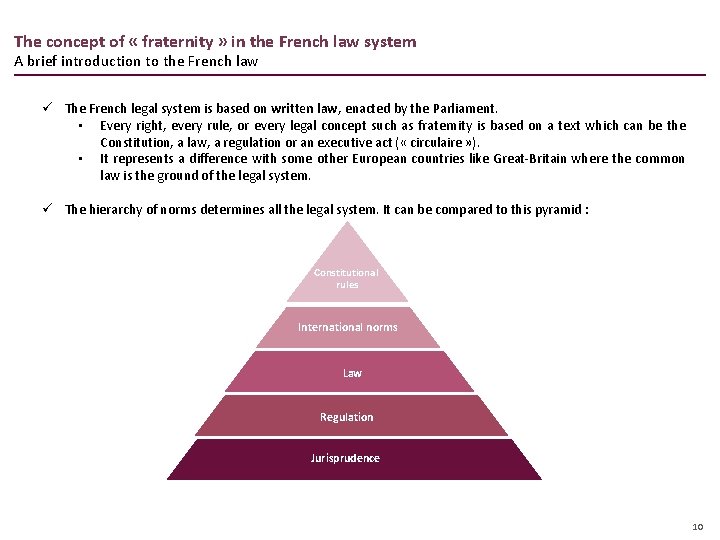
The concept of « fraternity » in the French law system A brief introduction to the French law ü The French legal system is based on written law, enacted by the Parliament. • Every right, every rule, or every legal concept such as fraternity is based on a text which can be the Constitution, a law, a regulation or an executive act ( « circulaire » ). • It represents a difference with some other European countries like Great-Britain where the common law is the ground of the legal system. ü The hierarchy of norms determines all the legal system. It can be compared to this pyramid : Constitutional rules International norms Law Regulation Jurisprudence 10
The concept of « fraternity » in the French law system Fraternity in the hierarchy of norms Fraternity is at the top of the hierarchy of norms Constitutional rules International norms Law Regulation Jurisprudence Fraternity is mentioned both in The Constitution and in the Preamble of 1946, which means that this concept is a the top of the legal system. An International norm cannot infringe the concept of fraternity. For instance, France refuses to transcript in its legal system the Charter for Regional or Minority Languages of the Council of Europe which is expected to break the fraternity among the French people by creating minorities. Creates rights in the name of fraternity. Ensures that fraternity is respected and applied. Defines what is fraternity, creates rights in the name of fraternity, condemns any attempt against fraternity. 11
The concept of « fraternity » in the French law system Fraternity : a broad concept in the hands of French law makers • Fraternity is at the top of the hierarchy of norms. As a consequence, the French law makers can use this concept to justify and implement a large scale of policies : • The Act of 9 and 14 October 1945 creates the Social Security system in France. • The Finance Law of 1989 creates the Wealth Tax Liability : above a certain level of income, citizens must pay a tax to the benefits of social policies. • The Law of 1 December 1988 establishes the Minimum Income Benefit (RMI). Fraternity is a legal source for social policies. 12
The concept of « fraternity » in the French law system 3 A concept extended and strengthened by the French jurisprudence 13
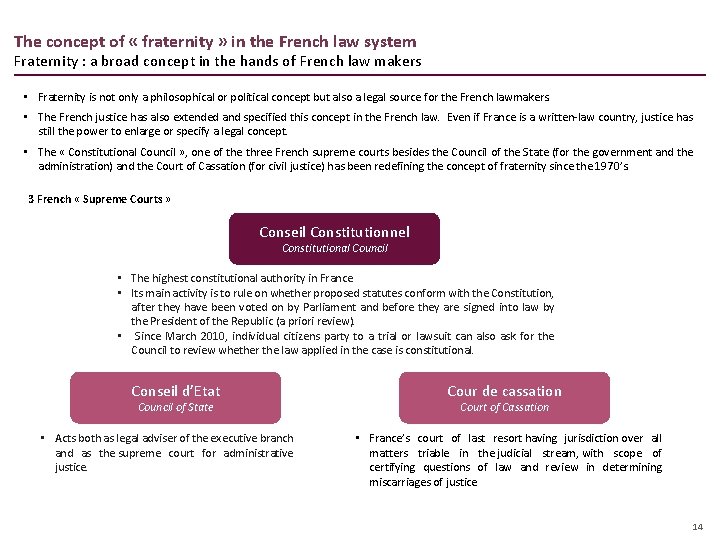
The concept of « fraternity » in the French law system Fraternity : a broad concept in the hands of French law makers • Fraternity is not only a philosophical or political concept but also a legal source for the French lawmakers. • The French justice has also extended and specified this concept in the French law. Even if France is a written-law country, justice has still the power to enlarge or specify a legal concept. • The « Constitutional Council » , one of the three French supreme courts besides the Council of the State (for the government and the administration) and the Court of Cassation (for civil justice) has been redefining the concept of fraternity since the 1970’s. 3 French « Supreme Courts » Conseil Constitutionnel Constitutional Council • The highest constitutional authority in France • Its main activity is to rule on whether proposed statutes conform with the Constitution, after they have been voted on by Parliament and before they are signed into law by the President of the Republic (a priori review). • Since March 2010, individual citizens party to a trial or lawsuit can also ask for the Council to review whether the law applied in the case is constitutional. Conseil d’Etat Council of State • Acts both as legal adviser of the executive branch and as the supreme court for administrative justice. Cour de cassation Court of Cassation • France’s court of last resort having jurisdiction over all matters triable in the judicial stream, with scope of certifying questions of law and review in determining miscarriages of justice 14
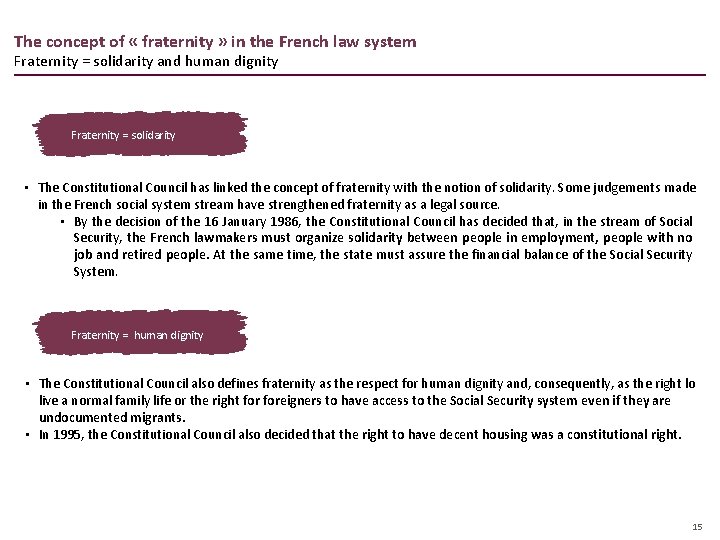
The concept of « fraternity » in the French law system Fraternity = solidarity and human dignity Fraternity = solidarity • The Constitutional Council has linked the concept of fraternity with the notion of solidarity. Some judgements made in the French social system stream have strengthened fraternity as a legal source. • By the decision of the 16 January 1986, the Constitutional Council has decided that, in the stream of Social Security, the French lawmakers must organize solidarity between people in employment, people with no job and retired people. At the same time, the state must assure the financial balance of the Social Security System. Fraternity = human dignity • The Constitutional Council also defines fraternity as the respect for human dignity and, consequently, as the right lo live a normal family life or the right foreigners to have access to the Social Security system even if they are undocumented migrants. • In 1995, the Constitutional Council also decided that the right to have decent housing was a constitutional right. 15
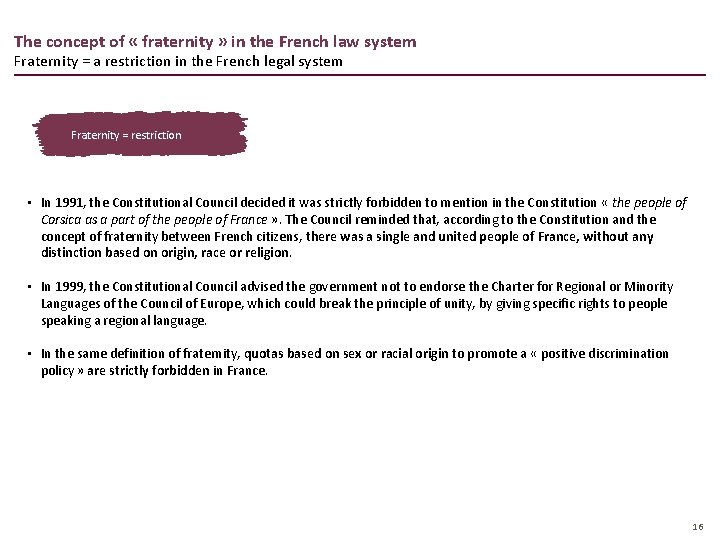
The concept of « fraternity » in the French law system Fraternity = a restriction in the French legal system Fraternity = restriction • In 1991, the Constitutional Council decided it was strictly forbidden to mention in the Constitution « the people of Corsica as a part of the people of France » . The Council reminded that, according to the Constitution and the concept of fraternity between French citizens, there was a single and united people of France, without any distinction based on origin, race or religion. • In 1999, the Constitutional Council advised the government not to endorse the Charter for Regional or Minority Languages of the Council of Europe, which could break the principle of unity, by giving specific rights to people speaking a regional language. • In the same definition of fraternity, quotas based on sex or racial origin to promote a « positive discrimination policy » are strictly forbidden in France. 16