
The Concept Mastery Routine The Content Enhancement Series
- Slides: 59
The Concept Mastery Routine The Content Enhancement Series 2006 The University of Kansas Center for Research on Learning Lawrence, Kansas
Content Enhancement A way of teaching an academically diverse group of students in which: – Both group and individual needs are valued and met; – The integrity of the content is maintained; 2 University of Kansas Center for Research on Learning 2006
Content Enhancement A way of teaching an academically diverse group of students in which: – Critical features of the content are selected and transformed in a manner that promotes student learning; and – Instruction is carried out in a partnership with students. 3 University of Kansas Center for Research on Learning 2006
Guidebooks in the Content Enhancement Series • Routines for planning and leading learning – Course Organizer Routine – Unit Organizer Routine – Lesson Organizer Routine 4 University of Kansas Center for Research on Learning 2006
Guidebooks in the Content Enhancement Series • Routines for exploring text, topics, and details – – Clarifying Routine Framing Routine Survey Routine ORDER Routine 5 University of Kansas Center for Research on Learning 2006
Guidebooks in the Content Enhancement Series • Routines for teaching concepts – Concept Anchoring Routine – Concept Comparison Routine – Concept Mastery Routine 6 University of Kansas Center for Research on Learning 2006
Guidebooks in the Content Enhancement Series • Routines for increasing performance – Teaching Cause and Effect Routine – The Question Exploration Routine – The Recall Enhancement Routine – The Vocabulary LINCing Routine – The Quality Assignment Routine 7 University of Kansas Center for Research on Learning 2006
Understanding the Challenge of Diversity • Introduction of difficult but important concepts requires creating connections to background knowledge. • Increased student diversity results in varying levels and types of background knowledge. 8 University of Kansas Center for Research on Learning 2006
Understanding the Challenge of Diversity • Students need new ways of thinking about critical concepts. • Teachers can take advantage of student diversity as they anchor new information to help students find and build learning on known information. 9 University of Kansas Center for Research on Learning 2006
Responding to the Challenge The Concept Mastery Routine helps students to: – understand an important targeted concept; – explore their prior knowledge of the concept; – understand the relationship of the targeted concept to the overall concept class to which the targeted concept belongs; 10 University of Kansas Center for Research on Learning 2006
Responding to the Challenge The Concept Mastery Routine helps students to: – classify characteristics associated with the targeted concept; – explore instances to distinguish examples from nonexamples of the concept; – construct a good definition of the targeted concept. 11 University of Kansas Center for Research on Learning 2006
Supporting Research • The Concept Mastery Routine has generated information about how teachers learn and use the Concept Mastery Routine and how students benefit from its use. • In each study, teachers learned the Concept Mastery Routine easily, and student learning gains were significant. 12 University of Kansas Center for Research on Learning 2006
Supporting Research • In the study, students in both LD and NLD groups made substantial increases on unit tests. • In the study, students took better notes during the enhancement condition than during baseline. Results of the satisfaction surveys were generally positive for both teacher and student. 13 University of Kansas Center for Research on Learning 2006
Supporting Research • Student results were achieved in regular classes when teachers: – had received 4 hours of instruction and practice using the routine prior to implementing it in their classrooms – had opportunities to discuss the routine and concepts with colleagues and consultants – spent the necessary amount of time to plan and implement the routine 14 University of Kansas Center for Research on Learning 2006
Supporting Research • Student results were achieved in regular classes when teachers: – taught their students how to participate in and use the routine to improve their own learning – reviewed the concept and its related elements during the regular test review prior to each test – used the routine regularly throughout a semester 15 University of Kansas Center for Research on Learning 2006
Components of The Concept Mastery Routine The Concept Diagram Teaching Device The Concept Linking Steps The Cue-Do-Review Sequence 16 University of Kansas Center for Research on Learning 2006
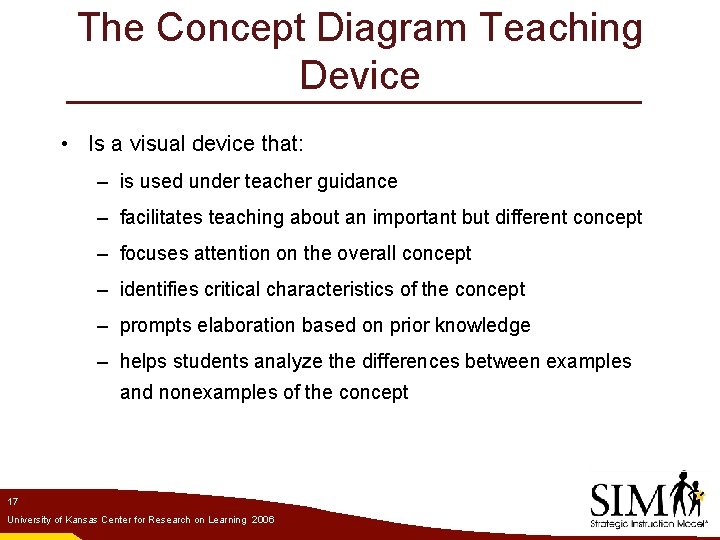
The Concept Diagram Teaching Device • Is a visual device that: – is used under teacher guidance – facilitates teaching about an important but different concept – focuses attention on the overall concept – identifies critical characteristics of the concept – prompts elaboration based on prior knowledge – helps students analyze the differences between examples and nonexamples of the concept 17 University of Kansas Center for Research on Learning 2006
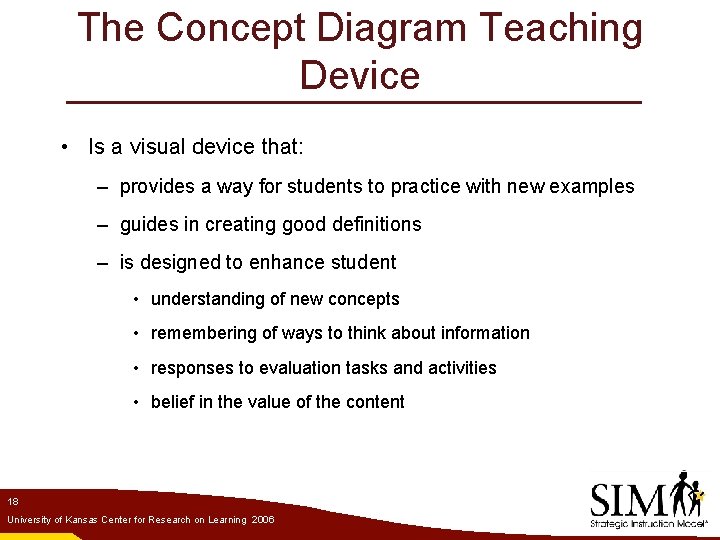
The Concept Diagram Teaching Device • Is a visual device that: – provides a way for students to practice with new examples – guides in creating good definitions – is designed to enhance student • understanding of new concepts • remembering of ways to think about information • responses to evaluation tasks and activities • belief in the value of the content 18 University of Kansas Center for Research on Learning 2006
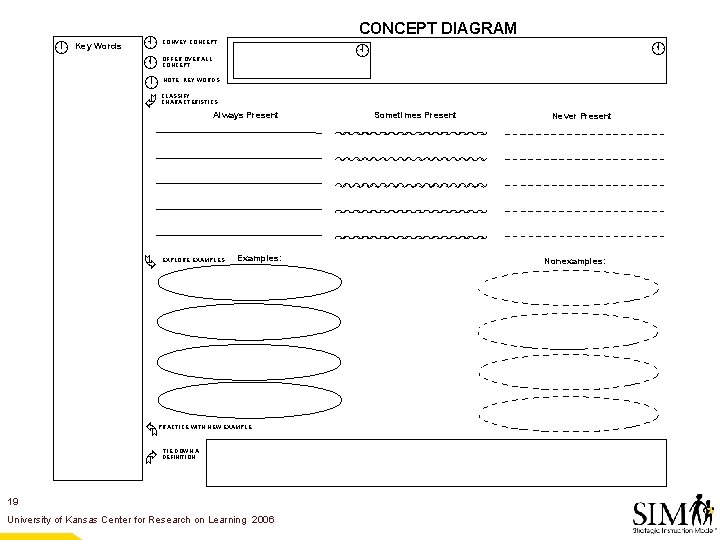
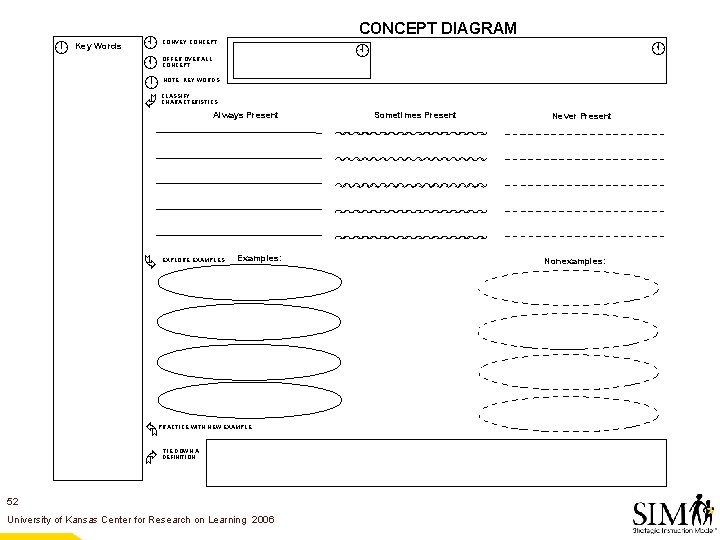
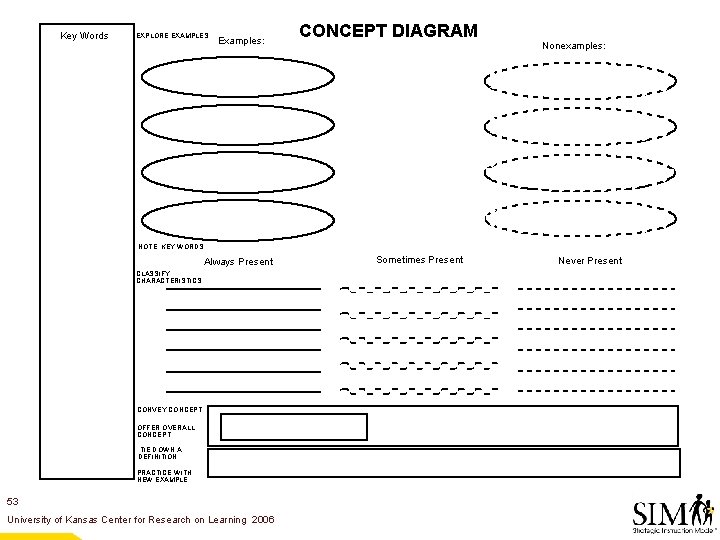
Key Words À Á Ã Ä Å Æ CONCEPT DIAGRAM À CONVEY CONCEPT OFFER OVERALL CONCEPT Á NOTE KEY WORDS CLASSIFY CHARACTERISTICS Always Present EXPLORE EXAMPLES Examples: PRACTICE WITH NEW EXAMPLE TIE DOWN A DEFINITION 19 University of Kansas Center for Research on Learning 2006 Sometimes Present Never Present Nonexamples:
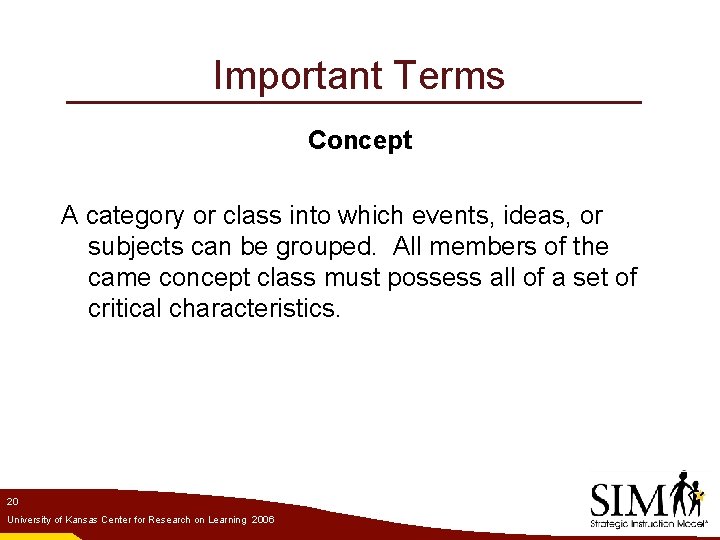
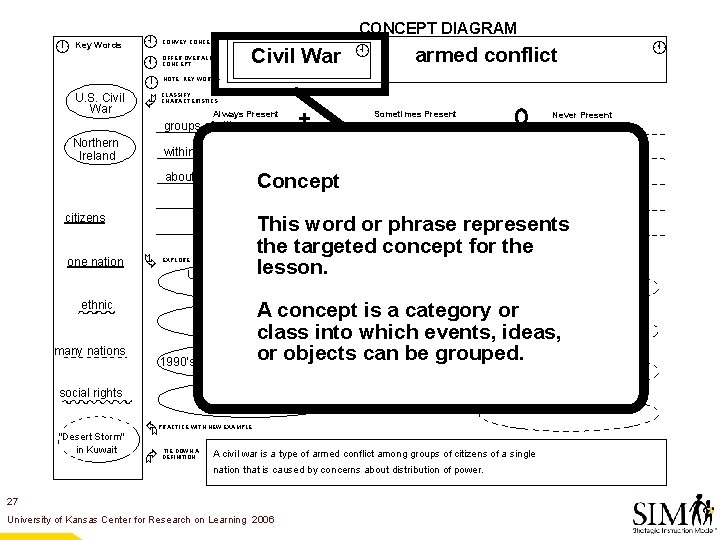
Important Terms Concept A category or class into which events, ideas, or subjects can be grouped. All members of the came concept class must possess all of a set of critical characteristics. 20 University of Kansas Center for Research on Learning 2006
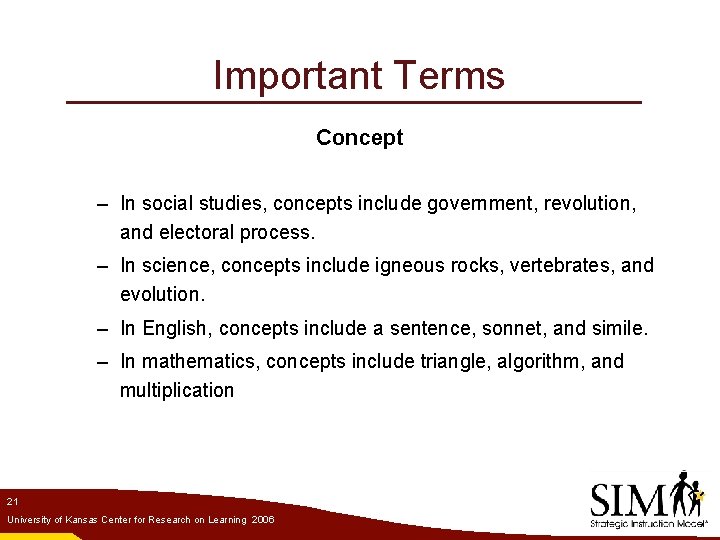
Important Terms Concept – In social studies, concepts include government, revolution, and electoral process. – In science, concepts include igneous rocks, vertebrates, and evolution. – In English, concepts include a sentence, sonnet, and simile. – In mathematics, concepts include triangle, algorithm, and multiplication 21 University of Kansas Center for Research on Learning 2006
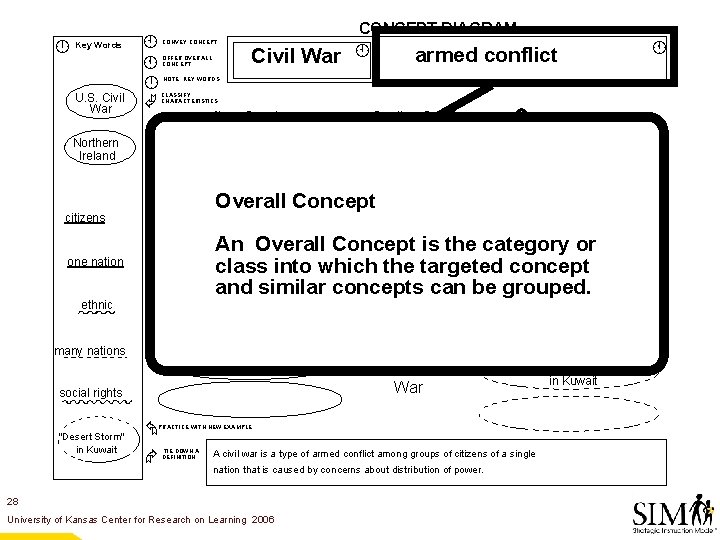
Important Terms Overall Concept The category or class into which the targeted concept and similar concepts can be grouped. 22 University of Kansas Center for Research on Learning 2006
Important Terms Characteristic Things that set examples of a concept apart from examples of all other concepts. Other words for "characteristics" include "qualities, " "traits, " or "attributes. " 23 University of Kansas Center for Research on Learning 2006
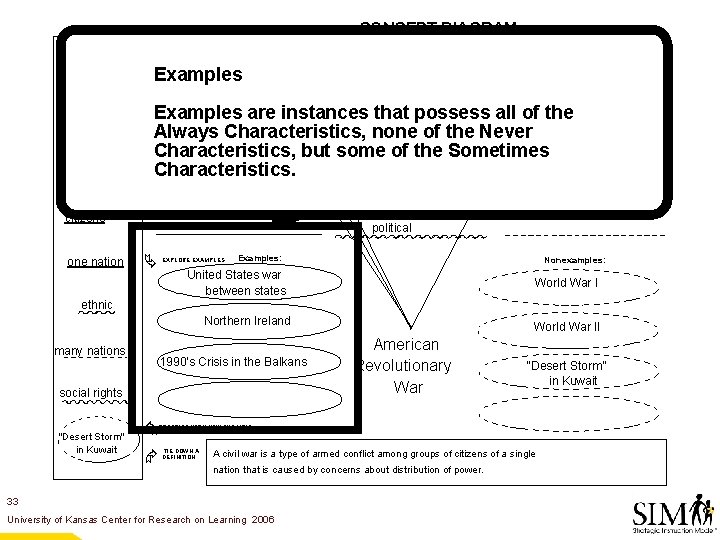
Important Terms Examples Individual things, events, ideas, or processes – possess all of the "always characteristics” – possess none of the "never characteristics” – may contain some of the "sometimes characteristics" 24 University of Kansas Center for Research on Learning 2006
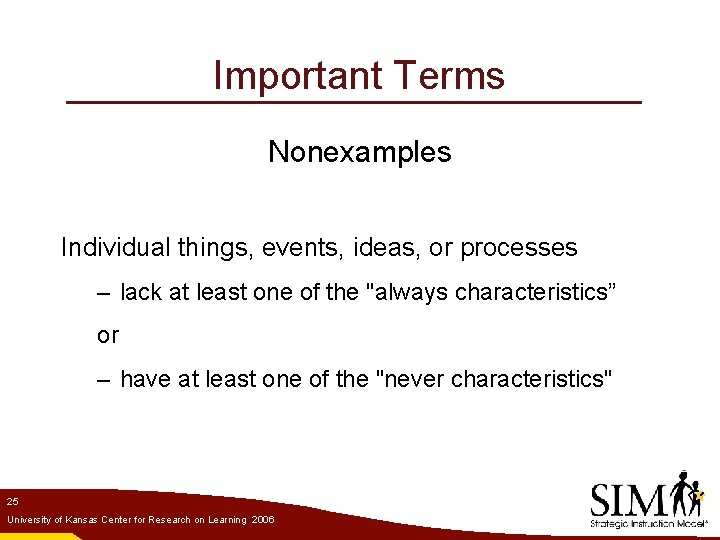
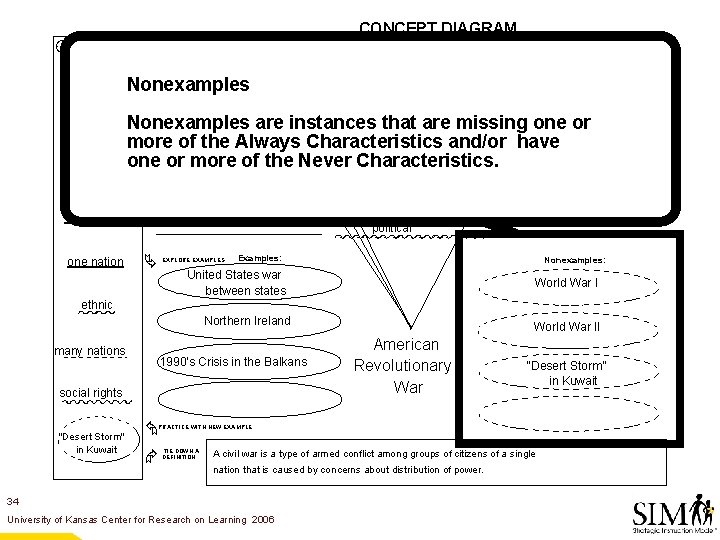
Important Terms Nonexamples Individual things, events, ideas, or processes – lack at least one of the "always characteristics” or – have at least one of the "never characteristics" 25 University of Kansas Center for Research on Learning 2006
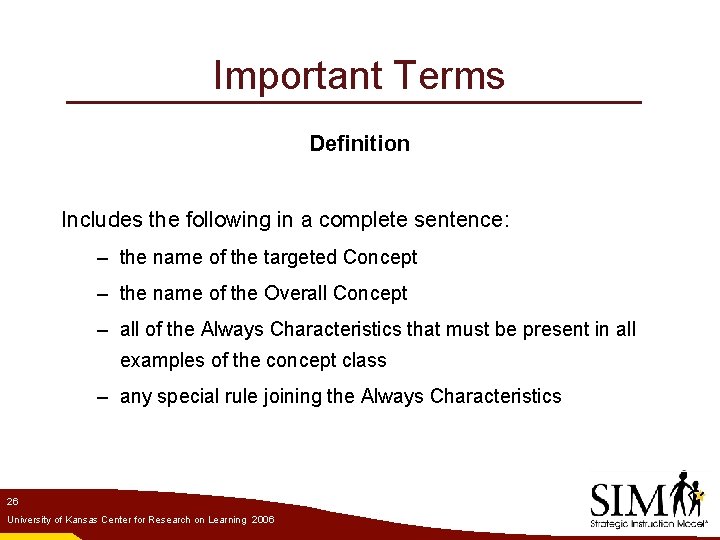
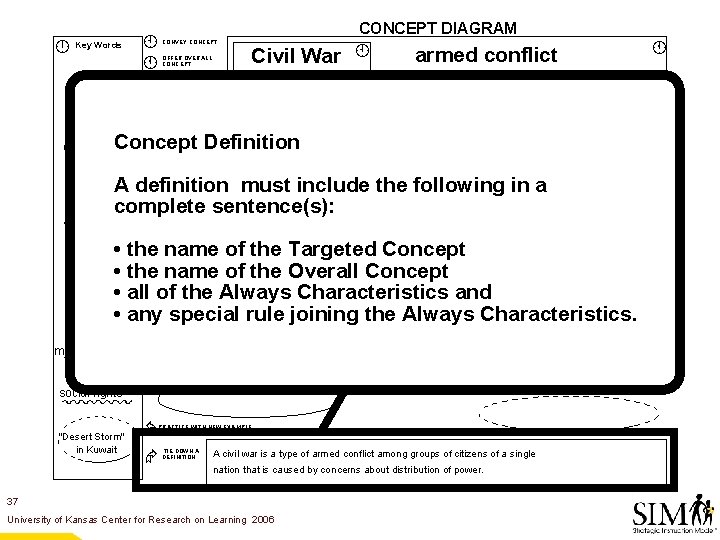
Important Terms Definition Includes the following in a complete sentence: – the name of the targeted Concept – the name of the Overall Concept – all of the Always Characteristics that must be present in all examples of the concept class – any special rule joining the Always Characteristics 26 University of Kansas Center for Research on Learning 2006
Key Words U. S. Civil War À Á Ã Northern Ireland CONVEY CONCEPT OFFER OVERALL CONCEPT Civil War CONCEPT DIAGRAM À armed conflict NOTE KEY WORDS CLASSIFY CHARACTERISTICS Always Present Sometimes Present groups of citizens economic within a single nation religious Concept about distribution of power Never Present war between nations ethnic social citizens one nation Ä This word or phrase represents political the targeted concept for the Nonexamples: Examples: United Stateslesson. war EXPLORE EXAMPLES World War I between states A concept is a category or World War II class into which events, ideas, American or objects can be grouped. "Desert Storm” 1990's Crisis in the Balkans ethnic Northern Ireland many nations Revolutionary War social rights "Desert Storm" in Kuwait Å Æ PRACTICE WITH NEW EXAMPLE TIE DOWN A DEFINITION A civil war is a type of armed conflict among groups of citizens of a single nation that is caused by concerns about distribution of power. 27 University of Kansas Center for Research on Learning 2006 in Kuwait Á
Key Words U. S. Civil War À Á Ã Northern Ireland CONVEY CONCEPT OFFER OVERALL CONCEPT NOTE KEY WORDS CLASSIFY CHARACTERISTICS Always Present Sometimes Present groups of citizens economic within a single nation religious about distribution of power ethnic political Ä ethnic An. Examples: Overall Concept is the category or Nonexamples: class into which the targeted concept United States war World War I and states similar concepts can be grouped. between EXPLORE EXAMPLES Northern Ireland many nations 1990's Crisis in the Balkans social rights "Desert Storm" in Kuwait Never Present war between nations Overall Conceptsocial citizens one nation Civil War CONCEPT DIAGRAM À armed conflict Å Æ World War II American Revolutionary War "Desert Storm” in Kuwait PRACTICE WITH NEW EXAMPLE TIE DOWN A DEFINITION A civil war is a type of armed conflict among groups of citizens of a single nation that is caused by concerns about distribution of power. 28 University of Kansas Center for Research on Learning 2006 Á
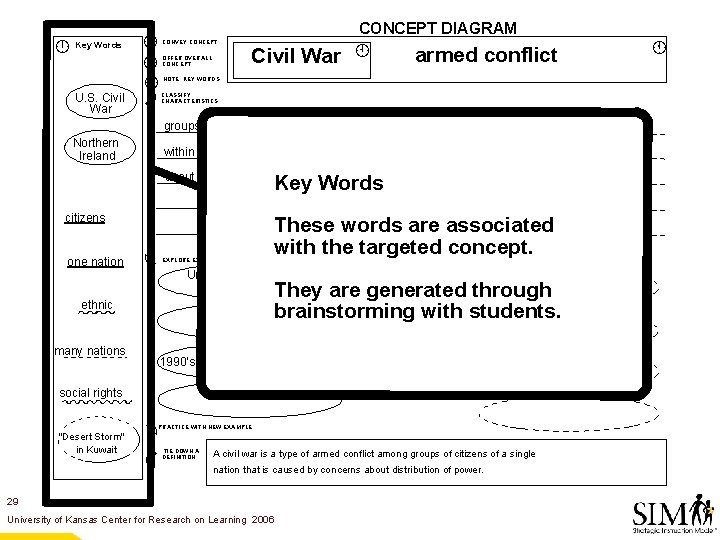
Key Words U. S. Civil War À Á Ã Northern Ireland CONVEY CONCEPT OFFER OVERALL CONCEPT Civil War CONCEPT DIAGRAM À armed conflict NOTE KEY WORDS CLASSIFY CHARACTERISTICS Always Present Sometimes Present groups of citizens economic within a single nation religious Never Present war between nations about distribution of power ethnic Key Words social citizens one nation Ä EXPLORE EXAMPLES politicalare associated These words with the targeted concept. Nonexamples: Examples: United States war between states World War I They are generated through brainstorming with students. Northern Ireland ethnic World War II many nations 1990's Crisis in the Balkans social rights "Desert Storm" in Kuwait Å Æ American Revolutionary War "Desert Storm” in Kuwait PRACTICE WITH NEW EXAMPLE TIE DOWN A DEFINITION A civil war is a type of armed conflict among groups of citizens of a single nation that is caused by concerns about distribution of power. 29 University of Kansas Center for Research on Learning 2006 Á
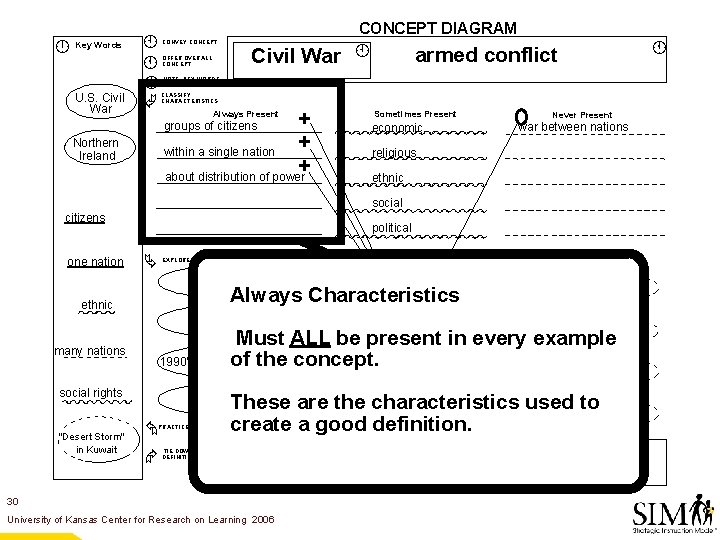
Key Words U. S. Civil War À Á Ã Northern Ireland CONVEY CONCEPT OFFER OVERALL CONCEPT Civil War CONCEPT DIAGRAM À armed conflict NOTE KEY WORDS CLASSIFY CHARACTERISTICS Always Present Sometimes Present groups of citizens economic within a single nation religious about distribution of power ethnic Never Present war between nations social citizens one nation political Ä EXPLORE EXAMPLES Examples: Nonexamples: United States war between states Always Characteristics ethnic Northern Ireland World War II Must ALL be present American in every example 1990's Crisis of in thethe Balkans concept. "Desert Storm” Revolutionary many nations War social rights "Desert Storm" in Kuwait World War I Å Æ in Kuwait These are the characteristics used to create a good definition. PRACTICE WITH NEW EXAMPLE TIE DOWN A DEFINITION A civil war is a type of armed conflict among groups of citizens of a single nation that is caused by concerns about distribution of power. 30 University of Kansas Center for Research on Learning 2006 Á
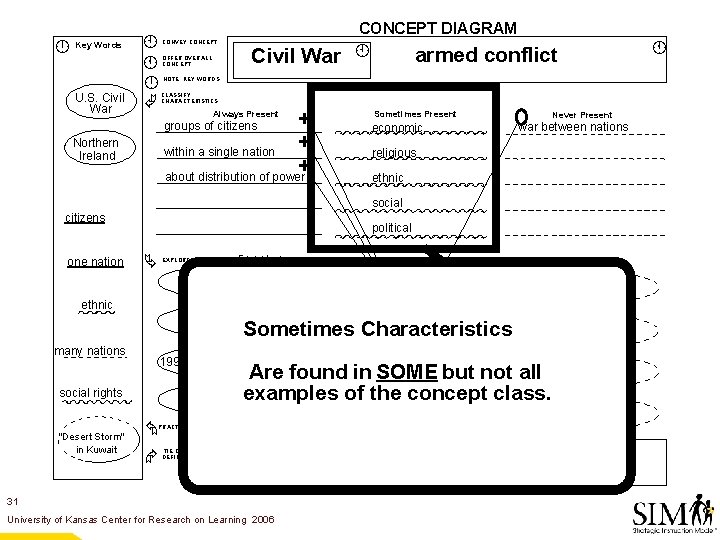
Key Words U. S. Civil War À Á Ã Northern Ireland CONVEY CONCEPT OFFER OVERALL CONCEPT Civil War CONCEPT DIAGRAM À armed conflict NOTE KEY WORDS CLASSIFY CHARACTERISTICS Always Present Sometimes Present groups of citizens economic within a single nation religious about distribution of power ethnic Never Present war between nations social citizens one nation political Ä EXPLORE EXAMPLES Examples: United States war between states Nonexamples: World War I ethnic Northern Ireland Sometimes Characteristics American 1990's Crisis in the Balkans "Desert Storm” Revolutionary Are found in SOME but not all in Kuwait War examples of the concept class. many nations social rights "Desert Storm" in Kuwait World War II Å Æ PRACTICE WITH NEW EXAMPLE TIE DOWN A DEFINITION A civil war is a type of armed conflict among groups of citizens of a single nation that is caused by concerns about distribution of power. 31 University of Kansas Center for Research on Learning 2006 Á
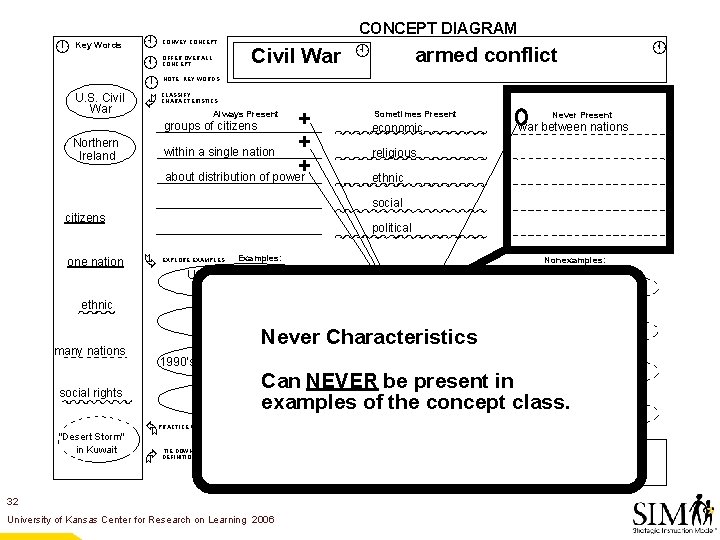
Key Words U. S. Civil War À Á Ã Northern Ireland CONVEY CONCEPT OFFER OVERALL CONCEPT Civil War CONCEPT DIAGRAM À armed conflict NOTE KEY WORDS CLASSIFY CHARACTERISTICS Always Present Sometimes Present groups of citizens economic within a single nation religious about distribution of power ethnic Never Present war between nations social citizens one nation political Ä EXPLORE EXAMPLES Examples: Nonexamples: United States war between states World War I ethnic Northern Ireland Never Characteristics American many nations 1990's Crisis in the Balkans Revolutionary NEVER be present War "Desert Storm” in Kuwait Can in examples of the concept class. social rights "Desert Storm" in Kuwait World War II Å Æ PRACTICE WITH NEW EXAMPLE TIE DOWN A DEFINITION A civil war is a type of armed conflict among groups of citizens of a single nation that is caused by concerns about distribution of power. 32 University of Kansas Center for Research on Learning 2006 Á
Key Words À Á Examples à CONVEY CONCEPT OFFER OVERALL CONCEPT Civil War CONCEPT DIAGRAM À armed conflict NOTE KEY WORDS U. S. Civil War Northern Ireland CLASSIFY CHARACTERISTICS Always Present Never Present Examples are instances Sometimes that possess all of the groups of citizens war between nations economic Always Characteristics, none of the Never within a single nation religious Characteristics, but some of the Sometimes Characteristics. about distribution of power ethnic social citizens one nation political Ä EXPLORE EXAMPLES Examples: Nonexamples: United States war between states World War I ethnic Northern Ireland many nations 1990's Crisis in the Balkans social rights "Desert Storm" in Kuwait Å Æ World War II American Revolutionary War "Desert Storm” in Kuwait PRACTICE WITH NEW EXAMPLE TIE DOWN A DEFINITION A civil war is a type of armed conflict among groups of citizens of a single nation that is caused by concerns about distribution of power. 33 University of Kansas Center for Research on Learning 2006 Á
À Civil Á Nonexamples U. S. Civil à War CONVEY CONCEPT Key Words OFFER OVERALL CONCEPT War CONCEPT DIAGRAM À armed conflict NOTE KEY WORDS CLASSIFY CHARACTERISTICS Always Present Northern Ireland Sometimes Present Never Present Nonexamples that are missingwarone ornations groups of citizensare instanceseconomic between morewithin of athe Always Characteristics and/or have single nation religious one or more of the Never Characteristics. about distribution of power ethnic social citizens one nation political Ä EXPLORE EXAMPLES Examples: Nonexamples: United States war between states World War I ethnic Northern Ireland many nations 1990's Crisis in the Balkans social rights "Desert Storm" in Kuwait Å Æ World War II American Revolutionary War "Desert Storm” in Kuwait PRACTICE WITH NEW EXAMPLE TIE DOWN A DEFINITION A civil war is a type of armed conflict among groups of citizens of a single nation that is caused by concerns about distribution of power. 34 University of Kansas Center for Research on Learning 2006 Á
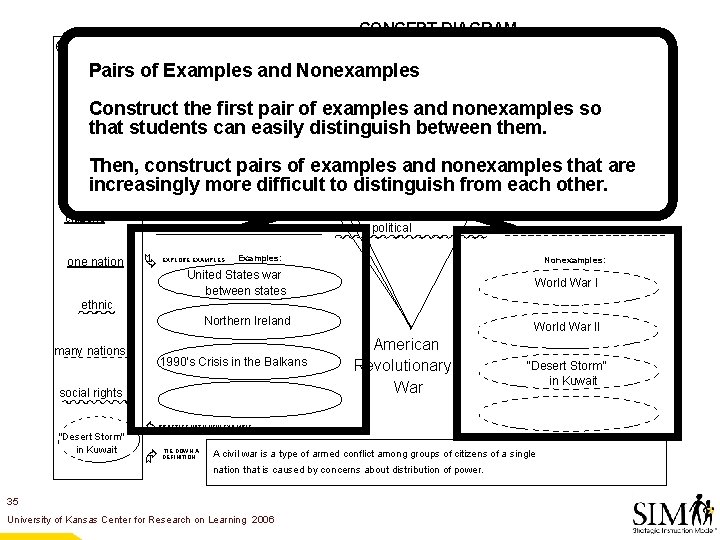
CONCEPT DIAGRAM À armed conflict À Civil War Á Pairs of Examples and Nonexamples U. S. Civil à War CONVEY CONCEPT Key Words OFFER OVERALL CONCEPT NOTE KEY WORDS CLASSIFY CHARACTERISTICS Construct the Always first. Present pair of examples and nonexamples Sometimes Present Never so Present groups of citizens war between nations economic that students can easily distinguish between them. Northern Ireland within a single nation religious Then, construct pairs of examples and nonexamples that are about distribution of power ethnic increasingly more difficult to distinguish from each other. social citizens one nation political Ä EXPLORE EXAMPLES Examples: Nonexamples: United States war between states World War I ethnic Northern Ireland many nations 1990's Crisis in the Balkans social rights "Desert Storm" in Kuwait Å Æ World War II American Revolutionary War "Desert Storm” in Kuwait PRACTICE WITH NEW EXAMPLE TIE DOWN A DEFINITION A civil war is a type of armed conflict among groups of citizens of a single nation that is caused by concerns about distribution of power. 35 University of Kansas Center for Research on Learning 2006 Á
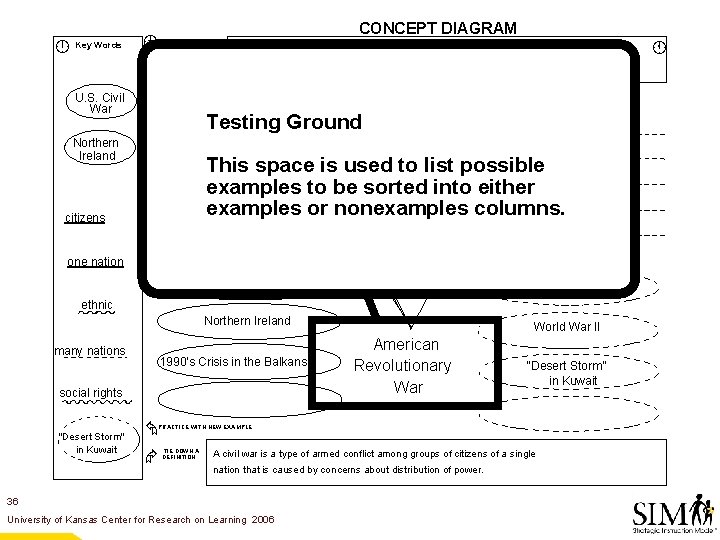
Key Words U. S. Civil War À Á Ã CONVEY CONCEPT OFFER OVERALL CONCEPT Civil War CONCEPT DIAGRAM À armed conflict NOTE KEY WORDS CLASSIFY CHARACTERISTICS Always Present Testing Ground Northern Ireland Sometimes Present groups of citizens economic within a single nation religious Never Present war between nations This space is used to list possible ethnic examples to be sorted into either social examples or nonexamples columns. about distribution of power citizens one nation political Ä EXPLORE EXAMPLES Examples: Nonexamples: United States war between states World War I ethnic Northern Ireland many nations 1990's Crisis in the Balkans social rights "Desert Storm" in Kuwait Å Æ World War II American Revolutionary War "Desert Storm” in Kuwait PRACTICE WITH NEW EXAMPLE TIE DOWN A DEFINITION A civil war is a type of armed conflict among groups of citizens of a single nation that is caused by concerns about distribution of power. 36 University of Kansas Center for Research on Learning 2006 Á
Key Words U. S. Civil War À Á Ã CONVEY CONCEPT OFFER OVERALL CONCEPT Civil War CONCEPT DIAGRAM À armed conflict NOTE KEY WORDS CLASSIFY CHARACTERISTICS Always Present groups of citizens Concept Definition within a single nation Northern Ireland Sometimes Present economic Never Present war between nations religious about distribution of power citizens A definition must include ethnic the following in a social complete sentence(s): political • the name of. Examples: the Targeted Concept Nonexamples: Ä • the name of the United States war Overall Concept World War I between states Characteristics and • all of the Always ethnic • any special Northernrule Irelandjoining the Always Characteristics. World War II one nation EXPLORE EXAMPLES many nations 1990's Crisis in the Balkans social rights "Desert Storm" in Kuwait Å Æ American Revolutionary War "Desert Storm” in Kuwait PRACTICE WITH NEW EXAMPLE TIE DOWN A DEFINITION A civil war is a type of armed conflict among groups of citizens of a single nation that is caused by concerns about distribution of power. 37 University of Kansas Center for Research on Learning 2006 Á
Rationales for Using The CONCEPT Linking Steps Guide the teacher in ways to: – present the Concept Diagram effectively; – involve students in constructing and using the Concept Diagram; – elicit and make connections to the prior knowledge of students; and – focus student attention on learning. 38 University of Kansas Center for Research on Learning 2006
The CONCEPT Linking Steps • Convey the targeted concept. • Offer the overall concept. • Note key words. • Classify characteristics always, sometimes, or never present. • Explore examples and nonexamples. • Practice with a new example. • Tie down a definition. 39 University of Kansas Center for Research on Learning 2006
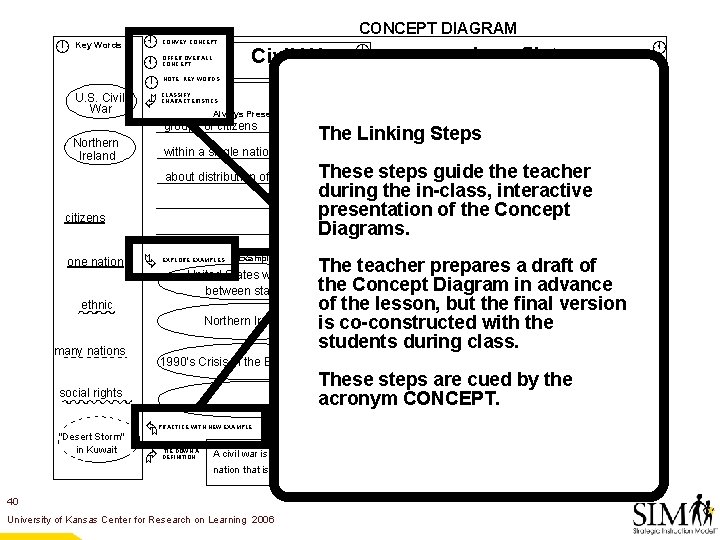
Key Words U. S. Civil War À Á Ã CONVEY CONCEPT OFFER OVERALL CONCEPT Civil War NOTE KEY WORDS CLASSIFY CHARACTERISTICS Always Present groups of citizens Northern Ireland within a single nation about distribution of power citizens one nation Ä EXPLORE EXAMPLES Examples: United States war between states ethnic Northern Ireland many nations 1990's Crisis in the Balkans social rights "Desert Storm" in Kuwait CONCEPT DIAGRAM À armed conflict Sometimes Present economic The Linking Steps Never Present war between nations religious Theseethnic steps guide the teacher during the in-class, interactive social presentation of the Concept political Diagrams. Nonexamples: The teacher prepares a draft of World War I the Concept Diagram in advance of the lesson, but the final version is co-constructed with the World War II students during class. American "Desert Storm” Revolutionary in Kuwait These steps War are cued by the acronym CONCEPT. Å Æ PRACTICE WITH NEW EXAMPLE TIE DOWN A DEFINITION A civil war is a type of armed conflict among groups of citizens of a single nation that is caused by concerns about distribution of power. 40 University of Kansas Center for Research on Learning 2006 Á
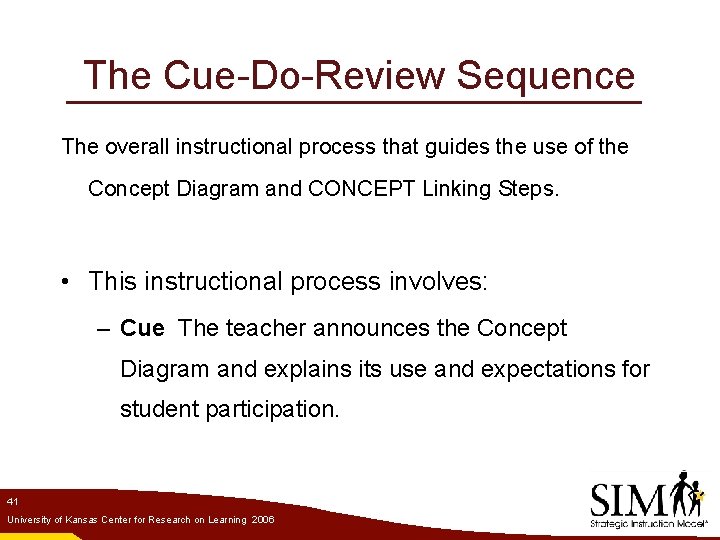
The Cue-Do-Review Sequence The overall instructional process that guides the use of the Concept Diagram and CONCEPT Linking Steps. • This instructional process involves: – Cue The teacher announces the Concept Diagram and explains its use and expectations for student participation. 41 University of Kansas Center for Research on Learning 2006
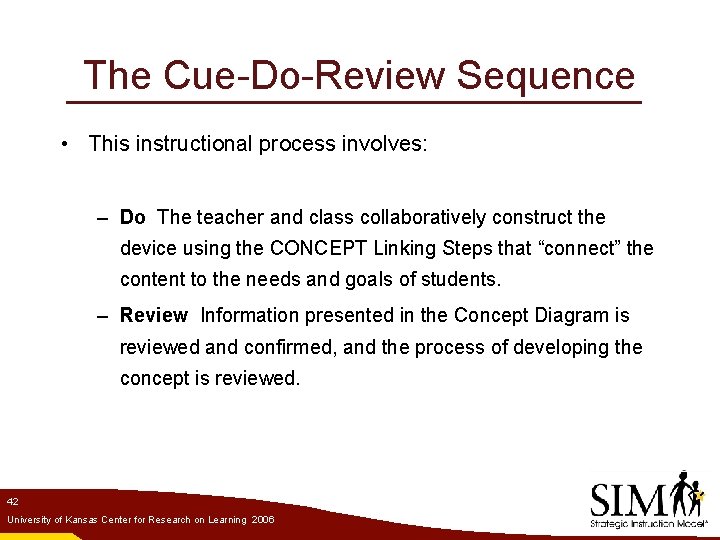
The Cue-Do-Review Sequence • This instructional process involves: – Do The teacher and class collaboratively construct the device using the CONCEPT Linking Steps that “connect” the content to the needs and goals of students. – Review Information presented in the Concept Diagram is reviewed and confirmed, and the process of developing the concept is reviewed. 42 University of Kansas Center for Research on Learning 2006
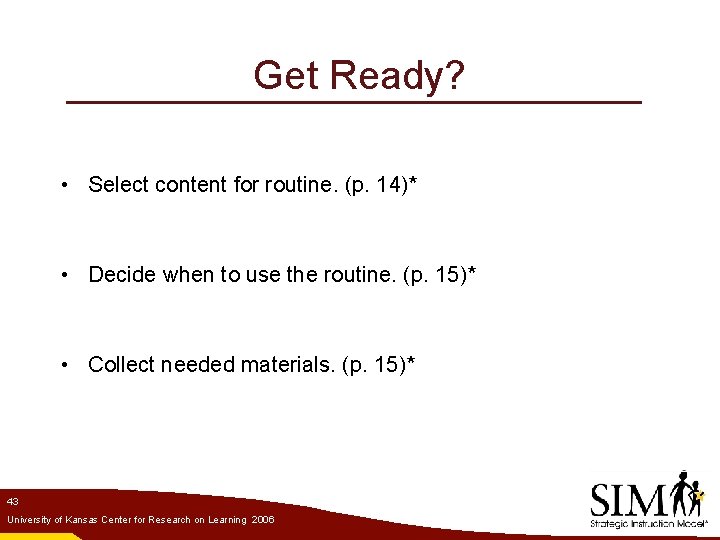
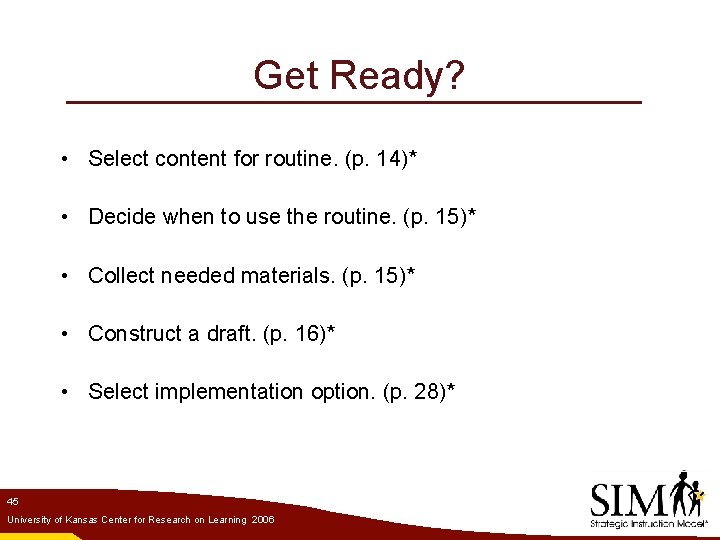
Get Ready? • Select content for routine. (p. 14)* • Decide when to use the routine. (p. 15)* • Collect needed materials. (p. 15)* 43 University of Kansas Center for Research on Learning 2006
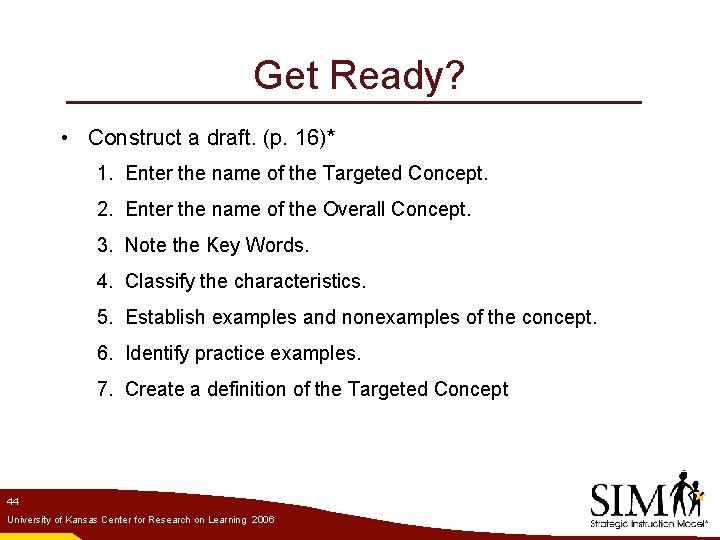
Get Ready? • Construct a draft. (p. 16)* 1. Enter the name of the Targeted Concept. 2. Enter the name of the Overall Concept. 3. Note the Key Words. 4. Classify the characteristics. 5. Establish examples and nonexamples of the concept. 6. Identify practice examples. 7. Create a definition of the Targeted Concept 44 University of Kansas Center for Research on Learning 2006
Get Ready? • Select content for routine. (p. 14)* • Decide when to use the routine. (p. 15)* • Collect needed materials. (p. 15)* • Construct a draft. (p. 16)* • Select implementation option. (p. 28)* 45 University of Kansas Center for Research on Learning 2006
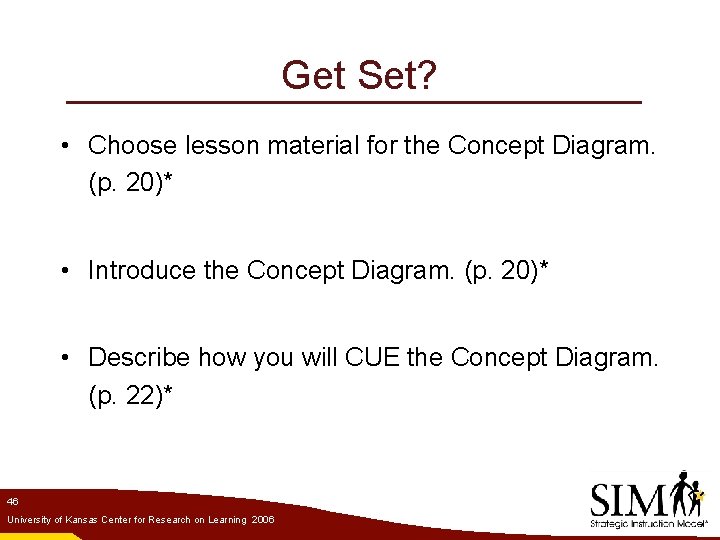
Get Set? • Choose lesson material for the Concept Diagram. (p. 20)* • Introduce the Concept Diagram. (p. 20)* • Describe how you will CUE the Concept Diagram. (p. 22)* 46 University of Kansas Center for Research on Learning 2006
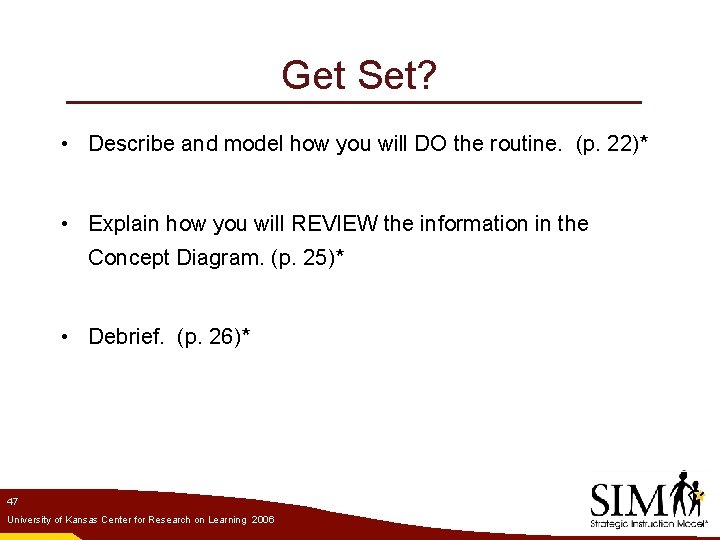
Get Set? • Describe and model how you will DO the routine. (p. 22)* • Explain how you will REVIEW the information in the Concept Diagram. (p. 25)* • Debrief. (p. 26)* 47 University of Kansas Center for Research on Learning 2006
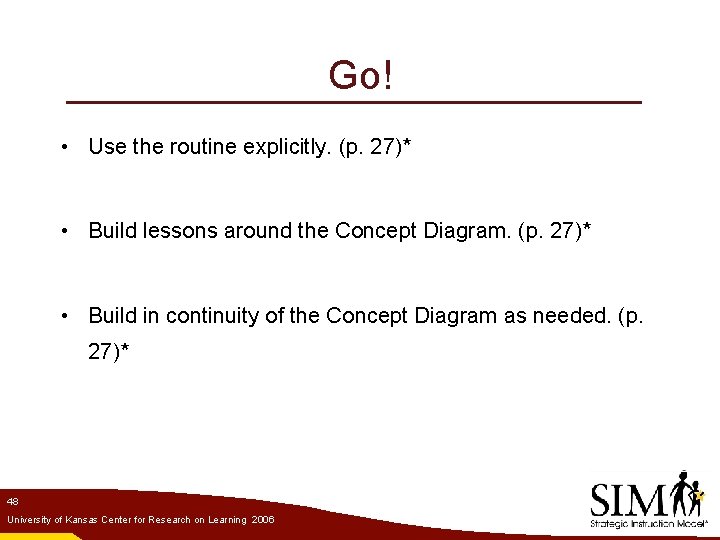
Go! • Use the routine explicitly. (p. 27)* • Build lessons around the Concept Diagram. (p. 27)* • Build in continuity of the Concept Diagram as needed. (p. 27)* 48 University of Kansas Center for Research on Learning 2006
Go! • Evaluate your use of the routine. (p. 28)* • Be creative. (p. 28)* • Beware of “pit” monsters. (p. 29)* 49 University of Kansas Center for Research on Learning 2006
Win! • Select the Concept Diagram as a personal growth target. (p. 30)* • Choose a way to learn. (p. 30)* • Choose a support system. (p. 30)* 50 University of Kansas Center for Research on Learning 2006
Win! • Plan for confidence building. (p. 30)* • Debug. (p. 30)* • Maximize the challenge. (p. 31)* • Develop your “ensurance” policy. (p. 31)* 51 University of Kansas Center for Research on Learning 2006
Key Words À Á Ã Ä Å Æ CONCEPT DIAGRAM À CONVEY CONCEPT OFFER OVERALL CONCEPT Á NOTE KEY WORDS CLASSIFY CHARACTERISTICS Always Present EXPLORE EXAMPLES Examples: PRACTICE WITH NEW EXAMPLE TIE DOWN A DEFINITION 52 University of Kansas Center for Research on Learning 2006 Sometimes Present Never Present Nonexamples:
Key Words EXPLORE EXAMPLES Examples: CONCEPT DIAGRAM Nonexamples: NOTE KEY WORDS Always Present CLASSIFY CHARACTERISTICS CONVEY CONCEPT OFFER OVERALL CONCEPT TIE DOWN A DEFINITION PRACTICE WITH NEW EXAMPLE 53 University of Kansas Center for Research on Learning 2006 Sometimes Present Never Present
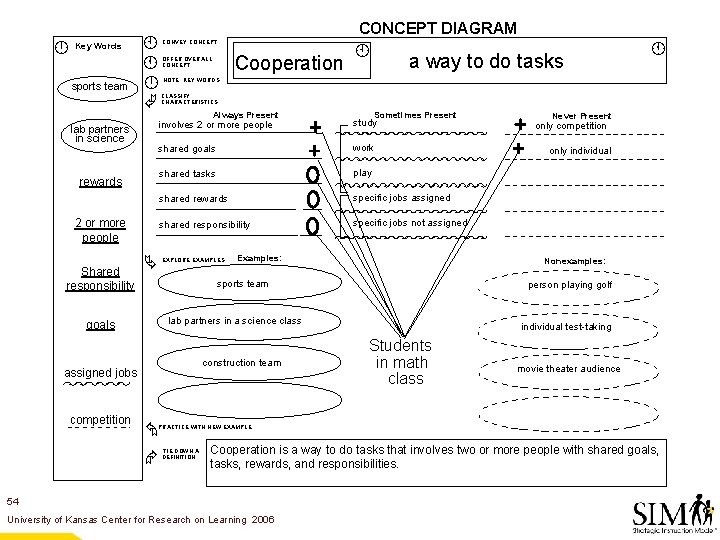
Key Words sports team À Á Ã lab partners in science rewards 2 or more people Shared responsibility Ä CONVEY CONCEPT a way to do tasks CLASSIFY CHARACTERISTICS Always Present Sometimes Present involves 2 or more people study shared goals work shared tasks play shared rewards specific jobs assigned shared responsibility specific jobs not assigned EXPLORE EXAMPLES Examples: construction team assigned jobs Æ Never Present only competition only individual Nonexamples: person playing golf lab partners in a science class Å Á NOTE KEY WORDS sports team goals competition Cooperation OFFER OVERALL CONCEPT DIAGRAM À individual test-taking Students in math class movie theater audience PRACTICE WITH NEW EXAMPLE TIE DOWN A DEFINITION Cooperation is a way to do tasks that involves two or more people with shared goals, tasks, rewards, and responsibilities. 54 University of Kansas Center for Research on Learning 2006
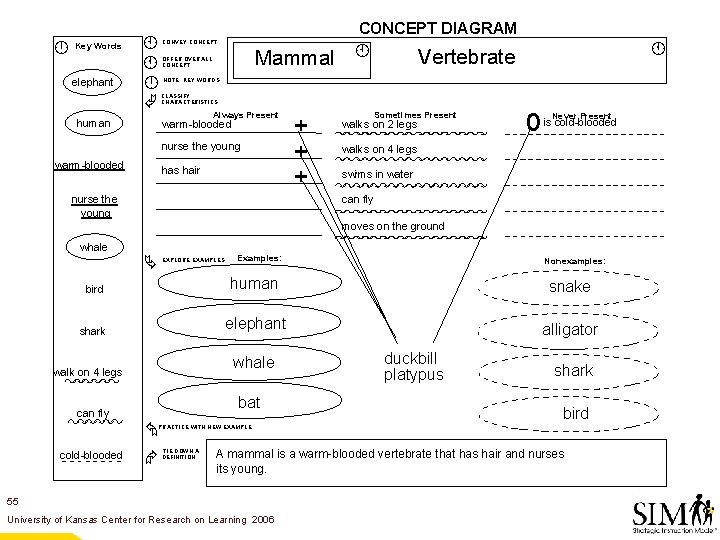
Key Words elephant À Á Ã human warm-blooded CONVEY CONCEPT Mammal OFFER OVERALL CONCEPT DIAGRAM À Vertebrate Á NOTE KEY WORDS CLASSIFY CHARACTERISTICS Always Present Sometimes Present warm-blooded walks on 2 legs nurse the young walks on 4 legs hair swims in water Never Present is cold-blooded can fly nurse the young moves on the ground whale Ä EXPLORE EXAMPLES Examples: Nonexamples: bird human snake shark elephant alligator whale walk on 4 legs can fly cold-blooded bat Å Æ duckbill platypus shark bird PRACTICE WITH NEW EXAMPLE TIE DOWN A DEFINITION A mammal is a warm-blooded vertebrate that has hair and nurses its young. 55 University of Kansas Center for Research on Learning 2006
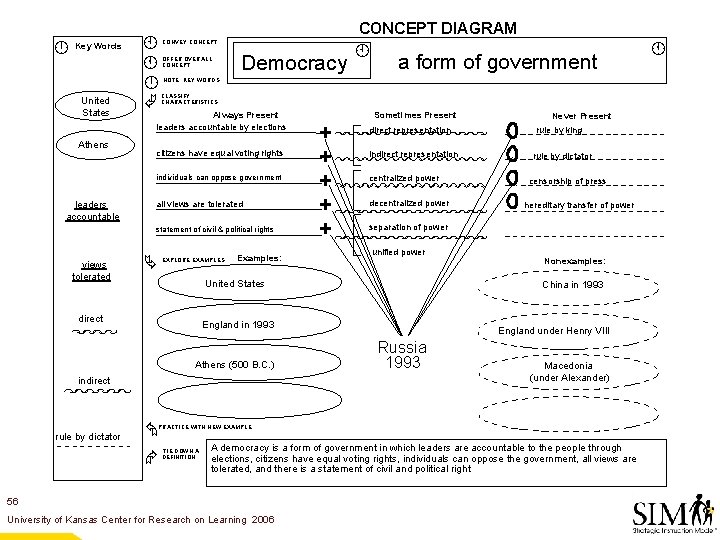
Key Words United States Athens leaders accountable views tolerated À Á Ã CONVEY CONCEPT OFFER OVERALL CONCEPT Democracy a form of government NOTE KEY WORDS CLASSIFY CHARACTERISTICS Always Present leaders accountable by elections direct representation citizens have equal voting rights indirect representation individuals can oppose government centralized power all views are tolerated decentralized power statement of civil & political rights separation of power Ä EXPLORE EXAMPLES Examples: Sometimes Present unified power United States direct Athens (500 B. C. ) Å Æ Never Present rule by king rule by dictator censorship of press hereditary transfer of power Nonexamples: China in 1993 England in 1993 indirect rule by dictator CONCEPT DIAGRAM À England under Henry VIII Russia 1993 Macedonia (under Alexander) PRACTICE WITH NEW EXAMPLE TIE DOWN A DEFINITION A democracy is a form of government in which leaders are accountable to the people through elections, citizens have equal voting rights, individuals can oppose the government, all views are tolerated, and there is a statement of civil and political right 56 University of Kansas Center for Research on Learning 2006 Á
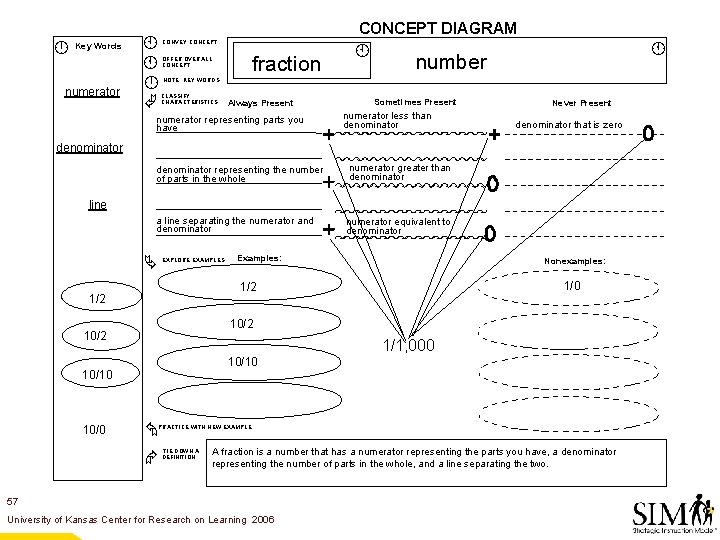
Key Words numerator À Á Ã CONVEY CONCEPT fraction OFFER OVERALL CONCEPT DIAGRAM À Á number NOTE KEY WORDS CLASSIFY CHARACTERISTICS Always Present numerator representing parts you have Sometimes Present numerator less than denominator Never Present denominator that is zero denominator representing the number of parts in the whole numerator greater than denominator a line separating the numerator and denominator numerator equivalent to denominator line Ä EXPLORE EXAMPLES Nonexamples: 1/0 1/2 10/2 1/1, 000 10/10 10/0 Examples: Å Æ PRACTICE WITH NEW EXAMPLE TIE DOWN A DEFINITION A fraction is a number that has a numerator representing the parts you have, a denominator representing the number of parts in the whole, and a line separating the two. 57 University of Kansas Center for Research on Learning 2006
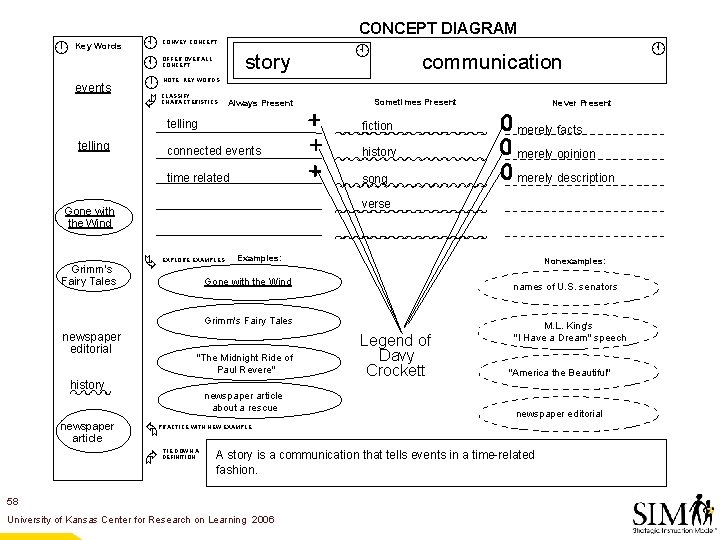
Key Words events À Á Ã telling CONVEY CONCEPT story OFFER OVERALL CONCEPT communication NOTE KEY WORDS CLASSIFY CHARACTERISTICS Always Present Sometimes Present fiction merely facts connected events history merely opinion time related song merely description verse Ä EXPLORE EXAMPLES Examples: Nonexamples: Gone with the Wind names of U. S. senators Grimm's Fairy Tales newspaper editorial "The Midnight Ride of Paul Revere" history newspaper article Never Present telling Gone with the Wind Grimm's Fairy Tales CONCEPT DIAGRAM À newspaper article about a rescue Å Æ Legend of Davy Crockett M. L. King's "I Have a Dream" speech "America the Beautiful" newspaper editorial PRACTICE WITH NEW EXAMPLE TIE DOWN A DEFINITION A story is a communication that tells events in a time-related fashion. 58 University of Kansas Center for Research on Learning 2006 Á
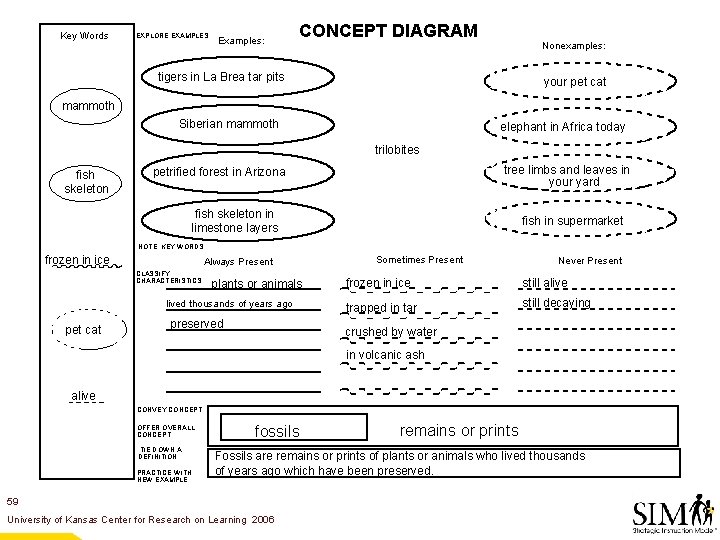
Key Words EXPLORE EXAMPLES Examples: CONCEPT DIAGRAM Nonexamples: tigers in La Brea tar pits your pet cat mammoth Siberian mammoth elephant in Africa today trilobites fish skeleton tree limbs and leaves in your yard petrified forest in Arizona fish skeleton in limestone layers fish in supermarket NOTE KEY WORDS frozen in ice Always Present CLASSIFY CHARACTERISTICS plants or animals lived thousands of years ago pet cat preserved Sometimes Present Never Present frozen in ice still alive trapped in tar still decaying crushed by water in volcanic ash alive CONVEY CONCEPT OFFER OVERALL CONCEPT TIE DOWN A DEFINITION PRACTICE WITH NEW EXAMPLE fossils remains or prints Fossils are remains or prints of plants or animals who lived thousands of years ago which have been preserved. 59 University of Kansas Center for Research on Learning 2006