
The computational complexity of entanglement detection Patrick Hayden







- Slides: 38
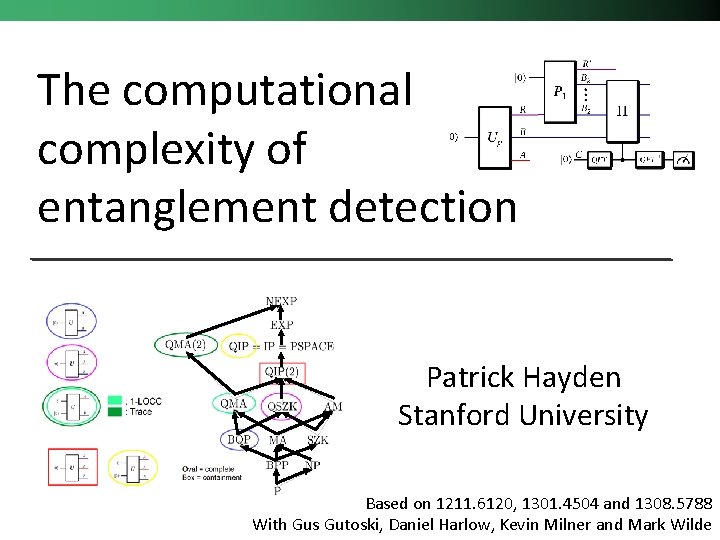
The computational complexity of entanglement detection Patrick Hayden Stanford University Based on 1211. 6120, 1301. 4504 and 1308. 5788 With Gus Gutoski, Daniel Harlow, Kevin Milner and Mark Wilde
How hard is entanglement detection? • Given a matrix describing a bipartite state, is the state separable or entangled? – NP-hard for d x d, promise gap 1/poly(d) [Gurvits ’ 04 + Gharibian ‘ 10] – Quasipolynomial time for constant gap [Brandao et al. ’ 10] • Probably not the right question for large systems. • Given a description of a physical process for preparing a quantum state (i. e. quantum circuit), is the state separable or entangled? • Variants: – – Pure versus mixed State versus channel Product versus separable Choice of distance measure (equivalently, nature of promise)
Why ask? • Provides a natural set of complete problems for many widely studied classes in quantum complexity • Personal motivation: – Quantum gravity! • Personal frustration at inability to find a “fast scrambler” • Possible implications for the black hole firewall problem
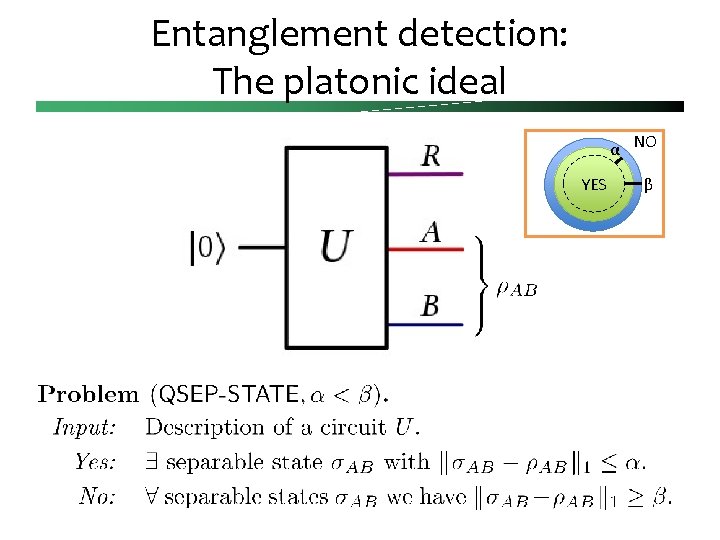
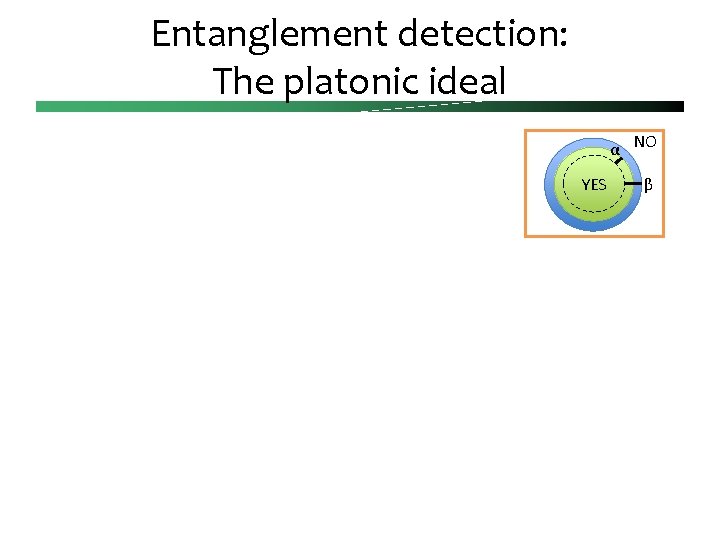
Entanglement detection: The platonic ideal α NO α YES β
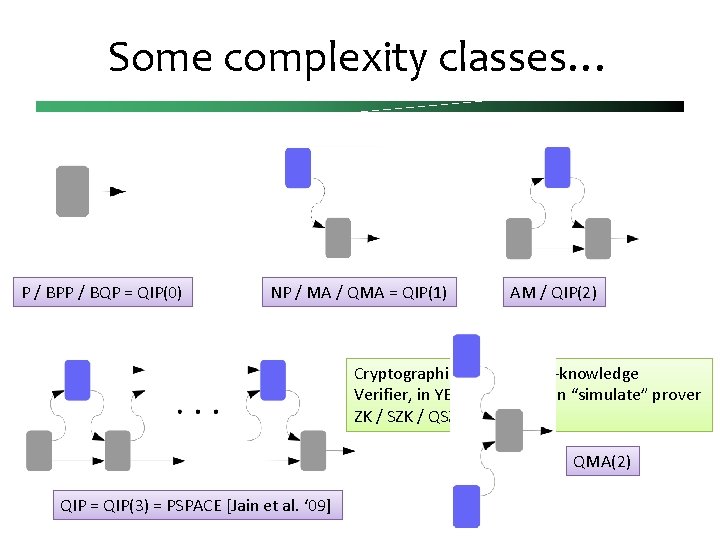
Some complexity classes… P / BPP / BQP = QIP(0) NP / MA / QMA = QIP(1) AM / QIP(2) Cryptographic variant: Zero-knowledge Verifier, in YES instances, can “simulate” prover ZK / SZK / QSZK = QSZK(2) QMA(2) QIP = QIP(3) = PSPACE [Jain et al. ‘ 09]
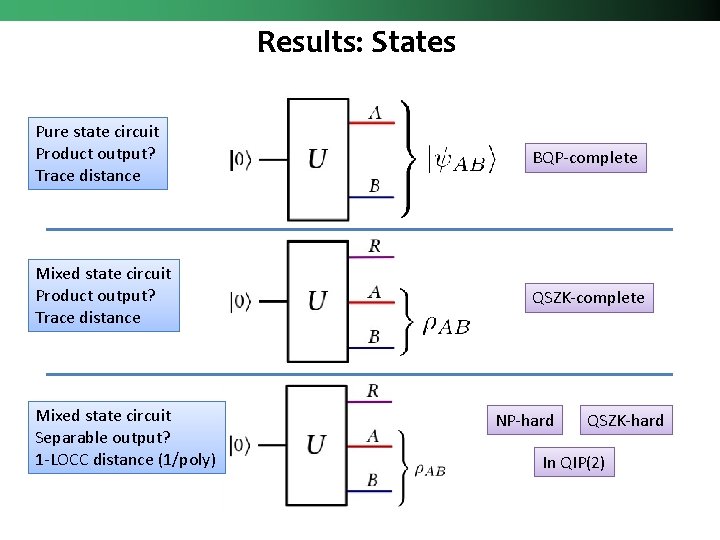
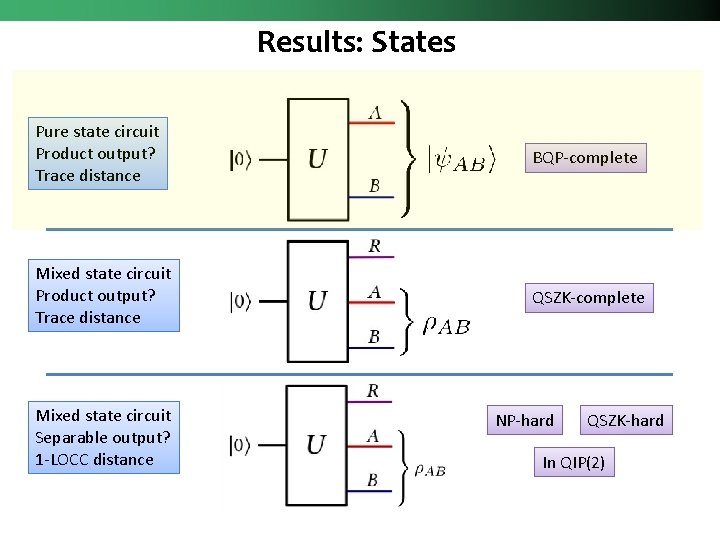
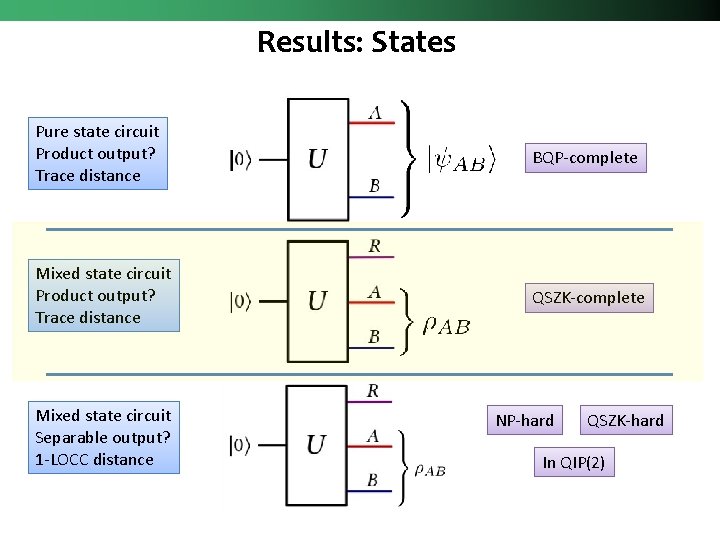
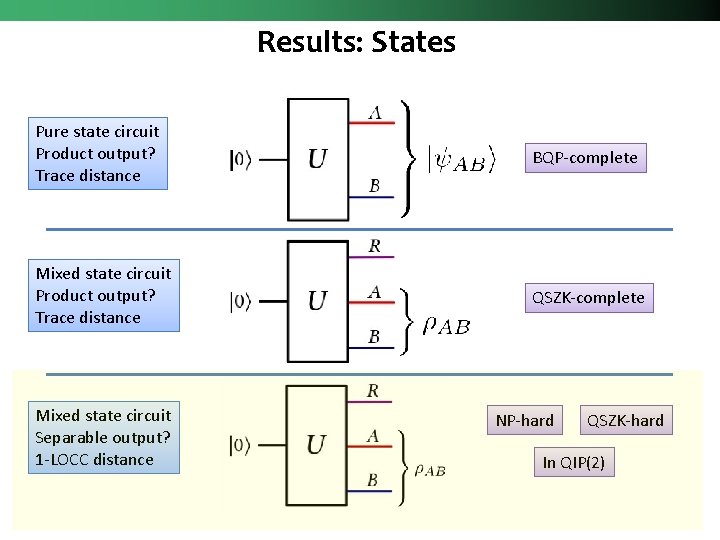
Results: States Pure state circuit Product output? Trace distance BQP-complete Mixed state circuit Product output? Trace distance QSZK-complete Mixed state circuit Separable output? 1 -LOCC distance (1/poly) NP-hard QSZK-hard In QIP(2)
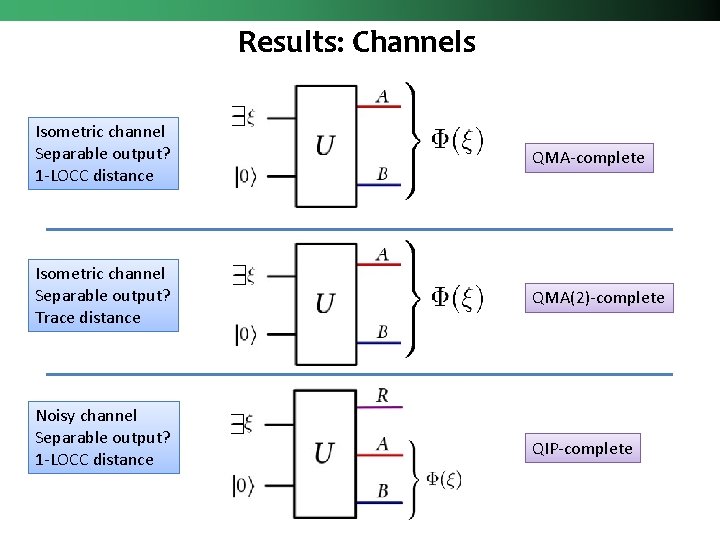
Results: Channels Isometric channel Separable output? 1 -LOCC distance QMA-complete Isometric channel Separable output? Trace distance QMA(2)-complete Noisy channel Separable output? 1 -LOCC distance QIP-complete
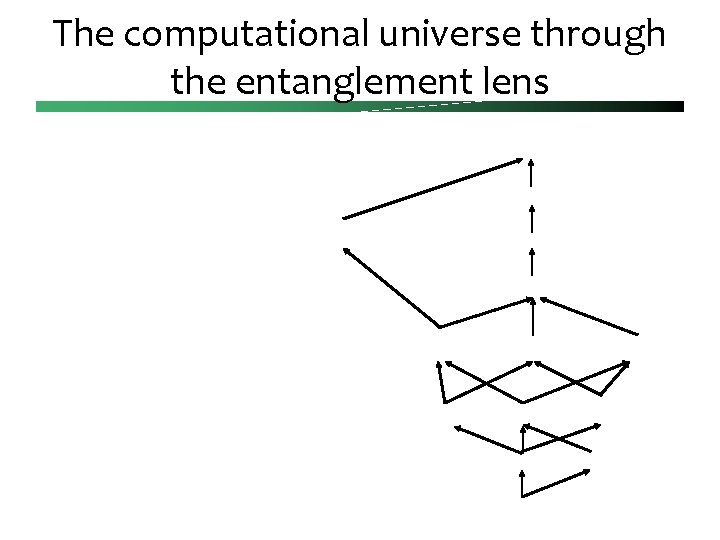
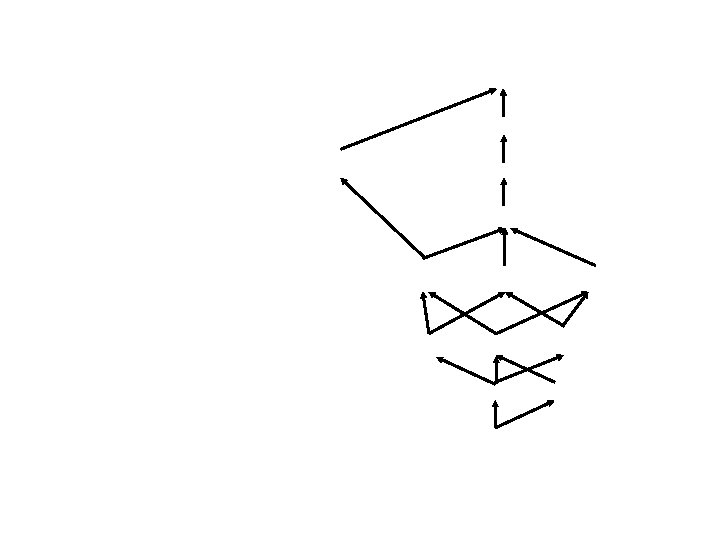
The computational universe through the entanglement lens
Results: States Pure state circuit Product output? Trace distance BQP-complete Mixed state circuit Product output? Trace distance QSZK-complete Mixed state circuit Separable output? 1 -LOCC distance NP-hard QSZK-hard In QIP(2)
Baby steps: Detecting pure product states
Baby steps: Detecting pure product states
1. QPROD-PURE-STATE is in BQP
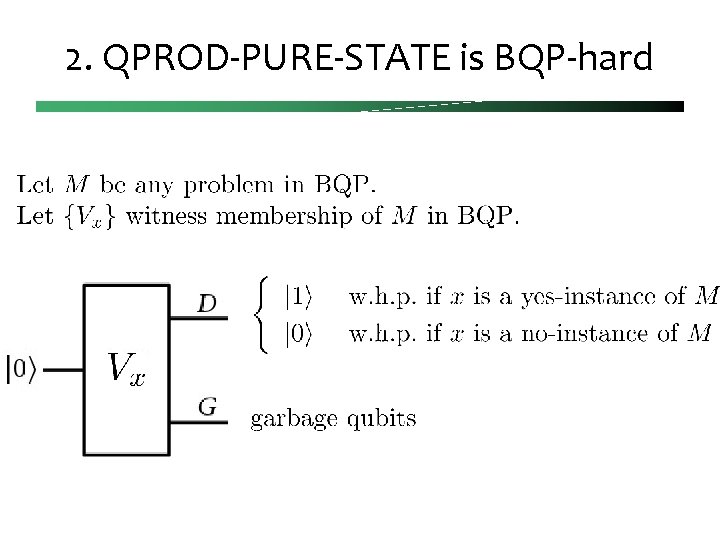
2. QPROD-PURE-STATE is BQP-hard
2. QPROD-PURE-STATE is BQP-hard
Results: States Pure state circuit Product output? Trace distance BQP-complete Mixed state circuit Product output? Trace distance QSZK-complete Mixed state circuit Separable output? 1 -LOCC distance NP-hard QSZK-hard In QIP(2)
Jaunty stroll: Detecting mixed product states
Jaunty stroll: Detecting mixed product states
Jaunty stroll: Detecting mixed product states
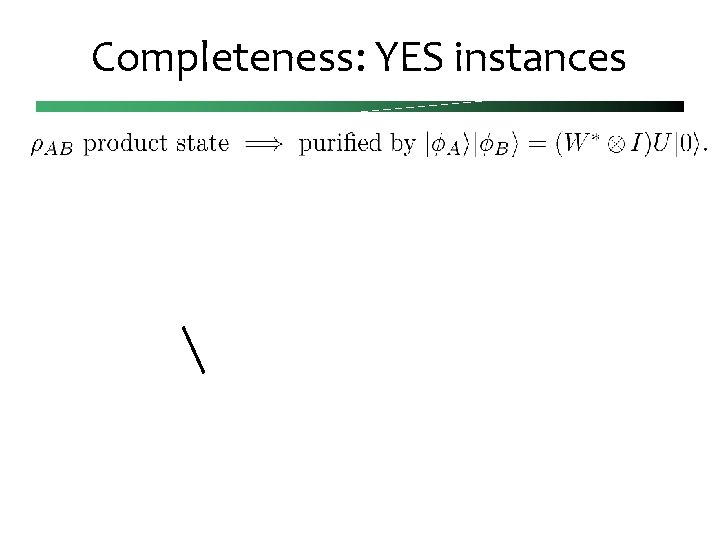
Completeness: YES instances
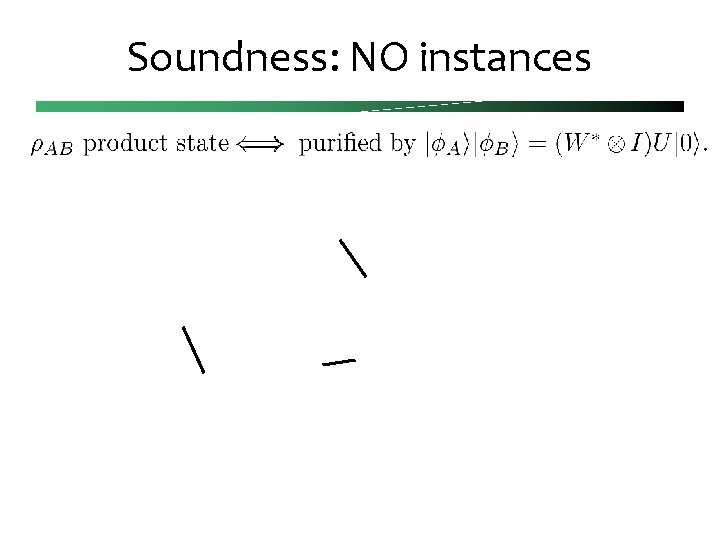
Soundness: NO instances
Zero-knowledge (YES instances): Verifier can simulate prover output
QPROD-STATE is QSZK-hard
Reduction from co-QSD to QPROD-STATE
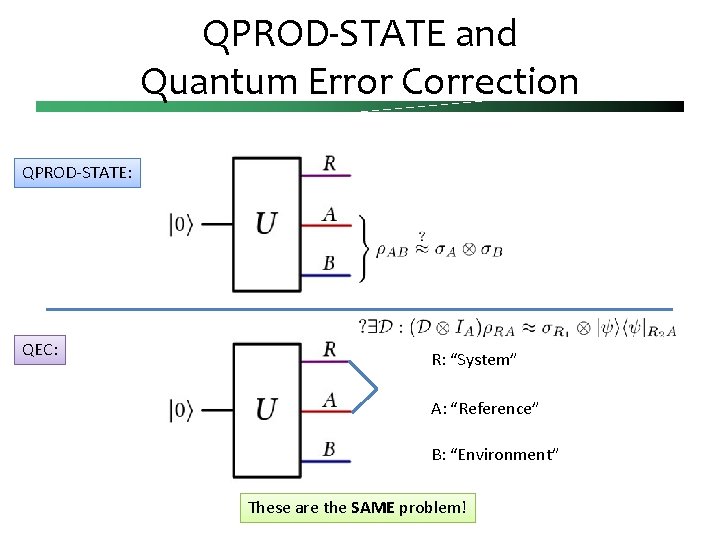
QPROD-STATE and Quantum Error Correction QPROD-STATE: QEC: R: “System” A: “Reference” B: “Environment” These are the SAME problem!
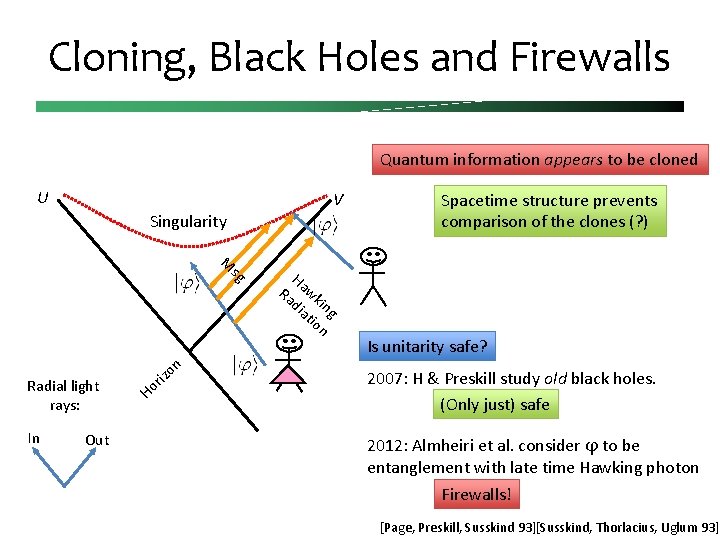
Cloning, Black Holes and Firewalls Quantum information appears to be cloned U V Singularity M sg n Radial light rays: In Out Ho o riz H Ra awk di ing at io n Spacetime structure prevents comparison of the clones (? ) Is unitarity safe? 2007: H & Preskill study old black holes. (Only just) safe 2012: Almheiri et al. consider φ to be entanglement with late time Hawking photon Firewalls! [Page, Preskill, Susskind 93][Susskind, Thorlacius, Uglum 93]
Cloning, Black Holes and Firewalls U Singularity V φ φ n Radial light rays: In Out Ho o riz Ea Ha rly Ra wk di ing at io n If infalling Bob is to experience the vacuum as he crosses the horizon, φ must be in infalling Hawking partner. If black hole entropy is to decrease, φ must be present in early Hawking radiation. But has cloning really occurred? Do two copies of φ exist? To test, Bob would need to decode (QEC) the early Hawking radiation: QSZK-hard but BH lifetime is poly(# qubits). 2012: Almheiri et al. consider φ to be entanglement with late time Hawking photon Firewalls! [Page, Preskill, Susskind 93][Susskind, Thorlacius, Uglum 93]
Results: States Pure state circuit Product output? Trace distance BQP-complete Mixed state circuit Product output? Trace distance QSZK-complete Mixed state circuit Separable output? 1 -LOCC distance NP-hard QSZK-hard In QIP(2)
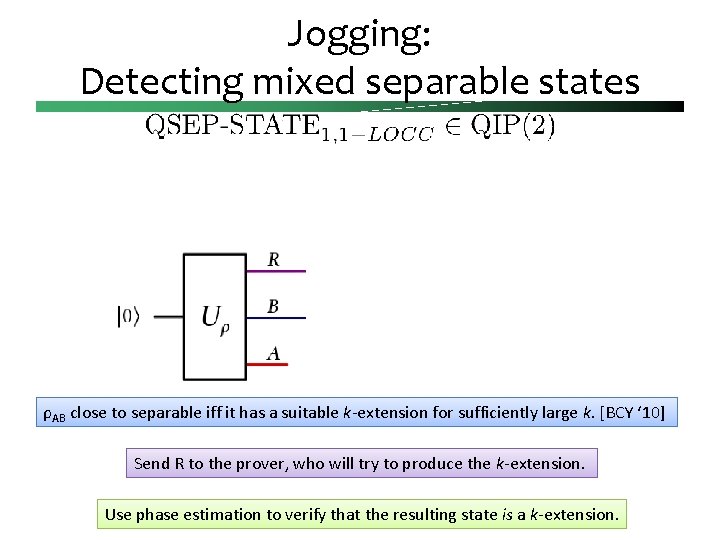
Jogging: Detecting mixed separable states ρAB close to separable iff it has a suitable k-extension for sufficiently large k. [BCY ‘ 10] Send R to the prover, who will try to produce the k-extension. Use phase estimation to verify that the resulting state is a k-extension.
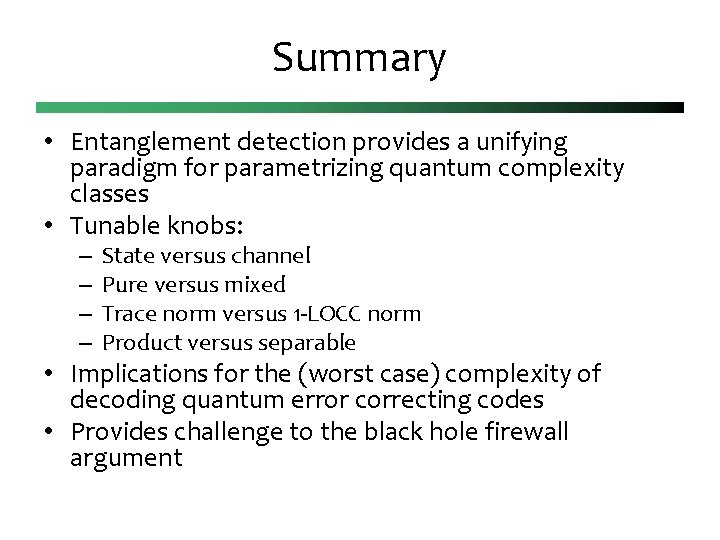
Summary • Entanglement detection provides a unifying paradigm for parametrizing quantum complexity classes • Tunable knobs: – – State versus channel Pure versus mixed Trace norm versus 1 -LOCC norm Product versus separable • Implications for the (worst case) complexity of decoding quantum error correcting codes • Provides challenge to the black hole firewall argument
Entanglement detection: The platonic ideal α NO α YES β
Complexity of QSEP-STATE? Who knows?
Soundness: NO instances