
The Compressor Concurrent Incremental and Parallel Compaction Haim
![Related Work l l Numerous concurrent and parallel garbage collectors. Copying collectors [Cheney 70]](https://slidetodoc.com/presentation_image/a7a0ea713be039c76f8b74559992f825/image-25.jpg "Related Work l l Numerous concurrent and parallel garbage collectors. Copying collectors [Cheney 70]")

- Slides: 28
The Compressor: Concurrent, Incremental and Parallel Compaction. Haim Kermany and Erez Petrank Technion – Israel Institute of Technology 1
The Compressor l l l The first compactor with one heap pass. Fully compacts all the objects in the heap. Preserves the order of the objects. Low space overhead. A parallel version and a concurrent version. 2
Garbage collection l Automatic memory management. l l User allocates objects Memory manager reclaims objects which “are not needed anymore”. In practice: unreachable from roots. 3
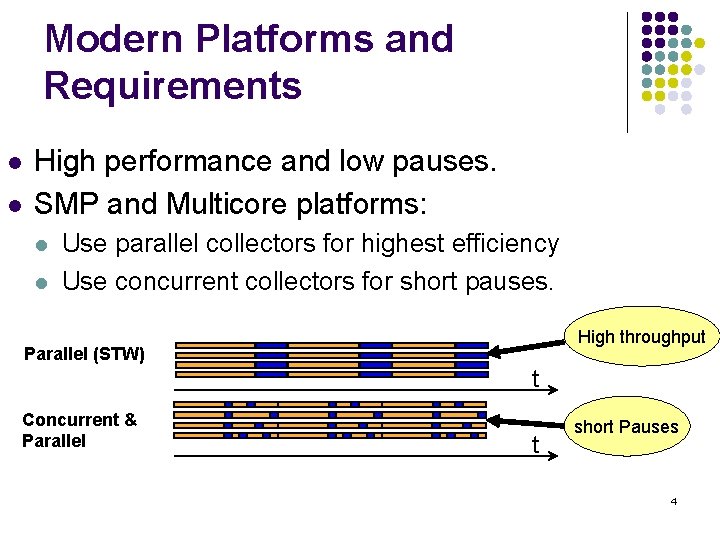
Modern Platforms and Requirements l l High performance and low pauses. SMP and Multicore platforms: l l Use parallel collectors for highest efficiency Use concurrent collectors for short pauses. High throughput Parallel (STW) t Concurrent & Parallel t short Pauses 4
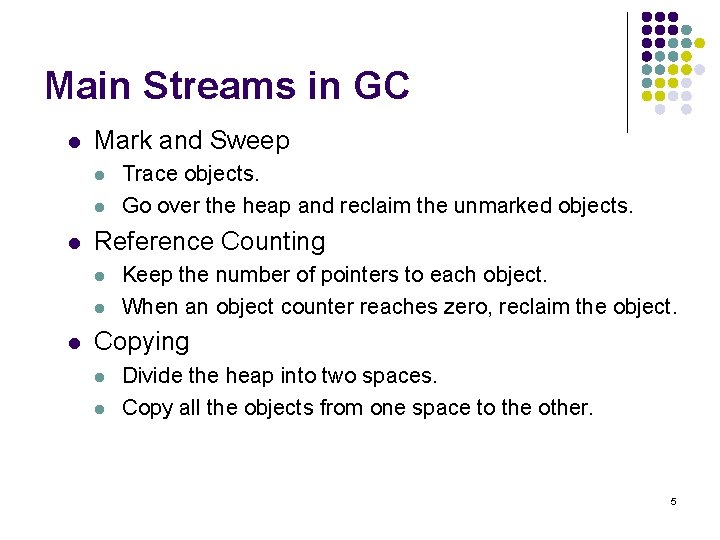
Main Streams in GC l Mark and Sweep l l l Reference Counting l l l Trace objects. Go over the heap and reclaim the unmarked objects. Keep the number of pointers to each object. When an object counter reaches zero, reclaim the object. Copying l l Divide the heap into two spaces. Copy all the objects from one space to the other. 5
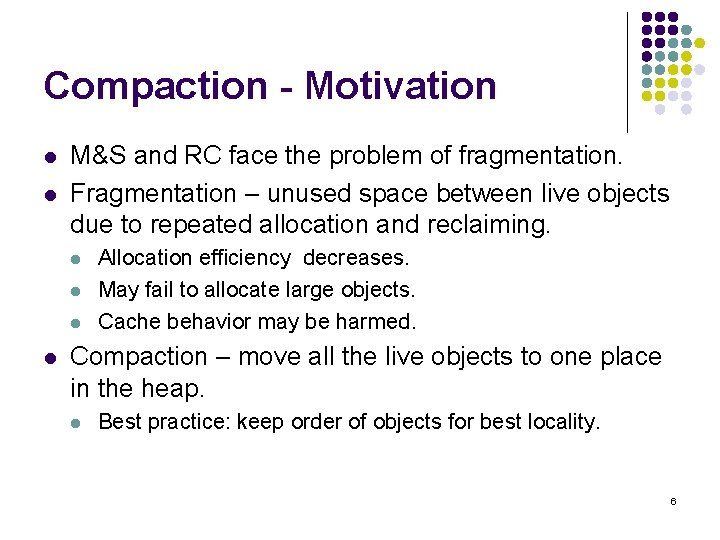
Compaction - Motivation l l M&S and RC face the problem of fragmentation. Fragmentation – unused space between live objects due to repeated allocation and reclaiming. l l Allocation efficiency decreases. May fail to allocate large objects. Cache behavior may be harmed. Compaction – move all the live objects to one place in the heap. l Best practice: keep order of objects for best locality. 6
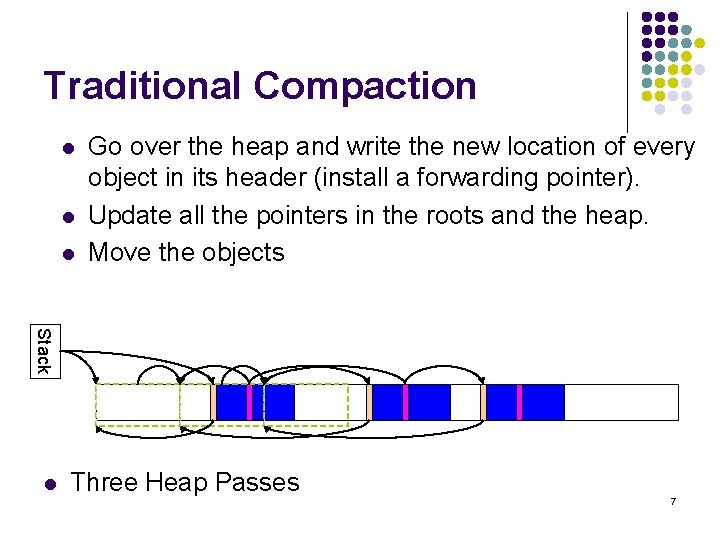
Traditional Compaction l l l Go over the heap and write the new location of every object in its header (install a forwarding pointer). Update all the pointers in the roots and the heap. Move the objects Stack l Three Heap Passes 7
Agenda l l Introduction: garbage collection, servers, compaction. The Compressor: l l l Basic technique l Obtain compaction with a single heap pass. The parallel version. The concurrent version. Measurements Related Work. Conclusion 8
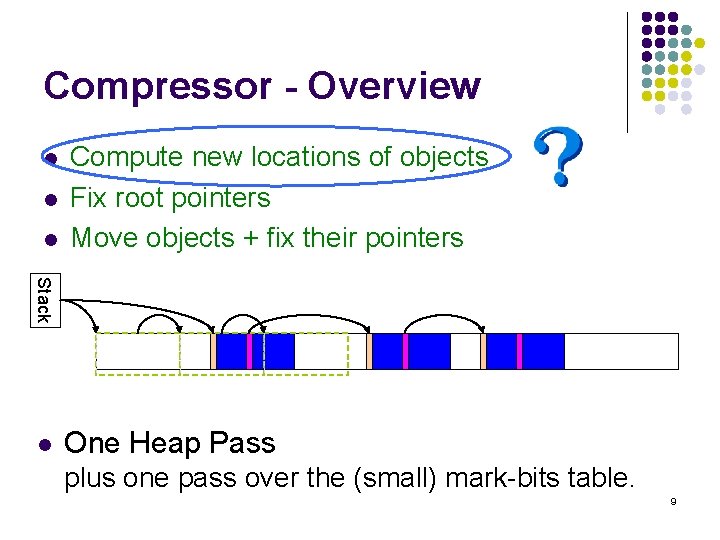
Compressor - Overview l l l Compute new locations of objects Fix root pointers Move objects + fix their pointers Stack l One Heap Pass plus one pass over the (small) mark-bits table. 9
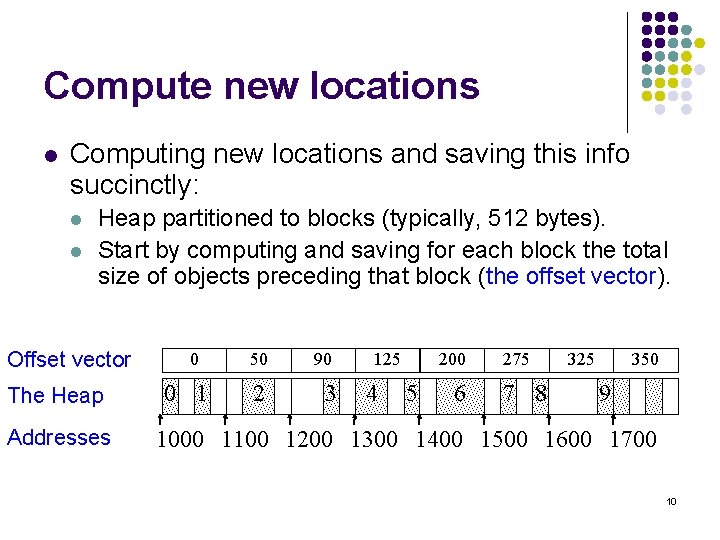
Compute new locations l Computing new locations and saving this info succinctly: l l Heap partitioned to blocks (typically, 512 bytes). Start by computing and saving for each block the total size of objects preceding that block (the offset vector). Offset vector The Heap Addresses 0 0 1 50 90 2 3 125 4 200 5 6 275 7 8 325 350 9 1000 1100 1200 1300 1400 1500 1600 1700 10
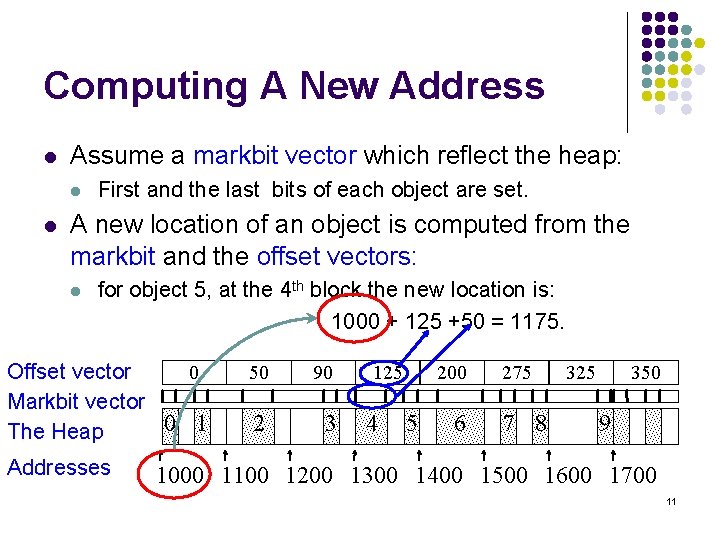
Computing A New Address l Assume a markbit vector which reflect the heap: l l First and the last bits of each object are set. A new location of an object is computed from the markbit and the offset vectors: l for object 5, at the 4 th block the new location is: 1000 + 125 +50 = 1175. Offset vector 0 Markbit vector 0 1 The Heap Addresses 50 90 2 3 125 4 200 5 6 275 7 8 325 350 9 1000 1100 1200 1300 1400 1500 1600 1700 11
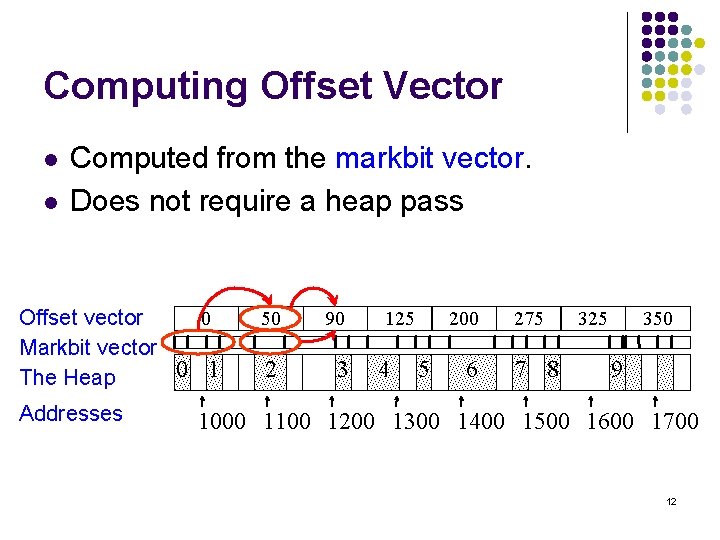
Computing Offset Vector l l Computed from the markbit vector. Does not require a heap pass Offset vector 0 Markbit vector 0 1 The Heap Addresses 50 90 2 3 125 4 200 5 6 275 7 8 325 350 9 1000 1100 1200 1300 1400 1500 1600 1700 12
Properties Single heap pass. Plus one pass over the markbit vector. Small space overhead. Does not need a forwarding pointer. Single threaded. Stop-the-world. l Next: l l A parallel stop-the-world (STW) version. A concurrent version. 13
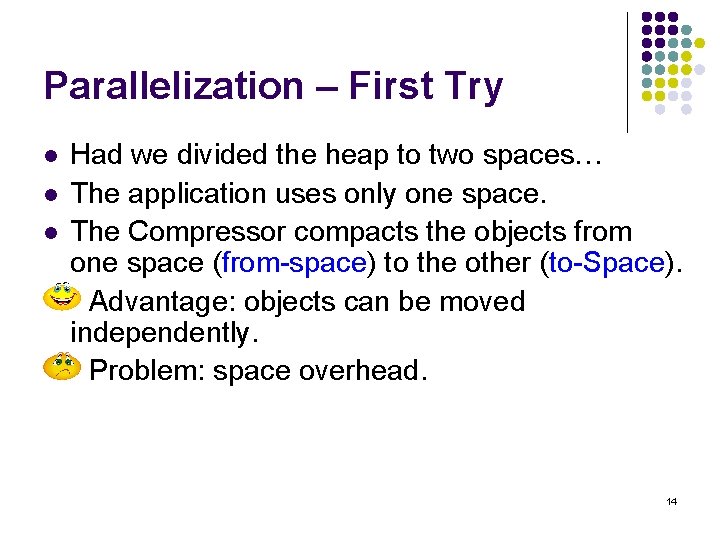
Parallelization – First Try l l l Had we divided the heap to two spaces… The application uses only one space. The Compressor compacts the objects from one space (from-space) to the other (to-Space). Advantage: objects can be moved independently. Problem: space overhead. 14
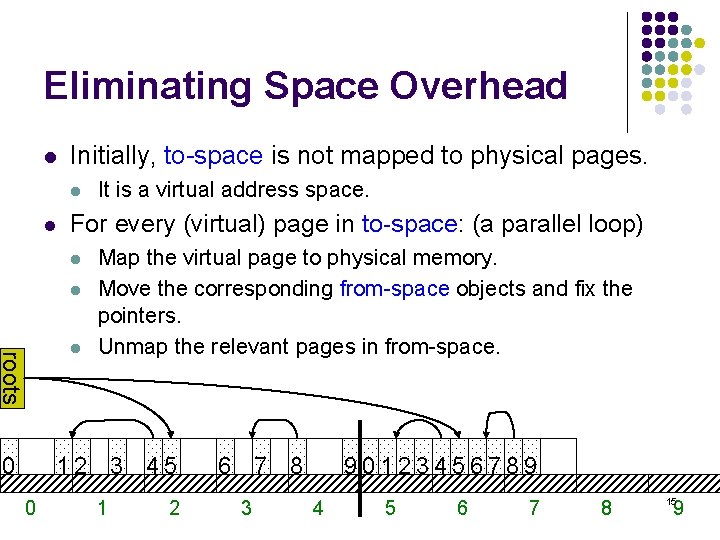
Eliminating Space Overhead l Initially, to-space is not mapped to physical pages. l l For every (virtual) page in to-space: (a parallel loop) l l ro o t s l 0 It is a virtual address space. Map the virtual page to physical memory. Move the corresponding from-space objects and fix the pointers. Unmap the relevant pages in from-space. 12 3 45 0 1 2 6 7 8 3 90123456789 4 5 6 7 8 15 9
Properties All virtues of basic Compressor: Single heap pass, small space overhead. Easy parallelization: each to-space page can be handled independently. Stop-The-World. 16
What about Concurrency? l l l Problem: two copies appear when moving objects during application run. Sync. problems between compaction and application. Solution (Baker style): Application can only access moved objects (in to-space). 17
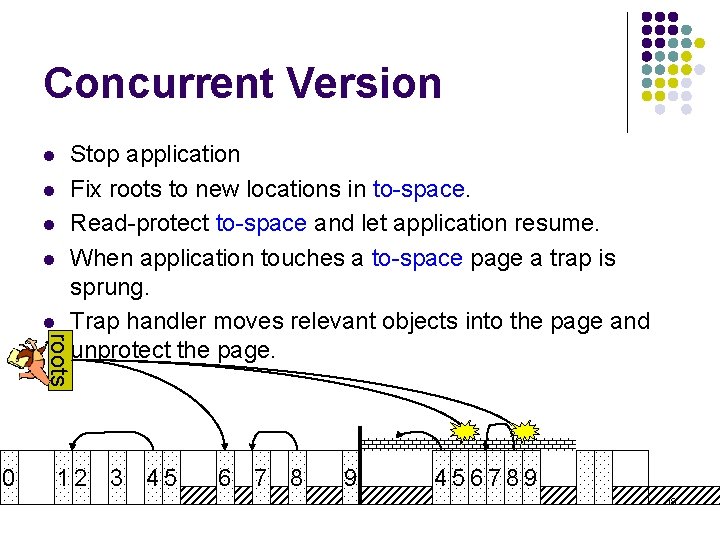
Concurrent Version l l l ro o t s Stop application Fix roots to new locations in to-space. Read-protect to-space and let application resume. When application touches a to-space page a trap is sprung. Trap handler moves relevant objects into the page and unprotect the page. 0 12 3 45 6 7 8 9 456789 18
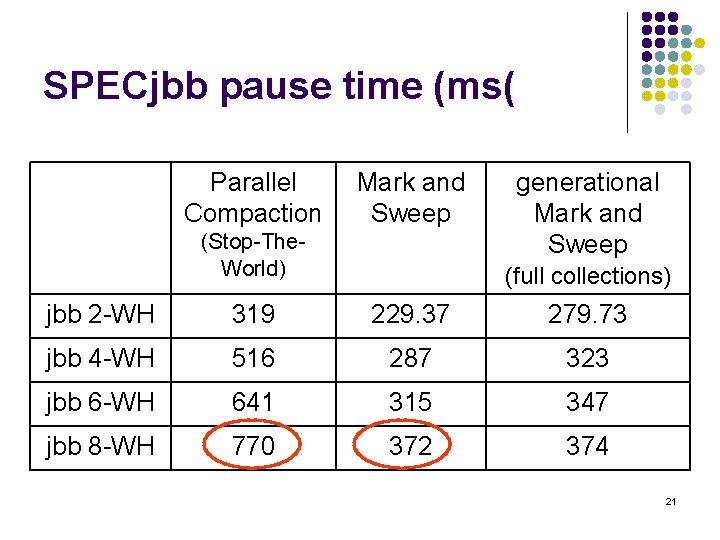
Implementation & Measurements l l Implementation on the Jikes RVM. Compressor added to a simple modification of the Jikes mark-sweep collector (main modification: allocation via local-caches). l l Benchmarks: SPECjbb, Dacapo, SPECjvm 98. l l Compressor invoked once every 10 collections. In the talk we concentrate on SPECjbb Compared collectors: l l no compaction algorithms on the Jikes RVM. Some comparison to mark-sweep (MS) and an Appel Generational collector (Gen. MS). 19
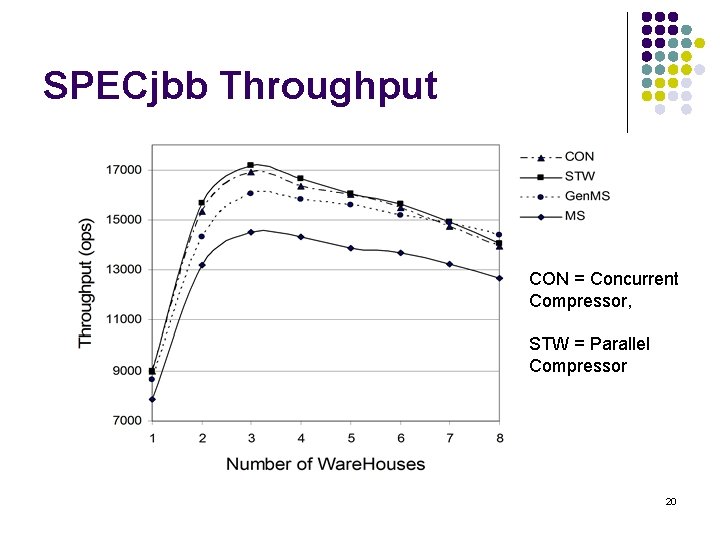
SPECjbb Throughput CON = Concurrent Compressor, STW = Parallel Compressor 20
SPECjbb pause time (ms( Parallel Compaction Mark and Sweep (Stop-The. World) generational Mark and Sweep (full collections) jbb 2 -WH 319 229. 37 279. 73 jbb 4 -WH 516 287 323 jbb 6 -WH 641 315 347 jbb 8 -WH 770 372 374 21
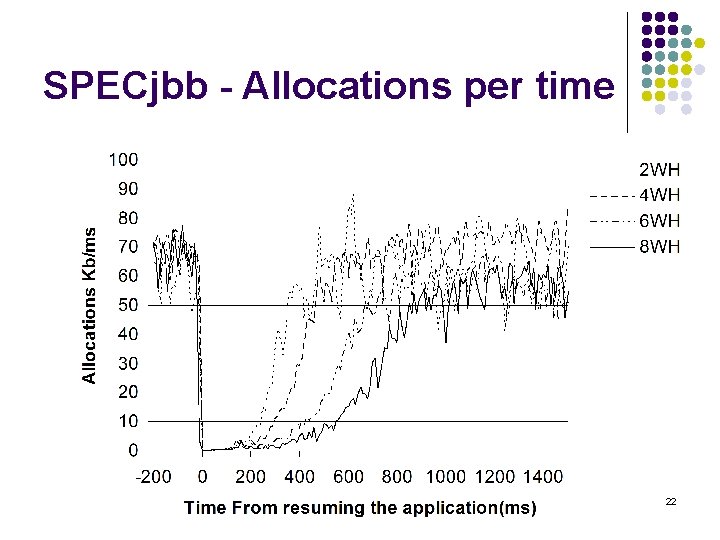
SPECjbb - Allocations per time 22
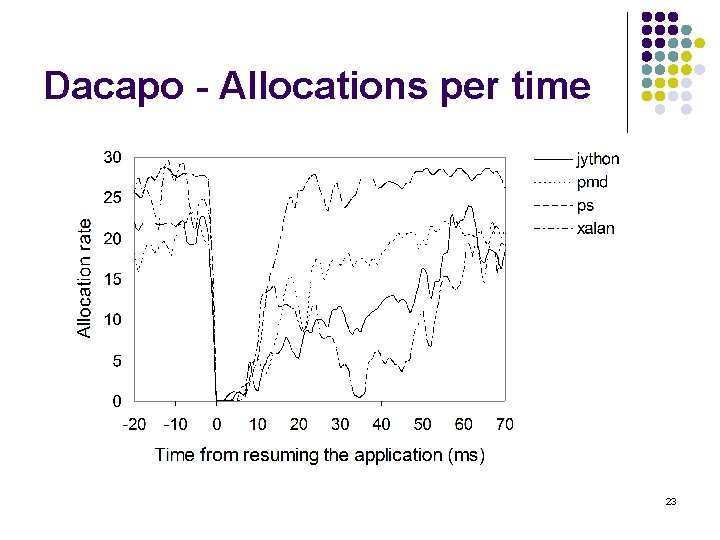
Dacapo - Allocations per time 23
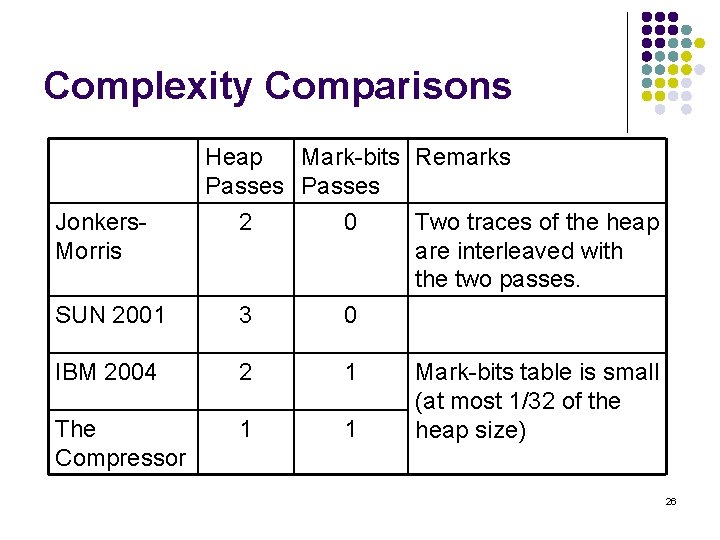
Previous Work on Compaction l l Early works: Two-finger, Lisp 2, and the threaded algorithm [Jonkers and Morris] are single threaded and therefore create a large pause time. [Flood et al. 2001] first parallel compaction algorithms. But has 3 heap passes and creates several dense areas. [Abuaiadh et al. 2004] Parallel with two heap passes, not concurrent. [Ossia et al. 2004] execute the pointer fix-up part concurrently. 24
Related Work l l Numerous concurrent and parallel garbage collectors. Copying collectors [Cheney 70] compact objects during the collection but require a large space overhead and do not retain objects order. Savings in space overhead for copying collectors [Sachindran and Moss 2004] [Bacon et al. 2003, Click et al. 2005] propose an incremental compaction. But it uses a read barrier, and does not keep the order of objects. 25
Complexity Comparisons Heap Mark-bits Remarks Passes Jonkers. Morris 2 0 SUN 2001 3 0 IBM 2004 2 1 The Compressor 1 1 Two traces of the heap are interleaved with the two passes. Mark-bits table is small (at most 1/32 of the heap size) 26
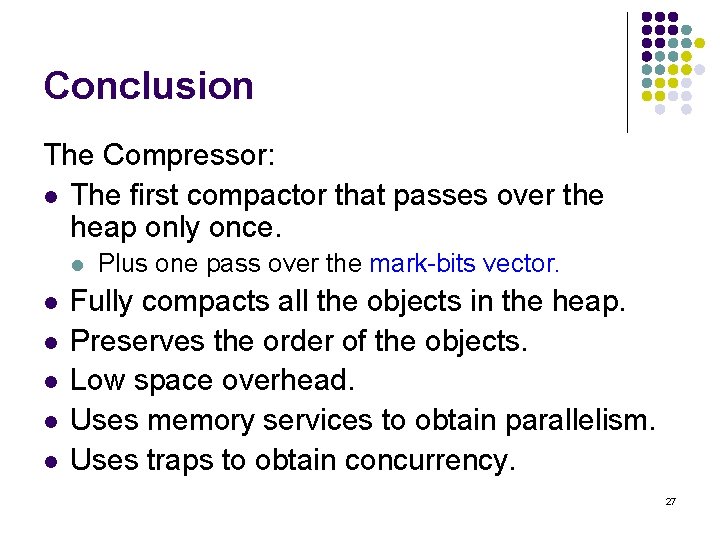
Conclusion The Compressor: l The first compactor that passes over the heap only once. l l l Plus one pass over the mark-bits vector. Fully compacts all the objects in the heap. Preserves the order of the objects. Low space overhead. Uses memory services to obtain parallelism. Uses traps to obtain concurrency. 27
Questions 28