
The Components of An Architecture for DSS 20201027


- Slides: 50
The Components of An Architecture for DSS 2020/10/27 Decision Support Systems 1
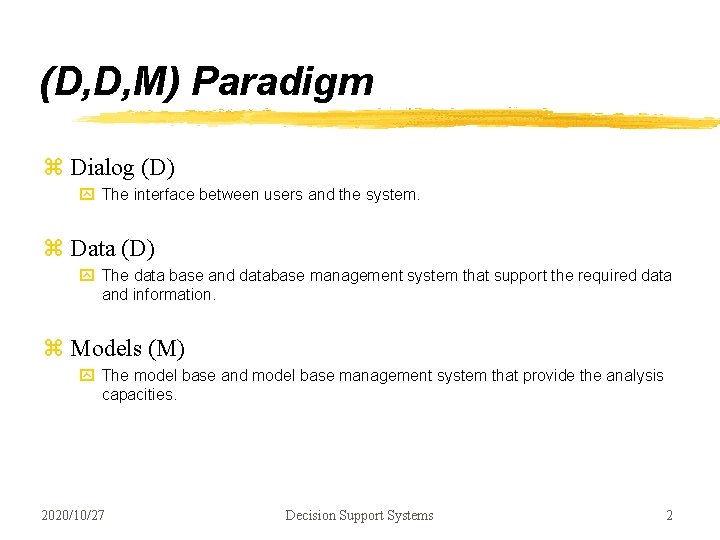
(D, D, M) Paradigm z Dialog (D) y The interface between users and the system. z Data (D) y The data base and database management system that support the required data and information. z Models (M) y The model base and model base management system that provide the analysis capacities. 2020/10/27 Decision Support Systems 2
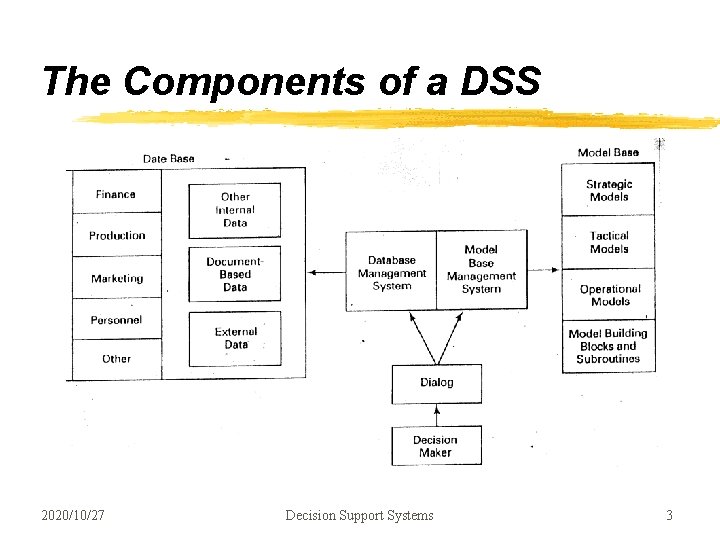
The Components of a DSS 2020/10/27 Decision Support Systems 3
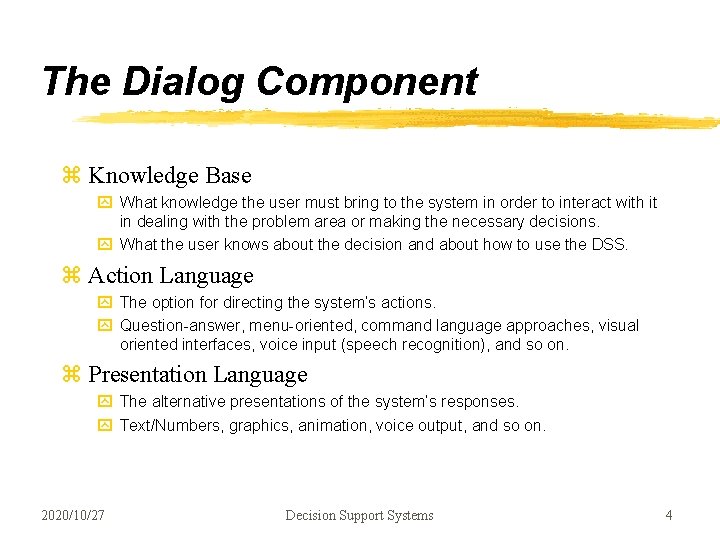
The Dialog Component z Knowledge Base y What knowledge the user must bring to the system in order to interact with it in dealing with the problem area or making the necessary decisions. y What the user knows about the decision and about how to use the DSS. z Action Language y The option for directing the system’s actions. y Question-answer, menu-oriented, command language approaches, visual oriented interfaces, voice input (speech recognition), and so on. z Presentation Language y The alternative presentations of the system’s responses. y Text/Numbers, graphics, animation, voice output, and so on. 2020/10/27 Decision Support Systems 4
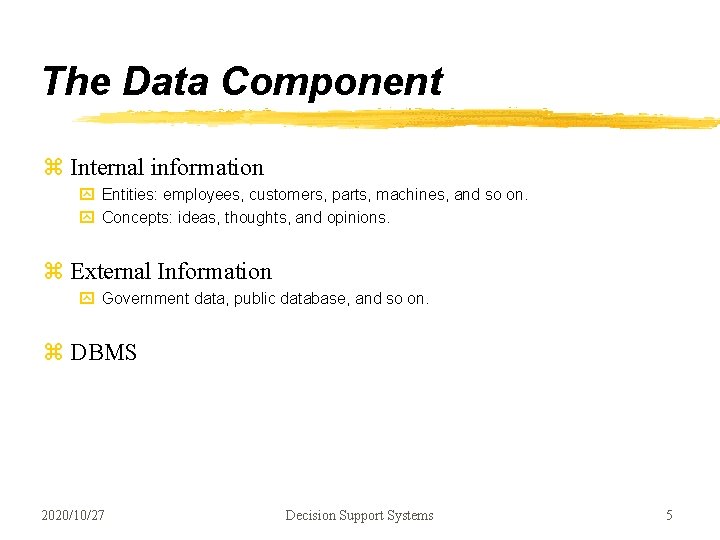
The Data Component z Internal information y Entities: employees, customers, parts, machines, and so on. y Concepts: ideas, thoughts, and opinions. z External Information y Government data, public database, and so on. z DBMS 2020/10/27 Decision Support Systems 5
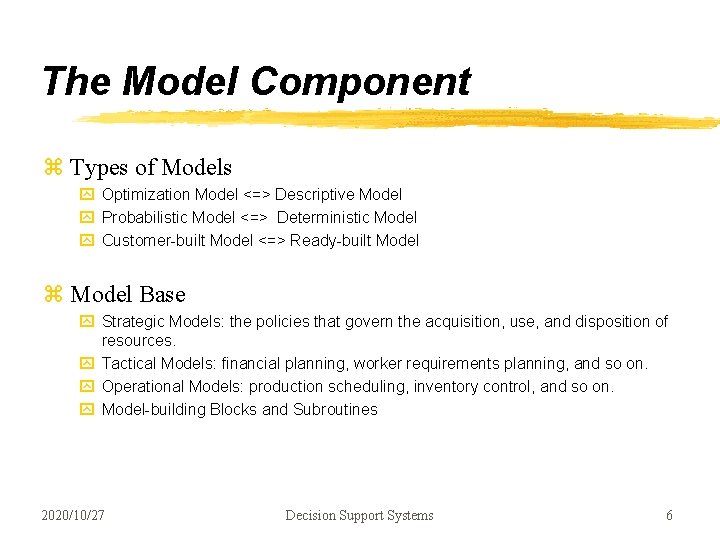
The Model Component z Types of Models y Optimization Model <=> Descriptive Model y Probabilistic Model <=> Deterministic Model y Customer-built Model <=> Ready-built Model z Model Base y Strategic Models: the policies that govern the acquisition, use, and disposition of resources. y Tactical Models: financial planning, worker requirements planning, and so on. y Operational Models: production scheduling, inventory control, and so on. y Model-building Blocks and Subroutines 2020/10/27 Decision Support Systems 6
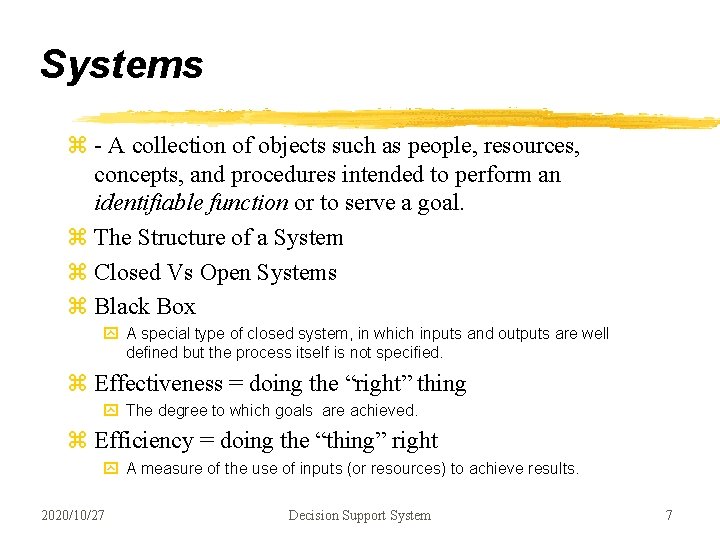
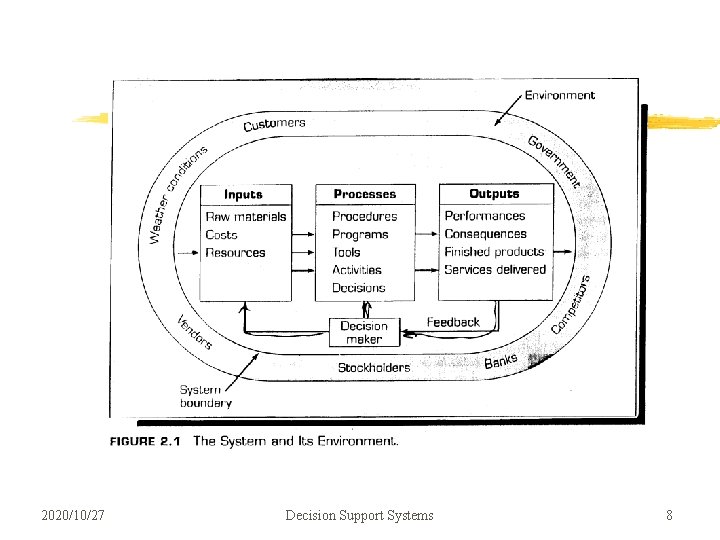
Systems z - A collection of objects such as people, resources, concepts, and procedures intended to perform an identifiable function or to serve a goal. z The Structure of a System z Closed Vs Open Systems z Black Box y A special type of closed system, in which inputs and outputs are well defined but the process itself is not specified. z Effectiveness = doing the “right” thing y The degree to which goals are achieved. z Efficiency = doing the “thing” right y A measure of the use of inputs (or resources) to achieve results. 2020/10/27 Decision Support System 7
2020/10/27 Decision Support Systems 8
Models z - Simplified representation or abstraction of reality. y Simplified y Representative y Keep relevant to the specific problem z Types of Models y Iconic (Scale) Models: ex. physical replica y Analog Models: ex. graphics, simulation/animation y Mathematical (Quantitative) Models 2020/10/27 Decision Support System 9
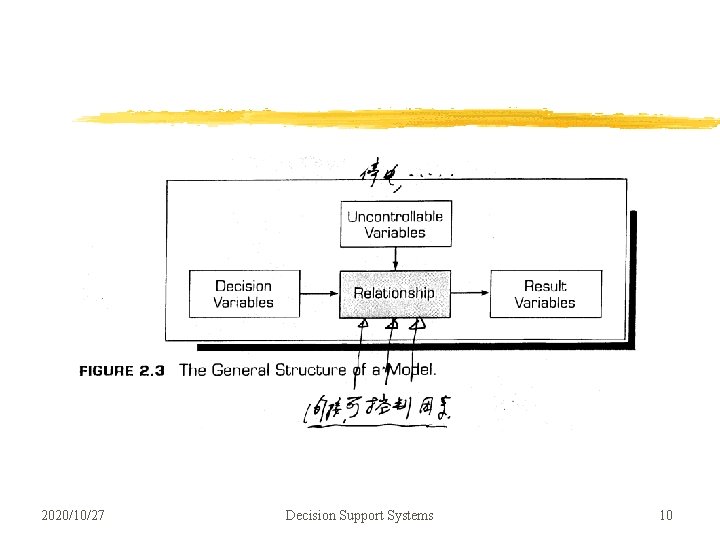
2020/10/27 Decision Support Systems 10
Modeling and Model Management z Types of Models y Statistical/Regression Analysis y Financial y Optimization z Some Aspects y y Identification of the Problem and Environmental Analysis Identification of the Variables Forecasting Models x Which to include, too many, or not enough? y Model Management 2020/10/27 Decision Support Systems 11
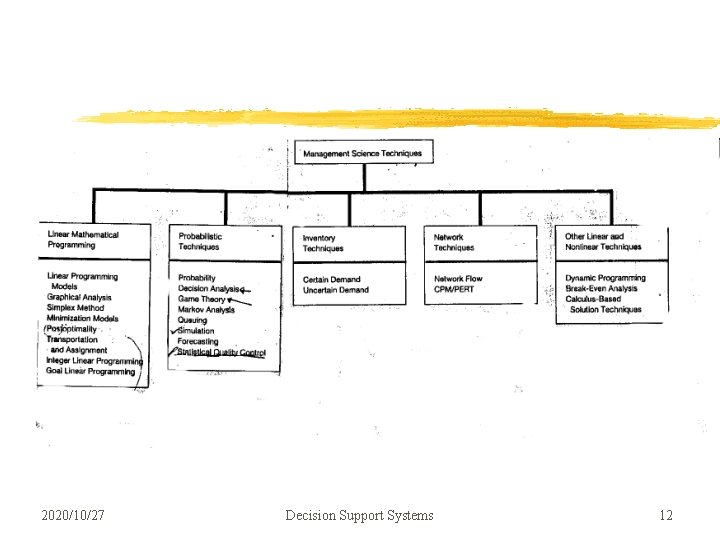
2020/10/27 Decision Support Systems 12
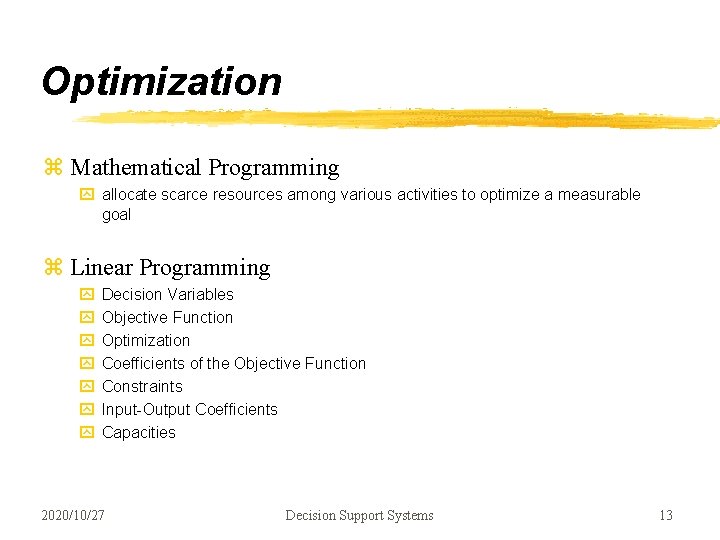
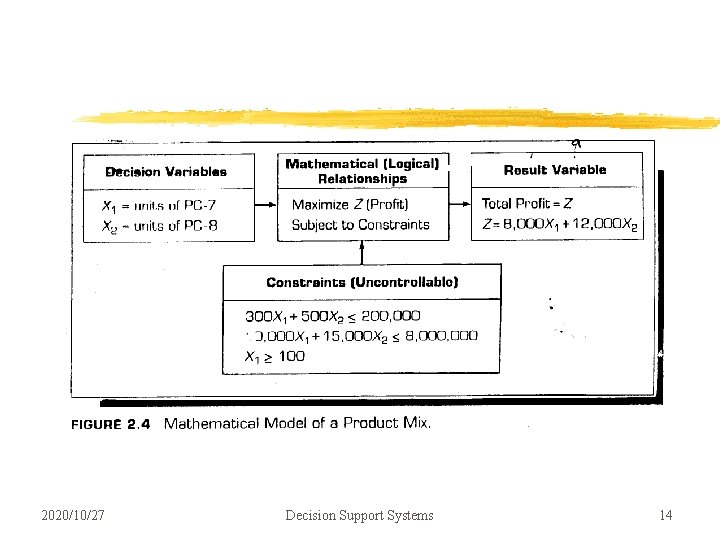
Optimization z Mathematical Programming y allocate scarce resources among various activities to optimize a measurable goal z Linear Programming y y y y Decision Variables Objective Function Optimization Coefficients of the Objective Function Constraints Input-Output Coefficients Capacities 2020/10/27 Decision Support Systems 13
2020/10/27 Decision Support Systems 14
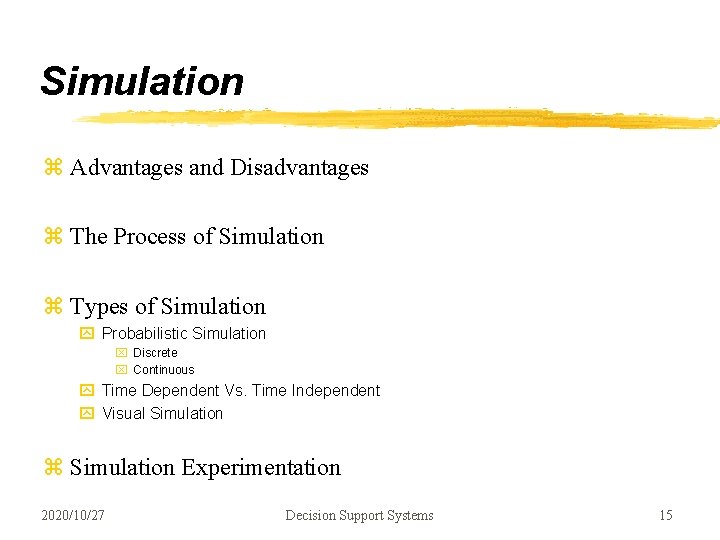
Simulation z Advantages and Disadvantages z The Process of Simulation z Types of Simulation y Probabilistic Simulation x Discrete x Continuous y Time Dependent Vs. Time Independent y Visual Simulation z Simulation Experimentation 2020/10/27 Decision Support Systems 15
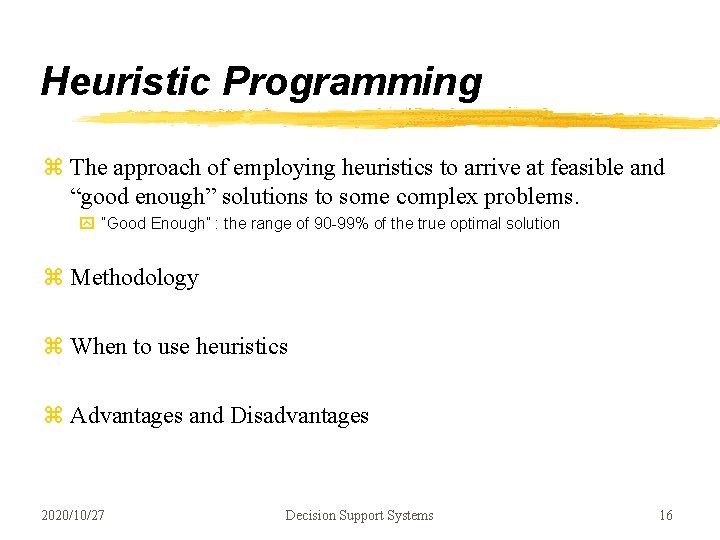
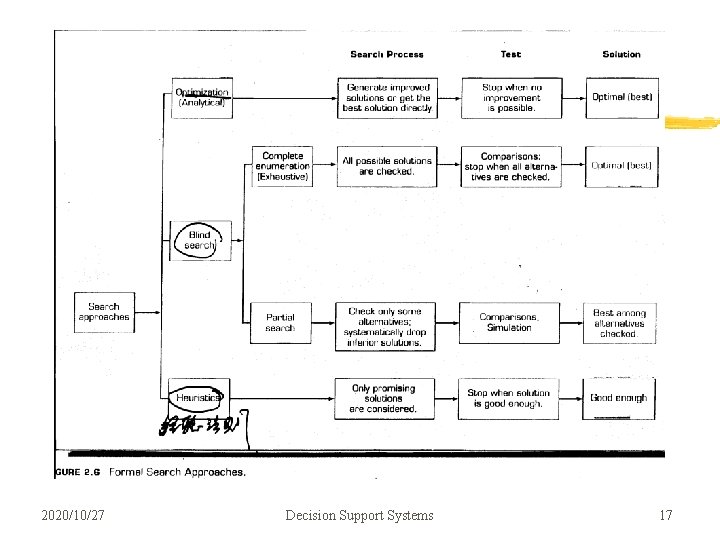
Heuristic Programming z The approach of employing heuristics to arrive at feasible and “good enough” solutions to some complex problems. y “Good Enough” : the range of 90 -99% of the true optimal solution z Methodology z When to use heuristics z Advantages and Disadvantages 2020/10/27 Decision Support Systems 16
2020/10/27 Decision Support Systems 17
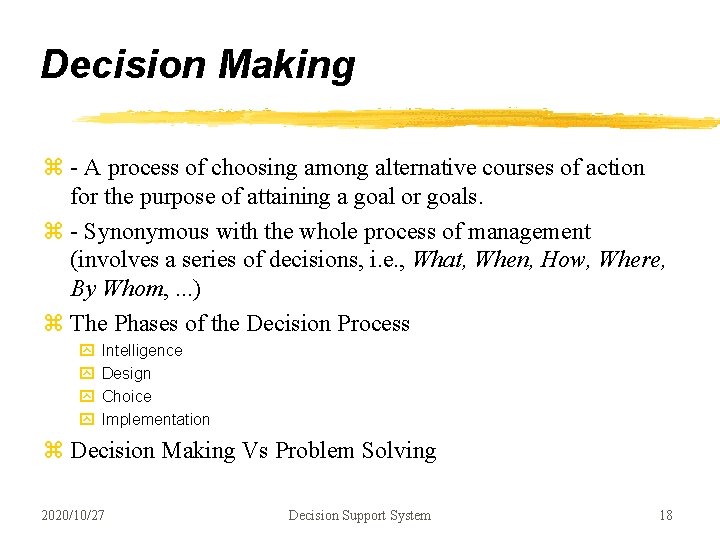
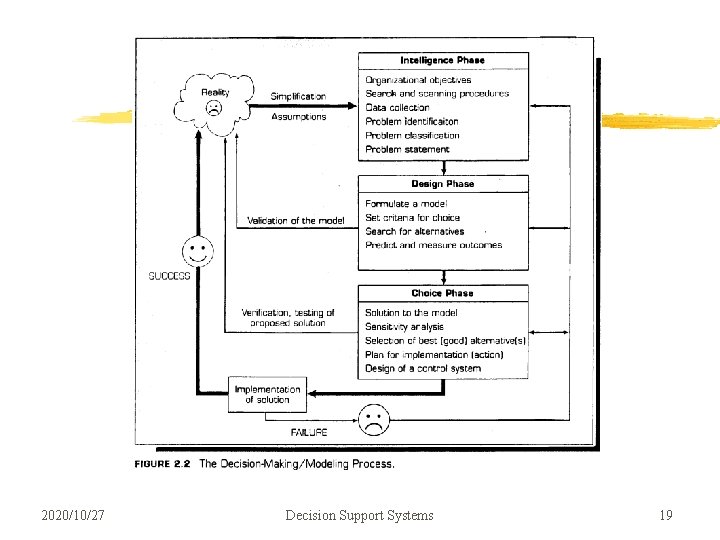
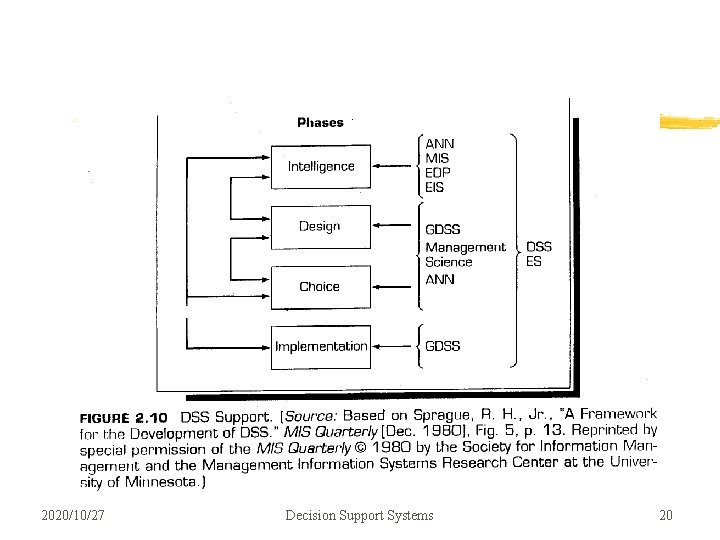
Decision Making z - A process of choosing among alternative courses of action for the purpose of attaining a goal or goals. z - Synonymous with the whole process of management (involves a series of decisions, i. e. , What, When, How, Where, By Whom, . . . ) z The Phases of the Decision Process y y Intelligence Design Choice Implementation z Decision Making Vs Problem Solving 2020/10/27 Decision Support System 18
2020/10/27 Decision Support Systems 19
2020/10/27 Decision Support Systems 20
Decision Analysis of Few Alternatives z Decision Tables y y y Maximax Maximin Equal Likelihood Hurwicz Minimax Regret EOL/EVPI z Decision Tree 2020/10/27 Decision Support Systems 21
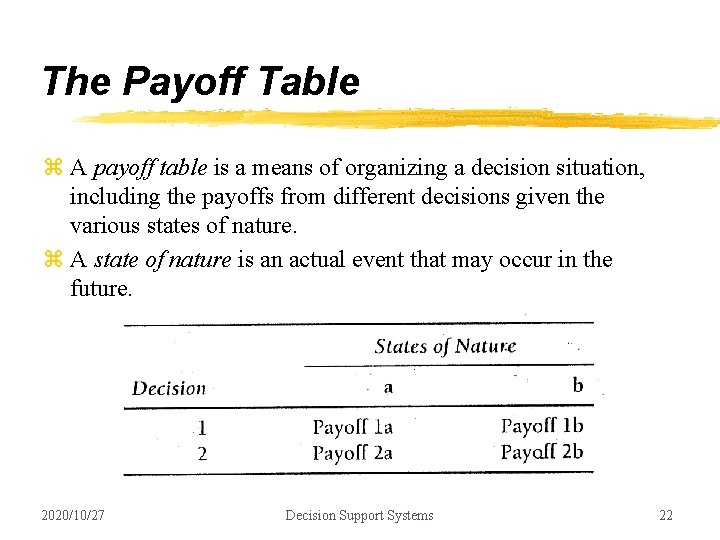
The Payoff Table z A payoff table is a means of organizing a decision situation, including the payoffs from different decisions given the various states of nature. z A state of nature is an actual event that may occur in the future. 2020/10/27 Decision Support Systems 22
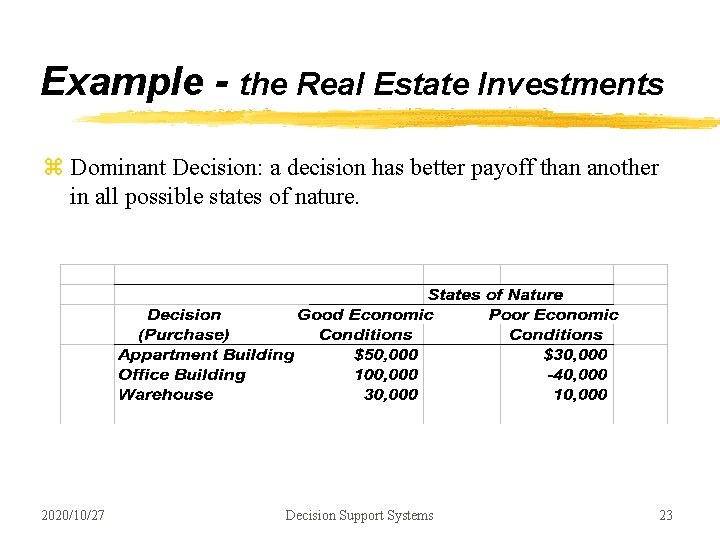
Example - the Real Estate Investments z Dominant Decision: a decision has better payoff than another in all possible states of nature. 2020/10/27 Decision Support Systems 23
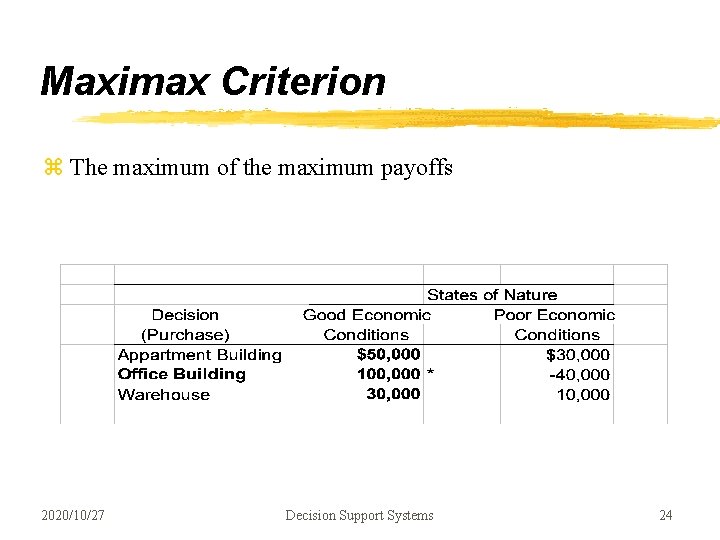
Maximax Criterion z The maximum of the maximum payoffs 2020/10/27 Decision Support Systems 24
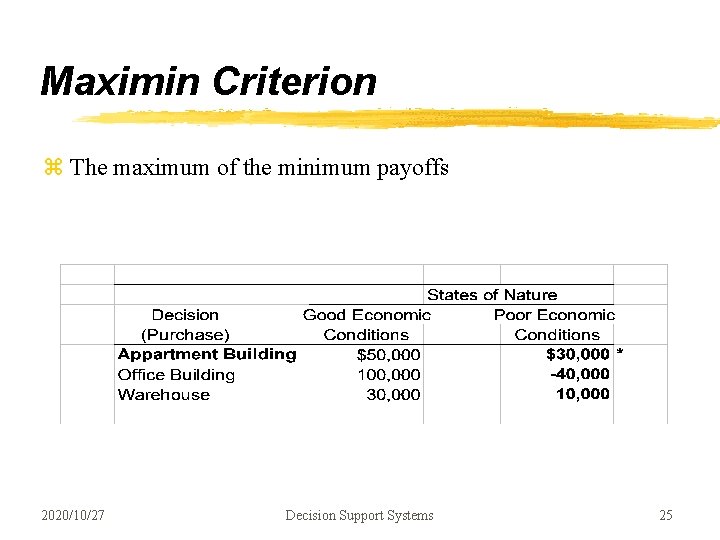
Maximin Criterion z The maximum of the minimum payoffs 2020/10/27 Decision Support Systems 25
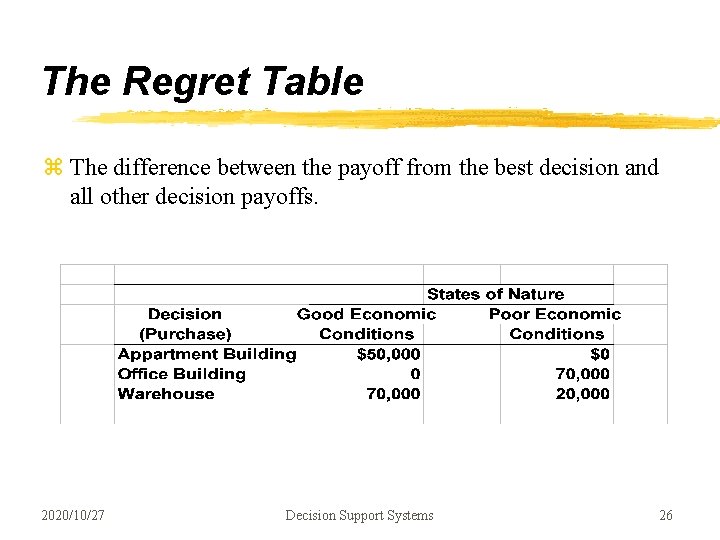
The Regret Table z The difference between the payoff from the best decision and all other decision payoffs. 2020/10/27 Decision Support Systems 26
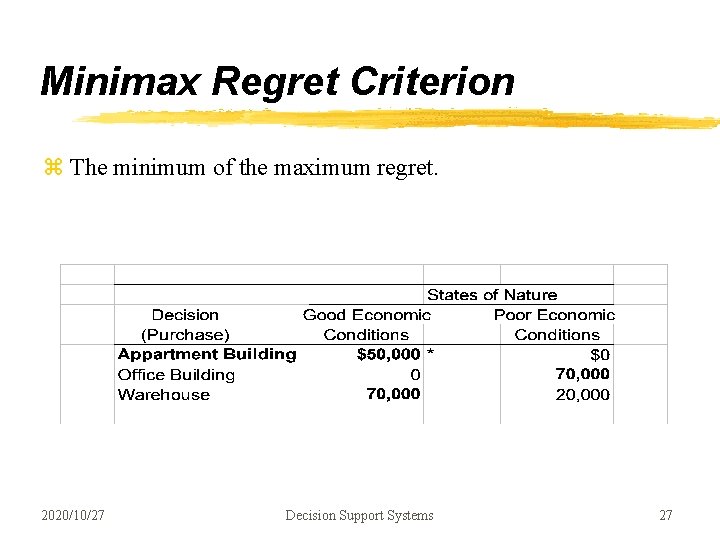
Minimax Regret Criterion z The minimum of the maximum regret. 2020/10/27 Decision Support Systems 27
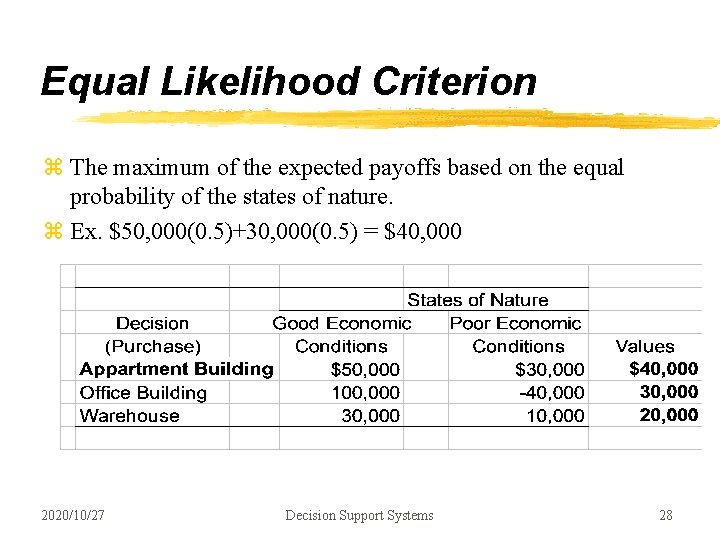
Equal Likelihood Criterion z The maximum of the expected payoffs based on the equal probability of the states of nature. z Ex. $50, 000(0. 5)+30, 000(0. 5) = $40, 000 2020/10/27 Decision Support Systems 28
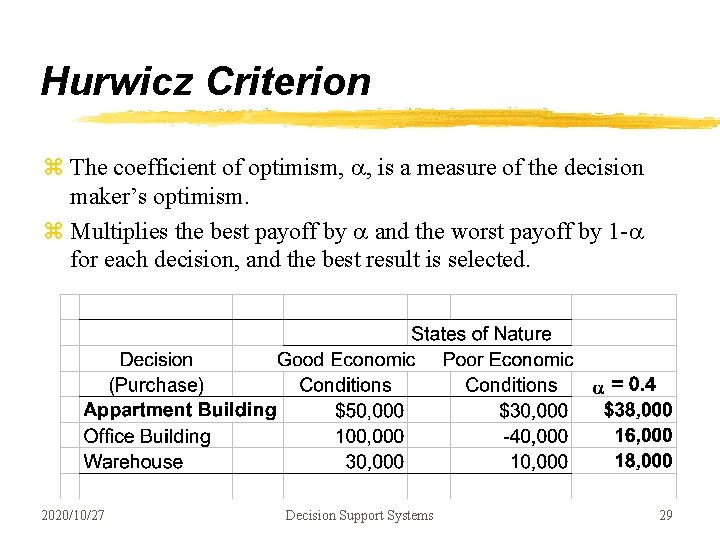
Hurwicz Criterion z The coefficient of optimism, a, is a measure of the decision maker’s optimism. z Multiplies the best payoff by a and the worst payoff by 1 -a for each decision, and the best result is selected. 2020/10/27 Decision Support Systems 29
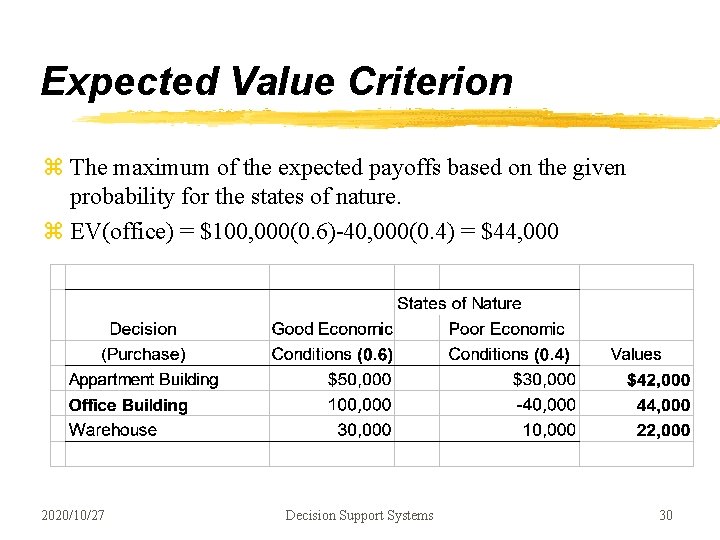
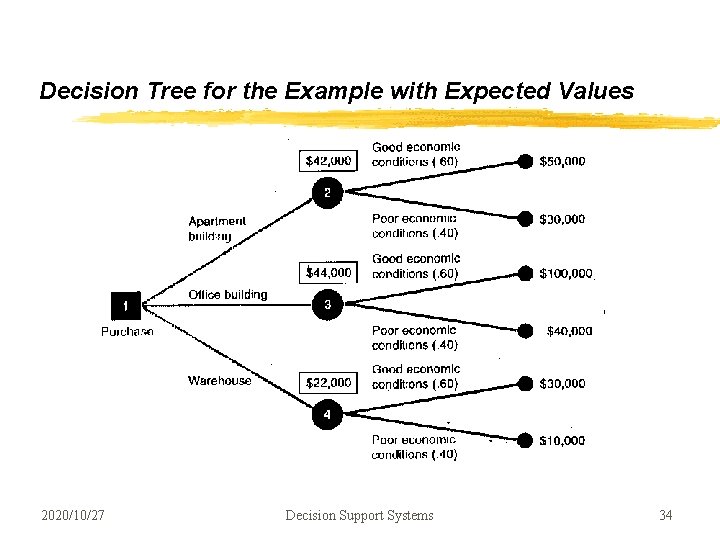
Expected Value Criterion z The maximum of the expected payoffs based on the given probability for the states of nature. z EV(office) = $100, 000(0. 6)-40, 000(0. 4) = $44, 000 2020/10/27 Decision Support Systems 30
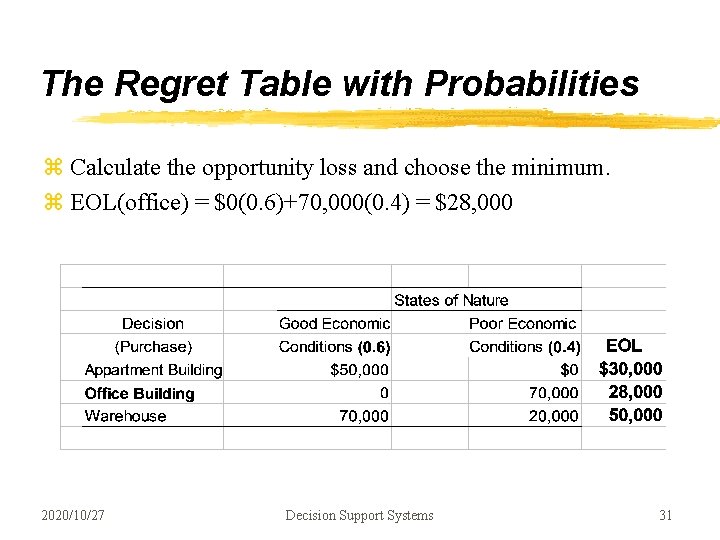
The Regret Table with Probabilities z Calculate the opportunity loss and choose the minimum. z EOL(office) = $0(0. 6)+70, 000(0. 4) = $28, 000 2020/10/27 Decision Support Systems 31
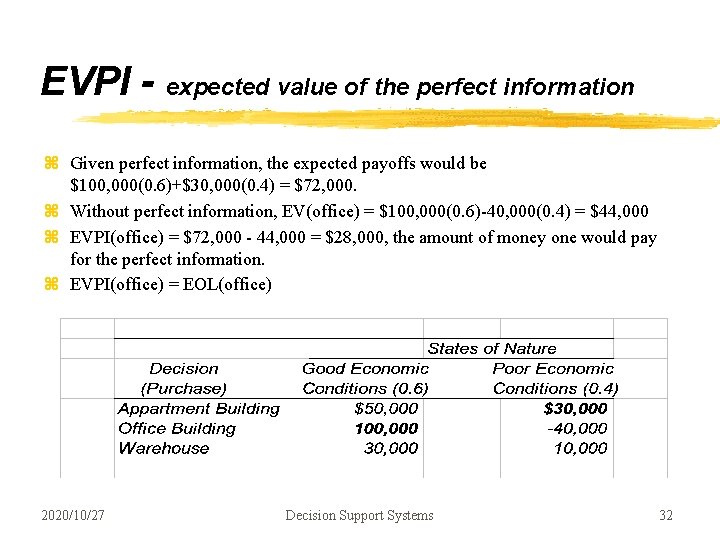
EVPI - expected value of the perfect information z Given perfect information, the expected payoffs would be $100, 000(0. 6)+$30, 000(0. 4) = $72, 000. z Without perfect information, EV(office) = $100, 000(0. 6)-40, 000(0. 4) = $44, 000 z EVPI(office) = $72, 000 - 44, 000 = $28, 000, the amount of money one would pay for the perfect information. z EVPI(office) = EOL(office) 2020/10/27 Decision Support Systems 32
Decision Tree for the Example z A decision tree is a diagram consisting of square decision nodes, circle probability nodes, and branches representing decision alternatives. 2020/10/27 Decision Support Systems 33
Decision Tree for the Example with Expected Values 2020/10/27 Decision Support Systems 34
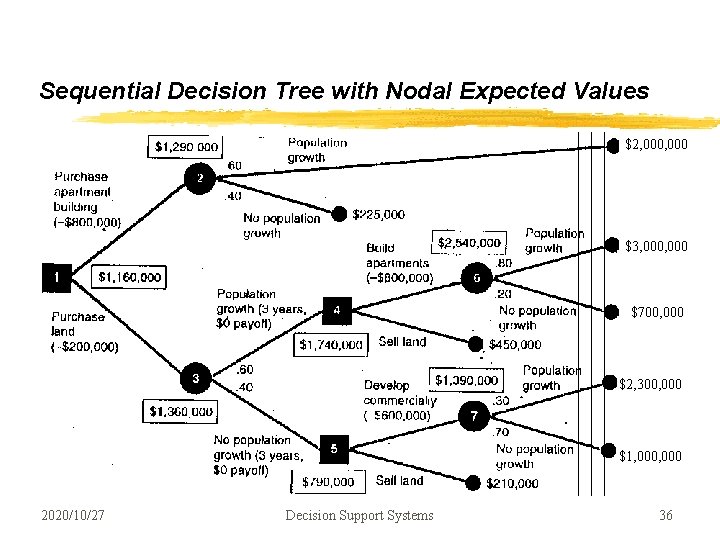
Sequential Decision Tree $2, 000 $3, 000 $700, 000 $2, 300, 000 $1, 000 2020/10/27 Decision Support Systems 35
Sequential Decision Tree with Nodal Expected Values $2, 000 $3, 000 $700, 000 $2, 300, 000 $1, 000 2020/10/27 Decision Support Systems 36
Analytic Hierarchy Process z A multiobjective multicriteria decision-making approach which employs a pairwise comparison procedure to arrive at a scale of preferences among sets of alternatives. 2020/10/27 Decision Support Systems 37
Why AHP ? z Deriving Weights (Priorities) for a set of activities according to importance. z Multiple Criteria z Multiple Objectives z A single overall priority for all activities z Tradeoffs, Fuzziness, and no unified scale of measurement 2020/10/27 Decision Support Systems 38
Assumption of AHP z The methods we use to pursue knowledge, to predict, and to control our world are relative, and that the goal that we seek, i. e. , knowledge, is itself relative. z It admits inconsistency (including lack of transitivity) and measures the effect of different levels of consistency on the results we seek. z “Perceived constraints must be examined and not taken for granted - the only hope we have to plan our way out of difficult problems” 2020/10/27 Decision Support Systems 39
AHP z Causal Processes y an action is described as an event with particular outcomes. y Cause -> Event (Outcome) z Purposive Action Processes y Action -> Event (outcome) -> Consequences y The actor makes his choice of actions through his perception of the consequences that the outcomes will have for him. z The AHP synthesizes these two approaches by identifying the outcomes that are more beneficial to the actors, and at the same time provides a way of accessing the factors (causes) which may have more to do with certain types of outcomes. 2020/10/27 Decision Support Systems 40
Applications of the AHP (1/2) z Setting Priorities z Generating a Set of Alternatives z Choosing a Best Policy Alternative z Determining Requirements z Making Decisions Using Benefits and Costs z Allocating Resources z Predicting Outcomes (Time Dependence) - Risk Assessment 2020/10/27 Decision Support Systems 41
Applications of the AHP (2/2) z Measuring Performance z Designing a System z Ensuring System Stability z Optimizing z Planning z Conflict Resolution 2020/10/27 Decision Support Systems 42
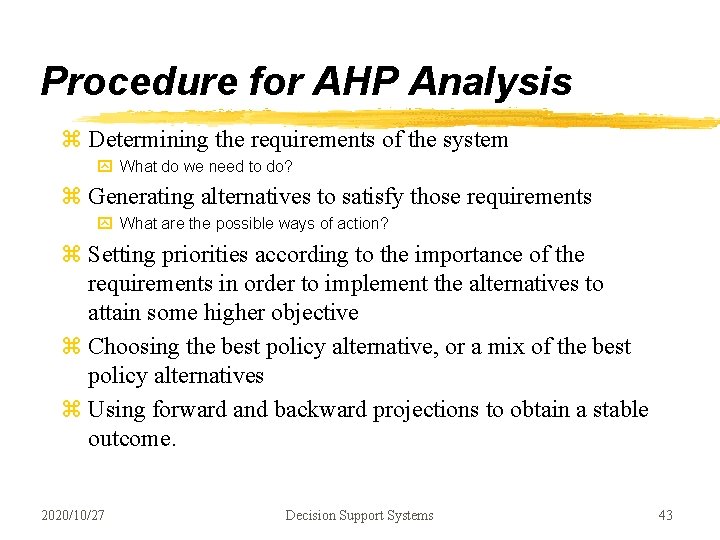
Procedure for AHP Analysis z Determining the requirements of the system y What do we need to do? z Generating alternatives to satisfy those requirements y What are the possible ways of action? z Setting priorities according to the importance of the requirements in order to implement the alternatives to attain some higher objective z Choosing the best policy alternative, or a mix of the best policy alternatives z Using forward and backward projections to obtain a stable outcome. 2020/10/27 Decision Support Systems 43
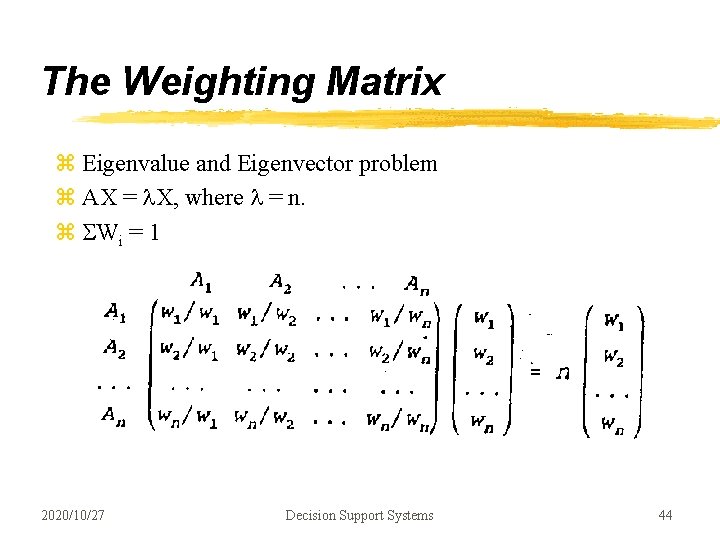
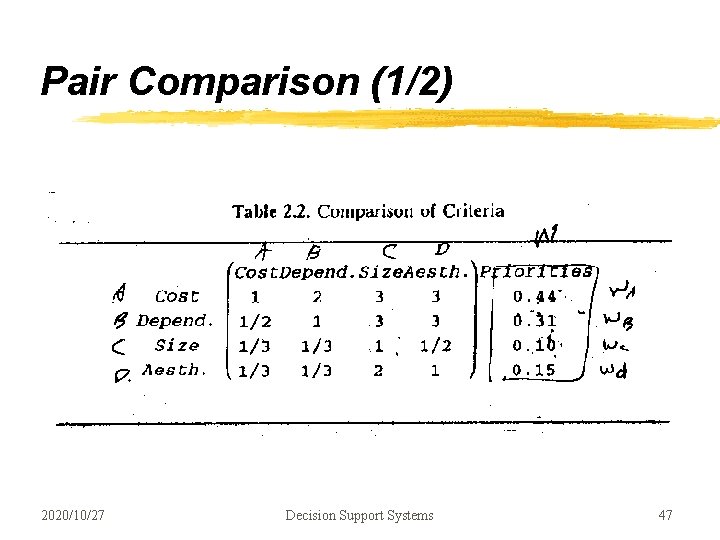
The Weighting Matrix z Eigenvalue and Eigenvector problem z AX = l. X, where l = n. z Wi = 1 2020/10/27 Decision Support Systems 44
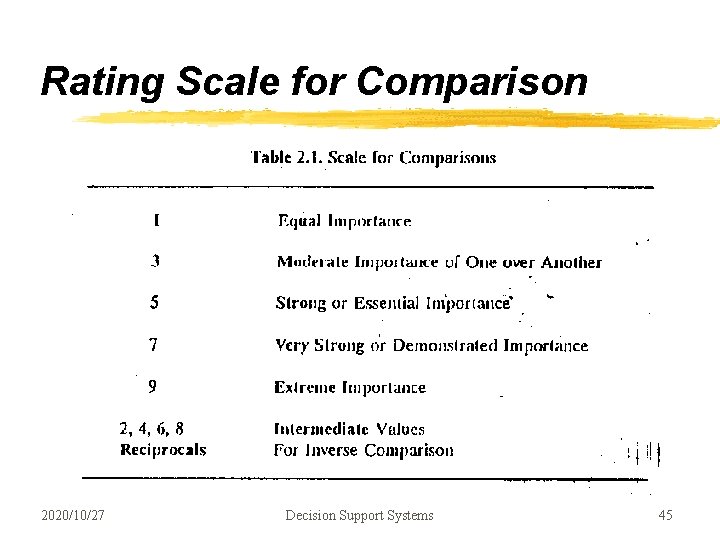
Rating Scale for Comparison 2020/10/27 Decision Support Systems 45
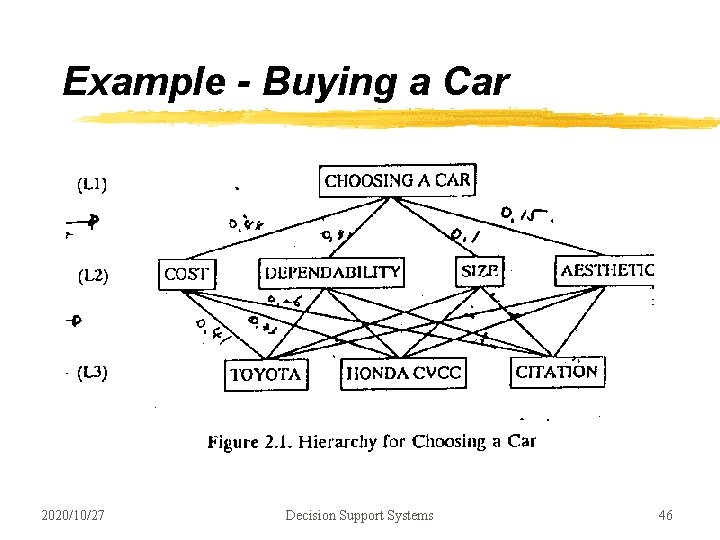
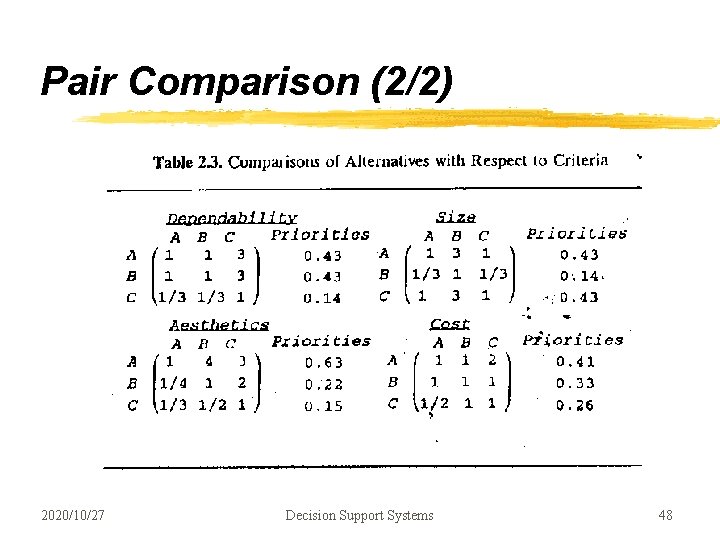
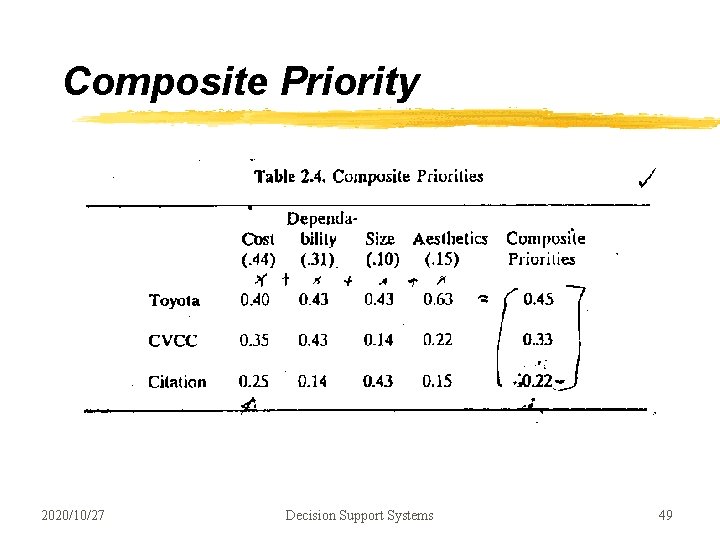
Example - Buying a Car 2020/10/27 Decision Support Systems 46
Pair Comparison (1/2) 2020/10/27 Decision Support Systems 47
Pair Comparison (2/2) 2020/10/27 Decision Support Systems 48
Composite Priority 2020/10/27 Decision Support Systems 49
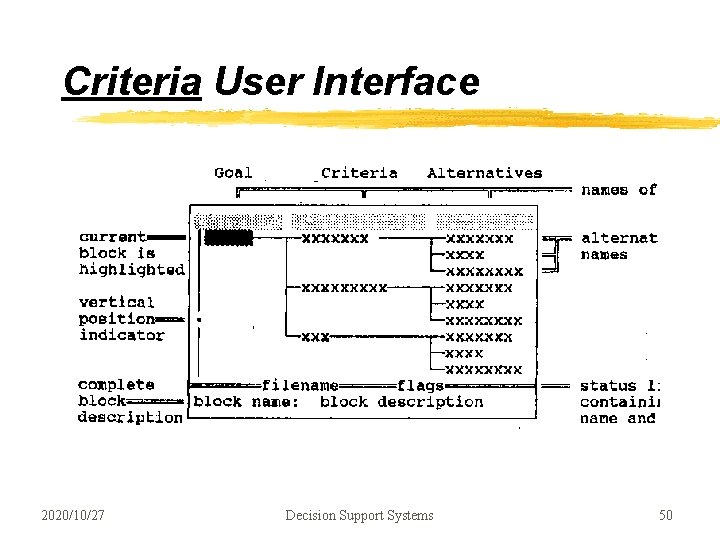
Criteria User Interface 2020/10/27 Decision Support Systems 50