
The Complexity of Unsupervised Learning Santosh Vempala Georgia


![Techniques � Random Projection [Dasgupta] Project mixture to a low-dimensional subspace to (a) make](https://slidetodoc.com/presentation_image/1c35810593ec02436f763d7f54ceccf5/image-10.jpg "Techniques � Random Projection [Dasgupta] Project mixture to a low-dimensional subspace to (a) make")
![Techniques PCA: � Use PCA once [V-Wang] � Use PCA twice [Hsu-Kakade] � Eat](https://slidetodoc.com/presentation_image/1c35810593ec02436f763d7f54ceccf5/image-12.jpg "Techniques PCA: � Use PCA once [V-Wang] � Use PCA twice [Hsu-Kakade] � Eat")
![Polynomial Algorithms I: Clustering spherical Gaussians [VW 02] �](https://slidetodoc.com/presentation_image/1c35810593ec02436f763d7f54ceccf5/image-13.jpg "Polynomial Algorithms I: Clustering spherical Gaussians [VW 02] �")
![Mixtures of Nonisotropic, Logconcave Distributions [KSV 04, AM 05] �](https://slidetodoc.com/presentation_image/1c35810593ec02436f763d7f54ceccf5/image-15.jpg "Mixtures of Nonisotropic, Logconcave Distributions [KSV 04, AM 05] �")
![Polynomial Algorithms II: Learning spherical Gaussians [HK] �](https://slidetodoc.com/presentation_image/1c35810593ec02436f763d7f54ceccf5/image-19.jpg "Polynomial Algorithms II: Learning spherical Gaussians [HK] �")
![Polynomial Algorithms III: Robust PCA for noisy mixtures [Brubaker 09] �](https://slidetodoc.com/presentation_image/1c35810593ec02436f763d7f54ceccf5/image-21.jpg "Polynomial Algorithms III: Robust PCA for noisy mixtures [Brubaker 09] �")
![Polynomial Algorithms IV: Affine-invariant clustering [BV 08] 1. 2. 3. 4. Make distribution isotropic.](https://slidetodoc.com/presentation_image/1c35810593ec02436f763d7f54ceccf5/image-23.jpg "Polynomial Algorithms IV: Affine-invariant clustering [BV 08] 1. 2. 3. 4. Make distribution isotropic.")
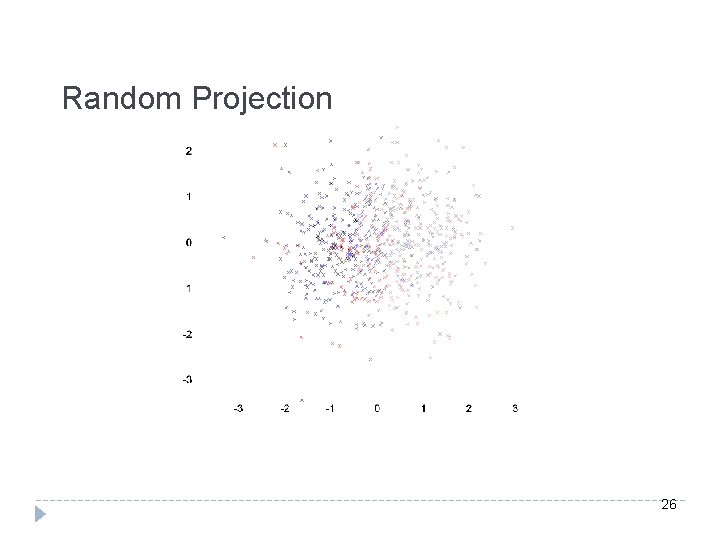
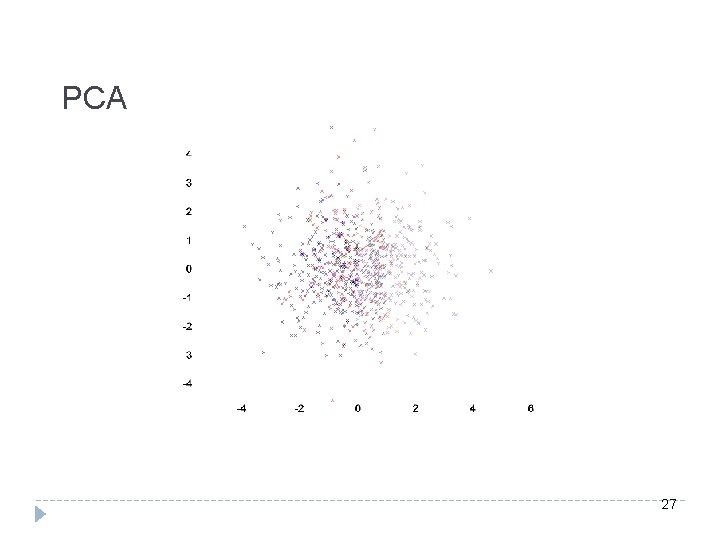
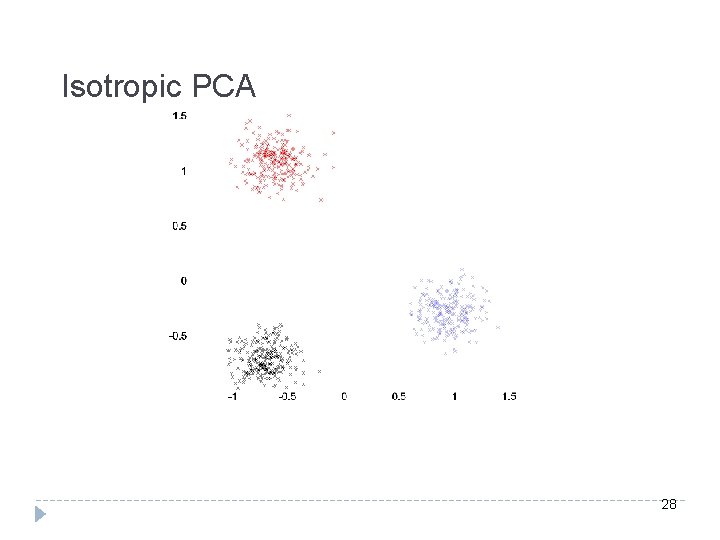
![Independent Component Analysis [Comon] �](https://slidetodoc.com/presentation_image/1c35810593ec02436f763d7f54ceccf5/image-30.jpg "Independent Component Analysis [Comon] �")
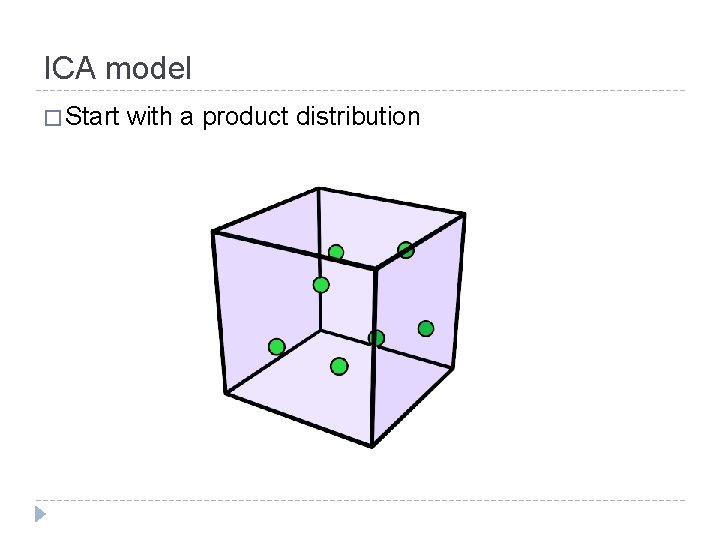
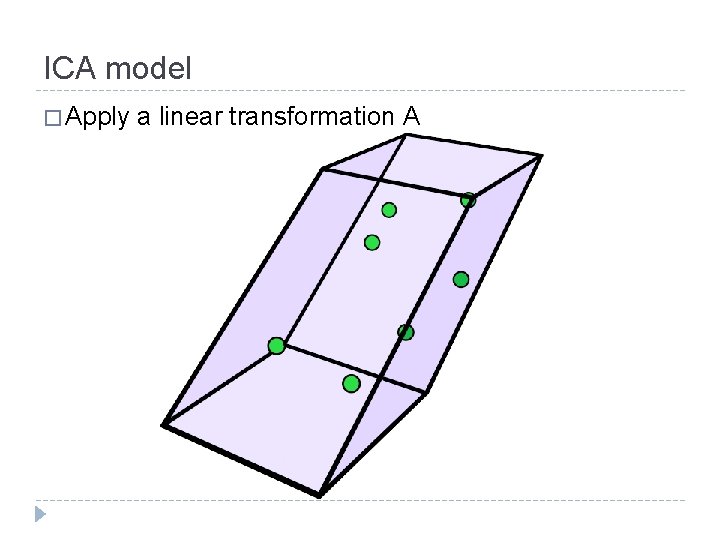
![Tensor decomposition [GVX 13] �](https://slidetodoc.com/presentation_image/1c35810593ec02436f763d7f54ceccf5/image-39.jpg "Tensor decomposition [GVX 13] �")

![Techniques � Combinatorial + SDP for even k. [A 12, BQ 09] � Subsampled](https://slidetodoc.com/presentation_image/1c35810593ec02436f763d7f54ceccf5/image-48.jpg "Techniques � Combinatorial + SDP for even k. [A 12, BQ 09] � Subsampled")
![Finding parity functions [Kearns, Blum et al] �](https://slidetodoc.com/presentation_image/1c35810593ec02436f763d7f54ceccf5/image-56.jpg "Finding parity functions [Kearns, Blum et al] �")

![Malicious Noise • Suppose E[x 12] = 2 and E[xi 2] = 1. •](https://slidetodoc.com/presentation_image/1c35810593ec02436f763d7f54ceccf5/image-67.jpg "Malicious Noise • Suppose E[x 12] = 2 and E[xi 2] = 1. •")


- Slides: 71
The Complexity of Unsupervised Learning Santosh Vempala, Georgia Tech
Unsupervised learning � Data is no longer the constraint in many settings … (imagine sophisticated images here)… � But, � How to understand it? � Make use of it? � What data to collect? � with no labels (or teachers)
Can you guess my passwords? � GMAIL MU 47286
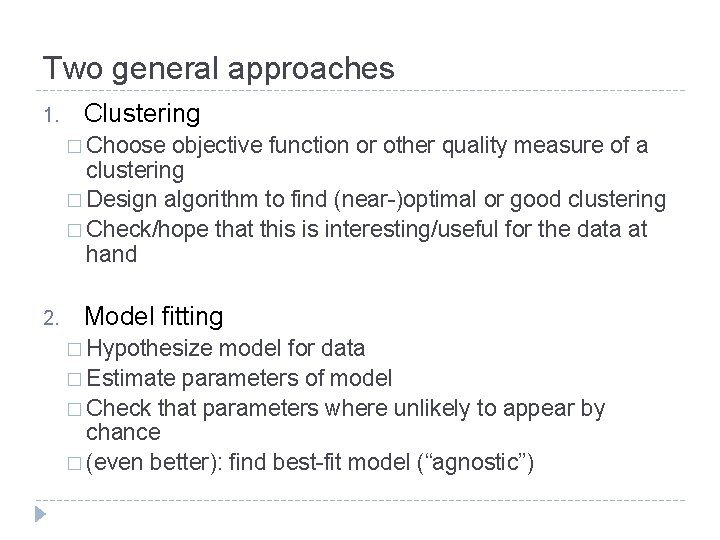
Two general approaches 1. Clustering � Choose objective function or other quality measure of a clustering � Design algorithm to find (near-)optimal or good clustering � Check/hope that this is interesting/useful for the data at hand 2. Model fitting � Hypothesize model for data � Estimate parameters of model � Check that parameters where unlikely to appear by chance � (even better): find best-fit model (“agnostic”)
Challenges � Both approaches need domain knowledge and insight to define the “right” problem � Theoreticians prefer generic problems with mathematical appeal � Some beautiful and general problems have emerged. These will be the focus of this talk. � There’s a lot more to understand, that’s the excitement of ML for the next century! � E. g. , How does the cortex learn? Much of it is (arguably) truly unsupervised (“Son, minimize the sum-of-squared-distances, ” is not a common adage)
Meta-algorithms � PCA � k-means � EM �… � Can be “used” on most problems. � But how to tell if they are effective? Or if they will converge in a reasonable number of steps? � Do they work? When? Why?
This talk � Mixture Models � Independent Component Analysis � Finding Planted Structures Many other interesting and widely studied models: topic models, hidden Markov models, dictionaries, identifying the relevant (“feature”) subspace, etc.
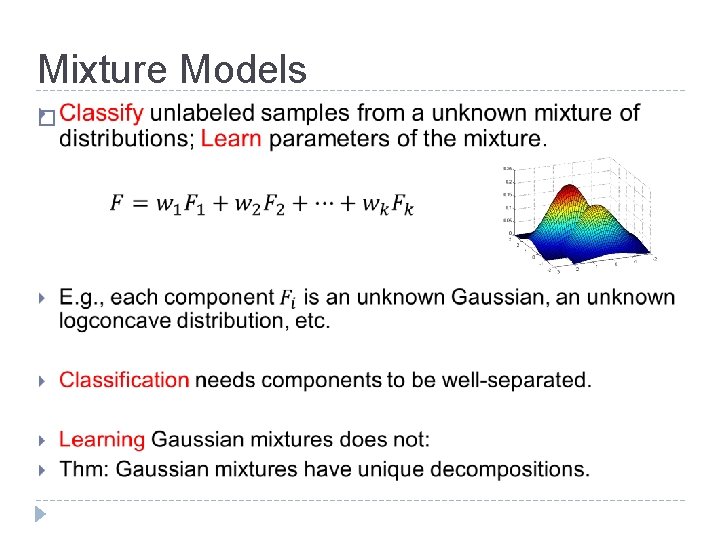
Mixture Models �
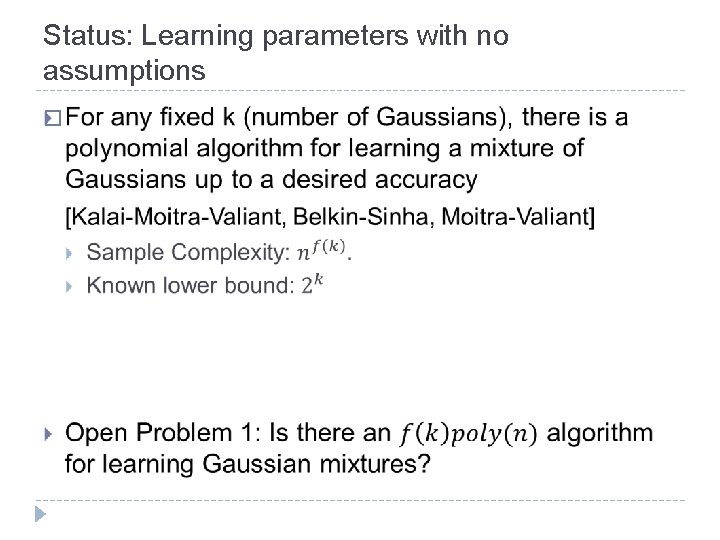
Status: Learning parameters with no assumptions �
Techniques � Random Projection [Dasgupta] Project mixture to a low-dimensional subspace to (a) make Gaussians more spherical and (b) preserve pairwise mean separation [Kalai] Project mixture to a random 1 -dim subspace; learn the parameters of the resulting 1 -d mixture; do this for a set of lines to learn the n-dimensional mixture! � Method of Moments [Pearson] Finite number of moments suffice for 1 -d Gaussians [Kalai-Moitra-Valiant] 6 moments suffice [B-S, M-V]
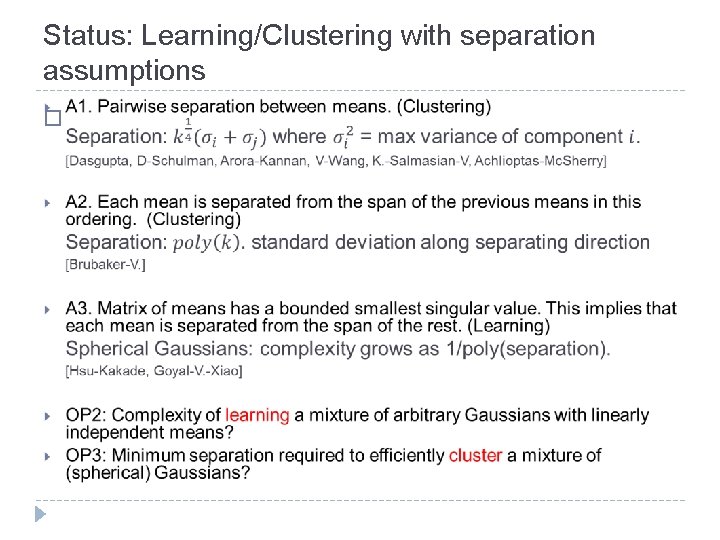
Status: Learning/Clustering with separation assumptions �
Techniques PCA: � Use PCA once [V-Wang] � Use PCA twice [Hsu-Kakade] � Eat chicken soup with rice; Reweight and use PCA [Brubaker-V. , Goyal-V. -Xiao]
Polynomial Algorithms I: Clustering spherical Gaussians [VW 02] �
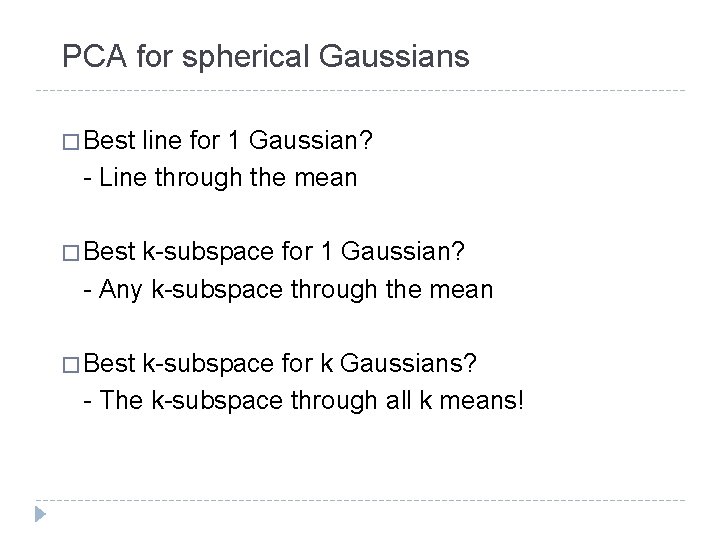
PCA for spherical Gaussians � Best line for 1 Gaussian? - Line through the mean � Best k-subspace for 1 Gaussian? - Any k-subspace through the mean � Best k-subspace for k Gaussians? - The k-subspace through all k means!
Mixtures of Nonisotropic, Logconcave Distributions [KSV 04, AM 05] �
Crack my passwords � GMAIL MU 47286 � AMAZON RU 27316
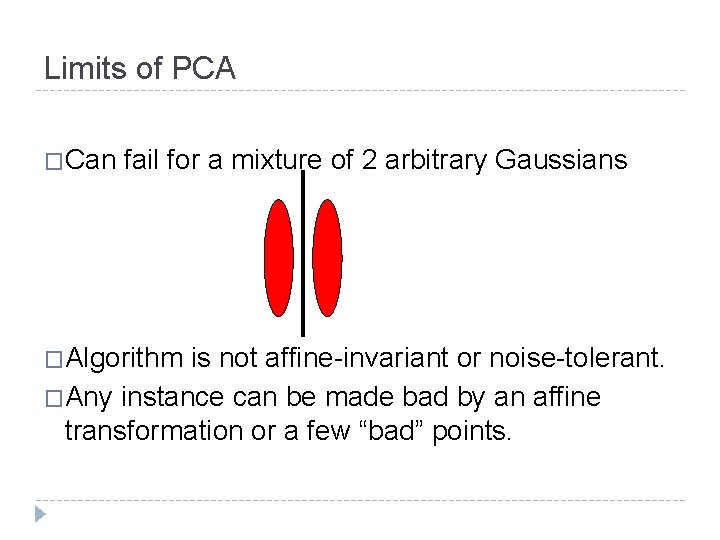
Limits of PCA �Can fail for a mixture of 2 arbitrary Gaussians �Algorithm is not affine-invariant or noise-tolerant. �Any instance can be made bad by an affine transformation or a few “bad” points.
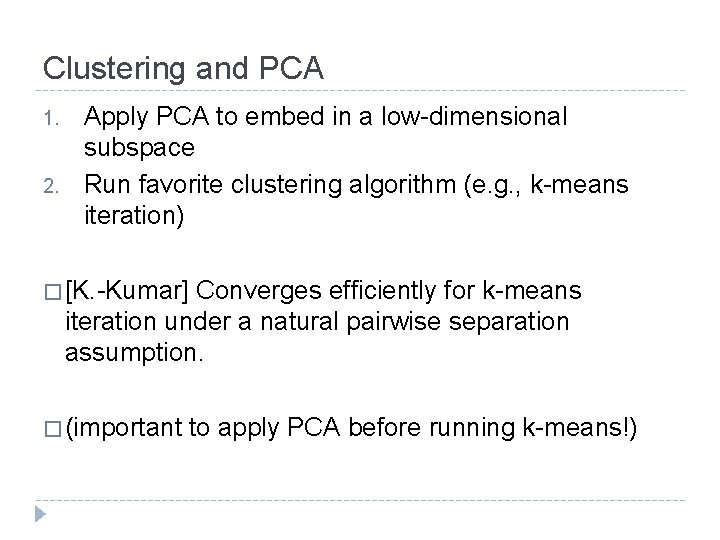
Clustering and PCA 1. 2. Apply PCA to embed in a low-dimensional subspace Run favorite clustering algorithm (e. g. , k-means iteration) � [K. -Kumar] Converges efficiently for k-means iteration under a natural pairwise separation assumption. � (important to apply PCA before running k-means!)
Polynomial Algorithms II: Learning spherical Gaussians [HK] �
Status: Noisy mixtures �
Polynomial Algorithms III: Robust PCA for noisy mixtures [Brubaker 09] �
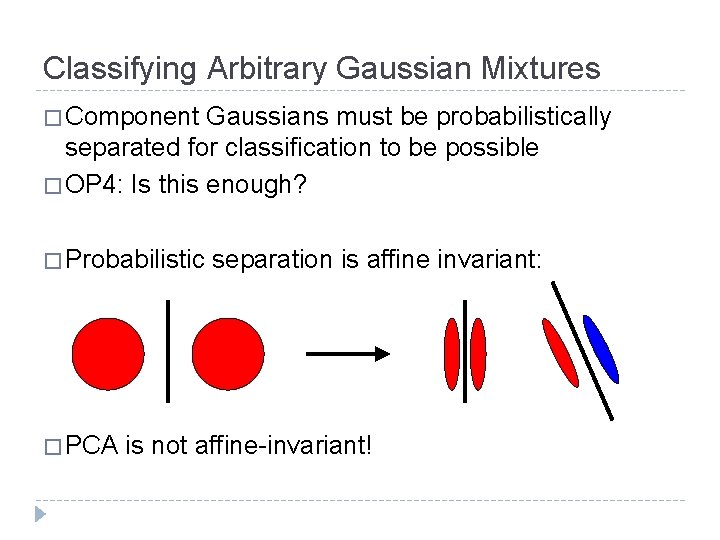
Classifying Arbitrary Gaussian Mixtures � Component Gaussians must be probabilistically separated for classification to be possible � OP 4: Is this enough? � Probabilistic separation is affine invariant: � PCA is not affine-invariant!
Polynomial Algorithms IV: Affine-invariant clustering [BV 08] 1. 2. 3. 4. Make distribution isotropic. Reweight points (using a Gaussian). If mean shifts, partition along this direction; Recurse. Otherwise, partition along top principal component; Recurse. � Thm. The algorithm correctly classifies samples from a mixture of k arbitrary Gaussians if each one is separated from the span of the rest. (More generally, if the overlap is small as measured by the Fisher criterion). � OP 4: Extend Isotropic PCA to logconcave mixtures.
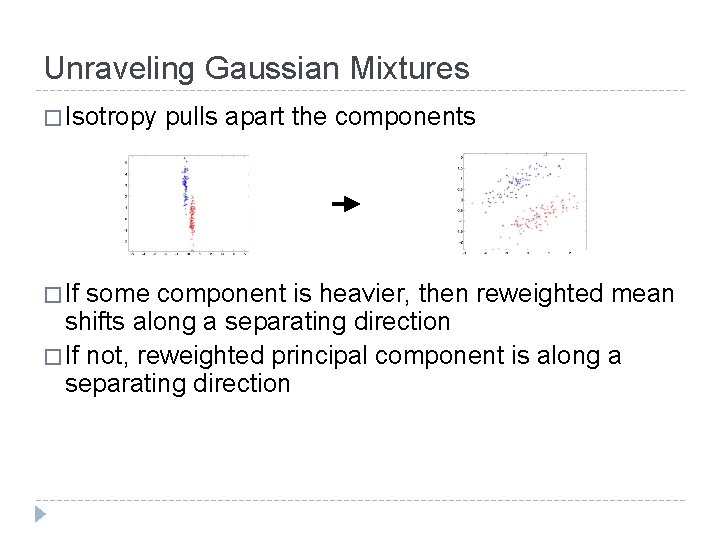
Unraveling Gaussian Mixtures � Isotropy pulls apart the components � If some component is heavier, then reweighted mean shifts along a separating direction � If not, reweighted principal component is along a separating direction
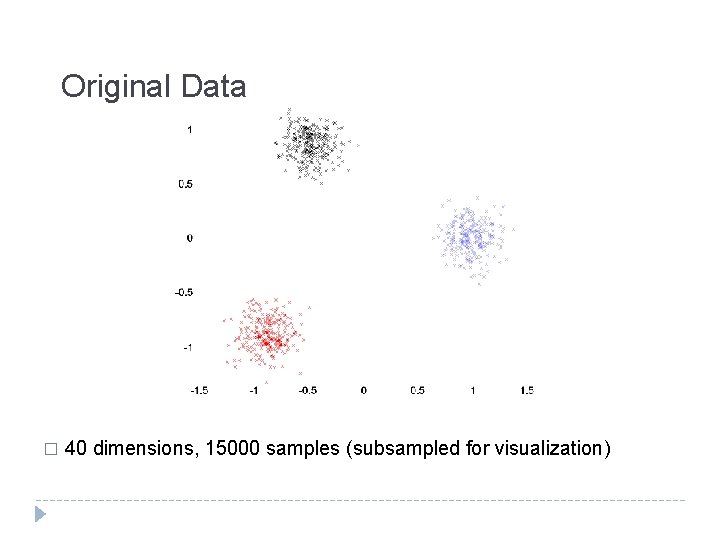
Original Data � 40 dimensions, 15000 samples (subsampled for visualization)
Random Projection 26
PCA 27
Isotropic PCA 28
Crack my passwords � GMAIL MU 47286 � AMAZON RU 27316 � IISC LH 857
Independent Component Analysis [Comon] �
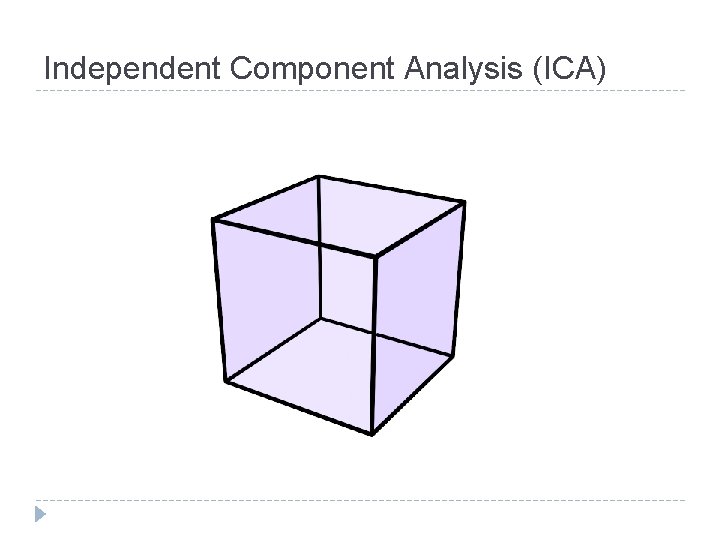
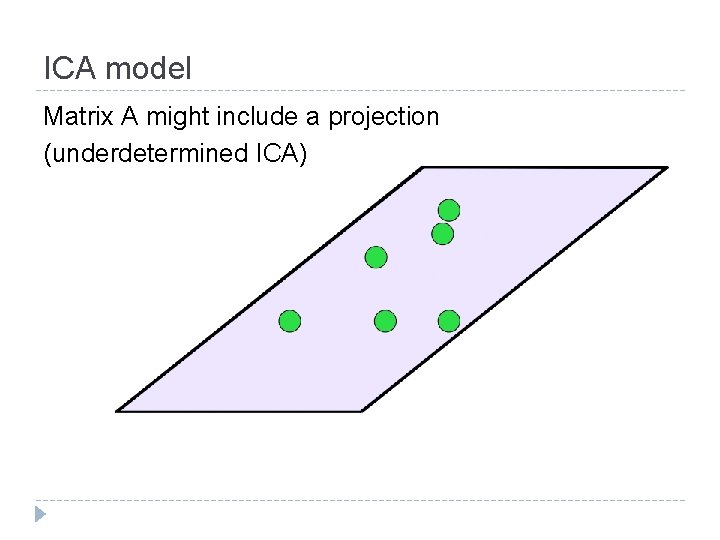
Independent Component Analysis (ICA)
ICA model � Start with a product distribution
ICA model � Apply a linear transformation A
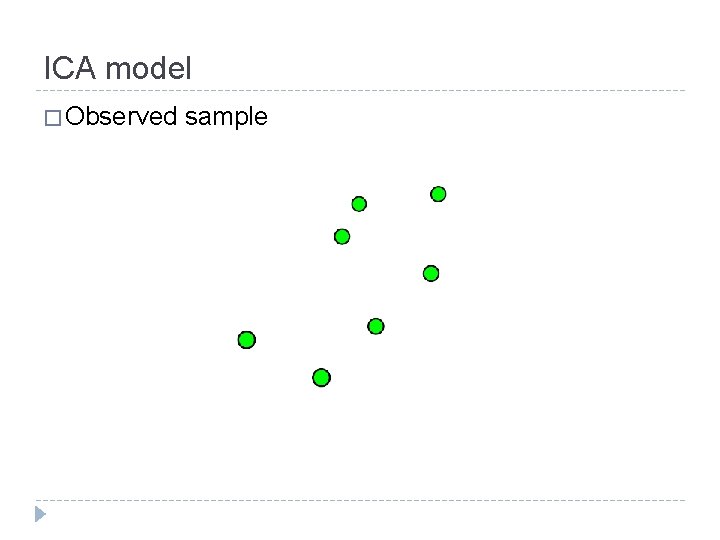
ICA model � Observed sample
ICA model Matrix A might include a projection (underdetermined ICA)
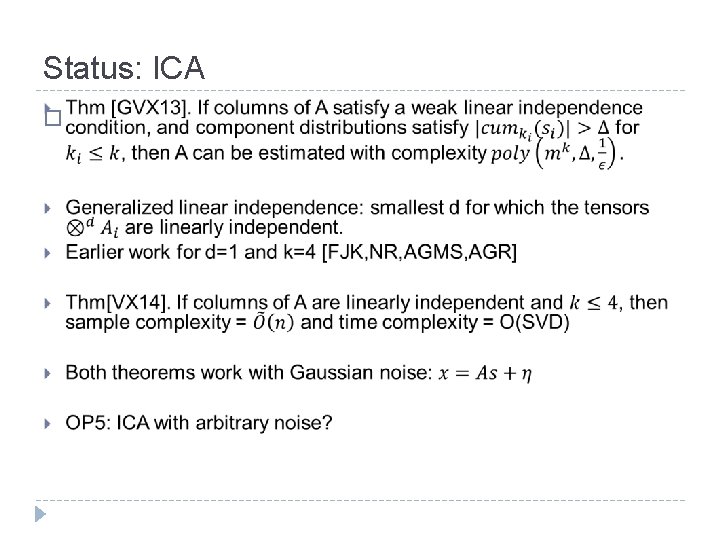
Status: ICA �
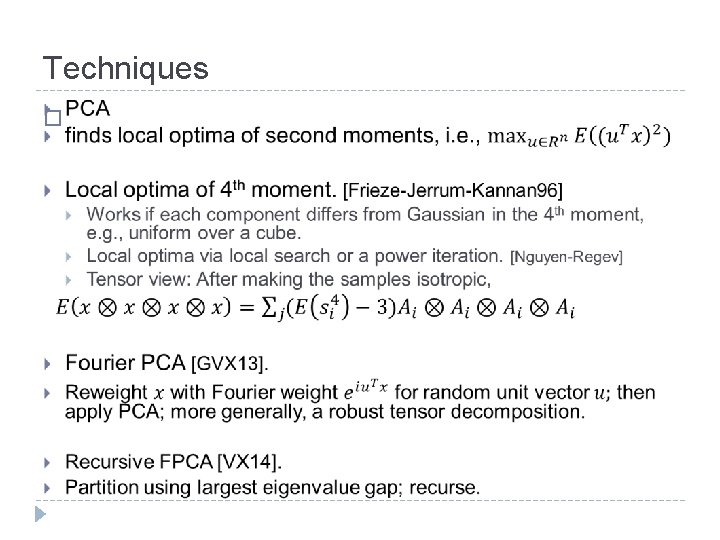
Techniques �
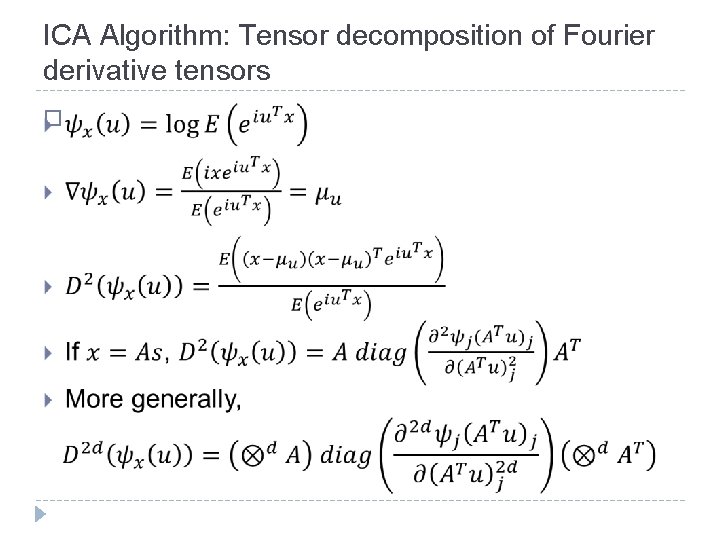
ICA Algorithm: Tensor decomposition of Fourier derivative tensors �
Tensor decomposition [GVX 13] �
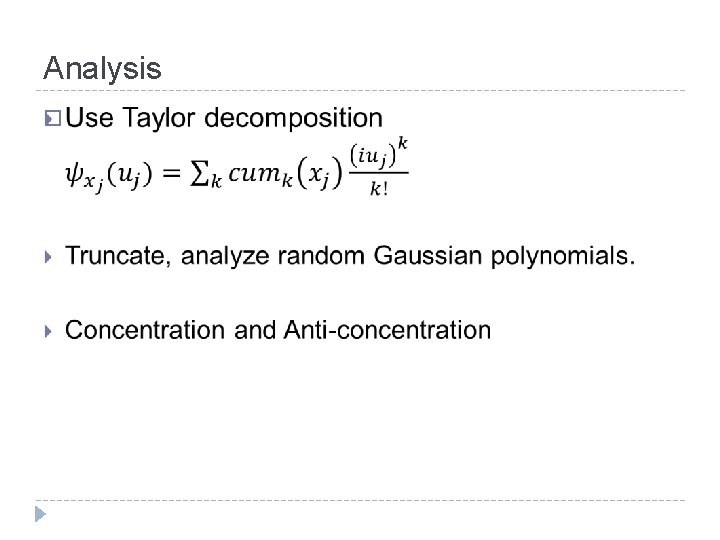
Analysis �
Crack my passwords � GMAIL MU 47286 � AMAZON RU 27316 � IISC LH 857 � SHIVANI HQ 508526
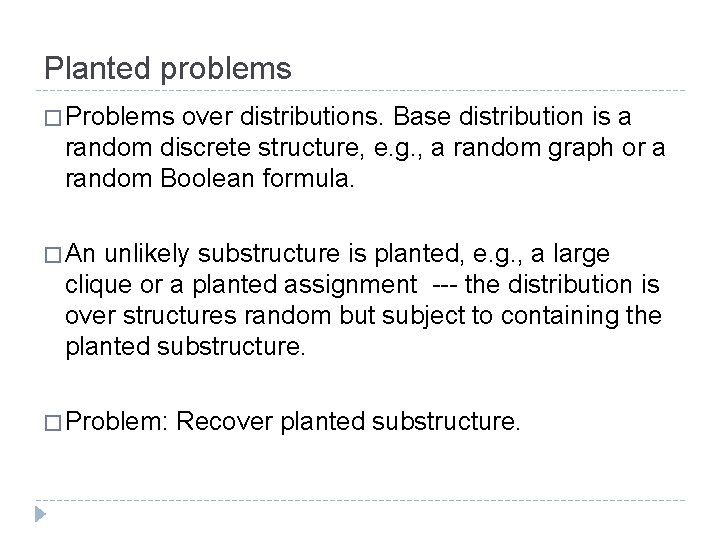
Planted problems � Problems over distributions. Base distribution is a random discrete structure, e. g. , a random graph or a random Boolean formula. � An unlikely substructure is planted, e. g. , a large clique or a planted assignment --- the distribution is over structures random but subject to containing the planted substructure. � Problem: Recover planted substructure.
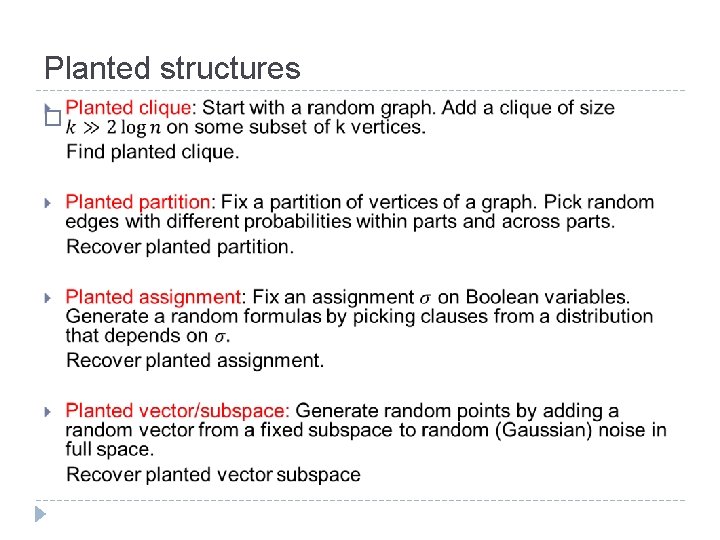
Planted structures �
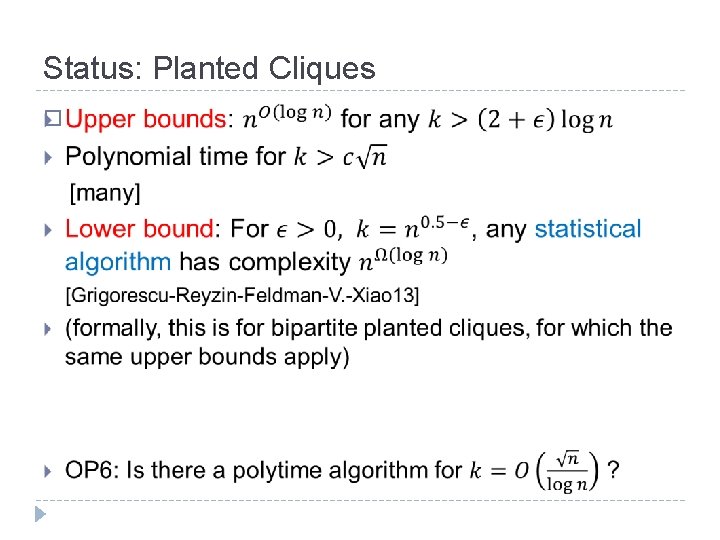
Status: Planted Cliques �
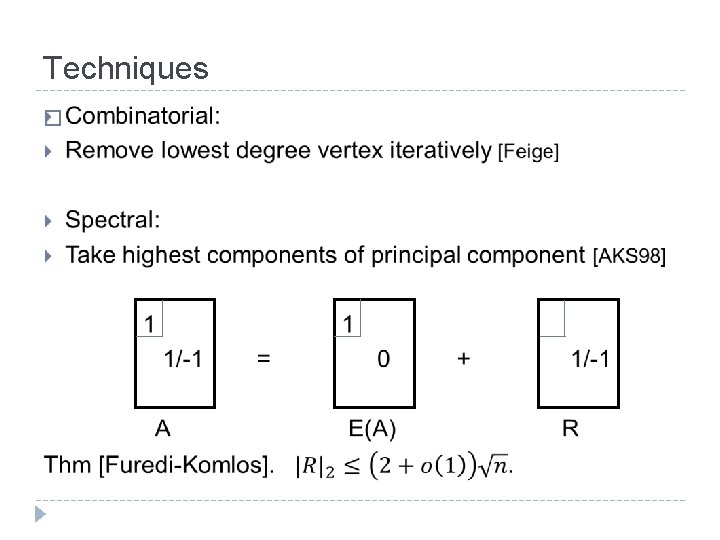
Techniques �
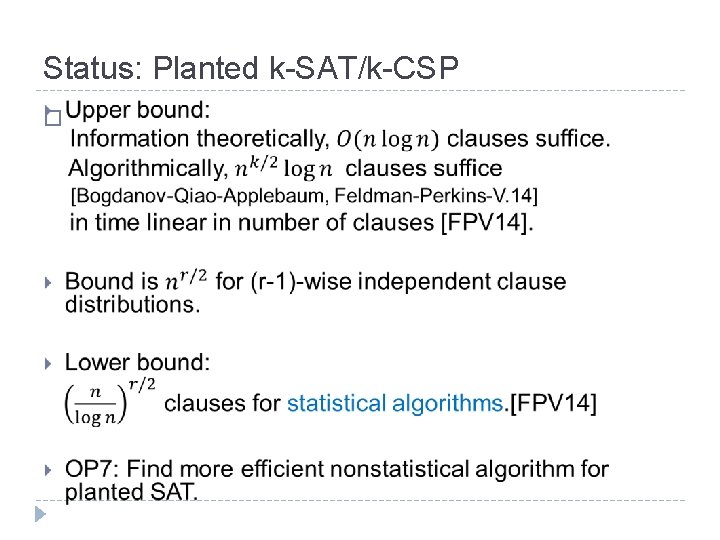
Status: Planted k-SAT/k-CSP �
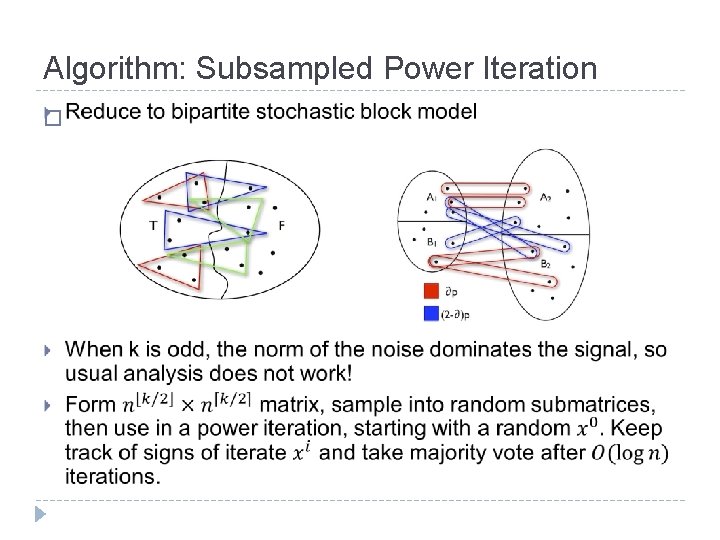
Techniques � Combinatorial + SDP for even k. [A 12, BQ 09] � Subsampled power iteration: works for any k and a more general hypergraph planted partition problem: [FPV 14] � Stochastic block theorem for k=2 (graph partition): a precise threshold on edge probabilities for efficiently recoverability. [Decelle-Krzakala-Moore-Zdeborova 11] [Massoulie 13, Mossel-Neeman-Sly 13].
Algorithm: Subsampled Power Iteration �
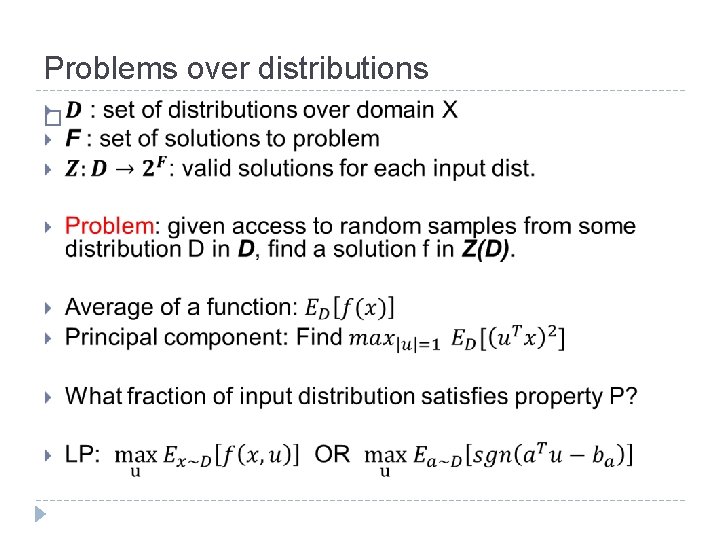
Problems over distributions �
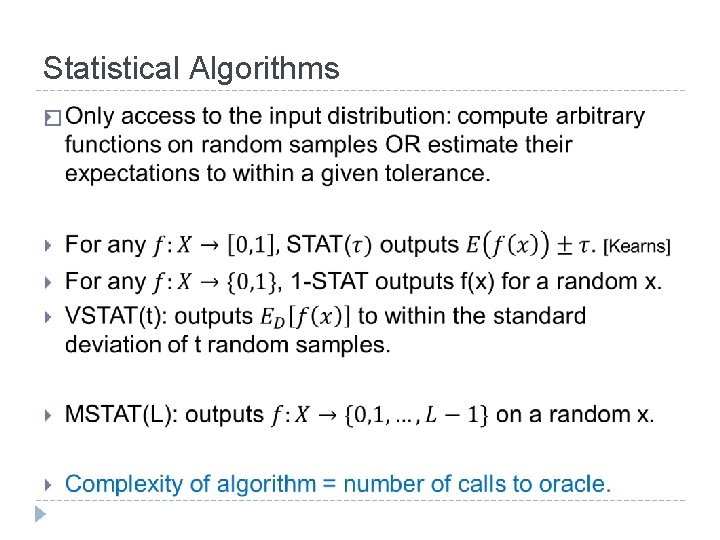
Statistical Algorithms �
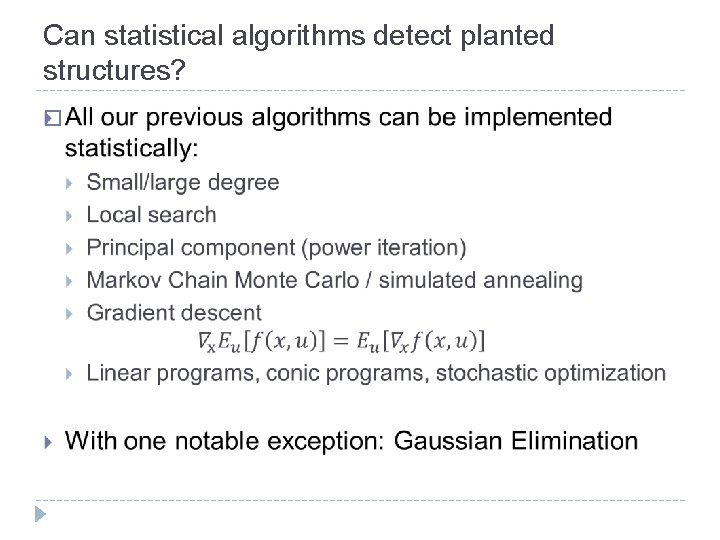
Can statistical algorithms detect planted structures? �
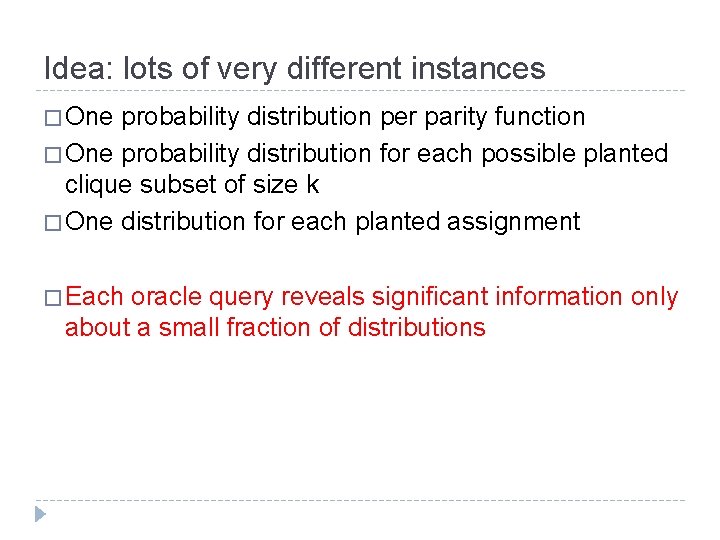
Idea: lots of very different instances � One probability distribution per parity function � One probability distribution for each possible planted clique subset of size k � One distribution for each planted assignment � Each oracle query reveals significant information only about a small fraction of distributions
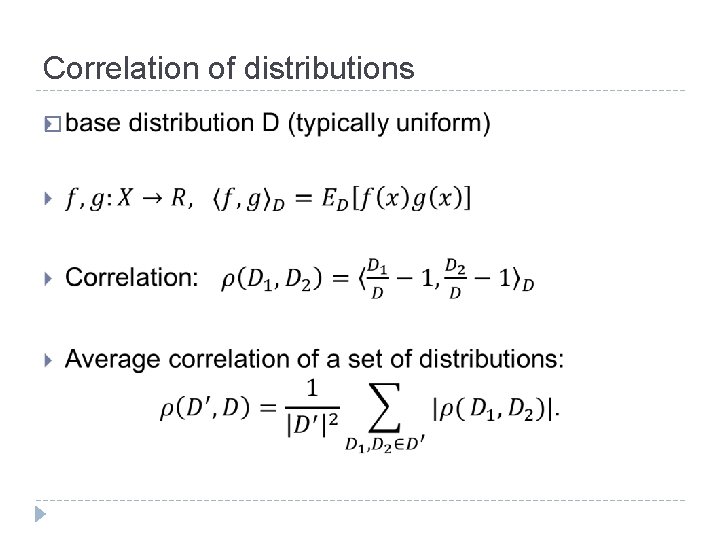
Correlation of distributions �
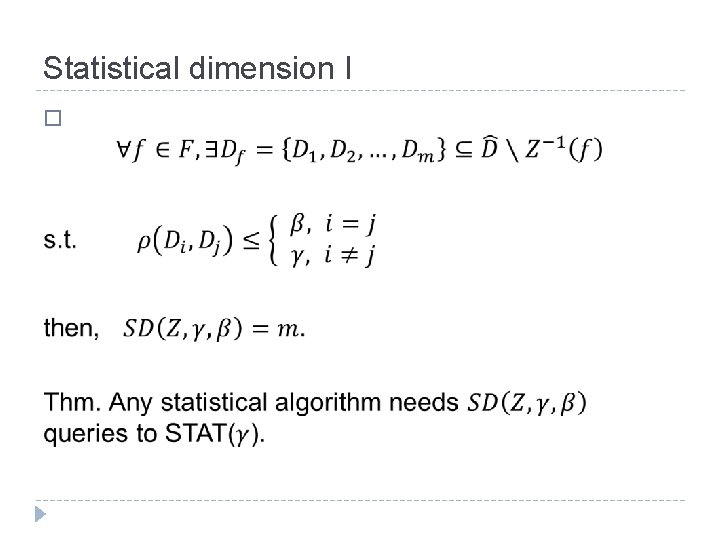
Statistical dimension I �
Finding parity functions [Kearns, Blum et al] �
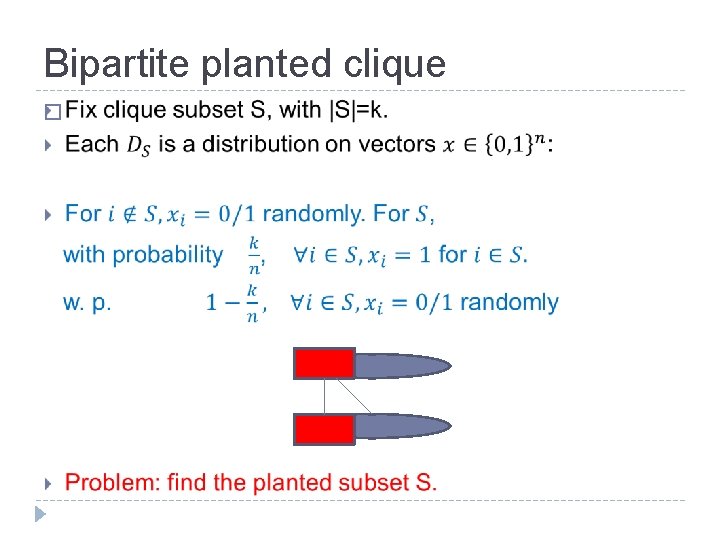
Bipartite planted clique �
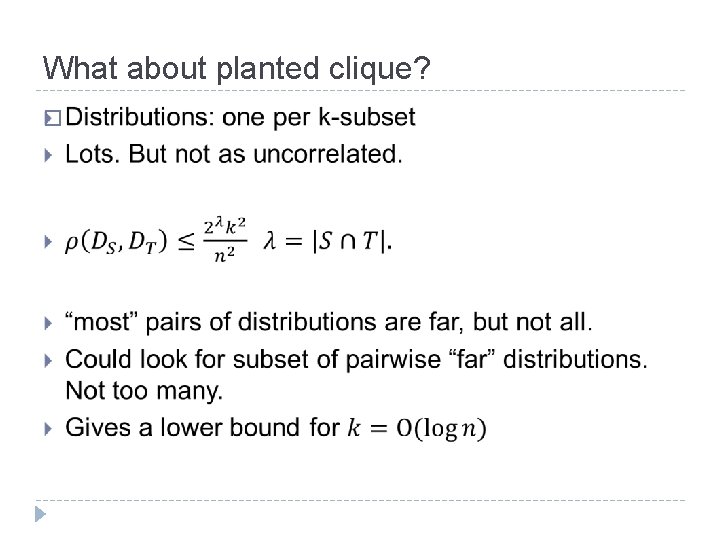
What about planted clique? �
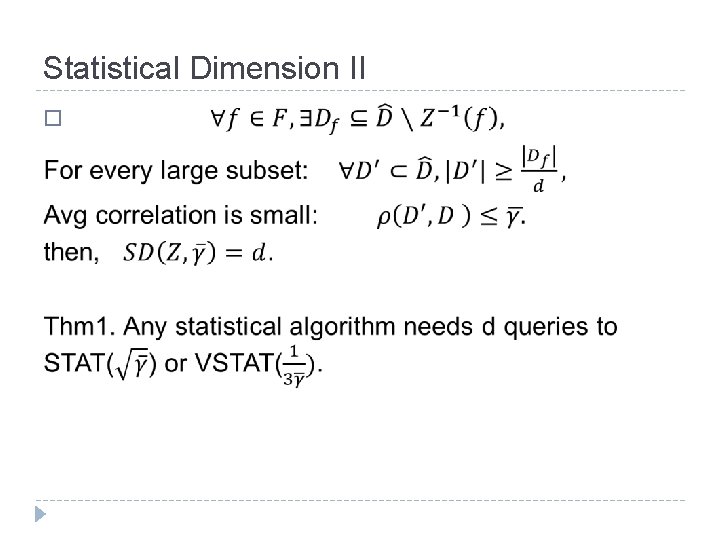
Statistical Dimension II �
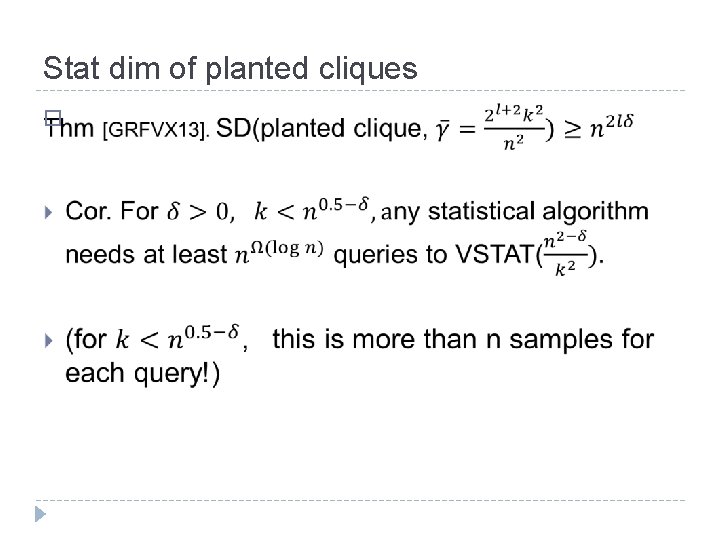
Stat dim of planted cliques �
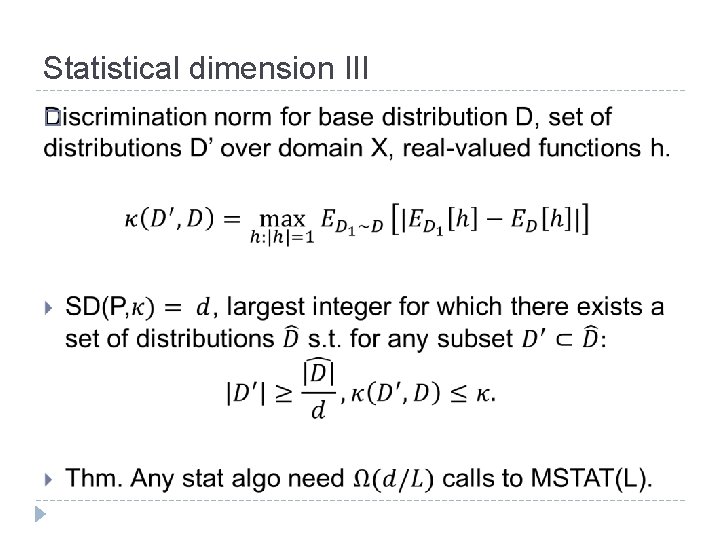
Statistical dimension III �
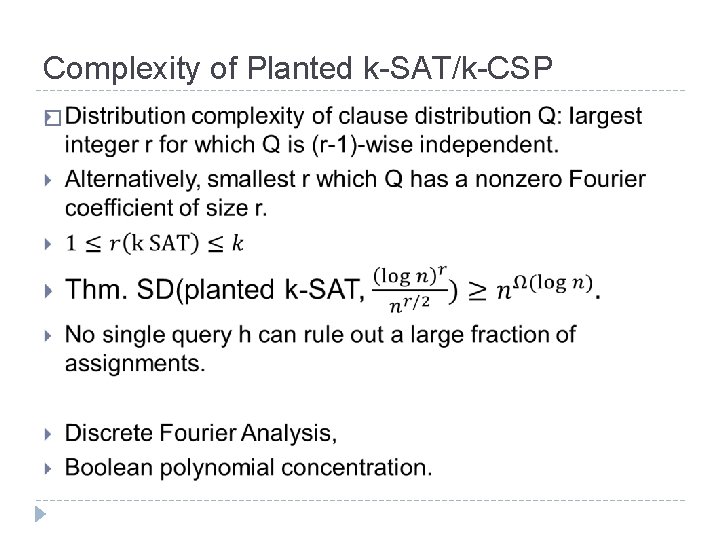
Complexity of Planted k-SAT/k-CSP �
Detecting planted solutions � Many interesting problems � Potential for novel algorithms � New computational lower bounds � Open problems in both directions!
Coming soon: The Password Game! � GMAIL MU 47286 � AMAZON RU 27316 � IISC LH 857 � SHIVANI HQ 508526 � UTHAPAM AX 010237
Thank you!
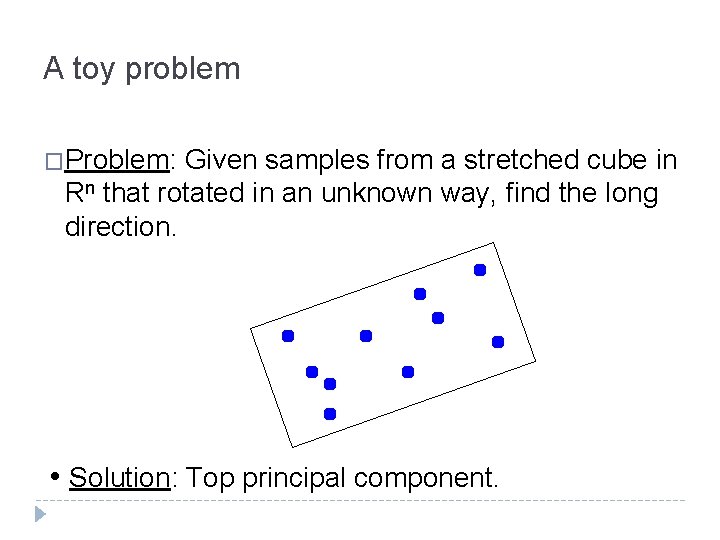
A toy problem �Problem: Given samples from a stretched cube in Rn that rotated in an unknown way, find the long direction. • Solution: Top principal component.
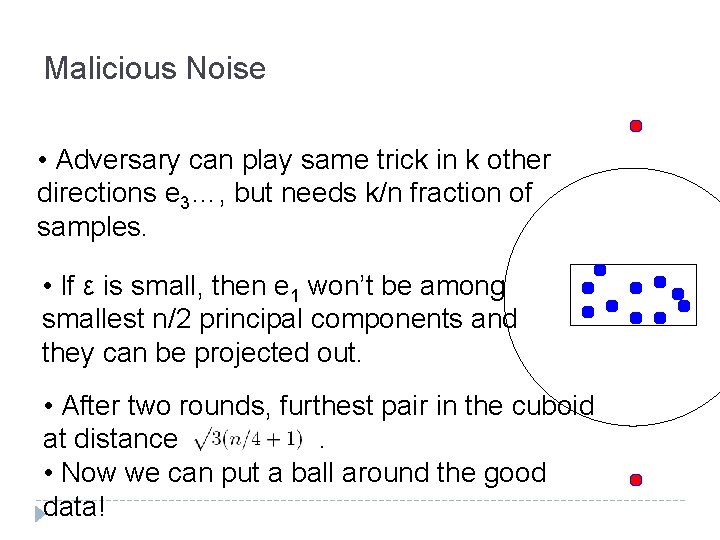
Malicious Noise • Suppose E[x 12] = 2 and E[xi 2] = 1. • Adversary puts a fraction of points at (n+1)e 2 • Now, E[x 12] < E[x 22] • And e 2 is the top principal component!
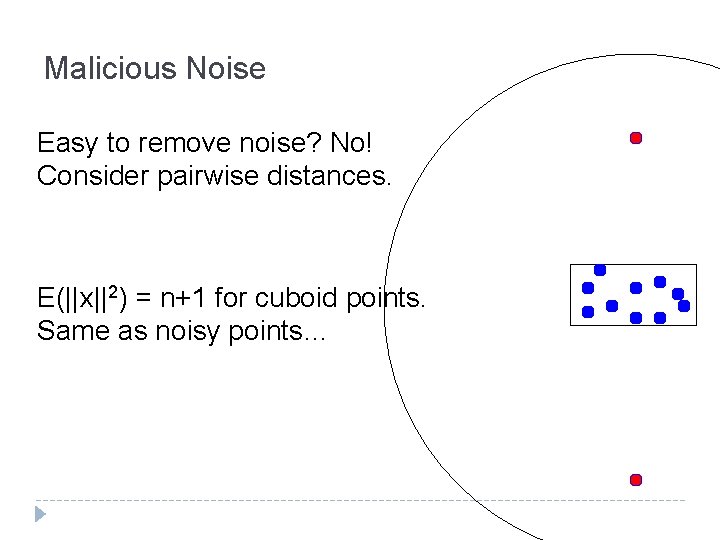
Malicious Noise Easy to remove noise? No! Consider pairwise distances. E(||x||2) = n+1 for cuboid points. Same as noisy points…
Malicious Noise • Adversary can play same trick in k other directions e 3…, but needs k/n fraction of samples. • If ε is small, then e 1 won’t be among smallest n/2 principal components and they can be projected out. • After two rounds, furthest pair in the cuboid at distance . • Now we can put a ball around the good data!