
The Complexity of Human Systems Complexity and the
- Slides: 45
The Complexity of Human Systems Complexity and the Implicate Order Prof Peter M. Allen Complex Systems Research Centre, Cranfield University, June, 2017
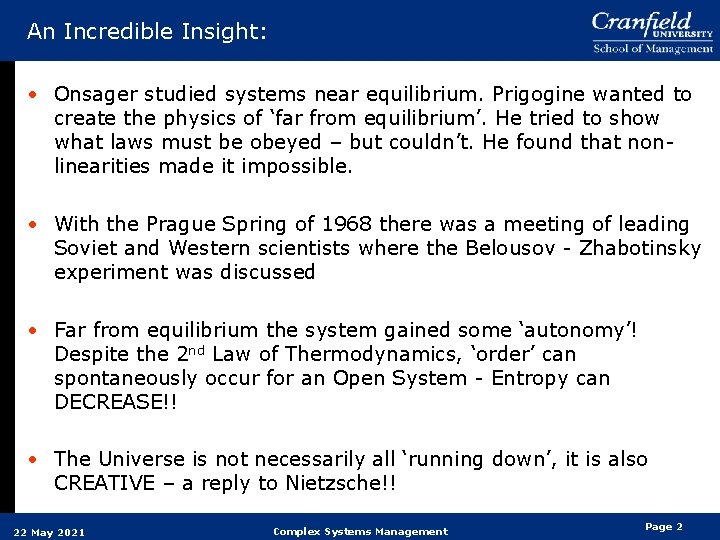
An Incredible Insight: • Onsager studied systems near equilibrium. Prigogine wanted to create the physics of ‘far from equilibrium’. He tried to show what laws must be obeyed – but couldn’t. He found that nonlinearities made it impossible. • With the Prague Spring of 1968 there was a meeting of leading Soviet and Western scientists where the Belousov - Zhabotinsky experiment was discussed • Far from equilibrium the system gained some ‘autonomy’! Despite the 2 nd Law of Thermodynamics, ‘order’ can spontaneously occur for an Open System - Entropy can DECREASE!! • The Universe is not necessarily all ‘running down’, it is also CREATIVE – a reply to Nietzsche!! 22 May 2021 Complex Systems Management Page 2
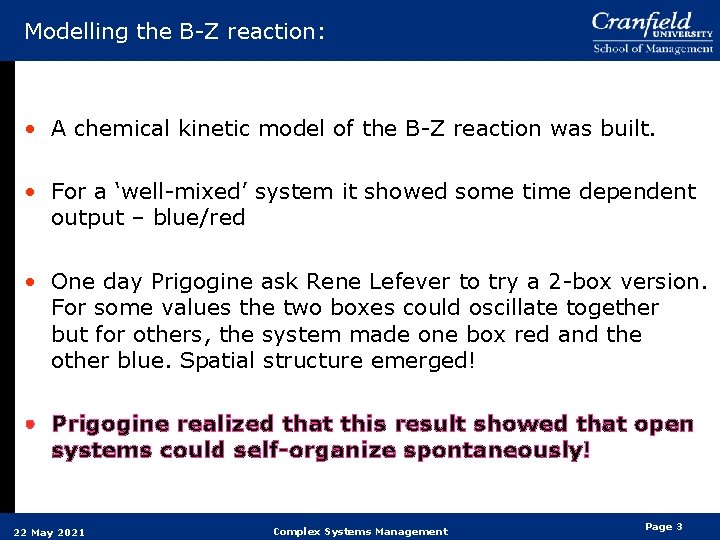
Modelling the B-Z reaction: • A chemical kinetic model of the B-Z reaction was built. • For a ‘well-mixed’ system it showed some time dependent output – blue/red • One day Prigogine ask Rene Lefever to try a 2 -box version. For some values the two boxes could oscillate together but for others, the system made one box red and the other blue. Spatial structure emerged! • Prigogine realized that this result showed that open systems could self-organize spontaneously! 22 May 2021 Complex Systems Management Page 3
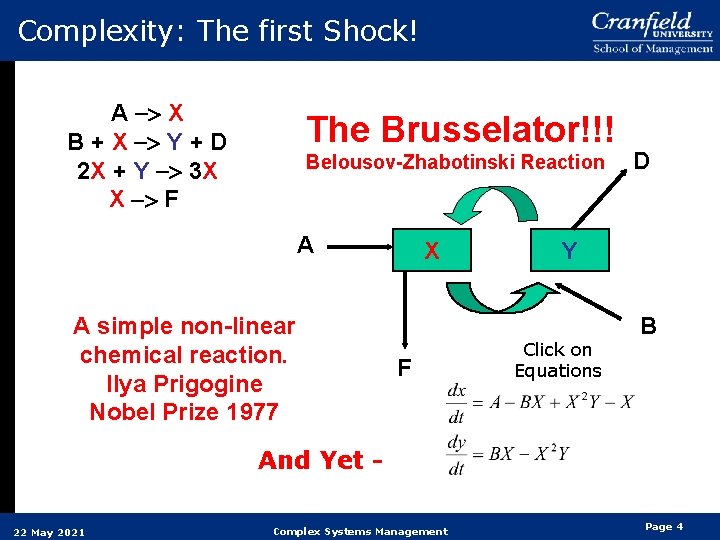
Complexity: The first Shock! A -> X B + X -> Y + D 2 X + Y -> 3 X X -> F The Brusselator!!! Belousov-Zhabotinski Reaction A A simple non-linear chemical reaction. Ilya Prigogine Nobel Prize 1977 X F D Y Click on Equations B And Yet 22 May 2021 Complex Systems Management Page 4
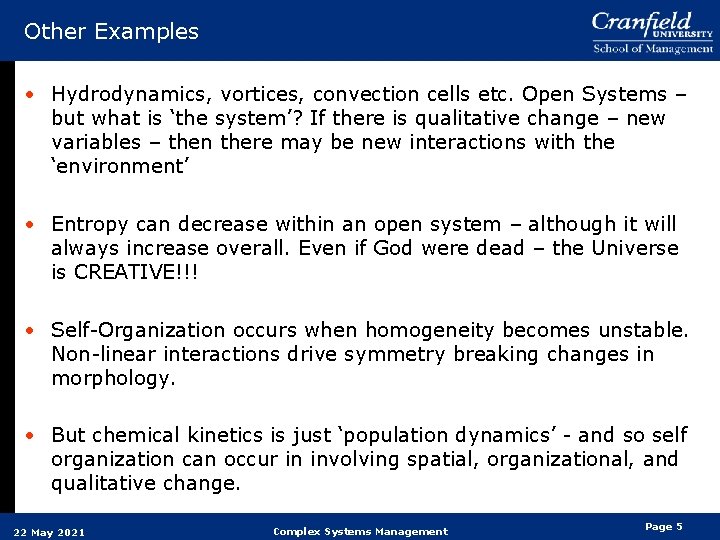
Other Examples • Hydrodynamics, vortices, convection cells etc. Open Systems – but what is ‘the system’? If there is qualitative change – new variables – then there may be new interactions with the ‘environment’ • Entropy can decrease within an open system – although it will always increase overall. Even if God were dead – the Universe is CREATIVE!!! • Self-Organization occurs when homogeneity becomes unstable. Non-linear interactions drive symmetry breaking changes in morphology. • But chemical kinetics is just ‘population dynamics’ - and so self organization can occur in involving spatial, organizational, and qualitative change. 22 May 2021 Complex Systems Management Page 5
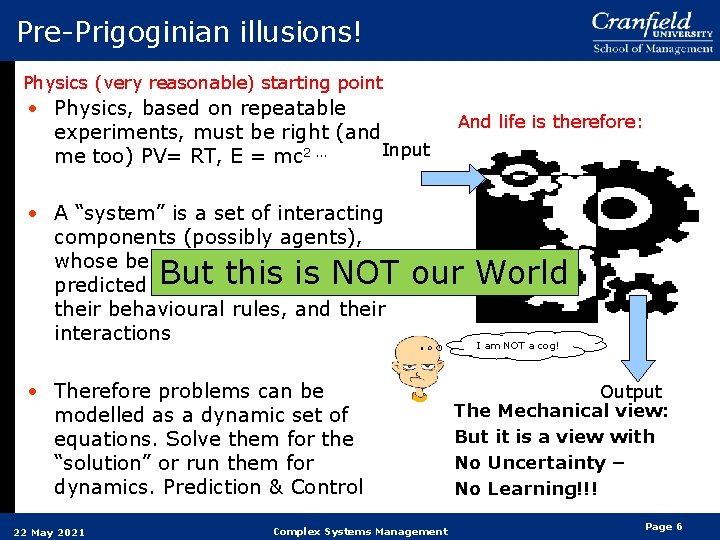
Pre-Prigoginian illusions! Physics (very reasonable) starting point • Physics, based on repeatable experiments, must be right (and Input me too) PV= RT, E = mc 2 … • A “system” is a set of interacting components (possibly agents), whose behaviour can be But this is NOT predicted providing we can define their behavioural rules, and their interactions our World • Therefore problems can be modelled as a dynamic set of equations. Solve them for the “solution” or run them for dynamics. Prediction & Control 22 May 2021 And life is therefore: Complex Systems Management I am NOT a cog! Output The Mechanical view: But it is a view with No Uncertainty – No Learning!!! Page 6
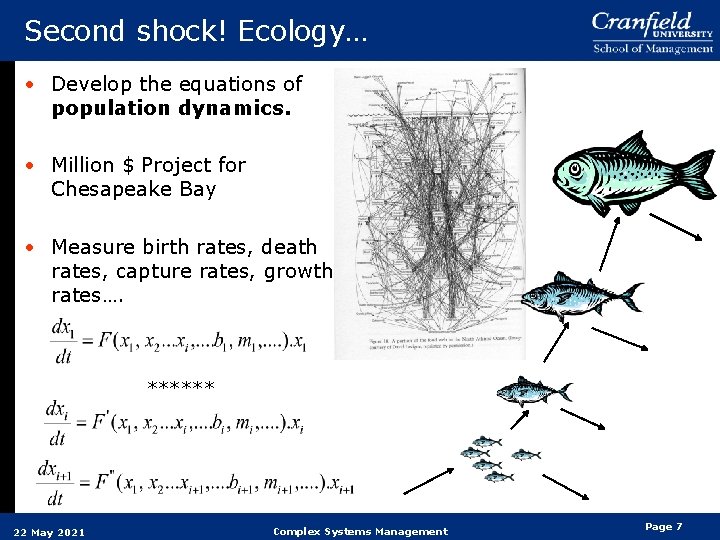
Second shock! Ecology… • Develop the equations of population dynamics. • Million $ Project for Chesapeake Bay • Measure birth rates, death rates, capture rates, growth rates…. ****** 22 May 2021 Complex Systems Management Page 7
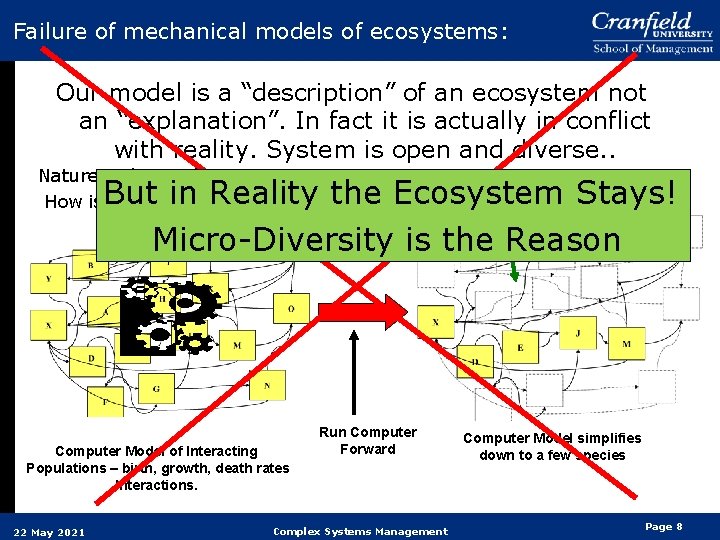
Failure of mechanical models of ecosystems: Our model is a “description” of an ecosystem not an “explanation”. In fact it is actually in conflict with reality. System is open and diverse. . Nature: What is there? How is this operating? Reality is like this, not like that!! But in Reality the Ecosystem Stays! Micro-Diversity is the Reason Computer Model of Interacting Populations – birth, growth, death rates Interactions. 22 May 2021 Run Computer Forward Complex Systems Management Computer Model simplifies down to a few species Page 8
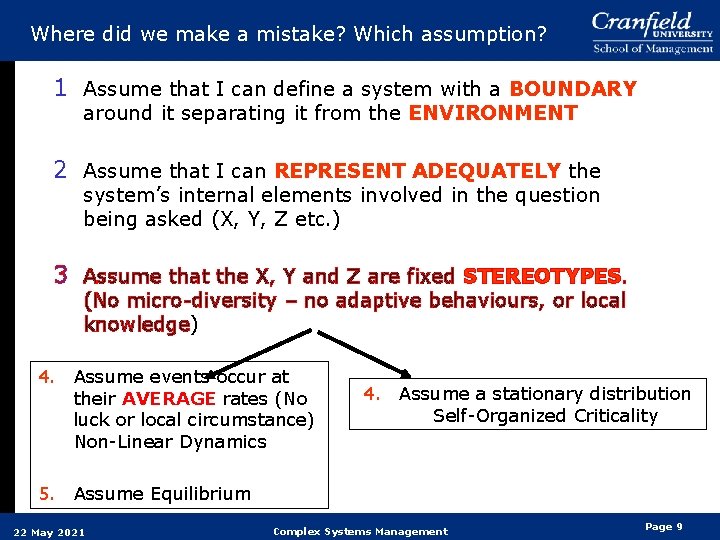
Where did we make a mistake? Which assumption? 1 Assume that I can define a system with a BOUNDARY around it separating it from the ENVIRONMENT 2 Assume that I can REPRESENT ADEQUATELY the system’s internal elements involved in the question being asked (X, Y, Z etc. ) 3 Assume that the X, Y and Z are fixed STEREOTYPES. (No micro-diversity – no adaptive behaviours, or local knowledge) 4. Assume events occur at their AVERAGE rates (No luck or local circumstance) Non-Linear Dynamics 4. Assume a stationary distribution Self-Organized Criticality 5. Assume Equilibrium 22 May 2021 Complex Systems Management Page 9
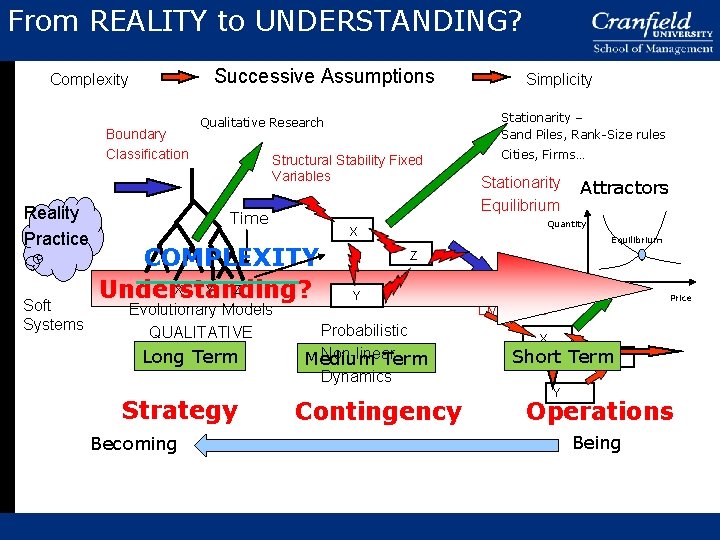
From REALITY to UNDERSTANDING? Successive Assumptions Complexity Boundary Classification Reality Practice Soft Systems Structural Stability Fixed Variables Evolutionary Models QUALITATIVE CHANGE Long Term Strategy Cities, Firms… Stationarity Equilibrium Attractors Quantity X COMPLEXITY X Y Z Understanding? Becoming Stationarity – Sand Piles, Rank-Size rules Qualitative Research Time Simplicity Equilibrium Z Y Probabilistic Non-linear Medium Term Dynamics Contingency Average Dynamics Price X Short Term Z Y Operations Being
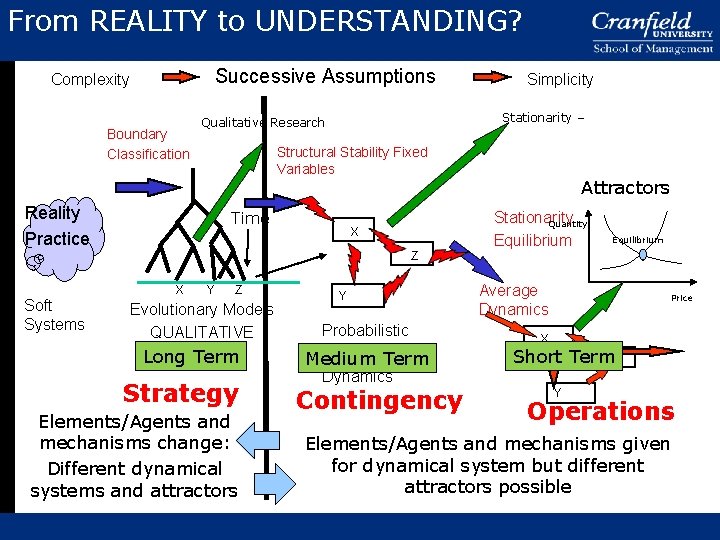
From REALITY to UNDERSTANDING? Successive Assumptions Complexity Boundary Classification Simplicity Stationarity – Qualitative Research Structural Stability Fixed Variables Reality Practice Time Attractors Stationarity Quantity Equilibrium X Equilibrium Z Soft Systems X Y Z Evolutionary Models QUALITATIVE CHANGE Long Term Strategy Elements/Agents and mechanisms change: Different dynamical systems and attractors Y Probabilistic Non-linear Medium Term Dynamics Contingency Average Dynamics Price X Short Term Z Y Operations Elements/Agents and mechanisms given for dynamical system but different attractors possible
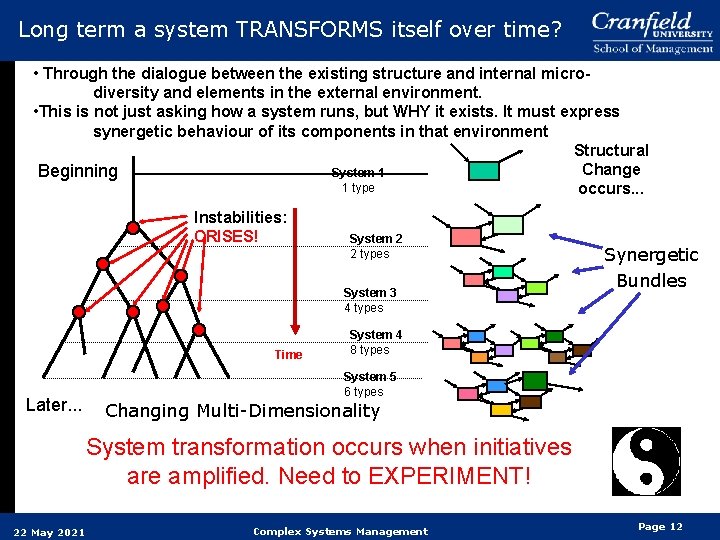
Long term a system TRANSFORMS itself over time? • Through the dialogue between the existing structure and internal microdiversity and elements in the external environment. • This is not just asking how a system runs, but WHY it exists. It must express synergetic behaviour of its components in that environment Structural Change Beginning System 1 1 type occurs. . . Instabilities: CRISES! System 2 2 types System 3 4 types Time Later. . . Synergetic Bundles System 4 8 types System 5 6 types Changing Multi-Dimensionality System transformation occurs when initiatives are amplified. Need to EXPERIMENT! 22 May 2021 Complex Systems Management Page 12
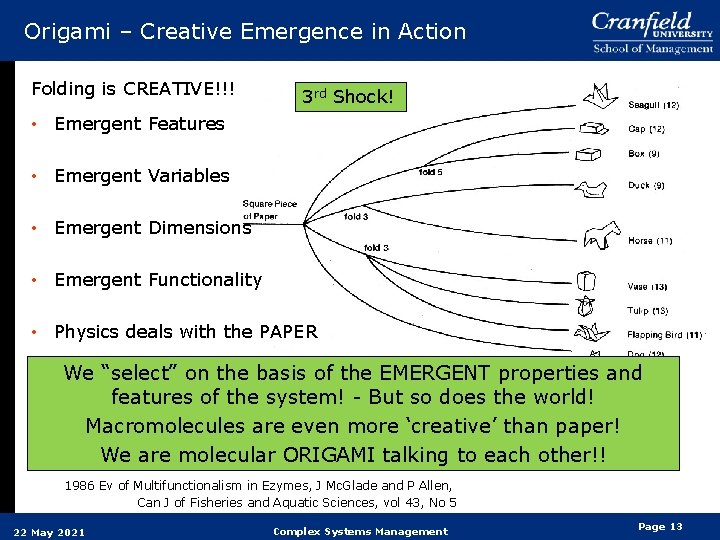
Origami – Creative Emergence in Action Folding is CREATIVE!!! 3 rd Shock! • Emergent Features • Emergent Variables • Emergent Dimensions • Emergent Functionality • Physics deals with the PAPER We “select” on the basis of the EMERGENT properties and features of the system! - But so does the world! Macromolecules are even more ‘creative’ than paper! We are molecular ORIGAMI talking to each other!! 1986 Ev of Multifunctionalism in Ezymes, J Mc. Glade and P Allen, Can J of Fisheries and Aquatic Sciences, vol 43, No 5 22 May 2021 Complex Systems Management Page 13
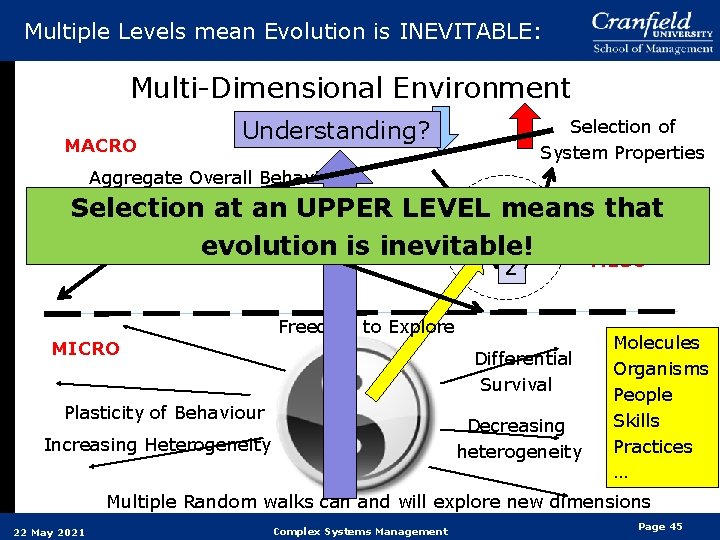
Multi-Level Co-Evolution: • If dynamics leads to structures, then these can have emergent characteristics and functions • But if ‘selection’ operates on the macro-structure – the emergent functionalities - it means that it cannot ‘see’ the microstructure! • This means that individual elements are not ‘visible’ to the external selection and micro-diversity can and will increase until something affects the emergent collective behaviour • This means that Evolution cannot be stopped! 22 May 2021 Complex Systems Management Page 14
Edmund Burke and the French Revolution: In 1790 Edmund Burke was suggesting (from Bryan Magee): • A developed society is so complex that a single mind cannot possibly understand it. It has come into being over many generations through numberless acts of initiative and organization on the part of individuals and groups who have had to cope with reality. Its institutions and arrangements embody innumerable choices and decisions, balanced judgements arrived at through experience, preferences based on knowledge. • The whole thing is like a vast and complex organism; and it changes organically developing new capacities in response to need, and perpetually adapting to ever-changing circumstances. It is not at all like a machine which can be built from scratch from a blueprint, and whose working parts can be removed and replaced at will. Neither in theory nor in practice could any one political thinker or any small group of political leaders wipe out a developed society and replace it with one that was adequate. But if people have nothing to lose, then they will give it a try…… 22 May 2021 Complex Systems Management Page 15
After Prigogine: From physics to social systems • The mathematics of Population Dynamics is the same as chemical kinetics, but for people/individuals • We can build spatial demographic/economic equations and see what equilibrium structures emerge • In economics Adam Smith advanced the idea that Free Markets lead to optimal outcomes for both producers and consumers. We can test this idea. • But what about evolutionary change in social systems – new people, new skills, and innovations? 22 May 2021 Complex Systems Management Page 16
Since 1970 – only 2 Good Ideas! (3 more than average) • Evolution occurs through structural instabilities: – Unintentional and intentional novel actions – experiments caused by internal heterogeneity, micro-diversity, ignorance, emotion or error. – To what ‘experiments’ is the system unstable? Which new actions, mutants, innovations, new practices will grow in the system if they occur? • For an innovation to persist: – Its component parts MUST TOGETHER possess an EMERGENT Capability – Selection occurs when the Environment of the sub-system Rewards or Starves this capability – This is the definition of SYNERGY! 22 May 2021 Complex Systems Management Page 17
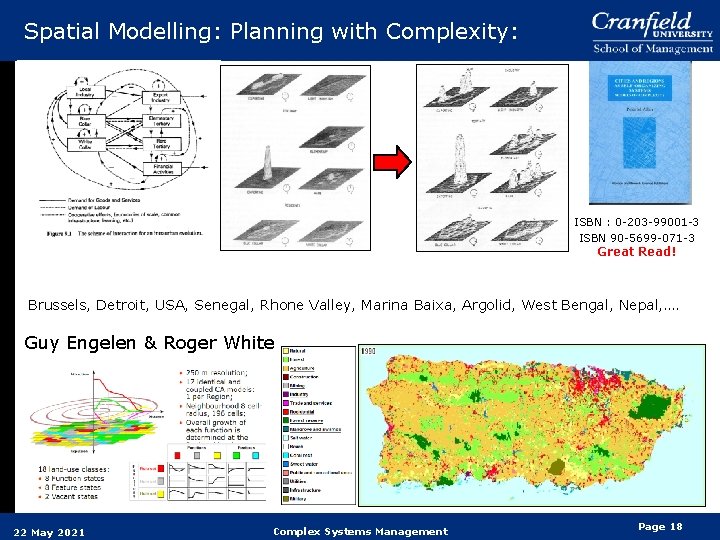
Spatial Modelling: Planning with Complexity: ISBN : 0 -203 -99001 -3 ISBN 90 -5699 -071 -3 Great Read! Brussels, Detroit, USA, Senegal, Rhone Valley, Marina Baixa, Argolid, West Bengal, Nepal, …. Guy Engelen & Roger White 22 May 2021 Complex Systems Management Page 18
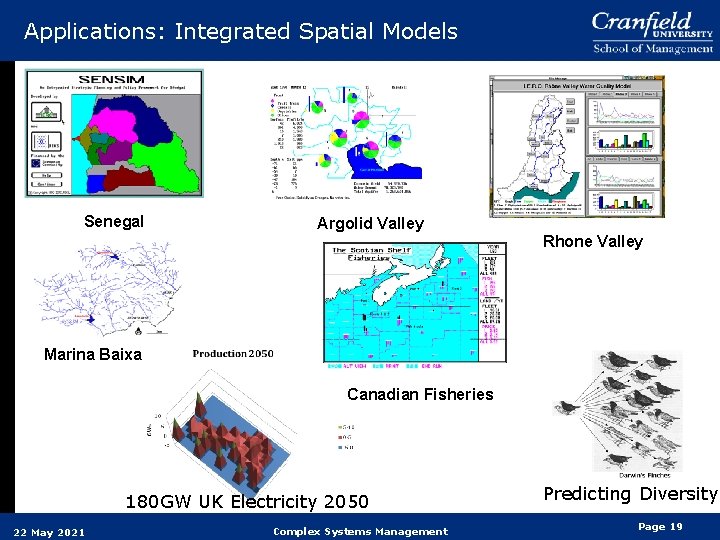
Applications: Integrated Spatial Models Senegal Argolid Valley Rhone Valley Marina Baixa Canadian Fisheries 180 GW UK Electricity 2050 22 May 2021 Complex Systems Management Predicting Diversity Page 19
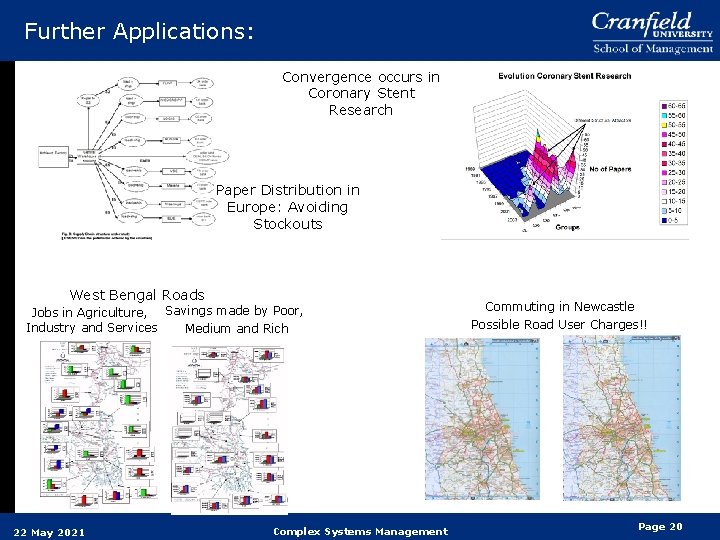
Further Applications: Convergence occurs in Coronary Stent Research Paper Distribution in Europe: Avoiding Stockouts West Bengal Roads Jobs in Agriculture, Savings made by Poor, Industry and Services Medium and Rich 22 May 2021 Complex Systems Management Commuting in Newcastle Possible Road User Charges!! Page 20
What does the Fishery model mean? • • Model can show crises and situations not in the DATA Fishing with high rationality on current information FAILS!!! Need both Discovery and Exploitation. Discovery requires some ‘randomness’ while exploitation requires rational focus: – Initial success for a Generalist strategy – Then Stochasts with Spying Cartesians (extra radios, tracking devices, spotter planes. . ) – Stochasts who hide information (Codes, night manoeuvres. . . ) – Cartesians allied to Stochasts – Alliance Members who cheat. . . • Evolution selects for Diverse behaviours, specialisation, heterogeneity Back 22 May 2021 Complex Systems Management Page 21
THE MYTH OF MARKETS • Are Markets ‘Magic’? (i. e. ‘Know’ more than anyone; go rapidly to an OPTIMAL for supply and Demand…) • Can I use a ‘market model’ to tell me how to win? Build a model: – What can “take-off”? – Idea 1 – What will turn out to have synergy with what is already there? – Idea 2 • Model of production: – Innovations and new firms start with a loss (can’t start) – Growth with expected rewards – BUT THEY CANNOT BE KNOWN! – So economic markets are based on ‘belief’ - self-belief and possibly self-delusion! 22 May 2021 Complex Systems Management Page 22
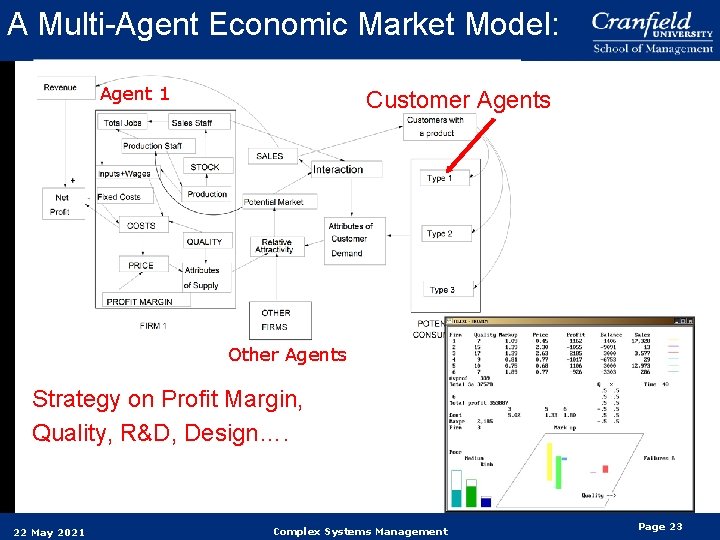
A Multi-Agent Economic Market Model: Agent 1 Customer Agents Other Agents Strategy on Profit Margin, Quality, R&D, Design…. 22 May 2021 Complex Systems Management Page 23
Markets are a Theatre of Learning: • There is NO INVISIBLE HAND. For a given POTENTIAL market the number and strategies of firms that actually emerge depends on LUCK!!!!!!! • Learning by experiment is the best meta-strategy, Learners tend to keep apart. Darwinists (intuitive leap) are next best. Imitators do worst! They arrive ‘late’ at a point of maximum competition • Some risk takers are needed for market evolution Schumpeter was right! Markets structures do not reflect RATIONAL behaviour, but arise when selfbelief gets lucky 22 May 2021 Complex Systems Management Page 24
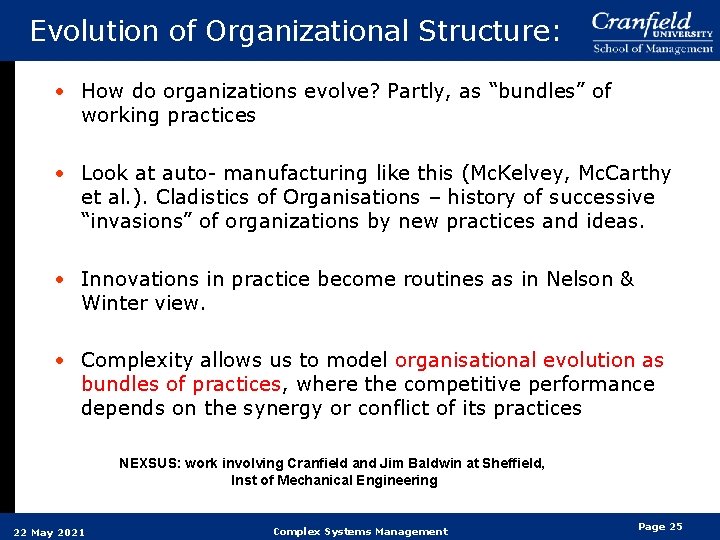
Evolution of Organizational Structure: • How do organizations evolve? Partly, as “bundles” of working practices • Look at auto- manufacturing like this (Mc. Kelvey, Mc. Carthy et al. ). Cladistics of Organisations – history of successive “invasions” of organizations by new practices and ideas. • Innovations in practice become routines as in Nelson & Winter view. • Complexity allows us to model organisational evolution as bundles of practices, where the competitive performance depends on the synergy or conflict of its practices NEXSUS: work involving Cranfield and Jim Baldwin at Sheffield, Inst of Mechanical Engineering 22 May 2021 Complex Systems Management Page 25
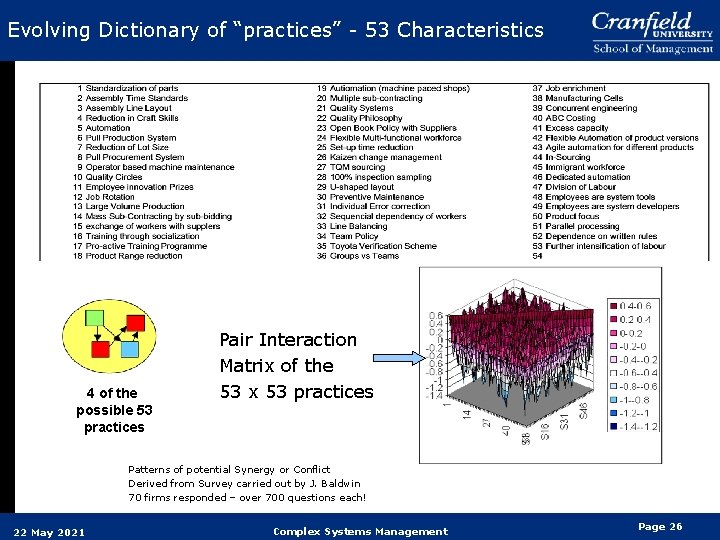
Evolving Dictionary of “practices” - 53 Characteristics 4 of the possible 53 practices Pair Interaction Matrix of the 53 x 53 practices Patterns of potential Synergy or Conflict Derived from Survey carried out by J. Baldwin 70 firms responded – over 700 questions each! 22 May 2021 Complex Systems Management Page 26
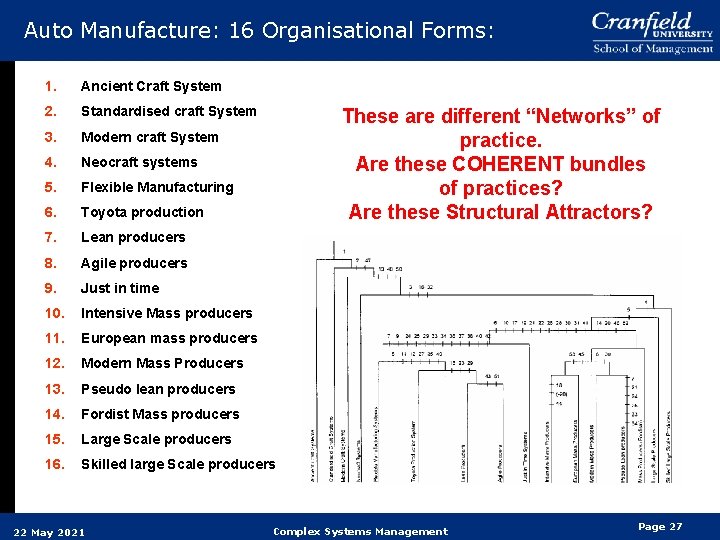
Auto Manufacture: 16 Organisational Forms: 1. Ancient Craft System 2. Standardised craft System 3. Modern craft System 4. Neocraft systems 5. Flexible Manufacturing 6. Toyota production 7. Lean producers 8. Agile producers 9. Just in time 10. Intensive Mass producers 11. European mass producers 12. Modern Mass Producers 13. Pseudo lean producers 14. Fordist Mass producers 15. Large Scale producers 16. Skilled large Scale producers 22 May 2021 These are different “Networks” of practice. Are these COHERENT bundles of practices? Are these Structural Attractors? Complex Systems Management Page 27
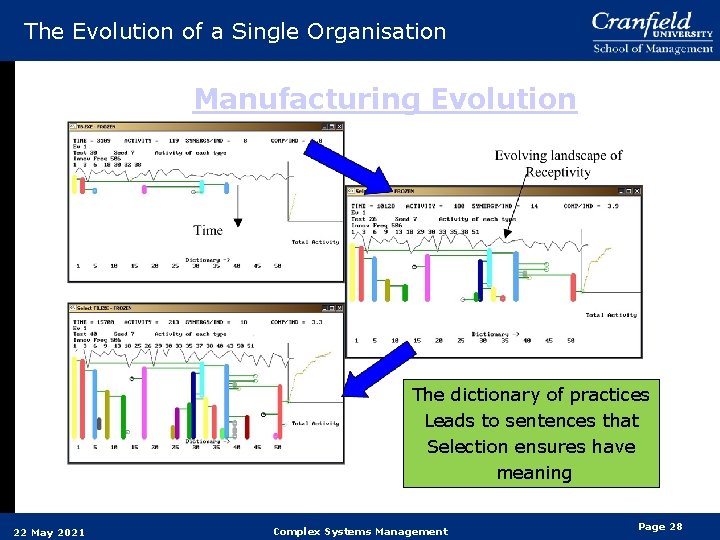
The Evolution of a Single Organisation Manufacturing Evolution The dictionary of practices Leads to sentences that Selection ensures have meaning 22 May 2021 Complex Systems Management Page 28
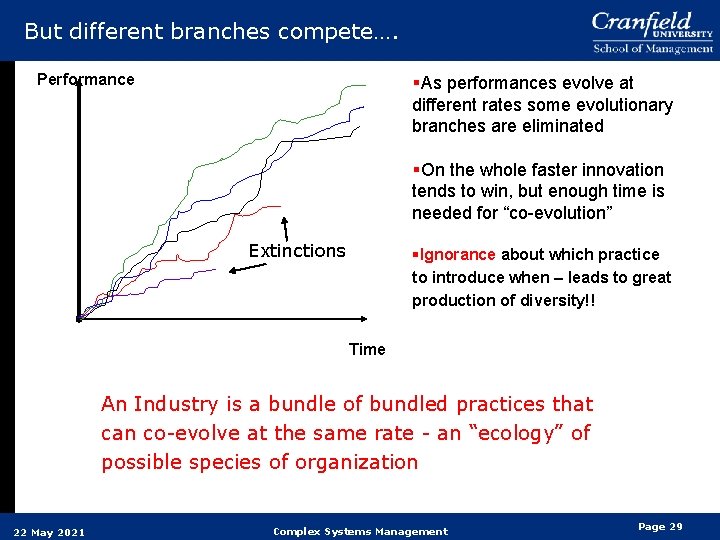
But different branches compete…. Performance §As performances evolve at different rates some evolutionary branches are eliminated §On the whole faster innovation tends to win, but enough time is needed for “co-evolution” Extinctions §Ignorance about which practice to introduce when – leads to great production of diversity!! Time An Industry is a bundle of bundled practices that can co-evolve at the same rate - an “ecology” of possible species of organization 22 May 2021 Complex Systems Management Page 29
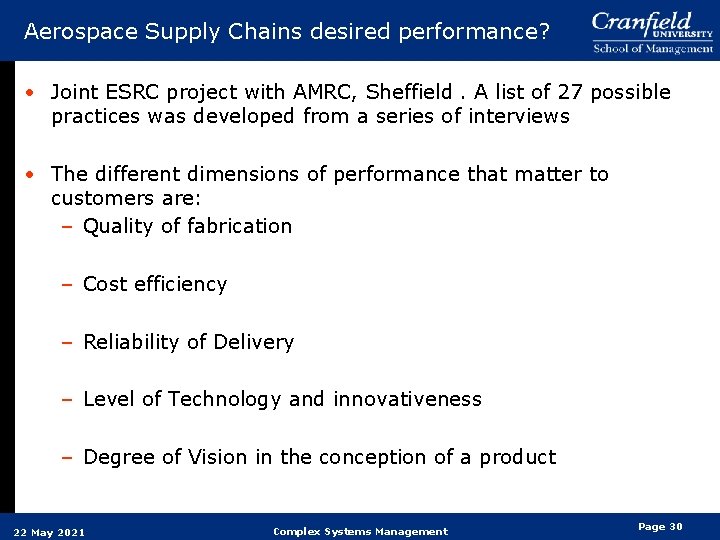
Aerospace Supply Chains desired performance? • Joint ESRC project with AMRC, Sheffield. A list of 27 possible practices was developed from a series of interviews • The different dimensions of performance that matter to customers are: – Quality of fabrication – Cost efficiency – Reliability of Delivery – Level of Technology and innovativeness – Degree of Vision in the conception of a product 22 May 2021 Complex Systems Management Page 30
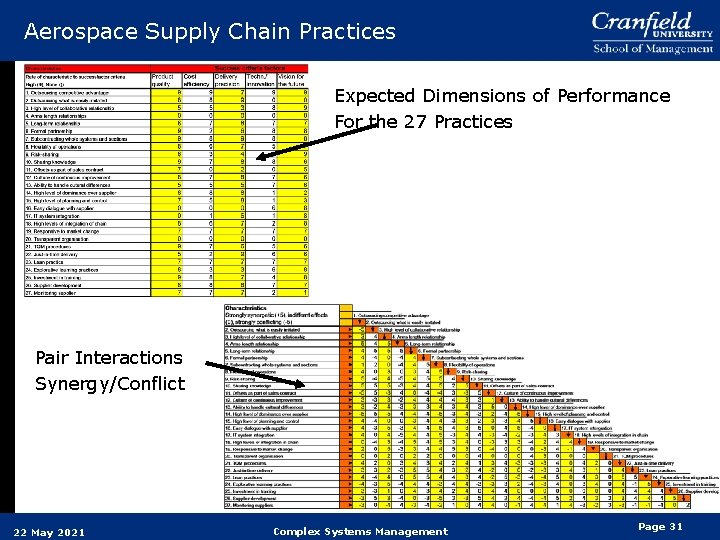
Aerospace Supply Chain Practices Expected Dimensions of Performance For the 27 Practices Pair Interactions Synergy/Conflict 22 May 2021 Complex Systems Management Page 31
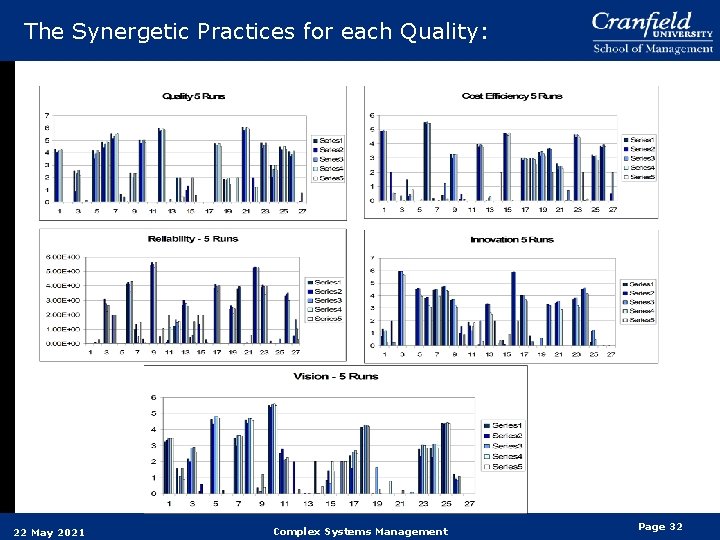
The Synergetic Practices for each Quality: 22 May 2021 Complex Systems Management Page 32
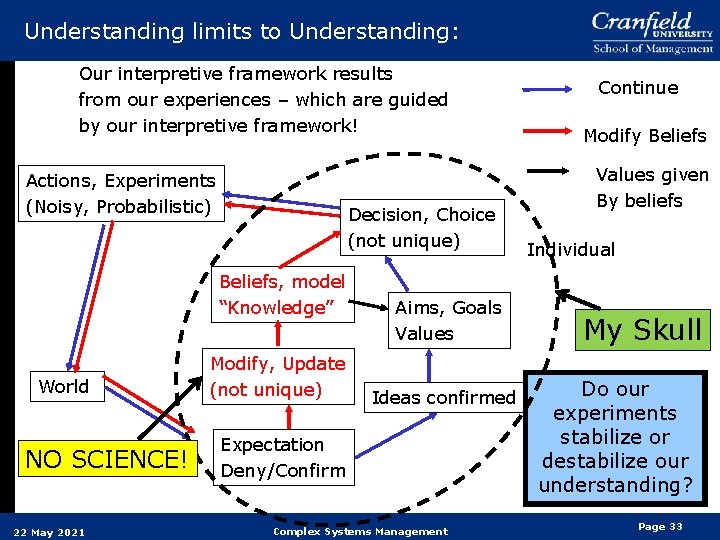
Understanding limits to Understanding: Our interpretive framework results from our experiences – which are guided by our interpretive framework! Actions, Experiments (Noisy, Probabilistic) Decision, Choice (not unique) Beliefs, model “Knowledge” World NO SCIENCE! 22 May 2021 Modify, Update (not unique) Aims, Goals Values Ideas confirmed Expectation Deny/Confirm Complex Systems Management Continue Modify Beliefs Values given By beliefs Individual My Skull Do our experiments stabilize or destabilize our understanding? Page 33
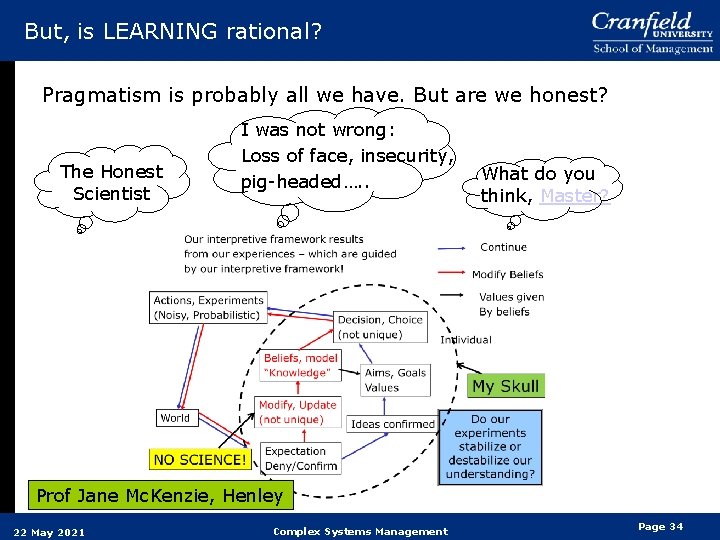
But, is LEARNING rational? Pragmatism is probably all we have. But are we honest? The Honest Scientist I was not wrong: Loss of face, insecurity, pig-headed…. . What do you think, Master? Prof Jane Mc. Kenzie, Henley 22 May 2021 Complex Systems Management Page 34
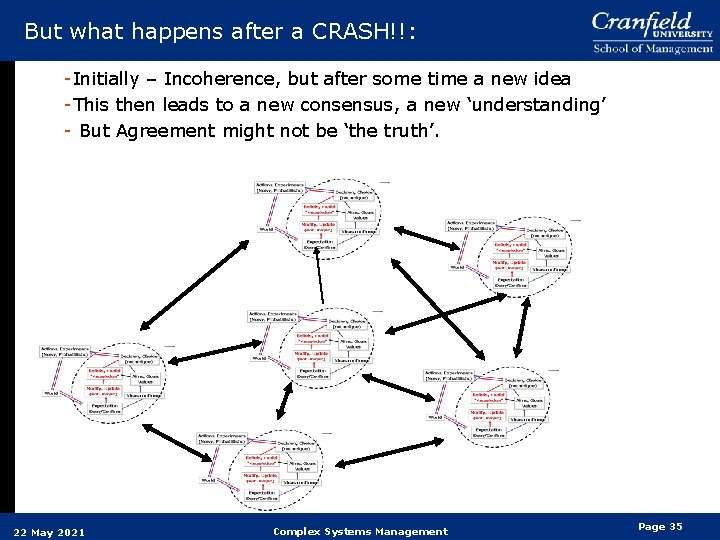
But what happens after a CRASH!!: -Initially – Incoherence, but after some time a new idea -This then leads to a new consensus, a new ‘understanding’ - But Agreement might not be ‘the truth’. 22 May 2021 Complex Systems Management Page 35
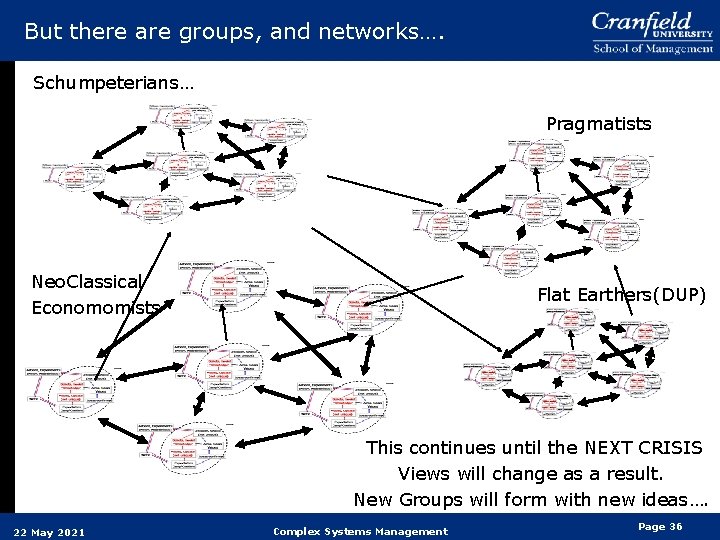
But there are groups, and networks…. Schumpeterians… Pragmatists Neo. Classical Economomists Flat Earthers(DUP) This continues until the NEXT CRISIS Views will change as a result. New Groups will form with new ideas…. 22 May 2021 Complex Systems Management Page 36
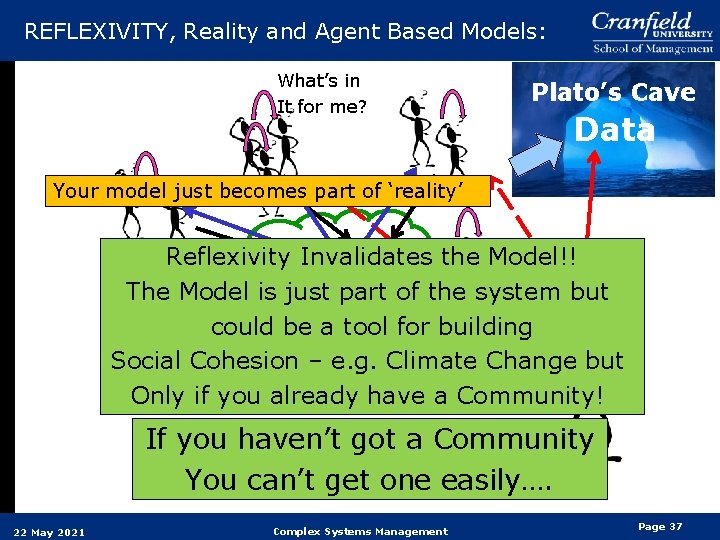
REFLEXIVITY, Reality and Agent Based Models: What’s in It for me? Plato’s Cave Data Your model just becomes part of ‘reality’ Reflexivity Invalidates the Model!! Model The Model is just part of the system but could be a tool for building Social Cohesion – e. g. Climate Change but Only if you already have a Community! If you haven’t got a Community Modeller You can’t get one easily…. 22 May 2021 Complex Systems Management Page 37
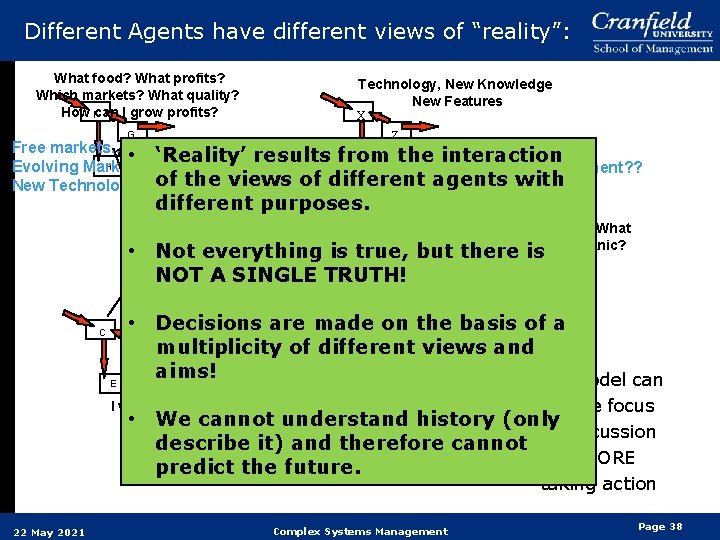
Different Agents have different views of “reality”: What food? What profits? Which markets? What quality? How Fcan I grow profits? Technology, New Knowledge New Features X G Z Free markets… • ‘Reality’ results from the interaction H Y Evolving Markets Sustainable Development? ? of the views of different agents strengths? with New Technologies Innovative different purposes. What crops should I grow? What Gives me most profit? Organic? • Not Reality? ? ? everything is true, but there is L NOT A SINGLE TRUTH! M N C E • Decisions are made on the basis of a multiplicity of different views and D aims! The Model can I want food I like, that is good be the focus • for We me, cannot and cheap. understand history (only of discussion I like sugar. Food Fashions describe it) and therefore cannot predict the future. 22 May 2021 Complex Systems Management BEFORE taking action Page 38
Prigogine and Evolutionary Complexity: • He saw that the ‘emergent spatial structures’ of the BZ reaction demonstrated that open physical systems could self-organize. • He had been calling these phenomena ‘Dissipative Structures’ and then moved on to ‘Self Organizing systems’. Neither was as catchy as ‘Synergetics’ that Herman Haken had adopted. Finally Complexity… • The scientific world has now been taken over by successive ideas: Catastrophe Theory, System Dynamics, Chaos Theory, Self-Organization, and Complexity theory • Statics, Kinetics/Dynamics, Evolutionary Kinetics and Multi-level Evolutionary Complexity. History is deeply present in evolution. 22 May 2021 Complex Systems Management Page 39
Post-Prigogine -1: What can we ‘understand’? • Traditional Science depends on Repeatable Experiments and provides Popperian Knowledge. The behaviour of the elements under study is not changed by their experiences. Molecules don’t get bored or angry and have a poor sense of humour! • In Social and biological systems all that we see are those things that happen to have been created, minus the non-viable and the unlucky! The presence of Organisms/Agents in a system does NOT mean they are OPTIMAL!! They are HISTORICAL! • This means that we will find does not necessarily ‘make sense’ and many elements may have no role or function. We do not necessarily understand ‘better’ by analysing more data. • This affects the nature of ‘explanation’ since we cannot always attribute functionality to elements. It also makes the outcomes of innovations unpredictable 22 May 2021 Complex Systems Management Page 40
Post-Prigogine – 2: What is the System -Reflexivity • ‘Understanding’ is about choosing what not to understand – Level of Description. The ‘micro-MESS’ is the engine of resilience and future evolution – the opaque core of evolutionary complexity. • In Social Systems we have REFLEXIVITY. Different agents behave according to their own acquired, changing, interpretive frameworks. But when agents see the outcomes predicted by a model, they may modify their behaviour. This would then INVALIDATE the model. • We could INCLUDE the changes in participating agents’ representations as part of the model. (Machiavelli) Or include agents anticipating other agents ‘learning’ in their internal representations. Machiavelliopoly!!! 22 May 2021 Complex Systems Management Page 41
Post-Prigogine - 3: What can we do? • Models with noise, randomness and non-linearities can tell us things that we didn’t know and weren’t in the data! • A complex system with internal diversity, may succeed, without knowing why. But models can help us reflect on what is happening and why, as well as what experiments to try. Our models and choices therefore change the future. • Our interpretive frameworks (Models) do not make predictions. They are our instruments of reflection. Better models can help us to act: e. g. climate change, ecology. Our models are part of ‘politics’. Prigogine showed that we could have qualitative evolution – emergent variables, mechanisms, characteristics and capabilities. • Our understanding and interpretive frameworks are just part of the Evolving Complex World. 22 May 2021 Complex Systems Management Page 42
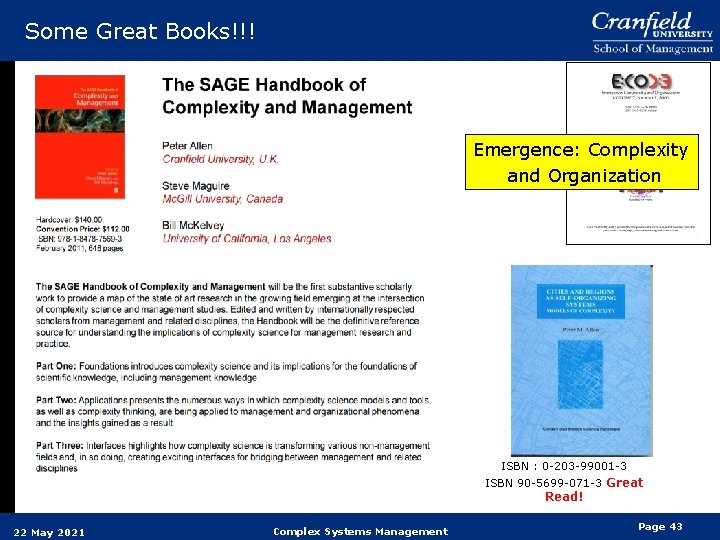
Some Great Books!!! Emergence: Complexity and Organization ISBN : 0 -203 -99001 -3 ISBN 90 -5699 -071 -3 Great Read! 22 May 2021 Complex Systems Management Page 43
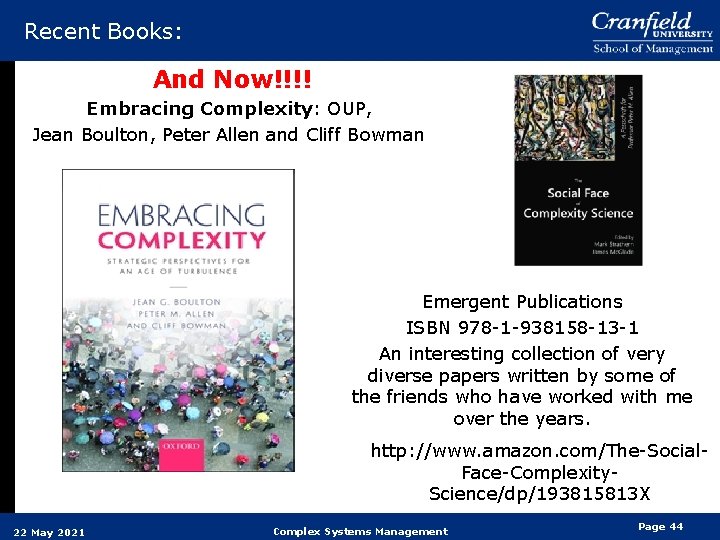
Recent Books: And Now!!!! Embracing Complexity: OUP, Jean Boulton, Peter Allen and Cliff Bowman Emergent Publications ISBN 978 -1 -938158 -13 -1 An interesting collection of very diverse papers written by some of the friends who have worked with me over the years. http: //www. amazon. com/The-Social. Face-Complexity. Science/dp/193815813 X 22 May 2021 Complex Systems Management Page 44
Multiple Levels mean Evolution is INEVITABLE: Multi-Dimensional Environment MACRO Understanding? Selection of System Properties Aggregate Overall Behaviour Protection at while stable Selection an UPPER Emergence when instability occurs LEVEL means that X Y evolution is inevitable! MESO Z Freedom to Explore MICRO Differential Survival Plasticity of Behaviour Decreasing heterogeneity Increasing Heterogeneity Molecules Organisms People Skills Practices … Multiple Random walks can and will explore new dimensions 22 May 2021 Complex Systems Management Page 45