
The Complexity and Viability of DNA Computations Martyn
The Complexity and Viability of DNA Computations Martyn Amos, Alan Gibbons and Paul E. Dunne Proc. Bio-computing and Emergent Computation (BCEC 97) © 2002 SNU CSE Biointelligence Lab
Abstract l Complexity issues are paramount in the search for so-called “killer applications”. l Strong model of computation which provides better estimates of the resources required by DNA algorithms. l Compare the complexities of published algorithm within this new model and the weaker, extant model © 2002 SNU CSE Biointelligence Lab 2
Introduction Computational paradigm employed by Adleman requires exponentially sized initial solution of DNA l NP-complete problems require exponential sequential running time. A DNA computation, in seeking to reduce this to sub-exponential parallel running time, will certainly require an exponential volume of DNA. l Complexity class NC l Polylogarithmic running time: O(log(n)k) for some k © 2002 SNU CSE Biointelligence Lab 3
Introduction The weak model of DNA computation and the strong model. l Compare time complexities of extant algorithms within both the weak and strong models. l Discuss the complexity of one extant Turingcomplete model of DNA computation in the context of the strong model. l Review current search for the killer application. l © 2002 SNU CSE Biointelligence Lab 4
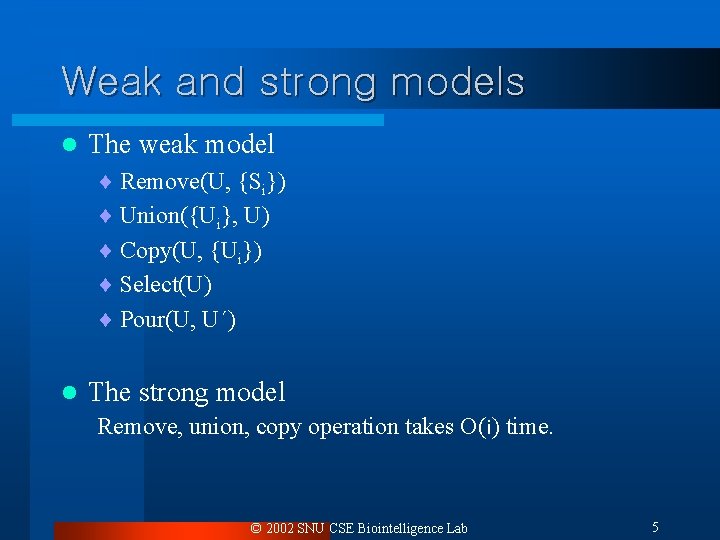
Weak and strong models l The weak model ¨ Remove(U, {Si}) ¨ Union({Ui}, U) ¨ Copy(U, {Ui}) ¨ Select(U) ¨ Pour(U, U´) l The strong model Remove, union, copy operation takes O(i) time. © 2002 SNU CSE Biointelligence Lab 5

Complexity comparisons in the weak and strong models Problem: Permutations l Solution l ¨ Input: all string of the form p 1 i 1 p 2 i 2…pnin. ¨ Algorithm for j = 1 to n do begin copy(U, {U 1, U 2, …, Un}) for i = 1, 2, …, n and all k > j remove(Ui, {pj¬I, pki}) union({U 1, U 2, …, Un}, U) end Pn U ¨ Complexity: O(n 2) parallel-time © 2002 SNU CSE Biointelligence Lab 6
Fully-algorithmic DNA computations l Simulation of Boolean circuits within a model of DNA computation, Ogihara and Ray. - real-time simulation of the class NC in time proportional to the depth of the circuit. l Time complexity should be proportional to the size of the circuit. - polynomial running time in the strong model. l At each level, it requires sequential pour operation, so in the general case it’s time complexity is O(C(S), not O(D(S)). © 2002 SNU CSE Biointelligence Lab 7
Conclusions Complexity considerations are important to the identification of “killer applications” for DNA computation. l Strong model of DNA computation allows realistic assessment of the time complexities of algorithms. l If we were to establish polylogarithmic time computations using only a polynomial volume of DNA, the vast potential for parallelisation would yield feasible solutions to very much larger problem sizes than could be achived using existing, siliconbased parallel machines. l © 2002 SNU CSE Biointelligence Lab 8
- Slides: 8