
THE COMPLEMENTARITY EFFECTS OF PROXIMITY DIMENSIONS ON KNOWLEDGE

- Slides: 23
THE COMPLEMENTARITY EFFECTS OF PROXIMITY DIMENSIONS ON KNOWLEDGE SPILLOVERS: Emanuela Marrocu, Raffaele Paci, Stefano Usai University of Cagliari and CRENo. S FP 7 -SSH-2010 -2. 2 -1, SEARCH project Topics in Economics
Motivation and aim Wide consensus based on both theoretical (Grossman and Helpman, 1990; Rallet and Torre, 1999) and empirical grounds (Jaffe, 1989; Coe and Helpman, 1995) that innovation activity depends on investments in research, knowledge and human capital as much as on interactive learning and the circulation of ideas. The capacity of a region to generate, transmit and acquire knowledge and innovation depends on a multifaceted set of factors: investment in R&D, education and training, work force experience, collaboration networks, technology transfer mechanisms, mobility of researchers. The main aim of this paper is to analyze the interaction of internal and external factors in determining the technological performance of European regions.
Specific aims More specifically: • we investigate to what extent the regional innovative capacity depends on intra-regional characteristics (mainly R&D expenditure and human capital) and on the ability to exploit inter-regional spillovers; • we analyze the mechanisms, in the form of different kinds of proximity and networks, which facilitate the emergence of such spillovers and how they interact - are they complementary or substitute?
Literature background • The literature on Endogenous Growth and on New Economic Geography provides theoretical backing to the idea that there are technological spillovers within and across regions and countries. • Such spillovers are obviously related to the geographical dimension since close-by agents are believed to have a better innovative performance because of pecuniary and pure technological advantages. • The French School of Proximity argues that geographical proximity is neither necessary nor sufficient: there is a separate role for a-spatial links among economic entities (Carrincazeaux - Coris, 2011). • Knowledge exchange and technological interdependence across agents are influenced by four other proximity dimensions: institutional, technological, social and organizational (Boschma, 2005). (Influence is not always positive: there might be either too much or too low proximity: there is an optimal level of proximity beyond which economies may experience lock in)
Types of Proximity, beyond geographical space • Institutional proximity (I): the effective transmission of knowledge may be facilitated by a common institutional framework, such as laws and norms (Maskell-Malmberg, 1999; Gertler, 2003). • Technological (or cognitive) proximity (T): knowledge transfer requires appropriate absorptive capacity (Cohen-Levinthal 1990) which entails an homogenous cognitive base with respect to the original knowledge in order to understand process it effectively. • Social (or relational) proximity (S): social closeness facilitates firms capacity to learn, absorb external knowledge and innovate since this breeds trust which, in turn, lowers transaction costs and facilitate collaboration (Granovetter, 1985). • Organisational proximity (O): relations within the same group or organisation influence the individual capacity to acquire new knowledge coming from different agents (Kirat - Lung 1999).
Types of Proximity, beyond local knowledge spillovers • Another relevant concept for the analysis of knowledge flows is the distinction between unintented and intented spillovers (Maggioni et al. , 2007). Proximity may induce a process of knowledge diffusion that does not depend directly on economic agents’ decisions. • In the case of intended spillovers, knowledge flows across aspatial networks where agents exchange ideas on a voluntary base thanks to formal or informal agreements (Cowan and Jonard, 2004). • Exchanges may be market or non market mediated, that is either pecuniary or pure technological spillovers (Breschi and Lissoni, 2001 and 2009, and Antonelli, 2007)
Empirics on knowledge spillovers • Seminal paper on geographical spillovers: Jaffe 1989. Extensions for US consider mainly geographical proximity (Acs et al 1992; Audretsch and Feldman, 1996; Anselin et al 1997; O´h. Uallachain - Leslie 2007). • Contributions on EU regions introduce technological and institutional proximity (Bottazzi-Peri 2003, Greunz 2003, Moreno-Paci-Usai 2005). • Role of social/relational networks (as a regional indicator) together with geographical proximity within a KPF: Maggioni et al. 2007, Lobo –Strumsky 2008 for US MSA’s, Crescenzi et al. 2007 for both US and EU, Miguelez-Moreno 2010 for EU NUTS 2 regions. • No contributions on the role of organizational proximity on regional innovation performance. The only partial exceptions are Sorensen et al 2009, Oerlemans. Meeus 2005 at the firms level.
Our contribution • We extend the Knowledge Production Function (KPF) model by including human capital as an additional input (important factor to account for the absorptive capacity) • Broad territorial coverage 276 regions in 29 countries (EU 27 plus Norway, Switzerland). • We assess the role of different types of proximity and networks in channeling technological spillovers across regions • Computation of direct, indirect and total impact of each factor • Spatial econometric techniques are applied to assess the role of different (two at a time) proximity dimensions simultaneously • Tentative and preliminary interpretation for policy suggestions
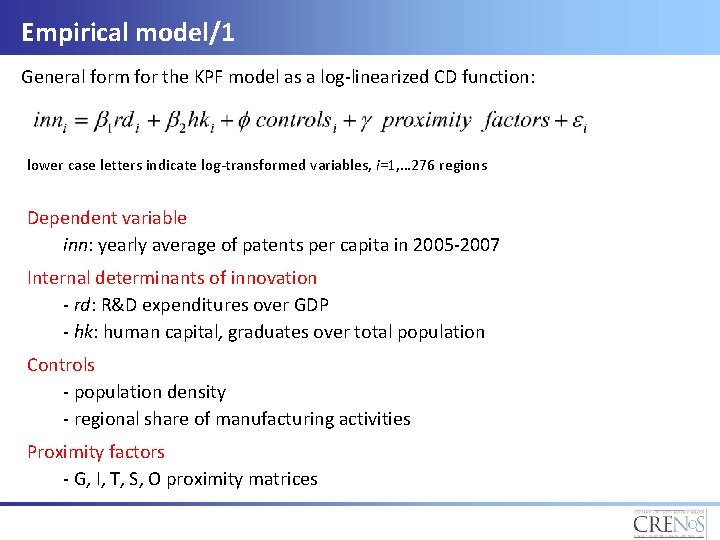
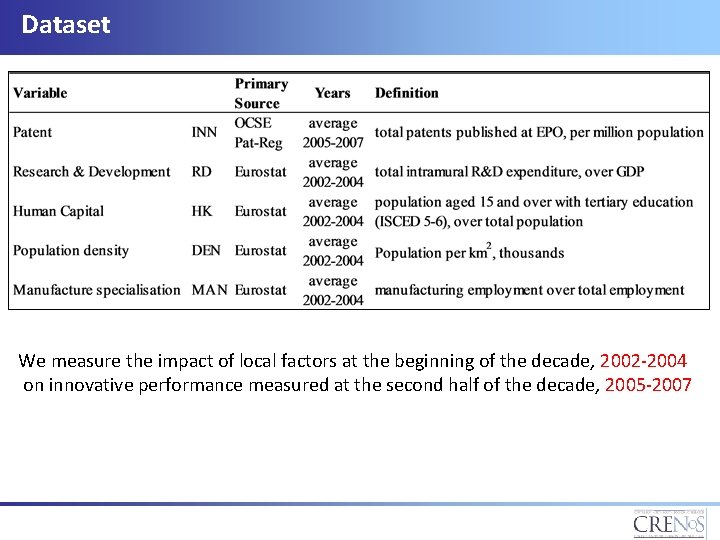
Empirical model/1 General form for the KPF model as a log-linearized CD function: lower case letters indicate log-transformed variables, i=1, … 276 regions Dependent variable inn: yearly average of patents per capita in 2005 -2007 Internal determinants of innovation - rd: R&D expenditures over GDP - hk: human capital, graduates over total population Controls - population density - regional share of manufacturing activities Proximity factors - G, I, T, S, O proximity matrices
Dataset We measure the impact of local factors at the beginning of the decade, 2002 -2004 on innovative performance measured at the second half of the decade, 2005 -2007
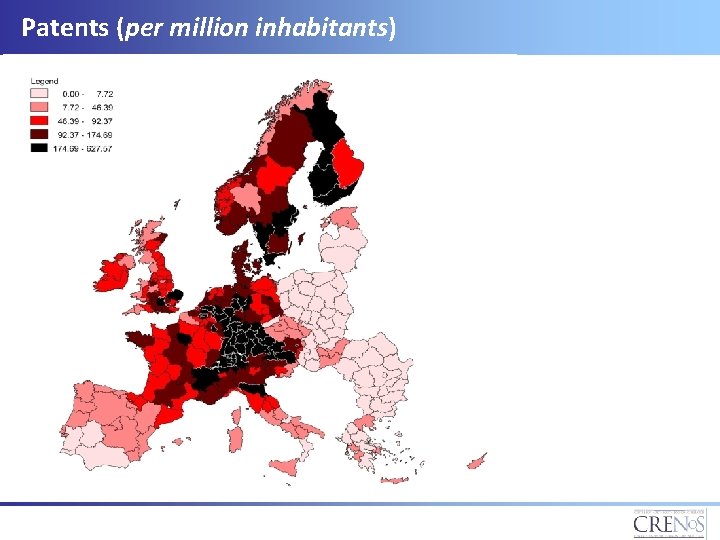
Patents (per million inhabitants)
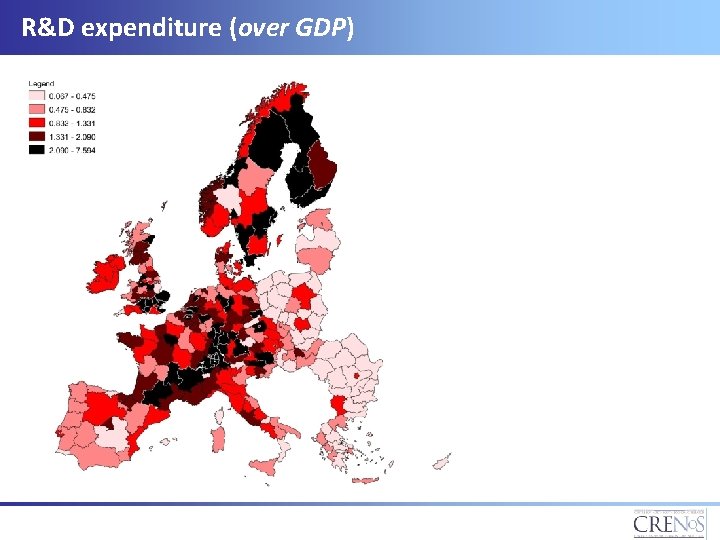
R&D expenditure (over GDP)
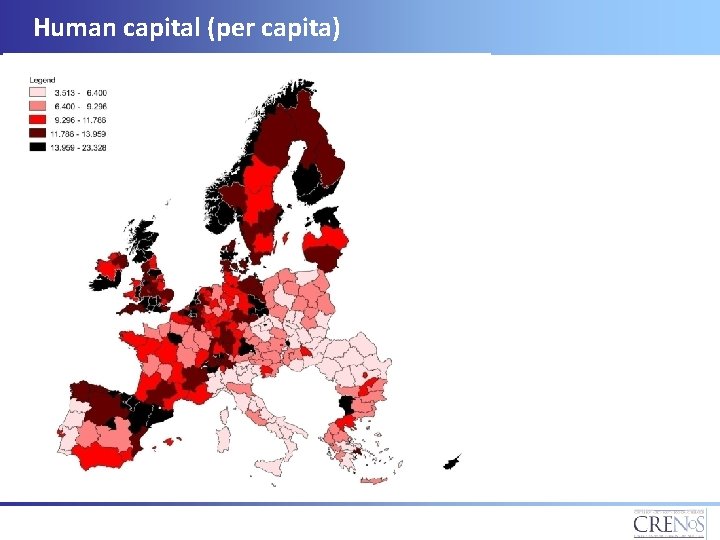
Human capital (per capita)
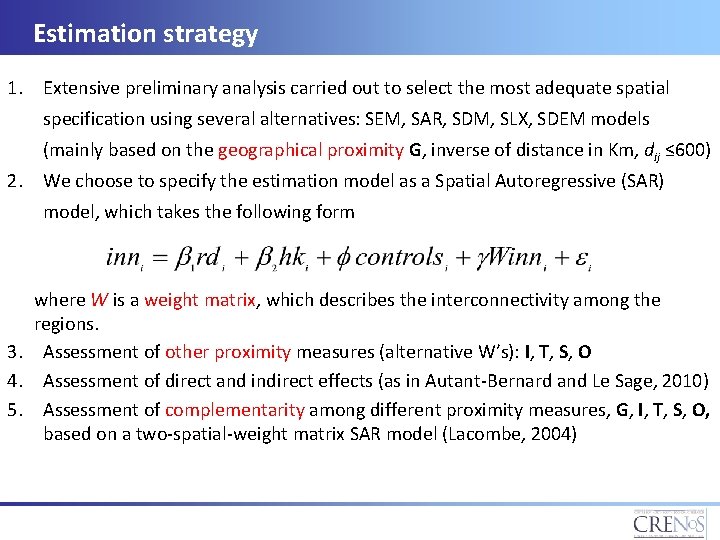
Estimation strategy 1. Extensive preliminary analysis carried out to select the most adequate spatial specification using several alternatives: SEM, SAR, SDM, SLX, SDEM models (mainly based on the geographical proximity G, inverse of distance in Km, dij ≤ 600) 2. We choose to specify the estimation model as a Spatial Autoregressive (SAR) model, which takes the following form where W is a weight matrix, which describes the interconnectivity among the regions. 3. Assessment of other proximity measures (alternative W’s): I, T, S, O 4. Assessment of direct and indirect effects (as in Autant-Bernard and Le Sage, 2010) 5. Assessment of complementarity among different proximity measures, G, I, T, S, O, based on a two-spatial-weight matrix SAR model (Lacombe, 2004)
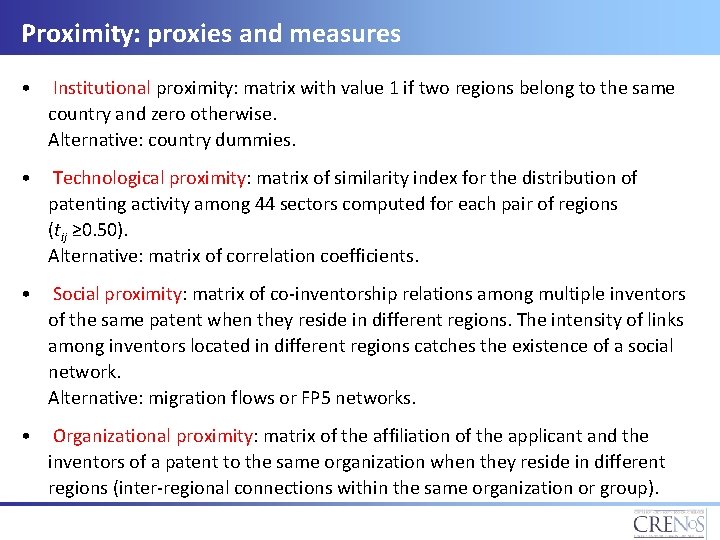
Proximity: proxies and measures • Institutional proximity: matrix with value 1 if two regions belong to the same country and zero otherwise. Alternative: country dummies. • Technological proximity: matrix of similarity index for the distribution of patenting activity among 44 sectors computed for each pair of regions (tij ≥ 0. 50). Alternative: matrix of correlation coefficients. • Social proximity: matrix of co-inventorship relations among multiple inventors of the same patent when they reside in different regions. The intensity of links among inventors located in different regions catches the existence of a social network. Alternative: migration flows or FP 5 networks. • Organizational proximity: matrix of the affiliation of the applicant and the inventors of a patent to the same organization when they reside in different regions (inter-regional connections within the same organization or group).
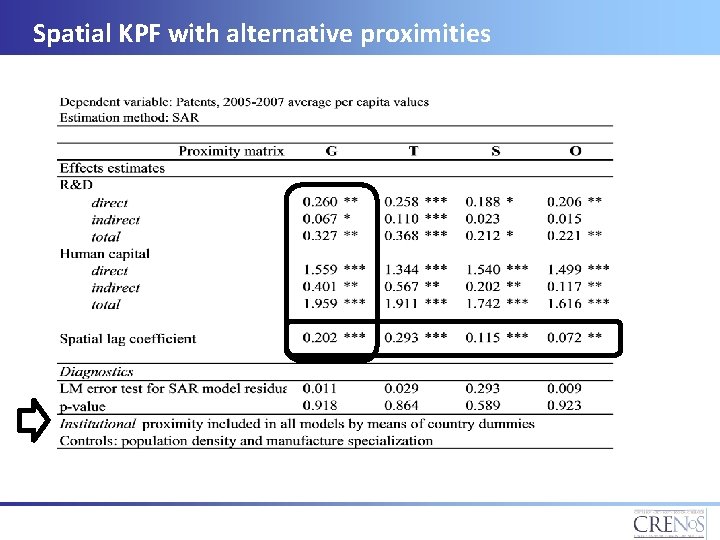
Spatial KPF with alternative proximities
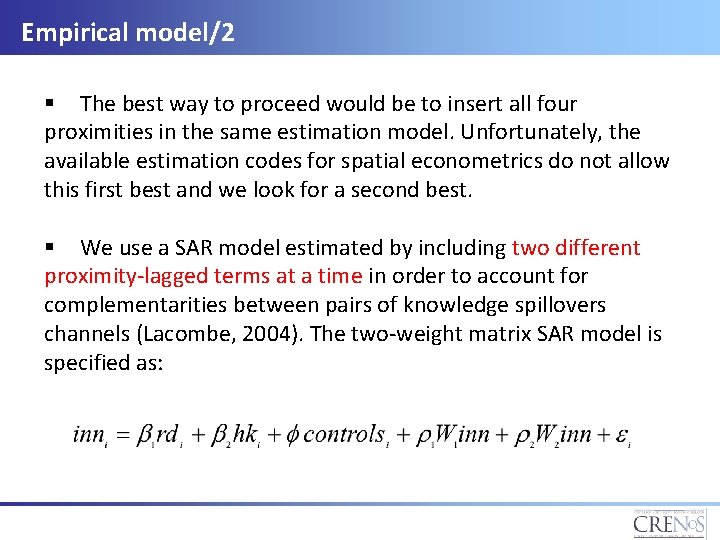
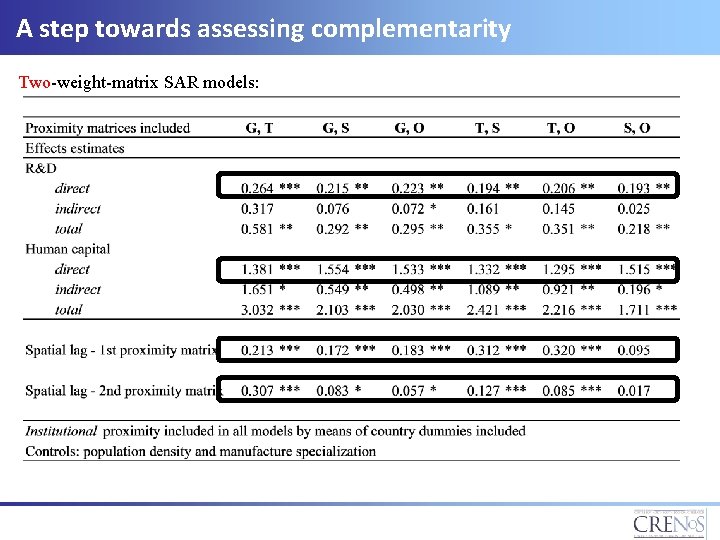
Empirical model/2 § The best way to proceed would be to insert all four proximities in the same estimation model. Unfortunately, the available estimation codes for spatial econometrics do not allow this first best and we look for a second best. § We use a SAR model estimated by including two different proximity-lagged terms at a time in order to account for complementarities between pairs of knowledge spillovers channels (Lacombe, 2004). The two-weight matrix SAR model is specified as:
A step towards assessing complementarity Two-weight-matrix SAR models:
A further step: model combining… A combined model is obtained on the basis of probabilities calculated from biased-adjusted AIC values (Burnham and Anderson, 2002)
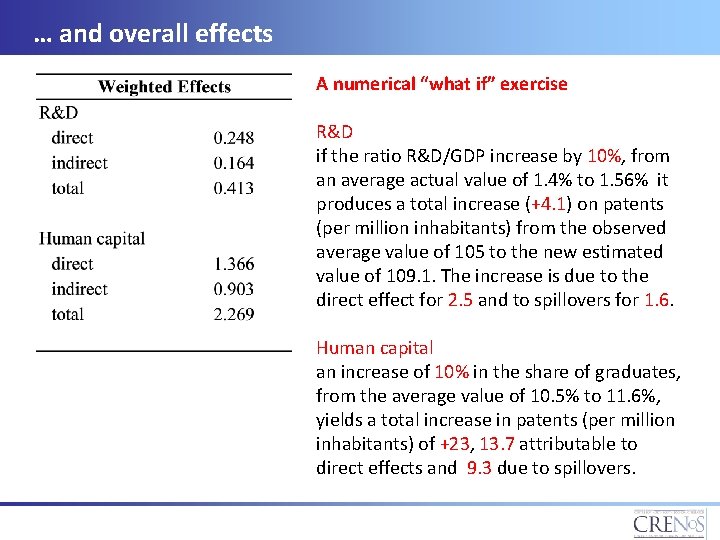
… and overall effects A numerical “what if” exercise R&D if the ratio R&D/GDP increase by 10%, from an average actual value of 1. 4% to 1. 56% it produces a total increase (+4. 1) on patents (per million inhabitants) from the observed average value of 105 to the new estimated value of 109. 1. The increase is due to the direct effect for 2. 5 and to spillovers for 1. 6. Human capital an increase of 10% in the share of graduates, from the average value of 10. 5% to 11. 6%, yields a total increase in patents (per million inhabitants) of +23, 13. 7 attributable to direct effects and 9. 3 due to spillovers.
Main conclusions • R&D and human capital are essential components for technological progress but with quite different impacts. • All dimensions of proximities are significantly related to innovative performance and they represent complementary channels of knowledge transmission. • Cognitive or technological proximity is individually the most effective and its role is enhanced by geographical closeness. • Social and organizational dimensions are important too, although the size of their spatial lag is more modest. Besides, these two dimensions turn out to be not always complements since the two proxies suffers from some overlapping. • Once the combined effect of all proximity measures is considered, it results that the effect of human capital on the production of knowledge is sizeable due to the spillover of external knowledge favoured by the absorptive capacity of well educated population within the region.
Policy implications/1 • Importance of policies aiming at increasing the endowments of well educated labor forces, given their strong and pervasive role in determining both the internal creation and the external diffusion and absorption of knowledge. Education in general and universities in particular have to be central in any innovation policy. • The existence of several channels of interregional spillovers calls for a coordinated strategy able to achieve different targets with diverse instruments. • More policies should aim directly to knowledge diffusion and absorption taking into account the diverse institutional and industrial contexts : no “one size fits all” policies (Todling and Trippl, 2005 and Asheim et al, 2011) • Practically, policies should support and encourage the formation of dense networks among regional innovation systems which go beyond geographical clusters.
Policy implication/2 • Technological proximity matter much more than the geographical one in influencing innovation spillovers. This suggests the implementation of specific industrial policies to support the formation and the functioning throughout Europe of a-spatial industrial clusters characterized by proximate technology. • Finally, the presence of externalities which exploit social interregional relations requires policies designed specifically to provide a balanced set of incentives to motivate economic agents towards more cooperative behaviours and actions with economic entities in other regions.