
The Competitive Advantage of Emerging Market Multinationals Chapter

- Slides: 20
The Competitive Advantage of Emerging Market Multinationals Chapter 4 Innovation by Chinese EMNES Xu Kunwei
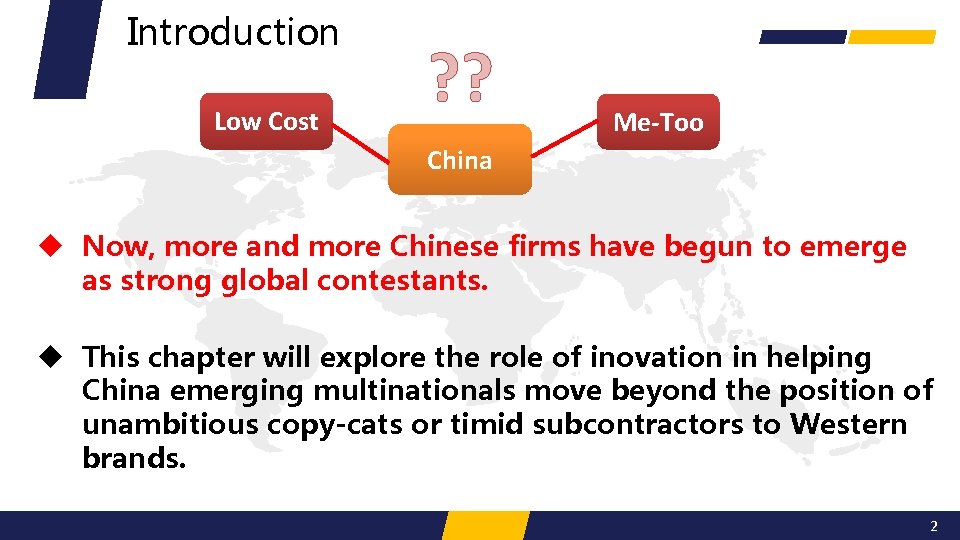
Introduction Low Cost ? ? Me-Too China u Now, more and more Chinese firms have begun to emerge as strong global contestants. u This chapter will explore the role of inovation in helping China emerging multinationals move beyond the position of unambitious copy-cats or timid subcontractors to Western brands. 2
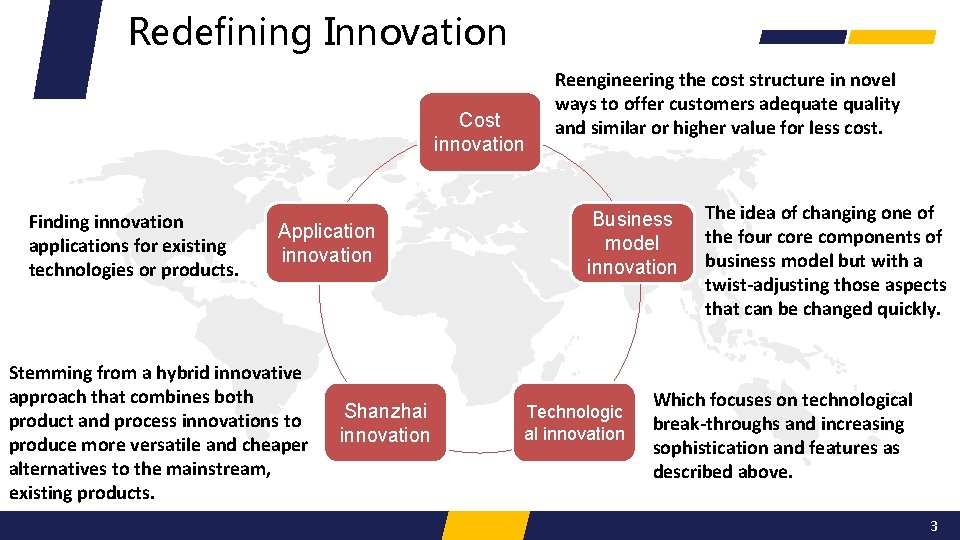
Redefining Innovation Cost innovation Finding innovation applications for existing technologies or products. Application innovation Stemming from a hybrid innovative approach that combines both product and process innovations to produce more versatile and cheaper alternatives to the mainstream, existing products. Shanzhai innovation Reengineering the cost structure in novel ways to offer customers adequate quality and similar or higher value for less cost. Business model innovation Technologic al innovation The idea of changing one of the four core components of business model but with a twist-adjusting those aspects that can be changed quickly. Which focuses on technological break-throughs and increasing sophistication and features as described above. 3
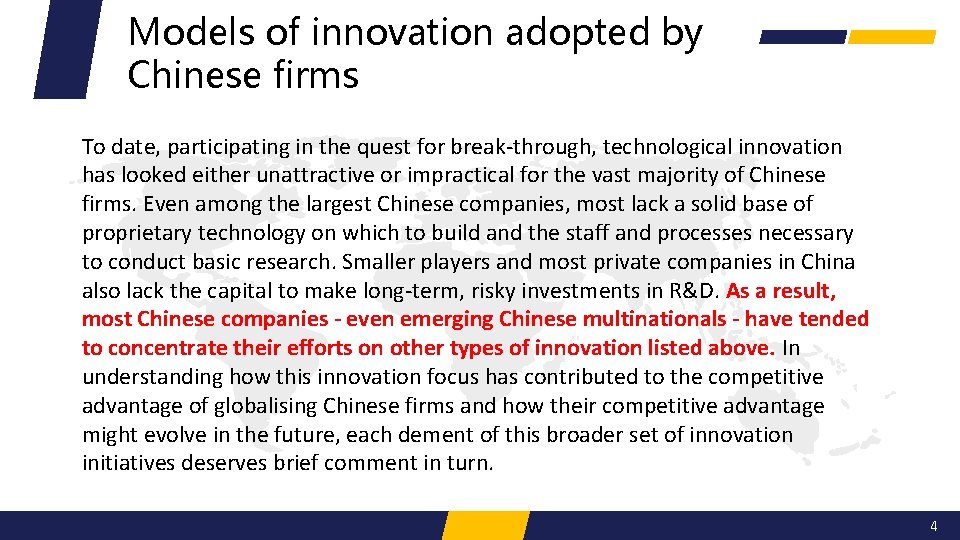
Models of innovation adopted by Chinese firms To date, participating in the quest for break-through, technological innovation has looked either unattractive or impractical for the vast majority of Chinese firms. Even among the largest Chinese companies, most lack a solid base of proprietary technology on which to build and the staff and processes necessary to conduct basic research. Smaller players and most private companies in China also lack the capital to make long-term, risky investments in R&D. As a result, most Chinese companies - even emerging Chinese multinationals - have tended to concentrate their efforts on other types of innovation listed above. In understanding how this innovation focus has contributed to the competitive advantage of globalising Chinese firms and how their competitive advantage might evolve in the future, each dement of this broader set of innovation initiatives deserves brief comment in turn. 4
Cost innovation - creating high quality with low cost What? Why? u The idea of innovation efforts focused primarily on reducing cost while maintaining quality - on producing cheaper products and offering similar functionality at better value for money. u Cost innovation involves creative ways of reengineering products or processes to eliminate things that do not add value (or value that consumers The developing-country are willing to pay markets for. ) as the engine of growth in global demand nowadays. In order to access the potential demand growth in these emerging markets, where income levels are relatively low, offering exceptional value-for-money will be critical. The capability for cost innovation, therefore, is a very promising source of competitive advantage. 5
E xample BY D Observing that the high cost of lithium ion (Li-Ion) batteries (at the time costing $40 each) was preventing their use in mainstream products, BYD focused their innovation efforts on reducing costs without compromising performance. Their R&D tried to find a way to replace some of the most expensive materials used in Li-Ion rechargeable batteries with cheaper substitutes. BYD also worked on reengineering the production process. It figured out how to make batteries at ambient temperature and humidity, avoiding the necessity to construct and maintain expensive ‘dry rooms’ in the plant. These moves resulted in costs falling by 45 percent, taking the cost for each battery down to just $12. These advances resulted in a value-for-money revolution that saw Li-Ion batteries replace their lower-performance nickel cadmium (Ni. Cad) predecessors in volume applications. As BYD hopped from volume segment to segment, costs fell further, allowing it to notch up global battery market shares of 75 percent in cordless phones, 38 per cent in toys, 30 per cent in power tools and 28 per cent in mobile phones. 2
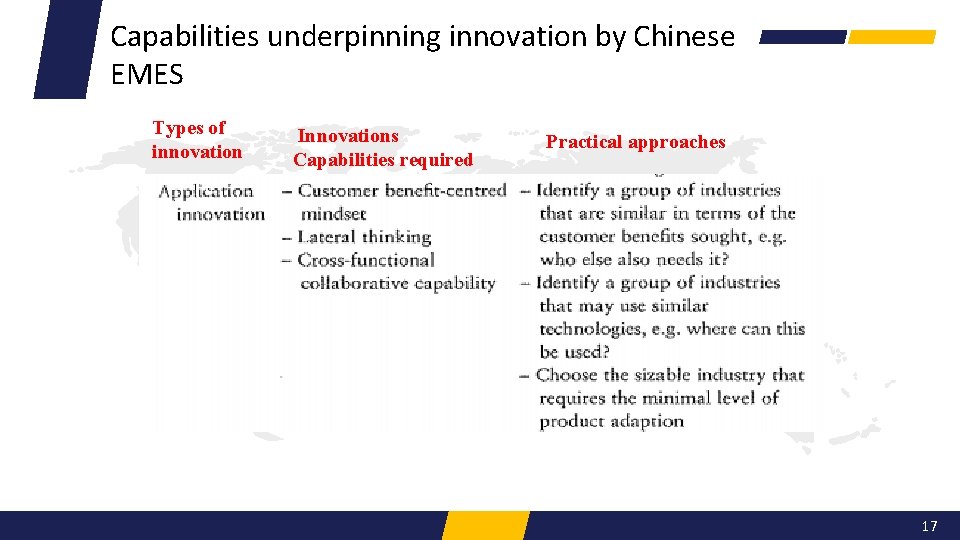
Application innovation - creating new applications of an existing technology What? Why? u Application innovation refers to innovation that is new in terms of its application, but not its technology. u Because they rely on proven technology, however, application innovations often require less investment and generate faster payoffs compared with cntiicly new inventions. Success in application innovation begins with lateral thinking that seemed to come naturally to many of the Chinese companies we studied - perhaps because Chinese philosophy starts from a view of the world as an inter-conncctcd whole, focusing more on similarities, connections and relations rather than on differences, division and idiosyncrasy of its component parts. As a result, application innovation was more common and also appeared to be more highly valued among Chinese corporate innovators chan among similar, incumbent multinationals. 7
E xample Antas Chemica l Compan y Builders traditionally use acrylic products to seal the frames of exterior doors and Windows, but when it rains, their performance suffers. This problem is usually solved by adding another highcost product. Aatas was not a supplier to the building industry but was well established in the business of selling the sealants used in shipping containers - a highly demanding environment for waterproofing. Its butane-based sealants not only offered better long-term performance and were waterproof the instant they were applied, they also had lower production costs. Their innovative idea of reformulating and repackaging the butane-technology sealants for easy use in the construction industry only looks obvious with hindsight. No one had seen the potential before Antas made the leap. 2
E xample Another variant of application innovation is to combine existing, even mature, technologies for a new purpose. Broa d Its founder Zhang Yue bad an innovative idea:instead of powering an air conditioner wirh expensive electricity, why not use waste heat or natural gas to generate cool air direcrly? The technologies for conversion of heat, either wasted by power stations and boilers, or prod need by combusting natural gas, were well established. But no one had applied them to large-scale commercial air conditioning plants of the type used in skyscrapers or airport terminals. Broad's innovation was to do just that. Over the years of applying existing technology in new ways it has succeeded in developing air conditioning systems that reduce energy consumption by up to 80 percent compared with conventional systems powered by electricity - with huge savings in both cost and greenhouse gas emissions. Today its products are installed in over sixty countries, including massive installations that cool Bangkok’s airport and the Expo 2010 pavilions. Broad is the number one supplier of this ‘green, technology to the US and Europe as well as China. 2
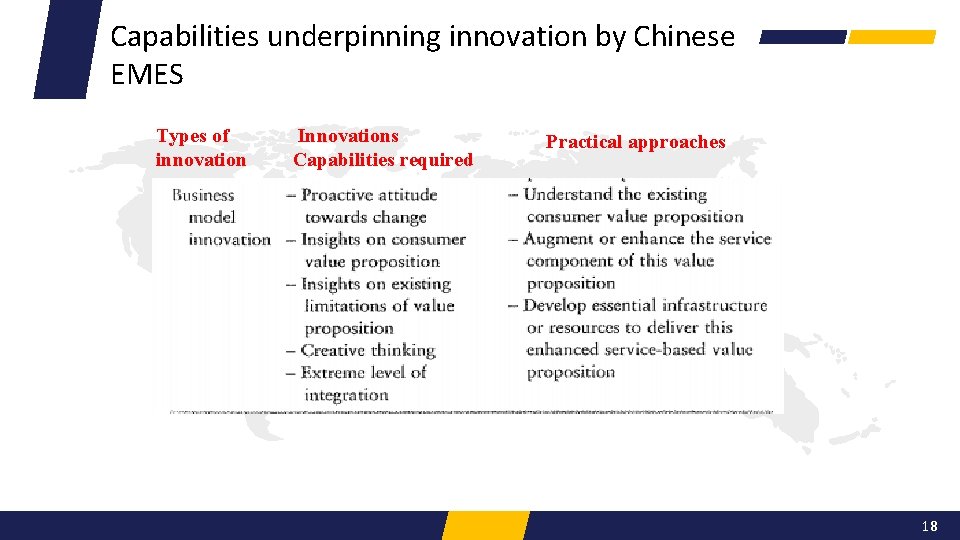
Business model innovation - creating new ways of doing business with extreme flexibility What? Why? u Business model innovation is the development of new, unique concepts supporting an organization's financial viability, including its mission, and the processes for bringing those concepts to fruition. The primary goal of business model innovation is to realize new revenue sources by improving product value and how products are delivered to customers. Some of the world’s most competitively successful innovations have stemmed from novel ideas that did not involve changes in the underlying technologies, products or services at all. Instead, they involved innovative redesign of the business model by which value was created and delivered to customers. Among Chinese companies, however, their research suggests that business model innovation is widely pursued in the quest for competitive advantage. Rarher than turning che organisation upside clown, Chinese companies tend to focus on fewer simple and we. II-targeted innovations in the way things are clone, that can still have the potential Co transform accepted business models. 10
E xample Tencent It used its links between PCs and the mobile network to allow its customers to play on-line games for free. By eliminating the need to download the software onto a gaming console, the problem of counterfeiting that had dissuaded many of its US and Japanese rivals from entering the market simply disappeared. Instead of charging for downloads of the gaming software, Tcnccnc collected revenue from the exploding number of gamers by selling them digital add-ons such as virtual weapons and clotliing. 2
E xample It is not only in high-tech, digital businesses, however, chat a focus on coming up with simple but powerful business model innovations is helping Chinese companies build competitive advantage. Delixi Established in 1984, is now one of the largest privately owned enterprises in China specialised in the manufacturing of electric power transmission equipment, such as high and low voltage switchgear secs. An important part of its value proposition is its ability to offer customers choice of a wide variety of product specifications, totalling some 30, 000 alternatives, to suit particular applications more closely than the more restricted product range offered by its competitors. Key to Ddixi’s ability to deliver this wide variety of specifications is the flexibility it has achieved by dividing its value chain down into micro-'components and activities. Each activity is undertaken by a number of small,family-owned firms that are specialist, but also agile. 2
Business model innovation - creating new ways of doing business with extreme flexibility advantage u What they observe among Chinese firms, is profitable business model innovation that does not involve a company in the long battle of accticion so often associated with rooc-ancl-branch organisational change. Instead, their innovation is to pinpoint a few critical, but simple innovations in the business model that can increase return on investment and cut the payback period. 13
Shanzhai innovation — improving over counterfeits at an extreme speed What? Why? u This category of innovation is perhaps seen as most controversial, especially in the West, because it has evolved from the long line of Chinese firms that specialised in making counterfeirs of well-known products and brands. As unacceptable as this practice may be, over successive cycles it has allowed some of the firms involved to develop a formidable set of capabilities of three types. Ø First, they have improved their technological skills enabling them to focus more on high-tech or technology-based products such as consumer electronics, telecoms products and even cars Ø Second, they have graduated from making an inferior version of the original products to developing the counterfeited versions that actually offer additional, improved features or benefits. Ø Third, they arc able to bring the counterfeited products to the market extremely quickly -. sometimes even overtaking the roll-out schedule of the original manufacrurcrs. 14
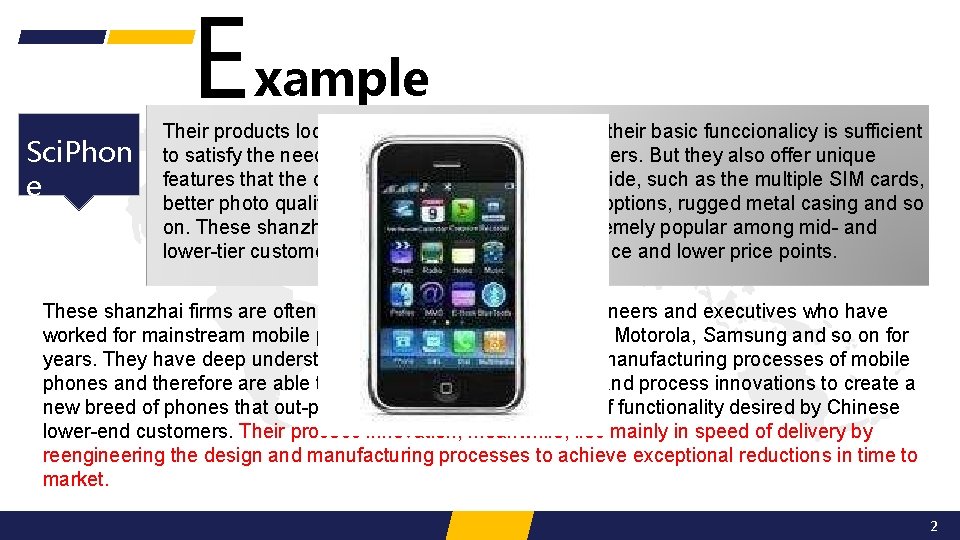
E xample Sci. Phon e Their products look very similar to the i. Phone and their basic funccionalicy is sufficient to satisfy the needs of lower- end Chinese consumers. But they also offer unique features that the original i. Phones do not even provide, such as the multiple SIM cards, better photo quality, large set of foreign language options, rugged metal casing and so on. These shanzhai smart phones have been extremely popular among mid- and lower-tier customers due to their versatility, resilience and lower price points. These shanzhai firms are often established by experienced engineers and executives who have worked for mainstream mobile phone producers, such as Nokia, Motorola, Samsung and so on for years. They have deep understanding of the technological and manufacturing processes of mobile phones and therefore able to use a combination of product and process innovations to create a new breed of phones that out-perform leading brands in terms of functionality desired by Chinese lower-end customers. Their process innovation, meanwhile, lies mainly in speed of delivery by reengineering the design and manufacturing processes to achieve exceptional reductions in time to market. 2
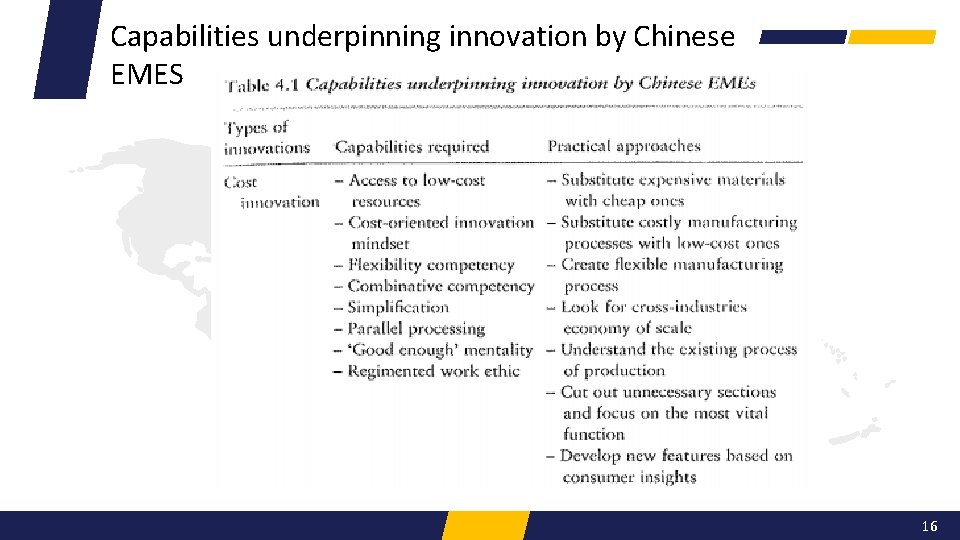
Capabilities underpinning innovation by Chinese EMES 16
Capabilities underpinning innovation by Chinese EMES Types of innovation Innovations Capabilities required Practical approaches 17
Capabilities underpinning innovation by Chinese EMES Types of innovation Innovations Capabilities required Practical approaches 18
Conclusions In this chapter they have outlined the range of innovation models that emerging Chinese multinationals are adopting and their contribution to creating sustainable competitive advantage for these firms in the global market. A key conclusion is that the leading Chinese firms who aspire to become global players have innovated in a variety of ways that potentially contribute to their competitive. 19
THANK YOU FOR INVOLVING