
The Competent Communicator THE COMPETENT COMMUNICATOR ACT There




- Slides: 11
The Competent Communicator
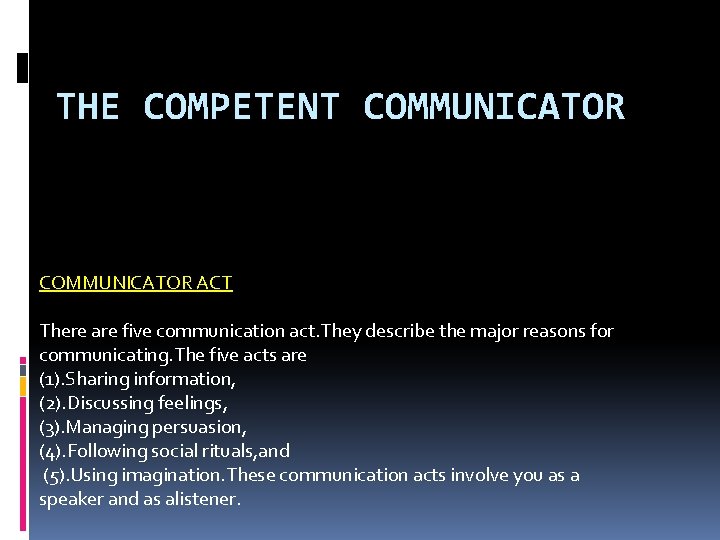
THE COMPETENT COMMUNICATOR ACT There are five communication act. They describe the major reasons for communicating. The five acts are (1). Sharing information, (2). Discussing feelings, (3). Managing persuasion, (4). Following social rituals, and (5). Using imagination. These communication acts involve you as a speaker and as alistener.
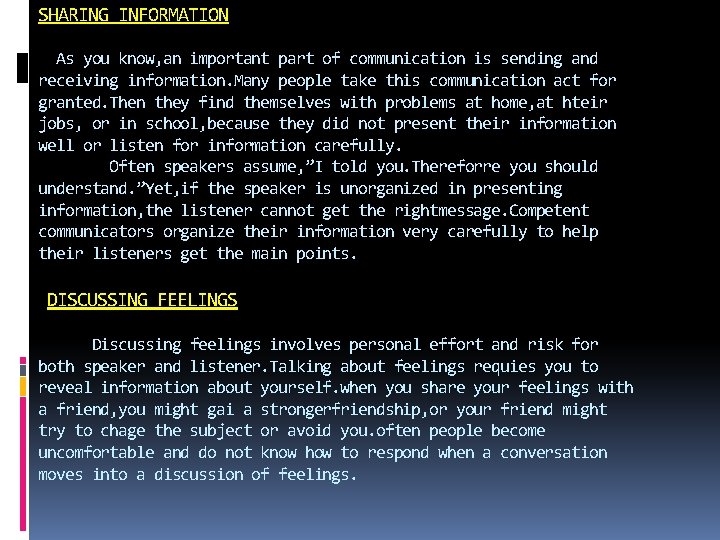
SHARING INFORMATION As you know, an important part of communication is sending and receiving information. Many people take this communication act for granted. Then they find themselves with problems at home, at hteir jobs, or in school, because they did not present their information well or listen for information carefully. Often speakers assume, ”I told you. Thereforre you should understand. ”Yet, if the speaker is unorganized in presenting information, the listener cannot get the rightmessage. Competent communicators organize their information very carefully to help their listeners get the main points. DISCUSSING FEELINGS Discussing feelings involves personal effort and risk for both speaker and listener. Talking about feelings requies you to reveal information about yourself. when you share your feelings with a friend, you might gai a strongerfriendship, or your friend might try to chage the subject or avoid you. often people become uncomfortable and do not know how to respond when a conversation moves into a discussion of feelings.
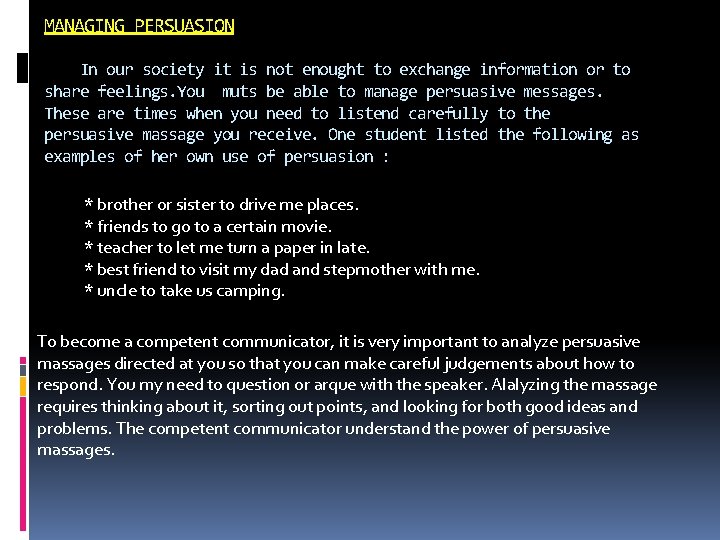
MANAGING PERSUASION In our society it is not enought to exchange information or to share feelings. You muts be able to manage persuasive messages. These are times when you need to listend carefully to the persuasive massage you receive. One student listed the following as examples of her own use of persuasion : * brother or sister to drive me places. * friends to go to a certain movie. * teacher to let me turn a paper in late. * best friend to visit my dad and stepmother with me. * uncle to take us camping. To become a competent communicator, it is very important to analyze persuasive massages directed at you so that you can make careful judgements about how to respond. You my need to question or arque with the speaker. Alalyzing the massage requires thinking about it, sorting out points, and looking for both good ideas and problems. The competent communicator understand the power of persuasive massages.
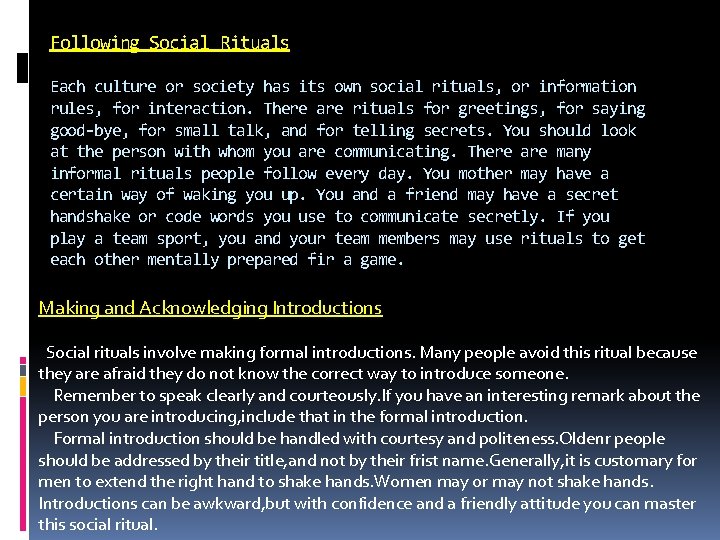
Following Social Rituals Each culture or society has its own social rituals, or information rules, for interaction. There are rituals for greetings, for saying good-bye, for small talk, and for telling secrets. You should look at the person with whom you are communicating. There are many informal rituals people follow every day. You mother may have a certain way of waking you up. You and a friend may have a secret handshake or code words you use to communicate secretly. If you play a team sport, you and your team members may use rituals to get each other mentally prepared fir a game. Making and Acknowledging Introductions Social rituals involve making formal introductions. Many people avoid this ritual because they are afraid they do not know the correct way to introduce someone. Remember to speak clearly and courteously. If you have an interesting remark about the person you are introducing, include that in the formal introduction. Formal introduction should be handled with courtesy and politeness. Oldenr people should be addressed by their title, and not by their frist name. Generally, it is customary for men to extend the right hand to shake hands. Women may or may not shake hands. Introductions can be awkward, but with confidence and a friendly attitude you can master this social ritual.
Making and Receiving Telephone Calls One rituals that is important in our interpersonal skills is making and receiving telephone calls. Many time, people do not know the person to whom they are talking on the phone. Therefore, impressions depend entirely upon the voice and manners of the person speaking. There are several key things you should remember for courteous and effective phone conversation (1). Making Calss (2). Receiving Calls (3). Business Calls Competency Steps Competent communicators work to again knowledge and skills to become effective at communiting. They grow in competence thorough meeting other people, dealing with new situations, and watching others talk. Over time, they develop plans of action for dealing with various situations. Competent communicators follow four specifik competency steps : (1). Thinking of strategies (2). Selecting a strategy (3). Acting on on the strategy
• Thinking of strategies A competent communicator has various communication strategies that can be applied to one situation. Communication strategies are the verbal and nonverbal massages created to reach a specifik goal. The older you get the more ways you have to cope with communication difficulties. Each year you have learned new strategies for handling certain events or problem. Apply (1). I plead for an extra half hour. (2). I inform my parent(s) I’m too old for this type of curfew. (3). I explain that ny friend’s parents do not give her or him a curfew. (4). I try to convince my parent(s) that this is a very special occasion. (5). I volunteer to help around the house tomorrow. (6). I promise I will never ask for a curvew change again. (7). I threaten to go live with my bst friend’s family (8). I remind my parent(s) how responsible I have been in the past. (9). I stop speaking to my parent(s). (10). I slam doors and sulk arround the house.
Did the strategis you used leave both you and your parent(s) statisfied ? Strategies do not apply just to your relationship with adults. You can be a more effective communicator with your friends if you have a number of different ways of handling difficult situations. The competent communicator thinks up a number of possible ways to deal with a situation. The greater the number of strategies, the more choice there is in dealing with a problem.
• Selecting a strategy Once you thought of a fiw ways to handle a problem consider the specifics of that situations. Think about the who, what, where, and when : > Who-When considering “who”, you need to think about what you know about the person. You also need to think about your past relatioship and possible future reklationship with this person > What-When considering “what”, you need to think about the importance of thr topic to you and to the other person > Where-When considering “ where”, you need to think about how the place or other people will affect your discussion of the topic > When-When considering “when”, you need to think about whether this is a good time to discuss the topic.
• Acting on the strategy Do you ever know exactly what you should say or do but then you never go ahead and really say or do it? Most peple find they do not carry out all their plans. They many think of some good strategies and even select the one they consider the best. And then they stop. Selecting the srategy doesn’t do much good until you act on iy. It is one thing to plan to tell a a friend that he or she hurt your feelings and another to actually say, “You hurt my feelinga” I want you to stop teasing me
Apply How often have you planned to do some of the following but never carried through with the behaviour. • • • Volunteer in class Ask a salesclerk for more information Tell your mother or father how wonderful she or he is Compliment a friend for something wll done Thank a teacher for help Apologize for talking badly about someone Competent communicators learn to follow through with their plans.