
The Compelling Need for Data Warehousing MMG 508

- Slides: 36
The Compelling Need for Data Warehousing MMG 508 – April 17 th , 2011
What all Business Managers Need to Understand about Business Intelligence �Understand the desperate need for strategic information �Recognize the information crisis at every enterprise �Distinguish between operational and informational systems �Learn why all past attempts to provide strategic information failed �Clearly see why data warehousing is the viable solution
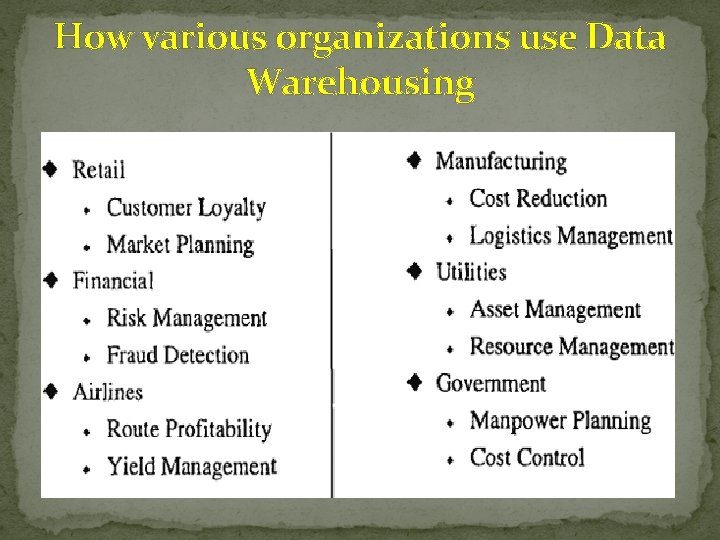
How various organizations use Data Warehousing
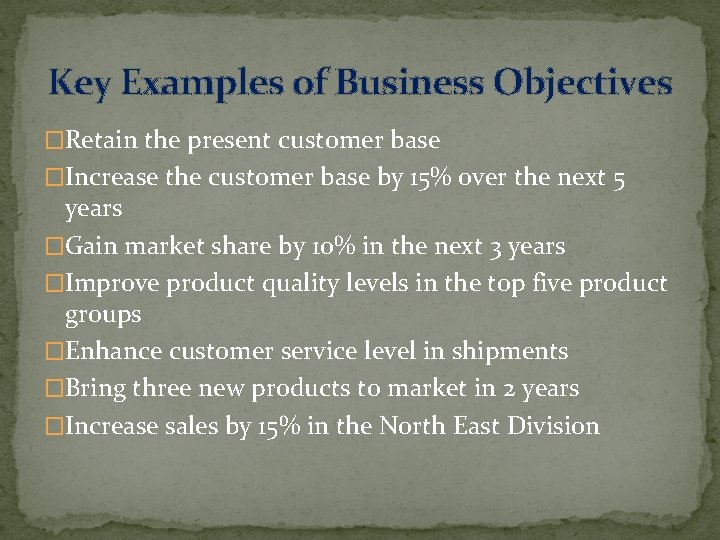
Strategic Information �Who needs strategic information in an enterprise? �What exactly do we mean by strategic information? � The executives and managers who are responsible for keeping the enterprise competitive need information to make proper decisions � They need information to formulate the business strategies, establish goals, set objectives, and monitor results. �Let’s see what these business objectives are:
Key Examples of Business Objectives �Retain the present customer base �Increase the customer base by 15% over the next 5 years �Gain market share by 10% in the next 3 years �Improve product quality levels in the top five product groups �Enhance customer service level in shipments �Bring three new products to market in 2 years �Increase sales by 15% in the North East Division
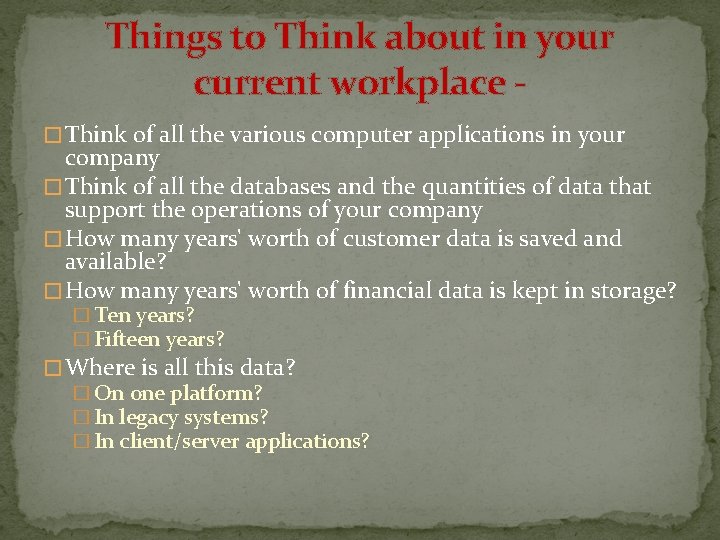
Things to Think about in your current workplace � Think of all the various computer applications in your company � Think of all the databases and the quantities of data that support the operations of your company � How many years' worth of customer data is saved and available? � How many years' worth of financial data is kept in storage? � Ten years? � Fifteen years? � Where is all this data? � On one platform? � In legacy systems? � In client/server applications?
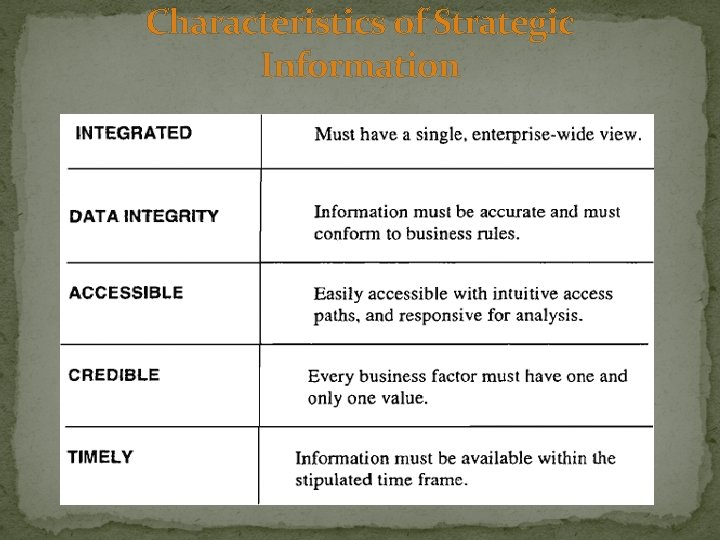
Characteristics of Strategic Information
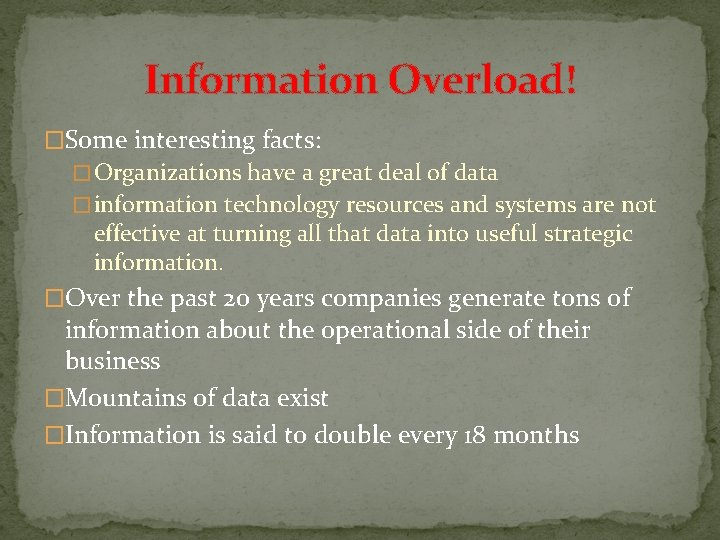
Information Overload! �Some interesting facts: � Organizations have a great deal of data � information technology resources and systems are not effective at turning all that data into useful strategic information. �Over the past 20 years companies generate tons of information about the operational side of their business �Mountains of data exist �Information is said to double every 18 months
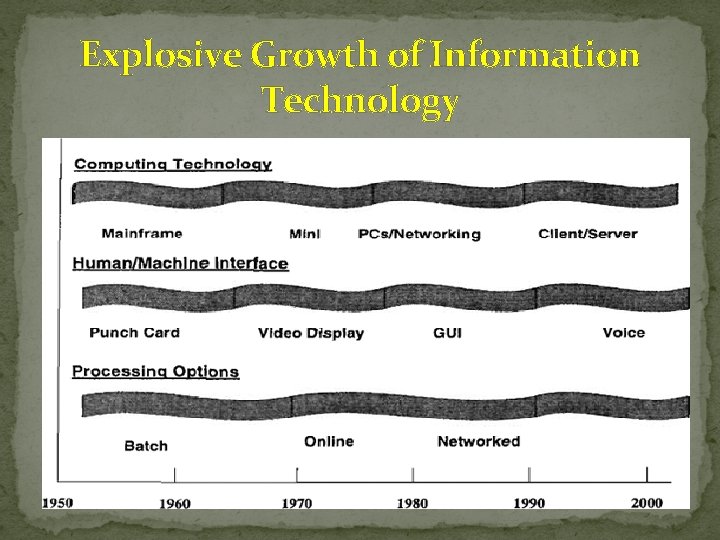
Processing Costs? �MIPs is continuing to decline �digital storage is costing less and less �network bandwidth is increasing as its price decreases �Specifically, we have seen explosive changes in these critical areas: � Computing technology � Human/machine interface � Processing options �The next slide shows some of these growth areas
Explosive Growth of Information Technology
Examples of the opportunities made available through the use of strategic information: �A business unit of a leading long-distance telephone carrier empowers its sales personnel to make better business decisions and thereby capture more business in a highly competitive, multibillion-dollar market. A Web-accessible solution gathers internal and external data to provide strategic information. �Availability of strategic information at one of the largest banks in the United States with assets in the $250 billion range allows users to make quick decisions to retain their valued customers.
Examples of the opportunities made available through the use of strategic information: (Cont’d) � In the case of a large health management organization, significant improvements in health care programs are realized, resulting in a 22% decrease in emergency room visits, 29% decrease in hospital admissions for asthmatic children, potentially sight-saving screenings for hundreds of diabetics, improved vaccination rates, and more than 100, 000 performance reports created annually for physicians and pharmacists. � At one of the top five U. S. retailers, strategic information combined with Web-enabled analysis tools enables merchants to gain insights into their customer base, manage inventories more tightly, and keep the right products in front of the right people at the right place at the right time.
Examples of the opportunities made available through the use of strategic information: (Cont’d) �A community-based pharmacy that competes on a national scale with more than 800 franchised pharmacies coast to coast gains in-depth understanding of what customers buy, resulting in reduced inventory levels, improved effectiveness of promotions and marketing campaigns, and improved profitability for the company.
The Other Side of the Coin (what happens without strategic information) �With an average fleet of about 150, 000 vehicles, a nationwide car rental company can easily get into the red at the bottom line if fleet management is not effective. �The fleet is the biggest cost in that business. With intensified competition, the potential for failure is immense if the fleet is not managed effectively. Car idle time must be kept to an absolute minimum. �In attempting to accomplish this, failure to have the right class of car available in the right place at the right time, all washed and ready, can lead to serious loss of business.
The Other Side of the Coin (Cont’d) �For a world-leading supplier of systems and components to automobile and light truck equipment manufacturers, serious challenges faced included � inconsistent data computations across nearly 100 plants � inability to benchmark quality metrics � and time-consuming manual collection of data. �Reports needed to support decision making took weeks. It was never easy to get company-wide integrated information.
The Other Side of the Coin (Cont’d) �For a large utility company that provided electricity to about 25 million consumers in five mid-Atlantic states in the United States, deregulation could result in a few winners and lots of losers. �Remaining competitive and perhaps even surviving itself depended on centralizing strategic information from various sources, streamlining data access, and facilitating analysis of the information by the business units.
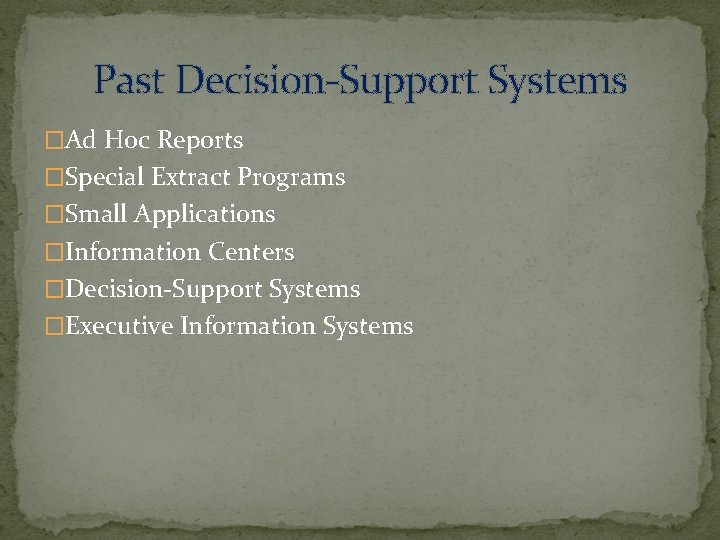
Past Decision-Support Systems �Ad Hoc Reports �Special Extract Programs �Small Applications �Information Centers �Decision-Support Systems �Executive Information Systems
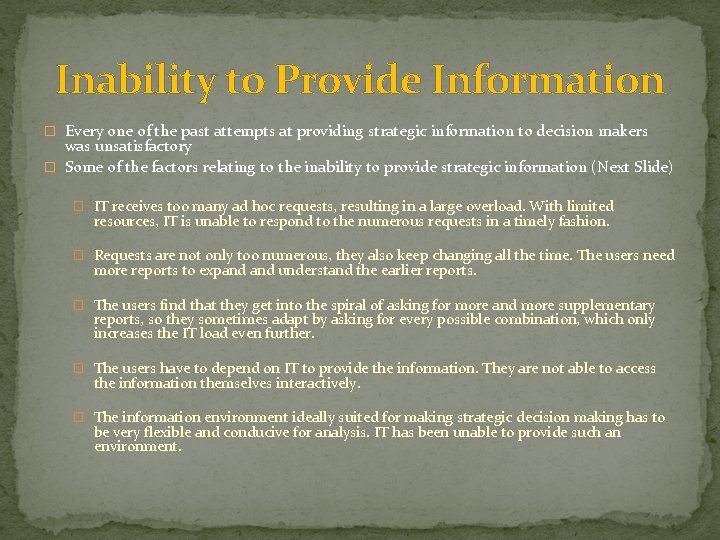
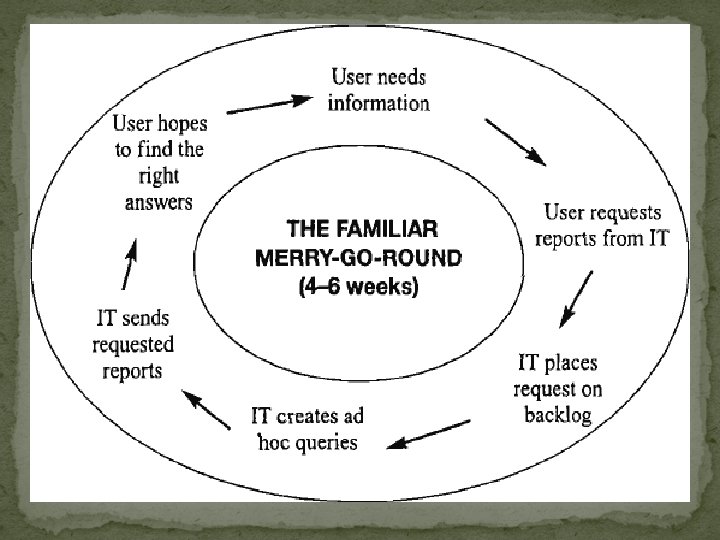
Inability to Provide Information � Every one of the past attempts at providing strategic information to decision makers was unsatisfactory � Some of the factors relating to the inability to provide strategic information (Next Slide) � IT receives too many ad hoc requests, resulting in a large overload. With limited resources, IT is unable to respond to the numerous requests in a timely fashion. � Requests are not only too numerous, they also keep changing all the time. The users need more reports to expand understand the earlier reports. � The users find that they get into the spiral of asking for more and more supplementary reports, so they sometimes adapt by asking for every possible combination, which only increases the IT load even further. � The users have to depend on IT to provide the information. They are not able to access the information themselves interactively. � The information environment ideally suited for making strategic decision making has to be very flexible and conducive for analysis. IT has been unable to provide such an environment.
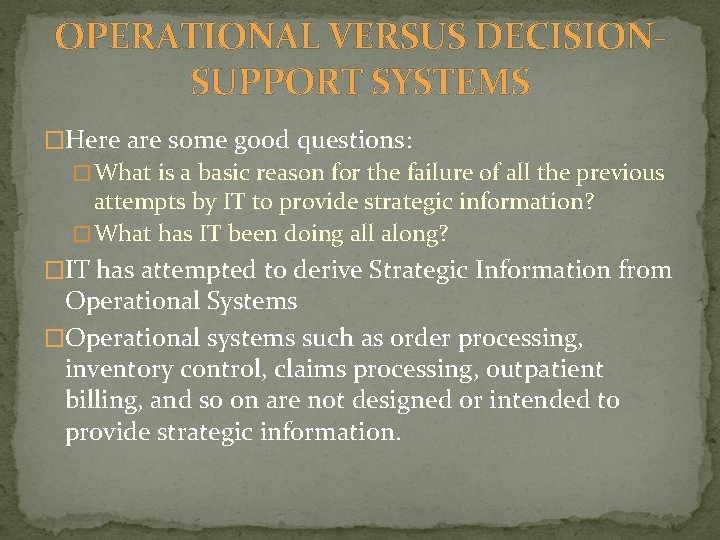
OPERATIONAL VERSUS DECISIONSUPPORT SYSTEMS �Here are some good questions: � What is a basic reason for the failure of all the previous attempts by IT to provide strategic information? � What has IT been doing all along? �IT has attempted to derive Strategic Information from Operational Systems �Operational systems such as order processing, inventory control, claims processing, outpatient billing, and so on are not designed or intended to provide strategic information.
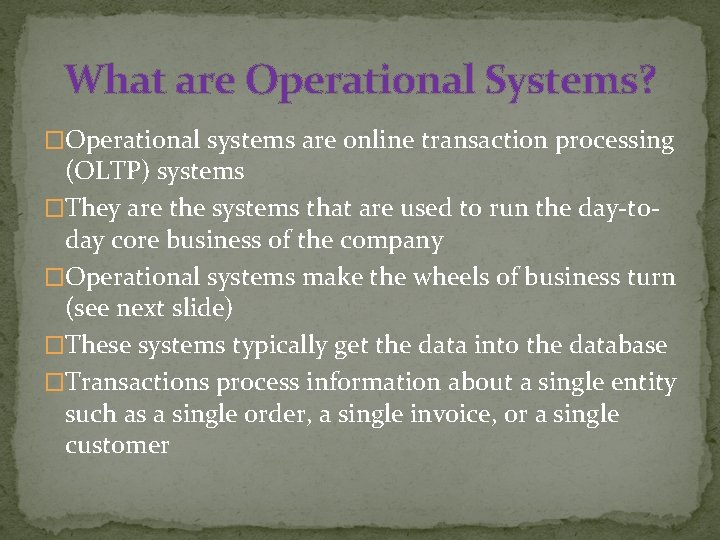
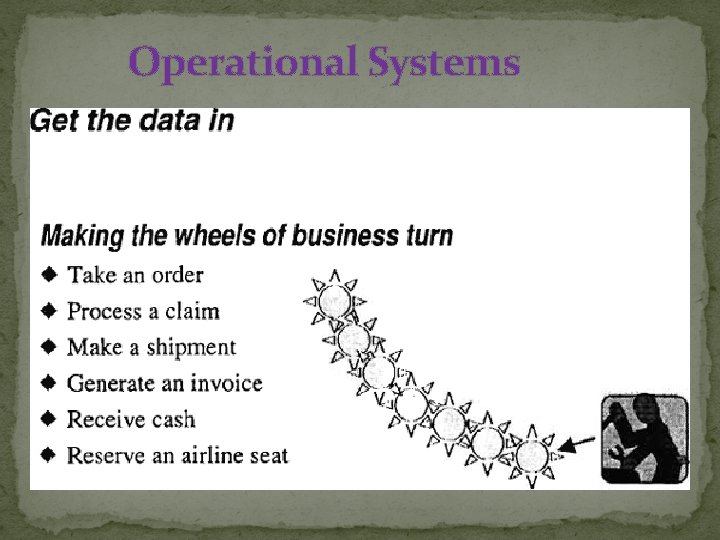
What are Operational Systems? �Operational systems are online transaction processing (OLTP) systems �They are the systems that are used to run the day-today core business of the company �Operational systems make the wheels of business turn (see next slide) �These systems typically get the data into the database �Transactions process information about a single entity such as a single order, a single invoice, or a single customer
Operational Systems
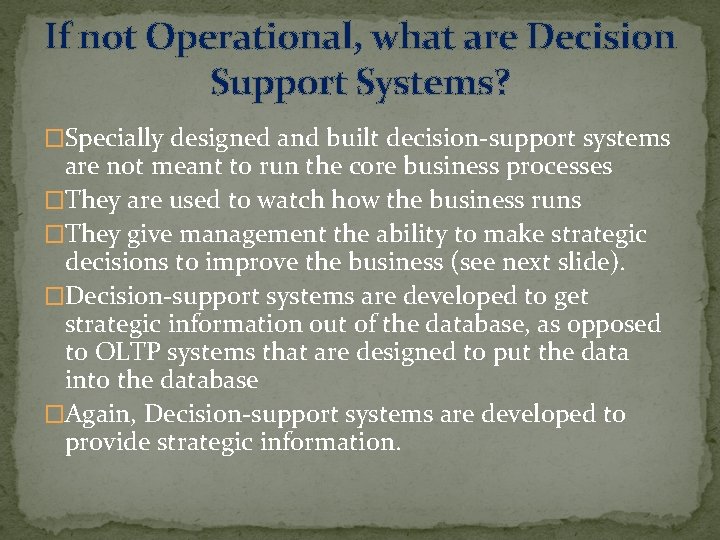
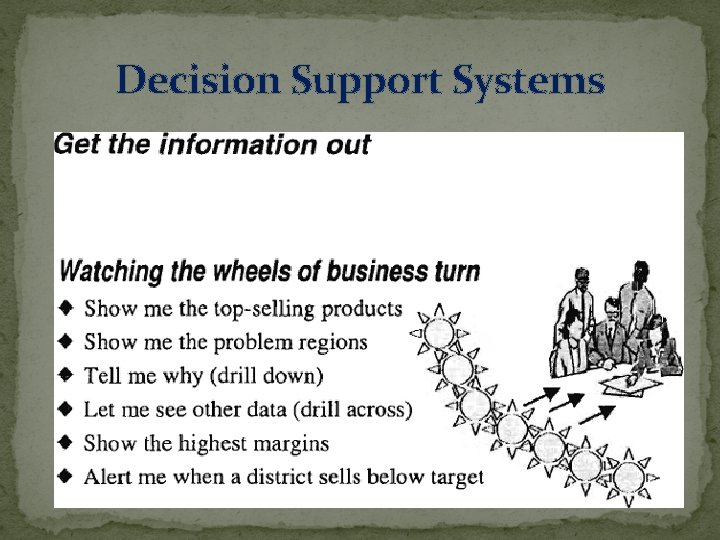
If not Operational, what are Decision Support Systems? �Specially designed and built decision-support systems are not meant to run the core business processes �They are used to watch how the business runs �They give management the ability to make strategic decisions to improve the business (see next slide). �Decision-support systems are developed to get strategic information out of the database, as opposed to OLTP systems that are designed to put the data into the database �Again, Decision-support systems are developed to provide strategic information.
Decision Support Systems
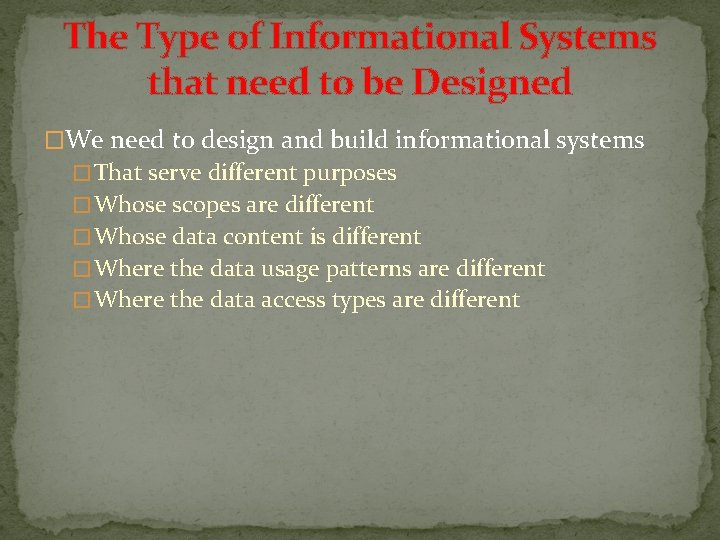
The Type of Informational Systems that need to be Designed �We need to design and build informational systems � That serve different purposes � Whose scopes are different � Whose data content is different � Where the data usage patterns are different � Where the data access types are different
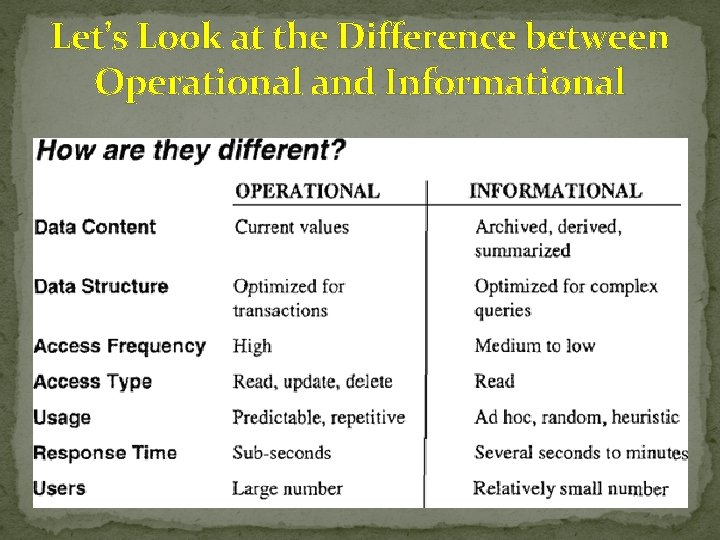
Let’s Look at the Difference between Operational and Informational
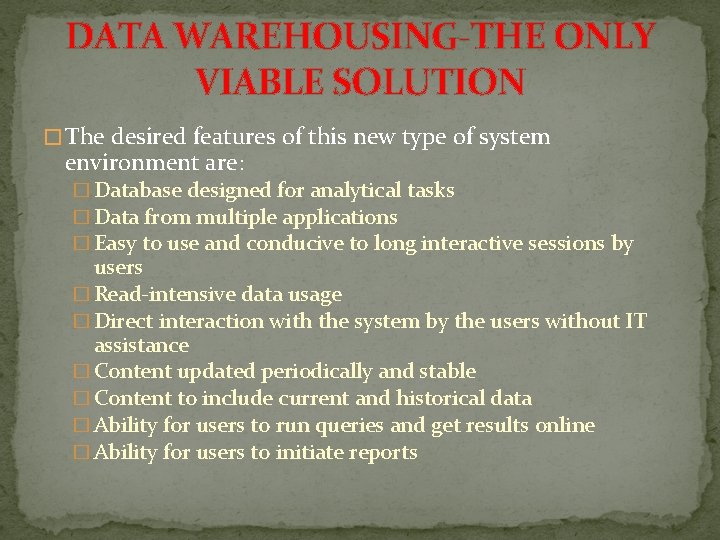
DATA WAREHOUSING-THE ONLY VIABLE SOLUTION � The desired features of this new type of system environment are: � Database designed for analytical tasks � Data from multiple applications � Easy to use and conducive to long interactive sessions by users � Read-intensive data usage � Direct interaction with the system by the users without IT assistance � Content updated periodically and stable � Content to include current and historical data � Ability for users to run queries and get results online � Ability for users to initiate reports
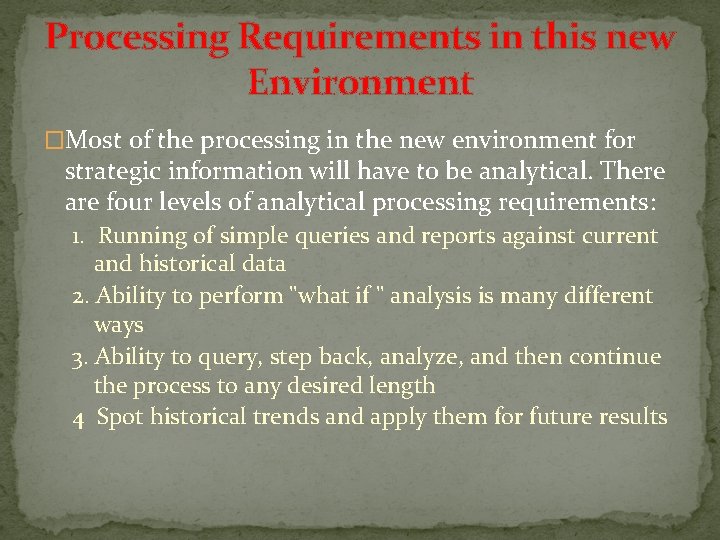
Processing Requirements in this new Environment �Most of the processing in the new environment for strategic information will have to be analytical. There are four levels of analytical processing requirements: 1. Running of simple queries and reports against current and historical data 2. Ability to perform "what if " analysis is many different ways 3. Ability to query, step back, analyze, and then continue the process to any desired length 4 Spot historical trends and apply them for future results
Business Intelligence at the Data Warehouse �This new system environment that users desperately need to obtain strategic information happens to be the new paradigm of data warehousing �This new environment is kept separate from the system environment supporting the day-to-day operations �The data warehouse essentially holds the business intelligence for the enterprise to enable strategic decision making. �The data warehouse is the only viable solution
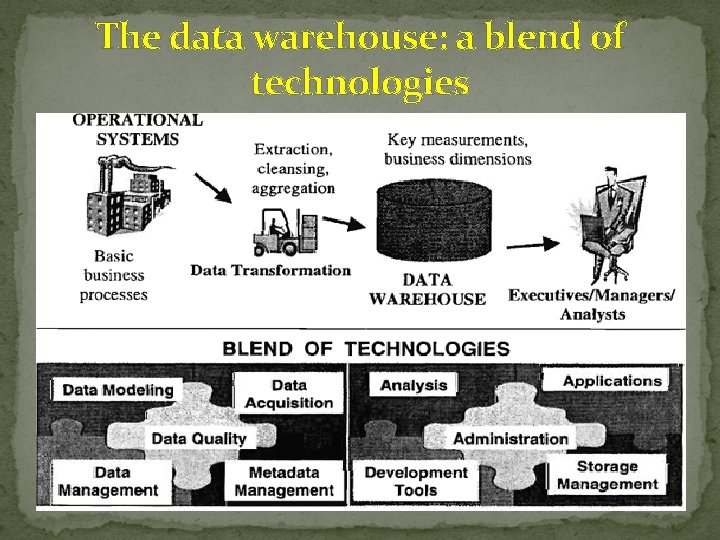
Where does the Data Warehouse get It’s Data? �Might contain units of sales, by product, day, customer group, sales district, sales region, and promotion �The data is derived from the operational systems that support the basic business processes of the organization �Between the operational systems and the data warehouse, there is a data staging area �In this staging area, the operational data is cleansed and transformed into a form suitable for placement in the data warehouse for easy retrieval.
Data Warehouse Defined �Let’s look at the Author’s functional definition of the data warehouse. �The data warehouse is an informational environment that � Provides an integrated and total view of the enterprise � Makes the enterprise's current and historical information easily available for decision making � Makes decision-support transactions possible without hindering operational systems � Renders the organization's information consistent � Presents a flexible and interactive source of strategic information
Data Ware Housing is an Environment – Not a Product �A data warehouse is not a single software or hardware product you purchase to provide strategic information �It is, rather, a computing environment where users can find strategic information �An environment where users are put directly in touch with the data they need to make better decisions �It is a user-centric environment
Data Ware Housing is an Environment – Not a Product (Cont’d) � In Summary: � An ideal environment for data analysis and decision support � Fluid, flexible, and interactive � 100 percent user-driven � Very responsive and conducive to the ask-answer-ask-again pattern � Provides the ability to discover answers to complex, unpredictable questions � Although a simple concept, it involves different functions: data extraction, the function of loading the data, transforming the data, storing the data, and providing user interfaces. (see next slide)
The data warehouse: a blend of technologies
Summary � Companies are desperate for strategic information to counter fiercer � � � competition, extend market share, and improve profitability. In spite of tons of data accumulated by enterprises over the past decades, every enterprise is caught in the middle of an information crisis. Information needed for strategic decision making is not readily available. All the past attempts by IT to provide strategic information have been failures. This was mainly because IT has been trying to provide strategic information from operational systems. Informational systems are different from the traditional operational systems. Operational systems are not designed for strategic information. We need a new type of computing environment to provide strategic information. The data warehouse promises to be this new computing environment. Data warehousing is the viable solution. There is a compelling need for data warehousing for every enterprise.
QUESTIONS? ? ?