
The Comparison of Vertical Jump Height Between Gender
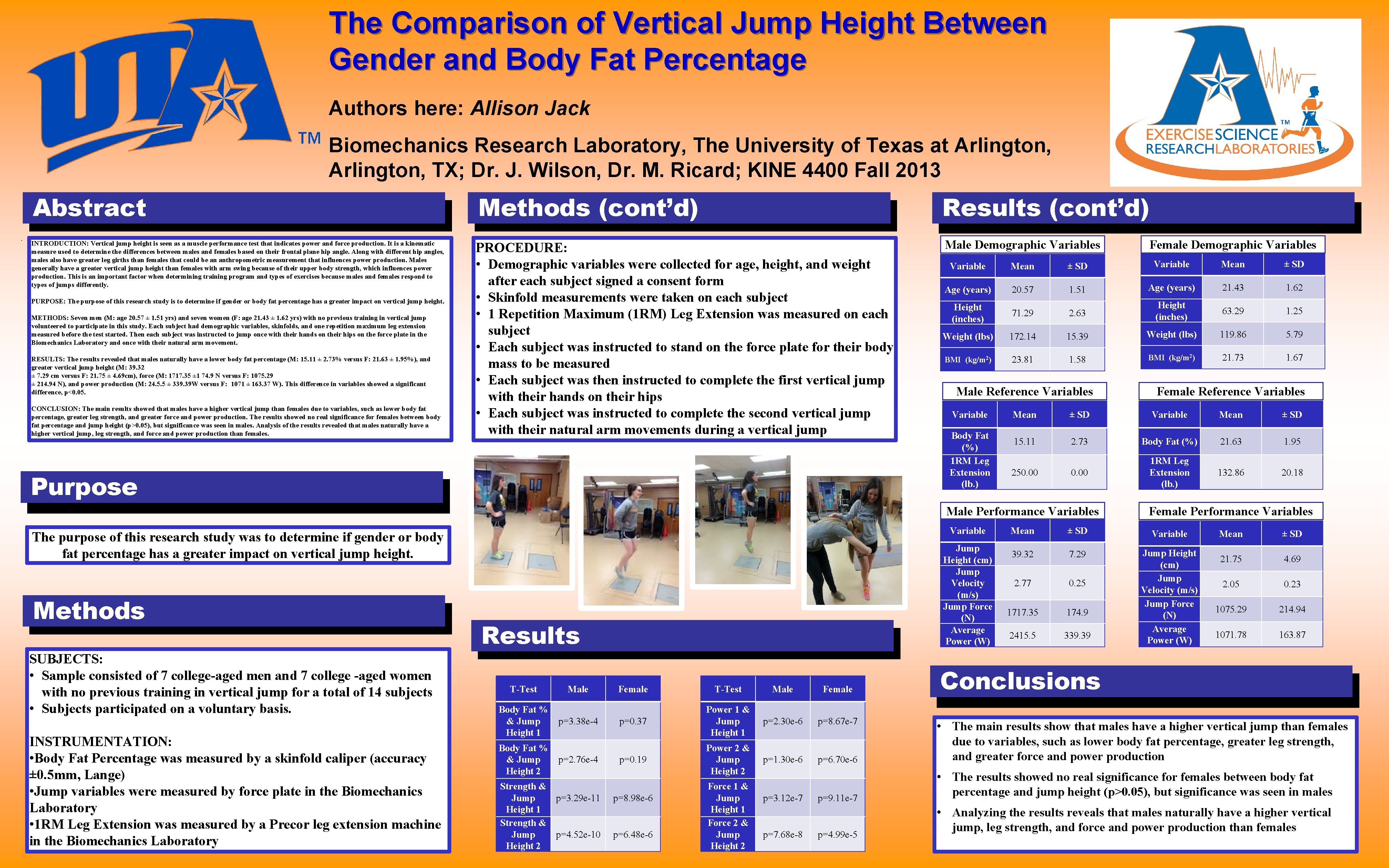
The Comparison of Vertical Jump Height Between Gender and Body Fat Percentage Authors here: Allison Jack Biomechanics Research Laboratory, The University of Texas at Arlington, TX; Dr. J. Wilson, Dr. M. Ricard; KINE 4400 Fall 2013 Abstract. INTRODUCTION: Vertical jump height is seen as a muscle performance test that indicates power and force production. It is a kinematic measure used to determine the differences between males and females based on their frontal plane hip angle. Along with different hip angles, males also have greater leg girths than females that could be an anthropometric measurement that influences power production. Males generally have a greater vertical jump height than females with arm swing because of their upper body strength, which influences power production. This is an important factor when determining training program and types of exercises because males and females respond to types of jumps differently. PURPOSE: The purpose of this research study is to determine if gender or body fat percentage has a greater impact on vertical jump height. METHODS: Seven men (M: age 20. 57 ± 1. 51 yrs) and seven women (F: age 21. 43 ± 1. 62 yrs) with no previous training in vertical jump volunteered to participate in this study. Each subject had demographic variables, skinfolds, and one repetition maximum leg extension measured before the test started. Then each subject was instructed to jump once with their hands on their hips on the force plate in the Biomechanics Laboratory and once with their natural arm movement. RESULTS: The results revealed that males naturally have a lower body fat percentage (M: 15. 11 ± 2. 73% versus F: 21. 63 ± 1. 95%), and greater vertical jump height (M: 39. 32 ± 7. 29 cm versus F: 21. 75 ± 4. 69 cm), force (M: 1717. 35 ± 1 74. 9 N versus F: 1075. 29 ± 214. 94 N), and power production (M: 24. 5. 5 ± 339. 39 W versus F: 1071 ± 163. 37 W). This difference in variables showed a significant difference, p<0. 05. CONCLUSION: The main results showed that males have a higher vertical jump than females due to variables, such as lower body fat percentage, greater leg strength, and greater force and power production. The results showed no real significance for females between body fat percentage and jump height (p>0. 05), but significance was seen in males. Analysis of the results revealed that males naturally have a higher vertical jump, leg strength, and force and power production than females. Methods (cont’d) Results (cont’d) PROCEDURE: • Demographic variables were collected for age, height, and weight after each subject signed a consent form • Skinfold measurements were taken on each subject • 1 Repetition Maximum (1 RM) Leg Extension was measured on each subject • Each subject was instructed to stand on the force plate for their body mass to be measured • Each subject was then instructed to complete the first vertical jump with their hands on their hips • Each subject was instructed to complete the second vertical jump with their natural arm movements during a vertical jump Male Demographic Variables Purpose Variable Mean ± SD Age (years) 20. 57 1. 51 Age (years) 21. 43 1. 62 63. 29 1. 25 Height (inches) 71. 29 2. 63 Height (inches) Weight (lbs) 172. 14 15. 39 Weight (lbs) 119. 86 5. 79 1. 58 BMI (kg/m 2) 21. 73 1. 67 BMI (kg/m 2) 23. 81 Male Reference Variables Variable Body Fat (%) 1 RM Leg Extension (lb. ) Variable Methods SUBJECTS: • Sample consisted of 7 college-aged men and 7 college -aged women with no previous training in vertical jump for a total of 14 subjects • Subjects participated on a voluntary basis. INSTRUMENTATION: • Body Fat Percentage was measured by a skinfold caliper (accuracy ± 0. 5 mm, Lange) • Jump variables were measured by force plate in the Biomechanics Laboratory • 1 RM Leg Extension was measured by a Precor leg extension machine in the Biomechanics Laboratory Jump Height (cm) Jump Velocity (m/s) Jump Force (N) Average Power (W) Results T-Test Body Fat % & Jump Height 1 Body Fat % & Jump Height 2 Male p=3. 38 e-4 p=2. 76 e-4 Strength & Jump p=3. 29 e-11 Height 1 Strength & Jump p=4. 52 e-10 Height 2 Female Reference Variables Mean ± SD Variable Mean ± SD 15. 11 2. 73 Body Fat (%) 21. 63 1. 95 0. 00 1 RM Leg Extension (lb. ) 132. 86 20. 18 250. 00 Male Performance Variables The purpose of this research study was to determine if gender or body fat percentage has a greater impact on vertical jump height. Female Demographic Variables Female Performance Variables Mean ± SD Variable 39. 32 7. 29 2. 77 0. 25 1717. 35 174. 9 2415. 5 339. 39 Jump Height (cm) Jump Velocity (m/s) Jump Force (N) Average Power (W) Mean ± SD 21. 75 4. 69 2. 05 0. 23 1075. 29 214. 94 1071. 78 163. 87 Conclusions Female T-Test Male Female p=0. 37 Power 1 & Jump Height 1 p=2. 30 e-6 p=8. 67 e-7 p=0. 19 Power 2 & Jump Height 2 p=1. 30 e-6 p=6. 70 e-6 • The main results show that males have a higher vertical jump than females due to variables, such as lower body fat percentage, greater leg strength, and greater force and power production p=9. 11 e-7 • The results showed no real significance for females between body fat percentage and jump height (p>0. 05), but significance was seen in males p=8. 98 e-6 p=6. 48 e-6 Force 1 & Jump Height 1 Force 2 & Jump Height 2 p=3. 12 e-7 p=7. 68 e-8 p=4. 99 e-5 • Analyzing the results reveals that males naturally have a higher vertical jump, leg strength, and force and power production than females
- Slides: 1