
The Compact LInear Collider CLIC project The CLIC
- Slides: 4
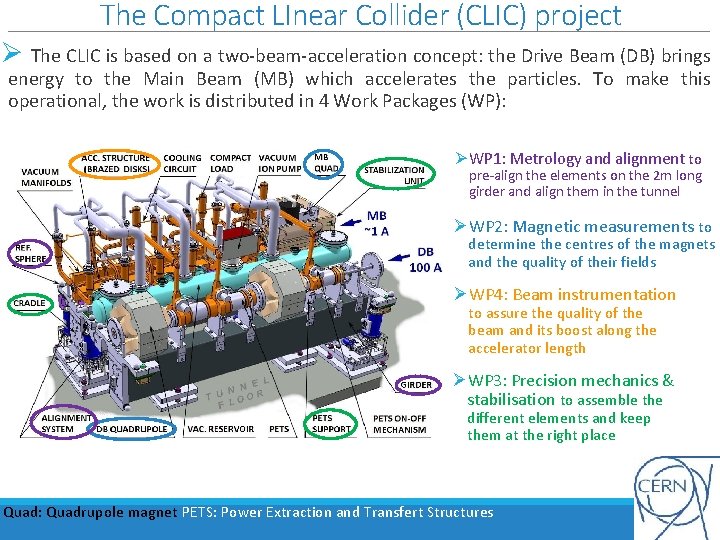
The Compact LInear Collider (CLIC) project Ø The CLIC is based on a two-beam-acceleration concept: the Drive Beam (DB) brings energy to the Main Beam (MB) which accelerates the particles. To make this operational, the work is distributed in 4 Work Packages (WP): ØWP 1: Metrology and alignment to pre-align the elements on the 2 m long girder and align them in the tunnel ØWP 2: Magnetic measurements to determine the centres of the magnets and the quality of their fields ØWP 4: Beam instrumentation to assure the quality of the beam and its boost along the accelerator length ØWP 3: Precision mechanics & stabilisation to assemble the different elements and keep them at the right place Quad: Quadrupole magnet PETS: Power Extraction and Transfert Structures
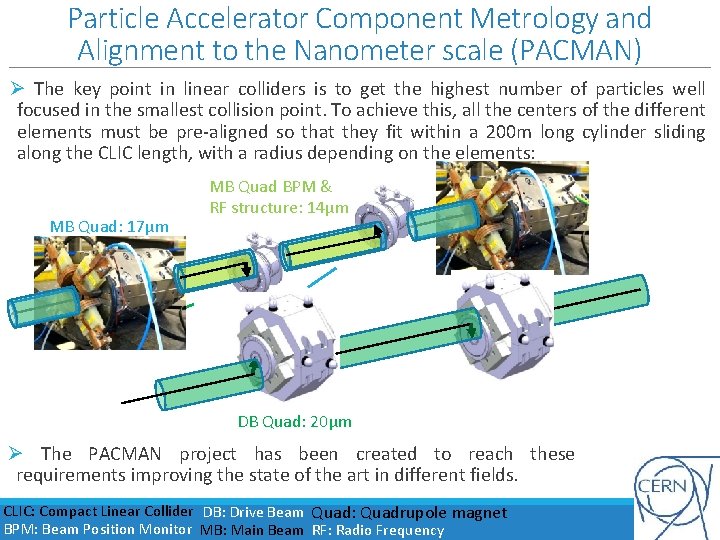
Particle Accelerator Component Metrology and Alignment to the Nanometer scale (PACMAN) Ø The key point in linear colliders is to get the highest number of particles well focused in the smallest collision point. To achieve this, all the centers of the different elements must be pre-aligned so that they fit within a 200 m long cylinder sliding along the CLIC length, with a radius depending on the elements: MB Quad: 17µm MB Quad BPM & RF structure: 14µm DB Quad: 20µm Ø The PACMAN project has been created to reach these requirements improving the state of the art in different fields. CLIC: Compact Linear Collider DB: Drive Beam Quad: Quadrupole magnet BPM: Beam Position Monitor MB: Main Beam RF: Radio Frequency
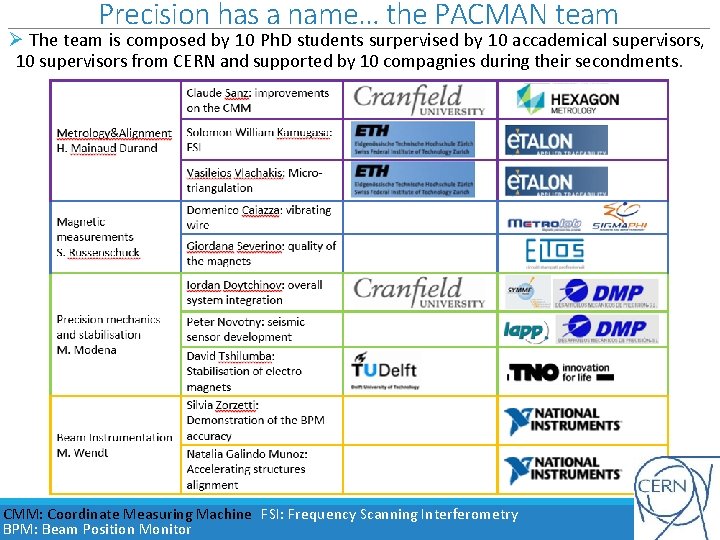
Precision has a name… the PACMAN team Ø The team is composed by 10 Ph. D students surpervised by 10 accademical supervisors, 10 supervisors from CERN and supported by 10 compagnies during their secondments. CMM: Coordinate Measuring Machine FSI: Frequency Scanning Interferometry BPM: Beam Position Monitor
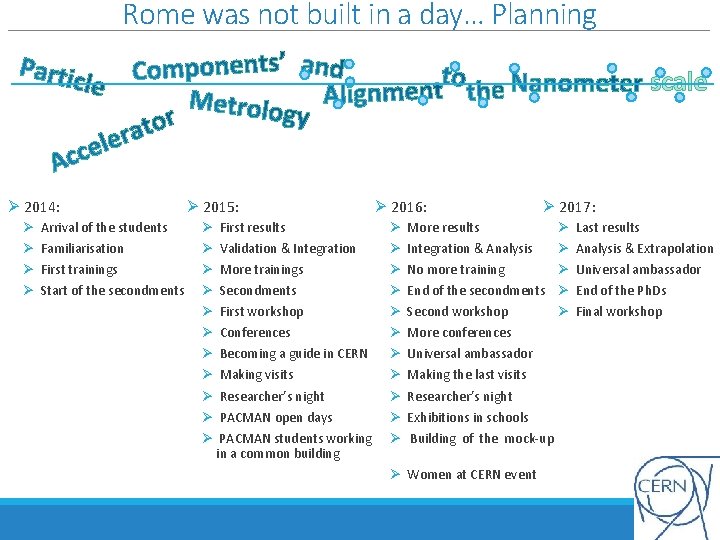
Rome was not built in a day… Planning scale Ø 2014: Ø Ø Arrival of the students Familiarisation First trainings Start of the secondments Ø 2015: Ø Ø Ø First results Validation & Integration More trainings Secondments First workshop Conferences Becoming a guide in CERN Making visits Researcher’s night PACMAN open days PACMAN students working in a common building Ø 2016: Ø Ø Ø More results Ø 2017: Ø Ø Integration & Analysis Ø No more training End of the secondments Ø Ø Second workshop More conferences Universal ambassador Making the last visits Researcher’s night Exhibitions in schools Building of the mock-up Ø Women at CERN event Last results Analysis & Extrapolation Universal ambassador End of the Ph. Ds Final workshop